
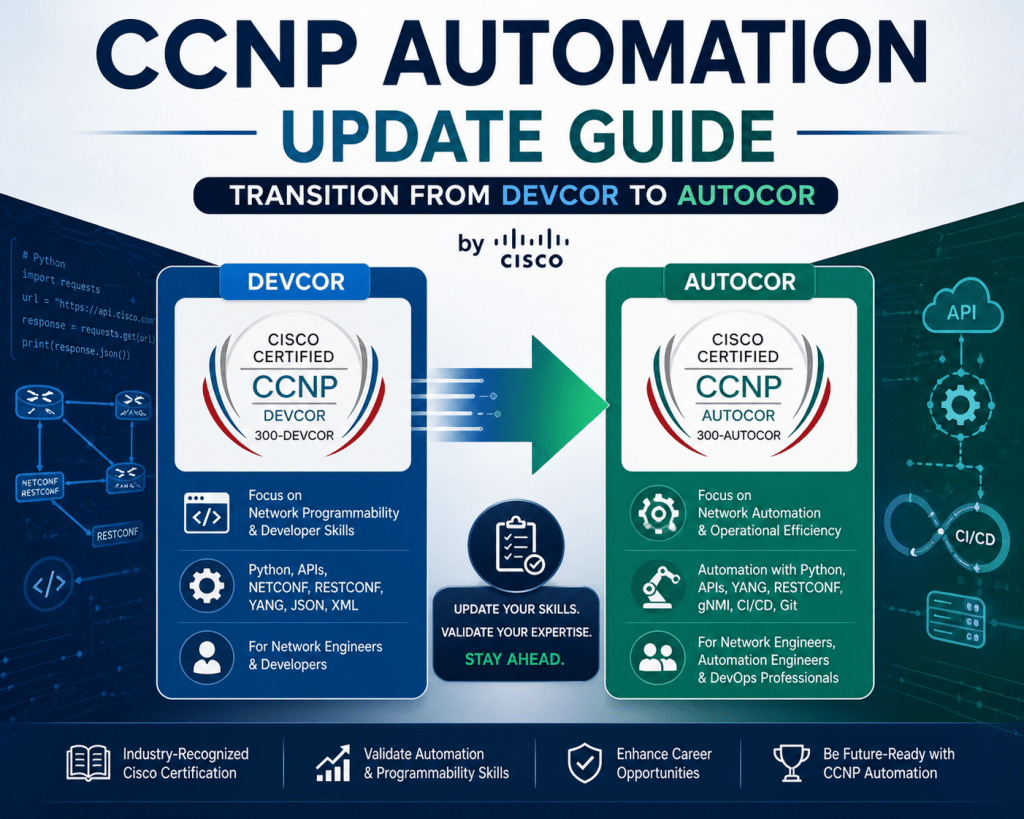
Cisco’s certification changes reflect a major transformation happening across the networking industry. Automation is no longer an optional skill but a core requirement for managing modern IT infrastructure. Networks today are far more complex than they were in the past, often spanning data centers, cloud platforms, and geographically distributed systems. Managing these environments manually is inefficient and increases the risk of errors.
In earlier networking models, engineers focused on configuring devices one at a time. Each router, switch, or firewall required individual attention, which made large-scale operations slow and difficult to maintain. As organizations expanded, this manual approach became unsustainable. Automation introduced a more efficient method, allowing engineers to manage multiple systems through scripts, tools, and centralized workflows.
This shift has directly influenced how certifications are structured. Instead of focusing only on theoretical knowledge, modern certifications emphasize practical, real-world skills. Cisco’s move toward an automation-focused certification path reflects the growing need for professionals who can manage networks at scale using modern tools and techniques.
From Development-Centric Skills to Real-World Execution
The earlier certification approach placed strong emphasis on development skills, particularly building applications that interact with network systems. While this helped bridge the gap between software and networking, it did not fully align with the daily responsibilities of most network engineers.
Today, the focus has shifted toward execution and operations. Engineers are expected to automate network deployments, manage configurations, and maintain system performance in live environments. This requires a combination of programming knowledge and operational expertise.
Automation is no longer limited to writing scripts. It involves creating workflows that handle deployment, monitoring, and troubleshooting automatically. Engineers must understand how to apply these workflows in real-world scenarios where reliability and uptime are critical.
This evolution highlights the importance of practical skills. Professionals are expected to not only understand automation concepts but also apply them effectively in dynamic environments. Certifications now reflect this expectation by focusing on real operational tasks rather than purely development-based activities.
Scalability as a Core Requirement in Modern Networks
One of the biggest drivers behind automation is the need for scalability. Organizations today manage large and complex networks that include thousands of devices across multiple locations. Manual configuration in such environments is not only time-consuming but also prone to inconsistency.
Automation allows engineers to deploy configurations quickly and uniformly across all systems. This ensures that every device follows the same standards, reducing errors and improving overall reliability. Scalability is no longer a luxury; it is a necessity for maintaining efficient operations.
Modern infrastructures also include hybrid and cloud environments. These setups require consistent management across different platforms, which can only be achieved through automation. Engineers must be able to work with tools that support large-scale operations and adapt to changing demands.
The updated certification structure reflects this need by focusing on techniques that enable efficient scaling. Professionals are expected to understand how to design and manage systems that can grow without compromising performance.
Infrastructure as Code and Standardized Workflows
Infrastructure as Code has become a fundamental concept in modern IT operations. It allows engineers to treat network configurations as code, which can be stored, versioned, and managed using standard tools. This approach introduces consistency and control into network management.
By using version control systems, engineers can track changes, collaborate with team members, and maintain a clear history of updates. This makes it easier to identify issues and roll back changes when necessary. It also supports automated workflows that improve efficiency and reduce manual intervention.
Standardized workflows are essential for maintaining reliable systems. Automation tools can integrate with pipelines that handle testing, deployment, and validation. This ensures that changes are implemented correctly and consistently across all environments.
The certification emphasizes these practices because they are widely used in modern organizations. Engineers must be familiar with these workflows to effectively manage automated systems and maintain operational stability.
Security and Reliability in Automated Systems
As automation becomes more widespread, security and reliability become even more important. Automated systems must be designed carefully to prevent vulnerabilities and ensure consistent performance. Engineers are responsible for implementing processes that protect networks while maintaining efficiency.
Automation can help enforce security policies by applying consistent configurations across all devices. This reduces the risk of human error, which is one of the most common causes of security issues. However, it also requires a strong understanding of best practices and potential risks.
Reliability is another critical factor. Automated systems must be able to handle failures and recover quickly. Engineers need to design workflows that include monitoring, alerting, and recovery mechanisms. These features help maintain stability and ensure that systems continue to operate smoothly.
The certification reflects these priorities by focusing on secure and reliable automation practices. Professionals must be able to design systems that balance efficiency with protection.
The Growing Role of Artificial Intelligence in Networking
Artificial intelligence is becoming an important part of network management. It allows systems to analyze large amounts of data and identify patterns that would be difficult for humans to detect. This helps engineers make better decisions and improve overall performance.
AI can also enhance automation by enabling systems to respond dynamically to changing conditions. For example, it can detect anomalies, predict potential issues, and recommend solutions. This makes network management more proactive and efficient.
However, the use of AI also introduces new challenges. Engineers must ensure that these systems are used responsibly and that they do not compromise security or data integrity. Understanding how to manage these risks is an important part of modern networking.
The inclusion of AI concepts in certification content reflects its growing importance. Professionals need to be prepared to work with these technologies as they become more integrated into network operations.
Standardizing Certification Paths for Clarity
Another important aspect of the certification update is the move toward a more unified structure. By aligning automation certifications with existing frameworks, the overall system becomes easier to understand and navigate.
A standardized approach helps professionals plan their career paths more effectively. It also makes it easier for employers to identify the skills associated with each certification. Clear naming conventions provide better visibility into what each credential represents.
This alignment ensures that certifications remain relevant and consistent with industry expectations. It also highlights the importance of automation as a central skill in modern networking roles.
The Expanding Responsibilities of Network Engineers
The role of network engineers has evolved significantly. They are no longer limited to configuring devices and troubleshooting issues. Instead, they are responsible for designing automated systems, managing workflows, and ensuring reliable operations.
This expanded role requires a broader skill set. Engineers must understand programming, system integration, and data analysis. They also need to collaborate with other teams, including development and operations, to achieve common goals.
Automation plays a key role in this transformation. It allows engineers to manage complex systems more efficiently and focus on strategic tasks. Certifications are adapting to reflect these changes by emphasizing skills that support modern responsibilities.
Continuous Learning in a Changing Industry
The networking industry is constantly evolving, and professionals must keep their skills up to date. Automation tools and practices are continuously improving, requiring engineers to adapt and learn new techniques.
Certifications play an important role in this process by providing structured learning paths. They help professionals stay current with industry trends and maintain their relevance in the job market.
Continuous learning is essential for long-term success. Engineers must be willing to update their knowledge and embrace new technologies as they emerge. The focus on automation ensures that professionals are prepared for the future of networking.
Data-Driven Network Management
Modern networks generate large amounts of data that can be used to improve performance and reliability. Automation tools can collect and analyze this data, providing insights into system behavior.
Engineers can use this information to identify trends, detect issues, and optimize operations. This approach allows for proactive management, where potential problems are addressed before they impact users.
Data-driven decision-making is becoming a standard practice in networking. Professionals must be able to interpret data and use it effectively to maintain efficient systems.
Adapting to the Future of Networking
The shift toward automation-focused certifications reflects the direction of the industry. Networks are becoming more complex, and traditional methods are no longer sufficient to manage them effectively.
Automation provides the tools needed to handle this complexity. It enables systems to operate more efficiently, adapt to changes, and maintain high levels of performance.
Engineers must develop the skills required to work in this environment. The updated certification structure provides a clear path for gaining these skills and staying aligned with industry needs.
Understanding the Structure of the AUTOCOR Exam
The AUTOCOR exam represents a refined and more focused approach to testing automation skills in modern networking environments. One of the most noticeable changes is the restructuring of the exam domains. Instead of spreading content across a broader set of categories, the updated version narrows the focus into four core domains. This allows candidates to explore each area in greater depth and develop a stronger understanding of how automation is applied in real-world scenarios.
This streamlined structure reflects a shift in learning philosophy. Rather than encouraging surface-level familiarity with many topics, the exam prioritizes practical mastery of essential skills. Candidates are expected to demonstrate not only theoretical knowledge but also the ability to apply concepts effectively. This aligns with industry expectations, where professionals must handle complex systems and make informed decisions under real conditions.
The four domains are designed to cover the full lifecycle of network automation. From initial configuration and deployment to ongoing operations and advanced technologies, the exam ensures that candidates are well-rounded in their capabilities. This holistic approach prepares engineers to handle the challenges of modern enterprise environments.
Network Automation Using Multi-Platform Tools
One of the central domains of the AUTOCOR exam focuses on network automation using widely adopted tools. Engineers are expected to work with technologies such as Python, Ansible, and Terraform to automate tasks and manage infrastructure. These tools have become standard in the industry due to their flexibility and ability to integrate with various platforms.
Python plays a key role in automation because of its simplicity and extensive library support. Engineers use it to write scripts that interact with network devices, process data, and automate repetitive tasks. Understanding how to structure scripts, handle exceptions, and work with external libraries is essential for effective automation.
Ansible is another important tool that simplifies configuration management. It allows engineers to define desired states for systems and apply those configurations consistently. Its agentless architecture makes it particularly useful for managing large networks without requiring additional software on each device. Engineers must understand how to create playbooks, manage inventories, and execute tasks efficiently.
Terraform introduces the concept of managing infrastructure through declarative configurations. Instead of manually setting up resources, engineers define the desired state in code, and Terraform ensures that the environment matches that definition. This approach is particularly valuable in cloud and hybrid environments, where resources must be provisioned and managed dynamically.
The ability to work across multiple platforms is a key requirement in modern networking. Organizations often use a combination of on-premises systems and cloud services, requiring engineers to integrate different tools and technologies. The exam emphasizes this versatility, ensuring that candidates can adapt to various environments and requirements.
Infrastructure as Code and Modern Deployment Practices
Infrastructure as Code is a foundational concept in the AUTOCOR exam. It transforms the way network configurations are managed by treating them as code that can be versioned, tested, and deployed systematically. This approach brings consistency and reliability to network operations.
Version control systems play a critical role in this process. Engineers use them to track changes, collaborate with team members, and maintain a history of configurations. This makes it easier to identify issues, revert changes, and ensure accountability. Understanding how to use version control effectively is an essential skill for automation professionals.
Modern deployment practices also include the use of pipelines that automate testing and deployment processes. These pipelines ensure that changes are validated before being applied, reducing the risk of errors. Engineers must understand how to design and manage these pipelines to support continuous integration and delivery.
Another important aspect of this domain is the use of modeling tools that simulate network environments. These tools allow engineers to test configurations in a controlled setting before applying them to live systems. This reduces the risk of disruptions and improves overall reliability.
The emphasis on Infrastructure as Code reflects the industry’s move toward standardized and repeatable processes. By adopting these practices, organizations can achieve greater efficiency and reduce the likelihood of errors.
Operational Excellence Through Automation
Automation is not limited to deployment; it extends to the ongoing operation and maintenance of networks. The AUTOCOR exam includes a domain dedicated to operational excellence, focusing on monitoring, troubleshooting, and maintaining system performance.
Telemetry plays a crucial role in this area. It involves collecting data from network devices to gain insights into their performance and behavior. Engineers use this data to identify trends, detect anomalies, and make informed decisions. Understanding how to collect, analyze, and act on telemetry data is essential for maintaining reliable systems.
Secrets management is another important topic within this domain. Automated systems often require access to sensitive information such as credentials and keys. Engineers must implement secure methods for storing and managing this data to prevent unauthorized access. This includes using encryption, access controls, and best practices for handling sensitive information.
Reliability is a key focus of operational automation. Engineers must design systems that can handle failures and recover quickly. This involves implementing redundancy, monitoring tools, and automated recovery mechanisms. The goal is to ensure that networks remain stable and available even under challenging conditions.
The inclusion of this domain highlights the importance of maintaining systems after deployment. Automation must be integrated into all مراحل of the network lifecycle to achieve consistent performance and reliability.
The Role of Artificial Intelligence in Network Automation
Artificial intelligence is becoming an integral part of network automation, and its inclusion in the AUTOCOR exam reflects its growing importance. AI technologies can analyze large volumes of data, identify patterns, and provide insights that enhance decision-making.
One of the key applications of AI in networking is predictive analysis. By examining historical data, AI systems can identify potential issues before they occur. This allows engineers to take proactive measures, reducing downtime and improving performance. Predictive capabilities are particularly valuable in large-scale environments where manual monitoring is not feasible.
AI can also assist in anomaly detection. It can identify unusual patterns in network behavior that may indicate security threats or performance issues. Engineers can use these insights to respond quickly and mitigate risks.
However, the use of AI also requires careful consideration of ethical and security implications. Engineers must ensure that AI systems are used responsibly and that they do not introduce vulnerabilities. This includes validating data sources, monitoring outputs, and maintaining transparency in decision-making processes.
The exam emphasizes the need for a balanced approach, where AI is used to enhance automation without compromising security or reliability. Professionals must understand both the benefits and challenges of integrating AI into network operations.
Clarity in Exam Topics and Technology Focus
Another improvement in the AUTOCOR exam is the clearer definition of topics and technologies. Candidates are provided with specific guidance on the platforms and tools that are relevant to the exam. This helps them focus their preparation efforts and avoid unnecessary complexity.
This clarity is particularly important in a field as broad as network automation. With so many tools and technologies available, it can be difficult to determine which ones are most important. By outlining the key areas of focus, the exam ensures that candidates can prioritize their learning effectively.
The emphasis on relevant technologies also reflects industry trends. The tools included in the exam are widely used in real-world environments, ensuring that candidates develop practical skills that can be applied مباشرة in their roles.
Skills That Carry Over from Previous Certifications
While the AUTOCOR exam introduces new concepts and focuses, it also retains several foundational skills from earlier certifications. These skills remain essential for network automation and continue to be relevant in modern environments.
Python programming is one of the most important skills that carries over. It is widely used for scripting and automation tasks, making it a critical tool for engineers. Understanding how to write efficient and maintainable code is essential for success in automation roles.
REST APIs are another key area. They enable communication between different systems and allow engineers to interact with network devices programmatically. Knowledge of APIs is essential for integrating tools and creating automated workflows.
Version control systems remain a fundamental part of automation practices. They support collaboration, change management, and accountability, making them indispensable in modern workflows.
Automation best practices, such as writing reusable code and maintaining documentation, are also emphasized. These practices ensure that automation efforts are sustainable and scalable over time.
The Transition from DEVCOR to AUTOCOR
The transition from DEVCOR to AUTOCOR marks a significant shift in focus. While DEVCOR emphasized development skills, AUTOCOR places greater importance on execution and operations. This change reflects the evolving role of network engineers and the increasing importance of automation in daily tasks.
The transition timeline provides flexibility for candidates. Those who are currently preparing for DEVCOR have the option to complete it before the cutoff date or switch to the new exam. This ensures that learners are not disrupted and can choose the path that best suits their needs.
The introduction of AUTOCOR also signals a broader shift in certification strategy. It aligns with the industry’s move toward automation and ensures that certifications remain relevant to current job requirements.
Preparing for the New Automation-Focused Exam
Preparing for the AUTOCOR exam requires a focus on practical skills and hands-on experience. Candidates must go beyond theoretical knowledge and develop the ability to apply concepts in real-world scenarios.
Hands-on practice is essential for mastering automation tools. Engineers should work on creating scripts, building workflows, and managing configurations in simulated or real environments. This experience helps them understand how different components interact and how to troubleshoot issues.
Understanding the underlying concepts is equally important. Candidates must have a strong foundation in networking principles, programming, and system integration. This knowledge provides the context needed to apply automation effectively.
Consistency in learning is another key factor. Automation involves a wide range of topics, and candidates must dedicate time to each area to develop a comprehensive understanding. Regular practice and review help reinforce concepts and improve retention.
The focus on practical skills ensures that candidates are well-prepared for the challenges they will face in their roles. By mastering these skills, they can contribute effectively to their organizations and adapt to evolving technologies.
The Broader Impact of Automation-Focused Certifications
The introduction of automation-focused certifications marks a turning point in how networking skills are defined and validated. As organizations continue to modernize their infrastructure, the expectations placed on network professionals have shifted significantly. Automation is no longer treated as a specialized skill reserved for advanced roles. Instead, it has become a baseline requirement for anyone working in enterprise networking environments.
This shift is driven by the need for efficiency, scalability, and consistency. Businesses are under constant pressure to deliver reliable services while adapting to rapid technological changes. Automation provides a way to meet these demands by reducing manual effort and enabling faster response times. Certifications that emphasize automation ensure that professionals are equipped with the skills needed to support these objectives.
The impact extends beyond individual roles. Teams that adopt automation practices can operate more effectively, with clearer processes and fewer errors. This leads to improved collaboration and better overall performance. By aligning certifications with these practices, the industry creates a standard that benefits both professionals and organizations.
Redefining Career Paths in Networking
The transition to automation-centric certifications has a direct influence on career development. Traditional networking roles were often focused on device configuration and troubleshooting. While these skills remain important, they are no longer sufficient on their own. Professionals must now combine networking knowledge with programming and automation expertise.
This evolution creates new opportunities for career growth. Engineers who develop automation skills can move into roles that involve system design, architecture, and integration. These positions often require a broader understanding of how different technologies interact, as well as the ability to manage complex workflows.
At the same time, the distinction between networking and other IT disciplines is becoming less defined. Professionals are expected to collaborate with development and operations teams, contributing to shared goals. Automation serves as a common language that connects these areas, enabling more efficient and coordinated efforts.
Certifications that reflect these changes provide a clear pathway for advancement. They help professionals understand what skills are required at each stage of their careers and how they can progress over time. This clarity is valuable in a field where technology is constantly evolving.
Aligning Certification Levels with Industry Needs
The restructuring of certification levels plays an important role in supporting this transformation. By aligning entry-level, professional, and expert certifications under a unified framework, the certification path becomes more intuitive and accessible. Each level represents a stage in the development of automation skills, from foundational knowledge to advanced expertise.
At the entry level, the focus is on introducing basic concepts and tools. Professionals learn how automation fits into networking and begin to develop practical skills. This foundation prepares them for more advanced topics and helps them understand the broader context of their work.
The professional level builds on this foundation by emphasizing real-world applications. Engineers are expected to implement automation strategies, manage infrastructure, and ensure system reliability. This level reflects the responsibilities of mid-career professionals who play a key role in executing automation initiatives.
At the expert level, the focus shifts to design and innovation. Professionals are expected to create complex systems, optimize performance, and address advanced challenges. This level requires a deep understanding of both technical and strategic aspects of networking.
By structuring certifications in this way, the industry provides a clear progression that aligns with job roles and responsibilities. This helps professionals plan their development and ensures that certifications remain relevant to employer expectations.
The Transition Timeline and Its Practical Implications
The transition from older certification models to automation-focused ones is designed to be gradual, allowing professionals to adapt without disruption. Candidates who are already preparing for existing exams have the option to complete their current path or transition to the new structure. This flexibility ensures that learners can make decisions based on their individual circumstances.
The timeline also allows organizations to update their training programs and align them with the new certification framework. This is important for maintaining consistency and ensuring that employees are prepared for the updated requirements. By providing a transition period, the industry avoids sudden changes that could create confusion or uncertainty.
For professionals, the transition represents an opportunity to reassess their skills and goals. It encourages them to consider how automation fits into their career plans and what steps they need to take to stay competitive. This proactive approach is essential in a field where change is constant.
The introduction of new certification names also helps clarify the focus of each track. By emphasizing automation, the certifications clearly communicate their relevance to modern networking practices. This makes it easier for both professionals and employers to understand their value.
The Role of Automation in Enterprise Transformation
Automation plays a central role in the broader transformation of enterprise IT. As organizations adopt digital strategies, they require systems that can adapt quickly to changing demands. Automation enables this adaptability by allowing processes to be executed بسرعة and consistently.
In large enterprises, automation is used to manage everything from network configurations to application deployments. It reduces the time required to implement changes and ensures that systems remain aligned with organizational goals. This capability is particularly important in environments where downtime can have significant consequences.
Automation also supports innovation by freeing up resources. When routine tasks are handled automatically, engineers can focus on developing new solutions and improving existing systems. This shift in focus contributes to overall growth and competitiveness.
The integration of automation into certification programs reflects its importance in enterprise environments. It ensures that professionals are prepared to contribute to these initiatives and support organizational objectives.
Collaboration Across IT Disciplines
Modern IT environments require close collaboration between different teams. Networking, development, and operations are no longer separate functions. They work together to build and maintain systems that are efficient, reliable, and scalable.
Automation facilitates this collaboration by providing a common framework for managing systems. Tools and processes that are used for automation can be shared across teams, enabling more consistent and coordinated efforts. This reduces duplication of work and improves communication.
Professionals must be able to work effectively in this collaborative environment. This includes understanding the needs of other teams and being able to integrate their work into broader workflows. Certifications that emphasize automation help develop these skills by focusing on tools and practices that support collaboration.
The ability to work across disciplines is becoming increasingly important as organizations adopt more integrated approaches to IT. Professionals who can navigate these environments are better positioned to succeed and contribute to their organizations.
The Importance of Continuous Skill Development
The rapid pace of technological change makes continuous learning essential for networking professionals. Automation tools and practices are constantly evolving, requiring engineers to update their skills regularly. Certifications provide a structured way to keep up with these changes and ensure that knowledge remains current.
Continuous skill development involves more than just learning new tools. It requires an understanding of how different technologies interact and how they can be applied effectively. This includes staying informed about industry trends and adapting to new methodologies.
Professionals who commit to ongoing learning are better equipped to handle the challenges of modern networking. They can respond to changes more effectively and take advantage of new opportunities. Certifications that emphasize automation encourage this mindset by highlighting the importance of adaptability.
The focus on continuous learning also benefits organizations. Employees who stay up to date with the latest technologies can contribute more effectively and help drive innovation. This creates a positive cycle where both individuals and organizations grow together.
Data-Driven Decision Making in Network Management
The increasing availability of data has transformed how networks are managed. Engineers now have access to detailed information about system performance, usage patterns, and potential issues. Automation tools can collect and analyze this data, providing insights that support decision-making.
Data-driven management allows for more proactive approaches. Instead of reacting to problems after they occur, engineers can identify trends and address issues before they escalate. This improves reliability and reduces downtime.
The ability to interpret and act on data is an important skill for modern professionals. It requires an understanding of analytics tools and the ability to translate insights into actionable steps. Certifications that include these concepts help prepare engineers for this aspect of their roles.
By integrating data analysis with automation, organizations can achieve higher levels of efficiency and performance. This combination enables more informed decisions and better outcomes.
Security Considerations in Automated Environments
As automation becomes more prevalent, security remains a critical concern. Automated systems must be designed to protect sensitive data and prevent unauthorized access. Engineers are responsible for implementing security measures that align with best practices.
Automation can enhance security by enforcing consistent policies across all systems. It reduces the likelihood of human error, which is a common cause of vulnerabilities. However, it also introduces new challenges, such as managing access to automation tools and ensuring the integrity of automated processes.
Professionals must understand how to balance efficiency with security. This includes implementing controls for sensitive information, monitoring system activity, and responding to potential threats. Certifications that emphasize these skills ensure that engineers are prepared to handle security challenges in automated environments.
The integration of security into automation practices is essential for maintaining trust and reliability. It ensures that systems remain protected while benefiting from the advantages of automation.
The Future of Networking and Automation
The future of networking is closely tied to the continued development of automation technologies. As systems become more complex, the need for intelligent and adaptive solutions will increase. Automation provides the foundation for these solutions, enabling networks to operate more efficiently and respond to changing conditions.
Emerging technologies such as artificial intelligence and machine learning will further enhance automation capabilities. These tools can analyze data, identify patterns, and make decisions that improve performance and reliability. Engineers must be prepared to work with these technologies and understand their implications.
The evolution of certifications reflects this forward-looking perspective. By focusing on automation, they prepare professionals for the challenges and opportunities that lie ahead. This ensures that the workforce remains capable of supporting the next generation of networking technologies.
As organizations continue to adopt new approaches, the role of automation will only grow. Professionals who develop expertise in this area will be well-positioned to lead and innovate in the field.
Conclusion
The transformation of Cisco’s certification framework toward automation reflects a much broader shift in the way modern networking is understood and practiced. What was once a field centered on manual configuration and device-level management has evolved into a discipline that demands strategic thinking, programming awareness, and the ability to operate complex systems at scale. The move from a development-heavy approach to one that prioritizes real-world automation is not simply a refinement of exam objectives, but a recognition of how enterprise environments actually function today. Networks are no longer static infrastructures; they are dynamic ecosystems that require continuous adaptation, and automation has become the mechanism that makes this possible.
This change highlights the growing expectation that network professionals must think beyond individual tasks and consider the entire lifecycle of a system. From deployment and configuration to monitoring and optimization, automation connects each stage into a seamless workflow. Engineers are no longer just implementers; they are designers of processes that ensure efficiency, consistency, and reliability. This shift in responsibility requires a deeper understanding of how tools, platforms, and methodologies interact, as well as the ability to anticipate challenges before they arise. By aligning certifications with these expectations, the industry is setting a new standard for what it means to be proficient in networking.
Another key takeaway from this transition is the emphasis on practical skills over theoretical knowledge. While foundational concepts remain important, the ability to apply those concepts in real scenarios is what ultimately defines success in modern roles. Automation tools, scripting languages, and infrastructure management practices are not abstract ideas; they are daily requirements in enterprise environments. Professionals must be comfortable working with these tools, integrating them into workflows, and adapting them to meet specific organizational needs. This practical orientation ensures that certified individuals are not only knowledgeable but also capable of contributing immediately in professional settings.
The integration of automation into certification paths also reinforces the importance of scalability and efficiency. As organizations continue to expand their digital operations, the demand for systems that can handle increased complexity without sacrificing performance becomes more critical. Automation provides the framework for achieving this balance, allowing engineers to manage large-scale environments with precision and consistency. This capability is particularly valuable in hybrid and cloud-based infrastructures, where resources must be coordinated across multiple platforms. By focusing on these areas, the updated certification structure prepares professionals to handle the realities of modern IT landscapes.
At the same time, the inclusion of advanced topics such as artificial intelligence and data-driven decision-making points to the future direction of networking. These technologies are not replacing traditional skills but enhancing them, providing new ways to analyze performance, predict issues, and optimize operations. Engineers must be able to work alongside these tools, understanding both their potential and their limitations. This requires a balanced approach that combines technical expertise with critical thinking and responsible usage. The emphasis on these emerging areas ensures that professionals are not only prepared for current challenges but also equipped to adapt to future developments.
The changes also underscore the importance of collaboration across different areas of IT. Networking, development, and operations are increasingly interconnected, and automation serves as the common thread that brings them together. Professionals must be able to communicate effectively with teams that have different perspectives and expertise, integrating their work into larger systems. This collaborative mindset is essential for building and maintaining environments that are both efficient and resilient. Certifications that reflect this reality help bridge the gap between disciplines and promote a more unified approach to IT management.
Continuous learning emerges as another central theme in this transformation. The pace of technological change means that no certification can remain static for long. Professionals must be willing to update their skills, explore new tools, and refine their approaches as the industry evolves. Automation itself is a rapidly changing field, with new frameworks and methodologies constantly being introduced. By focusing on adaptable skills and foundational principles, the updated certification path encourages a mindset of ongoing development. This not only benefits individuals but also ensures that organizations have access to a workforce capable of meeting future demands.
The transition timeline and restructuring of certification levels further support this process by providing clarity and flexibility. Professionals can navigate their learning paths with a better understanding of how each stage contributes to their overall growth. This structured approach reduces uncertainty and allows individuals to plan their careers more effectively. It also helps organizations align their training strategies with industry standards, ensuring that their teams are prepared for the challenges ahead. The consistency in naming and focus across certification levels reinforces the central role of automation and makes it easier to identify relevant skills.
Security and reliability remain critical considerations throughout this evolution. As systems become more automated, the potential impact of errors or vulnerabilities increases. Engineers must ensure that their workflows are not only efficient but also secure and resilient. This requires a thorough understanding of best practices, as well as the ability to implement safeguards that protect both data and infrastructure. The emphasis on these aspects within the certification framework highlights the need for a comprehensive approach to automation, where performance and protection go hand in hand.
Ultimately, the shift toward automation-focused certifications represents a necessary adaptation to the realities of modern networking. It acknowledges that the role of the network engineer has expanded and that new skills are required to meet contemporary challenges. By aligning certification objectives with industry needs, the updated framework provides a meaningful and relevant pathway for professional development. It equips individuals with the tools and knowledge needed to succeed in a rapidly changing environment while also supporting organizations in their pursuit of efficiency and innovation.
This transformation is not an endpoint but part of an ongoing journey. As technology continues to advance, the expectations placed on professionals will evolve, and certifications will need to adapt accordingly. The current changes lay a strong foundation for this future, emphasizing adaptability, practical expertise, and a forward-looking perspective. Professionals who embrace these principles will be well-positioned to navigate the complexities of modern networking and contribute to the continued growth and innovation of the field.