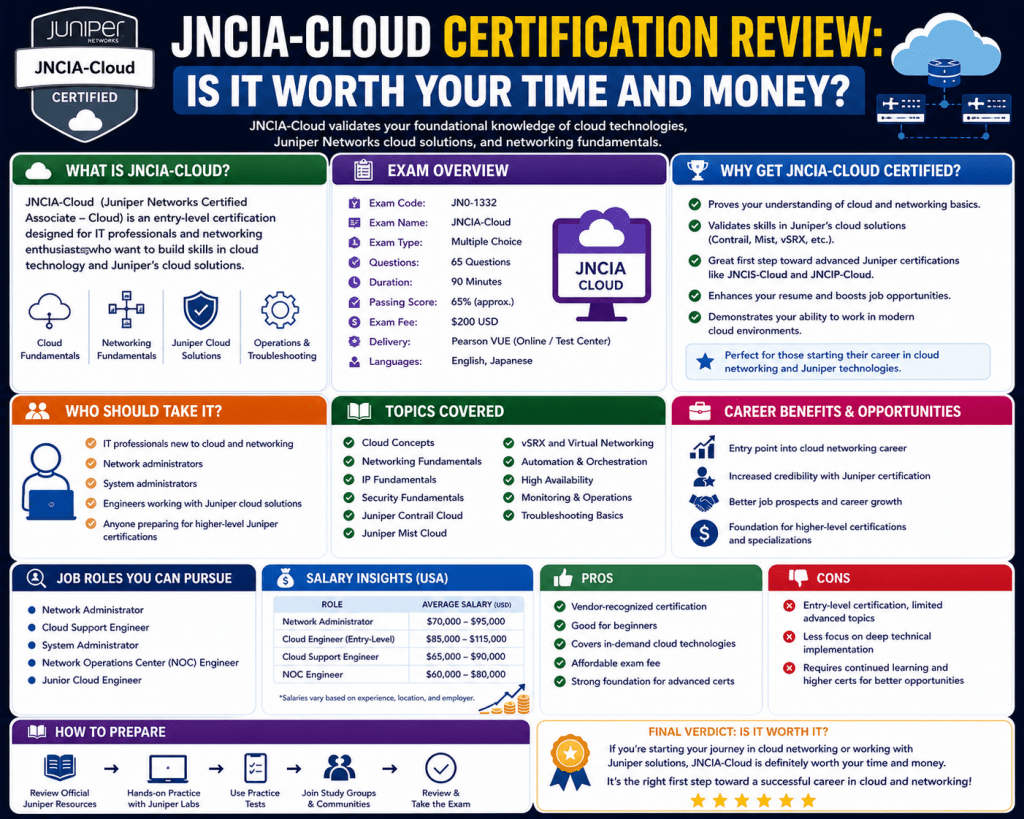
The JNCIA-Cloud certification represents an entry-level credential within the Juniper Networks certification pathway, specifically focused on cloud networking technologies. It is designed to introduce candidates to the foundational concepts of cloud-based network architectures and prepare them for working in environments where virtualization, automation, and distributed systems are central components of infrastructure design. As organizations continue transitioning from traditional hardware-based systems to cloud-driven environments, the demand for professionals who understand these technologies has significantly increased.
Cloud networking is not limited to a single type of system or deployment model. Instead, it encompasses a wide range of architectures that support flexible, scalable, and on-demand computing resources. These include public cloud environments where services are delivered over shared infrastructure, private cloud systems dedicated to a single organization, and hybrid models that combine both approaches. The certification introduces candidates to these deployment types and helps them understand how each model influences network design, performance, and security considerations.
A key focus of the certification is understanding how Juniper technologies integrate into cloud environments. This includes learning how networking solutions are adapted for virtualized infrastructure and how cloud-based tools are used to manage connectivity between distributed systems. Candidates are exposed to the principles that govern modern networking environments, including how data flows across physical and virtual layers.
The certification is positioned as a starting point for individuals who may not yet have advanced experience in cloud networking but possess basic networking knowledge. It acts as a structured introduction to concepts that are essential for working with modern infrastructure systems. By focusing on foundational understanding rather than deep specialization, it allows learners to gradually build expertise in cloud networking technologies.
Another important aspect of this certification is its alignment with industry transformation trends. Enterprises are increasingly adopting cloud-first strategies, meaning that traditional on-premise systems are being replaced or supplemented by cloud-native solutions. This shift requires professionals who can understand both legacy networking principles and modern cloud architectures. The JNCIA-Cloud certification bridges this gap by introducing both traditional networking fundamentals and newer cloud-based concepts.
Core Principles of Cloud Networking Covered in the Certification
Cloud networking relies on several foundational principles that define how modern systems operate. One of the primary concepts introduced in the certification is the idea of scalability. Cloud environments are designed to dynamically adjust resources based on demand, allowing networks to expand or contract without manual intervention. This flexibility is essential for supporting applications that experience variable workloads.
Another important principle is automation. In traditional networking environments, many configuration tasks are performed manually, which can be time-consuming and prone to errors. Cloud networking introduces automated processes that allow systems to configure, manage, and optimize themselves based on predefined rules. This reduces operational complexity and improves efficiency across large-scale networks.
Virtualization is also a core concept within the certification. It involves creating virtual versions of physical network components such as routers, firewalls, and switches. These virtual components operate on shared hardware but function independently, allowing multiple network environments to coexist on the same infrastructure. This approach improves resource utilization and reduces hardware dependency.
The certification also emphasizes the importance of orchestration. Orchestration refers to the coordination of multiple automated processes to achieve a specific outcome. In cloud networking, orchestration tools are used to manage complex workflows that involve multiple network functions and services. This ensures that systems operate cohesively and efficiently.
Another key principle is multi-tenancy, which allows multiple users or organizations to share the same infrastructure while maintaining isolation and security. This concept is essential in cloud environments where resources are shared but must remain secure and independent. Understanding how multi-tenancy is implemented helps candidates grasp how cloud providers manage large-scale systems.
Cloud Architecture Models and Their Importance
The certification introduces several cloud architecture models that form the foundation of modern networking systems. These models define how computing resources are deployed, managed, and accessed across different environments.
Public cloud architecture refers to environments where computing resources are delivered over the internet and shared among multiple users. This model is widely used due to its scalability and cost efficiency. It allows organizations to access resources without investing heavily in physical infrastructure.
Private cloud architecture, on the other hand, is dedicated to a single organization. This model provides greater control over security and customization but requires more investment in infrastructure management. It is often used by organizations with strict regulatory or security requirements.
Hybrid cloud architecture combines elements of both public and private clouds. This approach allows organizations to maintain sensitive data in private environments while leveraging public cloud resources for less critical workloads. It offers a balance between flexibility and control.
The certification also introduces the concept of underlay and overlay networks. The underlay network represents the physical infrastructure, including routers, switches, and cables. The overlay network is a virtual layer that runs on top of the underlay, enabling flexible and scalable connectivity. Understanding the relationship between these layers is essential for designing efficient cloud networks.
Another important concept is Infrastructure as a Service, Platform as a Service, and Software as a Service. These service models define how cloud resources are delivered to users. Infrastructure as a Service provides basic computing resources, Platform as a Service offers development environments, and Software as a Service delivers fully managed applications. Each model serves different operational needs and levels of control.
Network Function Virtualization and Its Role in Cloud Systems
Network Function Virtualization is a critical component of modern cloud networking. It involves replacing traditional hardware-based network functions with software-based equivalents that run on standard computing hardware. This approach reduces dependency on specialized hardware and increases flexibility in network design.
Virtual network functions include components such as virtual routers, virtual firewalls, and virtual load balancers. These functions operate independently but can be deployed dynamically based on network requirements. This allows organizations to scale services up or down as needed without physical infrastructure changes.
The certification introduces candidates to key NFV concepts, including the architecture that supports virtualization. This architecture defines how virtual network functions are deployed, managed, and connected within a cloud environment. It also explains how these functions interact with the underlying infrastructure.
NFV provides several advantages, including cost reduction, improved scalability, and faster deployment of services. By decoupling network functions from hardware, organizations can achieve greater agility and efficiency in managing their networks.
Understanding NFV is essential for working in modern cloud environments, as it forms the foundation for many advanced networking technologies. It also supports automation and orchestration, enabling more efficient network management.
Software-Defined Networking and Cloud Integration
Software-Defined Networking is another key area covered in the certification. It represents a shift from traditional networking models by separating the control plane from the data plane. This separation allows for centralized control of network traffic and more efficient management of network resources.
In a software-defined networking environment, network behavior is controlled through software applications rather than manual configuration of individual devices. This enables greater flexibility and automation in network operations.
The certification introduces different types of software-defined networking models and explains how they are implemented in cloud environments. It also covers the role of controllers that manage network traffic and enforce policies across the infrastructure.
Software-defined networking is closely integrated with cloud technologies, enabling seamless communication between virtualized resources. It supports dynamic provisioning of network services and improves the ability to respond to changing workloads.
Candidates are also introduced to orchestration systems that work alongside software-defined networking. These systems automate complex network tasks and ensure that resources are allocated efficiently across the environment.
Wide Area Networking and Cloud Connectivity Concepts
Wide Area Networking plays a significant role in cloud environments, particularly in connecting distributed locations and ensuring reliable communication between systems. The certification introduces software-defined WAN concepts that enhance traditional WAN architectures.
Software-defined WAN solutions provide centralized control over network traffic, allowing organizations to optimize routing and improve performance. These systems can dynamically select the best path for data transmission based on network conditions.
The certification also covers architectural components used in WAN environments, including tools that support intelligent routing and traffic management. These technologies help organizations maintain consistent performance across geographically distributed networks.
Cloud connectivity is a critical aspect of modern networking, as organizations increasingly rely on cloud-based applications and services. Understanding how WAN technologies integrate with cloud systems is essential for maintaining efficient and reliable communication.
Monitoring, Management, and Security in Cloud Networks
Monitoring and management are essential components of cloud networking, ensuring that systems operate efficiently and securely. The certification introduces tools and techniques used to analyze network performance and identify potential issues.
Telemetry plays a key role in monitoring, providing real-time data about network behavior. This information is used to detect anomalies, optimize performance, and maintain system stability.
Cloud-managed services simplify network operations by providing centralized platforms for configuration and monitoring. These services allow administrators to manage complex environments more efficiently.
Security is another critical focus area. Cloud environments introduce new security challenges due to their distributed nature. The certification covers basic security principles, including policy enforcement and threat detection mechanisms.
Understanding how to secure cloud networks is essential for protecting data and ensuring compliance with organizational requirements. The certification introduces foundational security concepts that form the basis for more advanced security strategies in cloud environments.
Career Relevance of JNCIA-Cloud in Modern IT Environments
The JNCIA-Cloud certification plays a significant role in shaping early-career professionals who aim to work in cloud networking environments. As organizations continue shifting toward cloud-first infrastructure models, the demand for engineers who understand both traditional networking and cloud-native systems has increased steadily. This certification helps bridge the gap between foundational networking knowledge and the specialized skills required for managing modern distributed systems.
In many IT environments today, networking is no longer limited to physical routers and switches. Instead, networks are increasingly defined by software, automation, and virtualized services that operate across multiple environments. The certification introduces professionals to this shift in architecture and helps them understand how cloud systems are designed, deployed, and maintained in real-world scenarios.
One of the key aspects of career relevance is the ability to understand multi-layered network systems. Cloud environments often involve multiple abstraction layers, including physical infrastructure, virtualization layers, and application delivery systems. Professionals who understand how these layers interact are better positioned to manage complex environments effectively.
The certification also supports career mobility across different IT roles. While it is primarily focused on networking, the concepts covered are relevant to cloud engineering, systems administration, and infrastructure operations. This cross-functional relevance makes it a useful credential for individuals who want to explore multiple career paths within IT infrastructure.
Another important factor is industry adoption. Many enterprises rely on hybrid and multi-cloud environments, meaning professionals must be comfortable working across different platforms and technologies. The certification introduces foundational knowledge that is applicable across these environments, making it easier for professionals to adapt to diverse workplace requirements.
Impact on Entry-Level Networking Careers
For individuals entering the IT industry, the JNCIA-Cloud certification serves as a structured introduction to cloud networking concepts. Entry-level professionals often begin with basic networking roles where they are responsible for monitoring systems, troubleshooting connectivity issues, and assisting with configuration tasks.
This certification helps build the conceptual foundation needed to perform these responsibilities more effectively. It introduces key principles such as network virtualization, software-defined control, and cloud-based service delivery. These concepts are increasingly relevant in entry-level job roles, especially in organizations that rely on modern infrastructure systems.
Entry-level professionals who understand cloud networking concepts are often better prepared to handle real-world challenges. For example, troubleshooting in cloud environments requires an understanding of both physical and virtual network components. Without this knowledge, identifying the root cause of an issue can become significantly more difficult.
The certification also helps professionals understand standardized practices used in modern networking environments. These practices include configuration consistency, automation workflows, and centralized management techniques. Learning these principles early in a career can improve efficiency and reduce operational errors.
In addition, entry-level professionals benefit from exposure to cloud service models and deployment strategies. Understanding how infrastructure is delivered and managed in cloud environments helps them adapt more quickly to workplace expectations and technical requirements.
Role in Network Engineering Skill Development
Network engineering is evolving rapidly due to the adoption of cloud technologies and software-defined infrastructure. Traditional networking skills remain important, but they are now complemented by cloud-specific knowledge and automation capabilities. The JNCIA-Cloud certification contributes to this evolution by introducing engineers to modern networking paradigms.
One of the key skill areas developed through this certification is virtualization. Network engineers must understand how virtual network functions operate and how they replace traditional hardware-based systems. This includes virtual routing, switching, and security functions that operate within cloud environments.
Another important skill area is automation. Modern network engineering relies heavily on automated processes for configuration, deployment, and monitoring. The certification introduces concepts that help engineers understand how automation tools interact with network infrastructure.
Engineers also develop an understanding of centralized network control. In software-defined environments, control systems manage network behavior across multiple devices and locations. This centralized approach simplifies management and improves scalability.
The certification also introduces engineers to cloud-native networking concepts. These include distributed architectures, dynamic resource allocation, and service-based connectivity models. Understanding these concepts is essential for working in modern enterprise environments.
Additionally, network engineers gain insight into troubleshooting in virtualized environments. Unlike traditional networks, cloud environments require a different approach to identifying and resolving issues due to their layered architecture and abstraction models.
Understanding Cloud Networking Architectures in Depth
Cloud networking architectures are built on several foundational principles that define how systems communicate and operate. One of the most important aspects is scalability. Cloud networks are designed to handle varying levels of demand without requiring manual intervention or physical upgrades.
Another critical aspect is elasticity. Elastic networks can automatically adjust resources based on real-time demand. This ensures that systems remain efficient even during periods of high or low usage.
Cloud architectures also rely heavily on abstraction. This means that the underlying physical infrastructure is hidden from the user, allowing them to focus on configuration and management rather than hardware details. This abstraction is made possible through virtualization technologies.
Multi-layered architecture is another defining feature of cloud networking. These layers typically include physical infrastructure, virtualization layers, control systems, and application delivery components. Each layer plays a specific role in ensuring smooth network operation.
The certification introduces professionals to how these layers interact and depend on each other. Understanding this interaction is essential for designing and managing efficient cloud networks.
Another important concept is distributed architecture. Cloud networks are not confined to a single location but are spread across multiple data centers and geographic regions. This distribution improves reliability and performance but also introduces complexity in management and coordination.
Importance of Network Virtualization Technologies
Network virtualization is one of the core concepts introduced in the certification. It enables the creation of virtual network components that operate independently of physical hardware. This approach has transformed how networks are designed and managed.
Virtual routers, virtual firewalls, and virtual switches are examples of network functions that can be deployed in software-based environments. These components perform the same functions as their physical counterparts but offer greater flexibility and scalability.
One of the main advantages of virtualization is resource optimization. Multiple virtual networks can run on a single physical infrastructure, maximizing hardware utilization and reducing costs.
Virtualization also improves deployment speed. Network functions can be deployed or modified quickly without requiring physical installation or configuration changes. This allows organizations to respond more rapidly to changing business needs.
The certification helps professionals understand how virtual network functions are managed within cloud environments. This includes understanding their lifecycle, configuration processes, and integration with other network components.
Virtualization also plays a key role in disaster recovery and redundancy. Virtual systems can be replicated and restored more easily than physical systems, improving overall network resilience.
Software-Defined Networking in Enterprise Environments
Software-defined networking is a transformative technology that has changed how networks are controlled and managed. Instead of configuring individual devices manually, SDN allows centralized software systems to control network behavior.
One of the key benefits of SDN is centralized control. Network administrators can manage entire networks from a single interface, improving efficiency and reducing complexity.
SDN also enables dynamic configuration. Network policies can be adjusted in real time based on changing requirements or conditions. This flexibility is essential for modern cloud environments.
Another important feature of SDN is programmability. Networks can be controlled using software applications, allowing for automation and integration with other systems.
The certification introduces professionals to how SDN is implemented in cloud environments and how it interacts with other technologies such as virtualization and orchestration systems.
SDN also improves scalability by allowing networks to expand or contract without physical modifications. This is particularly important in cloud environments where demand can fluctuate significantly.
Cloud Security and Operational Stability Concepts
Security is a fundamental aspect of cloud networking and is integrated into every layer of modern infrastructure. The certification introduces basic security principles that help professionals understand how cloud environments are protected.
One of the key concepts is policy-based security management. This approach uses predefined rules to control access and behavior within the network.
Another important concept is threat detection. Cloud environments require continuous monitoring to identify potential security risks and respond to them quickly.
Identity and access management also play a critical role. Ensuring that only authorized users and systems can access network resources is essential for maintaining security.
Operational stability is closely related to security. Stable networks require consistent performance, minimal downtime, and efficient resource management. The certification introduces concepts that help professionals maintain stability in cloud environments.
Monitoring tools are also an important part of operational management. These tools provide real-time insights into network performance and help identify potential issues before they escalate.
Cloud Management and Monitoring Systems
Cloud management systems provide centralized control over network infrastructure. These systems allow administrators to configure, monitor, and optimize network resources from a unified platform.
One of the key benefits of cloud management is visibility. Administrators can view the entire network infrastructure from a single interface, making it easier to identify issues and manage resources.
Monitoring systems collect data from various network components and provide insights into performance, traffic patterns, and system health. This data is essential for maintaining optimal performance.
Telemetry is another important component of cloud monitoring. It involves collecting and analyzing real-time data from network devices to understand system behavior.
Cloud management systems also support automation, allowing routine tasks to be performed without manual intervention. This improves efficiency and reduces the likelihood of human error.
These systems are essential for managing large-scale cloud environments where manual configuration would be inefficient and impractical.
Cloud Certification Roadmap and Position of JNCIA-Cloud in Career Progression
The JNCIA-Cloud certification sits at the entry level of Juniper’s cloud-focused certification track, but its importance becomes clearer when viewed as part of a broader professional development roadmap. In structured certification pathways, early-stage credentials are not designed to provide mastery but to establish conceptual grounding. This certification introduces foundational knowledge that supports progression toward more advanced certifications in cloud networking, automation, and infrastructure design.
Within a typical career progression, professionals begin with basic networking understanding and gradually move into specialized domains such as cloud architecture, software-defined networking, and network security. The JNCIA-Cloud certification marks the transition from traditional networking fundamentals into cloud-centric infrastructure models. This transition is increasingly important as enterprises move away from hardware-centric systems and adopt scalable, software-driven architectures.
As professionals advance beyond entry-level knowledge, they typically encounter more complex topics such as orchestration systems, multi-cloud integration, and advanced network automation. The foundational concepts learned in the JNCIA-Cloud certification serve as a reference point for understanding these advanced systems. Without this baseline knowledge, higher-level concepts can become difficult to interpret due to their abstraction and complexity.
The certification also plays a role in helping professionals decide their specialization path. Some may choose to focus on cloud engineering, others on network automation, while some may move toward security-focused roles. The exposure provided at this level helps candidates identify which areas align with their interests and strengths.
Another important aspect of career progression is the development of a structured learning mindset. Certification pathways encourage continuous learning, and the JNCIA-Cloud certification introduces the discipline required to study complex technical systems in a structured manner. This mindset becomes increasingly important as professionals move toward more advanced certifications and responsibilities.
Salary Expectations and Industry Value of Cloud Networking Skills
The value of cloud networking skills in the job market has increased significantly as organizations continue to adopt distributed infrastructure models. While entry-level certifications do not guarantee specific salary outcomes, they contribute to building the skill set required for higher-paying roles in networking and cloud engineering.
In modern IT environments, professionals with cloud networking knowledge are often involved in designing, deploying, and maintaining virtualized infrastructure. These responsibilities require an understanding of both traditional networking principles and modern cloud-based systems. As a result, professionals who possess this combination of skills tend to be more competitive in the job market.
Salary levels in networking roles vary depending on experience, specialization, and organizational scale. Entry-level professionals typically begin in support or junior engineering roles, where they gain hands-on experience with network monitoring and configuration. As they progress and acquire additional certifications and experience, they move into higher-paying engineering and architecture roles.
Cloud engineering roles generally offer higher compensation due to the complexity and strategic importance of the work involved. These roles require knowledge of automation, virtualization, and distributed systems. The JNCIA-Cloud certification contributes to building the foundational understanding needed for these responsibilities.
Another factor influencing salary growth is specialization. Professionals who develop expertise in cloud networking, software-defined infrastructure, or network security often command higher salaries due to the demand for these skills. The certification helps establish the initial knowledge base required for such specialization.
Industry demand for cloud networking skills continues to grow as organizations migrate workloads to cloud environments. This demand creates opportunities for professionals who are willing to invest in learning cloud technologies and gaining relevant certifications.
Real-World Application of JNCIA-Cloud Knowledge
The concepts covered in the JNCIA-Cloud certification are directly applicable to real-world networking environments. In modern organizations, network engineers are responsible for managing both physical and virtual infrastructure components. This requires an understanding of how cloud systems interact with traditional networks.
One common application is managing hybrid environments. Many organizations operate systems that combine on-premise infrastructure with cloud-based resources. Professionals must understand how data flows between these environments and how connectivity is maintained across different platforms.
Another real-world application involves network automation. Many tasks that were previously performed manually are now automated using software-defined systems. This includes configuration management, resource allocation, and performance optimization. The certification introduces concepts that help professionals understand how these automation systems function.
Virtual network management is another key application area. Engineers must work with virtual routers, firewalls, and switches that operate within cloud environments. Understanding how these components are deployed and managed is essential for maintaining network stability.
Monitoring and troubleshooting are also critical responsibilities in real-world environments. Network professionals must use telemetry and analytics tools to identify issues and maintain performance. The certification introduces foundational knowledge that supports these tasks.
Security management is another important application area. Cloud environments require continuous monitoring and enforcement of security policies to protect data and infrastructure. Professionals must understand how security is integrated into cloud networking systems.
Cloud Networking Challenges in Modern Infrastructure
While cloud networking offers significant advantages, it also introduces a number of challenges that professionals must understand. One of the primary challenges is complexity. Cloud environments involve multiple layers of abstraction, making it more difficult to visualize and manage network infrastructure.
Another challenge is visibility. In traditional networks, physical components are easier to monitor and manage. In cloud environments, many components are virtualized, making it more difficult to track performance and identify issues without advanced monitoring tools.
Security is also a major concern. Cloud environments are exposed to a wider range of threats due to their distributed nature and internet accessibility. Ensuring secure communication between systems requires careful configuration and continuous monitoring.
Performance optimization is another challenge. Cloud networks must handle varying workloads efficiently, which requires dynamic resource allocation and intelligent traffic management. Without proper configuration, performance bottlenecks can occur.
Integration between different systems can also be challenging. Many organizations use multiple cloud providers and legacy systems, which must work together seamlessly. Ensuring compatibility and connectivity between these systems requires careful planning and expertise.
Importance of Automation in Cloud Networking Environments
Automation is one of the most transformative aspects of modern networking. It reduces manual effort, increases efficiency, and minimizes the risk of human error. In cloud environments, automation is essential due to the scale and complexity of infrastructure systems.
Automated configuration management allows network settings to be deployed consistently across multiple devices and environments. This ensures standardization and reduces configuration errors.
Automated monitoring systems continuously track network performance and generate alerts when issues are detected. This allows for faster response times and improved system reliability.
Resource allocation can also be automated in cloud environments. Systems can dynamically assign resources based on demand, ensuring optimal performance without manual intervention.
The certification introduces foundational concepts related to automation, helping professionals understand how automated systems interact with network infrastructure. This understanding is essential for working in modern IT environments.
Role of Virtualization in Modern Network Infrastructure
Virtualization is a core component of cloud networking and plays a central role in modern infrastructure design. It allows multiple virtual systems to run on a single physical machine, improving resource utilization and flexibility.
Virtual network functions replace traditional hardware-based components, allowing networks to be deployed and managed more efficiently. These functions include routing, switching, and security services.
One of the key benefits of virtualization is scalability. Virtual systems can be easily scaled up or down based on demand, making them ideal for cloud environments.
Another benefit is cost efficiency. Organizations can reduce hardware costs by consolidating multiple virtual systems onto fewer physical devices.
Virtualization also improves flexibility. Network components can be deployed, modified, or removed without physical intervention, allowing for faster adaptation to changing requirements.
The certification introduces professionals to these concepts, helping them understand how virtualization supports modern cloud networking architectures.
Software-Defined Networking and Its Industry Transformation Impact
Software-defined networking has fundamentally changed how networks are designed and managed. By separating the control plane from the data plane, SDN enables centralized control and greater flexibility.
One of the key impacts of SDN is improved network agility. Changes can be implemented quickly through software rather than manual hardware configuration.
SDN also improves network visibility by providing centralized monitoring and control. This allows administrators to manage entire networks from a single interface.
Another important impact is automation integration. SDN systems can work alongside automation tools to streamline network operations and reduce manual workload.
Scalability is also enhanced through SDN. Networks can be expanded or modified dynamically without physical infrastructure changes.
The certification introduces these concepts to help professionals understand how SDN is reshaping modern networking environments.
Long-Term Value of JNCIA-Cloud in Technology Careers
The long-term value of the JNCIA-Cloud certification lies in its ability to establish foundational knowledge that supports continuous career development. While it is an entry-level credential, it introduces concepts that remain relevant throughout a professional’s career in networking and cloud infrastructure.
As technology continues to evolve, the importance of cloud networking skills will continue to increase. Organizations will rely more heavily on distributed systems, automation, and virtualization, all of which are introduced at a foundational level in this certification.
Professionals who begin with structured learning pathways are often better prepared for long-term success in technical roles. The certification encourages a disciplined approach to learning and provides a clear starting point for further specialization.
The knowledge gained through this certification also supports adaptability. As new technologies emerge, professionals with a strong understanding of foundational principles are better able to learn and adapt quickly.
In modern IT environments, adaptability is one of the most valuable skills. The ability to understand new systems and integrate them into existing infrastructure is essential for long-term career growth.
The JNCIA-Cloud certification contributes to building this adaptability by introducing core principles that remain relevant across different technologies and platforms.
Conclusion
The JNCIA-Cloud certification represents an important entry point into the evolving world of cloud networking, particularly for professionals who are beginning to work with modern infrastructure models built around virtualization, automation, and distributed systems. While it is positioned as an associate-level credential, its value extends beyond simple entry-level validation because it introduces foundational concepts that remain relevant throughout more advanced stages of a networking career. In a technology landscape that is rapidly shifting away from traditional hardware-centric networking toward software-defined and cloud-native architectures, this certification provides a structured starting point for understanding how these systems function and interact.
One of the most important takeaways from the JNCIA-Cloud pathway is how it frames networking as a layered and dynamic discipline rather than a static configuration of devices. Traditional networking focused heavily on physical hardware such as routers, switches, and firewalls, where configuration changes were manual, and infrastructure was relatively fixed. In contrast, cloud networking introduces abstraction layers that separate physical infrastructure from logical network design. This means professionals must think in terms of virtualized resources, automated orchestration, and centralized control systems rather than isolated devices. The certification helps build this shift in thinking, which is essential for adapting to modern enterprise environments.
Another key aspect of its value lies in its introduction to cloud architecture concepts such as public, private, and hybrid models. These deployment types are no longer theoretical; they form the backbone of most enterprise IT strategies today. Understanding how workloads are distributed across different environments, how data flows between them, and how connectivity is maintained is critical for any networking professional. The certification ensures that candidates are not only familiar with these concepts but also understand how they relate to real-world network design and operational requirements.
The emphasis on software-defined networking and network function virtualization also highlights why this certification remains relevant. These technologies represent a fundamental shift in how networks are built and managed. Instead of relying on dedicated hardware appliances, network functions are now delivered through software that can be deployed flexibly across cloud environments. This allows organizations to scale more efficiently, reduce costs, and respond more quickly to changing demands. However, it also introduces complexity, as networks become more abstract and distributed. The certification helps simplify these ideas for learners by breaking them into understandable components.
From a career development perspective, the JNCIA-Cloud certification is particularly valuable because it creates a foundation for progression into more advanced roles. While it does not make someone an expert, it prepares them to understand higher-level concepts that appear in more specialized certifications and job functions. For example, roles in cloud engineering, network automation, and infrastructure architecture all require familiarity with the principles introduced at this level. Without this foundational understanding, progressing into those roles becomes significantly more difficult.
It also plays an important role in validating knowledge for professionals who are already working in networking environments. Many individuals gain experience through hands-on work without formal certification, which can sometimes lead to gaps in theoretical understanding or inconsistent application of best practices. The certification helps align practical experience with standardized concepts and industry-recognized frameworks. This alignment is important because modern network environments often require collaboration across teams, vendors, and technologies, all of which depend on a shared understanding of core principles.
In addition, the certification reflects the increasing importance of automation in networking. Automation is no longer an optional enhancement but a core requirement in managing scalable and efficient cloud environments. Tasks such as configuration management, monitoring, provisioning, and troubleshooting are increasingly handled through automated systems. Understanding how these systems operate and how they interact with underlying infrastructure is essential for maintaining control and visibility in complex environments. The certification introduces these ideas early, allowing professionals to build confidence in working with automated workflows.
Security is another area where the certification provides foundational insight. As networks become more distributed and cloud-based, the attack surface expands, making security more complex and critical. Traditional perimeter-based security models are no longer sufficient in environments where users, devices, and applications operate across multiple locations and platforms. Instead, security must be integrated into every layer of the network. The certification introduces basic concepts of policy enforcement, identity management, and threat detection, which are essential building blocks for understanding modern cloud security frameworks.
Another long-term benefit of the certification is the way it encourages structured learning. Cloud networking is a broad and rapidly evolving field, and without a clear learning path, it can be difficult to know where to start or how to progress. The certification provides a defined entry point that organizes knowledge into logical domains such as architecture, virtualization, SDN, and cloud management. This structured approach helps learners avoid fragmentation and ensures that foundational concepts are understood before moving on to more complex topics.
The certification also helps professionals develop adaptability, which is one of the most important skills in the IT industry today. Technologies evolve quickly, and networking professionals are often required to learn new systems, tools, and methodologies throughout their careers. By introducing core principles rather than focusing solely on specific tools or platforms, the certification ensures that the knowledge gained remains applicable even as technologies change. This makes it a durable foundation for long-term career growth.
From an industry perspective, the increasing adoption of hybrid and multi-cloud environments means that professionals with cloud networking knowledge are becoming more valuable across sectors. Organizations are no longer relying on a single infrastructure model; instead, they combine multiple environments to achieve flexibility, resilience, and cost efficiency. This complexity requires professionals who can understand how different systems interact and how to maintain performance and security across distributed architectures. The certification helps prepare individuals for these demands by providing a broad understanding of cloud networking principles.
It is also important to recognize that while the certification is entry-level, it is not simplistic in content. The concepts it introduces, such as SDN, NFV, and cloud orchestration, are foundational to modern enterprise infrastructure. These are not niche technologies but core components of how networks are designed and operated today. Learning them at an early stage provides a significant advantage when transitioning into more advanced technical roles.
Ultimately, the value of the JNCIA-Cloud certification lies in its ability to bridge the gap between traditional networking and modern cloud-based systems. It does not attempt to make professionals experts in every area but instead equips them with the conceptual tools needed to understand and navigate complex environments. This makes it particularly useful for individuals who are either starting their careers in IT or transitioning from traditional networking roles into cloud-focused positions.
In a broader sense, the certification reflects the direction in which the entire networking industry is moving. As infrastructure becomes more virtualized, automated, and distributed, the ability to understand cloud networking principles is becoming a baseline requirement rather than a specialized skill. The JNCIA-Cloud certification helps establish that baseline, ensuring that professionals are prepared to engage with the technologies that define modern IT environments and continue evolving alongside them.