
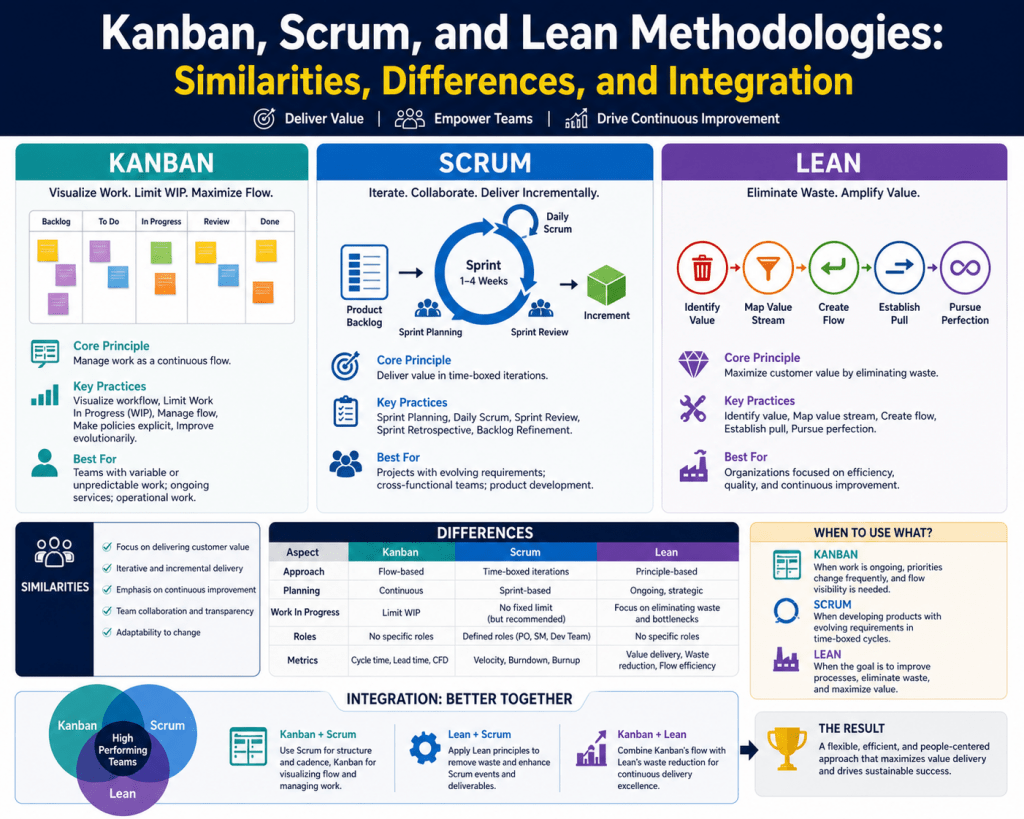
Agile and Lean are two foundational approaches that shape how modern software development and knowledge work are structured. They are not rigid methodologies with fixed steps but rather guiding philosophies that influence how teams plan, execute, and improve their work. Both emerged from different industries and challenges, yet they converge on a shared goal: delivering value efficiently while adapting to change.
Lean originated in manufacturing environments, particularly from production systems designed to reduce inefficiency and improve consistency. Over time, these principles were adapted beyond manufacturing and applied to knowledge work, especially software development. Lean thinking focuses heavily on identifying and eliminating waste in any process. Waste can include unnecessary work, delays, overproduction of features, excessive task switching, or bottlenecks that slow down delivery. The goal is to create a smooth and efficient flow of value from the beginning of work to its completion.
Agile, on the other hand, emerged from the challenges faced in software development, where requirements were often unclear, evolving, or unpredictable. Traditional project management methods struggled in such environments because they relied heavily on upfront planning and fixed execution paths. Agile introduced a different mindset, emphasizing flexibility, collaboration, and iterative progress. Instead of trying to define everything at the start, Agile encourages teams to deliver small increments of work, gather feedback, and continuously adapt.
Although Agile and Lean developed independently, they are now closely interconnected in modern work environments. Agile focuses on adaptability in uncertain conditions, while Lean focuses on optimizing efficiency and flow. Together, they provide a balanced approach that helps teams handle complexity while maintaining productivity.
The Core Philosophy Behind Lean Thinking
Lean thinking is centered on maximizing value while minimizing waste. The idea of value is defined strictly from the customer’s perspective. Anything that does not contribute directly or indirectly to customer value is considered waste and should be reduced or eliminated whenever possible.
Lean identifies several categories of waste, including unnecessary work that does not improve the product, waiting time between tasks, excessive handoffs between team members, and overloading teams with too much work at once. These inefficiencies slow down delivery and reduce overall system performance.
A key concept in Lean is the value stream. A value stream represents the entire process of delivering a product or service, from initial idea to final delivery. Lean thinking requires teams to analyze each step in this stream and determine whether it contributes to value creation. Steps that do not contribute are either improved or removed.
Another important principle in Lean is flow. Flow refers to the smooth and continuous movement of work through the system. When flow is disrupted by bottlenecks or inefficiencies, delivery slows down and predictability decreases. Lean aims to maintain a steady flow by reducing interruptions and balancing workloads.
Lean also emphasizes continuous improvement, often referred to as incremental optimization. Instead of making large changes all at once, teams are encouraged to make small, consistent improvements over time. This ensures that processes evolve gradually without introducing unnecessary risk.
The Core Philosophy Behind Agile Thinking
Agile is built around the idea that change is inevitable and should be embraced rather than resisted. In many modern environments, especially software development, requirements are not fully known at the beginning of a project. Customers may not fully understand what they need until they see early versions of the product. This makes traditional predictive planning less effective.
Agile addresses this challenge by promoting iterative development. Work is divided into small cycles, and each cycle produces a usable version of the product. This allows teams to gather feedback early and adjust direction based on real-world insights.
Collaboration is another key element of Agile thinking. Agile encourages close communication between team members, stakeholders, and customers. This ensures that everyone has a shared understanding of goals and progress, reducing misunderstandings and improving alignment.
Agile also emphasizes self-organizing teams. Instead of relying on strict top-down control, Agile teams are given autonomy to decide how to complete their work. This increases flexibility and allows teams to adapt more quickly to changing conditions.
Another important aspect of Agile is responsiveness. Agile teams are expected to respond quickly to changes in requirements, priorities, or market conditions. This responsiveness is achieved through short feedback loops and frequent delivery cycles.
How Agile and Lean Complement Each Other
Although Agile and Lean have different origins and focuses, they complement each other in meaningful ways. Lean focuses on improving efficiency and reducing waste in processes, while Agile focuses on improving adaptability and responsiveness in uncertain environments.
When combined, these approaches create a balanced system where work is both efficient and flexible. Lean ensures that processes are streamlined and that resources are not wasted. Agile ensures that teams can adjust quickly to new information and evolving requirements.
In modern software development, it is common for teams to apply both Agile and Lean principles simultaneously. For example, a team may use Agile practices to manage development cycles while using Lean principles to optimize workflow efficiency and reduce bottlenecks.
This combination helps teams deliver value faster while maintaining high quality and adaptability.
The Evolution of Modern Software Development Practices
Before Agile and Lean became widely adopted, many software development teams relied on traditional sequential models. These models required detailed planning at the beginning of a project, followed by strict execution phases. While this approach worked in stable environments, it struggled in dynamic conditions where requirements changed frequently.
As software systems became more complex and user expectations evolved rapidly, these traditional models became less effective. Teams needed a more flexible approach that allowed them to adapt without losing control over delivery.
Agile emerged as a response to this need by introducing iterative development and continuous feedback. Lean contributed by introducing efficiency-focused thinking that reduced delays and improved workflow.
Over time, these two philosophies became the foundation of modern software development practices. They influenced the creation of structured frameworks such as Scrum and Kanban, which translate abstract principles into practical workflows.
The Role of Value Delivery in Agile and Lean Systems
Both Agile and Lean place strong emphasis on delivering value to the customer. However, they approach value delivery from slightly different perspectives.
In Lean, value is delivered by optimizing the entire system to remove inefficiencies. The focus is on ensuring that work flows smoothly from start to finish without unnecessary delays or waste. This results in faster and more predictable delivery.
In Agile, value is delivered through iterative increments. Instead of waiting until the end of a project to deliver a complete product, Agile teams deliver small usable pieces of functionality throughout the development process. This allows customers to see progress early and provide feedback that shapes future work.
Together, these approaches ensure that value is both efficiently produced and continuously refined based on feedback.
Adaptability and Efficiency as Dual Pillars of Modern Work
One of the key insights from combining Agile and Lean is the importance of balancing adaptability and efficiency. Adaptability ensures that teams can respond to change, while efficiency ensures that resources are used effectively.
If a system is highly efficient but not adaptable, it may struggle to handle changing requirements. On the other hand, if a system is highly adaptable but inefficient, it may waste resources and slow down delivery.
Agile and Lean together create a balance where teams can respond to change while maintaining efficient workflows. This balance is essential in environments where both speed and flexibility are important.
Foundations for Frameworks Like Scrum and Kanban
Agile and Lean principles form the foundation for more structured frameworks such as Scrum and Kanban. These frameworks take abstract ideas and turn them into practical systems that teams can follow.
Scrum is built primarily on Agile principles, focusing on iterative delivery, structured roles, and time-boxed cycles. It provides a clear rhythm for planning, execution, and review.
Kanban is more closely aligned with Lean principles, focusing on visualizing work, managing flow, and limiting work in progress. It emphasizes continuous delivery and efficiency.
Both frameworks reflect different interpretations of the same underlying principles, showing how Agile and Lean can be applied in different ways depending on the needs of a team.
The Importance of Continuous Improvement in Modern Systems
Continuous improvement is a shared principle between Agile and Lean. In Lean, it is achieved through ongoing process optimization and waste reduction. In Agile, it is achieved through regular reflection and adaptation after each iteration.
This focus on continuous improvement ensures that systems do not remain static. Instead, they evolve based on experience, feedback, and changing conditions.
Teams that embrace continuous improvement are better able to refine their processes, improve collaboration, and deliver higher-quality results over time.
The Transition Toward Structured Agile Frameworks
As organizations adopted Agile and Lean principles, there was a growing need for more structured approaches that could guide implementation. This led to the development of frameworks like Scrum and Kanban.
These frameworks provide specific rules and practices while still remaining flexible enough to be adapted. They help teams translate abstract principles into day-to-day workflows that can be consistently applied.
Scrum and Kanban are now widely used because they offer practical ways to implement Agile and Lean thinking in real-world environments.
Scrum as a Structured Implementation of Agile Principles
Scrum is one of the most widely adopted frameworks within Agile project management, especially in software development and complex product environments. It is not a methodology in the rigid sense but a structured framework that translates Agile principles into actionable workflows. Scrum provides clarity on roles, responsibilities, events, and artifacts while still allowing teams flexibility in how they execute the work.
At its core, Scrum is designed to help teams manage complexity by breaking large, uncertain work into smaller, manageable cycles. These cycles allow teams to deliver value incrementally while continuously learning and adapting. Instead of attempting to plan an entire project from start to finish in detail, Scrum encourages iterative planning and execution.
Scrum is particularly effective in environments where requirements evolve, where user feedback is essential, and where uncertainty is high. It creates a system where teams can inspect progress frequently and adjust direction without losing momentum.
The Foundation of Scrum: Empiricism and Adaptation
Scrum is built on empirical process control, which relies on three pillars: transparency, inspection, and adaptation. These pillars ensure that decisions are based on real data and observations rather than assumptions.
Transparency ensures that all aspects of the work are visible to the team. This includes progress, challenges, and priorities. When work is transparent, teams can make informed decisions and identify issues early.
Inspection involves regularly reviewing progress and outcomes. In Scrum, inspection occurs during structured events such as daily meetings, iteration reviews, and retrospectives. These inspections help teams understand whether they are moving in the right direction.
Adaptation is the process of making changes based on what is observed. If issues or inefficiencies are identified during inspection, the team adjusts its approach to improve outcomes.
Together, these three pillars create a feedback-driven system that supports continuous improvement and responsiveness.
Scrum Roles and Their Functional Responsibilities
Scrum defines three primary roles that work together to ensure smooth execution and delivery.
The Product Owner is responsible for defining what the team should build. This role manages the product backlog, which is a prioritized list of features, improvements, and tasks. The Product Owner ensures that the team is always working on the most valuable items based on business needs and customer expectations.
The Scrum Master acts as a facilitator and process guide. This role ensures that Scrum practices are followed correctly and that the team can work without unnecessary obstacles. The Scrum Master helps remove blockers, supports collaboration, and ensures that the framework is understood and applied effectively.
The Development Team consists of professionals who actually create the product. This may include software developers, testers, designers, or other specialists, depending on the project. The team is self-organizing, meaning they decide how to complete the work without the external assignment of tasks.
These three roles work together to create a balanced system of decision-making, execution, and process guidance.
Scrum Artifacts and Their Purpose in Work Management
Scrum uses several key artifacts to organize and track work throughout the development process.
The Product Backlog is a continuously evolving list of all work that may be needed for the product. It is dynamic and constantly refined based on new information, feedback, and changing priorities. Items in the backlog are ordered by value and importance.
The Sprint Backlog is a subset of the Product Backlog selected for completion during a specific iteration. It represents the team’s short-term commitment and focus. Once selected, the items in the Sprint Backlog are broken down into actionable tasks.
The Increment represents the completed work at the end of a sprint. It must meet quality standards and be potentially usable. The Increment is the tangible output of the Scrum process and reflects progress toward the overall product goal.
These artifacts ensure transparency and alignment across the team and stakeholders.
Scrum Events and Their Role in Structuring Work
Scrum defines a set of structured events that guide the rhythm of work.
Sprint Planning is the event where the team decides what work will be completed during the upcoming sprint. The team selects items from the Product Backlog and defines a Sprint Goal that provides direction and focus.
Daily Scrum is a short, time-boxed meeting where team members synchronize their work. During this meeting, they discuss progress, upcoming tasks, and any obstacles. This ensures continuous communication and alignment.
Sprint Review is conducted at the end of the sprint to demonstrate the completed work. Stakeholders provide feedback that helps shape future development.
Sprint Retrospective is a reflective session where the team evaluates its processes and identifies areas for improvement. This supports continuous learning and optimization.
These events create a structured cadence that supports both planning and adaptability.
The Iterative Nature of Scrum Work Cycles
Scrum operates in fixed-length iterations known as sprints. Each sprint typically lasts a few weeks and results in a usable increment of the product.
The iterative nature of Scrum allows teams to break down complex work into manageable segments. Instead of waiting until the end of a long project to deliver results, teams deliver value continuously.
Each sprint follows a predictable pattern: planning, execution, review, and reflection. This repetition creates rhythm and stability while still allowing flexibility within each cycle.
Iterative delivery also enables rapid feedback. Stakeholders can see progress early and provide input that influences future work. This reduces the risk of building products that do not meet user needs.
How Scrum Handles Uncertainty in Projects
One of Scrum’s key strengths is its ability to manage uncertainty. In many projects, especially in software development, requirements are not fully known at the beginning. Scrum addresses this by avoiding overly detailed upfront planning.
Instead, Scrum focuses on short planning horizons. Teams only plan in detail for the upcoming sprint, while maintaining a broader vision through the product backlog.
This approach allows teams to adapt as new information becomes available. If priorities change, the backlog can be updated and future sprints adjusted accordingly.
By embracing uncertainty rather than resisting it, Scrum enables more flexible and responsive delivery.
Metrics and Performance Tracking in Scrum
Scrum uses several metrics to help teams understand performance and improve over time.
Velocity is one commonly used metric that measures how much work a team completes during a sprint. It helps teams understand their capacity and plan future work more accurately.
Burndown charts are another tool used to visualize progress during a sprint. They show how much work remains compared to time left, helping teams track whether they are on schedule.
These metrics are not used for strict performance evaluation but rather for process improvement and planning support.
Scrum and Collaboration in Team Environments
Scrum places strong emphasis on collaboration. Teams are expected to work closely together, share information openly, and solve problems collectively.
This collaborative environment reduces silos and improves communication. Because work is visible and regularly discussed, team members stay aligned and aware of overall progress.
Collaboration also extends to stakeholders, who are involved through review sessions. This ensures that feedback is integrated continuously rather than only at the end of a project.
Scrum as a Framework for Continuous Learning
Scrum is not just a delivery system but also a learning system. Each sprint provides opportunities to learn from outcomes, feedback, and process reflection.
The retrospective event is especially important for learning. It allows teams to analyze what worked well and what needs improvement. Over time, these insights lead to more efficient workflows and better collaboration.
This continuous learning cycle is one of the reasons Scrum is effective in dynamic environments.
Scalability of Scrum in Larger Environments
While Scrum is often used by small teams, it can also be scaled to larger organizations. Scaling involves coordinating multiple Scrum teams working on different parts of a larger product or system.
In such environments, additional coordination structures may be introduced to ensure alignment between teams. However, the core principles of Scrum remain the same regardless of scale.
This scalability makes Scrum suitable for both small projects and large enterprise systems.
Scrum’s Relationship with Agile Principles
Scrum is one of the most concrete implementations of Agile principles. It embodies Agile values such as iterative delivery, customer collaboration, and responsiveness to change.
However, Scrum is not the only way to implement Agile. It is one framework among many, each offering different structures and approaches.
Understanding Scrum requires understanding its connection to Agile principles, as it is built directly upon them.
Kanban as a Flow-Based Agile and Lean Framework
Kanban is a workflow management system that originates from Lean thinking and has become a widely used approach within Agile project management. Unlike Scrum, which organizes work into fixed iterations, Kanban focuses on continuous flow. Work items move steadily through different stages of a process until completion, without being constrained by time-boxed cycles.
The central idea behind Kanban is to visualize work, manage flow, and improve efficiency by limiting how much work is in progress at any given time. This creates a system where teams can see exactly what is happening, identify bottlenecks quickly, and improve delivery speed through better coordination.
Kanban does not prescribe strict roles or ceremonies. Instead, it provides a flexible structure that can be adapted to different types of work environments. This makes it suitable not only for software development but also for operations, support systems, and any environment where work arrives continuously.
Core Principles of Kanban and Lean Flow Thinking
Kanban is deeply rooted in Lean principles, particularly the focus on reducing waste and optimizing flow. In Lean thinking, waste refers to any activity that does not directly contribute to value delivery. Kanban applies this by ensuring that work moves smoothly through the system without unnecessary delays or overload.
One of the core principles of Kanban is visualizing work. By representing tasks on a board, teams gain clear visibility into what is being worked on, what is waiting, and what has been completed. This transparency helps teams understand the overall state of the system at a glance.
Another principle is limiting work in progress. By restricting how many tasks can be active at each stage, Kanban prevents overloading teams and reduces multitasking. This leads to faster completion times and higher quality output.
Flow optimization is another key principle. Kanban encourages teams to continuously monitor how work moves through the system and identify areas where delays occur. By addressing these bottlenecks, teams can improve overall efficiency.
Kanban Boards and Visualization of Work
A Kanban system typically uses a visual board divided into columns that represent different stages of work. These stages may include areas such as backlog, in progress, review, and completed.
Each work item is represented visually and moves from one column to the next as it progresses. This creates a clear visual representation of the workflow, making it easy for teams to understand status without needing complex reporting systems.
The simplicity of the Kanban board is one of its strengths. It provides immediate clarity and reduces the need for extensive documentation or meetings to understand progress.
Work in Progress Limits and System Control
One of the most important features of Kanban is the use of work-in-progress limits. These limits define the maximum number of tasks that can exist in a particular stage at any given time.
When a stage reaches its limit, no new work can enter that stage until existing tasks are completed or moved forward. This forces teams to focus on finishing work rather than starting new tasks.
Work in progress limits help prevent overload, reduce context switching, and improve flow efficiency. They also make bottlenecks visible. If work consistently piles up in one stage, it indicates a problem that needs to be addressed.
Flow Efficiency and Cycle Time in Kanban
Kanban emphasizes measuring how efficiently work moves through the system. One of the key metrics used is cycle time, which measures how long it takes for a task to move from start to completion.
By tracking cycle time, teams can understand how quickly they are delivering value and identify delays in the workflow. Shorter cycle times generally indicate better efficiency and smoother flow.
Another related concept is lead time, which measures the total time from when a task is requested to when it is completed. This provides a broader view of responsiveness from the customer’s perspective.
These metrics help teams make data-driven decisions to improve their processes.
Continuous Delivery and Incremental Improvement in Kanban
Kanban supports continuous delivery, meaning work is completed and released as soon as it is ready rather than waiting for scheduled iterations. This allows teams to deliver value more frequently and respond quickly to changing needs.
Continuous delivery aligns closely with Lean principles by reducing delays and improving flow. It ensures that completed work does not sit idle but is immediately delivered to users or stakeholders.
Kanban also supports incremental improvement. Teams regularly review their workflow, identify inefficiencies, and make small adjustments to improve performance over time. This continuous refinement leads to steady gains in productivity and efficiency.
Kanban’s Flexibility Compared to Structured Frameworks
Unlike Scrum, Kanban does not require fixed roles, time-boxed iterations, or formal ceremonies. This makes it highly flexible and adaptable to different environments.
Teams can introduce Kanban gradually without needing to change their existing processes completely. It can be applied on top of existing workflows to improve visibility and flow without disrupting established practices.
This flexibility makes Kanban especially useful in environments where work is unpredictable or where tasks arrive continuously rather than in batches.
How Kanban Supports Lean Thinking
Kanban is one of the most direct applications of Lean principles in modern work management. It focuses on optimizing the flow of value through a system and eliminating inefficiencies that slow down delivery.
By visualizing work, limiting work in progress, and continuously improving flow, Kanban embodies the Lean goal of reducing waste and increasing efficiency.
Kanban also encourages teams to focus on completing work rather than starting new tasks, which aligns with Lean’s emphasis on flow stability and system balance.
Comparing Kanban and Scrum in Work Structure
Kanban and Scrum are both Agile frameworks, but they differ significantly in structure and execution.
Scrum organizes work into fixed iterations called sprints, with defined roles and planned commitments for each cycle. It provides a structured rhythm for planning, execution, and review.
Kanban uses continuous flow without fixed iterations. Work is pulled through the system based on capacity and work-in-progress limits. It focuses more on real-time flow optimization than on planning cycles.
Scrum is more prescriptive, offering clear rules and roles, while Kanban is more adaptive, allowing teams to evolve their process gradually.
Shared Principles Between Scrum and Kanban
Despite their differences, Scrum and Kanban share several important principles.
Both frameworks aim to improve delivery efficiency and increase transparency in work processes. Both encourage teams to limit work in progress in some form, ensuring that focus is maintained on completing tasks.
Both also support continuous improvement through regular feedback and reflection. In Scrum, this happens through retrospectives, while in Kanban, it happens through ongoing process reviews.
Both frameworks ultimately aim to deliver value more effectively while adapting to change.
Hybrid Approaches Combining Scrum and Kanban
Many organizations use hybrid approaches that combine elements of both Scrum and Kanban. For example, a team may use Scrum for planning and structured iteration cycles while using Kanban boards to manage task flow within those cycles.
This combination allows teams to benefit from Scrum’s structured planning and Kanban’s continuous flow optimization.
Hybrid systems are particularly useful in complex environments where both predictability and flexibility are required. They allow teams to maintain structure while still optimizing efficiency.
Agile Project Management as an Umbrella System
Agile project management is not a single framework but an overarching approach that includes multiple methods such as Scrum, Kanban, and others influenced by Agile principles.
It provides a set of values and principles that guide how work should be approached rather than prescribing exact steps.
Within Agile project management, teams are encouraged to choose or combine frameworks that best suit their needs. This flexibility allows organizations to tailor their processes based on context, team size, and complexity.
Lean Influence on Modern Agile Systems
Lean continues to play a major role in shaping modern Agile systems. Its focus on efficiency, flow, and waste reduction is evident in frameworks like Kanban and even in Scrum practices.
Lean thinking encourages teams to continuously analyze their processes and remove inefficiencies. This mindset helps organizations improve performance over time without requiring major structural changes.
The combination of Lean and Agile principles has become a foundation for modern software development and knowledge work systems.
Flow vs Iteration: Two Complementary Approaches
One of the key differences between Kanban and Scrum is the concept of flow versus iteration.
Scrum is iteration-based, meaning work is delivered in fixed cycles with defined start and end points. This creates a predictable rhythm and structured planning process.
Kanban is flow-based, meaning work moves continuously through the system without being constrained by time-boxed cycles. This allows for more flexibility and faster response to incoming tasks.
Both approaches are valid and effective depending on the nature of the work environment.
Organizational Impact of Agile and Lean Frameworks
The adoption of Agile and Lean frameworks such as Scrum and Kanban has significantly changed how organizations manage work.
Teams now focus more on collaboration, transparency, and continuous improvement. Decision-making is often decentralized, allowing teams to respond faster to change.
Organizations also benefit from improved efficiency, reduced waste, and faster delivery cycles.
These frameworks have shifted the focus from rigid planning to adaptive execution.
Integration of Agile, Scrum, and Kanban in Real Environments
In real-world environments, Agile, Scrum, and Kanban are often used together rather than in isolation. Teams may adopt Scrum for structured development cycles while using Kanban principles to manage workflow efficiency.
This integrated approach allows organizations to benefit from both structure and flexibility.
By understanding how these systems relate, teams can design workflows that best fit their needs and continuously improve over time.
Conclusion
Agile and Lean together represent a major shift in how modern work is understood, planned, and delivered. Rather than treating projects as rigid sequences of fixed steps, these approaches recognize that knowledge work is inherently uncertain, evolving, and dependent on continuous learning. This shift has fundamentally changed software development and has also influenced many other industries where adaptability and efficiency are critical.
At the heart of both Agile and Lean is the idea of delivering value to the customer in the most effective way possible. Lean focuses on optimizing the system itself by removing waste, improving flow, and ensuring that work moves smoothly from start to finish. Agile focuses on how teams respond to change, learn from feedback, and adapt their direction as new information becomes available. While Lean is often associated with efficiency and system optimization, Agile is associated with flexibility and iterative progress. When combined, they create a balanced approach that supports both speed and adaptability.
Scrum and Kanban are two of the most widely used frameworks that translate these philosophies into practical systems. Scrum provides a structured environment where work is divided into time-boxed iterations, roles are clearly defined, and progress is reviewed at regular intervals. This structure is especially useful in complex projects where coordination, predictability, and regular feedback are essential. Scrum ensures that teams are aligned, work is prioritized effectively, and progress is consistently measured through iterative delivery.
Kanban, on the other hand, takes a more fluid approach. It focuses on visualizing work, limiting work in progress, and improving flow efficiency. Instead of fixed time cycles, Kanban allows work to move continuously through the system. This makes it particularly useful in environments where tasks arrive unpredictably or where responsiveness is more important than structured planning cycles. Kanban helps teams identify bottlenecks, reduce delays, and improve throughput by maintaining a steady and controlled flow of work.
Despite their differences, Scrum and Kanban are not competing systems. They are complementary approaches that can even be combined depending on the needs of a team or organization. Many teams use Scrum for planning and structured delivery cycles while incorporating Kanban practices to manage workflow more effectively within those cycles. This hybrid approach allows organizations to benefit from the discipline of Scrum and the flexibility of Kanban at the same time.
One of the most important insights from Agile and Lean thinking is that no single framework fits all situations. Work environments vary in complexity, uncertainty, team size, and customer expectations. Because of this, flexibility in choosing or combining frameworks is essential. Agile project management does not enforce a strict methodology but instead provides guiding principles that help teams select the most appropriate tools for their context. This adaptability is one of the reasons Agile has become so widely adopted across industries.
Another key takeaway is the importance of continuous improvement. Both Agile and Lean emphasize that processes should never remain static. Instead, teams should constantly reflect on their performance, identify inefficiencies, and make incremental adjustments. In Scrum, this happens through regular retrospectives where teams analyze their processes and identify improvements. In Kanban, improvement happens continuously as teams monitor flow metrics and adjust their workflow to reduce delays and inefficiencies. This culture of continuous improvement ensures that systems evolve and become more efficient and effective.
Communication and collaboration are also central to both Agile and Lean systems. Traditional project management often relied on strict hierarchies and formal communication channels. In contrast, Agile encourages open communication between team members, stakeholders, and customers. This ensures that everyone involved has a shared understanding of goals, progress, and challenges. Lean also supports this by promoting transparency in workflows and making inefficiencies visible so that teams can address them collectively.
Another important aspect of Agile and Lean is their focus on delivering value early and continuously. Instead of waiting until the end of a long project cycle to deliver a complete product, Agile encourages incremental delivery. This allows users to interact with early versions of the product, provide feedback, and influence future development. Lean complements this by ensuring that the process of delivery is efficient and that unnecessary delays are minimized. Together, they create a system where value is delivered quickly and refined continuously.
The relationship between Agile and Lean also highlights the importance of balancing adaptability with efficiency. Too much structure can make a system rigid and slow to respond to change, while too much flexibility can lead to inefficiency and lack of coordination. Agile provides adaptability through iterative cycles and feedback loops, while Lean provides efficiency through process optimization and waste reduction. Successful teams and organizations find the right balance between these two forces based on their specific needs.
Scrum and Kanban demonstrate how these principles can be applied in different ways. Scrum introduces structure through defined roles, events, and time-boxed iterations, making it suitable for projects that require coordination and planning discipline. Kanban removes time constraints and focuses on flow, making it suitable for environments where work is continuous and priorities shift frequently. Both approaches support transparency, continuous improvement, and value delivery, but they do so using different mechanisms.
In practice, organizations rarely rely on a single framework in isolation. Instead, they adapt and combine elements of multiple frameworks to create systems that fit their unique requirements. This pragmatic approach reflects the core Agile principle of responding to change over following a fixed plan. It also reflects Lean thinking by continuously optimizing workflows based on real-world performance.
The evolution of Agile and Lean has had a lasting impact on how teams approach problem-solving and product development. It has shifted the focus from rigid control to adaptive learning, from large-scale planning to incremental delivery, and from isolated work to collaborative systems. These changes have enabled organizations to become more responsive, efficient, and customer-focused in increasingly complex environments.
Ultimately, Agile and Lean are not just methodologies but ways of thinking about work. They encourage a mindset that values learning, improvement, collaboration, and efficiency. Scrum and Kanban are practical expressions of this mindset, offering structured ways to apply these principles in real-world settings. Understanding how these systems relate and complement each other allows teams to make informed decisions about how to organize their work effectively.