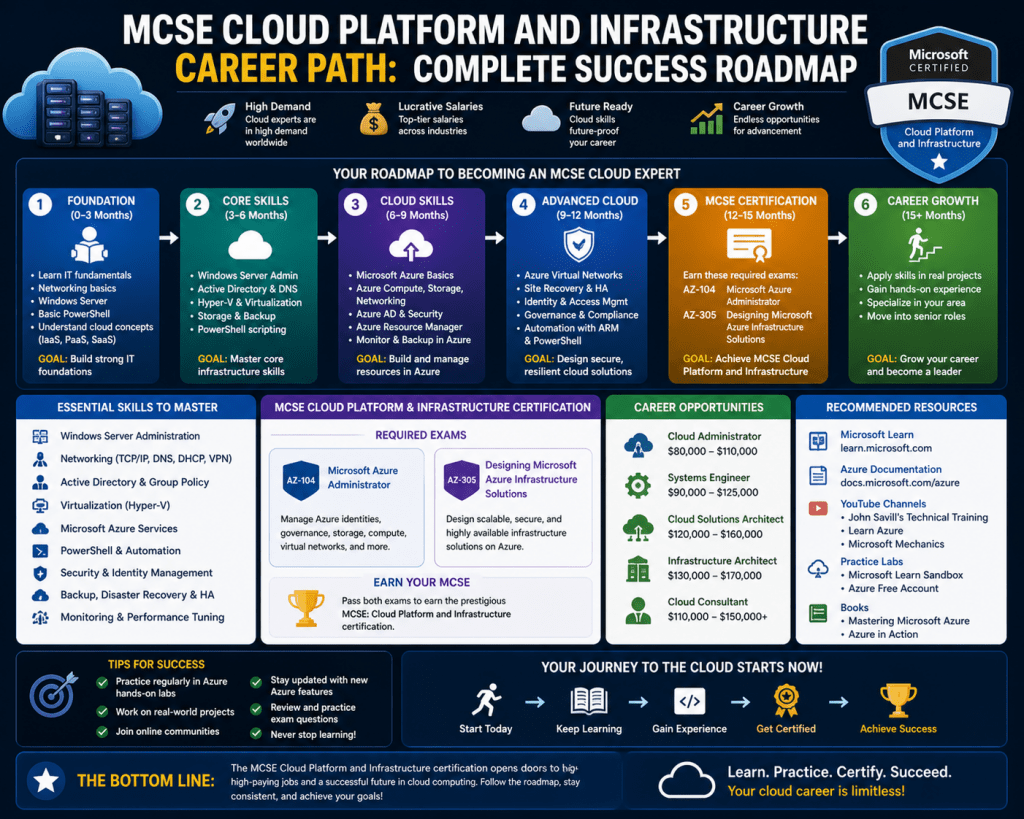
The MCSE Cloud Platform and Infrastructure certification represents an advanced professional benchmark for individuals working in enterprise IT environments where cloud computing, large-scale system administration, virtualization, and secure infrastructure design are central responsibilities. It is positioned at an expert level within a structured certification progression that reflects both technical depth and practical industry experience. The certification is designed for professionals who are expected to manage complex IT ecosystems that combine traditional data center infrastructure with modern cloud-based services. These ecosystems require continuous coordination between servers, virtual machines, identity systems, and network layers, all of which must operate with high reliability and performance.
In modern organizations, IT infrastructure is no longer limited to physical servers hosted on-site. Instead, most environments operate as hybrid systems that combine private infrastructure with public cloud platforms. This shift has created a demand for professionals who understand how to design and manage distributed systems that can scale dynamically based on workload requirements. The MCSE Cloud Platform and Infrastructure certification reflects this demand by focusing on the ability to integrate cloud services with existing enterprise systems while maintaining operational stability, security, and efficiency.
The certification also plays a role in validating the ability to make architectural decisions that affect long-term system performance. Professionals at this level are often involved in planning infrastructure strategies, selecting appropriate technologies, and ensuring that systems are aligned with organizational goals. This includes evaluating workload distribution, optimizing resource utilization, and ensuring that infrastructure components are designed for resilience and scalability.
Role of cloud and infrastructure skills in modern digital enterprises
Cloud and infrastructure skills have become essential in modern digital enterprises due to the increasing reliance on distributed computing environments. Organizations across industries depend on cloud-based systems for data storage, application hosting, communication services, and business analytics. These systems require skilled professionals who can manage both the physical and virtual components of IT infrastructure.
A key aspect of cloud infrastructure management involves understanding how resources are allocated and optimized across different environments. This includes managing virtual machines, configuring storage systems, and ensuring that applications can scale according to demand. Professionals must also ensure that systems remain secure by implementing identity management controls and access policies that protect sensitive data.
Networking plays a significant role in cloud environments, as systems must communicate efficiently across multiple platforms. This requires knowledge of routing, network segmentation, and traffic optimization. Infrastructure professionals are responsible for ensuring that data flows securely and efficiently between users, applications, and services.
Another important aspect is system reliability. Enterprises depend on the continuous availability of services, which means infrastructure must be designed with redundancy and fault tolerance in mind. This includes implementing backup systems, disaster recovery strategies, and monitoring tools that detect and resolve issues before they impact business operations.
Automation is also a critical component of modern infrastructure management. By automating routine tasks such as system updates, resource provisioning, and monitoring, organizations can improve efficiency and reduce the risk of human error. This allows IT teams to focus on higher-level strategic tasks such as system optimization and architecture design.
Certification pathway and foundational knowledge requirements
The pathway to achieving expert-level infrastructure certification begins with building a strong foundation in core IT principles. This includes understanding operating systems, networking fundamentals, server administration, and basic cloud computing concepts. These foundational skills are typically developed through associate-level certifications that focus on practical, hands-on experience.
At the foundational stage, learners gain experience in configuring and managing basic IT environments. This includes setting up servers, managing user accounts, configuring network connections, and understanding how data flows within a system. These skills are essential because they form the basis for more advanced infrastructure concepts.
As learners progress, they begin to explore more complex topics such as virtualization, hybrid cloud environments, and identity management systems. Virtualization allows multiple operating systems to run on a single physical machine, improving resource efficiency and scalability. Hybrid cloud environments require professionals to manage workloads across both on-premise and cloud systems, ensuring seamless integration and performance consistency.
Identity management becomes increasingly important at this stage, as organizations must ensure that only authorized users have access to specific systems and data. This involves configuring authentication systems, managing user permissions, and implementing security policies that protect organizational resources.
Once foundational knowledge is established, professionals can advance to expert-level training that focuses on designing and managing large-scale infrastructure systems. This includes working with enterprise cloud platforms, optimizing network performance, and implementing advanced security measures.
Evolution of enterprise data centers and hybrid systems
Enterprise data centers have undergone significant transformation over the past decade. Traditional data centers were primarily physical environments where organizations hosted their servers and storage systems. These environments required significant investment in hardware, maintenance, and physical security.
With the introduction of cloud computing, the structure of data centers has evolved into more flexible and scalable systems. Modern enterprises now rely on hybrid environments that combine on-premise infrastructure with cloud-based resources. This allows organizations to scale their operations more efficiently while reducing infrastructure costs.
Hybrid systems require careful coordination between different environments to ensure consistent performance and security. This includes managing data replication between cloud and local systems, ensuring secure communication channels, and maintaining system synchronization.
The evolution of data centers has also introduced new challenges related to system management and monitoring. IT professionals must now manage distributed systems that span multiple geographic locations and cloud platforms. This requires advanced knowledge of infrastructure design and system integration techniques.
Core technologies in cloud platform and infrastructure management
Several core technologies form the foundation of modern cloud platform and infrastructure management. Cloud computing is one of the most important components, enabling organizations to access scalable computing resources without relying solely on physical hardware. This includes infrastructure as a service, platform services, and virtualized computing environments.
Virtualization technology allows multiple virtual systems to run on a single physical server. This improves resource utilization and enables organizations to deploy applications more efficiently. Virtual machines can be created, modified, and deleted as needed, providing flexibility in system management.
Identity and access management systems are critical for maintaining security within IT environments. These systems ensure that users are properly authenticated and authorized before accessing organizational resources. They also help enforce security policies and protect sensitive data from unauthorized access.
Networking technologies play a central role in connecting different components of the IT infrastructure. This includes configuring routers, switches, and firewalls to ensure secure and efficient communication between systems. Network optimization is essential for maintaining performance in large-scale environments.
Storage systems are another key component, responsible for managing how data is stored, accessed, and protected. Modern storage solutions often include distributed storage systems that provide high availability and redundancy.
Monitoring and automation tools are also essential in infrastructure management. These tools allow IT professionals to track system performance, identify issues, and automate routine tasks. This improves operational efficiency and reduces system downtime.
Career roles and responsibilities in infrastructure environments
Professionals with advanced infrastructure expertise typically work in roles that require both technical knowledge and problem-solving skills. System administrators are responsible for maintaining server environments, managing updates, and ensuring system stability. They play a key role in day-to-day IT operations.
Network administrators focus on managing communication systems within an organization. This includes configuring network devices, monitoring traffic, and resolving connectivity issues. Their work ensures that data flows efficiently across systems.
Network engineers are responsible for designing and implementing network architectures. They focus on building scalable and secure networks that support organizational growth. Their work often involves planning long-term infrastructure strategies.
Systems engineers integrate different components of the IT infrastructure to ensure seamless operation. They work with both hardware and software systems to create unified environments that support business processes.
IT managers oversee infrastructure teams and ensure that technical operations align with organizational goals. They are responsible for planning, coordinating, and managing IT projects while ensuring system reliability.
Support specialists assist users with technical issues and ensure that systems function properly on a daily basis. They play an important role in maintaining operational continuity within organizations.
Importance of continuous development in infrastructure careers
The field of IT infrastructure is constantly evolving, making continuous professional development essential for long-term career success. New technologies, tools, and security practices are regularly introduced, requiring professionals to stay updated with industry changes.
Cloud platforms are frequently updated with new features that improve scalability, security, and performance. Infrastructure professionals must understand these updates to effectively manage enterprise systems. Similarly, advancements in automation and orchestration tools continue to change how IT environments are managed.
Security remains a critical focus area, as cyber threats continue to evolve. Professionals must stay informed about new security vulnerabilities and best practices for protecting infrastructure systems. This includes implementing updated authentication methods and monitoring systems for potential threats.
Continuous learning also enables professionals to adapt to changing job roles and responsibilities. As organizations adopt more advanced technologies, infrastructure roles become more specialized and strategic. Professionals who continue developing their skills are better positioned to take on advanced responsibilities and leadership roles within IT environments.
Mcse cloud platform and infrastructure advanced certification structure and progression
The MCSE Cloud Platform and Infrastructure certification represents an advanced stage in professional IT development, focusing on the ability to design, implement, and manage complex enterprise systems that integrate cloud computing with traditional on-premise infrastructure. This level of certification is built on the expectation that professionals already possess strong foundational knowledge in networking, system administration, virtualization, and cloud concepts. At this stage, the focus shifts from basic operational tasks to architectural thinking, system optimization, and enterprise-level decision making.
The certification structure is designed to reflect real-world IT environments where multiple systems interact simultaneously. These environments often include hybrid cloud deployments, identity management systems, distributed storage architectures, and automated deployment pipelines. Professionals are expected to understand how these components interact and how to maintain stability across all layers of infrastructure. The progression toward this certification is not linear but layered, meaning learners build upon previous knowledge while gradually expanding into more complex technical domains.
A defining feature of this certification level is its emphasis on scenario-based problem solving. Rather than focusing solely on memorization of technical concepts, candidates are evaluated on their ability to apply knowledge in realistic enterprise situations. This includes troubleshooting system failures, optimizing cloud resource usage, and designing scalable infrastructure solutions that align with business requirements.
The certification also reflects a shift in IT industry expectations. Modern infrastructure professionals are no longer just system maintainers; they are system designers and strategists. They must be able to evaluate organizational needs, predict system demands, and create infrastructure solutions that support long-term growth.
Deep integration of cloud computing into enterprise architecture
Cloud computing has become a foundational element of modern enterprise architecture. Organizations rely on cloud platforms to deliver scalable computing power, storage capacity, and application hosting services. This integration has transformed the role of infrastructure professionals, requiring them to manage systems that are no longer confined to physical data centers.
In enterprise environments, cloud computing is used to support a wide range of workloads, including web applications, databases, analytics platforms, and communication systems. These workloads must be carefully managed to ensure performance efficiency and cost optimization. Infrastructure professionals must understand how to allocate cloud resources dynamically based on demand patterns.
One of the most important aspects of cloud integration is elasticity. Systems must be able to scale up or down depending on usage requirements. This requires a deep understanding of load balancing, resource provisioning, and automated scaling mechanisms. Professionals must also ensure that scaling operations do not compromise system stability or security.
Another critical component is workload distribution. In hybrid environments, workloads may be split between on-premise servers and cloud platforms. This requires careful planning to ensure that data flows efficiently between environments and that latency is minimized. Infrastructure professionals must design systems that optimize performance while maintaining data consistency.
Security is also deeply integrated into cloud architecture. As data moves between systems, it must be protected through encryption, identity management, and access control mechanisms. Professionals must ensure that security policies are consistently applied across all environments.
Hybrid infrastructure design and operational complexity
Hybrid infrastructure represents one of the most complex aspects of modern IT environments. It involves the integration of on-premise systems with cloud-based platforms, creating a unified but distributed architecture. This design allows organizations to maintain legacy systems while gradually adopting cloud technologies.
Managing hybrid infrastructure requires a deep understanding of system interoperability. Different platforms often use different technologies, protocols, and configurations. Infrastructure professionals must ensure that these systems can communicate effectively without introducing performance bottlenecks or security vulnerabilities.
Data synchronization is a critical challenge in hybrid environments. Organizations must ensure that data remains consistent across both cloud and local systems. This requires implementing replication strategies, backup systems, and synchronization tools that maintain data integrity.
Latency management is another important consideration. Because hybrid systems span multiple environments, data must often travel long distances between servers. Infrastructure professionals must design networks that minimize latency and ensure fast response times for end users.
Operational complexity increases significantly in hybrid environments due to the number of components involved. Monitoring tools must be capable of tracking performance across multiple platforms simultaneously. This includes monitoring server health, network traffic, storage usage, and application performance.
Automation plays a key role in managing this complexity. By automating routine tasks such as system updates, resource allocation, and performance monitoring, organizations can reduce operational overhead and improve system reliability.
Advanced networking concepts in enterprise environments
Networking is a core component of enterprise infrastructure and becomes significantly more complex at the advanced certification level. Modern networks must support high volumes of traffic, secure communication channels, and seamless connectivity between distributed systems.
One of the key concepts in advanced networking is segmentation. Networks are divided into smaller segments to improve performance and enhance security. Each segment can be configured with specific access controls and performance parameters, allowing organizations to isolate critical systems from general traffic.
Routing optimization is another important area. Data must be efficiently routed between different systems and environments. Infrastructure professionals must understand how routing protocols work and how to configure them for optimal performance.
Network security is a major focus in enterprise environments. Firewalls, intrusion detection systems, and encryption technologies are used to protect data as it moves across networks. Professionals must ensure that security configurations are properly implemented and regularly updated.
Bandwidth management is also essential in large-scale environments. Organizations must allocate network resources efficiently to prevent congestion and ensure consistent performance. This includes prioritizing critical applications and limiting unnecessary traffic.
Cloud networking introduces additional complexity, as virtual networks must be configured to interact with physical infrastructure. This requires an understanding of virtual networking technologies and how they integrate with traditional network systems.
Identity and access management in distributed systems
Identity and access management is a critical component of enterprise infrastructure security. It ensures that only authorized users can access specific systems and resources. In distributed environments, this becomes even more complex due to the number of systems involved.
Authentication systems are used to verify user identities before granting access. These systems may include multi-factor authentication methods that enhance security by requiring multiple forms of verification.
Authorization determines what resources a user can access after authentication. This involves assigning roles and permissions based on job responsibilities and organizational policies.
In hybrid environments, identity management systems must operate across both cloud and on-premise platforms. This requires synchronization of user accounts and access policies to ensure consistency.
Single sign-on systems are often implemented to simplify user access across multiple applications. This allows users to authenticate once and gain access to multiple systems without repeated login processes.
Security auditing is also an important aspect of identity management. Organizations must track user activity to detect unauthorized access attempts and ensure compliance with security policies.
Virtualization and resource optimization strategies
Virtualization is a foundational technology in modern infrastructure management. It allows multiple virtual systems to run on a single physical machine, improving resource utilization and reducing hardware costs.
Virtual machines can be created, modified, and managed independently of physical hardware. This provides flexibility in system deployment and allows organizations to scale their infrastructure quickly.
Resource allocation is a key aspect of virtualization. Infrastructure professionals must ensure that virtual machines are assigned appropriate levels of CPU, memory, and storage resources based on workload requirements.
Load balancing is often used in virtualized environments to distribute workloads evenly across multiple systems. This helps prevent system overload and improves performance stability.
Snapshots and backups are important features of virtualization systems. They allow administrators to capture system states and restore them in case of failure.
Virtualization also supports testing and development environments. Developers can create isolated environments without affecting production systems, improving efficiency and reducing risk.
Storage architecture and data management systems
Storage systems play a critical role in enterprise infrastructure by managing how data is stored, accessed, and protected. Modern storage architectures are designed to handle large volumes of data while ensuring high availability and performance.
Distributed storage systems are commonly used in enterprise environments. These systems spread data across multiple storage nodes to improve redundancy and reliability.
Data replication ensures that copies of data are maintained across different locations. This protects against data loss in case of system failure.
Storage optimization techniques are used to improve performance and reduce costs. This includes data compression, deduplication, and tiered storage strategies.
Backup systems are essential for disaster recovery. They ensure that data can be restored in case of system failure or data corruption.
Cloud storage integration allows organizations to extend their storage capacity using external cloud resources. This provides scalability and flexibility in data management.
Monitoring, automation, and system performance optimization
Monitoring systems are essential for maintaining infrastructure health. They track system performance, detect anomalies, and provide alerts when issues occur.
Performance monitoring includes tracking CPU usage, memory consumption, network traffic, and storage utilization. This helps identify potential bottlenecks before they impact system performance.
Automation tools are used to streamline repetitive tasks such as system updates, resource provisioning, and backup management. This reduces operational workload and improves efficiency.
System optimization involves analyzing performance data and making adjustments to improve efficiency. This may include reconfiguring resources, optimizing network settings, or upgrading infrastructure components.
Predictive analytics is increasingly being used to anticipate system failures and performance issues. This allows organizations to take proactive measures before problems occur.
Security frameworks and risk management in infrastructure systems
Security is a fundamental aspect of enterprise infrastructure. Organizations must implement comprehensive security frameworks to protect systems from internal and external threats.
Risk management involves identifying potential vulnerabilities and implementing measures to mitigate them. This includes regular security assessments and system audits.
Encryption is used to protect data both at rest and in transit. This ensures that sensitive information cannot be accessed by unauthorized users.
Access control policies define who can access specific systems and resources. These policies must be regularly reviewed and updated.
Incident response strategies are used to handle security breaches. This includes identifying the source of the breach, containing the damage, and restoring affected systems.
Compliance requirements also play a role in infrastructure security. Organizations must ensure that their systems meet regulatory standards and industry best practices.
MCSE Cloud Platform and Infrastructure: Real-World Enterprise Deployment Scenarios
The MCSE Cloud Platform and Infrastructure certification ultimately represents the ability to apply advanced technical knowledge in real enterprise environments where systems are large, interconnected, and continuously evolving. At this level, professionals are expected to move beyond theoretical understanding and focus on practical implementation of infrastructure solutions that support business continuity, scalability, and security. Enterprise deployment scenarios typically involve complex combinations of cloud platforms, on-premise servers, identity systems, networking layers, and automation frameworks working together as a single ecosystem.
In real-world environments, infrastructure deployment begins with requirement analysis. Organizations first identify business goals such as improving system performance, reducing operational costs, or increasing the availability of services. These goals are then translated into technical requirements that guide infrastructure design. Professionals at the MCSE level are responsible for interpreting these requirements and creating solutions that align with both technical and business objectives.
Deployment scenarios often involve hybrid environments where legacy systems must coexist with modern cloud services. This requires careful planning to ensure compatibility between different platforms. For example, older applications hosted on physical servers may need to interact with cloud-based databases or virtual machines. Ensuring seamless communication between these systems is a critical responsibility of infrastructure professionals.
Another important aspect of enterprise deployment is scalability planning. Systems must be designed to handle varying workloads without performance degradation. This involves configuring load-balancing mechanisms, designing distributed architectures, and implementing auto-scaling strategies that adjust resources based on demand.
Cloud integration strategies in large-scale systems
Cloud integration is one of the most important components of modern enterprise infrastructure. Organizations rarely operate entirely in the cloud or entirely on-premise; instead, they use a combination of both to maximize flexibility and efficiency. This hybrid approach requires structured integration strategies to ensure seamless operation.
One key strategy involves workload distribution. Applications and services are divided between cloud environments and local systems based on performance requirements, security considerations, and cost efficiency. Critical workloads may remain on-premises for security reasons, while less sensitive workloads are migrated to cloud platforms for scalability.
Data integration is another critical component. Enterprises must ensure that data flows consistently between systems without duplication or loss. This requires synchronization mechanisms that maintain data integrity across multiple environments.
API-based integration is widely used in modern systems to enable communication between different platforms. APIs allow applications to exchange data and functionality without requiring direct access to underlying systems. This improves flexibility and simplifies system management.
Cloud integration also involves identity federation, where user authentication is shared across multiple systems. This allows users to access different platforms using a single identity, improving usability and security.
Infrastructure automation and orchestration in enterprise environments
Automation has become a defining feature of modern infrastructure management. In large-scale enterprise environments, manual system administration is no longer efficient due to the complexity and size of IT systems. Automation allows organizations to streamline operations, reduce human error, and improve consistency.
Infrastructure automation involves the use of scripts and tools to perform repetitive tasks such as system provisioning, configuration management, and software deployment. This ensures that systems are configured consistently across environments.
Orchestration takes automation a step further by coordinating multiple automated processes into a unified workflow. For example, deploying a new application may involve provisioning virtual machines, configuring network settings, setting up storage, and deploying software components. Orchestration tools manage these steps in a coordinated sequence.
Automation also plays a key role in system monitoring. Automated alerts can notify administrators of performance issues, security threats, or system failures. This allows for faster response times and reduces downtime.
Configuration management is another important aspect of automation. It ensures that system configurations remain consistent across all environments. This reduces the risk of configuration drift, where systems become inconsistent over time.
Advanced troubleshooting and system optimization techniques
Troubleshooting in enterprise infrastructure requires a systematic approach to identifying and resolving issues. Problems in large-scale systems can originate from multiple sources, including network failures, configuration errors, resource constraints, or software bugs.
A key aspect of troubleshooting is root cause analysis. Instead of focusing on symptoms, professionals must identify the underlying cause of system issues. This involves analyzing logs, monitoring system performance, and reviewing configuration settings.
Network troubleshooting is often complex due to the interconnected nature of enterprise systems. Issues such as latency, packet loss, or routing errors can affect multiple services simultaneously. Professionals must use diagnostic tools to trace data flow and identify bottlenecks.
System performance optimization is another critical area. This involves analyzing resource usage and making adjustments to improve efficiency. For example, increasing memory allocation, optimizing database queries, or redistributing workloads can significantly improve system performance.
Storage optimization is also important in large environments. Techniques such as data deduplication, compression, and tiered storage help improve efficiency and reduce costs.
Cloud security implementation and enterprise protection strategies
Security is one of the most important aspects of enterprise infrastructure management. As systems become more distributed and cloud-based, the attack surface increases, requiring more advanced security strategies.
One of the primary security mechanisms is encryption. Data must be encrypted both during transmission and while stored in databases or storage systems. This ensures that even if data is intercepted, it cannot be accessed without proper authorization.
Identity-based security controls are used to restrict access to systems. Only authenticated users with appropriate permissions can access sensitive resources. This is enforced through role-based access control systems.
Network security is implemented using firewalls, intrusion detection systems, and segmentation techniques. These tools help prevent unauthorized access and monitor suspicious activity.
Security monitoring systems continuously analyze system behavior to detect anomalies. If unusual activity is detected, alerts are generated for further investigation.
Compliance management is also an important aspect of security. Organizations must ensure that their infrastructure meets regulatory standards related to data protection and privacy.
Disaster recovery and business continuity planning in enterprise systems
Disaster recovery planning is essential for ensuring that organizations can continue operations in the event of system failures or unexpected disruptions. This involves creating backup systems and recovery strategies that minimize downtime.
Backup systems are used to create copies of critical data that can be restored in case of failure. These backups are often stored in multiple locations to ensure redundancy.
Failover systems automatically switch operations to backup systems when primary systems fail. This helps maintain service availability without manual intervention.
Business continuity planning involves designing infrastructure systems that can withstand disruptions such as hardware failures, cyberattacks, or natural disasters. This requires careful planning and redundancy at multiple levels of the system.
Recovery time objectives and recovery point objectives are used to define acceptable levels of downtime and data loss. These metrics guide the design of disaster recovery strategies.
Testing is a critical part of disaster recovery planning. Systems must be regularly tested to ensure that recovery mechanisms work as expected during real incidents.
Enterprise identity architecture and access governance models
Identity architecture in enterprise systems is designed to manage user identities across multiple platforms and services. This includes authentication, authorization, and identity lifecycle management.
Centralized identity systems allow organizations to manage user accounts from a single location. This improves consistency and simplifies administration.
Access governance ensures that users only have access to the resources they need to perform their roles. This reduces security risks and improves compliance.
Identity federation allows users to access multiple systems using a single identity. This improves user experience and reduces the need for multiple credentials.
Multi-factor authentication is used to enhance security by requiring multiple forms of verification before granting access.
Identity auditing tracks user activity and helps identify unauthorized access attempts or policy violations.
Cloud performance monitoring and optimization frameworks
Monitoring cloud infrastructure is essential for maintaining performance and reliability. Monitoring systems track metrics such as CPU usage, memory consumption, network latency, and application performance.
Performance dashboards provide real-time visibility into system health. This allows administrators to quickly identify and respond to issues.
Alerting systems notify administrators when performance thresholds are exceeded. This helps prevent system failures and downtime.
Optimization frameworks analyze performance data and recommend improvements. This may include adjusting resource allocation, optimizing workloads, or upgrading infrastructure components.
Predictive monitoring uses historical data to forecast potential system issues. This allows organizations to take proactive measures before problems occur.
Emerging trends in cloud infrastructure and enterprise computing
The field of cloud infrastructure continues to evolve rapidly with the introduction of new technologies and methodologies. One major trend is the increasing use of containerization, which allows applications to run in isolated environments that are lightweight and portable.
Serverless computing is another emerging trend that allows organizations to run applications without managing underlying infrastructure. This simplifies deployment and reduces operational overhead.
Artificial intelligence and machine learning are increasingly being integrated into infrastructure management systems. These technologies help automate decision-making and improve system efficiency.
Edge computing is also becoming more important, where data processing is performed closer to the source of data generation. This reduces latency and improves performance for real-time applications.
Infrastructure as code is another important trend that allows infrastructure to be managed using code-based configurations. This improves consistency and enables version control of infrastructure settings.
Strategic role of infrastructure professionals in digital transformation
Infrastructure professionals play a critical role in enabling digital transformation within organizations. They are responsible for designing systems that support new technologies and business models.
Their role involves aligning infrastructure capabilities with business objectives. This includes ensuring that systems are scalable, secure, and capable of supporting innovation initiatives.
They also contribute to strategic decision-making by evaluating new technologies and recommending infrastructure improvements.
As organizations continue to adopt cloud-based systems, the demand for skilled infrastructure professionals continues to grow. Their expertise is essential for ensuring that digital transformation initiatives are successful and sustainable.
Conclusion
The MCSE Cloud Platform and Infrastructure certification represents more than a technical credential; it reflects a structured progression into advanced enterprise IT capability where professionals are expected to operate at a strategic and architectural level. Across modern digital environments, infrastructure is no longer a background function but a core driver of business continuity, scalability, and innovation. This shift has elevated the importance of professionals who can design and manage systems that integrate cloud computing, virtualization, networking, identity management, storage architecture, and automation into unified operational frameworks.
One of the most important takeaways from this certification pathway is the transformation in the role of IT professionals. At earlier stages of learning, individuals typically focus on operational tasks such as configuring systems, managing users, or maintaining basic network connectivity. As expertise develops, responsibilities expand into more complex domains that require analytical thinking and system-wide understanding. At the MCSE level, professionals are expected to design infrastructure solutions rather than simply maintain them. This includes evaluating organizational needs, predicting system growth patterns, and building environments that can adapt to evolving workloads.
Modern enterprise systems are highly dynamic, often spanning multiple environments that include on-premise data centers and cloud platforms. This hybrid structure introduces both opportunities and challenges. On one hand, organizations benefit from scalability, flexibility, and cost efficiency. On the other hand, they must manage increased complexity, especially in areas such as data synchronization, security enforcement, and system interoperability. The certification pathway prepares professionals to address these challenges by developing a deep understanding of how different infrastructure components interact within a distributed system.
A major theme throughout this domain is integration. Cloud platforms are not isolated systems; they are deeply interconnected with identity services, networking frameworks, storage systems, and application layers. Successful infrastructure management requires the ability to ensure seamless communication between these components. This includes designing secure authentication systems, implementing efficient data routing mechanisms, and maintaining consistent performance across all environments. Without proper integration, even advanced systems can suffer from inefficiency, instability, or security vulnerabilities.
Another key aspect is scalability. In modern IT environments, workloads are rarely static. Applications may experience sudden spikes in usage, data volumes may grow rapidly, and business requirements may shift unexpectedly. Infrastructure professionals must design systems that can scale both vertically and horizontally to accommodate these changes. This requires careful planning of resource allocation, load balancing strategies, and automated scaling mechanisms that adjust system capacity based on demand. Scalability is not only a technical requirement but also a business necessity in competitive digital markets.
Security remains one of the most critical concerns in enterprise infrastructure. As systems become more distributed, the number of potential entry points for security threats increases. Professionals must implement layered security strategies that include identity verification, encryption, network segmentation, and continuous monitoring. Identity management plays a particularly important role, ensuring that only authorized users have access to specific resources. At the same time, organizations must maintain compliance with regulatory standards, making security both a technical and governance responsibility.
Automation has also become a defining feature of modern infrastructure environments. Manual system administration is no longer sufficient in large-scale deployments due to the speed and complexity of operations. Automation allows organizations to streamline repetitive tasks such as system provisioning, configuration updates, and performance monitoring. This not only improves efficiency but also reduces the likelihood of human error. Orchestration extends automation by coordinating multiple processes into unified workflows, enabling end-to-end system management with minimal manual intervention.
The evolution of infrastructure roles also highlights the increasing importance of monitoring and optimization. In complex environments, continuous visibility into system performance is essential. Monitoring tools provide real-time insights into resource usage, system health, and application behavior. This data allows professionals to identify inefficiencies, detect anomalies, and implement corrective actions before issues escalate. Optimization strategies based on this data help ensure that systems operate at peak efficiency while minimizing resource waste.
Disaster recovery and business continuity planning further emphasize the importance of resilience in enterprise systems. No infrastructure is immune to failure, whether due to hardware issues, cyber threats, or external disruptions. Professionals must design systems that can recover quickly from failures and maintain essential services during unexpected events. This involves implementing backup strategies, failover mechanisms, and recovery planning that minimize downtime and data loss. Resilience is a fundamental requirement for maintaining trust and reliability in digital services.
The career impact of developing expertise in cloud platform and infrastructure management is significant. Professionals in this field often progress into roles that involve both technical execution and strategic planning. They may become responsible for designing enterprise architectures, leading infrastructure teams, or managing large-scale IT operations. The combination of technical depth and architectural thinking makes these professionals valuable assets in any organization undergoing digital transformation.
At a broader level, the skills associated with this certification are closely aligned with global technology trends. The continued growth of cloud computing, increasing adoption of hybrid environments, and expansion of data-driven applications all contribute to rising demand for infrastructure expertise. Emerging technologies such as containerization, edge computing, and infrastructure as code further expand the scope of responsibilities for IT professionals, requiring continuous learning and adaptation.
Ultimately, the MCSE Cloud Platform and Infrastructure pathway reflects the evolution of IT from a support function into a strategic enabler of business success. Professionals who pursue this path develop the ability to manage complexity, ensure system reliability, and support innovation at scale. Their work directly impacts organizational performance, digital transformation efforts, and long-term technological resilience in an increasingly connected world.