
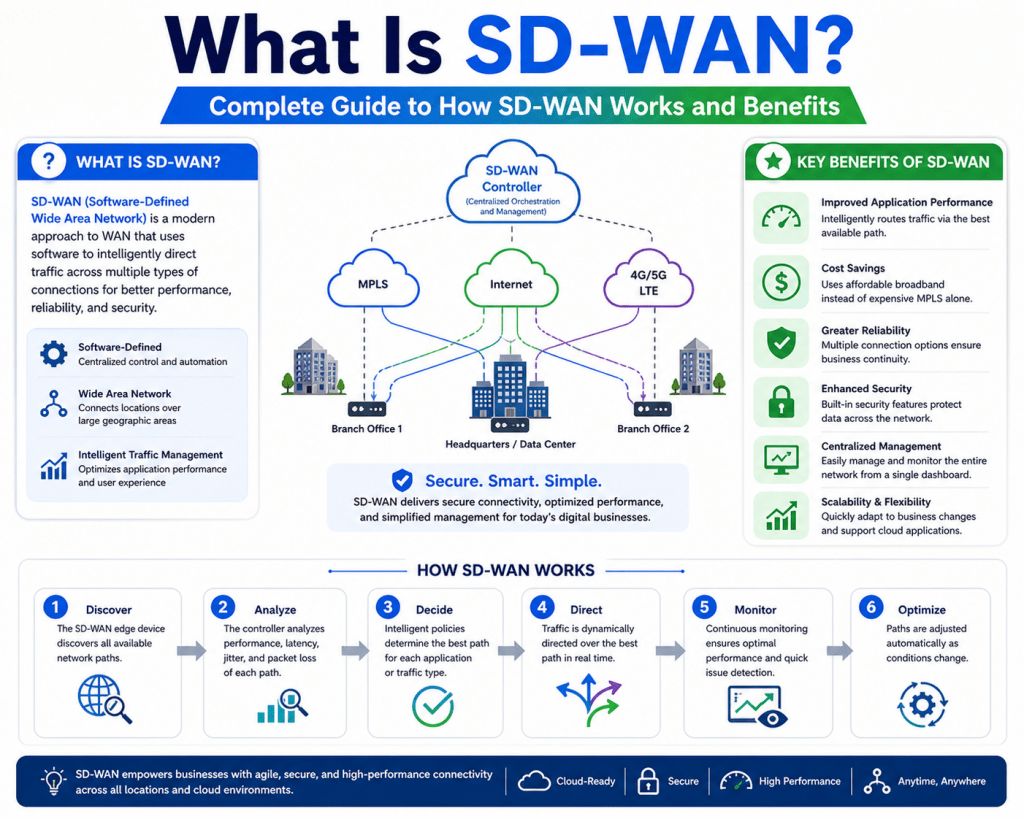
Software-defined wide area networking is a modern approach to building and managing enterprise connectivity that replaces rigid, hardware-dependent networking models with flexible, software-driven control. In traditional enterprise environments, wide area networks were built using fixed configurations where each branch office connected to central data centers through dedicated circuits. These setups often relied on expensive leased lines and required manual configuration for every change in routing or policy. SD-WAN transforms this model by introducing abstraction between network hardware and the intelligence that controls it. Instead of manually configuring each router, organizations define centralized policies that determine how traffic should move across different transport links. This allows enterprises to adapt quickly to changing demands such as cloud migration, remote work expansion, and increased reliance on distributed applications. The result is a more responsive, efficient, and scalable networking model that aligns with modern digital infrastructure requirements.
Evolution from Traditional WAN to Software-Defined Connectivity
The evolution from traditional WAN architecture to SD-WAN is closely tied to the rise of cloud computing and distributed application delivery. Earlier WAN designs were built around the assumption that most applications and services would reside in centralized data centers. Branch offices were considered extensions of this central environment, and all traffic was typically routed back to headquarters for processing and security inspection. While this design worked in stable, predictable environments, it struggled when internet-based applications became dominant. As organizations began adopting cloud platforms, software-as-a-service tools, and remote collaboration systems, the limitations of backhaul-based routing became more apparent. High latency, bandwidth inefficiencies, and rising operational costs forced businesses to rethink their network strategies. SD-WAN emerged as a solution that allows traffic to be intelligently distributed across multiple paths, reducing reliance on centralized routing and enabling direct access to cloud services from branch locations.
Core Architecture of Software-Defined WAN Systems
The architecture of SD-WAN is built on a separation of responsibilities that divides the system into logical components rather than tightly coupled hardware functions. At a high level, the architecture consists of centralized controllers and distributed edge devices. The controllers manage configuration, policy enforcement, and network visibility, while edge devices handle actual data forwarding at branch locations and remote sites. This separation allows organizations to maintain centralized control while enabling distributed execution. The architecture supports multiple transport types, including broadband internet, MPLS, LTE, and satellite connections. Each link is continuously monitored to assess performance metrics such as latency, jitter, and packet loss. Based on these measurements, traffic is dynamically assigned to the most suitable path. This architectural flexibility allows enterprises to optimize both cost and performance simultaneously, which is difficult to achieve in traditional WAN environments.
Control Plane Functionality in SD-WAN Networks
The control plane serves as the decision-making layer within the SD-WAN architecture. It is responsible for defining how traffic should be handled across the network based on predefined policies and real-time conditions. Unlike traditional networking systems, where routing decisions are distributed across individual devices, SD-WAN centralizes this intelligence within a controller framework. Administrators configure policies that define application priorities, security rules, and path selection criteria. The control plane then distributes these policies to edge devices, ensuring consistent behavior across all locations. It also continuously evaluates network conditions and adjusts routing decisions dynamically. This allows the system to respond to congestion, link failures, or performance degradation without manual intervention. The centralized nature of the control plane significantly reduces operational complexity and improves scalability in large enterprise environments.
Data Plane Operation and Traffic Forwarding Behavior
The data plane is responsible for executing the instructions provided by the control plane. It handles the actual movement of packets across the network and is implemented within SD-WAN edge devices. These devices inspect incoming traffic, apply security policies, and determine the appropriate forwarding path based on controller instructions. The data plane supports multiple simultaneous connections, allowing traffic to be distributed across different transport links depending on application requirements. For example, latency-sensitive applications such as voice or video conferencing may be routed through the lowest-latency path, while bulk data transfers may use more cost-effective broadband connections. The separation of data forwarding from control logic reduces processing overhead on edge devices and improves overall network efficiency. It also ensures that changes in policy do not require manual reconfiguration of individual devices.
Role and Function of SD-WAN Edge Devices
Edge devices are deployed at branch offices, remote locations, and sometimes within cloud environments to serve as the entry and exit points for network traffic. These devices replace traditional routers and are designed to operate under centralized management. Once installed, they establish secure connections to the SD-WAN controller and automatically receive configuration profiles. Edge devices are capable of performing multiple functions, including traffic encryption, application identification, performance monitoring, and intelligent path selection. They continuously analyze network conditions and adjust traffic flows according to policy definitions. This allows organizations to maintain consistent application performance even in environments with variable connectivity quality. Edge devices also support redundancy features, enabling seamless failover between multiple transport links when necessary.
Centralized Management and Policy-Based Network Control
Centralized management is one of the defining characteristics of SD-WAN technology. Instead of configuring each network device individually, administrators define global policies that are applied across the entire network infrastructure. These policies determine how different types of traffic should be treated under various conditions. For instance, critical business applications can be prioritized over less important background traffic, ensuring optimal performance for essential services. Policy-based control also simplifies network expansion, as new locations can be integrated by applying existing templates rather than manually configuring each device. This reduces deployment time and minimizes configuration errors. Centralized management also provides a unified view of network performance, enabling better monitoring and troubleshooting capabilities across distributed environments.
Deployment Models and Infrastructure Flexibility
SD-WAN can be deployed using multiple models depending on organizational requirements and existing infrastructure. In some cases, enterprises choose on-premises deployment where controllers are hosted within private data centers. This provides maximum control but requires additional maintenance effort. Alternatively, cloud-based deployment models place controllers within public cloud environments, offering greater scalability and reduced infrastructure overhead. Hybrid models combine both approaches, allowing organizations to distribute control functions across multiple environments for redundancy and performance optimization. Edge devices can also be deployed as physical appliances or virtual instances,s depending on performance needs. This flexibility allows businesses to adopt SD-WAN without completely replacing existing infrastructure, making it easier to transition from traditional WAN architectures.
Interaction Between Multiple Transport Links in SD-WAN
SD-WAN environments are designed to utilize multiple transport links simultaneously rather than relying on a single connection type. These links may include MPLS circuits, broadband internet, LTE networks, or other available connectivity options. The system continuously evaluates the quality of each link and assigns traffic based on performance requirements. This approach allows organizations to balance cost and performance effectively. High-priority applications can be routed through reliable, low-latency connections, while less critical traffic uses more economical links. If a primary connection experiences degradation or failure, traffic is automatically rerouted through alternative paths without disrupting application performance. This dynamic multi-path approach enhances network resilience and improves overall service availability.
Automation and Zero-Touch Provisioning in SD-WAN Environments
Automation plays a significant role in simplifying SD-WAN deployment and management. One of the key automation features is zero-touch provisioning, which allows new devices to be deployed without manual configuration. Once an edge device is connected to the network, it automatically communicates with the central controller, retrieves its configuration, and integrates into the existing topology. This eliminates the need for on-site technical expertise during deployment. Automation also extends to policy updates and network adjustments, which can be applied globally and instantly across all devices. This reduces operational workload and ensures consistency across large-scale deployments. Automated workflows also help in maintaining compliance with organizational policies and security standards.
Security Integration Within SD-WAN Architecture
Security is embedded directly into SD-WAN architecture rather than being treated as an external component. Traffic is encrypted across all transport paths, ensuring data protection regardless of whether it travels over private or public networks. SD-WAN systems also support segmentation, allowing organizations to isolate different types of traffic based on security requirements. This reduces the risk of unauthorized access and limits potential exposure in case of a breach. Additionally, security policies can be enforced at the edge, providing real-time inspection and filtering of network traffic. By integrating security into the networking layer, SD-WAN reduces the need for multiple standalone security appliances and creates a more unified and manageable infrastructure.
SD-WAN Traffic Engineering and Intelligent Path Selection
SD-WAN introduces a major shift in how enterprise traffic is engineered across wide area networks by moving away from static routing rules and replacing them with dynamic, policy-driven path selection. In traditional WAN environments, routing decisions are often based on fixed metrics or manually configured preferences, which do not adapt well to changing network conditions. SD-WAN continuously evaluates all available transport links in real time and makes decisions based on performance indicators such as latency, jitter, packet loss, and bandwidth availability. This allows applications to be mapped to the most appropriate path at any given moment, rather than being locked into a predefined circuit. For example, a video conferencing application can be automatically routed through a low-latency broadband connection during peak hours, while bulk data replication might be assigned to a higher-capacity but less responsive link. This adaptive behavior ensures that application performance remains stable even when underlying network conditions fluctuate. The system’s ability to make granular decisions at the application level represents a significant advancement over traditional IP routing models, which treat traffic more generically.
Application Awareness and Traffic Classification in SD-WAN Systems
One of the defining capabilities of SD-WAN is its ability to identify and classify traffic based on applications rather than just IP addresses or ports. This application-aware approach allows the network to understand what kind of traffic is being transmitted and apply appropriate policies accordingly. SD-WAN systems use deep packet inspection and behavioral analysis to recognize applications such as collaboration tools, cloud storage platforms, enterprise resource planning systems, and streaming services. Once identified, each application can be assigned a priority level and a routing preference. Critical business applications may be given priority access to high-performance links, while non-essential traffic is routed through cost-efficient paths. This classification also enables better bandwidth allocation, ensuring that high-priority services are not negatively impacted by lower-priority background traffic. Application awareness is particularly important in modern environments where multiple cloud-based services operate simultaneously, often competing for network resources. By understanding the nature of each application, SD-WAN ensures more efficient and predictable network behavior.
Policy-Driven Routing and Network Behavior Control
Policy-driven routing is at the core of SD-WAN functionality and replaces traditional manual routing configurations with centralized, software-defined rules. These policies determine how traffic should be handled under different conditions, including link performance changes, application type, security requirements, and business priorities. Administrators define high-level rules that are then automatically enforced across all edge devices in the network. For example, a policy might specify that financial applications must always use secure, low-latency connections, while web browsing traffic can be routed over public internet links. Another policy may define failover behavior, ensuring that traffic is automatically redirected when a primary link becomes unavailable. This level of control allows organizations to align network behavior directly with business objectives rather than technical constraints. Policy-driven routing also simplifies network management by eliminating the need to manually configure routing tables on individual devices. Instead, changes can be made centrally and propagated instantly across the entire infrastructure.
Cloud Integration and Direct-to-Cloud Connectivity Models
As organizations increasingly adopt cloud-based services, SD-WAN plays a critical role in optimizing connectivity between branch locations and cloud platforms. Traditional WAN architectures often route cloud-bound traffic through centralized data centers, creating unnecessary latency and inefficiency. SD-WAN enables direct-to-cloud connectivity, allowing branch offices to connect directly to cloud applications through the most optimal path. This reduces dependency on backhaul routing and improves application performance significantly. SD-WAN systems can also maintain multiple optimized paths to different cloud environments, ensuring redundancy and resilience. In multi-cloud strategies, where organizations use more than one cloud provider, SD-WAN intelligently distributes traffic based on performance, cost, and availability. This flexibility is essential for modern enterprises that rely heavily on SaaS platforms and distributed infrastructure. By enabling direct cloud access, SD-WAN reduces latency, improves user experience, and enhances overall network efficiency.
Hybrid WAN Architectures and Multi-Transport Utilization
SD-WAN supports hybrid WAN architectures that combine multiple types of connectivity into a single unified network. These may include MPLS circuits, broadband internet, cellular networks, and private leased lines. Instead of relying on a single transport method, SD-WAN aggregates all available links and uses them dynamically based on application requirements. This multi-transport approach allows organizations to balance cost and performance more effectively. Expensive private circuits can be reserved for mission-critical applications, while lower-cost internet connections handle general traffic. Cellular connectivity can be used as a backup or for temporary deployments in remote locations. The ability to seamlessly integrate different transport types provides significant flexibility and resilience. If one link experiences degradation or failure, SD-WAN automatically shifts traffic to alternative paths without disrupting service. This ensures continuous connectivity and reduces downtime risk in enterprise environments.
Load Balancing and Network Optimization Techniques
Load balancing in SD-WAN environments is performed dynamically and continuously based on real-time network conditions. Unlike traditional load balancing methods that distribute traffic evenly regardless of performance, SD-WAN uses intelligent algorithms to distribute traffic based on link quality and application requirements. This means that two links with the same bandwidth may be used differently depending on their latency or reliability. For example, a link with higher latency but stable throughput may be used for file transfers, while a low-latency but variable link may be reserved for real-time communication. This intelligent distribution ensures that network resources are used efficiently and that performance-sensitive applications receive optimal treatment. SD-WAN systems also adjust load balancing decisions in real time as conditions change, preventing congestion and improving overall user experience. This continuous optimization is essential in environments with fluctuating traffic patterns and diverse application demands.
Role of SD-WAN in Remote Work and Distributed Workforce Models
The rise of remote work has significantly increased the importance of SD-WAN in enterprise networking strategies. Traditional WAN architectures were not designed to support large numbers of remote users accessing cloud-based applications from multiple locations. SD-WAN addresses this challenge by extending enterprise network policies to remote endpoints, ensuring consistent connectivity regardless of user location. Remote devices can connect through secure tunnels that are automatically optimized for performance and security. This allows employees working from home or remote offices to access corporate applications with the same level of performance and protection as those in physical office environments. SD-WAN also supports secure internet breakout at remote locations, enabling users to access cloud services directly without routing traffic through centralized data centers. This reduces latency and improves application responsiveness, which is especially important for collaboration and productivity tools.
Security Enforcement and Encrypted Traffic Transport
Security within SD-WAN environments is deeply integrated into the network fabric rather than being applied as a separate layer. All traffic between SD-WAN edge devices is typically encrypted using secure tunneling protocols, ensuring confidentiality and integrity regardless of the transport medium. This is particularly important when using public internet connections, which are inherently less secure than private circuits. SD-WAN also supports identity-based security policies that control access based on user roles, device types, and application contexts. Traffic segmentation allows different types of data to be isolated within the same physical network, reducing the risk of lateral movement in case of compromise. Security policies can be applied consistently across all locations through centralized management, ensuring uniform protection across distributed environments. In addition, SD-WAN systems often include built-in threat detection capabilities that monitor traffic patterns and identify suspicious activity in real time.
High Availability and Network Resilience Strategies
High availability is a critical requirement for modern enterprise networks, and SD-WAN addresses this through redundant paths and automatic failover mechanisms. Each branch location typically connects to multiple transport links, ensuring that traffic can be rerouted instantly if one link fails. The system continuously monitors link health and performance, allowing it to detect issues before they result in outages. When degradation is detected, traffic is automatically shifted to healthier paths without manual intervention. This improves overall network resilience and reduces downtime. SD-WAN controllers themselves are often deployed in redundant configurations across multiple locations or cloud environments to ensure continuous availability. This distributed architecture ensures that no single point of failure can disrupt network operations. High availability is further enhanced by load-balancing and path-optimization mechanisms that distribute traffic efficiently across all available resources.
Scalability and Network Expansion in SD-WAN Environments
Scalability is one of the strongest advantages of SD-WAN architecture, allowing organizations to expand their networks quickly without significant infrastructure changes. Adding a new branch location typically involves deploying an edge device that automatically connects to the SD-WAN controller and retrieves its configuration. This eliminates the need for manual setup and reduces deployment time significantly. As organizations grow, additional locations can be integrated seamlessly into the existing network without redesigning the architecture. Centralized management ensures that new sites automatically inherit existing policies and security configurations. This scalability extends to cloud environments as well, where additional virtual instances can be deployed on demand to support increasing workloads. SD-WAN’s modular design makes it suitable for both small organizations with a few branches and large enterprises with global networks.
Operational Efficiency and Reduction of Network Complexity
SD-WAN significantly reduces operational complexity by centralizing management and automating routine tasks. Traditional networks require manual configuration of individual devices, which becomes increasingly difficult as the network grows. SD-WAN eliminates much of this complexity by allowing administrators to define high-level policies that are automatically applied across the entire infrastructure. This reduces configuration errors, improves consistency, and simplifies troubleshooting. Network visibility tools provide real-time insights into performance, allowing administrators to quickly identify and resolve issues. Automation features further reduce the need for manual intervention in tasks such as device provisioning, policy updates, and traffic optimization. By simplifying network operations, SD-WAN allows IT teams to focus more on strategic initiatives rather than day-to-day maintenance tasks.
Integration with Emerging Network Functions and Edge Services
SD-WAN often integrates with additional network functions such as firewalls, intrusion detection systems, and load balancers to create a unified edge platform. These integrated services, sometimes referred to as virtualized network functions, allow organizations to consolidate multiple networking capabilities into a single system. This reduces hardware requirements and simplifies infrastructure management. Edge-based services also improve performance by processing traffic closer to the source rather than routing it through centralized data centers. This distributed approach enhances scalability and reduces latency for end users. As networks continue to evolve, SD-WAN is increasingly becoming a foundational layer for edge computing environments where processing and decision-making occur closer to data sources.
Enterprise Adoption Patterns and Strategic Deployment Considerations
Organizations adopt SD-WAN for a variety of strategic reasons, including cost reduction, improved performance, and enhanced flexibility. Enterprises with large branch networks often transition to SD-WAN to reduce reliance on expensive private circuits while improving application performance. Others adopt SD-WAN as part of a broader cloud transformation strategy, enabling more direct and efficient access to cloud services. Deployment decisions typically consider factors such as existing infrastructure, performance requirements, security needs, and scalability goals. Many organizations implement SD-WAN in phases, starting with pilot deployments before expanding across the entire network. This gradual approach allows for better risk management and a smoother transition from traditional WAN architectures to software-defined models.
Real-World SD-WAN Deployment in Enterprise Branch Networks
Modern enterprise environments increasingly rely on distributed branch networks that must remain continuously connected to centralized services, cloud applications, and remote users. SD-WAN has become a foundational technology for connecting these branch networks in a way that is both flexible and resilient. In a typical deployment scenario, each branch office is equipped with an SD-WAN edge device that replaces or complements traditional routers. These devices automatically establish secure tunnels to centralized controllers and other branch locations, forming a dynamic overlay network. Unlike older WAN models, where each branch depended heavily on a central data center for routing decisions, SD-WAN enables branches to communicate more directly and efficiently. This reduces latency and improves application performance, especially for cloud-hosted tools and collaboration platforms. Enterprises with dozens or even thousands of branches benefit from the ability to manage all locations through a unified policy framework rather than configuring each site individually. This centralized yet distributed architecture allows large-scale networks to operate with consistency while still adapting to local conditions.
SD-WAN in Cloud-Centric Business Environments
As organizations increasingly migrate workloads to cloud platforms, SD-WAN plays a critical role in ensuring efficient connectivity between users and cloud-based resources. Traditional WAN architectures often force traffic to travel through centralized data centers before reaching cloud applications, a process known as backhauling. This approach introduces unnecessary latency and reduces performance for cloud-native applications. SD-WAN eliminates this inefficiency by enabling direct cloud access from branch locations. Traffic destined for cloud services can be routed through the most optimal internet path, bypassing intermediate hops. This direct-to-cloud model significantly improves application responsiveness and reduces bandwidth consumption on private circuits. In multi-cloud environments, SD-WAN also provides intelligent routing between different cloud providers, ensuring that workloads are distributed efficiently based on performance and cost considerations. This flexibility is essential for organizations that rely on hybrid cloud strategies and need seamless connectivity across multiple platforms.
Remote Workforce Connectivity and Distributed Access Models
The expansion of remote and hybrid work models has created new challenges for enterprise networking. Employees now access corporate resources from home networks, mobile devices, and remote locations, making traditional perimeter-based networking models less effective. SD-WAN addresses these challenges by extending enterprise connectivity beyond physical office boundaries. Remote users can connect through secure tunnels that integrate directly into the SD-WAN fabric, ensuring consistent performance and security regardless of location. These connections are dynamically optimized based on network conditions, allowing remote employees to experience similar application performance as office-based users. SD-WAN also enables secure internet breakout at remote endpoints, reducing dependency on centralized data centers. This improves latency for cloud-based applications and enhances user experience for collaboration tools. In environments with large remote workforces, SD-WAN provides a scalable and manageable way to maintain connectivity without increasing infrastructure complexity.
Security Architecture and Zero Trust Integration in SD-WAN Systems
Security in SD-WAN environments is deeply integrated into the network architecture rather than being treated as a separate layer. Modern deployments often incorporate zero-trust principles, where no device or user is automatically trusted regardless of location. Instead, access is continuously verified based on identity, device health, and contextual information. SD-WAN enforces encryption across all transport paths, ensuring that data remains secure whether it travels over public internet links or private circuits. Traffic segmentation is another key security feature, allowing different types of data to be isolated within the same physical infrastructure. This reduces the risk of unauthorized access and limits potential damage in the event of a breach. Security policies are centrally defined and distributed across all edge devices, ensuring consistent enforcement across the entire network. Many SD-WAN systems also integrate threat detection capabilities that analyze traffic patterns in real time to identify anomalies and potential security risks.
Dynamic Path Control and Real-Time Network Optimization
One of the most powerful capabilities of SD-WAN is its ability to dynamically adjust traffic paths based on real-time network conditions. This process involves continuous monitoring of link performance metrics such as latency, jitter, packet loss, and available bandwidth. Based on this data, SD-WAN systems make intelligent routing decisions that optimize application performance. For example, if a broadband connection experiences congestion, traffic can be automatically shifted to an alternative link without user intervention. Similarly, latency-sensitive applications like voice and video can be prioritized over less critical traffic, such as file downloads or software updates. This dynamic optimization ensures that network performance remains stable even under changing conditions. Unlike traditional routing protocols that rely on static configurations or periodic updates, SD-WAN operates continuously and reacts instantly to network changes. This responsiveness is essential in modern environments where application performance expectations are extremely high.
Multi-Cloud Networking and Distributed Application Delivery
Enterprises increasingly operate across multiple cloud environments, requiring seamless connectivity between different platforms and services. SD-WAN enables efficient multi-cloud networking by providing a unified framework for connecting branch locations, data centers, and cloud providers. Instead of treating each cloud environment as a separate network, SD-WAN creates a consistent overlay that spans all environments. This allows applications to be distributed across multiple clouds while maintaining reliable connectivity. Traffic can be intelligently routed based on performance, cost, or geographic proximity. For example, users in one region may be directed to a closer cloud data center to reduce latency, while users in another region may be routed differently based on availability. This flexibility improves application resilience and ensures consistent performance across global deployments. SD-WAN also simplifies the management of multi-cloud environments by centralizing policy control and visibility.
Internet Breakout Strategies and Local Traffic Optimization
In traditional WAN models, most traffic is routed through centralized data centers before accessing the internet. This approach can create bottlenecks and increase latency for cloud-based applications. SD-WAN introduces the concept of local internet breakout, where traffic is directly routed from branch locations to the internet without passing through central hubs. This improves performance for cloud applications such as email, collaboration tools, and SaaS platforms. Local breakout also reduces bandwidth usage on private circuits, lowering operational costs. SD-WAN systems apply security policies at the edge to ensure that locally broken-out traffic remains secure and compliant with organizational standards. This approach balances performance and security while optimizing network efficiency. In distributed environments, local breakout is often combined with centralized control to maintain consistency across all locations.
High Availability Design and Fault-Tolerant Network Architectures
High availability is a fundamental requirement for enterprise networks, and SD-WAN provides multiple mechanisms to ensure continuous connectivity. Each site is typically connected to multiple transport links, allowing traffic to be rerouted instantly in the event of a failure. SD-WAN continuously monitors link health and automatically detects degradation before it impacts applications. When issues are identified, traffic is seamlessly shifted to alternative paths without disruption. In addition to link redundancy, SD-WAN controllers themselves are often deployed in redundant configurations across different geographic regions or cloud environments. This ensures that control functions remain available even if one location experiences an outage. Fault-tolerant design principles are also applied to edge devices, which can maintain local forwarding capabilities even if connectivity to the controller is temporarily lost. These layered redundancy mechanisms significantly improve network resilience.
Bandwidth Management and Application Prioritization Techniques
Effective bandwidth management is essential in environments where multiple applications compete for limited network resources. SD-WAN provides advanced traffic shaping and prioritization capabilities that allow organizations to allocate bandwidth based on business requirements. Critical applications can be assigned guaranteed bandwidth levels, ensuring consistent performance even during peak usage periods. Less important traffic can be throttled or deprioritized to prevent congestion. SD-WAN also supports adaptive bandwidth allocation, where resources are dynamically redistributed based on real-time demand. This ensures that high-priority applications always receive sufficient resources while maximizing overall network efficiency. Application prioritization is particularly important in environments with mixed workloads, including real-time communication, cloud applications, and bulk data transfers.
Operational Monitoring, Visibility, and Network Analytics
SD-WAN provides comprehensive visibility into network performance, enabling administrators to monitor traffic patterns, application usage, and link health in real time. This visibility is achieved through centralized dashboards that aggregate data from all edge devices. Administrators can quickly identify performance issues, analyze traffic trends, and troubleshoot connectivity problems. Advanced analytics capabilities allow for predictive insights, helping organizations anticipate potential network issues before they occur. This proactive approach improves operational efficiency and reduces downtime. Visibility also extends to application performance, allowing organizations to understand how different services are behaving across the network. This level of insight is difficult to achieve in traditional WAN environments, where monitoring is often fragmented and limited to individual devices.
Scalability Strategies for Large-Scale SD-WAN Deployments
Scalability is one of the key advantages of SD-WAN, enabling organizations to expand their networks without significant architectural changes. Adding new sites typically involves deploying preconfigured edge devices that automatically integrate into the existing network. This plug-and-play approach reduces deployment time and simplifies expansion. Centralized policy management ensures that new locations inherit existing configurations, maintaining consistency across the entire network. SD-WAN architectures are designed to support thousands of sites without degrading performance, making them suitable for global enterprises. Scalability also extends to cloud environments, where virtual instances can be dynamically added or removed based on demand. This elasticity allows organizations to adapt quickly to changing business requirements.
Integration with Network Automation and Orchestration Platforms
SD-WAN is often integrated with broader network automation and orchestration systems to streamline operations further. These systems enable automated provisioning, configuration management, and policy enforcement across the entire infrastructure. Automation reduces the need for manual intervention and minimizes the risk of configuration errors. Orchestration platforms can also coordinate changes across multiple network layers, ensuring that updates are applied consistently. This integration is particularly valuable in large enterprises where network complexity can become difficult to manage manually. Automated workflows also support rapid deployment of new services and applications, improving agility and responsiveness.
Conclusion
SD-WAN has emerged as a defining technology in the evolution of enterprise networking, fundamentally reshaping how organizations design, manage, and optimize wide area connectivity. Its importance is not limited to a single technical improvement but rather spans across performance, cost efficiency, security, scalability, and operational simplicity. As businesses continue to shift toward cloud-first architectures and distributed work models, SD-WAN provides the foundational framework needed to support this transition in a stable and controlled manner.
At its core, SD-WAN replaces rigid, hardware-centric networking approaches with a flexible, software-defined model that allows traffic to be managed intelligently across multiple transport options. This shift addresses one of the most persistent challenges in traditional WAN design: the inability to adapt quickly to changing network demands. In older architectures, changes in routing, policy, or application requirements often required manual intervention and significant reconfiguration. SD-WAN eliminates much of this friction by introducing centralized policy control and automated enforcement across all connected sites. This alone significantly reduces operational overhead and allows IT teams to focus more on strategic initiatives rather than routine maintenance.
One of the most impactful outcomes of SD-WAN adoption is the improvement in application performance. In modern enterprise environments, applications are no longer confined to centralized data centers. Instead, they are distributed across cloud platforms, SaaS ecosystems, and hybrid infrastructures. SD-WAN addresses this distributed nature by enabling application-aware routing, where traffic is dynamically steered based on real-time network conditions and application requirements. This ensures that latency-sensitive applications such as video conferencing, VoIP, and virtual desktops receive priority over less critical traffic. As a result, end users experience more consistent performance regardless of their physical location or the underlying network conditions.
Cost optimization is another major benefit that has driven widespread SD-WAN adoption. Traditional WAN models often rely heavily on expensive private circuits such as MPLS links to ensure reliability and performance. While these connections are stable, they are also costly and inflexible. SD-WAN allows organizations to supplement or even replace these circuits with lower-cost broadband and wireless connections without sacrificing performance or security. Through intelligent path selection and dynamic traffic steering, SD-WAN ensures that critical applications still receive high-quality connectivity while leveraging more economical transport options for general traffic. This balanced approach helps organizations significantly reduce networking costs while maintaining or even improving service quality.
Security is also deeply integrated into SD-WAN architecture, rather than being treated as an external layer. In traditional networking models, security was often implemented through separate appliances and perimeter-based defenses. SD-WAN shifts this paradigm by embedding encryption, segmentation, and policy enforcement directly into the network fabric. All traffic between SD-WAN nodes is typically encrypted, ensuring secure communication across both private and public links. Additionally, segmentation capabilities allow organizations to isolate different types of traffic, reducing the risk of lateral movement in the event of a breach. This integrated security model aligns closely with modern zero-trust principles, where trust is continuously evaluated rather than assumed based on network location.
Scalability is another area where SD-WAN provides significant advantages. In traditional WAN environments, adding new branch locations often involves complex configurations, hardware deployment, and coordination with multiple network providers. SD-WAN simplifies this process through automated provisioning and centralized configuration management. New sites can be brought online quickly using preconfigured templates that automatically connect to the central controller and inherit existing policies. This allows organizations to scale their networks rapidly without introducing additional complexity or operational burden. Whether expanding to new geographic regions or supporting temporary remote locations, SD-WAN provides the flexibility needed to grow efficiently.
Operational simplicity is further enhanced through centralized visibility and monitoring capabilities. SD-WAN platforms typically provide comprehensive dashboards that offer real-time insights into network performance, application behavior, and link utilization. This level of visibility allows IT teams to quickly identify and resolve issues, often before end users are impacted. Advanced analytics also enable proactive decision-making by highlighting trends and potential bottlenecks. In many cases, this reduces the need for manual troubleshooting and significantly improves mean time to resolution for network issues. The ability to view the entire network from a single interface represents a major improvement over fragmented monitoring systems used in traditional WAN environments.
Another critical aspect of SD-WAN is its ability to support modern workforce models, particularly remote and hybrid work environments. As employees increasingly connect from outside traditional office locations, ensuring secure and high-performance access to enterprise resources becomes more challenging. SD-WAN extends enterprise connectivity to remote users by creating secure, optimized pathways to corporate applications and cloud services. This ensures that remote workers experience consistent performance and security regardless of their location. Additionally, SD-WAN enables direct internet access from remote sites, reducing unnecessary backhauling and improving application responsiveness.
From a strategic perspective, SD-WAN plays a key role in enabling digital transformation initiatives. As organizations adopt cloud computing, artificial intelligence, edge computing, and IoT technologies, they require a network infrastructure that can support high levels of flexibility and responsiveness. SD-WAN provides this foundation by decoupling network intelligence from physical infrastructure and enabling software-driven control. This allows organizations to adapt quickly to new business requirements, integrate emerging technologies, and respond to market changes more effectively.
The integration of SD-WAN with broader network ecosystems further enhances its value. It often works in conjunction with security platforms, cloud management tools, and network automation systems to create a unified infrastructure. This convergence simplifies management and improves overall efficiency by reducing the number of separate systems required to operate the network. It also enables more advanced use cases such as automated policy enforcement, predictive network optimization, and real-time application steering.
Despite its many advantages, SD-WAN adoption also requires careful planning and consideration. Organizations must evaluate their existing infrastructure, application requirements, and security policies to ensure a successful transition. Network design decisions, such as controller placement, edge device selection, and transport strategy, play a critical role in overall performance and reliability. Additionally, proper training and operational readiness are essential to fully realize the benefits of SD-WAN. Without the right expertise, organizations may struggle to manage the increased flexibility and complexity that comes with software-defined networking.
Ultimately, SD-WAN represents a significant evolution in enterprise networking, moving away from static, hardware-bound systems toward dynamic, software-controlled environments. Its ability to optimize performance, reduce costs, enhance security, and improve scalability makes it a central component of modern IT infrastructure strategies. As digital ecosystems continue to expand and become more distributed, the role of SD-WAN will only grow in importance, shaping the future of how organizations connect, communicate, and operate across global networks.