
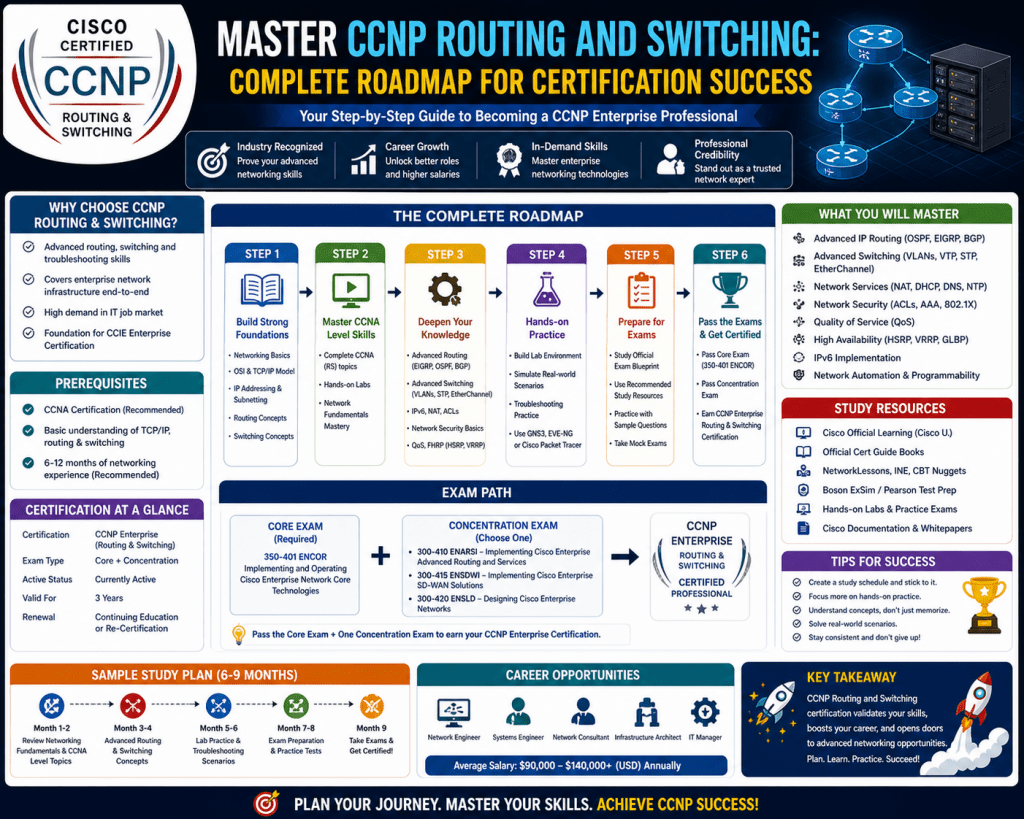
The Cisco Certified Network Professional Routing and Switching certification is widely recognized as a benchmark for intermediate-level networking expertise. It is designed for professionals who have already mastered foundational networking concepts and are ready to move into more advanced responsibilities within enterprise environments. This certification validates not only theoretical understanding but also the ability to apply knowledge in real-world scenarios involving complex network infrastructures.
As organizations increasingly depend on reliable and scalable networks, the need for skilled professionals continues to grow. This certification addresses that demand by equipping learners with the technical capabilities required to manage, optimize, and troubleshoot modern networks. It focuses on both local and wide-area networking environments, ensuring that candidates are prepared to handle a variety of operational challenges.
The value of this certification lies in its practical orientation. Rather than focusing solely on abstract concepts, it emphasizes hands-on skills that are directly applicable in professional settings. This makes it particularly relevant for individuals seeking to advance their careers and take on more specialized roles in networking.
Understanding the Role of a Network Professional
A network professional operating at this level is expected to perform a wide range of tasks that go beyond basic configuration. These responsibilities include designing network architectures, implementing advanced routing and switching solutions, and ensuring that systems operate efficiently under varying conditions. The role also involves maintaining network security, optimizing performance, and resolving issues that may impact connectivity or reliability.
In enterprise environments, networks are often composed of multiple interconnected systems that must work seamlessly together. This requires a deep understanding of how different technologies interact and the ability to configure devices accordingly. Professionals must be able to analyze network requirements, identify potential challenges, and implement solutions that meet organizational needs.
Collaboration is another important aspect of the role. Network professionals frequently work alongside specialists in areas such as security, wireless communication, and unified communications. This collaborative approach ensures that all aspects of the network are aligned and functioning as intended.
The ability to troubleshoot effectively is one of the most critical skills for a network professional. Issues can arise at any time, and resolving them quickly is essential to maintaining operational continuity. This requires a systematic approach to problem-solving, as well as a thorough understanding of network behavior.
Core Competencies Developed Through the Certification
The certification focuses on developing a comprehensive set of competencies that are essential for managing enterprise networks. These competencies are structured around key domains, including planning, implementation, verification, and troubleshooting.
Planning involves assessing organizational requirements and designing network solutions that meet those needs. This includes selecting appropriate technologies, defining network topologies, and ensuring scalability and redundancy. Effective planning lays the foundation for a stable and efficient network.
Implementation focuses on deploying the designed solutions. This includes configuring routers and switches, setting up routing protocols, and establishing connectivity between different network segments. Attention to detail is crucial during this phase, as even minor misconfigurations can lead to significant issues.
Verification is the process of ensuring that the network is operating as expected. This involves monitoring performance, analyzing traffic patterns, and validating configurations. Regular verification helps identify potential problems before they escalate.
Troubleshooting is the final and often most challenging domain. It requires identifying the root cause of network issues and implementing solutions to resolve them. This process involves analyzing logs, testing configurations, and using diagnostic tools to isolate problems.
By mastering these competencies, professionals can effectively manage complex network environments and ensure optimal performance.
Structure of the Certification Exams
The certification is structured around three primary exams, each focusing on a specific area of networking expertise. These exams collectively provide a comprehensive assessment of a candidate’s knowledge and skills.
The first exam focuses on routing technologies. It covers advanced topics such as dynamic routing protocols, route redistribution, and path optimization. Candidates are expected to understand how data is routed across networks and how to configure routers to ensure efficient communication.
The second exam centers on switching technologies. It explores concepts such as virtual local area networks, spanning tree protocols, and high-availability solutions. This exam emphasizes the role of switches in managing network traffic within local environments.
The third exam is dedicated to troubleshooting. It integrates knowledge from the other two domains and challenges candidates to diagnose and resolve complex network issues. This exam is often considered the most practical, as it simulates real-world scenarios.
Each exam includes a variety of question formats, including multiple-choice, drag-and-drop, and simulation-based tasks. These formats are designed to test both theoretical knowledge and practical skills.
Recommended Background and Prerequisites
Before pursuing this certification, candidates are generally expected to have a solid foundation in networking. This typically includes one to three years of hands-on experience working with network devices and technologies. Such experience helps build the practical skills needed to succeed in the certification exams.
In addition to experience, a foundational certification is usually required as a prerequisite. This ensures that candidates have a strong understanding of basic networking concepts, such as IP addressing, subnetting, and device configuration.
The progression from foundational to intermediate-level certification reflects a structured learning path. It allows professionals to build their expertise gradually, ensuring that they are well-prepared for more advanced topics.
Having a strong background in networking also makes the learning process more efficient. Candidates can focus on expanding their knowledge rather than revisiting basic concepts, which helps them progress more quickly.
Developing an Effective Study Strategy
Preparing for the certification requires a well-planned approach. Given the complexity of the topics involved, it is important to create a study plan that outlines clear goals and timelines. This helps ensure consistent progress and prevents last-minute cramming.
One effective strategy is to focus on one exam at a time. This allows candidates to concentrate on specific topics and develop a deeper understanding. Starting with routing can provide a strong foundation, as many advanced concepts are built upon routing principles.
Hands-on practice is essential for mastering the material. Setting up lab environments, whether physical or virtual, allows candidates to experiment with configurations and gain practical experience. This reinforces theoretical knowledge and helps build confidence.
Regular review is also important. Revisiting previously studied topics helps reinforce learning and ensures that information is retained over time. Practice tests can be used to assess progress and identify areas that need improvement.
Time management plays a crucial role in preparation. Allocating dedicated study periods and sticking to a schedule can help maintain momentum and ensure that all topics are covered.
Understanding Exam Format and Question Types
The exams are designed to evaluate both knowledge and practical skills. Each exam typically lasts two hours, during which candidates must answer a set number of questions. The number of questions varies depending on the exam, with routing generally having the most and troubleshooting the fewest.
Multiple-choice questions test theoretical understanding, while drag-and-drop questions assess the ability to organize and apply concepts. Simulation-based questions require candidates to interact with virtual network environments and perform tasks such as configuring devices or troubleshooting issues.
These simulation questions are particularly important, as they closely resemble real-world scenarios. Candidates must be able to navigate interfaces, interpret outputs, and make decisions based on the information available.
The combination of different question types ensures a comprehensive assessment of a candidate’s abilities. It also highlights the importance of both theoretical knowledge and practical experience.
Approach to Exam Sequencing
Although there is no mandatory order for taking the exams, many candidates follow a logical sequence. Starting with routing provides a strong foundation, as it introduces key concepts that are relevant to other areas of networking.
The switching exam is often taken next, as it builds upon the knowledge gained from routing. It focuses on managing traffic within local networks and ensuring efficient communication between devices.
The troubleshooting exam is typically taken last. It requires a comprehensive understanding of both routing and switching, as well as the ability to diagnose and resolve complex issues.
Some candidates may choose a different sequence based on their experience. For example, those with a strong background in switching may prefer to start with that exam. The flexibility in sequencing allows candidates to tailor their approach.
Importance of Hands-On Experience
Hands-on experience is a critical component of success in this certification. It allows candidates to apply theoretical knowledge in practical scenarios and develop the skills needed to perform real-world tasks.
Working with network devices helps build familiarity with configurations and commands. It also provides insight into how different components interact within a network. This understanding is essential for troubleshooting and optimization.
Simulation tools and virtual labs are valuable resources for gaining hands-on experience. They allow candidates to practice configurations and experiment with different scenarios without the need for physical equipment.
Practical experience also helps build confidence. By working through various scenarios, candidates become more comfortable with the tasks they will encounter in the exams and in professional environments.
Building a Strong Foundation for Career Growth
Achieving this certification represents a significant step in a networking career. It demonstrates a high level of expertise and a commitment to professional development. This can open up new opportunities and lead to more advanced roles.
The skills developed through this certification apply to a wide range of networking environments. This versatility makes it a valuable asset for professionals seeking to expand their career options.
In addition to technical skills, the certification helps develop critical thinking and problem-solving abilities. These skills are essential for navigating the complexities of modern networks and adapting to new technologies.
By building a strong foundation, professionals can continue to advance their careers and pursue further specialization. This certification serves as a stepping stone toward achieving higher levels of expertise and taking on more challenging roles in the field of networking.
Advanced Networking Concepts in Routing and Switching Environments
At the intermediate certification level, networking moves far beyond basic connectivity and enters a domain where design decisions directly impact performance, scalability, and resilience. Enterprise networks are no longer simple collections of devices; they are layered ecosystems that must support business-critical applications, remote connectivity, and increasingly complex traffic patterns. Understanding how routing and switching technologies interact becomes essential for maintaining stability and efficiency in such environments.
Routing at this level involves more than simply forwarding packets between networks. It requires a deep understanding of how routing protocols behave under different conditions, how convergence affects network performance, and how route selection impacts traffic flow. Engineers must be able to manipulate routing behavior to optimize paths, reduce latency, and ensure redundancy.
Switching, on the other hand, focuses on the efficient handling of data within local network segments. While routing connects different networks, switching ensures that devices within the same network communicate effectively. This includes managing broadcast domains, implementing segmentation strategies, and ensuring loop-free topologies.
Together, routing and switching form the backbone of enterprise networking, and mastery of both is essential for professionals aiming to operate at a higher technical level.
Dynamic Routing Protocol Behavior and Network Adaptation
Dynamic routing protocols are a core component of enterprise network design. They allow routers to automatically exchange information and adjust to changes in network topology without manual intervention. This adaptability is critical in environments where uptime and responsiveness are priorities.
Each routing protocol has distinct characteristics that influence how it behaves in a network. Some prioritize speed of convergence, while others focus on scalability or path optimization. Understanding these trade-offs is essential when designing or troubleshooting networks.
Network convergence refers to the time it takes for all routers in a network to agree on the current topology after a change occurs. Faster convergence improves network stability and reduces downtime, but it may come with increased processing overhead.
Route selection is another important concept. Routers often have multiple possible paths to a destination, and they must choose the most efficient one based on metrics such as cost, bandwidth, or delay. Engineers can influence these decisions through configuration adjustments, allowing for optimized traffic flow.
Route redistribution introduces additional complexity by enabling communication between different routing protocols. While this improves interoperability, it must be carefully managed to avoid routing loops or inconsistencies.
Scalability Challenges in Large Enterprise Networks
As networks grow, scalability becomes a primary concern. Large enterprise environments may include hundreds or thousands of devices, each contributing to the overall complexity of the system. Without proper design, scalability issues can lead to performance degradation and operational inefficiencies.
Hierarchical network design is commonly used to address scalability challenges. This approach divides the network into layers, each with specific responsibilities. Core layers handle high-speed transport, distribution layers manage routing decisions, and access layers connect end devices.
This structure helps reduce complexity and improve manageability. It also allows engineers to isolate issues more effectively and implement changes without disrupting the entire network.
IP addressing design plays a crucial role in scalability. Efficient allocation of address space ensures that networks can expand without requiring major redesigns. Summarization techniques are often used to reduce routing table size and improve performance.
As networks scale, redundancy becomes increasingly important. Redundant links and devices ensure that failures do not result in service disruptions. However, redundancy must be carefully managed to avoid loops and inefficiencies.
Switching Architectures and Layer 2 Optimization
Switching technologies operate at the data link layer and are responsible for forwarding frames within local networks. Modern switching architectures are designed to maximize efficiency while minimizing latency and congestion.
One of the key challenges in switching is managing broadcast traffic. Broadcasts are necessary for certain network functions, but excessive broadcast traffic can degrade performance. Segmenting networks into smaller broadcast domains helps mitigate this issue.
Virtual LANs provide a mechanism for logical segmentation. By grouping devices into separate virtual networks, engineers can improve security, reduce congestion, and simplify management. VLANs allow multiple logical networks to exist on the same physical infrastructure.
Spanning tree protocols are used to prevent loops in redundant switching topologies. Without loop prevention mechanisms, redundant paths could cause broadcast storms and network instability. Spanning tree ensures that only one active path exists between switches while keeping backup paths available.
Advanced switching techniques include link aggregation, which combines multiple physical links into a single logical connection. This improves bandwidth and provides redundancy in case of link failure.
Switching optimization also involves MAC address table management. Switches learn and store MAC addresses to efficiently forward frames. However, large networks require careful management of these tables to avoid memory limitations.
Network Performance Optimization Techniques
Performance optimization is a critical responsibility for network professionals at this level. Enterprise networks must support a wide range of applications, many of which are sensitive to latency and jitter.
Bandwidth utilization is one of the primary factors affecting performance. Efficient use of available bandwidth ensures that applications receive the resources they need without unnecessary congestion.
Traffic prioritization techniques allow certain types of traffic to be given preference over others. This is particularly important for real-time applications such as voice and video communication.
Latency refers to the delay experienced when data travels across a network. High latency can negatively impact application performance, especially in time-sensitive environments. Engineers must identify and minimize sources of delay wherever possible.
Jitter refers to variations in packet delay. Consistent delivery times are essential for maintaining quality in streaming and communication applications. Reducing jitter often involves traffic shaping and queuing strategies.
Congestion management techniques help control traffic flow during periods of high demand. By implementing queuing mechanisms, engineers can ensure that critical traffic is prioritized and delays are minimized.
Troubleshooting Methodologies and Diagnostic Approaches
Troubleshooting is one of the most important skills for any network professional. It requires a structured approach to identifying, isolating, and resolving issues within complex systems.
The first step in troubleshooting is problem identification. This involves gathering information about the issue, including symptoms, affected systems, and timing. Accurate identification is essential for effective resolution.
Once the problem is identified, the next step is isolation. Engineers must determine which part of the network is responsible for the issue. This may involve testing different segments or analyzing configuration settings.
After isolation, the root cause must be determined. This requires a deep understanding of network behavior and the ability to interpret diagnostic data. Logs, error messages, and performance metrics all provide valuable insights.
Resolution involves implementing a fix and verifying that the issue has been resolved. This step is critical, as incomplete fixes can lead to recurring problems.
Finally, documentation is important for future reference. Recording the issue and its resolution helps build institutional knowledge and improves future troubleshooting efforts.
Layered Network Analysis for Problem Solving
Effective troubleshooting often requires a layered approach. By analyzing the network layer by layer, engineers can systematically identify where issues are occurring.
At the physical layer, problems may involve cables, connectors, or hardware failures. These issues often result in a complete loss of connectivity.
At the data link layer, issues may involve MAC address conflicts or switching misconfigurations. These problems can cause intermittent connectivity or incorrect forwarding behavior.
At the network layer, routing issues are common. These may include incorrect routing tables, misconfigured protocols, or failed route advertisements.
Higher layers may involve application-level issues, such as authentication failures or service unavailability. These require coordination with other IT teams for resolution.
By following a layered approach, engineers can narrow down potential causes and resolve issues more efficiently.
Redundancy and High Availability Strategies
Enterprise networks must be designed with reliability in mind. Downtime can have significant operational and financial consequences, making redundancy a critical design principle.
Redundant pathways ensure that data can still be transmitted even if one path fails. This is achieved through multiple links and alternative routing configurations.
Device redundancy involves deploying backup routers and switches that can take over in case of failure. These devices are often configured to automatically assume control without manual intervention.
High availability strategies focus on minimizing downtime and ensuring continuous service. This may involve load balancing, failover mechanisms, and real-time monitoring.
While redundancy improves reliability, it also introduces complexity. Engineers must carefully design systems to avoid conflicts and inefficiencies.
Network Security Considerations in Routing and Switching
Security is an integral part of network design. Routing and switching environments must be protected against unauthorized access, misconfigurations, and malicious activity.
Access control mechanisms restrict who can interact with network devices. This helps prevent unauthorized changes and enhances overall security.
Segmentation is another important security strategy. By isolating different parts of the network, engineers can limit the spread of potential threats.
Monitoring tools are used to detect unusual activity and identify potential security breaches. Early detection is critical for minimizing damage.
Secure configuration practices help reduce vulnerabilities. This includes disabling unused services, applying updates, and enforcing strong authentication methods.
Performance Monitoring and Network Visibility
Maintaining visibility into network performance is essential for long-term stability. Monitoring tools provide real-time insights into traffic patterns, device status, and overall network health.
Performance metrics such as bandwidth usage, error rates, and latency are continuously tracked. These metrics help identify trends and potential issues before they escalate.
Traffic analysis tools allow engineers to understand how data flows through the network. This information is valuable for optimization and capacity planning.
Alerts and notifications help ensure that issues are addressed promptly. Automated systems can detect anomalies and trigger responses when thresholds are exceeded.
Visibility into network operations enables proactive management, reducing the likelihood of unexpected failures.
Evolving Role of Network Professionals in Modern Infrastructure
The role of network professionals continues to evolve as technology advances. Modern networks are increasingly integrated with cloud services, virtualization platforms, and automation tools.
This evolution requires professionals to expand their skill sets beyond traditional networking. Understanding automation, scripting, and orchestration is becoming increasingly important.
Despite these changes, the core principles of routing and switching remain fundamental. A strong understanding of these concepts provides a solid foundation for adapting to new technologies.
As enterprise environments become more complex, the demand for skilled network professionals continues to grow. Those who master these intermediate concepts are well-positioned to advance into more specialized and senior roles within the field.
Troubleshooting Enterprise Network Failures at an Advanced Level
At the professional networking stage, troubleshooting is no longer a reactive task performed after a failure occurs. It becomes a structured engineering discipline that focuses on prevention, early detection, and rapid resolution. Enterprise networks are highly dynamic systems where routing instability, switching misconfigurations, and performance degradation can occur simultaneously. Understanding how to approach these problems methodically is essential for maintaining service continuity.
Advanced troubleshooting begins with the ability to distinguish between symptoms and root causes. A slow application, for example, may not originate from the application layer itself but from congestion at the switching layer, misconfigured routing paths, or even physical infrastructure limitations. Identifying the correct layer of failure is the first step toward efficient resolution.
Network professionals at this level rely heavily on systematic diagnostic workflows. These workflows often begin with validating physical connectivity, followed by verifying data link integrity, checking IP configuration consistency, and finally analyzing routing behavior. Each step narrows down the possible causes until the root issue is isolated.
Time sensitivity is another critical factor. Enterprise environments cannot afford prolonged downtime, so engineers must prioritize high-impact issues first. This requires both technical knowledge and operational awareness, ensuring that the most critical services are restored as quickly as possible.
Deep Dive into Routing Protocol Stability and Optimization
Routing stability is a fundamental requirement in large-scale enterprise networks. Unstable routing behavior can lead to packet loss, increased latency, and even complete network outages. At this level, professionals must understand how routing protocols maintain stability and how to fine-tune them for optimal performance.
Routing convergence plays a central role in stability. When a network change occurs, routers must quickly update their routing tables to reflect the new topology. Slow convergence can result in temporary routing loops or black holes where traffic is dropped.
Route summarization is one technique used to improve stability. By aggregating multiple routes into a single entry, routing tables become more efficient, reducing processing overhead and improving convergence speed. However, improper summarization can lead to routing inconsistencies.
Path selection mechanisms also influence stability. Routing protocols use metrics such as cost, hop count, and bandwidth to determine the best path. Engineers can manipulate these metrics to influence traffic flow and improve performance.
Redistribution between routing protocols introduces additional complexity. While it allows interoperability between different systems, it must be carefully controlled to prevent routing loops and inconsistent route propagation.
Advanced Switching Behavior in Large-Scale Networks
Switching environments in enterprise networks is highly complex, often involving multiple interconnected switches operating at different layers. Understanding advanced switching behavior is essential for maintaining efficiency and preventing broadcast-related issues.
One of the key challenges in switching is managing broadcast and multicast traffic. Excessive broadcast traffic can overwhelm network resources and degrade performance. Proper segmentation is necessary to contain broadcast domains.
Virtual segmentation techniques allow network engineers to divide a physical network into multiple logical networks. This improves security, reduces congestion, and simplifies management. Each segment operates independently, even though they share the same physical infrastructure.
Loop prevention mechanisms are critical in redundant switching topologies. Without proper safeguards, loops can cause broadcast storms that severely impact network performance. Spanning tree mechanisms ensure that only one active path exists between switches while maintaining backup paths.
Advanced switching techniques, such as link aggregation, allow multiple physical links to function as a single logical connection. This improves bandwidth utilization and provides redundancy in case of link failure.
MAC address learning and aging processes are also important. Switches dynamically build MAC address tables to efficiently forward traffic, but these tables must be managed carefully in large environments to avoid overflow or inefficiency.
Enterprise Network Scalability and Growth Management
Scalability is one of the most important design considerations in enterprise networking. As organizations grow, their network infrastructure must be able to expand without requiring complete redesigns.
Hierarchical network design is a widely used approach to achieve scalability. By dividing the network into structured layers, engineers can isolate functions and reduce complexity. Core layers handle high-speed data transfer, distribution layers manage routing decisions, and access layers connect end devices.
This layered approach allows networks to scale more efficiently. Changes in one layer do not necessarily impact others, which reduces operational risk.
IP addressing strategies also play a significant role in scalability. Efficient address allocation ensures that new devices can be integrated without restructuring the entire network. Address summarization reduces routing table size and improves performance.
Redundancy becomes increasingly important as networks scale. Multiple pathways and backup devices ensure that failures do not disrupt services. However, redundancy must be carefully balanced to avoid unnecessary complexity.
Load-balancing techniques help distribute traffic evenly across available resources. This prevents congestion and ensures optimal utilization of network infrastructure.
Network Performance Engineering and Optimization Techniques
Performance engineering focuses on ensuring that networks operate efficiently under varying conditions. This involves continuous monitoring, analysis, and optimization of network behavior.
Bandwidth management is a key aspect of performance optimization. Networks must be designed to handle peak traffic loads without degradation in service quality. Efficient bandwidth allocation ensures that critical applications receive sufficient resources.
Latency optimization is another important consideration. High latency can negatively impact real-time applications such as voice and video communication. Engineers must identify sources of delay and implement strategies to minimize them.
Jitter control is essential for maintaining consistent packet delivery. Variations in delay can disrupt time-sensitive applications, so mechanisms such as traffic shaping and queuing are used to stabilize performance.
Traffic prioritization allows certain types of data to be treated with higher importance. This ensures that critical services are not affected by lower-priority traffic during periods of congestion.
Congestion management techniques help maintain performance during high-demand periods. By controlling how packets are queued and transmitted, engineers can prevent network overload.
Advanced Troubleshooting Methodologies in Complex Environments
Troubleshooting in large-scale networks requires a structured and repeatable methodology. Without a systematic approach, diagnosing issues can become time-consuming and inefficient.
The first step in any troubleshooting process is accurate problem definition. Engineers must clearly understand the symptoms and scope of the issue. This includes identifying affected systems, timing, and severity.
Once the problem is defined, isolation techniques are used to narrow down potential causes. This may involve disabling certain network segments or testing individual components.
Root cause analysis requires deep technical understanding. Engineers must interpret logs, analyze configuration settings, and examine network behavior to determine the underlying issue.
After identifying the root cause, corrective actions are implemented. These actions must be carefully tested to ensure that they resolve the issue without introducing new problems.
Post-resolution validation is essential. Engineers must confirm that the network is functioning correctly and that the original issue has been fully resolved.
Documentation plays a critical role in improving future troubleshooting efforts. Recording the problem and solution helps build organizational knowledge and improves response times for similar issues in the future.
Layered Diagnostics and Systematic Network Analysis
A layered approach to diagnostics is one of the most effective methods for troubleshooting complex networks. By analyzing each layer of the network model, engineers can systematically identify where failures occur.
At the physical layer, issues often involve hardware failures, cable damage, or power disruptions. These problems typically result in complete loss of connectivity.
At the data link layer, switching issues such as MAC address conflicts or VLAN misconfigurations may occur. These can lead to intermittent connectivity or incorrect traffic forwarding.
At the network layer, routing issues are common. These include incorrect route advertisements, misconfigured protocols, or broken connectivity between networks.
Higher layers involve application and service-level issues. These may include authentication failures, service unavailability, or misconfigured application settings.
By following a layered diagnostic approach, engineers can efficiently isolate problems and apply targeted solutions.
High Availability and Fault Tolerance Engineering
High availability is a core requirement in enterprise networking. Organizations depend on continuous network access, making fault tolerance a critical design principle.
Redundant network paths ensure that traffic can still flow even if one path fails. This reduces the risk of downtime and improves overall reliability.
Device redundancy involves deploying backup systems that can take over in case of hardware failure. These systems often operate in standby mode and activate automatically when needed.
Failover mechanisms ensure smooth transitions between primary and backup systems. These mechanisms must be fast and seamless to avoid service disruption.
Load balancing distributes traffic across multiple devices or paths. This not only improves performance but also enhances reliability by preventing single points of failure.
While redundancy improves resilience, it also increases complexity. Engineers must carefully design systems to avoid conflicts and ensure consistent behavior.
Security Integration in Routing and Switching Infrastructure
Security is deeply integrated into modern network design. Routing and switching environments must be protected against unauthorized access, configuration errors, and malicious activity.
Access control mechanisms restrict who can interact with network devices. This helps prevent unauthorized changes and enhances overall system integrity.
Network segmentation isolates different parts of the infrastructure. This limits the spread of potential threats and improves containment strategies.
Monitoring systems continuously analyze network behavior for anomalies. Early detection of unusual activity allows for faster response to potential security incidents.
Secure configuration practices reduce vulnerabilities by disabling unnecessary services and enforcing strong authentication methods.
Encryption and secure communication protocols protect data as it travels across the network, ensuring confidentiality and integrity.
Performance Monitoring and Operational Visibility
Continuous monitoring is essential for maintaining network health. Without visibility, it becomes difficult to detect and resolve issues before they impact users.
Performance metrics such as bandwidth utilization, error rates, and latency are constantly tracked. These metrics provide insight into network behavior and help identify trends.
Traffic analysis tools allow engineers to understand how data flows through the network. This information is used for optimization and capacity planning.
Alerting systems notify administrators when predefined thresholds are exceeded. This enables a proactive response to potential issues.
Operational visibility ensures that network administrators have a complete understanding of system behavior at all times.
Evolving Responsibilities of Network Professionals in Modern Infrastructure
The role of network professionals continues to evolve as technology advances. Modern networks are increasingly integrated with cloud platforms, automation tools, and virtualization systems.
This evolution requires professionals to expand their skill sets beyond traditional networking concepts. Knowledge of automation, orchestration, and scripting is becoming increasingly important.
Despite these changes, core networking principles remain essential. Routing, switching, and troubleshooting continue to form the foundation of enterprise networking.
Professionals who master these advanced concepts are well-positioned to adapt to emerging technologies and take on more specialized roles in the future.
Conclusion
The Cisco Certified Network Professional Routing and Switching certification represents far more than a milestone in a technical learning path. It functions as a structured transformation of how a networking professional understands, designs, and operates enterprise-scale infrastructures. At this level, knowledge is no longer limited to isolated commands or individual protocols. Instead, it becomes a cohesive system of reasoning where routing behavior, switching architecture, and troubleshooting methodology are interconnected components of a larger operational ecosystem.
One of the most important outcomes of pursuing this certification path is the shift in mindset it produces. Entry-level networking knowledge often focuses on “how” to configure devices. Intermediate-level expertise, however, emphasizes “why” systems behave in a certain way. This distinction is critical. Understanding why routing protocols prefer one path over another, or why switching loops can destabilize an entire network, allows professionals to move beyond reactive configuration and into proactive design and optimization. This analytical perspective is what separates operational technicians from true network engineers.
Another key takeaway is the importance of structured thinking in problem-solving. Enterprise networks are inherently complex, with multiple layers of abstraction and interdependent systems. Without a disciplined approach, troubleshooting can become inefficient and inconsistent. The methodologies associated with this certification encourage a layered diagnostic process, where issues are examined systematically from physical connectivity through to higher-level protocol behavior. This structured approach reduces ambiguity and ensures that root causes are identified rather than just symptoms being addressed. Over time, this develops a professional instinct for precision and logical reasoning under pressure.
Equally significant is the emphasis on scalability and resilience. Modern enterprise environments are not static; they evolve continuously in response to organizational growth, technological adoption, and changing user demands. Networks must therefore be designed with expansion and fault tolerance in mind from the outset. Concepts such as hierarchical design, redundancy planning, route summarization, and traffic optimization are not optional enhancements—they are fundamental requirements. Professionals who internalize these principles are better equipped to design infrastructures that remain stable under load and adaptable over time.
The certification also reinforces the importance of operational awareness. Networking is not only about building systems but also about maintaining them in real-time environments where performance and reliability must be continuously evaluated. Monitoring network behavior, interpreting performance metrics, and anticipating potential failures are essential skills. This proactive approach reduces downtime and improves overall service quality. It also aligns network engineering more closely with business objectives, where continuity and efficiency directly impact organizational performance.
Security considerations are another integral dimension of this learning path. While routing and switching are often viewed through a performance lens, they also play a critical role in enforcing network security boundaries. Segmentation, access control, and secure configuration practices are embedded into network design to reduce exposure to threats. As networks become more interconnected and distributed, the ability to integrate security principles into foundational infrastructure becomes increasingly important. This ensures that performance improvements do not come at the cost of vulnerability.
From a career development perspective, the knowledge gained through this certification creates a strong foundation for progression into more advanced roles. It establishes credibility in technical environments where reliability and precision are essential. However, more importantly, it builds adaptability. Networking technologies continue to evolve rapidly, incorporating cloud integration, automation frameworks, and software-defined architectures. Professionals grounded in core routing and switching principles are better positioned to adapt to these changes because they understand the underlying mechanics that remain constant even as implementation models shift.
Another important dimension is the development of confidence in decision-making. In real-world networking environments, engineers are often required to make quick yet accurate decisions that impact large-scale systems. The structured knowledge gained through this certification reduces uncertainty in these moments. Whether diagnosing a routing failure, resolving a switching loop, or optimizing traffic flow, professionals can rely on established principles and proven methodologies to guide their actions.
The broader significance of this certification lies in its role as a bridge between foundational networking knowledge and expert-level specialization. It provides the depth required to understand enterprise systems holistically while also preparing professionals for more advanced disciplines such as network architecture, security engineering, and infrastructure automation. This transitional role makes it one of the most strategically important certifications in the networking field.
Ultimately, the value of this certification is not limited to exam completion or credential acquisition. Its real impact is observed in the way professionals begin to approach network challenges with greater clarity, structure, and confidence. It cultivates a mindset that prioritizes stability, efficiency, and long-term design integrity over short-term fixes. This shift in thinking is what enables sustained success in complex IT environments.
As enterprise networks continue to expand in scale and complexity, the demand for professionals who can understand and manage these systems at a deep technical level will remain strong. The principles reinforced throughout this certification path—structured troubleshooting, scalable design, performance optimization, and integrated security—form a lasting foundation that extends well beyond any single technology or vendor ecosystem.