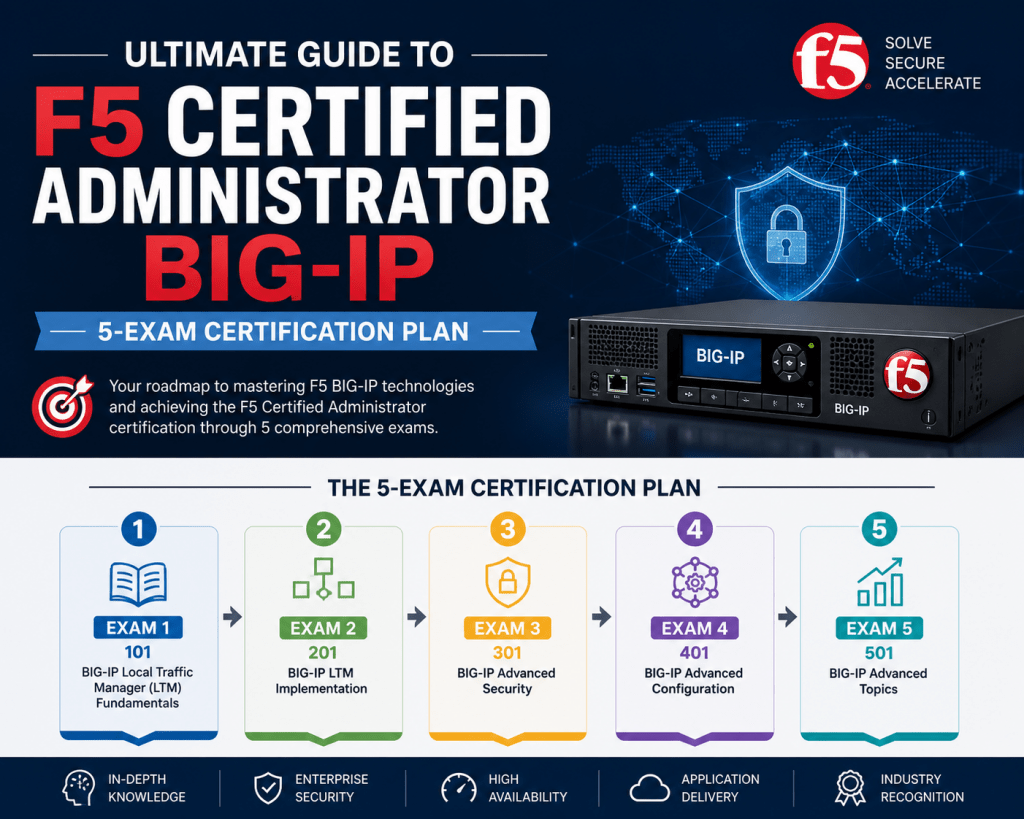
The F5 Certified Administrator BIG-IP credential represents a structured validation of foundational skills required to manage enterprise-grade application delivery environments. Introduced in 2025, this certification reflects a modernized approach to assessing technical competency in a modular format. Instead of relying on a single comprehensive examination, the certification is divided into multiple focused assessments that collectively evaluate a candidate’s ability to manage installation, configuration, traffic handling, system maintenance, and operational troubleshooting within BIG-IP environments. This structure aligns closely with real-world administrative responsibilities where tasks are distributed across multiple functional domains rather than a single unified workflow.
The certification is designed for IT professionals who work with application delivery infrastructure in environments where reliability, performance, and security are critical. As organizations increasingly adopt hybrid architectures combining on-premises data centers with cloud-based deployments, the demand for professionals who understand application delivery controllers has significantly increased. BIG-IP sits at the center of these environments, ensuring that applications remain accessible, secure, and optimized regardless of where they are hosted. The certification framework reflects this importance by focusing on practical, operational knowledge rather than purely theoretical understanding.
Evolution of the Modular Certification Model in BIG-IP Administration
The transition to a modular certification structure represents a significant shift in how technical competency is evaluated. Traditionally, certification programs relied on a single high-stakes examination that covered a broad range of topics. While effective in testing overall knowledge, this approach often placed a heavy cognitive load on candidates and did not always reflect real-world job segmentation. The modular model introduced in the BIG-IP certification framework addresses this limitation by dividing the knowledge domains into smaller, more focused assessments.
Each exam in the structure targets a specific operational area within BIG-IP administration. This allows candidates to develop and demonstrate expertise incrementally rather than attempting to master all domains simultaneously. The modular approach also improves flexibility, enabling professionals to schedule exams based on availability and readiness. This reduces pressure while encouraging a deeper understanding of each domain.
Another important aspect of this evolution is alignment with real-world job roles. In production environments, administrators often specialize in specific operational areas such as system configuration, traffic management, or troubleshooting. The modular certification model reflects this specialization by validating each competency area independently while still contributing to a unified certification outcome.
Understanding BIG-IP as an Application Delivery Platform
BIG-IP is a centralized application delivery platform designed to manage, optimize, and secure application traffic between users and backend systems. It operates as an intermediary layer that intelligently controls how requests are processed and routed across infrastructure components. Unlike basic network routing systems, BIG-IP is application-aware, meaning it can make decisions based on application behavior, user sessions, and performance metrics.
At its core, BIG-IP ensures that applications remain available and responsive even under fluctuating demand conditions. It achieves this by distributing traffic across multiple servers using advanced load-balancing algorithms. These algorithms go beyond simple distribution methods and incorporate real-time performance data, server health status, and predefined policy rules. This ensures optimal utilization of backend resources while maintaining a consistent user experience.
BIG-IP also plays a critical role in enforcing security policies at the application delivery layer. It can inspect traffic flows, manage encrypted sessions, and enforce access control rules before requests reach application servers. This reduces the burden on backend systems and enhances overall security posture. In addition, BIG-IP provides visibility into application performance metrics, enabling administrators to identify bottlenecks and optimize infrastructure efficiency.
Role of Local Traffic Manager in Application Delivery Operations
The Local Traffic Manager module is one of the most fundamental components of the BIG-IP ecosystem. It is responsible for controlling how application traffic is distributed across backend resources. This module ensures that user requests are routed efficiently based on predefined logic and real-time system conditions.
One of the primary responsibilities of the Local Traffic Manager is intelligent load balancing. Unlike static distribution methods, it dynamically evaluates server conditions before assigning traffic. This includes monitoring CPU usage, connection counts, and response times to ensure optimal request handling. As a result, no single server becomes overwhelmed while others remain underutilized.
Another key function is SSL termination, where encrypted traffic is decrypted at the BIG-IP level before being forwarded to backend servers. This improves performance by reducing computational overhead on application servers and allows centralized management of encryption policies. It also simplifies certificate management by consolidating SSL operations within the BIG-IP system.
Local Traffic Manager also supports session persistence mechanisms, ensuring that user sessions remain consistent across multiple requests. This is particularly important for applications that require stateful interactions, such as e-commerce platforms or enterprise portals. By maintaining session continuity, the system ensures a seamless user experience even when traffic is distributed across multiple backend nodes.
Architecture and Core Components of BIG-IP Systems
The architecture of BIG-IP is built around a modular design that separates control functions from data processing functions. This separation allows for efficient traffic handling while maintaining centralized system management. The data plane is responsible for processing application traffic, while the control plane manages configuration, system settings, and administrative functions.
Within the data plane, traffic flows through a series of processing stages that include inspection, policy evaluation, and routing decisions. These stages ensure that each request is handled according to predefined rules and performance criteria. The system also integrates health monitoring mechanisms that continuously evaluate backend server status and adjust traffic distribution accordingly.
The control plane is responsible for maintaining system integrity and operational consistency. It manages configuration synchronization, authentication services, logging mechanisms, and system updates. This separation of responsibilities ensures that administrative operations do not interfere with real-time traffic processing.
Another important component is the high availability framework, which ensures system resilience in the event of hardware or software failures. By maintaining redundant system instances, BIG-IP ensures continuous service availability even during unexpected disruptions. This is critical in enterprise environments where application downtime can result in significant operational impact.
Importance of BIG-IP in Hybrid and Cloud Infrastructure Environments
Modern enterprise environments are increasingly distributed across multiple infrastructure models, including on-premises data centers, private clouds, and public cloud platforms. BIG-IP plays a central role in unifying application delivery across these diverse environments. It provides consistent traffic management policies regardless of where applications are deployed.
In hybrid environments, BIG-IP acts as a bridge between legacy systems and modern cloud-native applications. It ensures that traffic is routed efficiently between different infrastructure layers while maintaining consistent security and performance policies. This is particularly important in scenarios where applications are migrated incrementally from traditional data centers to cloud environments.
BIG-IP also supports scalability requirements in cloud-based deployments. As application demand fluctuates, it can dynamically adjust traffic distribution to accommodate changing workloads. This elasticity ensures that applications remain responsive even during peak usage periods.
Security is another critical aspect of BIG-IP’s role in hybrid environments. Enforcing centralized security policies across distributed infrastructure, it ensures that application traffic remains protected regardless of its origin or destination. This reduces complexity for administrators while improving overall security posture.
Foundational Networking Concepts Required for Certification Success
A strong understanding of networking fundamentals is essential for success in the BIG-IP certification framework. This includes knowledge of TCP/IP communication, which forms the basis of all network traffic. Understanding how data packets are transmitted, routed, and received is critical for interpreting how BIG-IP processes application requests.
Domain name resolution is another important area, as it directly impacts how users access applications. Administrators must understand how DNS systems translate domain names into IP addresses and how BIG-IP interacts with these processes to manage traffic flow.
HTTP and HTTPS protocols are also central to application delivery. Since most modern applications rely on web-based communication, understanding request and response structures is essential. This includes knowledge of headers, status codes, and session management mechanisms.
In addition to protocol knowledge, familiarity with routing and switching concepts is important. This includes understanding VLAN segmentation, subnetting, and routing tables. These concepts directly influence how traffic enters and exits BIG-IP systems.
Core Technical Skills Expected for Entry-Level Administrators
Candidates pursuing this certification are expected to have practical exposure to system administration and network management tasks. This includes the ability to configure network interfaces, manage system resources, and perform basic troubleshooting operations.
Linux command-line proficiency is highly beneficial, as many administrative tasks require direct system interaction. This includes navigating file systems, analyzing logs, and executing diagnostic commands. These skills are particularly useful when investigating system performance issues or configuration errors.
Understanding SSL and certificate management is also important due to the widespread use of encrypted communication in modern applications. Administrators should be familiar with certificate chains, encryption algorithms, and secure handshake processes.
Operational awareness of traffic management concepts such as load balancing, failover mechanisms, and session persistence is essential. These concepts form the foundation of how BIG-IP ensures application availability and performance.
In addition to technical skills, candidates benefit from analytical thinking and problem-solving abilities. Many certification scenarios involve diagnosing system behavior under specific conditions, requiring logical reasoning and structured troubleshooting approaches.
Expanding the F5 Certification Ecosystem and Its Role in Modern IT Infrastructure
The F5 Certified Administrator BIG-IP certification sits within a broader ecosystem of application delivery and network infrastructure skills that are increasingly essential in modern IT environments. As organizations scale across hybrid and multi-cloud architectures, the complexity of managing application delivery continues to grow. This certification framework reflects that reality by emphasizing not only technical execution but also operational understanding of how traffic flows, how systems respond under load, and how administrators maintain continuity across distributed environments.
The second stage of understanding this certification goes beyond foundational concepts and moves into how BIG-IP integrates into enterprise architecture. At this level, the focus shifts from what the system is to how it behaves under real operational conditions. This includes understanding traffic patterns, redundancy strategies, configuration synchronization, and system resilience during partial or complete failures.
BIG-IP is no longer viewed as a standalone appliance but as a distributed application delivery layer embedded within broader infrastructure ecosystems. It interacts with cloud services, containerized workloads, software-defined networking systems, and traditional data center architectures. This interconnectedness requires administrators to think in terms of systems rather than isolated devices.
Operational Architecture and Data Flow Behavior in BIG-IP Systems
The operational architecture of BIG-IP is built around the concept of intelligent traffic mediation between clients and backend services. Every request entering the system is evaluated through a structured pipeline that includes inspection, policy evaluation, routing decision-making, and forwarding. This process ensures that traffic is not only delivered but also optimized based on system state and configuration rules.
At the data plane level, BIG-IP processes live traffic in real time. This includes evaluating incoming packets, applying load balancing logic, and determining the most appropriate backend destination. The system uses dynamic health checks to ensure that only available and responsive servers receive traffic. If a server becomes degraded or unreachable, it is automatically removed from the active pool until recovery is detected.
The control plane operates independently from live traffic processing and is responsible for configuration management, system monitoring, and administrative control. This separation ensures that changes to configuration do not directly impact active traffic flows, which is critical in enterprise environments where uptime is a primary requirement.
Another important aspect of BIG-IP architecture is its ability to maintain state awareness across distributed systems. This includes session persistence, where user sessions are consistently mapped to backend servers to ensure continuity. This is particularly important for applications that rely on stateful interactions, such as authentication portals, financial systems, or transactional platforms.
Traffic Management Intelligence and Load Distribution Strategies
Traffic management within BIG-IP is not a static process but a dynamic decision-making system that adapts to real-time conditions. Load balancing is one of its core functions, and it operates using multiple algorithms depending on application requirements and infrastructure design.
Common load balancing strategies include round-robin distribution, least connection handling, and performance-based routing. However, advanced implementations go beyond these basic models by incorporating health metrics, response latency, and server capacity into decision-making processes. This ensures that traffic is distributed not only evenly but intelligently.
BIG-IP also supports adaptive load balancing, where routing decisions evolve based on changing system conditions. For example, if a backend server begins to experience increased load or latency, the system gradually reduces traffic allocation to that server without requiring manual intervention. This adaptive behavior enhances overall system stability and performance.
In addition to load balancing, traffic shaping and prioritization mechanisms are used to manage bandwidth utilization. This allows critical applications to receive priority handling during periods of congestion. By controlling how traffic is prioritized, administrators can ensure that essential services remain responsive even under heavy load conditions.
High Availability Design and System Resilience Mechanisms
High availability is a core design principle within BIG-IP systems. Enterprise environments cannot tolerate prolonged downtime, making redundancy and failover mechanisms essential components of the architecture. BIG-IP supports active-active and active-standby configurations to ensure continuous service availability.
In an active-active configuration, multiple systems operate simultaneously, sharing traffic loads and providing redundancy. If one system experiences failure, others continue handling traffic without interruption. This model maximizes resource utilization while maintaining resilience.
In an active-standby configuration, one system actively handles traffic while another remains in a passive state, ready to take over in case of failure. This model is simpler but still provides strong fault tolerance capabilities. The choice between these models depends on infrastructure design, cost considerations, and performance requirements.
Failover mechanisms in BIG-IP are event-driven and rely on continuous health monitoring of system components. When a failure is detected, traffic is automatically redirected to healthy systems. This process occurs without user intervention and is designed to minimize disruption.
Configuration synchronization ensures that redundant systems maintain identical settings. This prevents inconsistencies during failover events and ensures that traffic behavior remains predictable regardless of which system is active.
System Configuration Management and Administrative Control Plane Functions
The control plane of BIG-IP is responsible for managing system configuration, administrative settings, and operational policies. This includes tasks such as defining traffic rules, managing authentication mechanisms, configuring system services, and maintaining logging infrastructure.
Configuration management is a critical aspect of system administration. Changes made within the control plane must be carefully controlled to avoid unintended impacts on live traffic. This is why BIG-IP uses structured configuration management processes that separate staging, validation, and deployment phases.
Administrative control also includes identity and access management. Administrators can define user roles and permissions to ensure that only authorized personnel can modify system settings. This is particularly important in enterprise environments where multiple teams may share access to infrastructure components.
System services such as time synchronization, logging, and monitoring are also managed through the control plane. Accurate time synchronization is essential for log correlation and troubleshooting, while centralized logging provides visibility into system behavior over time.
Backup and recovery processes are also handled at this level. System snapshots allow administrators to restore configurations in the event of misconfiguration or system failure. This ensures operational continuity and reduces recovery time during incidents.
Monitoring, Diagnostics, and Performance Analysis in BIG-IP Environments
Monitoring and diagnostics form a critical part of BIG-IP administration. The system provides extensive visibility into traffic behavior, system performance, and application health. This includes real-time dashboards, log analysis tools, and packet capture capabilities.
Performance monitoring focuses on key metrics such as throughput, latency, connection counts, and server response times. These metrics provide insight into how efficiently the system is operating and help identify potential bottlenecks.
Diagnostic tools allow administrators to inspect traffic flows at a granular level. This includes analyzing packet captures to understand how requests are processed and identifying where delays or failures occur. These tools are essential for troubleshooting complex issues that cannot be resolved through configuration adjustments alone.
Log analysis is another important aspect of diagnostics. BIG-IP generates detailed logs that record system events, configuration changes, and traffic behavior. These logs can be used to trace issues back to their source and identify patterns over time.
Performance analysis also involves evaluating system resource utilization. This includes CPU usage, memory consumption, and network interface load. Understanding these metrics helps administrators optimize system configuration and ensure efficient resource allocation.
Troubleshooting Methodologies and Operational Problem Resolution
Troubleshooting within BIG-IP environments requires a structured approach that combines system knowledge with analytical reasoning. Issues can arise at multiple layers, including network connectivity, configuration errors, application behavior, or infrastructure limitations.
The first step in troubleshooting is identifying the scope of the issue. This involves determining whether the problem is isolated to a specific application, server pool, or system component. Narrowing down the scope helps reduce complexity and focus diagnostic efforts.
Once the scope is identified, administrators analyze system logs and performance metrics to identify anomalies. This may include reviewing failed connection attempts, monitoring server response times, or examining configuration changes that occurred before the issue.
Packet analysis is often used to understand traffic behavior in detail. By inspecting packet flows, administrators can determine where communication breakdowns occur and whether issues are related to routing, encryption, or application logic.
Configuration validation is another important step. Many issues arise from misconfigured load balancing rules, incorrect network settings, or improperly defined traffic policies. Reviewing configuration files helps identify and correct these errors.
In more complex scenarios, troubleshooting may involve testing failover behavior, simulating traffic conditions, or isolating system components to identify failure points. This requires a deep understanding of how BIG-IP processes traffic and interacts with backend systems.
Integration of BIG-IP in Hybrid Cloud and Multi-Platform Environments
Modern IT infrastructure is increasingly distributed across multiple environments, including on-premises data centers, private cloud platforms, and public cloud services. BIG-IP plays a key role in unifying application delivery across these environments.
In hybrid architectures, BIG-IP ensures consistent traffic management policies regardless of where applications are hosted. This allows organizations to maintain uniform performance and security standards across different infrastructure layers.
Cloud integration capabilities enable BIG-IP to extend its functionality into virtualized environments. This includes deploying application delivery services within cloud instances and managing traffic between cloud and on-premises systems.
Multi-platform support also allows BIG-IP to interact with containerized workloads and microservices architectures. This ensures that modern application deployment models can still benefit from centralized traffic management and security enforcement.
Scalability is another important consideration in these environments. BIG-IP can dynamically adjust to changing workloads, ensuring that applications remain responsive even during rapid scaling events.
Security integration is also critical in hybrid environments. BIG-IP enforces consistent security policies across all deployment models, ensuring that application traffic remains protected regardless of its origin or destination.
Operational Readiness and Skill Development Path for Administrators
Developing operational readiness in BIG-IP administration requires a combination of theoretical knowledge and practical experience. Understanding system architecture is important, but hands-on exposure to configuration, monitoring, and troubleshooting is essential for building competence.
Skill development typically begins with foundational networking concepts and gradually progresses to advanced traffic management and system optimization techniques. This progression mirrors the structure of the certification itself, where each exam builds on the previous domain.
Administrators must also develop situational awareness, which involves understanding how system behavior changes under different operational conditions. This includes recognizing performance degradation patterns, identifying configuration anomalies, and responding to system alerts effectively.
Continuous learning is also important due to the evolving nature of application delivery technologies. As infrastructure models shift toward automation and cloud-native architectures, BIG-IP continues to evolve with new capabilities and integration options.
Practical experience in real-world environments remains one of the most valuable components of skill development. Exposure to production systems provides insight into how theoretical concepts are applied in operational scenarios, reinforcing understanding and improving problem-solving ability.
Advanced BIG-IP Administration and Enterprise-Scale Application Delivery Concepts
At the advanced stage of understanding F5 Certified Administrator BIG-IP concepts, the focus shifts from foundational system operations to enterprise-scale application delivery design and optimization. In large-scale environments, BIG-IP is not simply a traffic management tool but a strategic component of digital infrastructure that directly impacts application availability, security enforcement, and user experience consistency. The complexity of modern enterprise systems requires administrators to understand not only how individual components function but how they interact across distributed environments under dynamic load conditions.
BIG-IP operates as a centralized decision-making layer that continuously evaluates application traffic patterns and system health metrics. At scale, this involves managing thousands or even millions of concurrent sessions across geographically distributed infrastructure. The system must ensure that each request is processed efficiently while maintaining consistent performance and security policies across all nodes.
Enterprise environments introduce additional complexity due to the coexistence of legacy systems, virtualized infrastructure, and cloud-native applications. BIG-IP must bridge these environments seamlessly, ensuring that traffic flows remain uninterrupted regardless of underlying architectural differences. This requires a deep understanding of system behavior under variable conditions and the ability to interpret performance data in real time.
Deep Dive into Data Plane Processing and Traffic Lifecycle Management
The data plane in BIG-IP is responsible for the real-time processing of application traffic. Every request that enters the system follows a structured lifecycle that includes inspection, policy evaluation, load balancing decision-making, and forwarding to backend resources. This lifecycle is optimized for low latency and high throughput, ensuring that the user experience remains consistent even under heavy load.
When a packet enters the system, it is first evaluated against defined traffic policies. These policies determine how the request should be handled based on parameters such as source address, destination service, protocol type, and application-level attributes. Once evaluated, the system applies load balancing logic to determine the most appropriate backend server.
Load balancing decisions are influenced by multiple dynamic factors. These include server health status, current connection counts, response latency, and predefined configuration rules. Unlike static routing systems, BIG-IP continuously adapts its decisions based on real-time system feedback.
After routing decisions are made, the system forwards the request to the selected backend server. During this process, BIG-IP may also perform additional operations such as SSL termination, header modification, or session persistence enforcement. These actions ensure that the request is delivered in an optimized and secure manner.
The data plane is designed for high performance and operates independently from administrative functions. This separation ensures that traffic processing remains uninterrupted even during configuration changes or system updates.
Control Plane Governance and System-Wide Configuration Strategy
The control plane is responsible for managing system configuration, operational policies, and administrative functions across the BIG-IP environment. It acts as the governance layer that defines how the system behaves under different conditions.
Configuration management within the control plane is structured and hierarchical. Administrators define system behavior through a series of configurable objects that control traffic routing, security enforcement, authentication mechanisms, and system services. These objects are validated before deployment to ensure consistency and prevent misconfiguration.
One of the key responsibilities of the control plane is maintaining synchronization across redundant systems. In high-availability deployments, configuration consistency is essential to ensure seamless failover behavior. Any discrepancies between active and standby systems can result in unpredictable traffic behavior during failover events.
The control plane also manages system services such as logging, monitoring, and time synchronization. Accurate timekeeping is critical for log correlation and troubleshooting, especially in distributed environments where multiple systems generate event data simultaneously.
Administrative access control is another critical function. Role-based access mechanisms ensure that only authorized users can modify system configurations. This reduces the risk of accidental misconfiguration and enhances overall system security.
High Availability Engineering and Fault-Tolerant System Design
High availability is a core design principle in enterprise BIG-IP deployments. Systems are engineered to remain operational even in the event of hardware failure, software malfunction, or network disruption. This is achieved through redundancy, failover mechanisms, and continuous health monitoring.
In active-active configurations, multiple BIG-IP systems operate simultaneously and share traffic loads. This model provides both redundancy and performance scalability, as traffic is distributed across all available nodes. If one node fails, the remaining systems continue handling traffic without interruption.
In active-standby configurations, one system actively processes traffic while another remains in a passive state. The standby system continuously monitors the active node and automatically takes over if a failure is detected. This ensures service continuity with minimal disruption.
Failover decisions are based on health monitoring signals that evaluate system responsiveness, network connectivity, and service availability. These signals are continuously exchanged between clustered systems to ensure rapid detection of failure conditions.
Configuration synchronization ensures that both active and standby systems maintain identical configurations. This prevents inconsistencies during failover events and ensures predictable system behavior regardless of which node is active.
High availability design also includes network redundancy, ensuring that multiple communication paths exist between system components. This reduces the risk of single points of failure and enhances overall system resilience.
Advanced Traffic Engineering and Application Optimization Techniques
Traffic engineering in BIG-IP environments involves more than simple load balancing. It includes optimization of request handling, prioritization of application flows, and dynamic adjustment of routing behavior based on real-time conditions.
Advanced load-balancing techniques consider not only server availability but also application performance characteristics. For example, servers with lower response times or higher processing capacity may receive a larger share of traffic. This ensures optimal utilization of infrastructure resources.
Traffic prioritization allows critical applications to receive preferential treatment during periods of congestion. This is particularly important in environments where multiple applications share the same infrastructure resources but have different performance requirements.
Session persistence mechanisms ensure that user interactions remain consistent across multiple requests. This is essential for applications that maintain state information across sessions, such as authentication systems or transactional platforms.
BIG-IP also supports content-aware routing, where decisions are made based on application-level data such as URLs, headers, or payload content. This allows for highly granular control over traffic distribution and enables advanced application delivery strategies.
Performance Monitoring, Telemetry, and System Analytics
Performance monitoring is a critical component of BIG-IP administration. The system provides detailed telemetry data that allows administrators to analyze traffic patterns, system performance, and application behavior.
Key performance indicators include throughput, connection rates, latency metrics, and error rates. These metrics provide insight into how efficiently the system is operating and help identify potential performance bottlenecks.
Real-time monitoring tools allow administrators to observe system behavior as it occurs. This includes tracking active connections, monitoring server health, and analyzing traffic distribution across backend resources.
Historical data analysis is also important for capacity planning and trend identification. By reviewing long-term performance data, administrators can identify usage patterns and anticipate future infrastructure requirements.
Packet-level analysis provides deep visibility into traffic flows. This allows administrators to diagnose complex issues that cannot be identified through high-level metrics alone. It also enables validation of traffic behavior against expected configuration rules.
Log aggregation and correlation tools help consolidate event data from multiple system components. This is particularly useful in distributed environments where multiple BIG-IP instances generate independent log streams.
Troubleshooting Complex Enterprise-Scale Issues
Troubleshooting in large-scale BIG-IP environments requires a structured and methodical approach. Issues may arise from multiple sources, including configuration errors, network disruptions, application failures, or infrastructure limitations.
The first step in troubleshooting is isolating the scope of the issue. This involves determining whether the problem affects a single application, a group of services, or the entire system. Scope identification helps narrow down potential causes and focus diagnostic efforts.
Once the scope is defined, administrators analyze system logs and performance metrics to identify anomalies. This includes reviewing error messages, connection failures, and unusual traffic patterns.
Packet capture analysis is often required for deeper investigation. By examining raw network traffic, administrators can identify where communication breakdowns occur and determine whether issues are related to routing, encryption, or application logic.
Configuration validation is another critical step. Many issues are caused by incorrect load balancing rules, misconfigured network settings, or improper traffic policies. Reviewing configuration objects helps identify and correct these issues.
In complex scenarios, administrators may need to simulate traffic conditions or test failover behavior to reproduce issues. This helps identify system weaknesses and validate corrective actions.
Integration with Modern Cloud, Virtualized, and Containerized Environments
Modern enterprise environments increasingly rely on cloud-native architectures, virtualization platforms, and containerized applications. BIG-IP integrates into these environments to provide consistent application delivery and traffic management capabilities.
In cloud environments, BIG-IP can be deployed as a virtual instance that manages traffic between cloud-based applications and external users. This allows organizations to extend existing application delivery policies into cloud infrastructure without redesigning core systems.
Virtualized environments benefit from BIG-IP’s ability to manage traffic between virtual machines and application clusters. This ensures consistent performance and security policies across dynamic infrastructure layers.
Containerized environments introduce additional complexity due to the ephemeral nature of workloads. BIG-IP addresses this by integrating with orchestration systems that dynamically update routing configurations based on container lifecycle events.
Hybrid deployments combine multiple infrastructure models, requiring centralized traffic management across all environments. BIG-IP provides a unified control layer that ensures consistent application delivery regardless of underlying infrastructure.
Operational Maturity and Skill Advancement in BIG-IP Administration
Achieving operational maturity in BIG-IP administration requires continuous skill development and practical experience. Administrators must develop a deep understanding of system behavior under varying conditions and learn how to respond effectively to operational challenges.
Skill advancement typically follows a progression from basic configuration tasks to advanced troubleshooting and optimization techniques. This progression reflects increasing responsibility within enterprise environments.
At advanced levels, administrators are expected to design traffic management strategies, optimize system performance, and ensure high availability across distributed environments. This requires both technical expertise and strategic thinking.
Continuous exposure to real-world scenarios is essential for developing expertise. Production environments provide complex and unpredictable conditions that cannot be fully replicated in training environments.
As infrastructure continues to evolve, BIG-IP administrators must also adapt to new technologies, including automation frameworks, API-driven management systems, and infrastructure-as-code methodologies. These advancements further enhance the scalability and flexibility of application delivery systems.
Conclusion
The F5 Certified Administrator BIG-IP certification represents a structured response to the increasing complexity of modern application delivery environments. As enterprises expand across hybrid infrastructure, multi-cloud platforms, and distributed application architectures, the need for professionals who understand how traffic is managed, optimized, and secured has become more critical than ever. This certification does not simply validate theoretical knowledge; it reflects operational readiness in environments where application availability and performance directly influence business continuity.
One of the most important aspects of this certification framework is its modular design. By breaking the credential into multiple focused exams, it aligns closely with real-world administrative responsibilities. In production environments, tasks are rarely broad and generalized. Instead, they are segmented into specific operational domains such as system installation, configuration management, traffic engineering, and troubleshooting. The modular structure mirrors this reality, allowing candidates to develop expertise incrementally while building confidence in each functional area. This approach also reduces the cognitive overload often associated with traditional single-exam certifications and provides a more practical pathway for skill validation.
From a technical perspective, BIG-IP sits at the core of application delivery architecture. It functions as an intelligent intermediary between users and backend systems, ensuring that requests are handled efficiently and securely. Its ability to perform advanced load balancing, SSL termination, session persistence, and health monitoring makes it a foundational component in enterprise networking. As organizations increasingly rely on digital services, the importance of ensuring consistent application performance becomes paramount. BIG-IP addresses this requirement by dynamically adapting to traffic conditions and infrastructure changes in real time.
The certification also emphasizes the importance of understanding both data plane and control plane operations. The data plane is responsible for processing live traffic, making decisions about routing, load distribution, and request handling. The control plane, on the other hand, manages configuration, system services, authentication, and administrative control. Understanding the separation between these two layers is essential for effective troubleshooting and system optimization. Many operational issues in real environments arise from misalignment between configuration settings and traffic behavior, making this conceptual distinction critical for administrators.
Another key dimension of this certification is its focus on troubleshooting and operational resilience. In enterprise environments, system failures and performance degradation are inevitable. What differentiates effective administrators is their ability to quickly diagnose and resolve issues with minimal impact on end users. BIG-IP provides extensive diagnostic tools, including logging systems, packet capture capabilities, and performance monitoring dashboards. However, these tools are only effective when combined with structured analytical thinking. The certification framework encourages this mindset by incorporating troubleshooting scenarios that reflect real operational challenges.
High availability and system redundancy also play a central role in the BIG-IP ecosystem. Modern applications cannot tolerate prolonged downtime, and organizations expect seamless continuity even during hardware or software failures. BIG-IP addresses this requirement through active-active and active-standby configurations, along with continuous health monitoring and configuration synchronization. These mechanisms ensure that traffic is automatically redirected in failure scenarios without user intervention. Understanding how these failover systems operate is essential for maintaining enterprise-grade reliability.
The integration of BIG-IP into hybrid and cloud environments further enhances its relevance in today’s infrastructure landscape. As organizations adopt distributed computing models, application delivery must extend beyond traditional data centers. BIG-IP provides a consistent traffic management layer that spans across on-premises systems, private cloud deployments, and public cloud environments. This unified approach simplifies operational management and ensures consistent security and performance policies regardless of where applications reside. For administrators, this means developing skills that are not limited to a single environment but are applicable across multiple infrastructure models.
Security is another fundamental aspect reinforced by this certification. BIG-IP operates at a critical point in the network where application traffic can be inspected, filtered, and controlled. This position allows it to enforce security policies such as SSL encryption management, access control, and traffic inspection. In environments where cyber threats are increasingly sophisticated, having visibility and control at the application delivery layer provides an additional layer of defense. Administrators trained under this certification framework gain a deeper understanding of how security and performance intersect within application delivery systems.
The certification also indirectly promotes a shift in how IT professionals approach infrastructure management. Instead of viewing systems as isolated components, it encourages a holistic perspective where networking, security, application performance, and system reliability are interconnected. This systems-thinking approach is essential in modern IT environments where changes in one layer can have cascading effects across multiple services. BIG-IP administration requires awareness of these interdependencies and the ability to anticipate how configuration changes will impact overall system behavior.
From a career development perspective, the certification provides a strong foundation for progression into more advanced roles. While it focuses on entry-level administrative capabilities, the skills acquired through preparation are directly applicable to higher-level certifications and specialized roles in application delivery, network engineering, and infrastructure architecture. It serves as a stepping stone toward more advanced F5 certifications that focus on specialized modules and solution design. In addition, the practical knowledge gained through this certification is highly transferable to other networking and cloud platforms.
Another important outcome of this certification framework is the development of operational discipline. BIG-IP administration requires precision in configuration, careful monitoring of system behavior, and consistent application of best practices. These habits are reinforced throughout the certification structure, encouraging candidates to adopt a methodical approach to system management. This discipline is particularly valuable in production environments where small configuration errors can have significant operational consequences.
The evolution of application delivery technologies also highlights the long-term relevance of BIG-IP expertise. As enterprises continue to modernize their infrastructure, the need for intelligent traffic management and application-aware networking will only increase. Technologies such as automation, API-driven infrastructure management, and orchestration platforms are becoming more prevalent, but they still rely on foundational systems like BIG-IP to ensure reliable application delivery. This ensures that skills developed through this certification remain relevant even as infrastructure models evolve.
Ultimately, the F5 Certified Administrator BIG-IP certification represents more than a credential. It represents a structured understanding of how modern applications are delivered, secured, and maintained across complex environments. It bridges the gap between theoretical networking knowledge and practical operational expertise. For professionals entering the field or seeking to formalize their experience, it provides a clear and structured pathway into one of the most critical areas of enterprise IT infrastructure.
The value of this certification lies not only in its ability to validate technical skills but also in its emphasis on real-world applicability. It prepares professionals to operate in environments where uptime, performance, and security are non-negotiable. By focusing on modular learning, practical scenarios, and operational understanding, it aligns closely with the demands of modern IT organizations. As digital transformation continues to accelerate, the importance of application delivery expertise will continue to grow, making this certification a relevant and strategic investment in long-term career development.