Program managers operate at a strategic coordination level within organizations, overseeing groups of related projects that collectively contribute to broader business outcomes. Unlike roles that focus on individual task execution, this position is defined by systems thinking, where success is measured by how effectively multiple initiatives align toward a shared objective. In modern enterprises, especially those undergoing digital transformation or large-scale operational change, program managers serve as a central integration point between technical execution and executive strategy.
Their work is inherently cross-functional. A single program may involve engineering teams building software systems, operations teams handling deployment logistics, compliance teams ensuring regulatory alignment, and business units defining requirements. The program manager ensures that these diverse groups move in the same direction without duplication of effort or misalignment of priorities. This requires not only organizational skill but also the ability to interpret complex dependencies across multiple moving parts.
In many organizations, program management is considered a bridge between strategy and execution. Senior leadership defines goals such as improving customer experience, modernizing infrastructure, or expanding into new markets. Program managers translate these high-level objectives into structured, coordinated execution frameworks that can be delivered across multiple teams and timelines.
How Program Managers Differ from Project Managers
While program management and project management are often discussed together, they operate at distinctly different levels of scope and accountability. A project manager is typically responsible for delivering a defined output within constraints such as time, budget, and scope. Their focus is on execution efficiency and task completion.
A program manager, however, oversees multiple related projects that collectively contribute to a larger strategic initiative. Instead of focusing on individual deliverables, they focus on outcomes across an entire ecosystem of work. This means managing interdependencies between projects, resolving conflicts between teams, and ensuring that all efforts contribute to a unified goal.
For example, in a large-scale enterprise software implementation, one project might handle backend infrastructure, another might focus on user interface design, while another manages data migration. A project manager ensures each of these components is delivered correctly. The program manager ensures all of them integrate seamlessly into a functional system that meets business needs.
This difference in scope also changes the nature of decision-making. Project managers often make tactical decisions within a limited domain, while program managers make strategic decisions that can impact multiple teams and long-term outcomes. This elevated responsibility is one of the key reasons program management roles are often associated with higher compensation and broader organizational influence.
Core Responsibilities That Define Program Management
Program managers are responsible for maintaining alignment across multiple streams of work. One of their primary responsibilities is governance, which involves establishing frameworks, standards, and processes that ensure consistency across all projects within a program. This includes defining how progress is tracked, how risks are escalated, and how success is measured.
Another major responsibility is dependency management. Since program-level initiatives involve multiple projects, it is common for one team’s progress to depend on the completion of another. Program managers must identify these dependencies early and ensure that timelines are structured in a way that prevents bottlenecks or delays.
Risk management is also a critical component of the role. Unlike project-level risks, which are often isolated, program-level risks can affect multiple initiatives simultaneously. A delay in a foundational system, for example, may cascade across several dependent projects. Program managers must anticipate these risks and develop mitigation strategies that minimize disruption.
Communication is another core responsibility. Program managers act as the primary communication channel between executive leadership and execution teams. They must translate technical updates into business language for leadership while also conveying strategic direction back to operational teams. This requires clarity, consistency, and the ability to tailor messaging for different audiences.
Resource coordination also plays a significant role. Since multiple projects may require shared resources such as engineers, designers, or infrastructure teams, program managers must ensure that allocation is optimized to avoid conflicts and inefficiencies. This often involves negotiation and prioritization based on business impact.
Types of Program Manager Roles Across Industries
Program management is not a one-size-fits-all role. Its structure and focus can vary significantly depending on the industry and organizational needs. In technology-driven companies, Technical Program Managers are common. These professionals work closely with engineering teams and are often responsible for coordinating software development initiatives, system integrations, or infrastructure upgrades. Their role requires strong technical literacy in addition to management capabilities.
In enterprise IT environments, IT Program Managers focus on internal systems, operational platforms, and infrastructure modernization. Their responsibilities often include managing system migrations, cybersecurity initiatives, and enterprise-wide technology upgrades. These roles tend to emphasize stability, scalability, and operational continuity.
Strategic Program Managers operate at a higher level of abstraction. Instead of focusing on technical implementation, they oversee initiatives tied directly to business transformation. These may include organizational restructuring, market expansion strategies, or enterprise-wide efficiency improvements. Their work is closely aligned with executive leadership and long-term planning cycles.
In regulated industries such as finance or healthcare, program managers often deal with compliance-heavy environments. In these contexts, they must ensure that all projects adhere to strict legal and regulatory requirements while still achieving business objectives. This adds a layer of complexity to planning and execution.
Skills That Influence Program Management Performance
Effective program management requires a combination of leadership, analytical thinking, and structured communication. One of the most important skills is cross-functional communication. Program managers must interact with stakeholders across engineering, operations, finance, and executive leadership, often translating between technical and non-technical perspectives.
Leadership without authority is another critical capability. Program managers rarely have direct control over all team members involved in a program. Instead, they rely on influence, negotiation, and relationship-building to drive progress. This requires emotional intelligence and the ability to navigate organizational dynamics effectively.
Analytical thinking is essential for managing complexity. Program managers must evaluate performance metrics, identify trends, and make decisions based on incomplete or evolving data. This often involves balancing short-term execution needs with long-term strategic goals.
Risk awareness is another key skill. Program managers must anticipate potential issues before they escalate and develop mitigation strategies that protect program outcomes. This requires both experience and structured thinking.
Adaptability is increasingly important in modern environments where priorities shift rapidly. Program managers must adjust plans, reallocate resources, and re-sequence work without losing sight of overall objectives.
Tools and Systems Used in Program Management Work
Program managers rely on a variety of systems to coordinate complex initiatives. Work tracking platforms are commonly used to monitor progress across multiple projects, ensuring that tasks are completed according to plan and dependencies are properly managed. These tools provide visibility into timelines, ownership, and status updates.
Collaboration systems are essential for maintaining communication across distributed teams. These platforms support real-time messaging, document sharing, and structured discussions, enabling teams to stay aligned even when working across different locations or time zones.
Reporting tools play a significant role in program management. These systems help transform raw data into structured insights that can be shared with leadership. Program managers often create dashboards or summary reports that highlight progress, risks, and key performance indicators.
Documentation systems are also critical. Program managers must maintain clear records of decisions, processes, and changes throughout the lifecycle of a program. This ensures continuity and provides a reference point for stakeholders.
In organizations that use Agile methodologies, program managers often interact with systems designed to support iterative development and cross-team coordination. These environments require additional skills in managing sprint cycles, backlog prioritization, and incremental delivery.
How Program Management Fits Into Organizational Strategy
Program management is deeply embedded in organizational strategy execution. While executives define direction, program managers ensure that this direction is translated into actionable, coordinated work across the organization. This makes them essential to bridging the gap between planning and delivery.
In large organizations, strategic initiatives are rarely executed through a single project. Instead, they are broken down into multiple interdependent efforts that must be carefully coordinated. Program managers ensure that these efforts remain aligned with business objectives and adjust execution plans as priorities evolve.
They also play a key role in maintaining organizational alignment during periods of change. Whether a company is adopting new technologies, restructuring operations, or expanding into new markets, program managers ensure that transitions occur smoothly without disrupting ongoing operations.
Work Environment and Day-to-Day Expectations
The daily work of a program manager is dynamic and highly variable. One day may involve coordinating with engineering teams to resolve technical dependencies, while another may focus on presenting program status to senior leadership. Much of the role involves continuous communication, problem-solving, and decision-making across multiple levels of the organization.
Program managers often operate in fast-paced environments where priorities can shift quickly. As a result, they must remain flexible while maintaining control over long-term objectives. Their work requires balancing immediate operational needs with broader strategic goals.
A significant portion of their time is spent in meetings, not as passive participants but as active coordinators, ensuring alignment across teams. Outside of meetings, they focus on reviewing progress data, identifying risks, and adjusting plans to keep programs on track.
Program Manager Salary Ranges and Real-World Compensation Structures
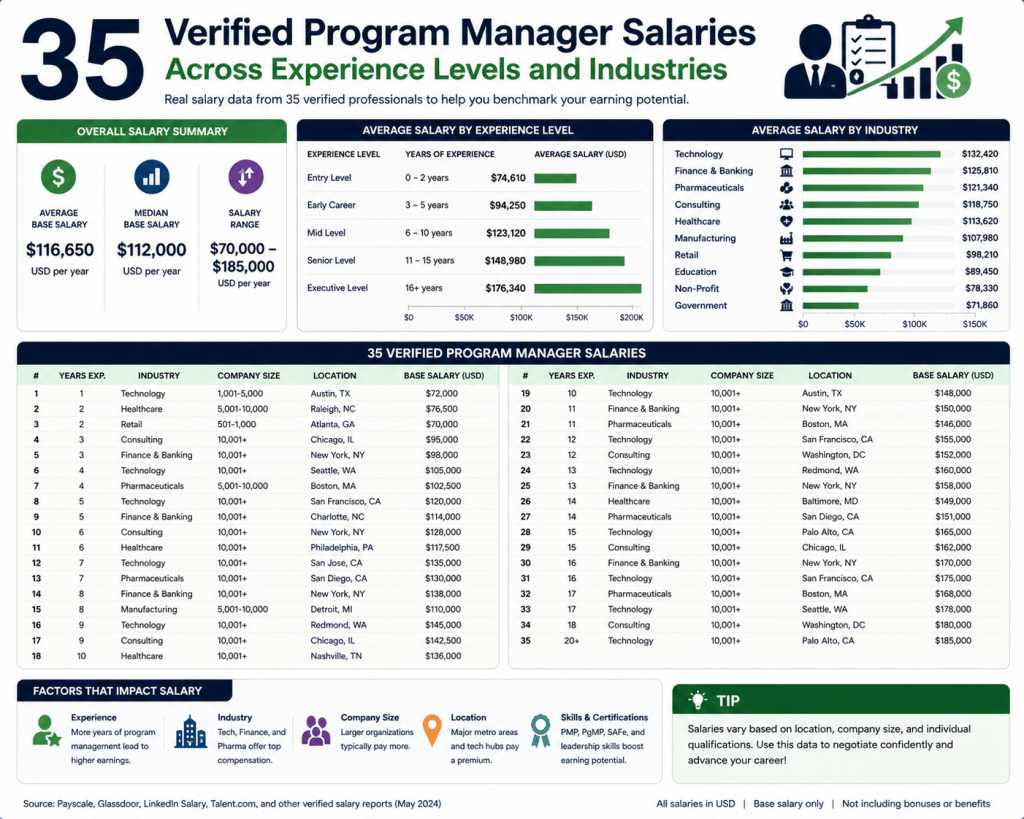
Program manager compensation varies significantly across industries, regions, and organizational maturity levels. Unlike standardized roles with narrow pay bands, program management salaries are influenced by multiple overlapping variables, including technical depth, leadership responsibility, business impact, and the complexity of the programs being managed. As a result, salary outcomes can differ dramatically even between professionals holding similar titles.
At a broad level, program managers tend to fall into mid-to-senior compensation brackets because the role itself sits between execution and strategy. Entry-level compensation typically starts at a competitive level due to the coordination and leadership expectations involved. However, as professionals progress into senior program management roles, compensation increases substantially, reflecting expanded responsibility over enterprise-wide initiatives and cross-functional leadership.
One of the defining characteristics of this role is the wide compensation distribution within the same geographic region. In a single metropolitan area, a junior program manager may earn significantly less than a senior technical program manager overseeing complex engineering initiatives. This spread reflects the importance of experience, technical depth, and organizational influence.
Key Drivers That Influence Program Manager Salary Levels
Several factors determine how much a program manager earns, and these factors often interact rather than operate independently. One of the most influential variables is industry type. Sectors such as technology, financial services, healthcare systems, and enterprise software development typically offer higher compensation due to the complexity and criticality of their programs. These industries rely heavily on program managers to coordinate large-scale transformation initiatives, which increases both responsibility and pay.
Company size also plays a significant role. Large multinational organizations generally offer higher salaries because they manage more complex programs involving multiple regions, teams, and regulatory environments. In contrast, smaller organizations may offer lower base salaries but sometimes compensate with broader responsibilities or faster career progression opportunities.
Geographic location remains another major factor. Urban centers with strong technology or finance ecosystems tend to offer higher compensation due to increased demand and higher living costs. However, remote work has started to shift this pattern, allowing professionals in lower-cost regions to access higher-paying roles tied to major metropolitan salary benchmarks.
Experience level is equally important. Early-career program managers typically earn less because they are still developing the ability to manage complex dependencies and executive-level communication. Mid-career professionals begin to see significant increases as they take ownership of larger programs. Senior program managers who manage enterprise-wide initiatives or multiple program portfolios often command the highest salaries in the field.
Entry-Level Program Manager Compensation Landscape
Entry-level program managers generally fall within the early professional salary band, though expectations for responsibility are still relatively high compared to other entry-level roles. Even at this stage, individuals are expected to manage coordination tasks across multiple teams, track progress, and support senior program managers in execution oversight.
At the lower end of entry-level compensation, salaries reflect limited experience and smaller organizational scope. These roles often involve supporting established program teams rather than independently managing programs. Responsibilities may include maintaining documentation, tracking milestones, coordinating meetings, and assisting with reporting functions.
At the higher end of entry-level compensation, individuals may already be managing smaller programs or leading components of larger initiatives. These roles require stronger communication skills, familiarity with project management tools, and the ability to understand cross-functional workflows. Even at this level, exposure to Agile environments, cloud systems, or enterprise software ecosystems can significantly improve compensation potential.
Entry-level program managers who demonstrate early leadership capability often transition quickly into mid-level roles, where compensation increases more rapidly due to expanded responsibility and decision-making authority.
Mid-Level Program Manager Compensation Growth Stage
Mid-level program managers typically experience the most noticeable compensation growth. At this stage, professionals are expected to independently manage multiple interconnected projects and ensure alignment with broader program objectives. They are no longer just coordinators but active decision-makers responsible for delivery outcomes.
Mid-level compensation reflects this increased responsibility. These professionals often manage cross-functional teams, handle stakeholder communication directly with department leaders, and take ownership of program-level risks and dependencies. Their influence extends beyond execution into planning, prioritization, and strategic alignment.
One of the defining characteristics of this stage is the ability to manage ambiguity. Mid-level program managers are often required to make decisions without complete information, balancing competing priorities and adjusting program direction based on evolving business needs.
Compensation at this level is also influenced by specialization. Program managers with technical expertise, particularly in cloud infrastructure, enterprise software systems, or data platforms, tend to earn higher salaries than those in non-technical environments. This is because technical literacy allows them to engage more deeply with engineering teams and contribute to architectural or design-level discussions.
Mid-level professionals who consistently deliver successful outcomes often progress into senior roles within a relatively short timeframe, especially in fast-growing organizations or industries undergoing rapid transformation.
Senior Program Manager Compensation and Executive-Level Influence
Senior program managers operate at a significantly higher level of responsibility and influence. At this stage, individuals are often accountable for enterprise-wide programs that span multiple departments, regions, or business units. These programs may include digital transformation initiatives, infrastructure modernization efforts, or large-scale product rollouts.
Compensation at this level reflects not only technical and managerial capability but also strategic impact. Senior program managers are expected to contribute directly to business outcomes by ensuring that large-scale initiatives deliver measurable value. They often interact regularly with executive leadership and may participate in strategic planning discussions.
One of the key differentiators at this level is portfolio management capability. Senior program managers may oversee multiple programs simultaneously, ensuring that all initiatives align with organizational priorities and resource constraints. This requires advanced prioritization skills and a deep understanding of business strategy.
Another factor influencing compensation is organizational complexity. In global organizations, senior program managers must coordinate across multiple time zones, regulatory environments, and cultural contexts. This adds significant complexity to program execution and increases overall responsibility.
At the highest end of the spectrum, senior program managers may transition into director-level roles or portfolio leadership positions. These positions involve oversight of entire program ecosystems and often include responsibility for budget allocation, strategic alignment, and organizational transformation initiatives.
Regional Variations in Program Manager Compensation
Geographic location continues to play a significant role in determining compensation levels. Regions with strong technology ecosystems or financial industries tend to offer higher salaries due to increased demand for skilled program managers.
Urban technology hubs typically provide the highest compensation ranges. These areas are home to large technology companies, startups, and enterprise organizations that require complex program management capabilities. Salaries in these regions are often adjusted to reflect higher living costs as well as competitive labor markets.
Mid-tier cities offer moderate compensation levels but may provide a better balance between salary and cost of living. In these regions, program managers may find that their purchasing power is comparable to or even better than in high-cost metropolitan areas, depending on lifestyle factors.
Lower-cost regions generally offer lower nominal salaries, but remote work opportunities have begun to reduce this gap. Many organizations now base compensation on role complexity and company benchmarks rather than strictly local market conditions. This shift has expanded access to higher-paying program management roles for professionals outside traditional urban centers.
Industry-Based Compensation Differences
Industry selection has one of the strongest impacts on program manager compensation. Technology and software companies typically offer the highest salaries due to the fast-paced, innovation-driven nature of their work. These environments require program managers to coordinate complex engineering efforts and manage rapidly evolving product cycles.
Financial services organizations also offer strong compensation due to regulatory complexity and high-stakes operational environments. Program managers in this sector often oversee risk management initiatives, compliance programs, and large-scale system integrations.
Healthcare and life sciences industries present unique challenges due to regulatory requirements and operational sensitivity. Program managers in these environments often manage initiatives related to patient systems, data security, or clinical infrastructure.
Manufacturing and logistics industries rely on program managers to optimize supply chain operations, production systems, and distribution networks. While compensation may vary, the complexity of global operations can still result in competitive pay structures.
Public sector and nonprofit environments generally offer lower compensation compared to private industry roles. However, these positions may provide other benefits such as stability, structured work environments, or mission-driven work.
How Organizational Maturity Impacts Salary Potential
The maturity level of an organization significantly influences program manager compensation. In early-stage companies or startups, program managers may wear multiple hats, combining project management, operations, and even product responsibilities. Compensation may be lower initially, but can increase rapidly as the organization scales.
In mid-sized organizations, program management roles tend to become more structured, with clearer responsibilities and established frameworks. Compensation in these environments is often more standardized but still offers strong growth potential.
In large enterprises, program managers operate within highly structured environments where responsibilities are clearly defined, and programs are large in scale. These organizations typically offer the highest compensation due to the complexity and impact of the work involved.
Career Progression Patterns and Compensation Trajectories
Program management careers typically follow a structured progression from support roles into independent management and eventually into strategic leadership positions. Early-career professionals focus on coordination and execution support. As they gain experience, they transition into managing full programs independently.
Mid-career professionals expand their scope to include multiple projects and cross-functional leadership responsibilities. At this stage, compensation increases significantly due to the expanded complexity of work.
Senior professionals take on enterprise-level responsibility, often influencing organizational strategy and managing large portfolios of work. Compensation at this level reflects both leadership capability and business impact.
Progression is not strictly linear, as specialization, industry shifts, and technical expertise can accelerate advancement. Professionals who develop strong technical depth or leadership visibility often move into higher compensation brackets faster than those following traditional timelines.
External Market Forces Affecting Program Manager Salaries
Broader economic conditions also influence program manager compensation. In high-demand labor markets, salaries tend to increase due to competition for skilled professionals. Technological innovation cycles also impact demand, particularly in areas such as cloud computing, artificial intelligence, and enterprise software systems.
Organizational restructuring and digital transformation initiatives also contribute to increased demand for program managers. As companies adopt new systems and processes, they require experienced professionals to coordinate complex transitions.
Globalization has also expanded the scope of program management roles, increasing demand for professionals who can manage distributed teams and international initiatives. This has added complexity to the role while also expanding compensation opportunities.
The Relationship Between Responsibility and Compensation Growth
A consistent pattern across program management roles is the direct relationship between responsibility and compensation. As individuals take on larger programs, manage higher levels of complexity, and interact more frequently with executive leadership, their earning potential increases accordingly.
This progression reflects the strategic importance of the role within modern organizations. Program managers are not just coordinators but key enablers of business transformation, making their compensation closely tied to organizational impact rather than just task execution.
Career Growth Pathways for Program Managers in Modern Organizations
Program management offers a structured yet highly flexible career path that can evolve in multiple directions depending on specialization, industry, and individual strengths. Unlike roles that follow a narrow linear trajectory, program management allows professionals to move into broader leadership positions, technical specializations, or portfolio-level oversight roles.
At its core, career progression in program management is defined by increasing scope and complexity. Early roles focus on coordination and execution support, while later stages involve strategic decision-making, enterprise-wide leadership, and organizational transformation. As professionals progress, they shift from managing individual programs to influencing entire systems of work across departments or business units.
One of the most important aspects of career growth in this field is the gradual expansion of responsibility. This includes managing larger teams, overseeing more complex dependencies, and interacting more frequently with senior leadership. Each step forward requires not only experience but also the ability to demonstrate measurable business impact.
Entry-Level Program Management Career Development Stage
At the entry level, program management professionals typically begin in supporting roles that focus on coordination, documentation, and operational assistance. These positions are essential for building foundational knowledge of how programs function within an organization. Entry-level professionals often work closely with senior program managers to understand workflows, communication structures, and reporting systems.
During this stage, exposure to multiple projects is common. Entry-level professionals may assist in tracking milestones, organizing meetings, updating dashboards, and ensuring that teams have the information needed to stay aligned. While responsibilities may appear administrative, they provide critical exposure to cross-functional collaboration and program structure.
This stage is also where professionals begin developing core competencies such as communication, organization, and problem-solving. Understanding how different teams interact and how dependencies affect timelines is essential for future advancement.
Career progression at this stage is largely determined by the ability to absorb complexity and demonstrate reliability. Individuals who consistently deliver accurate updates, communicate effectively, and show initiative often move into mid-level roles more quickly.
Mid-Level Program Management Expansion Phase
Mid-level program managers operate with significantly greater autonomy and responsibility. At this stage, professionals are expected to manage entire programs or large components of complex initiatives without direct oversight. This requires a deeper understanding of business objectives and the ability to translate strategy into execution plans.
One of the defining characteristics of mid-level roles is ownership. Program managers are responsible for outcomes rather than just activities. They must ensure that multiple projects remain aligned, risks are managed proactively, and stakeholders are continuously informed of progress.
Mid-level professionals often serve as the primary coordination point between technical teams and business leadership. This requires strong communication skills, especially when translating technical updates into business impact. It also requires the ability to influence without authority, as program managers rarely have direct control over all team members involved in a program.
Another important aspect of this stage is decision-making under uncertainty. Mid-level program managers frequently encounter situations where complete information is not available, requiring them to make informed decisions quickly while balancing competing priorities.
This stage often serves as a turning point in a program management career. Professionals who excel at managing complexity, maintaining alignment, and delivering consistent outcomes are often promoted into senior roles.
Senior Program Management Leadership Stage
Senior program managers operate at a strategic level within organizations. Their responsibilities extend beyond individual programs to include enterprise-wide initiatives that impact multiple departments, regions, or business units. At this level, program management becomes closely aligned with organizational strategy and long-term planning.
One of the key responsibilities at this stage is portfolio awareness. Senior program managers often oversee multiple programs simultaneously, ensuring that all initiatives align with broader business goals. This requires strong prioritization skills and the ability to allocate resources effectively across competing demands.
Another defining feature of senior-level roles is executive interaction. Senior program managers frequently engage with leadership teams, presenting updates, discussing risks, and contributing to strategic decisions. This requires the ability to communicate complex information clearly and confidently at the executive level.
Risk management also becomes more sophisticated at this stage. Instead of managing isolated risks, senior program managers must evaluate systemic risks that could impact multiple programs simultaneously. This requires a broader perspective and the ability to anticipate long-term implications.
Senior program managers are often responsible for driving organizational change. This may include digital transformation initiatives, enterprise system implementations, or large-scale operational improvements. These initiatives require coordination across multiple teams and often involve significant complexity and visibility.
Transitioning Into Program Management Leadership Roles
Beyond senior program management, professionals often transition into leadership roles such as director of program management or portfolio manager. These positions involve overseeing entire program ecosystems and aligning them with organizational strategy.
At this level, the focus shifts from execution oversight to strategic governance. Leaders are responsible for defining program frameworks, establishing governance structures, and ensuring that all programs contribute to business objectives.
Budget ownership also becomes a key responsibility. Program management leaders often oversee financial planning for multiple initiatives, ensuring that resources are allocated efficiently and in alignment with strategic priorities.
Another important aspect of leadership roles is talent development. Program management leaders are often responsible for mentoring and developing junior and mid-level program managers, ensuring that the organization has a strong pipeline of future leaders.
This stage represents a significant shift from operational execution to strategic influence. Success is measured not only by program outcomes but also by organizational impact and long-term value creation.
Specialization Paths Within Program Management Careers
Program management is not a single fixed career path. Many professionals choose to specialize based on industry, technical expertise, or functional focus.
Technical specialization is one common path. Technical program managers focus heavily on engineering, software development, cloud infrastructure, and system architecture. These roles require strong technical literacy and the ability to engage deeply with engineering teams.
Another specialization path is industry-focused program management. Professionals may choose to work specifically in industries such as healthcare, finance, or manufacturing. Each industry has unique regulatory, operational, and technical challenges that shape program management responsibilities.
Some professionals specialize in transformation programs, focusing on organizational change initiatives such as digital transformation, process reengineering, or enterprise modernization. These roles require strong strategic thinking and change management skills.
Others move into portfolio management, where the focus is on overseeing multiple programs and ensuring alignment with organizational strategy. This path requires strong governance, prioritization, and executive communication skills.
Skills That Accelerate Program Management Career Growth
Career advancement in program management is strongly influenced by skill development. One of the most important skills is strategic thinking. Program managers who can connect individual project outcomes to broader business objectives are more likely to advance into senior roles.
Communication skills are equally critical. The ability to clearly articulate complex ideas, present updates to executives, and align cross-functional teams is essential for leadership success.
Technical literacy is increasingly important, especially in technology-driven environments. Understanding system architecture, cloud platforms, and software development processes allows program managers to engage more effectively with engineering teams.
Leadership capability without authority is another key differentiator. Program managers must influence outcomes through collaboration and trust rather than direct control.
Analytical skills also play a significant role in career growth. The ability to interpret data, identify trends, and make informed decisions is essential for managing complex programs.
Adaptability is increasingly valuable in dynamic business environments. Program managers must be able to adjust plans quickly in response to changing priorities or unexpected challenges.
Impact of Industry Evolution on Program Management Careers
The evolution of industries has significantly expanded the role of program managers. Digital transformation has become a primary driver of demand, requiring organizations to manage large-scale system upgrades, cloud migrations, and process automation initiatives.
As organizations adopt more complex technologies, program managers are increasingly required to understand technical systems and infrastructure. This has elevated the importance of technical program management as a specialization.
Globalization has also expanded the scope of program management. Many programs now span multiple countries, requiring coordination across different time zones, regulatory environments, and cultural contexts.
The rise of Agile methodologies has also influenced program management practices. Program managers must now coordinate iterative development cycles, manage cross-team dependencies in Agile environments, and ensure alignment across distributed teams.
Work Environment and Daily Operational Realities
The daily experience of a program manager is highly dynamic. No two days are identical, as responsibilities shift based on program needs, stakeholder interactions, and emerging risks.
A significant portion of time is spent in coordination activities, including meetings with project teams, discussions with stakeholders, and alignment sessions with leadership. These interactions are essential for maintaining program visibility and ensuring consistent communication.
Outside of meetings, program managers focus on reviewing progress data, identifying risks, and adjusting plans as needed. They also spend time preparing reports and summaries for executive audiences.
Problem-solving is a constant aspect of the role. Program managers must frequently address unexpected challenges, resolve conflicts between teams, and adjust timelines or priorities based on changing conditions.
Long-Term Value of Program Management Careers
Program management offers long-term career value due to its strategic importance within organizations. As businesses continue to scale and adopt more complex systems, the need for professionals who can coordinate large initiatives continues to grow.
The role also provides flexibility in career direction. Professionals can move into leadership, technical specialization, or portfolio management depending on their interests and strengths.
Because program management sits at the intersection of strategy and execution, it remains a critical function in nearly every large organization. This ensures continued demand and opportunities for advancement over time.
Evolving Nature of Program Management in Modern Enterprises
Program management continues to evolve alongside technological and organizational change. As businesses become more data-driven and globally distributed, program managers are expected to operate with greater strategic awareness and technical fluency.
The role is increasingly viewed not just as a coordination function but as a core driver of business transformation. This shift continues to elevate both the importance of the role and its long-term career potential across industries and organizational structures.
Conclusion
Program management sits at a unique intersection of strategy, execution, and leadership, which is why it remains one of the most influential roles in modern organizations. Across industries, the position has evolved far beyond simple coordination work. It now represents a critical function responsible for translating business vision into structured, measurable outcomes. When organizations plan large-scale transformation—whether digital modernization, infrastructure expansion, or product ecosystem growth—they rely heavily on program managers to ensure that complexity does not turn into fragmentation.
One of the most consistent themes across program management is variability. No two roles are identical, even when job titles look similar on paper. Compensation, responsibilities, and expectations shift depending on industry, company size, technical environment, and geographic region. This variability is not a weakness of the profession; rather, it reflects the adaptability required to operate in diverse business environments. A program manager in a global technology company managing cloud infrastructure initiatives will have a very different experience from someone coordinating operational programs in a mid-sized manufacturing firm. Yet both operate under the same fundamental principle: aligning multiple moving parts toward a unified objective.
This adaptability is one of the key reasons program management remains in high demand. Modern organizations rarely execute change through isolated projects. Instead, they operate through interconnected systems of work that require synchronization across departments, technologies, and leadership layers. Without program managers, these systems would quickly become disorganized, leading to missed deadlines, duplicated efforts, and misaligned priorities. The role acts as the stabilizing force that ensures strategic intent is preserved throughout execution.
Another important takeaway is that compensation in program management is closely tied to responsibility rather than just tenure. While years of experience matter, what truly influences earning potential is the scope of influence a professional holds. A program manager overseeing a single departmental initiative will naturally earn less than one responsible for enterprise-wide transformation programs spanning multiple business units and geographies. As responsibility expands, so does the expectation for strategic thinking, leadership maturity, and decision-making under uncertainty.
Technical literacy has also become a major differentiator in modern program management careers. As organizations increasingly adopt cloud computing, automation, and data-driven systems, program managers who understand these technologies are better positioned to succeed. This does not necessarily mean they must be engineers, but they must be fluent enough in technical concepts to engage meaningfully with development teams, anticipate risks, and understand architectural constraints. This technical awareness often translates into higher compensation, particularly in technology-driven industries where program complexity is high.
Leadership capability remains another defining factor in long-term success. Program managers are frequently required to lead without formal authority, which means influence becomes more important than control. The ability to align diverse stakeholders, manage competing priorities, and maintain organizational focus is central to the role. Strong program managers are often those who can maintain clarity in environments where ambiguity is the norm. They provide structure without rigidity and direction without micromanagement.
Communication is equally essential, particularly in environments where decisions must be translated across technical and non-technical audiences. A program manager may need to explain system architecture changes to executives in business terms or communicate strategic priorities to engineering teams in operational detail. This dual communication responsibility requires precision, clarity, and the ability to adjust messaging based on audience needs. Poor communication at the program level can quickly cascade into misalignment across multiple projects.
From a career development perspective, program management offers a relatively clear progression path but also allows for multiple directions. Professionals can move upward into senior program management, portfolio leadership, or director-level positions where they oversee entire program ecosystems. Others may choose to specialize in technical domains, becoming highly skilled in areas such as cloud systems, enterprise architecture, or digital transformation. Some transition into adjacent roles such as product leadership or operations management, leveraging their cross-functional experience.
What makes program management particularly valuable as a long-term career is its transferability. The core skills developed in this role—coordination, stakeholder management, risk assessment, strategic planning—are applicable across nearly every industry. This flexibility provides resilience in changing job markets and opens opportunities across sectors that may not be directly related but still require complex coordination of work.
The role also continues to evolve alongside broader business trends. As organizations become more global and digitally integrated, program managers are increasingly required to operate across distributed teams, manage remote collaboration, and navigate different regulatory environments. This global dimension adds complexity but also increases the strategic importance of the role. Programs are no longer confined to a single location or department; they often span continents and involve multiple organizational layers.
At the same time, the rise of Agile and hybrid delivery models has reshaped how program managers operate. Instead of relying solely on traditional linear planning approaches, they now work in environments that emphasize iteration, feedback loops, and continuous delivery. This requires greater flexibility and a deeper understanding of how multiple Agile teams interact within a larger program structure. The ability to balance structured governance with adaptive execution has become a critical skill.
Looking at compensation trends, it is clear that program management remains a financially rewarding career path, particularly for those who develop strong technical, leadership, and strategic capabilities. However, salary growth is not automatic. It is closely tied to the ability to take on larger, more complex programs and demonstrate measurable business impact. Professionals who consistently deliver results in high-visibility initiatives are the ones who progress fastest in both responsibility and compensation.
Ultimately, program management is best understood as a discipline of integration. It is about connecting people, processes, systems, and strategies into a coherent whole. While individual projects may focus on specific outputs, program managers focus on ensuring those outputs work together to create meaningful outcomes. This systems-level perspective is what distinguishes the role from more tactical positions and what makes it essential in modern organizations.
As businesses continue to grow in complexity, the demand for skilled program managers is likely to remain strong. Organizations will continue to rely on professionals who can navigate ambiguity, manage large-scale coordination, and ensure that strategic objectives are successfully executed. For individuals in the field, this represents both an opportunity and a responsibility: the opportunity to work on impactful initiatives and the responsibility to ensure that complexity is managed with clarity, structure, and purpose.