
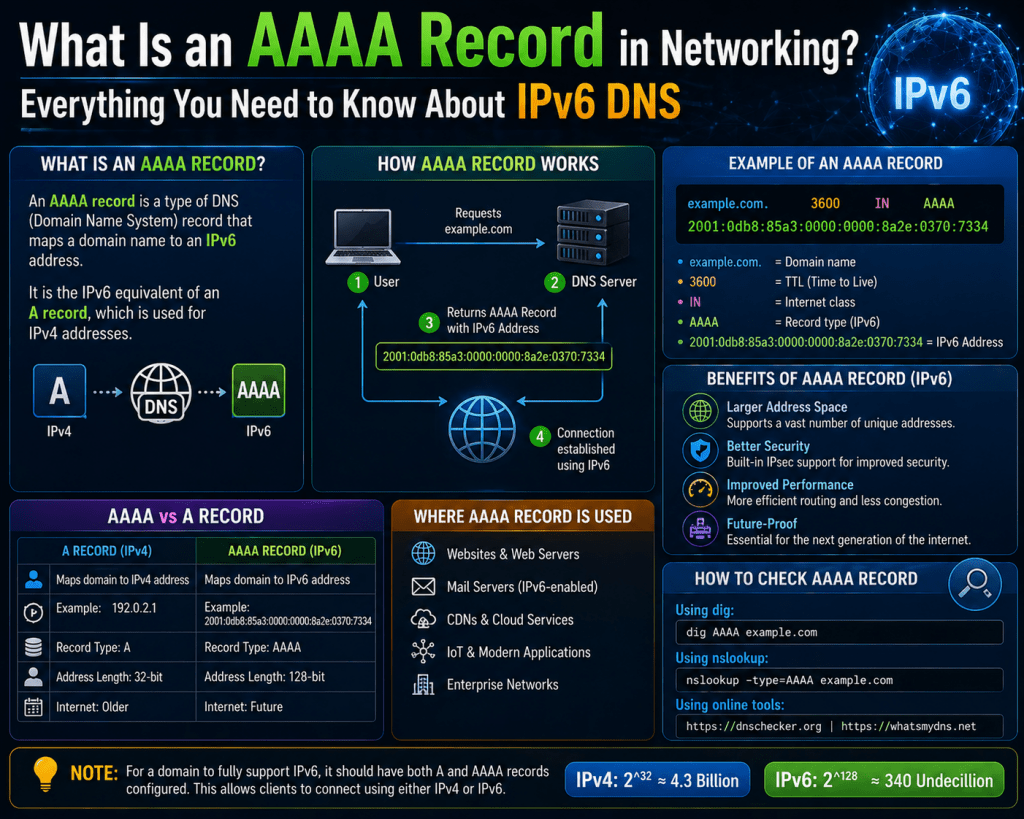
The Domain Name System operates as the translation layer between human-readable naming conventions and machine-level addressing systems. Every interaction across the internet depends on this resolution mechanism to map recognizable identifiers to numerical endpoints that networking equipment can process. Without this translation layer, digital communication would require memorization of complex numerical strings rather than intuitive naming structures.
At its core, DNS functions as a distributed hierarchical database. It allows systems to query and retrieve mapping records that associate identifiers with corresponding network addresses. These mappings are stored in structured resource records, each serving a specific purpose. Among these, address records play a critical role in directing traffic to the correct destination.
The evolution of internet usage has significantly increased the demand for addressable endpoints. As digital ecosystems expanded across consumer devices, enterprise infrastructures, and cloud-based services, the limitations of earlier addressing systems became more evident. This shift created the need for a more scalable and sustainable solution.
Introduction to IP Addressing Evolution
Internet Protocol addressing was initially designed with a finite capacity that seemed sufficient during the early stages of network development. The original system, now referred to as IPv4, uses a 32-bit addressing scheme. This allows for approximately 4.3 billion unique addresses, which once appeared more than adequate.
Over time, the proliferation of connected devices, including mobile systems, embedded technologies, and large-scale infrastructure deployments, rapidly consumed the available address pool. Techniques such as Network Address Translation were introduced to extend usability, but these approaches added complexity and were not a long-term solution.
To address scalability concerns, a new addressing standard was developed. IPv6 introduces a 128-bit address structure, dramatically increasing the number of possible unique addresses. This expansion enables a virtually inexhaustible supply, ensuring that future growth can be accommodated without the constraints experienced in earlier systems.
The structural differences between IPv4 and IPv6 are not limited to address length. IPv6 incorporates enhancements in routing efficiency, auto-configuration capabilities, and overall network performance optimization. These improvements align with the demands of modern networking environments.
Defining AAAA Records in DNS
AAAA records are a specific type of DNS resource record designed to map domain identifiers to IPv6 addresses. Functionally, they serve the same purpose as traditional address records but operate within the IPv6 framework. When a client system initiates a query for a resource, it may request IPv6 resolution if the network stack supports it.
The naming convention of AAAA originates from the structure of IPv6 addresses. Each segment of an IPv6 address consists of hexadecimal values, and the designation reflects the extended length compared to earlier address formats. Despite the technical naming, the operational purpose remains straightforward: enabling resolution to IPv6 endpoints.
When a DNS resolver processes a query, it checks for the presence of AAAA records associated with the requested identifier. If available, the resolver returns the IPv6 address, allowing the client to establish a connection using the newer protocol. This process is seamless and typically invisible to end users.
The coexistence of IPv4 and IPv6 introduces dual-stack environments where both addressing systems operate simultaneously. In such scenarios, DNS may return both A and AAAA records, and the client determines which protocol to use based on its configuration and network conditions.
Comparing A Records and AAAA Records
A records and AAAA records share a common objective but differ in the addressing systems they support. A records map identifiers to IPv4 addresses, while AAAA records map identifiers to IPv6 addresses. This distinction is essential for ensuring compatibility across different network environments.
The structure of an IPv4 address consists of four octets separated by periods, whereas IPv6 addresses are composed of eight groups of hexadecimal values separated by colons. This increased complexity in IPv6 addressing reflects its expanded capacity and design improvements.
In practical deployments, both record types are often configured together. This approach ensures that systems relying on IPv4 can still access resources while enabling IPv6-capable systems to utilize the newer protocol. The selection process is typically handled by the client, who evaluates available options and chooses the most appropriate path.
This dual compatibility is a critical factor in the gradual transition toward IPv6 adoption. It allows organizations to implement IPv6 without disrupting existing services that depend on IPv4 infrastructure.
The Importance of IPv6 Adoption
The transition to IPv6 is not merely a technical upgrade but a necessity driven by resource limitations and evolving network demands. As the number of connected devices continues to grow, the availability of unique addresses becomes increasingly critical.
IPv6 provides a scalable solution that eliminates the need for complex address-sharing mechanisms. This simplification improves network transparency and reduces reliance on intermediary translation processes. Additionally, IPv6 enhances routing efficiency by allowing for more hierarchical addressing structures.
Security considerations also play a role in IPv6 adoption. While not inherently more secure, IPv6 was designed with modern networking requirements in mind, enabling better integration with security protocols. This alignment supports more robust implementations of network protection mechanisms.
The gradual adoption of IPv6 is influenced by infrastructure readiness, compatibility considerations, and operational priorities. While many networks continue to rely on IPv4, the integration of IPv6 through AAAA records represents a forward-looking approach that prepares systems for future requirements.
How AAAA Records Fit into DNS Resolution
When a client initiates a connection request, the system typically performs a DNS lookup to resolve the target identifier into an address. If the client supports IPv6, it may request AAAA records as part of this process. The DNS resolver then searches for matching records within its database.
If a valid AAAA record is found, the resolver returns the associated IPv6 address. The client can then use this address to establish a direct connection with the destination server. This interaction occurs within milliseconds and is a fundamental component of modern network communication.
In environments where both IPv4 and IPv6 are available, resolution strategies may vary. Some systems prioritize IPv6 connectivity, while others evaluate performance metrics before selecting a protocol. This flexibility allows networks to optimize traffic flow based on current conditions.
The integration of AAAA records into the DNS infrastructure requires minimal changes to existing systems. Most modern DNS servers support IPv6 resolution, making it straightforward to implement AAAA records alongside existing configurations.
Structural Characteristics of IPv6 Addresses
IPv6 addresses are significantly longer than their IPv4 counterparts, consisting of 128 bits represented in hexadecimal format. This structure allows for an immense number of unique combinations, ensuring long-term scalability.
Each IPv6 address is divided into segments, typically represented as eight groups of four hexadecimal digits. These segments are separated by colons, creating a format that may appear complex but follows consistent rules. Compression techniques can be applied to simplify representation, such as removing leading zeros or using shorthand notation for consecutive zero segments.
The design of IPv6 addresses supports hierarchical allocation, enabling more efficient routing and aggregation. This structure reduces the size of routing tables and improves overall network performance.
Understanding the format of IPv6 addresses is essential when configuring AAAA records. Accuracy is critical, as even minor errors can lead to resolution failures or misdirected traffic.
Deployment Scenarios for AAAA Records
AAAA records are commonly used in environments that support IPv6 connectivity. These include modern hosting infrastructures, enterprise networks, and cloud-based platforms that prioritize scalability and future readiness.
In dual-stack deployments, AAAA records coexist with traditional address records. This configuration ensures compatibility across a wide range of client systems. As IPv6 adoption increases, the reliance on AAAA records becomes more prominent.
Organizations implementing IPv6 often begin by enabling support within their infrastructure and gradually introducing AAAA records. This phased approach allows for testing and validation without disrupting existing services.
The deployment of AAAA records also involves coordination with network providers and infrastructure components. Ensuring end-to-end IPv6 support is essential for achieving reliable connectivity.
Operational Considerations for AAAA Records
Managing AAAA records requires attention to detail and an understanding of DNS behavior. Factors such as propagation time, caching mechanisms, and record accuracy can impact resolution performance.
Time-to-live settings determine how long DNS responses are cached by clients and intermediate systems. Proper configuration of these values is important when making changes to AAAA records, as it affects how quickly updates are reflected across the network.
Consistency between IPv4 and IPv6 configurations is also important. Discrepancies can lead to connectivity issues or inconsistent user experiences. Maintaining synchronized records ensures that services remain accessible regardless of the protocol used.
Monitoring and validation tools can be used to verify the accuracy of AAAA records and detect potential issues. Regular checks help maintain reliability and prevent disruptions.
Establishing AAAA Records in Modern DNS Architecture
AAAA records are implemented within the DNS infrastructure to map domain identifiers to IPv6 addresses. Their creation follows the same structural principles as other DNS resource records, but the key distinction lies in the address format being stored. Instead of linking to IPv4 endpoints, AAAA records point to 128-bit IPv6 addresses, enabling next-generation network compatibility.
Within a DNS zone file or management interface, each record is defined with a hostname, record type, time-to-live value, and the corresponding IPv6 address. The hostname identifies the domain or subdomain being resolved, while the IPv6 address defines the target endpoint. This relationship allows DNS resolvers to direct traffic efficiently across IPv6-enabled networks.
The configuration process must ensure strict accuracy. IPv6 addresses contain multiple hexadecimal segments, and even a minor deviation can render the record invalid. Unlike IPv4, where human readability is relatively straightforward, IPv6 introduces complexity that requires careful validation during configuration.
Role of AAAA Records in Dual Stack Environments
Modern network infrastructures often operate in dual-stack mode, where both IPv4 and IPv6 protocols are enabled simultaneously. In such environments, AAAA records coexist with traditional address records, allowing systems to support both addressing schemes without disruption.
When a client initiates a DNS query, the resolver may return both IPv4 and IPv6 responses. The client operating system then determines which protocol to prioritize based on internal preferences, network conditions, or application requirements. This decision-making process is transparent to users but critical for maintaining seamless connectivity.
Dual stack deployment ensures backward compatibility while enabling progressive adoption of IPv6. AAAA records play a key role in this transition by allowing services to be reachable through IPv6 without eliminating IPv4 support. This gradual approach minimizes risk and supports operational continuity.
Propagation and DNS Resolution Behavior
Once an AAAA record is created or modified, it must propagate across distributed DNS servers. This propagation process depends on caching mechanisms defined by time-to-live settings. These values determine how long a DNS response is stored by resolvers before being refreshed.
During propagation, different users may receive different results depending on cached data. This is a normal behavior within distributed DNS systems. As caches expire, updated AAAA records gradually replace older values across the network.
Resolution behavior also depends on client capabilities. Systems with IPv6-enabled network stacks will attempt to use AAAA records when available. If IPv6 connectivity is not present, fallback mechanisms may redirect traffic to IPv4-based A records. This ensures continuity of service even in mixed environments.
IPv6 Address Assignment and AAAA Record Alignment
For AAAA records to function correctly, IPv6 addresses must be properly assigned at the network interface level. These addresses are typically provided by internet service infrastructure or internal network allocation systems. Once assigned, they must be accurately reflected in DNS configurations.
Each AAAA record should correspond directly to an active IPv6 interface on a server or network device. Mismatches between DNS records and actual interface assignments can result in failed connections or routing inconsistencies. Maintaining synchronization between infrastructure and DNS configuration is essential for operational stability.
IPv6 addressing also supports multiple address types, including global unicast, link-local, and unique local addresses. AAAA records typically reference globally routable addresses to ensure accessibility across external networks.
TTL Strategy and DNS Performance Optimization
Time-to-live values are a critical component of AAAA record management. TTL defines how long a DNS response is cached by resolvers before a new query is required. Proper configuration of TTL values directly influences update speed and query efficiency.
Lower TTL values allow faster propagation of changes but increase query volume to authoritative DNS servers. Higher TTL values reduce query load but delay the reflection of updates across the network. Selecting an appropriate balance depends on operational requirements and expected change frequency.
During planned infrastructure updates, reducing TTL in advance can minimize propagation delays. Once changes are fully deployed and validated, TTL values can be restored to optimize performance. This approach supports controlled transitions without disrupting connectivity.
Integration with Network Infrastructure Components
AAAA records operate in conjunction with multiple network infrastructure layers, including load balancers, firewalls, and routing systems. Each component must support IPv6 to ensure end-to-end compatibility.
Load balancers may distribute traffic based on IPv6 endpoints, requiring proper configuration of backend systems. Firewalls must be configured to recognize and permit IPv6 traffic flows, as rule sets designed for IPv4 do not automatically apply.
Routing systems must also be capable of handling IPv6 prefixes and forwarding traffic accordingly. Without full infrastructure support, AAAA records may exist but fail to function effectively in real-world scenarios.
Consistency Between DNS Records and Server Configuration
One of the most critical aspects of AAAA record management is ensuring consistency between DNS entries and server-side configurations. The IPv6 address defined in a DNS record must match the address assigned to the corresponding network interface.
Inconsistencies can arise during server migrations, infrastructure scaling, or provider changes. When servers are reassigned new IPv6 addresses, DNS records must be updated accordingly to prevent resolution failures.
Automation tools and configuration management systems are often used to maintain alignment between DNS records and infrastructure states. These systems reduce the likelihood of human error and improve reliability in dynamic environments.
Impact of Caching Layers on AAAA Record Behavior
DNS caching occurs at multiple layers, including operating systems, routers, and recursive resolvers. Each layer stores previously resolved AAAA records to improve performance and reduce query overhead.
While caching improves efficiency, it can also delay visibility of changes. If an AAAA record is updated, cached versions may continue to serve outdated IPv6 addresses until their TTL expires. This behavior must be considered during troubleshooting and deployment planning.
Cache flushing mechanisms exist at various levels but are not always immediately accessible or practical in large-scale environments. As a result, TTL planning becomes the primary method for controlling update propagation.
Security Considerations in AAAA Record Deployment
Although AAAA records themselves do not introduce security mechanisms, their integration into IPv6 networks affects the overall security posture. IPv6 expands the address space significantly, reducing reliance on techniques such as NAT, which can impact network visibility.
Firewall rules must be explicitly configured for IPv6 traffic, as IPv4-based filtering does not automatically apply. Failure to configure appropriate controls may expose services unintentionally.
IPv6 also supports end-to-end connectivity, which can change how security boundaries are enforced. Proper segmentation and access control mechanisms must be implemented to maintain secure communication channels.
Migration Strategies for IPv4 to IPv6 Transition
Transitioning from IPv4-centric environments to IPv6-enabled systems involves phased implementation. AAAA records are introduced alongside existing A records to support incremental adoption.
During migration, systems are tested for IPv6 compatibility while maintaining IPv4 fallback options. This ensures that services remain accessible regardless of client capability. Over time, as IPv6 adoption increases, reliance on IPv4 may decrease.
Migration strategies often involve staged rollout plans, starting with internal systems before extending to public-facing services. This reduces operational risk and allows for controlled validation of IPv6 functionality.
Operational Synchronization Across Distributed Systems
In distributed environments, AAAA records must remain consistent across multiple DNS nodes. Any discrepancy between authoritative servers can lead to inconsistent resolution behavior.
Replication mechanisms ensure that updates are propagated across all DNS instances. Monitoring systems are often used to verify consistency and detect synchronization issues.
High availability architectures further enhance reliability by distributing DNS services across multiple geographic locations. AAAA record consistency across these nodes ensures stable IPv6 resolution globally.
Behavior of AAAA Records in Complex Network Environments
In large-scale networking systems, AAAA records function as part of a multi-layered resolution architecture where DNS queries interact with distributed resolvers, caching nodes, and routing infrastructures. The behavior of these records is influenced not only by DNS configuration but also by the underlying IPv6 connectivity stack across client and server systems.
When a resolution request is initiated, the DNS hierarchy processes queries through recursive and authoritative layers. If an AAAA record exists, it is returned alongside or instead of IPv4-based records, depending on client capability and resolver logic. In dual-protocol environments, selection behavior is often determined by system-level preference mechanisms rather than DNS itself.
This interaction introduces variability in response outcomes, particularly in heterogeneous networks where IPv6 adoption is inconsistent. Some clients may prefer IPv6 pathways, while others default to IPv4 even when AAAA records are present. This dynamic behavior must be considered when designing resilient DNS architectures.
Propagation Dynamics in Distributed DNS Systems
AAAA record propagation is governed by hierarchical caching systems that exist at multiple levels of the DNS ecosystem. Once a record is updated at an authoritative source, it must traverse recursive resolvers, ISP-level caches, and local system caches before achieving full network consistency.
The propagation timeline is not uniform. Instead, it is influenced by time-to-live parameters and the caching policies of intermediate systems. Lower TTL values accelerate update visibility but increase query load, while higher TTL values reduce load but delay propagation.
In global infrastructures, propagation delays can result in temporary inconsistencies where different clients receive different IPv6 addresses for the same domain identifier. This phenomenon is expected behavior within distributed DNS systems and typically resolves as cached entries expire.
Common Failure Scenarios in AAAA Record Resolution
Failures in AAAA record resolution often originate from misalignment between DNS configuration and actual IPv6 network readiness. One frequent issue occurs when an AAAA record points to an address that is not actively assigned to a network interface. In such cases, DNS resolution succeeds, but connection attempts fail at the transport layer.
Another common scenario involves incomplete IPv6 deployment. If a system has an AAAA record configured but lacks proper routing or firewall support for IPv6 traffic, clients attempting IPv6 connections may experience timeouts or fallback delays.
In some environments, partial IPv6 configuration leads to inconsistent behavior where certain services are reachable over IPv6 while others are not. This fragmentation typically results from uneven infrastructure upgrades across network components.
Diagnostic Methodologies for AAAA Record Issues
Troubleshooting AAAA record issues requires systematic validation across DNS, network, and host layers. The first step involves verifying DNS resolution results from authoritative and recursive sources to ensure the correct IPv6 address is being returned.
Subsequent validation focuses on end-to-end connectivity testing. This includes confirming that the resolved IPv6 address corresponds to an active interface and that routing paths exist between client and server networks.
Network-layer diagnostics often involve examining packet flow behavior to determine whether IPv6 traffic is being transmitted, received, or blocked. Absence of packet response typically indicates routing or firewall configuration issues rather than DNS misconfiguration.
At the host level, interface configuration must be validated to ensure IPv6 addresses are correctly bound and active. Any mismatch between DNS records and interface assignments can result in resolution success without functional connectivity.
Impact of Firewall and Security Policies on IPv6 Resolution
Firewall configurations play a critical role in AAAA record functionality because IPv6 traffic requires explicit rule definitions. Unlike the IPv4 environment,s where NAT-based filtering may exist, IPv6 often relies on direct address-based filtering.
If firewall rules are not updated to include IPv6 allowances, AAAA-based connections may fail even when DNS resolution is correct. This creates a scenario where IPv4 traffic functions normally while IPv6 traffic is silently blocked.
Security policies must therefore be explicitly extended to support IPv6 protocols. This includes access control lists, stateful inspection rules, and intrusion prevention mechanisms. Failure to align security configurations with AAAA record deployment can result in asymmetric connectivity behavior.
Performance Considerations in IPv6-Enabled DNS Systems
The introduction of AAAA records influences performance dynamics in DNS resolution workflows. IPv6 queries may introduce additional lookup paths depending on client configuration and resolver logic.
In optimized environments, parallel querying techniques are used where both A and AAAA records are requested simultaneously. This allows clients to select the fastest available response based on network conditions.
Latency differences between IPv4 and IPv6 pathways can also influence routing decisions. In some cases, IPv6 may provide more efficient routing due to simplified header structures and improved hierarchical addressing. In other cases, IPv4 may still outperform IPv6 depending on infrastructure maturity.
Performance tuning in DNS systems often involves balancing query efficiency, caching behavior, and protocol preference to ensure consistent response times across mixed environments.
Large-Scale Deployment of AAAA Records
In enterprise-grade or global-scale systems, AAAA records are deployed across distributed DNS zones to support high availability and redundancy. This requires careful coordination between DNS architecture and underlying infrastructure provisioning.
Each deployment must ensure that IPv6 addresses are consistently assigned across redundant systems. Load-balanced environments often require synchronized AAAA records across multiple backend nodes to prevent uneven traffic distribution.
Automation frameworks are commonly used to manage large-scale AAAA record deployments. These systems ensure that changes in infrastructure are reflected in DNS configurations without manual intervention, reducing the risk of configuration drift.
Synchronization Challenges in Dynamic Infrastructure
Modern infrastructure environments often rely on dynamic provisioning systems where servers are created, modified, or decommissioned frequently. In such contexts, AAAA record management becomes more complex due to the need for real-time synchronization.
If DNS records are not updated in alignment with infrastructure changes, stale AAAA entries may persist, leading to failed connections or misrouted traffic. This issue is particularly common in elastic scaling environments where IPv6 addresses are dynamically assigned.
To mitigate this, systems often integrate DNS updates directly into provisioning workflows. This ensures that AAAA records are created, modified, or removed in parallel with infrastructure lifecycle events.
Caching Inconsistencies and Resolution Conflicts
Caching layers can introduce temporary inconsistencies in AAAA record resolution. When changes occur, some resolvers may continue serving outdated IPv6 addresses until their cache entries expire.
These inconsistencies can lead to intermittent connectivity issues, especially in distributed user environments. The same domain may resolve differently depending on the geographic or network location of the client.
Resolution conflicts are typically self-correcting over time but can be minimized through careful TTL management and cache-aware deployment strategies. Reducing TTL before major changes helps ensure faster convergence across resolver networks.
IPv6 Routing Implications for AAAA Records
AAAAs are directly dependent on IPv6 routing infrastructure. Unlike IPv4 systems that may rely heavily on NAT, IPv6 supports end-to-end routing, which changes how traffic flows are established.
Routing inefficiencies or missing IPv6 routes can result in partial or complete failure of AAAA-based connectivity. Proper configuration of routing tables and prefix advertisements is essential to ensure reachability.
In global environments, routing optimization plays a key role in ensuring that IPv6 traffic follows efficient paths between clients and servers. Poor routing design can negate the performance benefits of IPv6 even when AAAA records are correctly configured.
Operational Stability in Mixed Protocol Networks
Maintaining stability in environments where both IPv4 and IPv6 coexist requires consistent DNS alignment and infrastructure parity. AAAA records must accurately reflect the state of IPv6 readiness across all service endpoints.
Operational instability often arises when one protocol is updated without corresponding updates to the other. This can lead to inconsistent user experiences depending on which protocol is selected during resolution.
Ensuring parity between A and AAAA records is a foundational requirement for stable dual-stack operations. This includes synchronized updates, consistent monitoring, and coordinated infrastructure changes.
Scalability Considerations for Future Network Growth
AAAA records support long-term scalability by enabling virtually unlimited address space utilization. This eliminates constraints associated with IPv4 exhaustion and supports the continued expansion of connected systems.
Scalability is further enhanced by hierarchical address allocation in IPv6, which reduces routing complexity and improves aggregation efficiency. This structure supports large-scale deployments without the fragmentation issues common in older systems.
As network ecosystems continue to expand, AAAA records will play an increasingly central role in ensuring that services remain reachable, efficient, and adaptable to future infrastructure demands.
Final Perspective on AAAA Records and IPv6-Driven DNS Evolution
The evolution of DNS infrastructure reflects a broader transformation in global networking, where scalability, address availability, and protocol efficiency have become central design considerations. AAAA records sit at the intersection of this transformation, functioning as the mapping mechanism that enables domain resolution over IPv6 networks. Their significance is not limited to technical implementation but extends into the structural future of how connectivity is maintained across increasingly distributed systems.
At a fundamental level, AAAA records represent a response to the exhaustion limitations inherent in earlier IPv4-based architectures. While IPv4 provided a functional foundation for the early internet, its 32-bit addressing scheme imposed a finite constraint that became increasingly problematic as digital ecosystems expanded. The introduction of IPv6, and consequently AAAA records within DNS, resolved this constraint by introducing a vastly expanded address space. This shift eliminated the scarcity model and replaced it with a framework capable of supporting exponential growth in connected devices.
However, the importance of AAAA records extends beyond simple address expansion. They play a crucial role in enabling protocol coexistence during transitional phases of network evolution. Modern infrastructures rarely operate in purely IPv6 environments; instead, they function in dual-stack configurations where both IPv4 and IPv6 coexist. In such environments, AAAA records ensure that systems capable of IPv6 communication can utilize modern routing pathways without disrupting legacy compatibility. This dual availability creates resilience, allowing systems to adapt dynamically based on client capabilities and network conditions.
From an architectural standpoint, AAAA records also contribute to more efficient routing behavior. IPv6 was designed with hierarchical aggregation in mind, reducing the fragmentation of routing tables and improving overall network efficiency. When AAAA records are correctly implemented, they allow traffic to traverse optimized IPv6 paths that can, in many cases, reduce latency and improve throughput compared to older routing structures. This is particularly relevant in large-scale distributed environments where routing efficiency directly impacts service performance and user experience.
The operational behavior of AAAA records is tightly coupled with DNS caching mechanisms and propagation dynamics. Because DNS is inherently distributed, changes to AAAA records do not take effect instantaneously across all systems. Instead, they propagate gradually as cached entries expire and are refreshed. This introduces a temporal dimension to DNS consistency, where different clients may observe different resolution outcomes during transitional periods. While this behavior is expected, it requires careful planning in environments where continuity and predictability are critical.
In addition to propagation considerations, AAAA records must be managed in alignment with underlying infrastructure states. IPv6 addresses assigned to systems must remain consistent with DNS configurations to prevent resolution mismatches. In dynamic environments where resources are frequently created, scaled, or decommissioned, maintaining this alignment becomes a non-trivial operational challenge. Automated synchronization mechanisms are often employed to ensure that DNS records reflect real-time infrastructure states, reducing the risk of stale or invalid mappings.
Security considerations also influence the role of AAAA records within modern networks. IPv6 removes reliance on certain legacy constructs such as NAT, which previously provided an indirect layer of obscurity in IPv4 networks. As a result, IPv6 environments expose endpoints more directly, requiring explicit security configurations at the firewall and routing levels. AAAA records, by enabling IPv6 connectivity, necessitate corresponding updates in security policy frameworks to ensure that access control mechanisms remain consistent across both protocol stacks. This alignment is essential for maintaining secure communication channels in dual-protocol environments.
Performance characteristics associated with AAAA records are influenced by both network design and client-side behavior. In some cases, IPv6 pathways may offer reduced latency due to simplified packet structures and more efficient routing hierarchies. In other scenarios, IPv4 may still provide faster or more stable connectivity depending on infrastructure maturity. As a result, modern systems often implement parallel resolution strategies, allowing clients to evaluate multiple protocol options and select the most efficient path dynamically. This adaptive behavior contributes to overall system resilience and performance optimization.
Scalability remains one of the most significant long-term advantages associated with AAAA records and IPv6 adoption. The virtually unlimited address space provided by IPv6 eliminates the structural constraints that previously limited network expansion. This allows for more granular allocation of addresses, improved segmentation of network domains, and more efficient hierarchical design. AAAA records serve as the operational interface that connects this expanded addressing capability to user-facing domain resolution systems, making them a critical component of scalable network architecture.
Despite their advantages, AAAA records also introduce operational complexity, particularly in mixed-protocol environments. Ensuring consistent behavior across IPv4 and IPv6 requires careful coordination between DNS configuration, routing infrastructure, firewall policies, and application-level behavior. Any inconsistency between these layers can result in unpredictable connectivity patterns or partial service availability. As such, AAAA record management must be treated as part of a broader systems engineering discipline rather than an isolated DNS configuration task.
In long-term network evolution, AAAA records are expected to become increasingly dominant as IPv6 adoption continues to grow. While IPv4 remains widely used due to legacy dependencies, the structural limitations of the protocol make continued reliance unsustainable in the long term. AAAA records provide the transitional and eventually primary mechanism through which domain resolution will operate in a fully IPv6-enabled environment. Their role will likely expand as more systems shift toward IPv6-native architectures, reducing dependency on backward compatibility layers.
Ultimately, AAAA records represent more than a technical DNS record type. They are a foundational component of internet scalability, protocol evolution, and global connectivity design. Their implementation reflects a broader shift toward future-ready infrastructure capable of supporting continuous growth without structural limitations. As networks continue to expand in complexity and scale, AAAA records will remain integral to ensuring that domain resolution mechanisms evolve in step with underlying protocol advancements, maintaining seamless connectivity across an increasingly interconnected digital landscape.
In practical deployments, their value becomes especially clear in environments that demand high availability and global redundancy. Content delivery architectures, distributed application frameworks, and large-scale enterprise systems all benefit from the ability to route traffic efficiently across multiple network layers. AAAA records support this by allowing IPv6-capable clients to establish direct connections that bypass some of the limitations associated with older translation-based mechanisms.
As automation, containerization, and ephemeral infrastructure continue to define modern computing models, DNS records, including AAAA entrie,s increasingly function as dynamic configuration artifacts rather than static entries. This shift reinforces the importance of synchronization, observability, and lifecycle management within DNS operations. The long-term trajectory of networking points toward a model where IPv6 becomes the default transport layer, and AAAA records evolve from optional enhancements into standard resolution components embedded in every scalable system design.