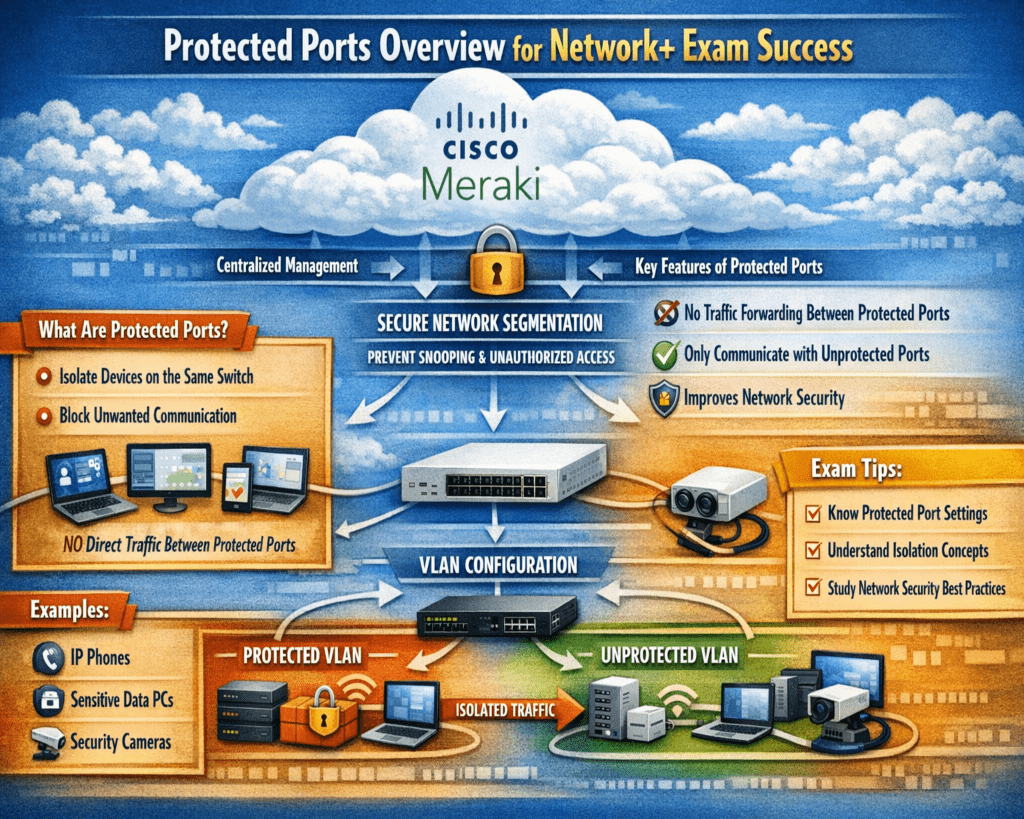
Protected ports represent a Layer 2 switching feature designed to enforce intra-VLAN isolation between selected interfaces. In traditional Ethernet switching, all devices connected to a common VLAN share the same broadcast domain, meaning that any frame destined for broadcast, multicast, or unknown unicast is forwarded to all participating ports. While this design supports efficient communication, it also introduces a structural limitation in environments where endpoint-to-endpoint communication is undesirable or poses security risks. Protected ports address this limitation by modifying the forwarding behavior at the switch level, ensuring that traffic originating from one protected interface cannot be directly forwarded to another protected interface within the same VLAN. This mechanism operates independently of routing or higher-layer filtering and is enforced entirely within the switching hardware, allowing for high-speed isolation without performance degradation. The fundamental concept is not to restrict all communication but to selectively prevent peer-to-peer interaction while maintaining access to shared infrastructure services such as default gateways, authentication servers, and centralized resources. This creates a controlled communication topology within a shared Layer 2 segment, balancing operational simplicity with security enforcement.
Layer 2 Switching Behavior and Broadcast Domain Fundamentals
To fully understand the significance of protected ports, it is necessary to examine how Layer 2 switching operates within a VLAN. When multiple devices are connected to a switch and assigned to the same VLAN, they are placed within a single broadcast domain. This means that certain types of traffic, particularly broadcasts and unknown destination frames, are flooded to all ports within that VLAN. The switch maintains a MAC address table to map known destination addresses to specific interfaces, allowing unicast traffic to be forwarded efficiently. However, when two devices attempt to communicate within the same VLAN, the switch normally permits direct frame forwarding between their respective ports without any additional filtering unless specific controls are applied. This default behavior assumes trust among endpoints within the same broadcast domain, which is not always appropriate in modern network environments. Protected ports introduce an additional rule within this forwarding logic. When a port is designated as protected, the switch alters its forwarding decision process so that frames sourced from one protected interface cannot be delivered directly to another protected interface. This restriction applies regardless of whether the traffic is unicast, multicast, or broadcast in nature. The MAC address table continues to function normally, but forwarding is selectively blocked based on port classification rather than destination resolution alone. This subtle modification allows for granular control without disrupting the fundamental switching process.
Communication Isolation Within Shared VLAN Environments
In many enterprise networks, VLANs are used to group devices that share functional or administrative similarities. However, within a single VLAN, there may still be a requirement to isolate individual endpoints from one another. For example, user workstations, virtual machines, or shared hosting environments may all exist within the same subnet for addressing simplicity, yet require strict separation at the data link layer. Without additional controls, any device within that VLAN can directly communicate with any other device, which increases the risk of lateral movement in the event of a compromise. Protected ports introduce a communication boundary within this shared environment by preventing direct frame exchange between selected interfaces. This means that even though devices share the same IP subnet and broadcast domain, they are unable to directly exchange Layer 2 traffic if both are configured as protected ports. The isolation is enforced at the switching layer, meaning that it does not rely on software agents or endpoint configuration. This makes the mechanism transparent to end devices while still providing deterministic enforcement. The result is a segmented communication model where endpoints can access shared services but are prevented from interacting directly with each other.
Forwarding Logic Modification in Protected Port Environments
The internal forwarding logic of a switch is modified when protected ports are enabled. Under normal conditions, when a frame arrives at a switch interface, the device examines the destination MAC address and consults its forwarding table to determine the appropriate egress port. If the destination is unknown, the frame is flooded across all ports within the same VLAN. However, when protected ports are involved, an additional condition is introduced into this decision-making process. If both the source and destination interfaces are classified as protected, the switch suppresses forwarding between them. This suppression applies even if the destination MAC address is known and correctly mapped in the MAC address table. The enforcement occurs after the switching decision is made but before frame transmission, ensuring that isolation is maintained without disrupting MAC learning or table updates. Importantly, this behavior does not affect communication between a protected port and a non-protected port. Frames originating from a protected interface can still be forwarded to non-protected interfaces, and vice versa, provided no additional filtering mechanisms are in place. This selective enforcement allows network designers to isolate endpoints while preserving access to shared infrastructure resources.
Role of Protected Ports in Security-Oriented Network Design
From a security architecture perspective, protected ports serve as a lightweight internal segmentation mechanism. In environments where multiple endpoints share the same VLAN, the risk of lateral movement becomes a critical concern. Attackers who gain access to one device may attempt to discover and interact with other devices on the same subnet using techniques such as ARP scanning, MAC table probing, or broadcast-based enumeration. Protected ports reduce the effectiveness of these techniques by preventing direct Layer 2 communication between endpoints. Even if a malicious device attempts to send frames to another endpoint within the same VLAN, the switch will not forward the traffic if both interfaces are protected. This reduces internal visibility and limits the ability of compromised systems to map or interact with neighboring devices. However, it is important to recognize that protected ports are not a comprehensive security control. They do not inspect payload data, enforce authentication, or prevent higher-layer attacks. Instead, they function as a structural constraint within the switching fabric, reducing unnecessary exposure at Layer 2. For this reason, they are typically deployed as part of a broader security strategy that includes routing controls, access policies, and endpoint protection mechanisms.
Operational Context and Deployment Scenarios
Protected ports are commonly deployed in access-layer switching environments where endpoint devices connect directly to the network infrastructure. In such scenarios, simplicity and performance are important considerations, and administrators often prefer solutions that do not require complex routing or firewall configurations. Protected ports provide a way to enforce isolation without modifying IP addressing schemes or introducing additional VLAN segmentation. This is particularly useful in environments where maintaining a single subnet is desirable for administrative or operational reasons. Examples include shared office environments, virtualized infrastructure hosts, and environments where multiple tenants or users coexist on the same physical switching platform. In these contexts, protected ports allow administrators to maintain a flat Layer 2 topology while still enforcing strict endpoint separation. The feature is typically applied selectively to access ports rather than trunk or uplink interfaces, as those interfaces are responsible for carrying aggregated traffic between network segments or devices. Applying protected behavior to infrastructure links would disrupt essential communication paths and is generally avoided in standard network design practices.
Traffic Flow Characteristics in Protected Port Configurations
Once protected port behavior is enabled, traffic flow within the VLAN becomes partially segmented. Frames originating from a protected interface are still processed by the switch in the same manner as any other frame, including MAC address learning and VLAN tagging behavior. However, when the destination interface is also classified as protected, the switch suppresses forwarding of that frame. This applies consistently across unicast, multicast, and broadcast traffic types. As a result, even network-wide broadcasts are not delivered between protected endpoints. Despite this restriction, communication with non-protected interfaces remains unaffected. This ensures that endpoints can still reach critical network services such as default gateways, DNS resolvers, and centralized authentication systems. The traffic model created by protected ports is therefore asymmetric in nature. Isolation exists only between protected peers, while communication with infrastructure remains open. This asymmetry is intentional and allows for flexible deployment without requiring major architectural changes.
MAC Address Learning and Switching Table Behavior
Protected port configuration does not interfere with MAC address learning processes within the switch. When a frame is received on a protected interface, the switch still records the source MAC address and associates it with that interface in its forwarding table. This ensures that the switch maintains accurate knowledge of device locations within the network. However, even if the destination MAC address is known and mapped to another protected interface, the switch will not forward the frame if both interfaces are protected. This separation between learning and forwarding is a key aspect of protected port functionality. It ensures that isolation does not disrupt normal switching intelligence while still enforcing communication boundaries. The MAC table continues to evolve dynamically as devices transmit traffic, but forwarding decisions are filtered through the protected port rule set before transmission occurs.
Design Considerations for Scalable Network Environments
In large-scale environments, protected ports must be applied consistently to maintain predictable behavior across multiple switching devices. Inconsistent configuration can lead to unexpected communication patterns and complicate troubleshooting efforts. Network designers must clearly define which interfaces are intended for endpoint isolation and ensure that infrastructure ports are explicitly excluded from protected behavior. This requires careful planning of interface roles and consistent configuration standards across access-layer switches. Additionally, because protected ports operate at Layer 2, they should be evaluated in conjunction with higher-layer segmentation strategies to ensure that the overall network architecture remains coherent. While protected ports reduce the need for additional VLAN segmentation in some cases, they do not replace structured network design principles. Instead, they provide a complementary mechanism that enhances isolation within existing VLAN frameworks without introducing significant overhead or complexity.
Protected Port Implementation in Enterprise Switching Environments
Protected port implementation in enterprise switching environments focuses on enforcing intra-VLAN isolation at the access layer without altering the overall VLAN structure or IP addressing scheme. In most real-world deployments, switches operate as aggregation points for large numbers of endpoint devices that share common broadcast domains. Within these domains, devices are typically able to communicate freely at Layer 2 unless additional controls are applied. Protected ports introduce a targeted restriction model where communication between selected interfaces is blocked while preserving connectivity to non-protected infrastructure. The implementation process is fundamentally a configuration-based modification of interface behavior, meaning that the switch continues to operate normally while enforcing additional forwarding constraints at the port level. This allows network administrators to introduce isolation gradually and selectively, rather than requiring a redesign of the entire network topology. The feature is commonly applied in environments where endpoint separation is required for security, compliance, or operational segmentation purposes while maintaining a simplified Layer 2 design.
Establishing a Controlled Baseline Before Isolation Enforcement
Before applying protected port configuration, it is essential to establish a controlled and predictable baseline of network behavior. This involves ensuring that all target interfaces are functioning correctly within their assigned VLAN and that normal communication between endpoints is operational. In a typical scenario, multiple access ports are assigned to the same VLAN, placing connected devices within a shared broadcast domain. At this stage, devices should be able to exchange traffic without restriction, including unicast communication between endpoints and broadcast propagation across the VLAN. Establishing this baseline is critical because it provides a reference point for verifying the effects of isolation once protected port behavior is enabled. Without this step, it becomes difficult to distinguish between pre-existing connectivity issues and changes introduced by configuration. In addition to connectivity verification, it is also important to confirm that IP addressing is correctly assigned and that devices are reachable at Layer 3. This ensures that any subsequent communication failures can be accurately attributed to Layer 2 isolation rather than IP configuration errors or routing issues.
Interface Role Definition and Access Layer Configuration Strategy
Protected port implementation relies heavily on proper interface role definition within the switching environment. Access layer interfaces are typically used for endpoint connectivity, including user devices, servers, or virtual machines. These interfaces are configured in access mode to ensure that they belong to a single VLAN and do not carry multiple tagged VLANs simultaneously. This simplifies traffic handling and ensures predictable behavior at Layer 2. Once interfaces are placed into access mode, they are assigned to a specific VLAN that represents their broadcast domain. At this stage, all devices connected to these interfaces are logically grouped from a switching perspective. Protected port behavior is then applied selectively to interfaces where isolation is required. This selective approach allows administrators to maintain a flat VLAN structure while still enforcing segmentation at the port level. Infrastructure interfaces, such as uplinks or trunk connections, are typically excluded from protected configuration because they are responsible for carrying aggregated traffic between switches or network segments. Misclassification of these interfaces could result in unintended isolation of critical network paths.
Mechanics of Enabling Protected Port Behavior on Switch Interfaces
Enabling protected port behavior involves modifying the forwarding characteristics of specific switch interfaces. When an interface is designated as protected, the switch updates its internal forwarding logic to include additional filtering rules for traffic originating from that port. This modification does not affect VLAN membership, IP configuration, or MAC address learning processes. Instead, it introduces a conditional forwarding restriction that is evaluated during frame transmission. When a frame is received on a protected interface and destined for another interface within the same VLAN, the switch checks whether the destination interface is also protected. If both interfaces are protected, the switch suppresses forwarding of the frame. This rule applies consistently across all traffic types, including unicast, multicast, and broadcast. The configuration can be applied to multiple interfaces simultaneously, allowing for scalable isolation of groups of endpoints. Once enabled, the behavior is enforced at the hardware switching level, ensuring minimal latency and consistent performance regardless of traffic volume.
Impact of Protected Ports on Layer 2 Forwarding Behavior
The introduction of protected ports modifies the standard Layer 2 forwarding model by introducing an additional decision layer within the switching process. Under normal conditions, switches rely on MAC address tables to determine the appropriate egress interface for a given destination address. This process is highly efficient and forms the basis of Ethernet switching. However, protected port behavior adds a supplementary condition that overrides standard forwarding decisions when both source and destination interfaces are classified as protected. In such cases, the switch prevents frame transmission even if the destination MAC address is known and correctly mapped. This ensures that isolation is enforced independently of MAC table accuracy or state. The MAC learning process continues uninterrupted, meaning that the switch still builds and maintains an accurate representation of device locations within the network. However, forwarding decisions are filtered through the protected port rule set before transmission occurs, creating a separation between learning and forwarding logic. This architectural separation is what enables protected ports to function without disrupting overall switching performance.
Validation of Isolation Through Controlled Connectivity Testing
After implementing protected port configuration, validation is required to confirm that isolation behavior is functioning as intended. This typically involves testing communication between endpoints that were previously able to exchange traffic. If both endpoints are connected to protected interfaces, direct Layer 2 communication should fail. This failure indicates that the switch is correctly enforcing forwarding restrictions between protected ports. At the same time, communication between a protected interface and a non-protected interface should remain operational, confirming that isolation is selective rather than absolute. This dual validation approach is important because it verifies both enforcement and exception behavior. Additionally, switch-level inspection commands can be used to confirm interface status and verify that protected mode is active. These verification steps ensure that the configuration has been applied correctly and that the switch is enforcing the intended communication policy. Without proper validation, misconfigurations may go unnoticed and result in unexpected network behavior.
Traffic Segmentation Model Created by Protected Ports
Protected ports create a segmented traffic model within a single VLAN by introducing directional communication restrictions. In this model, protected interfaces are isolated from each other but are able to communicate with non-protected infrastructure. This results in a hybrid communication structure where endpoints are partially segmented without requiring multiple VLANs. The segmentation is strictly enforced at Layer 2, meaning that it operates independently of IP routing or higher-layer protocols. Broadcast traffic is also affected by this segmentation model, as broadcasts originating from protected interfaces are not delivered to other protected interfaces. However, non-protected interfaces continue to receive broadcast traffic normally. This selective propagation of traffic allows for controlled information dissemination within the network while preventing unnecessary peer-to-peer exposure. The result is a communication environment where endpoints operate within a shared subnet but are logically isolated at the switching layer.
Operational Considerations in Large-Scale Network Deployments
In large-scale network environments, protected port configuration must be applied consistently to ensure predictable behavior across multiple switching devices. Inconsistent configuration can lead to fragmented communication patterns and complicate troubleshooting efforts. As networks scale, maintaining clear documentation of interface roles becomes increasingly important. Administrators must distinguish between endpoint-facing interfaces and infrastructure-facing interfaces to avoid accidental isolation of critical network paths. Protected ports are typically applied at the access layer, where endpoint devices connect directly to the network. They are not commonly used on distribution or core layer interfaces, as these are responsible for interconnecting network segments and must maintain full communication capabilities. Proper planning ensures that protected ports enhance security without interfering with essential network operations.
Interaction Between Protected Ports and Network Services
Protected ports do not interfere with access to centralized network services such as DHCP, DNS, or authentication systems. This is because these services are typically located on non-protected infrastructure interfaces. When a device connected to a protected port communicates with a network service, the traffic is forwarded normally by the switch as long as the destination interface is not also protected. This ensures that endpoint isolation does not disrupt essential network functionality. The selective nature of protected ports allows them to coexist with standard service delivery mechanisms without requiring additional configuration changes at higher network layers. This compatibility is one of the key reasons why protected ports are widely used in environments that require both security and operational simplicity.
Scalability and Consistency in Protected Port Deployment Models
Scalability is an important factor when deploying protected ports across multiple switches in an enterprise environment. Consistent configuration ensures that isolation behavior remains uniform regardless of physical location or switch model. This consistency simplifies network management and reduces the likelihood of configuration errors. In scalable deployments, protected ports are often applied using standardized templates or configuration baselines to ensure uniform behavior across all access-layer devices. This approach reduces operational complexity and ensures that endpoint isolation is maintained even as the network grows. Consistency also plays a key role in troubleshooting, as predictable behavior makes it easier to identify and resolve connectivity issues.
Role of Protected Ports in Access Layer Security Design
Within access layer security design, protected ports serve as a foundational control mechanism for limiting endpoint interaction. While they do not provide deep packet inspection or identity-based authentication, they establish a structural barrier at Layer 2 that reduces unnecessary communication paths. This makes them particularly useful in environments where simplicity and performance are prioritized alongside basic security enforcement. By restricting direct communication between endpoints, protected ports reduce the risk of internal reconnaissance and lateral movement. They also complement other access layer controls such as port security, VLAN segmentation, and authentication mechanisms. Together, these controls form a layered security model that enhances overall network resilience.
Advanced Design Strategies for Protected Ports in Complex Networks
Protected ports become significantly more valuable when viewed not as a standalone feature but as part of a broader Layer 2 and Layer 3 design strategy. In complex enterprise environments, networks are rarely flat or static. They consist of multiple access layers, distribution layers, and core layers, each serving a specific function. Within this hierarchy, the access layer is where endpoints connect, and it is also where most lateral movement risks originate. Protected ports operate at this exact layer, making them a precise tool for enforcing endpoint isolation without introducing architectural disruption. Rather than redesigning VLANs or introducing additional routing boundaries, protected ports allow administrators to enforce communication constraints directly at the edge. This approach aligns with modern network design principles that emphasize minimizing unnecessary communication paths while preserving operational simplicity. By strategically applying protected ports to endpoint-facing interfaces, organizations can reduce exposure within shared VLANs while maintaining centralized control through non-protected infrastructure interfaces.
Integration With Broader Network Segmentation Techniques
Protected ports are most effective when integrated with other segmentation techniques rather than used in isolation. VLAN segmentation remains the primary method for dividing broadcast domains, while routing policies enforce separation between different subnets. Protected ports operate within this framework by adding a secondary layer of control inside a VLAN. This layered approach allows for granular segmentation without excessive fragmentation of network design. For example, an organization may use VLANs to separate departments or functional groups while using protected ports to isolate individual devices within those groups. This reduces the need for creating multiple VLANs for every isolation requirement, which can complicate routing and increase administrative overhead. Additionally, protected ports complement access control mechanisms such as authentication-based network access, where devices are verified before being allowed to connect. Once connected, protected ports ensure that even authorized devices cannot directly interact with each other unless explicitly permitted. This combination of techniques creates a defense-in-depth model that addresses both access control and communication control.
Behavioral Analysis of Traffic in Protected Port Topologies
Understanding how traffic behaves in a protected port topology is essential for effective deployment. In such environments, traffic flows are intentionally constrained to follow specific paths. When a device connected to a protected port sends a frame, the switch processes it normally but evaluates the destination interface before forwarding. If the destination is another protected port, the frame is dropped. If the destination is a non-protected interface, the frame is forwarded without restriction. This creates a hub-and-spoke communication model where endpoints communicate indirectly through shared infrastructure rather than directly with each other. Broadcast traffic follows similar rules, meaning that broadcast frames generated by one protected port are not delivered to other protected ports. This reduces broadcast visibility among endpoints, limiting opportunities for network discovery and reconnaissance. However, infrastructure devices continue to receive broadcast traffic, ensuring that essential network functions such as address resolution and service discovery remain operational. This controlled traffic flow model is predictable and can be incorporated into network design documentation to ensure clarity in communication paths.
Security Implications and Threat Mitigation Capabilities
Protected ports play a significant role in mitigating internal network threats by limiting the ability of compromised devices to interact with other endpoints. In many attack scenarios, once an attacker gains access to a network, the next step is to explore the local environment and identify additional targets. This often involves scanning for active devices, attempting to establish connections, or exploiting vulnerabilities in neighboring systems. Protected ports disrupt this process by preventing direct Layer 2 communication between endpoints. Even if an attacker attempts to send traffic to another device within the same VLAN, the switch will not forward the frames if both interfaces are protected. This effectively isolates the compromised device from its peers, reducing the potential impact of the breach. However, it is important to recognize that protected ports do not eliminate all attack vectors. Traffic directed toward non-protected infrastructure remains unaffected, meaning that attackers may still attempt to exploit centralized services. For this reason, protected ports should be used in conjunction with other security measures such as access controls, monitoring systems, and endpoint protection solutions.
Comparison With Alternative Isolation Mechanisms
Protected ports are one of several mechanisms available for achieving endpoint isolation. Alternative approaches include private VLANs, access control lists, and firewall-based segmentation. Each of these methods has its own advantages and limitations. Private VLANs provide more granular control by defining isolated and community VLAN structures, allowing for more complex communication patterns. However, they also introduce additional configuration complexity and may not be supported on all devices. Access control lists operate at higher layers and can filter traffic based on IP addresses or protocols, but they require more detailed configuration and can impact performance if not optimized. Firewall-based segmentation provides deep inspection and policy enforcement but typically operates at Layer 3 or above, introducing additional processing overhead. Protected ports, in contrast, offer a simple and efficient solution for basic isolation requirements. They are easy to configure, require minimal resources, and operate entirely at the switching layer. This makes them particularly suitable for scenarios where lightweight isolation is sufficient, and performance is a priority.
Design Pitfalls and Common Misconfigurations
Despite their simplicity, protected ports can lead to unintended consequences if not configured correctly. One common pitfall is applying protected port configuration to infrastructure interfaces such as uplinks or trunk ports. Doing so can disrupt communication between switches or prevent access to critical network services. Another issue arises when administrators assume that protected ports block all traffic, including communication with non-protected devices. This misunderstanding can lead to incorrect troubleshooting conclusions when endpoints remain able to access certain resources. Additionally, inconsistent configuration across multiple switches can create unpredictable behavior, where some endpoints are isolated while others are not. To avoid these issues, it is essential to clearly define interface roles and apply protected port configuration only to appropriate endpoints. Thorough testing and validation should be conducted after implementation to ensure that communication behaves as expected. Documentation of configuration standards and consistent application across the network also helps prevent errors and maintain operational stability.
Operational Monitoring and Troubleshooting Techniques
Monitoring and troubleshooting protected port environments require an understanding of both switching behavior and isolation rules. When communication issues arise, administrators must determine whether the problem is caused by protected port configuration or other factors such as VLAN mismatches, IP addressing errors, or physical connectivity issues. One effective approach is to test communication paths systematically, starting with known working connections and gradually isolating the point of failure. For example, if two endpoints cannot communicate, verifying whether both interfaces are configured as protected can quickly identify whether isolation is the cause. Switch-level inspection tools provide visibility into interface status and configuration, allowing administrators to confirm whether protected mode is active. Logging and monitoring systems can also be used to track traffic patterns and identify anomalies. Because protected ports operate at Layer 2, traditional Layer 3 troubleshooting tools may not reveal the root cause of communication issues. Therefore, a combination of interface-level inspection and controlled testing is required to accurately diagnose problems.
Scalability Considerations in Large Enterprise Deployments
As networks grow in size and complexity, scalability becomes a critical factor in the deployment of protected ports. In large enterprise environments, hundreds or even thousands of endpoints may require isolation. Applying protected port configuration manually to each interface can be time-consuming and prone to error. To address this challenge, organizations often use standardized configuration templates or automated deployment tools to ensure consistency across all access-layer switches. This approach reduces administrative overhead and ensures that isolation policies are applied uniformly. Scalability also involves considering the impact of protected ports on network performance and manageability. Because the feature operates at the hardware level, it does not introduce significant processing overhead, making it suitable for high-density environments. However, administrators must ensure that configuration management practices are robust enough to handle large-scale deployments without introducing inconsistencies. Proper planning and automation are key to achieving scalable and reliable protected port implementations.
Role in Multi-Tenant and Shared Infrastructure Environments
Protected ports are particularly valuable in multi-tenant environments where multiple users or organizations share the same physical network infrastructure. In such scenarios, maintaining strict separation between tenants is essential for both security and compliance. While VLANs can provide basic segmentation, they may not be sufficient when tenants share the same VLAN for operational reasons. Protected ports adl layer of isolation by preventing direct communication between tenant endpoints. This ensures that one tenant cannot access or interfere with another tenant’s devices, even if they are part of the same broadcast domain. The feature is also useful in environments where temporary or untrusted devices are connected, such as guest networks or testing environments. By isolating these devices at the port level, administrators can reduce the risk of unauthorized interaction with other systems. This makes protected ports a flexible tool for managing shared infrastructure while maintaining security boundaries.
Future Relevance of Protected Ports in Evolving Network Architectures
As network architectures continue to evolve, the role of protected ports remains relevant due to their simplicity and effectiveness. Modern networks increasingly incorporate virtualization, cloud integration, and software-defined networking concepts. While these technologies introduce new methods of segmentation and control, the need for efficient Layer 2 isolation at the access layer persists. Protected ports provide a straightforward solution that complements more advanced technologies without requiring significant changes to existing infrastructure. Their ability to enforce isolation at the hardware level ensures that they remain efficient even as network demands increase. In environments where performance, simplicity, and reliability are critical, protected ports continue to serve as a practical tool for controlling communication within shared VLANs. By integrating this feature into a broader network design strategy, organizations can enhance security while maintaining operational efficiency and scalability.
Conclusion
Protected ports provide a focused and efficient way to control communication within a shared Layer 2 environment without requiring structural changes to VLAN design or IP addressing. In networks where simplicity often leads to multiple devices sharing the same broadcast domain, the risk of unrestricted peer-to-peer communication becomes a significant concern. By introducing selective isolation at the switch interface level, protected ports reduce unnecessary exposure between endpoints while still allowing access to essential infrastructure. This balance between restriction and accessibility is what makes the feature particularly valuable in practical deployments where both usability and security must coexist.
The strength of protected ports lies in their operational simplicity. Unlike more complex segmentation techniques that require additional configuration layers or policy definitions, protected ports rely on a straightforward rule set that is easy to understand and implement. Once enabled, the switch enforces isolation consistently at the hardware level, ensuring that performance is not compromised. This makes the feature suitable for high-density environments where large numbers of devices must be managed efficiently. The absence of dependency on higher-layer processing also reduces the likelihood of bottlenecks, allowing networks to maintain predictable performance even as traffic volumes increase.
Another important aspect is the role protected ports play in limiting lateral movement within a network. In many real-world scenarios, threats do not originate from external sources alone but also from compromised internal devices. When endpoints can freely communicate with each other, the potential for an issue to spread across the network increases significantly. Protected ports address this by restricting direct interaction between devices, effectively containing potential threats within a limited scope. This does not eliminate all risks, but it reduces the number of pathways available for exploitation, making it more difficult for malicious activity to propagate.
At the same time, protected ports maintain essential connectivity by allowing communication with non-protected interfaces. This ensures that devices can still access shared services such as gateways, authentication systems, and centralized applications. The design avoids creating isolated silos that would disrupt normal operations. Instead, it introduces a controlled communication pattern where endpoints rely on designated infrastructure rather than direct peer interaction. This approach aligns well with modern network principles that emphasize centralization and controlled access rather than open connectivity.
The feature also fits naturally into layered security strategies. It does not replace other controls such as authentication, monitoring, or higher-layer filtering, but it complements them by addressing a specific aspect of network behavior. By enforcing isolation at Layer 2, protected ports reduce reliance on more complex mechanisms to achieve similar results. This allows other security measures to focus on their intended roles without being burdened by basic traffic separation tasks. The result is a more balanced and efficient security architecture where each component contributes to overall protection without unnecessary overlap.
In environments where multiple users or systems share infrastructure, protected ports offer a practical solution for maintaining boundaries without increasing administrative complexity. Creating separate VLANs for every isolation requirement can quickly become difficult to manage, especially in large networks. Protected ports provide an alternative by enabling segmentation within existing VLANs. This reduces the need for additional routing configurations and simplifies network design while still achieving the desired level of separation. The ability to apply the feature selectively also allows administrators to adapt it to different scenarios without affecting the entire network.
Consistency in deployment is an important factor in realizing the full benefits of protected ports. When applied uniformly across access-layer switches, the behavior becomes predictable and easier to manage. Inconsistent configuration can lead to confusion and unexpected communication patterns, which can complicate troubleshooting efforts. Establishing clear guidelines for where and how protected ports should be used helps maintain stability and ensures that the intended isolation is consistently enforced. This becomes increasingly important as networks grow and evolve.
It is also essential to understand the limitations of protected ports. While they effectively control Layer 2 communication, they do not provide visibility into traffic content or enforce policies based on user identity or application type. As a result, they should not be viewed as a complete security solution. Instead, they serve as a foundational control that addresses a specific aspect of network behavior. When combined with other technologies such as access control mechanisms and monitoring systems, they contribute to a comprehensive approach that covers multiple layers of the network.
From an operational perspective, protected ports reduce the need for reactive measures by proactively limiting communication paths. This shift from reactive to preventive control is valuable in maintaining network integrity. By defining clear boundaries at the point of connection, administrators can minimize the likelihood of issues arising from unintended interactions between devices. This proactive approach not only enhances security but also simplifies network management by reducing the number of variables that must be considered during troubleshooting.
As network environments continue to evolve, the importance of efficient and scalable isolation mechanisms remains consistent. While new technologies introduce additional capabilities, the fundamental need to control how devices communicate at the most basic level does not change. Protected ports address this need in a way that is both practical and effective, making them a relevant tool in a wide range of scenarios. Their ability to integrate seamlessly with existing infrastructure ensures that they can be adopted without significant disruption, allowing organizations to enhance their network design incrementally.
In summary, protected ports offer a targeted method for controlling communication within shared VLANs, combining simplicity, efficiency, and effectiveness. They reduce unnecessary exposure between endpoints, support centralized access models, and integrate well with broader security strategies. While not a standalone solution, they play a crucial role in shaping how traffic flows within a network, contributing to a more controlled and resilient environment.