A desktop support technician is responsible for maintaining the usability and reliability of end-user computing systems across an organization. This includes a wide range of responsibilities such as diagnosing hardware failures, resolving software errors, managing user accounts, supporting operating system installations, and ensuring that devices remain connected to network resources. In modern IT environments, this role is no longer limited to simple break-fix tasks. Instead, it has evolved into a critical operational function that ensures business continuity in digital workplaces.
Organizations today depend heavily on distributed computing systems, cloud-based applications, and hybrid work environments. As a result, desktop support technicians are expected to manage issues that span across physical devices and virtual environments. They often serve as the first point of contact for technical issues, meaning they must quickly assess problems, identify root causes, and implement effective solutions under time pressure. Their work directly affects productivity, as even minor system failures can disrupt workflows across entire departments.
Beyond troubleshooting, desktop support technicians also handle system setup and configuration tasks. This includes installing operating systems, deploying software applications, configuring security settings, and ensuring that devices comply with organizational policies. They may also assist in onboarding new employees by preparing their workstations and ensuring all required tools and access permissions are properly configured.
The Expanding Scope of Responsibilities in IT Support Roles
The responsibilities of desktop support technicians have expanded significantly as technology ecosystems have become more complex. In earlier IT environments, support tasks were primarily focused on standalone computers and basic network connectivity. Today, technicians must work across interconnected systems that include cloud services, remote access platforms, mobile devices, and virtual desktops.
One of the most important aspects of this expanded role is user support across multiple platforms. Technicians are often required to troubleshoot issues involving Windows, macOS, Linux, and mobile operating systems. Each platform has its own architecture, configuration methods, and common failure points. This requires a broad understanding of system behavior and the ability to adapt troubleshooting techniques accordingly.
In addition, modern organizations rely heavily on networked environments where devices continuously interact with servers, cloud applications, and centralized authentication systems. Desktop support technicians must therefore understand how network connectivity affects application performance and user access. Issues such as DNS misconfigurations, IP conflicts, and authentication failures often fall within their scope of responsibility.
Security has also become a major component of desktop support work. Technicians must ensure that endpoints comply with organizational security policies, including antivirus protection, firewall configurations, encryption standards, and access controls. They may also assist in responding to security incidents by isolating affected systems and assisting cybersecurity teams with initial diagnostics.
Factors Influencing Desktop Support Technician Salaries
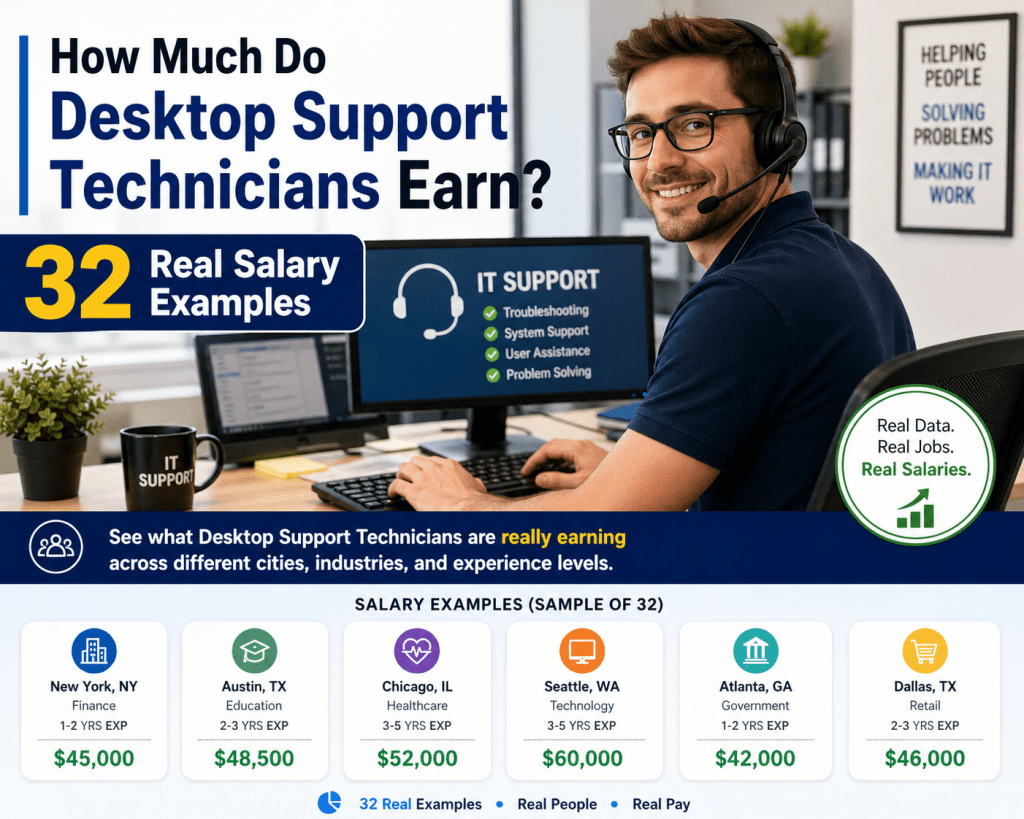
Salary levels in desktop support roles are influenced by a combination of technical, geographic, and organizational factors. One of the most significant determinants is experience level. Entry-level technicians typically earn less because their responsibilities are limited to basic troubleshooting and routine maintenance tasks. As professionals gain experience, they develop deeper technical expertise, which allows them to handle more complex issues and command higher compensation.
Geographic location also plays a major role in salary differences. Areas with higher costs of living generally offer higher salaries to offset living expenses. Urban centers and technology hubs tend to provide more competitive compensation packages due to higher demand for skilled IT professionals. In contrast, smaller cities or rural regions may offer lower salaries but also have reduced living costs.
Industry type further influences compensation structures. Sectors such as finance, healthcare, and government often require more advanced IT support due to strict regulatory requirements and high system reliability needs. These industries typically offer higher salaries to attract qualified professionals capable of maintaining secure and stable environments.
Company size is another important factor. Large enterprises with complex IT infrastructures often employ dedicated support teams and offer higher salaries to retain skilled technicians. Smaller organizations may have limited budgets and rely on generalist IT staff, resulting in lower compensation levels.
Entry-Level Desktop Support Compensation and Career Entry Dynamics
Entry-level desktop support positions serve as the starting point for many IT professionals. At this stage, individuals are primarily responsible for handling basic technical issues such as password resets, software installation support, printer configuration, and simple hardware troubleshooting. These tasks require foundational technical knowledge but do not typically involve advanced system administration responsibilities.
Because entry-level roles are designed to be accessible to individuals with limited professional experience, salaries at this stage are generally modest. However, these positions provide essential hands-on experience that forms the foundation for career advancement. Many professionals use this stage to develop problem-solving skills, gain familiarity with enterprise systems, and learn how IT support workflows operate within organizations.
Entry-level technicians also begin to develop communication skills that are critical in IT support environments. Since they frequently interact with end users who may have limited technical knowledge, the ability to explain solutions clearly and professionally becomes an important part of the job. This combination of technical and interpersonal skills is essential for long-term success in the field.
Mid-Level Desktop Support Responsibilities and Skill Development
As technicians gain experience, they transition into mid-level roles where responsibilities become more complex and technically demanding. At this stage, professionals are expected to handle advanced troubleshooting scenarios that require deeper system knowledge and analytical thinking.
Mid-level technicians often deal with issues involving network connectivity, enterprise software failures, and multi-device integration problems. They may also support virtual environments, remote access systems, and cloud-based applications. This requires a stronger understanding of how different IT components interact within an organizational infrastructure.
In addition to technical responsibilities, mid-level professionals often contribute to system maintenance and improvement initiatives. This may include assisting with software rollouts, participating in infrastructure upgrades, and helping optimize IT support processes. Their role becomes more proactive rather than purely reactive, as they begin to identify recurring issues and implement long-term solutions.
Salary increases at this stage reflect the expanded scope of responsibilities. Organizations value technicians who can handle more complex tasks independently, reducing the workload on senior IT staff and improving overall operational efficiency.
Advanced Technical Expertise and Senior-Level Responsibilities
Senior desktop support technicians operate at a higher level of technical and organizational responsibility. They are often tasked with managing critical incidents that affect large groups of users or essential business systems. Their role requires advanced diagnostic skills, strong problem-solving abilities, and the capacity to work under pressure.
At this level, technicians are expected to understand enterprise IT architecture, including directory services, virtualization platforms, and large-scale network environments. They often collaborate with system administrators, network engineers, and cybersecurity teams to resolve complex issues that span multiple domains.
Senior technicians also play a role in mentoring junior staff. They provide guidance on troubleshooting techniques, system configurations, and best practices for IT support operations. This mentorship function contributes to team efficiency and helps maintain consistent support quality across the organization.
In many cases, senior desktop support professionals are involved in planning and implementing IT policies. This includes contributing to decisions about software deployment strategies, endpoint security measures, and infrastructure improvements. Their experience provides valuable insight into how systems perform under real-world conditions.
Geographic Salary Variation and Economic Influence
Geographic location remains one of the most influential factors affecting desktop support salaries. In regions with high concentrations of technology companies and corporate headquarters, demand for skilled IT professionals is significantly higher. This increased demand leads to more competitive salary structures.
Urban environments often offer higher compensation due to the complexity and scale of IT operations. However, these regions also tend to have higher living costs, which can offset salary advantages. Professionals must therefore consider both income and cost of living when evaluating job opportunities.
In contrast, smaller cities and rural areas may offer lower salaries but provide a more balanced cost-of-living ratio. While compensation may be lower in absolute terms, purchasing power can remain competitive depending on local economic conditions.
Industry Demand and Organizational Dependence on IT Support
Different industries rely on IT support to varying degrees, which directly impacts desktop support compensation. Industries with high data sensitivity or operational dependency on technology tend to invest more heavily in IT support infrastructure.
In finance-related environments, system uptime and data integrity are critical. Even minor disruptions can have significant financial consequences, making reliable IT support essential. Similarly, healthcare organizations depend on stable IT systems to manage patient data and ensure continuity of care.
Government institutions also maintain large and complex IT infrastructures that require ongoing support. These environments often involve legacy systems combined with modern technologies, creating unique technical challenges for support teams.
Organizations in these sectors typically offer higher salaries to attract technicians capable of managing complex and sensitive environments. The increased responsibility associated with these roles contributes directly to compensation levels.
Work Environment Complexity and Technical Demand
The complexity of the IT environment within an organization plays a significant role in determining salary levels. Environments with diverse systems, multiple operating platforms, and hybrid infrastructures require more advanced technical expertise.
Technicians working in such environments must be capable of diagnosing issues across interconnected systems. This includes understanding how changes in one component can affect overall system performance. As complexity increases, so does the value of technicians who can navigate these systems effectively.
Organizations with highly integrated IT environments often prioritize hiring experienced technicians who can work independently and manage complex issues without extensive supervision. This increases salary potential for professionals with advanced technical skills and problem-solving capabilities.
Early Career Growth and Professional Development Pathways
Career progression in desktop support typically follows a structured pathway from entry-level roles to more specialized IT positions. Early career development focuses on building foundational technical knowledge and gaining hands-on experience with enterprise systems.
As professionals progress, they begin to specialize in specific areas such as network support, systems administration, or cybersecurity. This specialization allows them to move beyond general desktop support responsibilities and into higher-paying technical roles.
Continuous learning plays a critical role in career advancement. Technicians who actively expand their technical knowledge and adapt to new technologies are better positioned for long-term growth within the IT industry.
Mid-Level Desktop Support Technician Growth and Salary Progression
As desktop support technicians move beyond entry-level responsibilities, their role shifts from basic troubleshooting to more complex technical problem-solving. Mid-level professionals are expected to operate with greater independence, handling incidents that require deeper diagnostic reasoning and broader system knowledge. At this stage, they are no longer simply reacting to user issues; instead, they begin to identify patterns, anticipate recurring failures, and contribute to improving IT support efficiency across the organization.
Mid-level technicians typically manage more critical support cases involving network instability, enterprise application failures, authentication issues, and system performance degradation. These problems often require them to analyze logs, interpret system behavior, and collaborate with other IT departments, such as network engineering or systems administration. Their work becomes increasingly analytical, requiring a structured approach to identifying root causes rather than applying temporary fixes.
Salary growth at this stage reflects the increased responsibility and technical competence required. Organizations are willing to pay more for technicians who can resolve complex issues efficiently, reduce downtime, and improve end-user satisfaction. This stage is often where professionals begin to see significant financial progression in their IT careers, especially if they have developed strong troubleshooting frameworks and cross-platform expertise.
Advanced Troubleshooting and Diagnostic Thinking
One of the defining characteristics of mid-level desktop support roles is the ability to perform advanced troubleshooting. This involves moving beyond surface-level symptom resolution and instead focusing on identifying underlying system failures. Technicians must evaluate multiple layers of infrastructure, including hardware, operating systems, network configurations, and application dependencies.
For example, a performance issue in a business application may not originate from the application itself but from network latency, insufficient system resources, or misconfigured authentication services. Mid-level technicians are expected to systematically isolate variables and determine the true source of the problem. This requires not only technical knowledge but also structured analytical thinking.
In many organizations, these professionals also begin to document recurring issues and contribute to internal knowledge bases. This helps reduce resolution times for future incidents and improves overall IT support efficiency. Their ability to recognize patterns across multiple incidents becomes a valuable asset to the organization.
Expanded Role in Network and Infrastructure Support
As desktop support technicians gain experience, their exposure to network infrastructure increases significantly. While they may not fully transition into network engineering roles, they are often responsible for diagnosing and resolving common connectivity issues that affect end users.
This includes problems related to IP configuration, DNS resolution, DHCP assignment, VPN connectivity, and wireless network stability. Mid-level technicians must understand how these systems interact and how misconfigurations in one area can cascade into broader connectivity failures.
They may also work closely with network administrators to escalate more complex infrastructure issues. In doing so, they act as the first layer of technical analysis, helping to narrow down potential causes before escalation. This collaboration improves response times and ensures that higher-level engineers can focus on deeper architectural problems.
Understanding infrastructure behavior also allows mid-level technicians to contribute to system optimization. They may identify bottlenecks in network performance or inefficiencies in device configuration that impact overall productivity.
Operating System Expertise Across Multiple Platforms
A key requirement for mid-level desktop support technicians is strong proficiency across multiple operating systems. Unlike entry-level roles that may focus primarily on a single platform, mid-level professionals are expected to support a diverse environment that includes Windows, macOS, Linux, and mobile operating systems.
Each operating system presents unique challenges in terms of configuration, security, and troubleshooting. Windows environments often involve Active Directory integration, group policy management, and registry-level diagnostics. macOS systems require familiarity with Apple-specific tools and system architecture, while Linux environments demand command-line proficiency and an understanding of file permissions, processes, and system services.
Mobile device support adds another layer of complexity, particularly in organizations that use bring-your-own-device policies. Technicians must ensure that mobile devices comply with security standards while maintaining access to corporate resources.
This multi-platform expertise significantly increases a technician’s value within an organization and directly contributes to higher salary potential.
Enterprise Application and Software Support Responsibilities
Mid-level desktop support technicians frequently handle issues related to enterprise applications used across departments. These applications may include productivity suites, customer relationship management systems, financial software, and collaboration platforms.
Supporting these systems requires more than basic installation knowledge. Technicians must understand how applications interact with operating systems, databases, and network services. They must also be capable of diagnosing application-specific errors that may arise due to configuration issues, permission restrictions, or compatibility conflicts.
In many cases, they work closely with application administrators or vendor support teams to resolve complex software issues. This collaboration often involves analyzing error logs, testing configurations, and implementing controlled fixes in production environments.
The ability to support enterprise applications effectively is a key differentiator in salary progression, as it demonstrates both technical depth and business awareness.
Role in IT Incident Management and Escalation Processes
Mid-level technicians play an important role in incident management frameworks within IT departments. They are often responsible for triaging incoming support tickets, prioritizing issues based on severity, and determining whether escalation is required.
This requires strong judgment skills, as improper escalation can overwhelm higher-level support teams, while delayed escalation can prolong system downtime. Technicians must quickly assess the impact of an issue on business operations and decide on the appropriate response path.
They also contribute to incident resolution documentation, ensuring that all steps taken during troubleshooting are properly recorded. This information is essential for post-incident analysis and helps improve future response strategies.
In more mature IT environments, incident management processes are highly structured, and mid-level technicians are expected to follow defined workflows while still exercising independent technical judgment.
Introduction to System Administration Concepts
At the mid-level stage, desktop support technicians begin to develop familiarity with system administration principles. While they may not fully transition into administrative roles, they often interact with systems that require an administrative-level understanding.
This includes user account management, group policy configuration, system imaging, software deployment, and access control management. In many organizations, desktop support technicians assist system administrators by handling routine administrative tasks or supporting large-scale deployments.
This exposure provides valuable experience that can serve as a pathway to more advanced IT roles. Technicians who demonstrate strong administrative capabilities are often considered for promotions into systems administration or infrastructure support positions.
Security Awareness and Endpoint Protection Responsibilities
Cybersecurity awareness becomes increasingly important at the mid-level stage of desktop support. Technicians are often responsible for ensuring that endpoints comply with organizational security policies and are protected against common threats.
This includes verifying antivirus functionality, ensuring operating system updates are applied, and monitoring for signs of malware or unauthorized access. They may also assist in responding to security incidents by isolating affected systems and collecting initial diagnostic information.
In some organizations, desktop support technicians are involved in enforcing security policies such as encryption requirements, password standards, and access restrictions. Their role in maintaining endpoint security makes them an important part of the organization’s overall cybersecurity posture.
Understanding security fundamentals also enhances career growth, as cybersecurity knowledge is highly valued in modern IT environments.
Remote Support and Distributed Work Environments
The rise of remote and hybrid work models has significantly changed the responsibilities of desktop support technicians. Mid-level professionals are now expected to support users who are not physically present in the office environment.
Remote support requires proficiency with remote access tools, virtual desktop infrastructure, and cloud-based collaboration platforms. Technicians must be able to diagnose and resolve issues without direct physical access to devices, which increases the complexity of troubleshooting.
They must also be skilled in guiding users through technical steps remotely, often requiring clear communication and patience. This aspect of the role places greater emphasis on interpersonal skills alongside technical expertise.
Organizations value technicians who can efficiently support distributed workforces, as remote operations have become a standard part of modern business structures.
Ticketing Systems and Workflow Optimization
Mid-level desktop support technicians frequently work with IT service management platforms that track and organize support requests. These systems help prioritize tasks, assign responsibilities, and monitor resolution timelines.
At this stage, technicians are expected to manage their workload efficiently, ensuring that high-priority incidents are addressed promptly while maintaining overall ticket resolution targets. They may also identify inefficiencies in support workflows and suggest improvements to streamline operations.
Understanding ticketing systems is essential for maintaining structured IT support processes and ensuring accountability within teams. It also provides valuable data that organizations use to evaluate performance and optimize resource allocation.
Communication Skills and Cross-Department Collaboration
As technicians advance in their careers, communication becomes increasingly important. Mid-level desktop support professionals frequently interact with non-technical users, IT managers, system administrators, and external vendors.
They must be able to translate technical issues into understandable language for end users while also communicating detailed technical information to IT teams. This dual communication requirement is essential for effective problem resolution and collaboration.
Strong communication skills also contribute to better user satisfaction and improved efficiency in resolving support requests. Organizations often consider communication ability as a key factor in promotion decisions.
Preparation for Senior-Level IT Roles
The mid-level stage serves as a critical transition point toward senior IT positions. Technicians who excel at this level often begin preparing for roles in systems administration, network engineering, cybersecurity, or IT infrastructure management.
This preparation involves developing deeper technical expertise, gaining exposure to enterprise systems, and building experience with complex IT environments. It also includes refining problem-solving methodologies and expanding knowledge of system architecture.
Professionals who successfully navigate this stage position themselves for significantly higher salary brackets and more specialized career paths in the IT industry.
Long-Term Salary Growth Potential
Salary progression at the mid-level stage is strongly influenced by performance, specialization, and technical versatility. Technicians who consistently handle complex issues, contribute to system improvements, and develop cross-platform expertise tend to experience faster salary growth.
Organizations reward individuals who reduce system downtime, improve operational efficiency, and contribute to IT stability. As a result, mid-level desktop support roles often represent the most dynamic phase of salary progression within the IT support career path.
Senior Desktop Support Technician Responsibilities and Strategic IT Value
At the senior level, desktop support technicians operate as highly experienced technical professionals who go far beyond routine troubleshooting. Their role is no longer centered on simple ticket resolution; instead, it involves strategic support of enterprise IT environments, stabilization of critical systems, and guidance of less experienced staff. Senior technicians often serve as the bridge between frontline support and specialized IT departments such as systems engineering, network operations, and cybersecurity teams.
In practical terms, senior desktop support professionals handle the most complex and high-impact technical incidents. These may include widespread system outages, authentication failures affecting multiple departments, or deep-rooted performance issues that require cross-system analysis. Their decisions directly influence organizational productivity, making their role essential to operational continuity.
Unlike earlier career stages, senior technicians are expected to think in terms of system-wide impact rather than isolated user problems. They assess how infrastructure components interact and how failures propagate across environments. This requires a strong understanding of enterprise architecture, including identity management systems, virtualization platforms, endpoint security frameworks, and hybrid cloud integrations.
Leadership and Mentorship Within IT Support Teams
A defining characteristic of senior desktop support roles is leadership responsibility. While they may not always hold formal managerial titles, senior technicians often guide junior and mid-level staff through complex troubleshooting scenarios. This mentorship role is essential in maintaining consistency and quality across IT support operations.
Senior technicians train new employees on internal procedures, troubleshooting methodologies, and escalation protocols. They also help standardize best practices within the team, ensuring that support processes are efficient and repeatable. By sharing their experience, they reduce knowledge gaps and improve overall team performance.
In many organizations, senior technicians also play a role in performance evaluation discussions and skill development planning for junior staff. Their feedback helps shape training programs and identifies areas where additional technical development is needed within the team.
Advanced Incident Management and Crisis Response
At the senior level, incident management becomes a critical responsibility. Senior desktop support technicians are often involved in responding to major IT incidents that affect business operations at scale. These incidents may involve server failures, network outages, security breaches, or system-wide application disruptions.
During such events, senior technicians coordinate response efforts, prioritize resolution steps, and communicate with stakeholders across the organization. They act as technical decision-makers, determining the fastest and most effective path to system recovery.
Crises require calm analytical thinking and the ability to work under pressure. Senior technicians must quickly isolate root causes, evaluate potential solutions, and implement fixes without causing further disruption. Their ability to manage high-stakes incidents is one of the key reasons they command higher salaries.
Enterprise Infrastructure and Systems Integration Knowledge
Senior desktop support technicians possess deep knowledge of enterprise infrastructure. This includes understanding how servers, storage systems, network devices, and endpoint systems interact within a unified architecture. They are often involved in troubleshooting issues that span multiple layers of this infrastructure.
For example, a login failure affecting multiple users may require investigation across authentication servers, domain controllers, network connectivity layers, and endpoint configurations. Senior technicians are capable of tracing these dependencies and identifying the root cause efficiently.
They also contribute to system integration projects, where new technologies are introduced into existing environments. This may include deploying new operating system versions, integrating cloud services, or implementing centralized management systems. Their experience ensures that integrations do not disrupt existing operations.
Role in Endpoint Standardization and Policy Enforcement
Senior desktop support technicians often contribute to defining and enforcing endpoint standards across an organization. This includes ensuring that all devices meet minimum security requirements, configuration baselines, and performance standards.
They may help design system images used for deploying new devices, ensuring consistency across the organization. They also assist in implementing group policies, software deployment rules, and access control frameworks.
By maintaining standardization, senior technicians help reduce system variability, which in turn reduces the number of support incidents. This proactive approach improves overall IT stability and efficiency.
Security Responsibilities at the Senior Level
Security becomes a major focus at the senior stage of desktop support. Technicians are often involved in implementing endpoint protection strategies, monitoring for security threats, and assisting with incident response activities.
They ensure that systems are properly patched, encrypted, and configured according to organizational security policies. In some cases, they work directly with cybersecurity teams to investigate suspicious activity or contain security breaches.
Senior technicians also help enforce compliance requirements, particularly in regulated industries. This may involve ensuring that systems meet auditing standards, logging requirements, and access control policies.
Their role in security is critical because endpoints are often the first point of entry for cyber threats. Properly secured systems significantly reduce organizational risk.
Cross-Functional Collaboration With IT Departments
At the senior level, desktop support technicians work closely with multiple IT disciplines. They collaborate with network engineers to resolve connectivity issues, system administrators to manage server-related problems, and cybersecurity teams to address security incidents.
This cross-functional interaction requires a broad understanding of IT systems and the ability to communicate effectively across technical domains. Senior technicians act as intermediaries who translate end-user issues into technical terms that specialized teams can act upon.
They also participate in infrastructure planning discussions, providing insights based on real-world support experience. This helps ensure that new IT implementations are practical and aligned with user needs.
Optimization of IT Support Processes
Senior technicians often play a key role in improving IT support efficiency. By analyzing recurring incidents and support trends, they identify underlying system weaknesses and propose long-term solutions.
This may include automating repetitive tasks, improving ticket routing systems, or refining troubleshooting procedures. Their goal is to reduce the overall volume of support requests while improving resolution speed.
Process optimization is a critical aspect of senior roles because it directly impacts organizational productivity. Efficient IT support systems reduce downtime and allow employees to focus on core business activities.
Advanced Troubleshooting Methodologies and Root Cause Analysis
Senior desktop support technicians use structured methodologies to diagnose complex technical problems. Rather than relying on trial-and-error approaches, they apply systematic root cause analysis techniques.
This involves gathering detailed system data, reviewing logs, analyzing system behavior over time, and testing hypotheses in controlled environments. Their approach is methodical and data-driven, allowing them to isolate issues with high accuracy.
They also document findings thoroughly to ensure that similar issues can be resolved more quickly in the future. This contributes to organizational knowledge and reduces long-term support costs.
Virtualization and Cloud Environment Support
Modern IT environments heavily rely on virtualization and cloud technologies, and senior desktop support technicians are expected to understand these systems. They may support virtual desktop infrastructure, cloud-hosted applications, and hybrid environments that combine on-premises and cloud resources.
Understanding virtualization requires knowledge of how virtual machines operate, how resources are allocated, and how performance is managed across shared infrastructure. Cloud environments introduce additional complexity, including identity management, remote access control, and distributed system behavior.
Senior technicians ensure that end users can seamlessly access virtual and cloud-based resources without disruption, even in complex distributed environments.
Remote Workforce Infrastructure Management
As organizations increasingly adopt remote and hybrid work models, senior desktop support technicians play a key role in maintaining remote access infrastructure. This includes VPN systems, remote desktop platforms, and cloud collaboration tools.
They ensure that remote users have secure and reliable access to organizational resources. This often involves troubleshooting connectivity issues that occur outside traditional office networks.
Supporting remote environments requires strong diagnostic skills and the ability to resolve issues without physical access to devices. Senior technicians must rely heavily on remote tools and user communication to diagnose and resolve problems effectively.
Performance Metrics and Service Quality Management
Senior desktop support technicians are often evaluated based on performance metrics such as resolution time, ticket closure rates, and user satisfaction scores. They may also be responsible for monitoring team performance and ensuring that service-level agreements are met.
They analyze support data to identify bottlenecks in the IT support process and implement improvements where necessary. This data-driven approach helps organizations maintain high levels of service quality.
By improving efficiency and reducing resolution times, senior technicians directly contribute to organizational productivity and cost reduction.
Technical Documentation and Knowledge Management
A significant responsibility at the senior level is the creation and maintenance of technical documentation. This includes troubleshooting guides, system configuration documentation, and internal support procedures.
Well-maintained documentation ensures consistency in support processes and allows junior technicians to resolve issues more effectively. It also reduces dependency on individual expertise by making knowledge accessible across the team.
Senior technicians often lead efforts to build internal knowledge bases that serve as central repositories for IT support information.
Career Expansion Beyond Desktop Support
Senior desktop support roles often serve as a gateway to more specialized IT careers. Professionals at this level may transition into system administration, network engineering, cybersecurity analysis, or IT operations management.
This transition is typically driven by accumulated experience and specialization in specific areas of IT infrastructure. Senior technicians who demonstrate strong technical leadership and system expertise are well-positioned for advancement into higher-paying roles.
The skills developed at this stage—such as advanced troubleshooting, infrastructure understanding, and cross-functional collaboration—are highly transferable across multiple IT disciplines.
Long-Term Salary Potential and Professional Value
At the senior level, salary potential increases significantly due to the combination of technical expertise, leadership ability, and organizational impact. Senior desktop support technicians are valued not only for their ability to resolve issues but also for their contribution to system stability and process improvement.
Their experience allows them to handle high-impact situations efficiently, reducing downtime and minimizing business disruption. This level of responsibility justifies higher compensation and positions them as key contributors within IT departments.
Over time, senior technicians who continue to develop specialized skills and expand their technical scope can move into highly paid roles across enterprise IT environments, where their foundational support experience becomes a critical asset.
Conclusion
Desktop support technician roles represent one of the most foundational yet strategically important positions within modern IT environments. Although often categorized as entry-level, the role actually spans a wide spectrum of technical depth, operational responsibility, and career development potential. Across organizations, these professionals act as the primary stabilizing force for end-user computing systems, ensuring that daily business operations continue without interruption. The importance of this function has only increased as workplaces have become more dependent on digital infrastructure, cloud-based services, and interconnected systems that require constant maintenance and oversight.
One of the most defining characteristics of this career path is its progression structure. At the beginning stage, technicians focus on resolving basic technical issues, supporting users, and maintaining device functionality. These responsibilities, while seemingly simple, form the backbone of IT service delivery. Without this layer of support, organizations would experience frequent disruptions in productivity, communication, and workflow execution. Entry-level professionals, therefore,e play a crucial role in ensuring operational continuity, even though their work is often underestimated in broader discussions about IT careers.
As professionals advance, their responsibilities expand significantly in both technical complexity and organizational impact. Mid-level technicians transition into more analytical roles where problem-solving becomes less about quick fixes and more about identifying systemic issues. At this stage, they begin to understand how different components of an IT environment interact, including networks, operating systems, enterprise applications, and identity management systems. This broader perspective allows them to diagnose problems more effectively and contribute to long-term improvements in system reliability. Their work becomes increasingly important in reducing recurring issues and improving the efficiency of IT operations.
Senior-level roles further elevate this responsibility by introducing strategic oversight, leadership expectations, and cross-functional collaboration. Experienced technicians at this stage are not only responsible for resolving complex incidents but also for guiding team members, shaping support processes, and contributing to infrastructure planning discussions. Their expertise allows them to influence how IT systems are designed, maintained, and optimized over time. In many cases, they serve as the link between frontline support teams and specialized IT departments, ensuring that communication flows effectively across technical domains.
A key factor that consistently influences career progression in this field is the accumulation of practical, real-world experience. Unlike purely theoretical roles, desktop support work is deeply rooted in hands-on problem solving. Every technical issue encountered contributes to a growing knowledge base that improves diagnostic accuracy and decision-making over time. This experiential learning process is one of the most valuable aspects of the profession, as it builds both technical competence and confidence in handling complex systems.
Another major element shaping career growth is adaptability. The IT landscape is constantly evolving, with new operating systems, cloud platforms, security requirements, and collaboration tools being introduced regularly. Desktop support technicians who succeed long-term are those who continuously adapt to these changes and expand their skill sets accordingly. This adaptability not only improves job performance but also directly influences salary progression and career mobility within the broader IT industry.
Communication skills also play a critical role in determining success in this field. While technical ability is essential, the ability to clearly explain issues, guide users through solutions, and collaborate with other IT professionals is equally important. Effective communication ensures that technical solutions are implemented correctly and that end users feel supported throughout the troubleshooting process. In many cases, strong communication skills differentiate average technicians from highly valued professionals within an organization.
From a compensation perspective, salary variation across desktop support roles reflects the wide range of responsibilities and expertise levels within the field. Factors such as geographic location, industry type, organizational size, and technical specialization all contribute to differences in earning potential. More advanced roles naturally command higher salaries due to the increased complexity of work, greater accountability, and broader impact on organizational performance. However, even within similar roles, individual skill level and experience can significantly influence compensation outcomes.
The long-term career potential in desktop support is also notable. While some professionals remain within support roles, many use this career path as a gateway into more specialized IT domains. Fields such as systems administration, network engineering, cybersecurity, and IT operations management often attract experienced desktop support technicians due to their foundational knowledge of enterprise environments. This makes the role an important entry point into the broader technology industry.
Ultimately, desktop support technicians serve as essential contributors to organizational stability and technological efficiency. Their work ensures that digital systems remain functional, secure, and accessible to users across all levels of a business. While the role may begin with basic technical tasks, it evolves into a complex and highly skilled profession that offers substantial opportunities for growth, specialization, and financial advancement. The combination of hands-on technical experience, continuous learning, and increasing responsibility makes this career path both dynamic and strategically valuable within the modern IT landscape.