
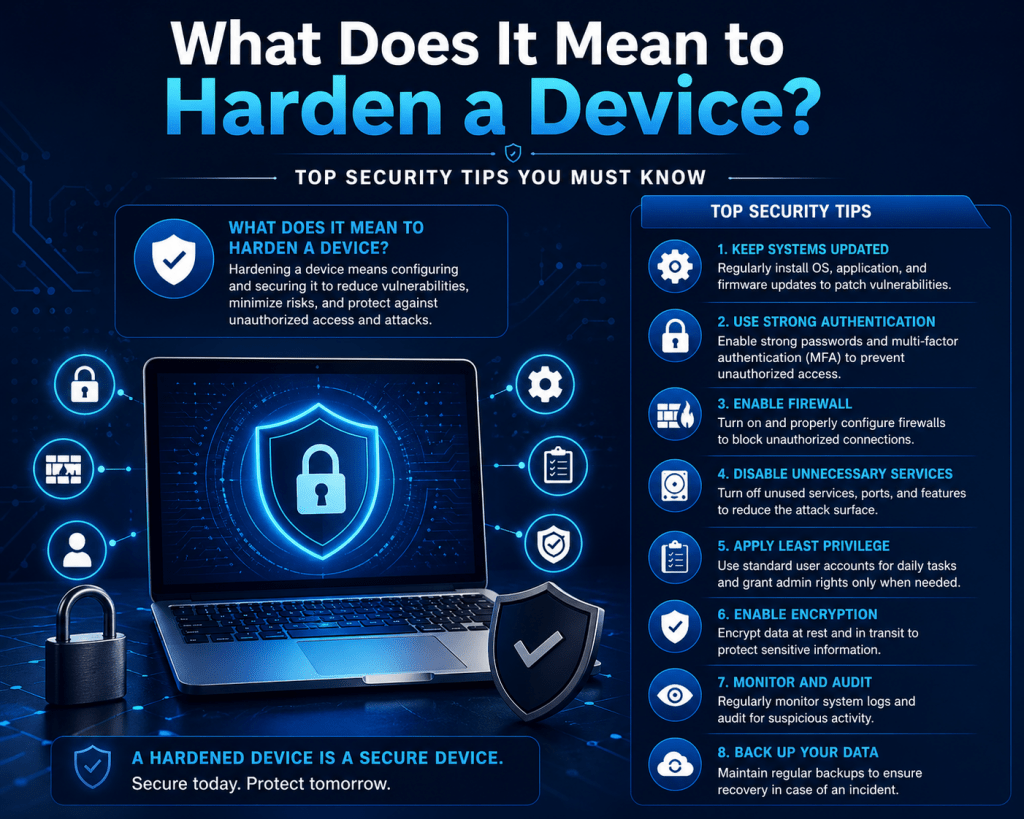
Device hardening in cybersecurity refers to the structured process of reducing vulnerabilities within a computing system by tightening its configuration, removing unnecessary components, and enforcing strict security controls. The objective is to minimize the attack surface so that unauthorized users, malicious software, and external threat actors have fewer opportunities to exploit weaknesses. In practical terms, hardening transforms a default system into a more controlled and resilient environment designed to resist compromise under real-world attack conditions.
Every computing device, whether it is a workstation, server, mobile device, or network appliance, is initially designed with a balance between usability and functionality. Out of the box configurations are generally not optimized for security. They prioritize compatibility and ease of use. This creates an environment where unnecessary services may run, default credentials might exist, and system permissions may be overly permissive. Device hardening systematically addresses these issues by reconfiguring the system to remove unsafe defaults and enforce security-first principles.
A key aspect of hardening is understanding that no system can ever be made completely secure. There is always a theoretical possibility of compromise if sufficient resources, time, and expertise are applied by an attacker. Because of this, cybersecurity focuses on making systems more difficult to exploit than alternative targets. Hardening is therefore a comparative strategy: the more effort required to break into a system, the less attractive it becomes to attackers who typically seek the easiest path to success.
Why Attack Surface Reduction Matters in Modern Systems
The attack surface of a device refers to the total number of possible points where an unauthorized user can attempt to enter or extract data from a system. This includes open ports, active services, installed applications, user accounts, network interfaces, and even physical access points. The larger the attack surface, the more opportunities exist for exploitation.
Reducing the attack surface is one of the primary goals of device hardening. By disabling unnecessary services, removing unused software, and restricting system functionality to only what is required for business operations, the number of potential entry points decreases significantly. This directly lowers the likelihood of successful exploitation.
Modern computing environments are highly interconnected, which increases exposure to threats. Devices frequently communicate over internal networks, cloud platforms, and external services. Each connection introduces additional risk. Without proper hardening, these interconnected systems can become pathways for lateral movement, where an attacker compromises one device and then expands access across the entire network.
Another important factor is automation in cyberattacks. Many threat actors use automated scanning tools to identify vulnerable systems across the internet. These tools do not target systems manually; instead, they scan large ranges of IP addresses looking for known weaknesses such as open ports, outdated software versions, or misconfigured services. Devices with larger attack surfaces are far more likely to be detected and exploited by these automated systems.
Security Baselines as the Foundation of Hardening
A security baseline is a predefined configuration standard that defines the minimum acceptable level of security for a system or environment. It serves as a structured reference point for securing devices consistently across an organization. Without a baseline, security configurations can become inconsistent, leading to gaps that attackers may exploit.
Security baselines typically define settings such as password complexity requirements, account lockout thresholds, encryption standards, logging configurations, and service restrictions. These settings are carefully selected to balance security and operational functionality. A baseline does not represent maximum security; instead, it represents a safe starting point that ensures all systems meet a minimum level of protection.
One of the most important roles of a baseline is consistency. In large environments, multiple administrators may manage different systems. Without standardized configurations, each system may be secured differently, leading to uneven protection levels. Attackers often target the weakest system in a network, making inconsistency a serious risk. A baseline ensures that all devices follow the same security rules, reducing variability.
Baselines are also essential for compliance purposes. Many industries require organizations to adhere to specific security standards to protect sensitive data. These requirements often include strict guidelines for authentication, encryption, and system configuration. A well-defined baseline helps organizations meet these obligations more efficiently by embedding compliance requirements directly into system configurations.
However, baselines are not static. They must evolve as new threats emerge and technology changes. A configuration that is secure today may become outdated tomorrow due to newly discovered vulnerabilities or changes in attack techniques. Regular review and updates are necessary to ensure that baselines remain effective over time.
Configuration Hardening Techniques for System Protection
Configuration hardening involves modifying system settings to eliminate unnecessary risk while preserving essential functionality. This process begins with identifying all non-essential components within a system. These may include unused applications, background services, default accounts, or open communication ports.
Disabling unnecessary services is one of the most effective hardening techniques. Every active service increases the potential for exploitation. If a service is not required for business operations, it should be disabled or removed entirely. This reduces both the attack surface and system complexity.
Another important technique is the secure configuration of system parameters. This includes setting strict password policies, enforcing account lockout mechanisms, and disabling insecure protocols. Weak authentication mechanisms are one of the most common entry points for attackers, making credential security a critical component of hardening.
System permissions must also be carefully configured. Users and applications should only be granted the minimum level of access required to perform their tasks. This principle limits the damage that can occur if an account is compromised. For example, administrative privileges should be restricted and closely monitored to prevent unauthorized system changes.
File system security is another key area of focus. Sensitive files and directories should have restricted access permissions to prevent unauthorized reading or modification. In addition, system integrity controls can be implemented to detect unauthorized changes to critical files.
Hardening also extends to application configuration. Applications often include features or modules that are not required for specific environments. Disabling these features reduces potential vulnerabilities. Additionally, applications should be configured to operate with the least amount of privilege necessary.
Identity and Access Control Hardening Strategies
Identity and access control are fundamental components of device hardening because it governs who can access systems and what actions they can perform. Weak identity management is one of the most common causes of security breaches, making it a critical area for reinforcement.
Strong authentication mechanisms are essential for securing access. This includes enforcing complex passwords, implementing multi-factor authentication, and preventing reuse of previously compromised credentials. These measures significantly reduce the likelihood of unauthorized access even if credentials are exposed.
Role-based access control is another key strategy. Instead of assigning permissions individually to users, access is grouped into roles based on job responsibilities. This simplifies management and ensures that users only have access to the resources they need. It also reduces the risk of privilege escalation.
Account lifecycle management is also important. User accounts should be regularly reviewed to ensure they are still required. Dormant or unused accounts should be disabled or removed to prevent unauthorized access through forgotten credentials.
Privileged accounts require additional protection due to their elevated access rights. These accounts should be strictly limited, closely monitored, and used only when necessary. Administrative actions should be logged to ensure accountability and traceability.
Session management controls further enhance security by limiting session duration and enforcing automatic logout after periods of inactivity. This reduces the risk of unauthorized access to unattended devices.
Patch Management and Vulnerability Control in Hardened Systems
Patch management is a critical aspect of device hardening because it addresses known vulnerabilities in software and operating systems. Cyber attackers frequently exploit outdated systems that have not received security updates. Applying patches promptly significantly reduces this risk.
A structured patch management process involves identifying available updates, testing them in controlled environments, and deploying them across production systems. Testing is important to ensure that updates do not introduce compatibility issues or system instability.
Vulnerability management extends beyond patching. It includes continuous scanning of systems to identify weaknesses such as misconfigurations, outdated software, or insecure protocols. Once identified, these vulnerabilities must be prioritized based on risk level and addressed accordingly.
Not all vulnerabilities carry the same level of risk. Some may have a limited impact, while others could allow full system compromise. Effective vulnerability management involves assessing both the severity and exploitability of each issue to determine remediation priority.
Automated tools are often used to streamline patch and vulnerability management processes. These tools can detect missing updates, track system compliance, and generate reports for administrators. Automation ensures faster response times and reduces the likelihood of human error.
Monitoring, Logging, and Continuous Compliance Enforcement
Monitoring and logging are essential for maintaining hardened systems over time. While hardening focuses on preventing attacks, monitoring ensures that any suspicious activity is detected quickly. Without visibility into system behavior, even well-secured environments can be compromised without detection.
System logs record events such as login attempts, configuration changes, and application activity. These logs provide valuable insight into system behavior and can be used to identify anomalies. For example, repeated failed login attempts may indicate a brute-force attack in progress.
Continuous monitoring systems analyze logs and network traffic in real time to detect unusual patterns. These systems can generate alerts when suspicious activity is identified, allowing administrators to respond quickly. Early detection is critical for minimizing the impact of security incidents.
Compliance monitoring ensures that systems remain aligned with established security baselines. Over time, configurations may drift due to updates, user changes, or unauthorized modifications. Continuous compliance checks help identify and correct these deviations.
Long-term security effectiveness depends on maintaining visibility and control over all system components. Without ongoing monitoring and enforcement, even well-designed hardening strategies can degrade over time, leaving systems exposed to emerging threats.
Enterprise-Level Device Hardening and Security Architecture
In enterprise environments, device hardening expands beyond individual system configuration and becomes part of a broader security architecture that governs how all endpoints, servers, and network components interact. At this scale, hardening is not just a technical activity but an architectural discipline that integrates policy, engineering standards, and operational controls. The goal is to ensure that every device within the ecosystem adheres to a consistent security posture while still supporting business operations efficiently.
Enterprise hardening begins with the assumption that every endpoint is potentially exposed to threats, regardless of whether it is located inside or outside the corporate network. This assumption eliminates the traditional concept of a “trusted internal network” and replaces it with a zero-trust mindset where verification is required for every access request. As a result, devices must continuously authenticate, validate, and enforce policy compliance before interacting with systems or data.
Scalability is a major challenge in enterprise hardening. Large organizations may manage thousands or even hundreds of thousands of devices across multiple geographic regions. Manually configuring each system is not feasible, so standardized policies and centralized management frameworks are used. These frameworks enforce configuration rules automatically, ensuring consistency across all endpoints.
Another key aspect is segmentation. Instead of allowing devices to communicate freely across the network, enterprise environments divide systems into logical segments based on function, sensitivity, or risk level. For example, finance systems may be isolated from general user environments, while development systems are separated from production infrastructure. This limits lateral movement in case of compromise and reduces the overall blast radius.
Identity management plays a central role in enterprise hardening. Centralized identity systems control authentication and authorization across all devices and services. This ensures that access policies remain consistent regardless of where a user logs in from or which device they use. Strong identity governance also allows organizations to enforce conditional access rules based on device compliance, location, or risk signals.
Monitoring at the enterprise level is continuous and data-driven. Large-scale logging systems collect security events from all devices and analyze them for anomalies. This provides visibility into potential threats that may not be detectable at the individual device level. Correlation across multiple data sources allows security teams to identify complex attack patterns that would otherwise remain hidden.
Operating System Hardening and Kernel-Level Security Controls
Operating system hardening focuses on securing the core software layer that manages hardware resources and application execution. Since the operating system acts as the foundation for all other processes, its security directly impacts the overall resilience of the device. Weaknesses at this level can compromise the entire system, making OS hardening one of the most critical aspects of device security.
One of the primary techniques in OS hardening is minimizing installed components. Operating systems often include a wide range of features, utilities, and services that are not required in every environment. Each unnecessary component introduces potential vulnerabilities. Removing or disabling these components reduces exposure and simplifies system management.
User account control is another important element. Operating systems typically support multiple privilege levels, with administrative accounts having full control over system configuration. Limiting the use of administrative privileges and enforcing strict separation between standard and privileged accounts helps prevent unauthorized system modifications. Even if a standard account is compromised, the attacker’s ability to make system-wide changes remains restricted.
Kernel-level protections are essential for defending against advanced attacks. The kernel is responsible for managing memory, processes, and hardware communication. Attacks targeting the kernel can bypass many traditional security controls. Modern operating systems implement protections such as address space layout randomization, data execution prevention, and kernel patch protection to mitigate these risks.
Secure boot mechanisms ensure that only trusted software is loaded during system startup. This prevents malicious code from being executed before security controls are activated. By verifying digital signatures of boot components, secure boot protects against low-level attacks that attempt to compromise systems before the operating system fully loads.
File integrity monitoring is also used to detect unauthorized changes to critical system files. By comparing current file states against known trusted baselines, organizations can identify tampering attempts and respond quickly. This is particularly important for detecting persistent threats that attempt to modify system behavior.
Logging at the operating system level provides detailed insight into system activity. Events such as process creation, privilege escalation, and system configuration changes are recorded for analysis. These logs are essential for forensic investigations and real-time threat detection.
Network-Level Hardening and Traffic Control Mechanisms
Network hardening focuses on controlling how data flows between devices and ensuring that only authorized communication is permitted. Since networks serve as the primary communication medium between systems, they are a common target for attackers attempting to intercept, manipulate, or disrupt data.
One of the fundamental principles of network hardening is segmentation. By dividing networks into isolated zones, organizations can limit the spread of attacks. Each segment can have its own security policies, access controls, and monitoring systems. This ensures that even if one segment is compromised, others remain protected.
Firewalls play a central role in enforcing network security policies. They inspect incoming and outgoing traffic and block unauthorized connections based on predefined rules. Properly configured firewalls ensure that only necessary services are exposed to external networks, reducing the attack surface significantly.
Intrusion detection and prevention systems add another layer of protection by analyzing network traffic for malicious patterns. These systems can identify known attack signatures as well as unusual behavior that may indicate emerging threats. When suspicious activity is detected, alerts are generated, or traffic is actively blocked.
Network access control mechanisms ensure that only compliant devices can connect to the network. Devices may be required to meet specific security criteria, such as having updated software, enabled encryption, and active security tools. Non-compliant devices are either denied access or placed in restricted network zones.
Encryption of network traffic is essential for protecting data in transit. Without encryption, sensitive information can be intercepted and read by attackers using network monitoring tools. Secure communication protocols ensure that data remains confidential and tamper-resistant during transmission.
Traffic monitoring and analysis provide visibility into network behavior. By examining patterns such as bandwidth usage, connection frequency, and destination endpoints, security teams can identify anomalies that may indicate malicious activity or compromised devices.
Endpoint Hardening in Modern Digital Environments
Endpoints such as laptops, desktops, and mobile devices represent one of the most common entry points for cyberattacks. Endpoint hardening focuses on securing these devices against malware, unauthorized access, and data leakage. Since endpoints are often used outside controlled environments, they require additional layers of protection.
One of the primary strategies in endpoint hardening is application control. This involves restricting which applications can be installed or executed on a device. By allowing only approved software, organizations can significantly reduce the risk of malicious applications being introduced into the environment.
Device encryption is another critical component. Encrypting data stored on endpoints ensures that even if a device is lost or stolen, the information remains inaccessible without proper authentication. Encryption protects both system files and user data, making physical theft far less impactful.
Mobile device management systems are commonly used to enforce security policies on portable devices. These systems allow administrators to remotely configure settings, enforce compliance, and even wipe devices if they are compromised or lost. This level of control is essential for securing devices that frequently operate outside organizational boundaries.
Endpoint detection and response tools provide continuous monitoring of device activity. These tools analyze behavior in real time to detect malicious activity such as unauthorized process execution, suspicious file modifications, or abnormal network connections. When threats are detected, automated responses can be triggered to contain the incident.
Patch management is particularly important for endpoints due to their exposure to external networks. Devices that are not regularly updated become easy targets for attackers who exploit known vulnerabilities. Automated update systems help ensure that endpoints remain current with the latest security patches.
User behavior also plays a significant role in endpoint security. Many attacks target human error through techniques such as phishing or social engineering. Educating users about safe practices and reinforcing security awareness helps reduce the likelihood of successful attacks.
Cloud and Virtual Environment Hardening Strategies
Cloud computing environments introduce unique challenges for device hardening due to their distributed and dynamic nature. Unlike traditional infrastructure, cloud systems operate across shared resources and virtualized components. This requires specialized hardening strategies tailored to cloud architecture.
One of the primary principles in cloud hardening is configuration management. Cloud resources are often created and destroyed dynamically, making consistent configuration essential. Infrastructure as code approaches allow security policies to be embedded directly into deployment templates, ensuring that every new resource adheres to predefined security standards.
Access control in cloud environments is highly granular. Identity-based policies determine who can access specific resources and under what conditions. These policies must be carefully designed to avoid excessive permissions, which could lead to unauthorized access or privilege escalation.
Virtual machine hardening follows similar principles to traditional operating system hardening but includes additional considerations such as hypervisor security. The hypervisor manages virtual machines and must be protected against attacks that could compromise multiple virtual environments simultaneously.
Cloud storage systems require strict access controls and encryption mechanisms. Data stored in cloud environments is often distributed across multiple physical locations, making encryption essential for maintaining confidentiality. Access policies ensure that only authorized users and applications can retrieve or modify data.
Monitoring in cloud environments is highly automated. Logs are collected from multiple services and analyzed centrally to detect anomalies. This provides visibility into resource usage, access patterns, and potential security incidents across the entire cloud infrastructure.
Automation and Continuous Hardening Enforcement
Automation plays a critical role in modern device hardening by ensuring that security configurations are consistently applied and maintained across all systems. Manual configuration is not only time-consuming but also prone to human error, especially in large-scale environments.
Automated configuration management tools enforce predefined security policies across devices. These tools continuously check system states and correct deviations from established baselines. This ensures that systems remain compliant even as changes occur over time.
Continuous compliance monitoring extends automation by providing real-time visibility into system security posture. Instead of relying on periodic audits, organizations can continuously assess whether systems meet security requirements. This allows for faster detection and remediation of configuration drift.
Automated patch deployment ensures that systems receive security updates promptly. By removing delays in the patching process, organizations reduce the window of opportunity for attackers to exploit known vulnerabilities. Automation also allows for controlled rollout strategies that minimize disruption.
Security orchestration integrates multiple tools and processes into a unified workflow. When a threat is detected, automated systems can trigger responses such as isolating affected devices, revoking access credentials, or initiating forensic analysis. This reduces response time and limits the impact of incidents.
Policy enforcement automation ensures that security rules are consistently applied across all environments. Whether a device is newly added, updated, or modified, automated systems verify compliance and apply necessary corrections. This creates a self-maintaining security ecosystem that adapts to changes dynamically.
Advanced Threat Landscape and the Need for Continuous Device Hardening
The modern threat landscape is no longer static, predictable, or limited to isolated attack attempts. Instead, it is dynamic, automated, and highly adaptive, with threat actors continuously refining their methods to bypass traditional defenses. This evolution has fundamentally changed how device hardening must be approached. It is no longer sufficient to apply a one-time configuration and assume long-term protection. Instead, hardening must operate as a continuous, adaptive process that evolves alongside emerging threats.
Attackers today leverage a combination of automated scanning tools, exploit kits, and artificial intelligence-assisted reconnaissance to identify weak systems at scale. These tools are capable of scanning millions of IP addresses within short timeframes, identifying vulnerable services, outdated software versions, and misconfigured systems. Any device that is not properly hardened becomes an easy target in this automated discovery process.
One of the most significant shifts in recent years is the rise of opportunistic attacks. These attacks do not necessarily target specific organizations but instead focus on finding any exploitable system across the internet. In this context, device hardening becomes a defensive filtering mechanism. The better a system is hardened, the less likely it is to appear in attacker reconnaissance results or be successfully exploited if discovered.
Another major factor is the increasing sophistication of exploit chains. Modern attacks often involve multiple stages, starting with initial access through a minor vulnerability and escalating into full system compromise through privilege escalation, lateral movement, and persistence mechanisms. Device hardening disrupts these chains by removing common entry points and restricting the attacker’s ability to move within the system.
Threat intelligence also plays a critical role in shaping hardening strategies. Organizations must continuously monitor global vulnerability disclosures, attack trends, and exploit developments. This information helps security teams prioritize hardening efforts based on real-world risk rather than theoretical vulnerabilities.
Zero Trust Architecture as a Modern Hardening Model
Zero Trust architecture has become one of the most influential frameworks in modern cybersecurity, and it directly aligns with advanced device hardening principles. The core idea of Zero Trust is simple but powerful: never automatically trust any user, device, or system, regardless of whether it is inside or outside the network perimeter.
In traditional security models, internal networks were often treated as trusted zones. Once an attacker gained access to the internal network, they could move freely between systems. Zero Trust eliminates this assumption by enforcing continuous verification at every stage of interaction. This means that every access request must be authenticated, authorized, and validated before being granted.
Device hardening within a Zero Trust model focuses heavily on identity-based controls. Each device must prove its compliance status before accessing resources. This includes verifying system configuration, patch levels, encryption status, and security posture. Non-compliant devices are restricted or denied access entirely.
Micro-segmentation is another key component of this model. Instead of relying on broad network zones, systems are isolated into small, controlled segments. Each segment has its own access policies, and communication between segments is tightly controlled. This limits lateral movement and ensures that even if one device is compromised, the attacker cannot easily spread to others.
Continuous authentication is also an important element. Instead of validating identity only at login, systems continuously assess risk throughout the session. If suspicious behavior is detected, access can be restricted or revoked in real time. This dynamic approach ensures that security adapts to changing conditions.
Device posture assessment is a critical mechanism in Zero Trust environments. Before granting access, systems evaluate whether a device meets security requirements. This includes checking for enabled encryption, updated patches, active security tools, and compliance with baseline configurations. Devices that fail these checks are automatically restricted.
Advanced Endpoint Security and Behavioral Protection
Endpoints remain one of the most targeted components in any infrastructure due to their direct interaction with users and external networks. As a result, advanced endpoint hardening goes beyond basic configuration and incorporates behavioral analysis, real-time monitoring, and adaptive defense mechanisms.
Traditional endpoint security relied heavily on signature-based detection, where known malicious patterns were identified and blocked. However, modern threats often use obfuscation, encryption, and polymorphic behavior to evade signature detection. This has led to a shift toward behavior-based securityhat analyze how applications and behavior, rather than relying solely on known signatures.
Behavioral monitoring allows systems to detect anomalies such as unusual process execution, unexpected file modifications, or abnormal network communication. These behaviors may indicate malware activity, even if the specific malware has never been seen before. This approach significantly improves the detection of zero-day threats.
Application sandboxing is another important hardening technique. By isolating applications within controlled environments, any malicious behavior is contained and prevented from affecting the broader system. Sandboxing limits access to system resources and ensures that applications operate within defined boundaries.
Memory protection mechanisms are also critical in advanced endpoint security. Many modern attacks attempt to exploit memory vulnerabilities such as buffer overflows or code injection. Operating systems implement protections such as address space randomization and executable space protection to mitigate these risks.
Device control policies further enhance endpoint security by restricting the use of external devices such as USB drives. These devices can be used to introduce malware or extract sensitive data. By controlling or disabling external device access, organizations reduce the risk of physical data exfiltration.
Endpoint detection and response systems provide continuous visibility into device activity. These systems collect telemetry data, analyze behavior patterns, and respond to threats in real time. If suspicious activity is detected, automated containment actions such as isolating the device from the network can be triggered immediately.
Cryptographic Hardening and Data Protection Mechanisms
Cryptography is one of the most critical components of device hardening because it protects data confidentiality, integrity, and authenticity. Without proper encryption, sensitive information becomes vulnerable to interception, theft, and manipulation.
At the device level, encryption ensures that data stored on disks or memory cannot be accessed without proper authorization. Even if a device is physically stolen, encrypted data remains inaccessible without the correct cryptographic keys. This makes encryption an essential defense for mobile devices and portable systems.
Key management is a fundamental aspect of cryptographic security. Encryption is only as strong as the protection of its keys. If keys are exposed or poorly managed, encryption becomes ineffective. Secure key storage mechanisms, such as hardware security modules and trusted platform modules, help protect cryptographic keys from unauthorized access.
Transport encryption ensures that data transmitted across networks remains secure. This prevents attackers from intercepting sensitive information during communication. Secure protocols establish encrypted channels between devices, ensuring confidentiality and integrity during transmission.
Hashing mechanisms are used to verify data integrity. By generating fixed-length representations of data, systems can detect whether information has been altered. This is particularly important for software updates, configuration files, and authentication systems.
Digital signatures provide authentication and non-repudiation. They ensure that data originates from a trusted source and has not been modified. This is essential for verifying software integrity and preventing tampering.
Full disk encryption is widely used in endpoint protection strategies. It ensures that all data stored on a device is encrypted, including system files and user data. This provides comprehensive protection in case of physical theft or unauthorized access.
Physical Security and Hardware-Level Hardening
While digital security controls are essential, physical security remains a foundational aspect of device hardening. If an attacker gains physical access to a device, many software-based protections can be bypassed or neutralized. Therefore, securing the physical environment is a critical component of a comprehensive hardening strategy.
Controlled access environments are commonly used to restrict physical entry to sensitive systems. This includes server rooms, data centers, and network infrastructure areas. Access is typically restricted using authentication mechanisms such as key cards, biometric verification, or multi-factor authentication.
Device tampering prevention mechanisms are also important. Hardware security features such as tamper-evident seals and intrusion detection sensors can alert administrators if a device has been physically altered. These mechanisms help detect unauthorized access attempts at the hardware level.
BIOS and firmware security play a crucial role in protecting devices from low-level attacks. Firmware is responsible for initializing hardware components before the operating system loads. If compromised, attackers can gain control of systems before security controls are activated. Secure firmware updates and verification mechanisms help mitigate these risks.
Boot integrity protection ensures that only trusted software is executed during system startup. This prevents malicious bootkits or rootkits from loading before the operating system. By verifying digital signatures during boot, systems ensure that only authorized components are executed.
Hardware-based encryption also enhances physical security. By integrating encryption directly into storage devices, data remains protected even if drives are removed from the system. This reduces the risk of data extraction through physical tampering.
Risk Management and Security Governance in Hardening Strategies
Device hardening does not exist in isolation; it is part of a broader risk management framework that governs how organizations identify, assess, and mitigate security risks. Effective hardening strategies are aligned with organizational risk tolerance and business objectives.
Risk assessment is the first step in this process. It involves identifying potential threats, evaluating vulnerabilities, and determining the potential impact of security incidents. This helps prioritize hardening efforts based on actual risk rather than theoretical concerns.
Risk mitigation strategies include implementing technical controls, administrative policies, and physical safeguards. Device hardening falls primarily under technical controls, but it is often supported by policies and procedures that guide implementation.
Security governance defines the rules and responsibilities for maintaining security across the organization. This includes defining roles for administrators, establishing compliance requirements, and enforcing accountability for security practices.
Policy enforcement ensures that hardening standards are consistently applied across all systems. Without enforcement mechanisms, security policies may be ignored or inconsistently implemented, leading to gaps in protection.
Audit processes provide oversight by evaluating whether security controls are functioning as intended. Regular audits help identify weaknesses, verify compliance, and ensure continuous improvement in security posture.
Future Trends in Device Hardening and Adaptive Security
The future of device hardening is closely tied to advancements in automation, artificial intelligence, and adaptive security systems. As threats become more complex, static security configurations are no longer sufficient.
Adaptive security systems are emerging as a key trend. These systems dynamically adjust security controls based on real-time risk assessments. For example, if a device exhibits unusual behavior, its access privileges can be automatically restricted until the behavior is verified.
Artificial intelligence is increasingly used to detect patterns of malicious activity that traditional systems may miss. Machine learning models can analyze large volumes of data to identify subtle anomalies that indicate potential threats.
Self-healing systems represent another emerging concept. These systems can automatically detect misconfigurations or vulnerabilities and correct them without human intervention. This reduces response times and improves overall resilience.
Quantum-resistant cryptography is also becoming an area of focus as computing technology advances. Future encryption methods must be able to withstand attacks from quantum computing systems that could break traditional cryptographic algorithms.
Device hardening will continue to evolve from a manual configuration process into a fully automated, intelligence-driven discipline that adapts continuously to changing threats and environments.
Conclusion
Device hardening is best understood as a continuous security discipline rather than a fixed configuration task. Across modern digital environments, systems are constantly exposed to evolving threats, automated attack tools, and increasingly sophisticated adversaries. In this context, hardening serves as a foundational defense strategy that reduces exposure, limits attacker capabilities, and strengthens overall system resilience. It is not designed to create perfect security, because such a state does not exist in practical computing environments. Instead, its purpose is to shift the balance of effort in favor of defenders by making systems significantly more difficult and less attractive to compromise.
At its core, device hardening is about reducing unnecessary risk. Every system contains a combination of essential functions and optional components. The presence of unused services, default configurations, and excessive privileges creates opportunities for exploitation. Hardening systematically removes or restricts these elements, ensuring that only required functionality remains active. This reduction in complexity directly translates into a smaller attack surface, which is one of the most important defensive outcomes in cybersecurity engineering.
A key insight that emerges from understanding device hardening is that security is relative, not absolute. Systems are not judged by whether they can be made unbreakable, but by how difficult they are to compromise compared to alternative targets. Threat actors typically operate under constraints of time, automation, and economic return. They prioritize systems that are easy to exploit and yield high value. By implementing strong hardening practices, organizations effectively push their systems out of this “low-effort target” category. This shift in attacker economics is one of the most powerful defensive mechanisms available.
Security baselines remain central to this entire discipline. They provide structured, repeatable, and enforceable standards for system configuration. Without baselines, security becomes fragmented and inconsistent, especially in environments with large numbers of devices or distributed infrastructures. Baselines ensure that every system meets a minimum level of protection, regardless of who configures it or where it is deployed. They also create a measurable reference point for auditing, compliance, and continuous improvement.
However, baselines alone are not sufficient unless they are actively maintained. One of the most important characteristics of effective hardening strategies is adaptability. Threat landscapes evolve continuously, and attackers frequently discover new methods to bypass existing controls. This means that static configurations degrade in value over time. A system that is fully hardened today may become vulnerable tomorrow if updates, patches, and configuration reviews are not consistently applied. For this reason, device hardening must be treated as a living process supported by monitoring, automation, and regular reassessment.
The role of automation in modern hardening cannot be overstated. In large-scale environments, manual configuration is neither efficient nor reliable. Automation ensures that security policies are consistently applied across all systems, reducing human error and configuration drift. It also enables continuous compliance, where systems are constantly evaluated against defined baselines rather than checked periodically. This shift from static auditing to continuous enforcement significantly improves security posture and response time.
Another important conclusion is that device hardening is deeply interconnected with identity and access management. Many real-world breaches occur not because systems are fundamentally weak, but because access controls are insufficient or improperly configured. Enforcing strong authentication, least privilege principles, and role-based access structures ensures that even if a system is exposed, the potential damage remains limited. Identity becomes the new security perimeter in modern environments, especially in distributed and cloud-based architectures.
Ultimately, device hardening represents a shift in mindset as much as a technical process. It requires viewing systems not as static tools but as dynamic assets operating in a hostile environment. Every configuration decision, every enabled service, and every access permission contributes to the overall security posture. When approached systematically and maintained continuously, device hardening becomes one of the most effective strategies for protecting modern digital infrastructure against an increasingly complex and persistent threat landscape.