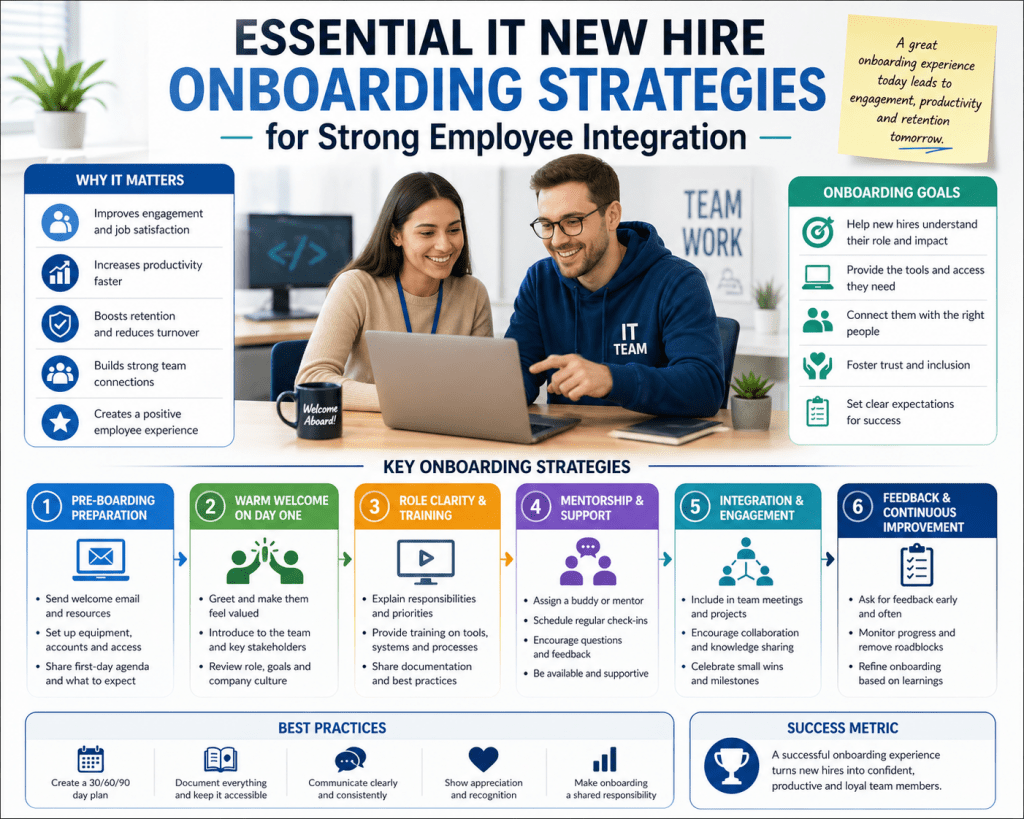
A structured onboarding process for IT professionals is a critical component in establishing operational efficiency, role clarity, and early productivity within technical teams. In modern IT environments, where systems are interconnected and workflows depend on precision, onboarding is not simply an introductory phase but a controlled integration mechanism that determines how quickly a new employee can contribute to live operations. Without a structured approach, new hires often face fragmented information, delayed access to systems, and unclear expectations, all of which slow down their ability to function effectively. A well-designed onboarding framework eliminates these barriers by aligning technical readiness, role definition, and organizational orientation into a single coordinated process. This ensures that employees are not only introduced to their responsibilities but are also equipped with the tools, access, and contextual understanding required to perform them efficiently. IT onboarding must therefore be viewed as a strategic function that directly impacts productivity, security compliance, and long-term employee retention. It also reduces operational risk by ensuring consistent adoption of standardized workflows across all new technical staff, which is essential in maintaining system stability and minimizing human error in critical environments.
Establishing Clear Role Definition and Performance Expectations
One of the most important elements of effective IT onboarding is the establishment of precise and operationally relevant role definitions before the employee begins work. Unlike general job descriptions used during recruitment, onboarding role definitions should focus on practical responsibilities, system interactions, and measurable performance expectations. This includes detailing specific tasks such as infrastructure monitoring, system administration duties, application support responsibilities, or security-related functions, depending on the position. Clear expectations help eliminate ambiguity and allow new hires to understand exactly what is required of them from the beginning. In technical environments, unclear roles often lead to inefficiencies, duplicated effort, or misalignment between teams. By defining responsibilities in operational terms, organizations create a structured environment where employees can prioritize tasks effectively. Performance expectations should also be realistic and aligned with early-stage learning curves, ensuring that new hires are evaluated fairly while still being guided toward productivity. Additionally, clearly defined roles help employees understand boundaries of responsibility, which reduces unnecessary escalation and improves decision-making efficiency in day-to-day operations.
Pre-Configured System Access and Infrastructure Readiness
Ensuring full technical readiness before a new IT employee’s first working day is essential for a smooth onboarding experience. System access, credentials, permissions, and tool availability must be configured in advance to prevent delays in initial productivity. IT roles depend heavily on access to internal platforms, monitoring tools, development environments, and communication systems. Any delay in provisioning these resources can result in lost time and reduced engagement during the critical early phase of employment. A properly prepared infrastructure ensures that new hires can immediately log into systems, explore environments, and begin familiarizing themselves with workflows. This preparation requires coordination between IT administrators, security teams, and system owners to verify that access levels are correctly assigned and fully functional. It also includes ensuring that hardware setups are complete and that all required software applications are installed and operational. A seamless technical setup creates a strong first impression and allows employees to focus on learning rather than troubleshooting basic access issues. Beyond initial access, readiness also includes verifying network stability, authentication systems, and backup access methods to avoid disruptions during early tasks.
Development of Structured Welcome and Orientation Resources
A structured welcome resource plays an important role in guiding new IT employees through the initial phase of their onboarding experience. This resource serves as a centralized reference point containing essential organizational information, key contacts, communication channels, and operational guidelines. In technical environments, where systems and processes can be complex, having a clear and accessible orientation guide reduces confusion and helps employees navigate their early days more effectively. The content should be organized in a logical format that allows quick access to relevant information, such as team structures, escalation procedures, and system usage guidelines. It should also provide clarity on internal workflows and expectations, helping employees understand how different teams interact and how responsibilities are distributed across the organization. A well-structured orientation resource reduces dependency on constant managerial intervention and enables new hires to independently resolve basic questions, improving efficiency during the onboarding phase. Additionally, it serves as a long-term reference document that employees can revisit whenever they encounter unfamiliar processes or system updates, reinforcing consistency in operational understanding.
Managerial Involvement in Early Role Integration
Active involvement from managers and supervisors during IT onboarding significantly improves the quality and effectiveness of the integration process. Leadership participation ensures that new employees receive clear direction regarding team objectives, operational priorities, and performance standards. Managers play a key role in contextualizing the employee’s responsibilities within broader organizational goals, helping them understand how their contributions impact system performance and business outcomes. This early engagement also fosters relationship-building, which is essential in collaborative IT environments where coordination between teams is frequent and necessary. When managers are present during onboarding, they reinforce expectations and provide clarity that reduces uncertainty. They also establish communication channels that encourage employees to seek guidance when needed, creating a supportive environment that promotes confidence and engagement from the beginning. In addition, managerial involvement helps align onboarding outcomes with strategic goals, ensuring that new hires are not only technically prepared but also culturally integrated into the organization’s working environment and long-term operational vision.
Role-Specific Training Frameworks for Technical Development
A structured training framework tailored to specific IT roles is essential for guiding new employees through their early development stages. This framework should outline the progression of skills required for the role, starting from foundational system knowledge and advancing toward more complex technical competencies. In IT environments, where continuous learning is necessary due to evolving technologies, a structured approach ensures that employees develop skills logically and sustainably. The training framework should align with real operational requirements, allowing employees to immediately apply what they learn to practical scenarios. This connection between learning and application strengthens understanding and accelerates skill development. It also ensures that employees are not overwhelmed by excessive information but instead progress through manageable learning stages that build confidence and capability over time.
Early Assignment of Controlled Technical Tasks for Skill Application
Introducing controlled technical tasks during the early stages of onboarding helps new IT employees transition from theoretical learning to practical application. These tasks should be simple, clearly defined, and directly related to the employee’s role. The objective is to allow new hires to become familiar with tools, workflows, and systems in a structured environment without excessive pressure. Early task assignments provide opportunities for hands-on experience while still maintaining supervisory support. This approach helps employees develop familiarity with operational processes and gradually build confidence in their abilities. It also allows managers to assess progress and identify areas where additional support may be required. Over time, these controlled tasks serve as a foundation for more complex responsibilities, ensuring a smooth transition into full operational participation.
Assigning Mentorship Support for Guided Technical Adaptation
Mentorship is a valuable component of IT onboarding, particularly in complex technical environments where practical knowledge and situational understanding are essential. Assigning an experienced team member as a mentor provides new employees with direct access to guidance, clarification, and contextual insights. Mentors help bridge the gap between formal training and real-world application by offering explanations that are based on practical experience. This support system allows new hires to navigate early challenges more effectively and reduces the likelihood of errors during initial task execution. Mentorship also contributes to team integration by fostering communication, collaboration, and knowledge sharing. As employees gain experience, the mentorship relationship evolves from basic guidance to more advanced professional development support, reinforcing long-term growth within the organization.
First-Day Technical Integration and Operational Readiness for IT New Hire
The first working day for an IT professional is a pivotal stage that determines how effectively they transition from preparation into active operational engagement. In technical environments, the first day should not be treated as a passive orientation experience but as a structured integration into live systems, workflows, and team interactions. The primary objective is to ensure that the employee can begin interacting with core tools and environments without unnecessary delays or confusion. This requires careful orchestration of system access validation, workstation readiness, and initial task exposure. A well-planned first day reduces cognitive overload by presenting information in a controlled sequence rather than overwhelming the employee with excessive details. It also ensures that foundational elements such as login access, communication tools, and system navigation are fully functional. When executed properly, the first day establishes momentum, allowing new hires to feel operationally engaged rather than observationally disconnected.
Structured Onboarding Introduction to Teams and Technical Ecosystem
Introducing new IT employees to their broader technical ecosystem is essential for establishing clarity in communication, workflow alignment, and collaborative expectations. IT roles are inherently interconnected, often requiring interaction with infrastructure teams, development teams, cybersecurity units, and operational support groups. A structured introduction ensures that new hires understand not only who they will be working with but also how different roles contribute to system stability and organizational performance. This introduction should be intentional and organized, focusing on functional relevance rather than casual interaction. Employees should be made aware of reporting structures, escalation pathways, and collaboration channels early in the process. This clarity helps reduce communication delays and prevents uncertainty when technical issues arise. By establishing early familiarity with key stakeholders, organizations create a foundation for efficient teamwork and coordinated problem-solving across departments.
Guided Configuration of Workstations and Core IT Tools
The setup of a new employee’s workstation is a critical step in ensuring immediate productivity in IT environments. This process involves configuring hardware, installing required applications, verifying system access, and ensuring compatibility with internal networks and platforms. In many technical roles, multiple tools must function simultaneously, including development environments, monitoring systems, communication platforms, and security utilities. Any misconfiguration or delay in setup can significantly impact early performance and reduce engagement. A guided configuration process ensures that employees are supported during this setup phase rather than left to troubleshoot independently. This includes validating system credentials, testing application functionality, and confirming network connectivity. It also provides an opportunity to introduce employees to essential tools and explain their purpose within daily workflows. Proper workstation configuration ensures that employees can transition smoothly into operational tasks without technical interruptions.
Early Introduction to Security Protocols and Operational Compliance Standards
Security awareness and compliance understanding are essential components of IT onboarding due to the sensitive nature of systems and data managed by technical staff. Early exposure to security protocols ensures that employees understand their responsibilities in maintaining system integrity and protecting organizational assets. This includes guidance on access control mechanisms, authentication procedures, data handling practices, and incident reporting workflows. In IT environments, where security risks can arise from even minor oversights, establishing awareness from the beginning is critical. Employees should also be introduced to operational compliance standards that govern system usage, communication practices, and data management. This ensures that they are aligned with organizational expectations and regulatory requirements. When security and compliance are clearly communicated during onboarding, employees are more likely to adopt responsible behaviors and integrate secure practices into their daily workflows.
Continuous Feedback Loops During Early IT Role Adaptation
Continuous feedback is a fundamental mechanism for supporting IT professionals during the early stages of their integration. Unlike formal performance evaluations, early feedback is designed to be frequent, constructive, and development-focused. It provides employees with immediate insights into their performance, helping them correct misunderstandings and refine their approach to tasks. In technical environments, where workflows can be complex and interdependent, timely feedback significantly accelerates learning. Scheduled check-ins allow supervisors to assess progress, clarify expectations, and address challenges before they escalate. This structured communication also helps employees feel supported and reduces uncertainty during their adaptation phase. Over time, continuous feedback builds a strong foundation for performance consistency and operational confidence, ensuring that employees develop correct practices from the outset.
Establishing Open Communication Channels for Technical Clarity and Support
Effective onboarding in IT environments requires strong communication systems that allow employees to seek clarification and support without hesitation. Open communication channels ensure that new hires can access assistance through appropriate platforms depending on the nature of their questions. These channels may include direct messaging systems, structured documentation resources, or scheduled support sessions. Encouraging open communication reduces the likelihood of misunderstandings and ensures that technical issues are resolved efficiently. It also fosters a culture of transparency where employees feel comfortable engaging with peers and supervisors. In complex IT environments, where multiple systems and processes operate simultaneously, clear communication is essential for maintaining operational efficiency. When employees know where and how to seek help, they are more likely to engage actively and resolve challenges quickly.
Adapting Onboarding Flow Based on Skill Level and Learning Speed
Not all IT professionals enter an organization with the same level of experience or technical expertise. As a result, onboarding processes must be adaptable to accommodate different learning speeds and backgrounds. A flexible onboarding flow ensures that employees receive the appropriate level of support based on their individual needs. This involves adjusting task complexity, training intensity, and guidance levels depending on how quickly an employee is adapting. Some employees may require additional time to become familiar with systems, while others may progress more quickly into advanced responsibilities. Adapting the onboarding process ensures that neither group is disadvantaged. It also helps maintain engagement by providing appropriate levels of challenge and support. This personalized approach leads to more effective skill development and ensures that employees reach productivity milestones at a sustainable pace.
Early Exposure to System Architecture and Operational Dependencies
Understanding system architecture is essential for IT professionals to effectively navigate their roles within complex technical environments. Early exposure to how systems are structured, interconnected, and maintained provides employees with a foundational understanding of operational dependencies. This includes awareness of how servers, networks, applications, databases, and security systems interact within the broader infrastructure. When employees understand these relationships, they are better equipped to troubleshoot issues, implement changes, and anticipate potential impacts of system modifications. Operational dependencies also help employees understand how different teams contribute to system functionality and how their role fits into the larger technical ecosystem. This foundational knowledge supports more effective decision-making and improves overall system awareness, which is critical for long-term performance in IT roles.
Gradual Transition into Real-Time Operational Participation
A structured transition into real-time operational environments is an important phase in IT onboarding. This process allows employees to move from observation to active participation in live systems under controlled conditions. Initially, employees may observe experienced team members handling operational tasks, responding to incidents, and managing system workflows. This observation phase helps them understand the real-world application of theoretical knowledge. Over time, employees gradually begin participating in tasks with supervision, allowing them to apply their learning in practical scenarios. This step-by-step transition ensures that employees are not exposed to high-risk responsibilities too early while still gaining valuable hands-on experience. It also helps build confidence and situational awareness, which are essential for effective performance in dynamic IT environments.
Early Reinforcement of Structured Task Execution and Operational Discipline
Structured task execution during onboarding helps establish operational discipline and consistency in IT roles. By assigning clearly defined tasks with specific instructions and expected outcomes, organizations ensure that employees develop correct working habits from the beginning. This structured approach reduces ambiguity and helps employees understand how tasks should be executed within organizational standards. It also provides opportunities for supervisors to evaluate performance and provide corrective guidance when necessary. Over time, structured task execution transitions into more independent responsibilities as employees become familiar with workflows and systems. This gradual progression reinforces discipline, improves efficiency, and ensures that employees are well-prepared for more complex operational challenges in later stages of their integration.
Transitioning IT New Hires into Long-Term Operational Independence
The final stage of IT onboarding focuses on transitioning new employees from guided integration to full operational independence. At this point, the objective is no longer basic orientation or initial skill development but the establishment of self-sufficiency within live technical environments. IT professionals are expected to move beyond structured supervision and begin managing responsibilities with minimal intervention. This transition must be gradual and carefully managed to avoid performance gaps or operational risks. Independence is achieved when employees can confidently navigate systems, resolve technical issues, and make informed decisions aligned with organizational standards. However, this outcome is only possible when earlier onboarding phases have successfully established foundational knowledge, system familiarity, and procedural clarity. Long-term independence is not a sudden shift but the result of progressive exposure to increasing levels of responsibility, supported by structured learning and continuous feedback. At this stage, employees also begin to develop personal working patterns, refine troubleshooting approaches, and build internal mental models of system behavior that allow them to operate more efficiently without constant guidance.
Sustained Performance Monitoring and Productivity Evaluation Frameworks
Even after initial onboarding phases are complete, ongoing performance monitoring remains essential for IT professionals. This does not involve strict evaluation or pressure-based assessment but instead focuses on understanding long-term productivity trends, technical adaptability, and workflow efficiency. Performance monitoring in IT environments should be structured around realistic operational indicators such as task completion accuracy, system response efficiency, collaboration effectiveness, and incident resolution capability. These indicators help organizations understand how well employees are adapting to their roles over time. Continuous evaluation also provides insights into whether additional training or support is required. Importantly, performance monitoring during this stage serves a developmental purpose, ensuring that employees continue to grow and refine their skills while contributing effectively to operational stability. It also helps organizations identify strengths and potential areas for specialization within their IT workforce. Over time, this data-driven visibility supports workforce planning, resource allocation, and succession planning by highlighting emerging expertise and identifying where additional reinforcement may be required.
Progressive Skill Expansion Through Structured Technical Growth Pathways
As IT professionals advance beyond onboarding, structured skill expansion becomes a central component of their development. This involves systematically increasing technical complexity, exposure to advanced tools, and engagement with specialized systems. Growth pathways are designed to ensure that employees build on foundational knowledge while gradually acquiring more advanced competencies. These pathways may include deeper involvement in system administration, network optimization, cybersecurity operations, cloud infrastructure management, or application lifecycle processes, depending on the role. Structured progression ensures that learning remains organized and aligned with both individual capability and organizational needs. It also prevents skill stagnation by continuously introducing new challenges that encourage professional growth. Over time, this structured approach helps transform entry-level IT professionals into highly capable technical contributors who can operate independently in complex environments. Additionally, this progression encourages curiosity-driven learning, where employees begin to proactively explore advanced concepts beyond their immediate job requirements, strengthening both innovation and adaptability.
Strengthening Technical Decision-Making and Operational Accountability
A critical aspect of long-term IT integration is the development of strong decision-making abilities and operational accountability. As employees gain experience, they are expected to make informed technical decisions without constant supervision. This includes troubleshooting system issues, evaluating potential solutions, and implementing changes that align with organizational standards. Accountability ensures that employees take responsibility for their actions and understand the impact of their decisions on system performance and operational continuity. Developing these capabilities requires a balance between autonomy and support, where employees are given increasing responsibility while still having access to guidance when necessary. Over time, this fosters confidence and reinforces a sense of ownership over technical tasks. Strong decision-making abilities are essential in IT environments where timely and accurate responses can significantly affect system stability and business operations. It also encourages employees to think critically rather than relying solely on predefined procedures, which is vital in dynamic and unpredictable technical environments.
Integration into Organizational Knowledge and Documentation Systems
As IT professionals mature in their roles, integration into organizational knowledge systems becomes increasingly important. These systems serve as centralized repositories for technical documentation, operational procedures, troubleshooting guides, and system configurations. Active participation in these systems ensures that employees are not only consumers of information but also contributors to organizational knowledge. This contribution is critical in IT environments where systems evolve continuously,y and documentation must remain current and accurate. By documenting solutions, updating procedures, and sharing insights, employees help strengthen the organization’s collective technical intelligence. This process also reinforces learning, as articulating technical knowledge requires a deeper understanding of systems and processes. Over time, this creates a self-sustaining knowledge ecosystem that improves efficiency, reduces redundancy, and supports consistent operational practices across teams. It also ensures that critical knowledge is not siloed within individuals, reducing operational risk when personnel changes occur.
Development of Cross-Team Collaboration and Communication Proficiency
Effective IT professionals must develop strong collaboration skills to work efficiently across multiple teams and departments. As employees progress beyond onboarding, they increasingly interact with stakeholders from infrastructure, development, security, and business operations units. This requires not only technical knowledge but also the ability to communicate clearly and adapt messaging based on audience needs. Cross-team collaboration ensures that technical solutions align with broader organizational goals and that system changes are implemented smoothly without disrupting operations. Developing communication proficiency also involves learning how to translate complex technical concepts into understandable language for non-technical stakeholders. Over time, this improves coordination, reduces miscommunication, and enhances overall operational efficiency. Strong collaboration skills are essential in modern IT environments where systems are highly interconnected and dependent on cross-functional input. It also supports faster incident resolution, as coordinated responses across teams often lead to more effective problem-solving outcomes.
Continuous Adaptation to Evolving Technologies and System Environments
The IT field is characterized by constant technological evolution, making adaptability a key requirement for long-term success. As employees progress in their roles, they must continuously adjust to new tools, platforms, frameworks, and security practices. This requires a mindset focused on continuous learning and flexibility. Organizations support this adaptation by providing exposure to updated systems, structured learning opportunities, and access to emerging technologies. Employees who adapt effectively are better equipped to maintain productivity and relevance in rapidly changing environments. Adaptation also involves the ability to critically evaluate new technologies and determine how they can be integrated into existing systems. This ensures that organizations remain competitive and efficient while maintaining stable operations. Long-term adaptability is therefore a defining characteristic of successful IT professionals, enabling them to remain valuable contributors even as technical landscapes shift significantly over time.
Reinforcing Professional Identity and Cultural Alignment in IT Roles
As IT professionals become more established within an organization, they begin to develop a stronger professional identity aligned with their technical role and organizational culture. This identity is shaped by repeated exposure to workflows, collaboration patterns, and operational expectations. Cultural alignment ensures that employees understand how to behave within the organizational environment, including communication norms, teamwork expectations, and decision-making processes. Over time, employees begin to see themselves as integral contributors to system reliability, innovation, and operational success rather than simply task executors. This sense of identity strengthens motivation, engagement, and long-term commitment to the organization. It also encourages proactive behavior, where employees actively seek improvements, identify inefficiencies, and contribute to system optimization initiatives. As this identity matures, employees often take on informal leadership roles, guiding newer colleagues and reinforcing organizational standards through example.
Establishing a Sustainable IT Workforce Through Structured Onboarding Completion
The outcome of a well-executed IT onboarding process is the creation of a sustainable, capable, and adaptable workforce. When onboarding is structured effectively, it ensures that employees are not only technically competent but also aligned with organizational expectations and collaborative frameworks. This leads to improved operational stability, reduced turnover, and enhanced team performance. A sustainable IT workforce continues to grow, adapt, and contribute to organizational goals long after initial onboarding is complete. Structured onboarding, therefore,e serves as the foundation for long-term workforce resilience, ensuring that technical teams remain capable of meeting evolving demands while maintaining high levels of efficiency and reliability. It also creates an environment where continuous improvement becomes embedded in daily operations, allowing both individuals and teams to evolve in parallel with technological advancements and organizational growth.
Conclusion
A structured IT onboarding process ultimately serves as the operational bridge between hiring a technically capable individual and enabling that individual to function as a fully integrated contributor within a live technical environment. Across all stages of onboarding—from pre-boarding preparation to long-term independence—the central purpose remains consistent: to reduce uncertainty, accelerate productivity, and establish a stable foundation for sustained technical performance. In IT environments where systems are interdependent and operational accuracy is critical, even small inefficiencies in onboarding can translate into delayed output, increased support overhead, and avoidable system risks. This is why onboarding must be treated not as a formality but as a controlled, intentional process that directly influences the stability and efficiency of technical operations.
One of the most important outcomes of a well-executed onboarding framework is the rapid alignment of new hires with organizational expectations. When role definitions, system access, and workflow structures are clearly communicated from the beginning, employees are able to understand not only what they are expected to do but also how their work fits into broader technical operations. This clarity reduces confusion and prevents the common inefficiencies that arise when employees are unsure about priorities or escalation paths. In IT roles, where tasks often require coordination between multiple systems and teams, this alignment is essential for maintaining consistency and avoiding operational fragmentation.
Another key impact of structured onboarding is the acceleration of technical confidence. Confidence in IT roles is not simply a product of prior knowledge but is heavily influenced by familiarity with internal systems, tools, and processes. When employees are given early exposure to properly configured environments, guided workflows, and supported task execution, they gradually develop the ability to navigate complex systems independently. This confidence then translates into improved decision-making, faster troubleshooting, and greater willingness to take ownership of tasks. Over time, this progression reduces dependency on senior staff and allows teams to distribute workload more efficiently.
Onboarding also plays a crucial role in minimizing operational risk. Inadequately onboarded IT professionals may inadvertently introduce errors due to a o lack of familiarity with system architecture, security protocols, or internal procedures. These risks can affect system stability, data integrity, and even organizational security posture. A structured onboarding process mitigates these risks by ensuring that employees are introduced to critical policies, access controls, and operational standards in a controlled and progressive manner. This early reinforcement of security awareness and procedural discipline helps establish safe working habits that persist throughout an employee’s tenure.
A further benefit of structured onboarding is improved workforce retention. Technical roles often involve steep learning curves, and without adequate support, new employees may feel overwhelmed or disconnected from their responsibilities. When onboarding is designed to provide guidance, mentorship, and gradual exposure to increasing responsibility, employees are more likely to feel supported and valued. This sense of support reduces early attrition and strengthens long-term commitment to the organization. Retention is not only a human resource outcome but also a critical operational advantage, as it preserves institutional knowledge and reduces the cost and disruption associated with frequent rehiring.
The role of communication throughout onboarding cannot be overstated. Clear, consistent, and accessible communication channels ensure that new IT employees can resolve uncertainties quickly and efficiently. Whether through direct managerial interaction, peer support, or structured documentation systems, communication acts as the backbone of effective onboarding. When employees know where to seek information and how to escalate issues, they are able to maintain workflow continuity without unnecessary delays. This also contributes to a more collaborative environment, where knowledge sharing becomes a natural part of daily operations rather than an exception.
Mentorship and guided support further enhance onboarding effectiveness by providing personalized learning pathways. While structured training defines what needs to be learned, mentorship helps clarify how that knowledge is applied in real-world scenarios. Experienced professionals can offer context that is often absent from formal documentation, such as practical troubleshooting techniques, system-specific nuances, and workflow optimization strategies. This type of informal learning accelerates adaptation and helps new employees bridge the gap between theoretical understanding and operational execution. Over time, mentorship relationships often evolve into professional development channels that continue to support career growth beyond the onboarding phase.
Another long-term benefit of structured onboarding is the development of consistent operational standards across IT teams. When all new hires follow a unified onboarding framework, they develop a shared understanding of systems, processes, and expectations. This consistency reduces variability in performance and ensures that teams operate using the same procedural foundation. In environments where multiple teams interact with shared infrastructure, this standardization is essential for maintaining system coherence and preventing misalignment between departments. It also simplifies collaboration, as employees can rely on common workflows and terminology when working across functional boundaries.
Onboarding also serves as the foundation for continuous learning and professional development. In IT environments, where technologies evolve rapidly, static skill sets quickly become outdated. A strong onboarding process introduces employees to the expectation of continuous improvement from the outset. As they progress in their roles, they are encouraged to expand their technical capabilities, explore new tools, and adapt to changing system requirements. This mindset of ongoing development ensures that the workforce remains adaptable and capable of responding to emerging challenges in the technology landscape.
From an organizational perspective, effective onboarding contributes directly to operational efficiency and cost optimization. Employees who are onboarded successfully require less supervision, generate fewer errors, and reach productivity milestones more quickly. This reduces the burden on senior staff and allows teams to focus on higher-value strategic initiatives rather than repetitive training or correction activities. Additionally, well-onboarded employees are more likely to contribute to process improvements, documentation enhancements, and system optimization efforts, further increasing overall efficiency.
Cultural integration is another important dimension of onboarding that influences long-term success. Beyond technical skills, employees must understand how to operate within the organization’s communication norms, collaboration structures, and behavioral expectations. When onboarding incorporates cultural alignment, employees are better able to integrate into teams, communicate effectively, and contribute positively to workplace dynamics. This cultural understanding also supports stronger teamwork, reduced friction, and improved coordination across technical and non-technical stakeholders.
Ultimately, the effectiveness of IT onboarding is measured not by how quickly it ends, but by how successfully it enables long-term performance, adaptability, and independence. A well-structured onboarding process creates a foundation upon which all future development is built. It ensures that employees are not only capable of performing their immediate tasks but are also prepared to grow, adapt, and contribute to evolving organizational needs over time. In this sense, onboarding is not a short-term activity but a strategic investment in workforce capability, operational stability, and sustained technical excellence.