
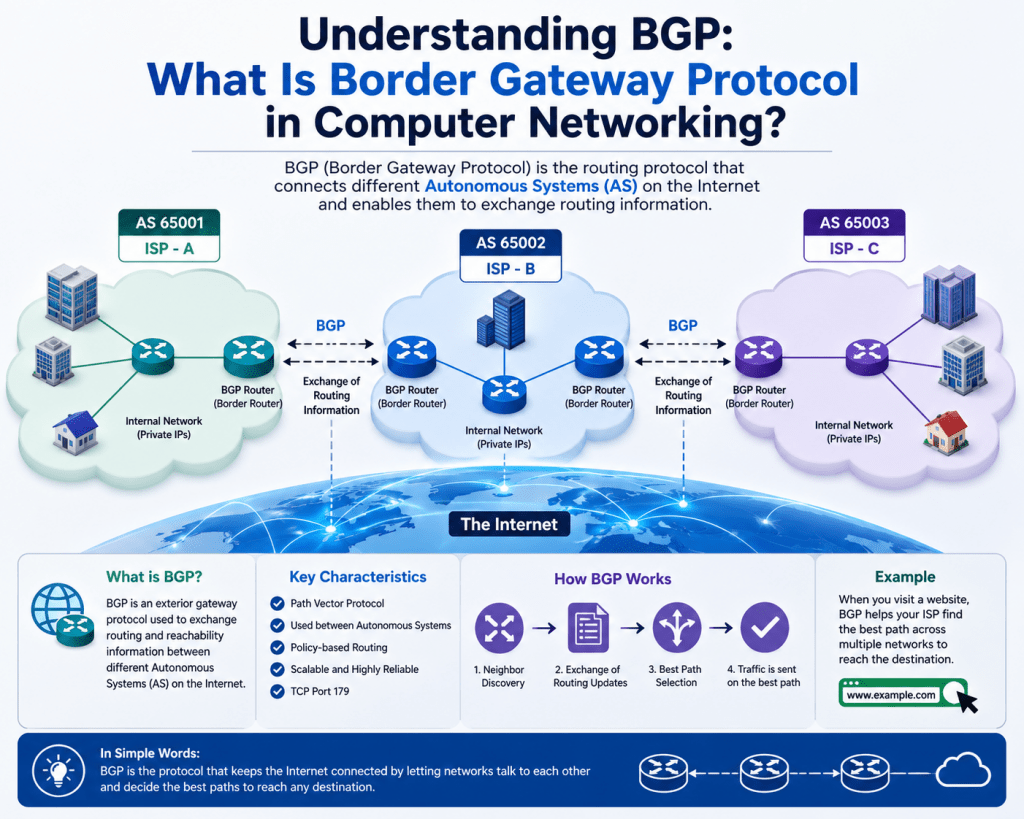
Border Gateway Protocol, commonly known as BGP, is a standardized exterior gateway protocol responsible for exchanging routing information between autonomous systems across the global internet. It operates at the core level of internet communication, enabling different networks to connect and exchange data efficiently. Without BGP, global-scale internet routing between independent networks would not function reliably. In modern networking environments, it acts as one of the most critical mechanisms that keeps global connectivity stable, scalable, and continuously operational even under changing network conditions.
BGP is fundamentally built for scale rather than simplicity. It is designed to handle extremely large and complex routing environments where thousands of networks interact simultaneously. This makes it different from many internal routing protocols that operate within a single organization. Instead, BGP focuses on communication between independent networks that may follow different policies, infrastructures, and technical standards.
What Border Gateway Protocol Actually Does
BGP is not an internal routing protocol used within a single network. Instead, it is designed for interdomain routing, meaning it connects entirely separate networks known as autonomous systems. These systems may belong to internet service providers, large enterprises, data center operators, or global cloud infrastructures.
The main function of BGP is to exchange routing information between these systems and determine the best possible path for data to travel across the Internet. Unlike simpler routing protocols that focus only on distance or speed, BGP uses policy-based decision-making, allowing network operators to control how traffic flows between networks. These policies may prioritize cost efficiency, performance optimization, redundancy planning, or even geopolitical routing preferences depending on organizational requirements.
BGP also provides flexibility in how networks are advertised and received. Each autonomous system can define which routes it shares and which routes it accepts. This creates a controlled yet interconnected ecosystem where global routing decisions emerge from local policies.
How Internet Traffic Uses BGP in Real Life
When a device connects to the internet, it is assigned an IP address by a router. That device can then communicate beyond its local network. However, once data leaves the local network, it must pass through multiple external networks before reaching its destination.
Each time data moves from one network to another, routing decisions are required. This is where BGP becomes essential. It determines how traffic should move between large networks, such as from an internet service provider to another provider or to a remote server located in a different region or continent.
A simple way to understand this is through a delivery system analogy. Just like a package moves through multiple distribution centers before reaching its destination, internet traffic moves through multiple routers and networks. Each intermediate system evaluates where the data should go next, and BGP provides the intelligence that allows these decisions to be made consistently across the global infrastructure.
In real-world internet communication, this process happens in milliseconds. A single request from a browser may traverse multiple countries, backbone networks, and exchange points before reaching a destination server. BGP ensures that each transition between networks is possible and that alternative routes exist when primary paths are unavailable.
Understanding BGP Routing Decisions
BGP does not rely on a single metric like speed, distance, or hop count. Instead, it evaluates multiple attributes when selecting the best route. These attributes include path length, routing policies, network reliability preferences, and administrative configurations defined by network operators.
This multi-attribute decision system allows organizations to influence how traffic enters and exits their networks. For example, a company may prefer one internet service provider over another based on cost or performance agreements. In other cases, traffic may be routed through specific regions to reduce latency or comply with regulatory requirements.
Because of this flexibility, BGP is often described as a policy-based routing protocol rather than a purely technical shortest-path system. The final routing decision is the result of layered evaluation logic rather than a single formula.
In more complex environments, routing decisions can also include traffic engineering strategies. These strategies are used to balance load across multiple links, prevent congestion, and ensure redundancy in case of network failures.
The Role of BGP in Global Internet Scale
The internet contains hundreds of thousands of networks, and each one advertises routes to other networks using BGP. These routes collectively form what is known as the global routing table.
Maintaining this massive routing database requires high efficiency and stability. Instead of constantly recalculating every possible route, BGP updates only when changes occur in the network topology. This event-driven behavior significantly reduces processing overhead and allows routers to maintain performance even at a global scale.
The routing table itself is continuously evolving. New networks are added, existing networks change providers, and routing policies are updated. Despite this constant change, BGP ensures that the global internet remains interconnected and functional.
How BGP Sessions and Peering Work
BGP operates by forming connections between routers known as peers. These peers exchange routing information through established sessions that are manually configured or negotiated between network operators. Once a session is active, routers share information about which networks they can reach and how those networks can be accessed.
These connections are essential for maintaining global connectivity. Without peering relationships, independent networks would not be able to exchange routing information, and large portions of the internet would become isolated.
Each router continuously monitors these sessions and updates its routing information based on changes in network availability. If a new route becomes available or an existing route becomes unreachable, updates are exchanged to reflect the new state of the network.
Why BGP Can Handle Network Failures
One of the most important strengths of BGP is its ability to handle network failures gracefully. If a route becomes unavailable due to a link failure, congestion, or outage, BGP automatically recalculates alternative paths.
This dynamic rerouting capability ensures that data can still reach its destination even when parts of the network are not functioning. In large-scale internet infrastructure, failures are expected rather than exceptional, so this resilience is essential.
BGP continuously evaluates multiple possible routes, which means redundancy is built into its design. If one path becomes unavailable, another path is quickly selected without requiring manual intervention. This behavior is one of the key reasons the global internet maintains high availability.
Route Aggregation in BGP
BGP also supports route aggregation, which reduces the size of routing tables. Instead of listing every individual network route separately, multiple routes can be combined into a single summarized entry.
This improves efficiency by reducing memory usage, lowering processing requirements, and simplifying routing decisions. In large-scale networks, route aggregation plays a critical role in maintaining system performance.
Without aggregation, routing tables would grow uncontrollably, making it difficult for routers to process updates quickly. Aggregation ensures that the global routing system remains manageable even as the number of networks continues to increase.
Security Considerations in BGP Operation
BGP operates on a trust-based model, which means networks assume that routing information received from peers is valid. However, this introduces potential risks if incorrect or malicious routing information is introduced into the system.
Such issues can lead to traffic misdirection, interception, or service disruption. To mitigate these risks, network operators implement filtering rules, route validation techniques, and strict policy controls. These mechanisms help ensure that only legitimate and authorized routes are accepted into routing tables.
Security in BGP is an ongoing area of focus because of its critical role in the Internet infrastructure. Even small routing errors can have widespread effects, so careful configuration and monitoring are essential.
Why BGP Matters in Everyday Internet Usage
Even though users do not interact with BGP directly, it plays a critical role in everyday internet activity. Every time a website is accessed, a video is streamed, or data is transmitted across the internet, BGP is involved in determining the path that data takes.
This process happens entirely behind the scenes, but it is essential for ensuring global communication between networks. It enables users to access services hosted anywhere in the world without needing to understand how routing decisions are made.
BGP remains one of the foundational systems that keeps the internet connected, scalable, and resilient across global infrastructure.
BGP Routing Architecture, Peering Relationships, and Global Route Exchange Mechanisms
Border Gateway Protocol operates through a highly structured routing architecture that enables independent networks to exchange reachability information at a global scale. Unlike internal routing protocols that operate within a single administrative domain, BGP is built for communication between autonomous systems that often have no shared internal infrastructure. This makes its architecture fundamentally policy-driven, distributed, and highly dependent on negotiated relationships between networks.
At its core, BGP functions as a path-vector protocol. This means it does not simply calculate the shortest route but instead maintains a record of the entire path that routing information has taken. Each advertised route includes a sequence of autonomous systems that the data must traverse. This path-based design helps prevent routing loops and provides administrators with visibility into how traffic flows across the internet.
Autonomous Systems and the Foundation of BGP Connectivity
An autonomous system is a collection of IP networks operated under a single administrative authority. Each autonomous system is assigned a unique identifier and is responsible for managing its own internal routing policies. These systems can vary in size from small organizations to large global internet service providers.
BGP enables these autonomous systems to communicate with each other by exchanging routing information. Each system advertises the networks it can reach, and in return, it learns about external networks through neighboring systems. This exchange creates a global mesh of interconnected routing information that forms the backbone of internet connectivity.
The relationship between autonomous systems is not random. It is based on agreements, policies, and technical configurations that define how routes are shared and accepted. These relationships determine how traffic flows across the internet and influence performance, cost, and reliability.
BGP Peering and the Establishment of Routing Relationships
BGP peering refers to the process of establishing a connection between two routers in different autonomous systems to exchange routing information. These connections are manually configured and require mutual agreement between both parties.
Once a peering session is established, the routers begin exchanging information about reachable networks. This includes IP prefixes, path attributes, and policy information. The session remains active as long as both sides maintain connectivity and adhere to agreed-upon policies.
Peering relationships are essential for global internet functionality. Without them, networks would be isolated and unable to communicate beyond their own boundaries. These relationships form a complex web of interconnections that collectively define the structure of the internet.
There are different types of peering relationships depending on business and technical requirements. Some are based on equal exchange of traffic, while others involve hierarchical arrangements where one network provides transit services for another.
The Role of BGP Routing Tables in Decision Making
Each BGP-enabled router maintains a routing table that contains information about all known network paths. This table includes not only destination networks but also detailed attributes that describe how each route was learned and how it should be treated.
The routing table is continuously updated as new information is received from BGP peers. When a new route is advertised, it is evaluated against existing routes based on a set of decision criteria. These criteria determine which route is considered the most preferred path for forwarding traffic.
The routing table is one of the most critical components in BGP operation. It acts as a real-time database of global network reachability and is constantly evolving as network conditions change.
Path Attributes and Their Influence on Routing Behavior
BGP uses a variety of path attributes to determine the best route for a given destination. These attributes provide detailed information about each route and allow administrators to influence routing behavior.
One of the most important attributes is the AS path, which records the sequence of autonomous systems a route has passed through. Shorter AS paths are often preferred, but this is not the only factor considered.
Other attributes include local preference, multi-exit discriminator values, and origin type. These attributes allow network operators to prioritize certain routes over others based on performance, cost, or strategic considerations.
Because BGP evaluates multiple attributes simultaneously, routing decisions are highly flexible. This flexibility allows complex traffic engineering strategies to be implemented across large-scale networks.
Route Propagation Across the Global Internet
Once a route is learned by a BGP router, it can be propagated to other peers. This process is known as route advertisement. Each router decides whether to advertise a route based on its own policy configuration.
Route propagation is what allows information about network reachability to spread across the Internet. As routes are advertised from one autonomous system to another, they gradually become part of the global routing table.
This propagation process is controlled and filtered at each step. Not all routes are shared universally, and each network can decide which routes to advertise or suppress. This ensures that routing information remains manageable and aligned with organizational policies.
Transit Networks and Internet Backbone Connectivity
Some autonomous systems function as transit networks. These networks carry traffic between other networks and form the backbone of the Internet. Large internet service providers typically operate as transit networks, providing connectivity between smaller networks and global destinations.
Transit networks play a crucial role in ensuring global reachability. They allow data to move across continents and between different regions of the world. Without transit networks, communication between distant networks would be fragmented and inefficient.
BGP is the protocol that enables transit networks to function. It allows them to exchange routing information with multiple peers and determine optimal paths for forwarding traffic.
BGP Convergence and Route Stability
BGP convergence refers to the process by which all routers in the network reach a consistent view of the routing table after a change occurs. When a network failure or update happens, BGP must propagate this information across all affected systems.
The convergence process is not instantaneous. It can take time for updates to propagate through the global internet. During this period, different routers may have slightly different views of network reachability.
Despite this delay, BGP is designed to eventually stabilize. Once convergence is complete, all routers agree on the best available paths, ensuring consistent routing behavior across the network.
Route stability is a key design goal of BGP. Frequent changes in routing information can lead to instability, so the protocol includes mechanisms to reduce unnecessary updates and dampen rapid fluctuations.
Route Filtering and Policy Enforcement in BGP
Route filtering is a mechanism used to control which routes are accepted or advertised by a BGP router. This is essential for maintaining security, stability, and policy compliance.
Network operators can define rules that determine which routes are considered valid. These rules may be based on source, destination, path attributes, or other criteria. Routes that do not meet these criteria are rejected or modified before being added to the routing table.
Policy enforcement ensures that routing behavior aligns with organizational goals. For example, a network may choose not to accept routes from certain peers or may prioritize routes based on performance agreements.
Filtering plays a critical role in preventing routing anomalies and maintaining the integrity of the global routing system.
BGP Scalability and Internet Growth
One of the reasons BGP remains the dominant interdomain routing protocol is its ability to scale with the growth of the Internet. As the number of connected networks increases, BGP is able to accommodate additional routes without requiring fundamental changes to its architecture.
This scalability is achieved through incremental updates, route aggregation, and hierarchical routing structures. Instead of recomputing the entire routing table, BGP only processes changes, which reduces computational overhead.
The hierarchical structure of autonomous systems also helps distribute routing responsibility across multiple levels. This prevents any single system from becoming overwhelmed by global routing complexity.
Redundancy and Multi-Homing in BGP Networks
Many networks use a strategy called multi-homing, where they connect to multiple upstream providers. This provides redundancy and improves reliability by ensuring that alternative paths are available if one connection fails.
BGP supports multi-homing by allowing multiple routes to the same destination. The protocol evaluates these routes and selects the most appropriate one based on configured policies.
This redundancy is a key factor in maintaining high availability in modern networks. It ensures that even if one provider experiences an outage, connectivity can still be maintained through alternative routes.
BGP Update Mechanisms and Network Communication Flow
BGP communicates changes through update messages that inform peers about new, withdrawn, or modified routes. These updates are triggered only when changes occur, making the protocol efficient in terms of bandwidth and processing.
Each update is evaluated by receiving routers, which then decide whether to accept or propagate the information further. This controlled propagation ensures that only relevant routing changes are distributed across the network.
Over time, these updates shape the global routing table and ensure that it reflects the current state of the internet.
The Structural Importance of BGP in Modern Networking
BGP is more than just a routing protocol. It is a structural component of the internet itself. It defines how networks interconnect, how traffic flows between regions, and how global communication is maintained.
Its design reflects the decentralized nature of the internet, where no single authority controls all routing decisions. Instead, thousands of independent systems cooperate through BGP to maintain global connectivity.
This distributed model is what allows the internet to scale, evolve, and remain resilient under constant change.
BGP Path Selection, Convergence Behavior, Optimization Techniques, and Real-World Internet Engineering
Border Gateway Protocol operates as the decision-making layer of global internet routing, where multiple possible paths exist between any two networks and only one is selected as the preferred route for traffic forwarding. This selection process is not random or purely based on distance. Instead, it is a structured evaluation system driven by multiple attributes, network policies, and hierarchical decision rules.
At a global scale, routing decisions made by BGP determine how traffic flows between continents, service providers, and large-scale infrastructure systems. Because the internet is composed of independently operated autonomous systems, each with its own routing preferences, BGP must reconcile conflicting policies while still ensuring that data reaches its destination efficiently and reliably.
The Concept of BGP Path Selection and Decision Hierarchy
BGP path selection is the process by which a router evaluates multiple available routes to a destination and chooses the most preferred one based on a defined decision hierarchy. Unlike shortest-path algorithms used in interior routing protocols, BGP does not rely on a single metric. Instead, it evaluates a sequence of attributes in a strict order.
The first factor typically considered is local preference, which is a value assigned by network administrators to prioritize certain routes over others. This attribute is internal to an autonomous system and is used to enforce routing policies such as preferring one provider over another.
If local preference values are equal, the next factor is usually the AS path length, which represents the number of autonomous systems a route has traversed. Shorter paths are generally preferred because they often indicate fewer network hops and potentially lower latency.
Beyond these initial criteria, BGP evaluates additional attributes such as origin type, multi-exit discriminator values, and internal routing cost to the next hop. Each step in the decision process helps narrow down the list of candidate routes until a single best path is selected.
This structured hierarchy ensures deterministic routing behavior, meaning that under the same conditions, routers will consistently choose the same path.
Understanding BGP Route Preference and Traffic Engineering
Route preference in BGP is not only a technical mechanism but also a strategic tool used in traffic engineering. Network operators intentionally manipulate routing attributes to influence how traffic flows through their infrastructure.
For example, an organization may prefer to send outbound traffic through a specific internet service provider due to lower cost or better performance. This can be achieved by adjusting local preference values or modifying path attributes.
Similarly, inbound traffic can be influenced using techniques such as AS path prepending, where additional autonomous system identifiers are artificially added to make a route appear less attractive to external networks. These techniques allow operators to balance traffic loads, avoid congestion, and improve overall performance.
Traffic engineering is especially important in large-scale networks where multiple redundant paths exist. Without proper optimization, traffic may concentrate on a single link, leading to inefficiency or bottlenecks.
BGP Convergence and Network Stability Mechanisms
BGP convergence refers to the process through which all routers in the network reach a consistent understanding of routing information after a change occurs. This change could be the failure of a network link, the introduction of a new route, or a modification in routing policy.
When such a change happens, BGP propagates updates throughout the network. Each router processes these updates, recalculates its best path, and forwards relevant information to its peers. This process continues until all routers have converged on a stable set of routes.
Convergence is not instantaneous. Because of the distributed nature of BGP, updates propagate gradually across the global Internet. During this period, different parts of the network may temporarily have inconsistent routing views.
To improve stability, BGP implements mechanisms such as route damping, which reduces the impact of rapidly flapping routes. This helps prevent instability caused by frequent changes in network availability.
Once convergence is achieved, routing behavior stabilizes until the next significant change occurs.
Route Optimization Strategies in Large-Scale Networks
Optimization in BGP involves improving the efficiency, reliability, and performance of routing decisions. This is achieved through careful configuration of routing policies and attributes.
One common optimization technique is load balancing across multiple links. By manipulating route attributes, traffic can be distributed more evenly across available paths, preventing overuse of a single connection.
Another strategy involves selecting geographically optimal routes. Networks may prefer routes that minimize latency by choosing paths that remain within specific regions rather than traversing long-distance links.
Redundancy optimization is also important. By maintaining multiple backup routes, networks ensure continuity of service in case of failures. These backup routes are carefully ranked so that failover occurs automatically and seamlessly.
Optimization is an ongoing process because network conditions constantly change. Operators must continuously monitor performance and adjust policies accordingly.
The Role of BGP in Internet Resilience and Fault Tolerance
One of the most critical functions of BGP is ensuring resilience in the global internet infrastructure. Because networks are distributed and independently operated, failures are inevitable. Links can go down, routers can malfunction, and entire regions can experience outages.
BGP handles these failures by dynamically recalculating routes and selecting alternative paths. This ability ensures that data can still reach its destination even when parts of the network are unavailable.
Fault tolerance in BGP is achieved through redundancy and continuous route evaluation. Multiple paths are always available, and the protocol continuously monitors their status. When a failure is detected, affected routes are withdrawn and replaced with alternative options.
This resilience is one of the key reasons the internet can operate continuously at a global scale despite frequent disruptions.
BGP Scaling Challenges and Global Routing Complexity
As the internet continues to expand, BGP faces increasing challenges related to scale and complexity. The global routing table contains hundreds of thousands of prefixes, and this number continues to grow as new networks are introduced.
Managing this volume of routing information requires efficient processing and memory usage. Routers must be capable of storing large routing tables while still making rapid forwarding decisions.
To address scalability challenges, techniques such as route aggregation and hierarchical routing are used. These reduce the size of routing tables and simplify decision-making processes.
Despite these optimizations, scaling remains a continuous challenge, especially as new technologies and services increase demand for connectivity.
BGP Security Risks and Routing Integrity Protection
BGP was originally designed in a trust-based environment, where networks assumed that routing information received from peers was valid. However, this assumption introduces potential security risks.
One major risk is route hijacking, where incorrect routing information is introduced into the network, intentionally or unintentionally. This can lead to traffic being redirected through unintended paths.
Another risk is route leaks, where routing information is improperly propagated beyond its intended scope. This can cause instability and misrouting across multiple networks.
To mitigate these risks, network operators use filtering mechanisms, route validation techniques, and authentication systems. These measures help ensure that only legitimate routing information is accepted.
Security in BGP is an evolving field, and continuous improvements are being developed to strengthen routing integrity across the Internet.
Real-World Role of BGP in Internet Service Providers
Internet service providers rely heavily on BGP to manage connectivity with other providers and customers. They use it to exchange routing information, manage traffic flow, and ensure service availability.
In provider networks, BGP is used to connect multiple upstream providers, downstream customers, and peer networks. This creates a highly interconnected environment where routing decisions must be carefully controlled.
Service providers also use BGP to implement traffic policies that align with business agreements. These policies determine how traffic is routed between different networks and help optimize performance and cost.
Because of its central role, BGP is considered one of the most important protocols in service provider infrastructure.
BGP in Enterprise and Cloud Environments
Beyond service providers, BGP is widely used in enterprise networks and cloud infrastructures. Large organizations use it to connect multiple data centers, manage hybrid cloud connectivity, and ensure redundancy across regions.
In cloud environments, BGP enables dynamic routing between virtual networks and external systems. It supports scalable architectures where workloads can move across regions while maintaining connectivity.
Enterprises also use BGP for multi-homing strategies, connecting to multiple providers to ensure continuous internet access. This improves resilience and reduces dependency on a single connection.
The Future Evolution of BGP in Modern Networking
As networking continues to evolve, BGP remains a foundational protocol, but it is also adapting to new requirements. Modern networks demand higher levels of automation, security, and scalability.
Future developments focus on improving routing security, reducing convergence time, and enhancing automation in policy management. These improvements aim to address current limitations while maintaining compatibility with existing infrastructure.
Despite its age, BGP continues to be central to global internet operations. Its ability to scale, adapt, and interconnect diverse networks ensures that it remains relevant in evolving network architectures.
BGP’s role in Internet engineering is not diminishing. Instead, it is becoming more critical as global connectivity demands continue to grow and diversify.
Conclusion
Border Gateway Protocol remains one of the most fundamental components of global internet infrastructure, even though it operates entirely behind the scenes for most users. Its primary responsibility is to ensure that independent networks across the world can communicate with each other in a structured, reliable, and scalable way. Without it, the internet would not function as a unified system but rather as a collection of isolated networks with limited or no interconnectivity. The ability of BGP to coordinate routing between autonomous systems is what makes global digital communication possible in its current form.
At its core, BGP represents a coordination mechanism rather than a simple routing algorithm. It does not attempt to calculate the fastest or shortest path in a purely mathematical sense. Instead, it reflects real-world network relationships, business agreements, and operational policies. This is one of the key reasons why it is often described as a policy-driven protocol. Every routing decision made by BGP is influenced by a combination of technical attributes and administrative preferences, which allows organizations to shape traffic flow according to their needs.
The importance of this flexibility becomes especially clear when considering the scale of the modern internet. With hundreds of thousands of networks interacting simultaneously, a rigid routing system would not be able to accommodate the complexity of real-world connectivity. BGP solves this problem by allowing each autonomous system to define its own routing rules while still participating in a global exchange of reachability information. This decentralized approach is what enables the internet to scale continuously without a single controlling authority.
Another critical aspect of BGP is its resilience. The internet is not a static environment; it is constantly changing due to network failures, maintenance activities, congestion, and infrastructure upgrades. BGP is designed to adapt to these changes dynamically. When a route becomes unavailable, it is withdrawn and replaced with an alternative path. This ensures that communication can continue even in the presence of disruptions. The ability to reroute traffic in real time is one of the main reasons why the internet maintains high availability despite frequent underlying failures.
However, this resilience is not automatic or effortless. It depends heavily on proper configuration, policy design, and continuous monitoring by network operators. Misconfigurations in BGP can have widespread consequences, affecting connectivity across large portions of the internet. This highlights the responsibility that comes with managing BGP environments. Operators must carefully design routing policies to ensure stability, prevent routing loops, and avoid unintended traffic behavior.
Scalability is another defining characteristic of BGP. As the number of connected devices, services, and networks continues to grow, the volume of routing information also increases. BGP handles this growth through incremental updates and route aggregation techniques. Instead of recalculating entire routing tables from scratch, it processes only changes in the network. This makes it efficient enough to support global-scale operations while maintaining acceptable performance levels.
Route aggregation plays a particularly important role in controlling the size of routing tables. By summarizing multiple network prefixes into broader entries, BGP reduces complexity and improves processing efficiency. This allows routers to manage large amounts of routing information without being overwhelmed. Without such mechanisms, the global routing system would become unsustainable as the Internet expanded.
Another key dimension of BGP is its role in inter-network relationships. The internet is built on agreements between independent organizations, and BGP serves as the technical foundation for these agreements. Whether networks are exchanging traffic equally or through transit arrangements, BGP enables these relationships by facilitating controlled route exchange. This creates a structured ecosystem where connectivity is both cooperative and competitive at the same time.
Security remains one of the most challenging aspects of BGP. Because it was originally designed in a trust-based environment, it does not inherently verify the authenticity of routing information. This opens the door to potential issues such as route leaks or route hijacking. Over time, various mechanisms have been introduced to mitigate these risks, including filtering, validation systems, and route verification frameworks. Despite these improvements, securing BGP remains an ongoing effort in the networking industry.
The real-world impact of BGP extends far beyond technical infrastructure. Every online activity, whether it is browsing a website, streaming content, or accessing cloud services, relies on routing decisions made by BGP. These decisions determine not only whether data reaches its destination but also how efficiently and reliably it does so. Although invisible to end users, BGP directly influences the quality of internet experiences worldwide.
In enterprise environments, BGP plays a strategic role in ensuring redundancy and connectivity. Organizations often connect to multiple service providers to avoid dependency on a single network. This approach, known as multi-homing, relies heavily on BGP to manage traffic distribution and failover behavior. By carefully configuring routing preferences, enterprises can ensure continuous connectivity even during outages or network disruptions.
In cloud computing environments, BGP supports dynamic and scalable network architectures. It enables seamless communication between distributed data centers and external networks. This is particularly important in modern application deployments where services are distributed across multiple geographic regions. BGP ensures that traffic is routed efficiently between these environments, maintaining performance and availability.
Despite its complexity, the foundational principles of BGP remain consistent. It is built on the idea of exchanging reachability information between independent systems and selecting optimal paths based on defined policies. This simplicity at the conceptual level is what allows it to scale to such a massive and complex global system. While the implementation details are intricate, the underlying purpose is straightforward: to ensure that networks can communicate with each other reliably.
The continued evolution of the internet ensures that BGP will remain relevant for the foreseeable future. While enhancements and supplementary technologies may improve security, automation, and performance, the core role of BGP is unlikely to be replaced. It is deeply embedded in the structure of global networking and serves as the foundation for inter-domain communication.
Understanding BGP provides valuable insight into how the Internet actually works beyond the surface level. It reveals the layered complexity behind something that appears simple to end users. Every connection, every request, and every data transfer depends on a vast system of routing decisions coordinated through BGP. Recognizing this complexity helps in appreciating the engineering effort required to maintain global connectivity at scale.
Ultimately, BGP is not just a protocol but a critical enabler of the modern digital world. It connects networks, supports global communication, and ensures the stability of the internet infrastructure. Its importance cannot be overstated, as it continues to serve as one of the key pillars that hold the internet together.