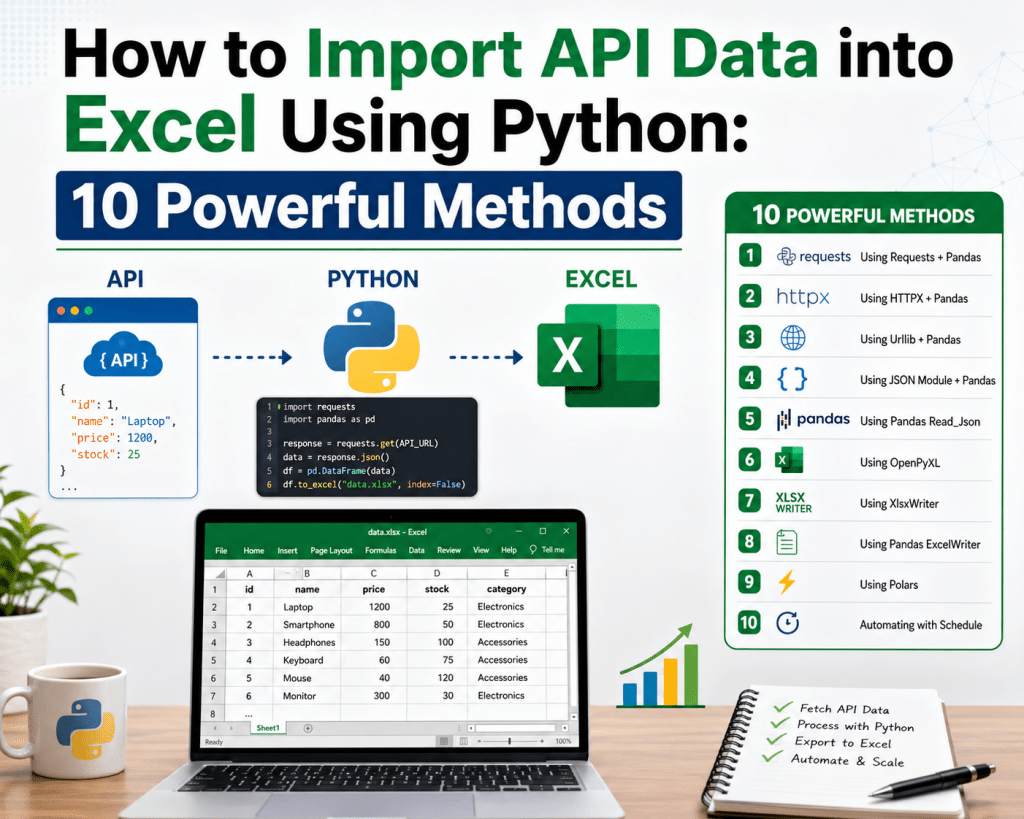
For a long time, spreadsheets have remained one of the most dependable tools for organizing, analyzing, and presenting data. Despite the rise of advanced analytics platforms, spreadsheets continue to dominate everyday workflows because of their simplicity and accessibility. However, traditional spreadsheet usage often involves repetitive manual updates, which introduce inefficiencies and increase the likelihood of human error. This is where Python changes the entire workflow by enabling automated data retrieval from external sources and seamless integration into structured spreadsheet environments.
Python serves as a bridge between dynamic data sources and structured reporting formats. When paired with spreadsheet tools, it allows users to eliminate manual data entry and replace it with automated pipelines. This approach not only improves accuracy but also significantly enhances productivity. Instead of copying and pasting information from various sources, users can rely on scripts to fetch, process, and organize data in a consistent manner.
The integration between Python and spreadsheets creates a hybrid workflow that combines flexibility with usability. Python handles complex operations such as retrieving data from external systems, transforming it into usable formats, and applying logic for filtering or calculations. Meanwhile, spreadsheets provide a familiar interface for reviewing, visualizing, and sharing that data. This combination is particularly effective for professionals who need reliable reporting without sacrificing control over how information is presented.
Modern data workflows increasingly rely on external data sources, commonly accessed through application programming interfaces. These interfaces act as gateways that allow systems to communicate and exchange information. Instead of relying on static datasets, users can pull real-time or near-real-time information directly into their workflows. This capability is essential for industries where data changes frequently, such as finance, marketing analytics, operations, and business intelligence.
Setting Up the Python Environment for API and Excel Workflow
The process of connecting Python with spreadsheet tools begins with setting up the appropriate environment. This involves installing the programming language itself and ensuring that the necessary libraries are available. Libraries extend Python’s capabilities by providing pre-built functions that simplify tasks like sending requests, processing structured data, and interacting with spreadsheet files. Without these tools, implementing such workflows would require significantly more effort and technical complexity.
Once the environment is ready, the next step involves structuring a script that can handle the entire workflow from start to finish. A well-organized script typically includes sections for defining connection details, retrieving data, processing that data, and exporting it into a structured format. Maintaining a clear structure ensures that the script remains scalable and easy to maintain as requirements evolve.
Understanding how external data is delivered is a critical part of this process. Most modern systems use structured formats that allow easy parsing and manipulation. These formats are designed to represent complex information in a hierarchical way, making it possible to extract only the relevant portions needed for analysis. Learning how to navigate and interpret this structure is essential for building efficient workflows.
Retrieving Data from APIs Using Python
Data retrieved from external sources is rarely ready for immediate use. It often contains unnecessary fields, inconsistent naming conventions, or nested structures that need to be simplified. This is where data transformation becomes important. Python provides powerful tools for reshaping data into a format that aligns with reporting requirements. By cleaning and organizing the data before exporting it, users can ensure that their spreadsheets remain clear, consistent, and easy to interpret.
Another advantage of using Python in this context is the ability to apply logic during the data preparation stage. Instead of performing calculations manually within a spreadsheet, users can define rules within their scripts. These rules can include filtering data, calculating new metrics, or reformatting values to meet specific requirements. This approach reduces dependency on manual spreadsheet manipulation and ensures that results remain consistent across different runs.
The export process is designed to transfer structured data into a spreadsheet format while preserving its organization. Once the data is in place, additional formatting can be applied to improve readability. This includes adjusting column widths, applying styles to headers, and ensuring that numerical values are presented in a clear and meaningful way. Automating these steps ensures that every output maintains the same level of quality without requiring manual adjustments.
Transforming API Data into Structured Spreadsheet Format
Automation is one of the most significant benefits of combining Python with spreadsheets. Once a script is created and tested, it can be scheduled to run at specific intervals. This means that reports can be updated automatically without any human intervention. For organizations that rely on timely data, this capability can transform how reporting processes are managed. Instead of spending hours updating spreadsheets, users can focus on analyzing the results and making informed decisions.
Scalability is another important factor to consider. As data requirements grow, manual workflows become increasingly difficult to manage. Python-based solutions can scale alongside these requirements by handling larger datasets and integrating multiple data sources. This makes it possible to build complex reporting systems that would be impractical to maintain manually.
Security and reliability also improve when automation is introduced. Manual data entry often leads to inconsistencies and errors that can compromise the integrity of reports. Automated scripts follow predefined rules, ensuring that data is handled consistently every time. This reduces the risk of discrepancies and improves overall confidence in the results.
Building Automated Data Workflows with Python and Spreadsheets
In addition to improving efficiency, this approach encourages a more structured way of thinking about data workflows. Instead of treating spreadsheets as isolated tools, users begin to see them as part of a larger system. This perspective makes it easier to identify opportunities for optimization and ensures that processes remain adaptable to changing requirements.
The flexibility of Python allows users to work with a wide range of data sources. Whether the data comes from financial systems, analytics platforms, or operational databases, the same principles can be applied. This versatility makes Python an essential tool for anyone looking to modernize their data workflows while maintaining compatibility with familiar spreadsheet environments.
Another key advantage is the ability to reuse and adapt scripts. Once a workflow is established, it can be modified to accommodate different data sources or reporting requirements. This reduces the need to build new solutions from scratch and ensures that best practices are consistently applied across different projects.
Scaling and Maintaining API to Excel Automation Systems
As organizations continue to rely on data-driven decision-making, the demand for efficient workflows will only increase. Combining Python with spreadsheets provides a practical solution that balances technical capability with ease of use. It allows users to automate repetitive tasks, improve data accuracy, and create reliable reporting systems without requiring advanced programming expertise.
This integration also opens the door to more advanced techniques. As users become more comfortable with automation, they can begin to explore additional features such as data validation, error handling, and performance optimization. These enhancements further improve the reliability and efficiency of their workflows.
Ultimately, the goal of integrating Python with spreadsheets is to create a streamlined process that reduces manual effort while maintaining flexibility. By leveraging automation, users can focus on extracting insights from their data rather than spending time on repetitive tasks. This shift not only improves productivity but also enhances the overall quality of analysis.
The foundation established in this section provides a clear understanding of how Python and spreadsheets work together to handle external data. The next step involves exploring deeper mechanisms of API handling and advanced data structuring techniques.
Working with APIs in Python for Scalable Data Retrieval
APIs are the backbone of modern data exchange systems, allowing applications to communicate and share structured information efficiently. In the context of Python and spreadsheet integration, APIs act as the primary source of dynamic data. Instead of relying on static files or manual exports, APIs enable direct access to continuously updated datasets that can be processed and transformed in real time.
At a technical level, an API functions as a controlled interface that exposes specific endpoints. Each endpoint is designed to return a particular type of data. For example, one endpoint might return user profiles, another might provide financial metrics, and another might deliver product-related information. Python interacts with these endpoints using HTTP requests, typically through standardized methods such as GET or POST.
When building a scalable data pipeline, understanding how APIs structure and deliver data is essential. Most APIs return information in a structured format that can be easily parsed into Python objects. These responses often contain nested elements, requiring careful extraction to isolate relevant fields. This becomes especially important when preparing data for spreadsheet environments, where clarity and structure are critical.
A major advantage of using Python for API interaction is its ability to handle complex request logic. This includes managing authentication, handling parameters, and controlling request frequency. In real-world applications, APIs often impose limits on how frequently data can be requested. These limits are designed to ensure system stability and prevent overload. Python scripts must therefore be designed with efficiency in mind, ensuring that requests are optimized and unnecessary calls are avoided.
Another important aspect of API usage is parameterization. Instead of retrieving all available data at once, APIs allow users to filter results based on specific conditions. These conditions may include date ranges, categories, or numeric thresholds. By using parameters effectively, Python scripts can reduce data volume and focus only on relevant information, improving both performance and clarity.
Handling Authentication and Secure API Access
Many modern APIs require authentication before granting access to data. This ensures that only authorized users or applications can retrieve information. Authentication methods vary depending on the system, but they commonly include API keys, tokens, or OAuth-based mechanisms.
In Python, authentication is typically handled by including credentials in request headers or parameters. These credentials act as identifiers that validate the request. Proper handling of authentication is essential, especially when building automated systems that run without manual intervention.
Security considerations also play a significant role in API integration. Sensitive credentials should never be hardcoded directly into scripts. Instead, they are often stored in environment variables or secure configuration files. This approach reduces the risk of exposure and ensures that credentials can be managed independently of the main codebase.
Once authentication is successfully implemented, the API will respond with data based on the user’s permissions. In some cases, different users may have access to different levels of information. This hierarchical access model is common in enterprise systems and ensures that sensitive data remains protected.
Extracting and Structuring Complex API Responses
API responses are rarely flat or simple. Instead, they often contain nested structures such as dictionaries within lists or lists within dictionaries. This structure allows APIs to represent complex relationships between data elements. However, it also introduces challenges when preparing data for spreadsheet integration.
Python provides powerful tools for navigating and extracting nested data structures. The process typically involves iterating through hierarchical elements and selecting only the required fields. This step is crucial because spreadsheets require structured, tabular data rather than deeply nested formats.
For example, an API might return a dataset containing multiple records, each with its own set of attributes. Within each record, additional nested information may exist, such as metadata or subcategories. The goal of data extraction is to flatten these structures into a consistent format where each row represents a single record, and each column represents a specific attribute.
This transformation process is essential for maintaining clarity in spreadsheet outputs. Without proper structuring, data can become difficult to interpret and analyze. Python’s flexibility allows developers to define custom extraction logic based on the structure of the API response.
Transforming Raw Data into Analytical Structures
Once data has been extracted from an API, it must be transformed into a format suitable for analysis. Raw data often contains inconsistencies, missing values, or irrelevant fields that need to be addressed before it can be used effectively.
Transformation typically involves cleaning, filtering, and restructuring operations. Cleaning refers to the removal or correction of inaccurate or incomplete data. Filtering involves selecting only the relevant subset of data based on predefined conditions. Restructuring focuses on reorganizing data into a consistent format that aligns with analytical requirements.
Python excels in handling these operations due to its extensive data manipulation capabilities. Through structured workflows, raw API responses can be converted into clean, tabular datasets. These datasets are then ready for export into spreadsheet environments.
Another important aspect of transformation is standardization. Different data sources may use varying formats for similar types of information. For example, dates may be represented in different formats, or numerical values may include inconsistent units. Standardization ensures that all data follows a consistent structure, making it easier to analyze and compare.
In addition to cleaning and structuring, transformation can also include the creation of new calculated fields. These fields are derived from existing data and provide additional insights. For example, percentages, ratios, or growth metrics can be calculated during the transformation stage, reducing the need for manual calculations later in the spreadsheet.
Managing Large API Datasets Efficiently
As data volume increases, efficiency becomes a critical factor in API-based workflows. Large datasets can slow down processing and increase memory usage if not handled properly. Python provides several strategies for managing large-scale data retrieval and transformation.
One common approach is pagination. Many APIs limit the amount of data returned in a single request. Instead of returning all records at once, data is divided into pages. Python scripts must therefore loop through these pages and combine results into a unified dataset. This ensures that large datasets can be retrieved without overwhelming system resources.
Another important technique is selective retrieval. Instead of requesting all available fields, scripts can specify only the required attributes. This reduces data payload size and improves processing speed. It also simplifies downstream transformation steps, as unnecessary information is excluded from the beginning.
Memory management is also important when working with large datasets. Instead of storing all data in memory at once, Python can process data in chunks. This approach is particularly useful when dealing with continuous data streams or very large API responses. Chunk-based processing ensures that systems remain stable even when handling high data volumes.
Preparing API Data for Spreadsheet Integration
Once data has been retrieved and transformed, the next step is preparing it for spreadsheet integration. Spreadsheets require data to be structured in a tabular format, where each row represents a record and each column represents a variable.
Python simplifies this process by providing tools for converting structured data into table-like formats. During this stage, attention is given to column naming, data ordering, and formatting consistency. Proper preparation ensures that the final spreadsheet is easy to read and analyze.
Column naming conventions play an important role in usability. Clear and descriptive names make it easier for users to understand the meaning of each field. Inconsistent or unclear naming can lead to confusion and misinterpretation of data.
Data ordering is another important consideration. In many cases, data is sorted based on relevance, date, or numerical value before being exported. This improves readability and helps users quickly identify important trends or patterns.
Formatting consistency ensures that all values follow a standardized structure. This includes consistent date formats, numerical precision, and text alignment. Although spreadsheets allow for manual formatting, handling these aspects within Python ensures uniformity across all outputs.
Building Reliable Data Pipelines with Python
A data pipeline refers to a structured process that moves data from a source to a destination while applying transformations along the way. In the context of Python and spreadsheets, the pipeline begins with API data retrieval and ends with structured spreadsheet output.
Building a reliable pipeline requires careful planning of each stage. The first stage involves data extraction, where API responses are collected. The second stage focuses on transformation, where data is cleaned and structured. The final stage involves exporting data into a spreadsheet format.
Error handling is a critical component of pipeline design. APIs may fail due to network issues, authentication errors, or server limitations. A robust pipeline must be able to detect and handle these failures gracefully. This ensures that the overall system remains stable even when individual components encounter issues.
Logging is another important feature in pipeline systems. Logs provide a record of each step in the process, making it easier to identify and troubleshoot issues. This becomes especially important in automated environments where processes run without manual supervision.
Scalability must also be considered when designing pipelines. As data volume increases, pipelines should be able to handle additional load without significant performance degradation. This often involves optimizing request patterns, improving data processing logic, and ensuring efficient memory usage.
Preparing for Automated Data Workflows
The ultimate goal of integrating Python with API data sources and spreadsheets is automation. Once a pipeline is established, it can be scheduled to run automatically at defined intervals. This eliminates the need for manual intervention and ensures that data remains up to date.
Automation requires careful consideration of timing, resource usage, and error recovery. Scheduled tasks must be configured to run at appropriate intervals based on data update frequency. For example, financial data may require more frequent updates than static business metrics.
Resource management is also important in automated systems. Scripts should be optimized to minimize unnecessary processing and reduce system load. This ensures that automated tasks do not interfere with other operations.
Error recovery mechanisms allow systems to continue functioning even when failures occur. This may include retry logic, fallback procedures, or notification systems that alert users when issues arise. These mechanisms improve the reliability of automated workflows.
Building Fully Automated Python-to-Excel Data Pipelines
Modern data workflows increasingly depend on automation rather than manual intervention. Once the foundation of API data retrieval and transformation is established, the next stage is constructing a fully automated pipeline that continuously moves data from external systems into structured spreadsheet outputs. This approach eliminates repetitive tasks and ensures that datasets remain consistently updated without human effort.
A fully automated pipeline typically follows a structured sequence. First, data is retrieved from one or more external APIs. Next, it is processed and transformed into a clean, structured format. Finally, the processed data is exported into a spreadsheet system where it can be used for reporting and analysis. Each stage is connected in a controlled workflow that operates without manual input once activated.
The key advantage of automation lies in consistency. Manual workflows often introduce variation due to human error or inconsistent timing. Automated systems, on the other hand, follow predefined logic every time they execute. This ensures that outputs remain stable and predictable regardless of how frequently the process runs.
Automation also improves scalability. As data requirements grow, manual processes become increasingly inefficient. Automated pipelines can handle larger volumes of data without requiring proportional increases in effort. This makes them suitable for environments where data continuously expands or changes in structure.
Another important aspect of automation is modular design. Instead of building a single large script, workflows are often divided into smaller components. Each component handles a specific task such as data retrieval, cleaning, transformation, or export. This modular structure improves maintainability and makes it easier to update individual parts without affecting the entire system.
Designing Reliable Scheduling Systems for Data Updates
Once a pipeline is built, it must be executed at regular intervals to maintain up-to-date data. Scheduling systems play a critical role in this process by automating execution based on predefined time conditions. These systems ensure that scripts run consistently without requiring manual triggering.
Scheduling can be implemented at the operating system level, where tasks are configured to run at specific times or intervals. This approach allows pipelines to operate in the background, updating spreadsheets automatically based on business requirements. Common scheduling intervals include hourly, daily, or weekly execution, depending on how frequently the underlying data changes.
Reliability is a key consideration when designing scheduled workflows. Since these processes run without supervision, they must be able to handle unexpected conditions such as network interruptions or temporary API failures. A well-designed system includes retry mechanisms that attempt to re-run failed operations after a short delay.
Another important feature of scheduling systems is execution logging. Logs record each run of the pipeline, including timestamps, success status, and error messages if applicable. These logs are essential for monitoring system health and diagnosing issues when they occur.
Time zone considerations also play a role in scheduling. In distributed environments, data sources and users may operate in different regions. Scheduling systems must account for these differences to ensure that data updates occur at appropriate times relative to user expectations.
Error Handling and Fault Tolerance in Data Pipelines
No automated system is completely free from errors. APIs may become unavailable, network connections may fail, or unexpected data formats may be returned. For this reason, robust error handling is essential in any production-level pipeline.
Error handling involves detecting failures and responding to them in a controlled manner. Instead of allowing a script to crash, the system should identify the issue and take appropriate action. This may include retrying the request, skipping the problematic data, or logging the error for later review.
Retry logic is one of the most common strategies used in API-based workflows. When a request fails, the system waits for a short period before attempting again. This approach is particularly useful for handling temporary issues such as network instability or rate limiting.
Fault tolerance goes beyond simple error handling. It ensures that a pipeline can continue operating even when certain components fail. For example, if one API endpoint becomes unavailable, the system may continue processing data from other sources.
Data validation is another important layer of protection. Before data is processed or exported, it should be checked for completeness and correctness. This helps prevent corrupted or incomplete data from entering the final spreadsheet output.
In more advanced systems, alerts can be configured to notify users when errors occur. These alerts provide immediate visibility into system issues and allow for quick intervention when necessary.
Optimizing Performance in Large-Scale Data Processing
As data volume increases, performance optimization becomes increasingly important. Inefficient scripts can lead to slow execution times, excessive memory usage, and delayed updates. Optimization ensures that pipelines remain efficient even when handling large datasets.
One of the most effective optimization techniques is minimizing unnecessary data retrieval. Instead of requesting all available information from an API, scripts should request only the fields that are required. This reduces data transfer size and improves processing speed.
Another optimization strategy involves batch processing. Instead of handling all data at once, information is processed in smaller chunks. This reduces memory consumption and allows systems to handle larger datasets without performance degradation.
Caching is also commonly used to improve efficiency. Frequently accessed data can be stored temporarily to reduce repeated API calls. This is particularly useful when working with static or slowly changing data sources.
Efficient data structures also contribute to better performance. Choosing appropriate structures for storing and processing data can significantly reduce computation time. For example, structured tabular formats are often more efficient for spreadsheet-related workflows.
Parallel processing is another advanced optimization technique. By distributing tasks across multiple processing units, systems can handle larger workloads in less time. However, this approach must be carefully managed to avoid conflicts or data inconsistencies.
Scaling Data Pipelines for Enterprise-Level Usage
As organizations grow, their data requirements become more complex. Simple scripts are often insufficient for handling enterprise-level workloads. Scalable pipeline design addresses this challenge by ensuring that systems can expand without major restructuring.
Scalability begins with architectural design. Instead of relying on a single monolithic script, systems are built using distributed components. Each component handles a specific part of the workflow, allowing the system to scale horizontally as demand increases.
Data partitioning is another important concept in scalable systems. Large datasets are divided into smaller segments that can be processed independently. This improves efficiency and allows multiple processes to run simultaneously.
Resource management becomes critical at scale. Systems must ensure that processing power, memory, and network usage are balanced effectively. Overloading any single resource can lead to performance bottlenecks.
Scalable systems also require robust monitoring. As complexity increases, it becomes more difficult to track system behavior manually. Monitoring tools provide real-time insights into performance, errors, and data flow.
Another important aspect of scalability is maintainability. As systems grow, they must remain easy to update and modify. Modular design, clear documentation, and consistent coding practices all contribute to long-term maintainability.
Ensuring Data Consistency Across Automated Workflows
Data consistency is essential in any automated system that feeds into spreadsheet reporting. Inconsistent data can lead to inaccurate analysis and flawed decision-making. Ensuring consistency involves standardizing processes and maintaining strict control over data transformations.
One approach to maintaining consistency is enforcing schema definitions. A schema defines the expected structure of data, including field names, data types, and formatting rules. By validating incoming data against a schema, systems can ensure that only properly structured information is processed.
Normalization is another important technique. This involves converting data into a standard format before it is used. For example, dates may be converted into a uniform format, and numerical values may be rounded to a consistent precision level.
Version control also plays a role in maintaining consistency. As pipelines evolve, changes to logic or structure must be tracked carefully. This ensures that updates do not introduce unexpected behavior or break existing workflows.
Data reconciliation processes can also be implemented to compare outputs against expected results. This helps identify discrepancies and ensures that automated systems remain accurate over time.
Advanced Integration Strategies for Multi-Source Data Systems
In more complex environments, data often comes from multiple sources rather than a single API. Integrating multiple data streams requires careful coordination to ensure that information remains consistent and properly aligned.
Data merging is a key component of multi-source integration. This involves combining datasets based on shared attributes such as identifiers or timestamps. Proper merging ensures that related data points are accurately aligned across different sources.
Conflict resolution strategies are also necessary when dealing with multiple sources. In cases where conflicting information is received, predefined rules determine which data should take precedence.
Synchronization is another important consideration. Data from different sources maybe updatede at different intervals. Systems must account for these differences to ensure that combined outputs remain accurate.
Multi-source systems often require more advanced transformation logic. Each data source may have its own structure and format, requiring custom processing before integration. Python’s flexibility makes it particularly well-suited for handling these scenarios.
Long-Term Maintenance of Automated Data Systems
Once a pipeline is deployed, ongoing maintenance becomes essential to ensure continued reliability. APIs may change over time, data structures may evolve, and system requirements may shift. Maintenance ensures that pipelines remain functional under changing conditions.
Regular updates are often required to accommodate changes in external APIs. This may include adjusting endpoints, modifying authentication methods, or updating data extraction logic.
Performance monitoring is also important for long-term maintenance. Over time, changes in data volume or structure may affect system efficiency. Monitoring helps identify these issues early and allows for timely optimization.
Documentation plays a critical role in maintainability. Clear documentation ensures that future modifications can be made without confusion. It also helps new users understand how the system operates.
Testing is another essential component of maintenance. Automated tests can be used to verify that pipelines continue to function correctly after updates. This reduces the risk of introducing errors during modifications.
Evolving Data Workflows with Automation and Intelligence
As automation becomes more advanced, data workflows evolve from simple pipelines into intelligent systems capable of adapting to changing conditions. These systems are not only automated but also optimized for efficiency, reliability, and scalability.
The integration of Python with spreadsheet systems represents a powerful approach to modern data management. It eliminates manual effort, reduces errors, and enables continuous data flow from external sources into structured reporting environments.
With properly designed pipelines, organizations can shift their focus from data collection to data interpretation. This transition enhances decision-making and allows for more strategic use of information.
As data ecosystems continue to grow, automated systems will play an increasingly central role in managing complexity and ensuring consistency across multiple data sources and reporting structures.
Conclusion
The integration of Python with APIs and spreadsheet systems represents a significant shift in how data is collected, processed, and used in modern workflows. Instead of relying on manual methods that involve copying information, updating spreadsheets, and correcting human errors, automated pipelines introduce a structured and repeatable process that ensures accuracy and consistency. This approach is especially important in environments where data changes frequently, and decisions depend on up-to-date information.
One of the most important outcomes of using Python for API-driven spreadsheet automation is the reduction of manual workload. In traditional workflows, data handling often consumes a large portion of time, especially when reports need to be updated regularly. Each update requires extracting data from external sources, cleaning it, reformatting it, and then inserting it into spreadsheets. This repetitive cycle not only slows down productivity but also increases the risk of inconsistencies. Automation removes these repetitive steps and replaces them with a single structured process that can run repeatedly without variation.
Another major benefit is accuracy. Human involvement in repetitive data tasks often leads to small mistakes that can have large consequences over time. These mistakes might include incorrect entries, missed updates, or formatting inconsistencies. When Python scripts handle these processes, the logic remains consistent every time the workflow runs. This ensures that the same rules are applied uniformly across all data points, reducing the likelihood of errors and improving trust in the final output.
Scalability is another critical advantage of this approach. As data sources grow and become more complex, manual workflows quickly become unmanageable. Python-based systems can handle increasing volumes of data without requiring proportional increases in effort. Whether dealing with a small dataset or large-scale information streams, the same underlying logic can be applied with minimal adjustments. This makes it possible to expand reporting systems without redesigning the entire workflow.
Flexibility also plays a major role in the strength of this integration. APIs come in many different forms, each with its own structure, authentication method, and data format. Python provides the flexibility needed to adapt to these variations. Scripts can be modified to accommodate different endpoints, handle multiple data formats, and process information from diverse sources. This adaptability ensures that workflows remain useful even as external systems evolve.
Automation also changes the way data is consumed. Instead of viewing spreadsheets as static documents that require manual updates, they become dynamic outputs of ongoing processes. Each time the pipeline runs, the spreadsheet is refreshed with the latest available data. This creates a living reporting system that always reflects current information. In fast-moving industries such as finance, marketing, and operations, this level of freshness is essential for making informed decisions.
Reliability is another key outcome of this approach. Once properly configured, automated pipelines operate consistently over long periods of time. They follow predefined rules and do not deviate from expected behavior unless the underlying logic is changed. This predictability allows organizations to depend on automated reports without constantly verifying their accuracy. It also frees up time for more strategic tasks such as analysis and planning.
Error handling mechanisms further enhance reliability. In real-world conditions, external data sources are not always stable. APIs may experience downtime, network connections may fail, or unexpected data formats may appear. Well-designed Python workflows include safeguards that detect these issues and respond appropriately. Instead of failing, systems can retry operations, skip problematic data, or log errors for later review. This ensures that the overall pipeline remains functional even when individual components encounter issues.
Another important aspect of this ecosystem is maintainability. As workflows grow more complex, maintaining clarity in structure becomes essential. Breaking processes into modular components allows each part of the system to be updated independently. This reduces the risk of introducing errors when changes are made and makes it easier to understand how each part of the system contributes to the overall workflow. Clear structure also helps when new data sources are added or existing ones are modified.
The long-term value of Python-based automation lies in its ability to evolve alongside organizational needs. Initial implementations may start with simple data retrieval and export tasks, but over time, these systems can expand into fully integrated data pipelines. Additional features such as data validation, multi-source integration, and advanced transformation logic can be added without rebuilding the entire system. This progressive development approach allows systems to grow organically as requirements increase.
From an operational perspective, automation also improves decision-making speed. When data is updated automatically and consistently, decision-makers have access to real-time or near-real-time insights. This reduces delays caused by manual reporting cycles and allows for faster responses to changing conditions. In competitive environments, this speed advantage can have a significant impact on outcomes.
Data consistency across different sources is another benefit of structured automation. When multiple APIs or datasets are involved, inconsistencies in format or structure can create confusion. Python workflows address this by standardizing data before it reaches the spreadsheet layer. This ensures that all information follows a consistent format, making it easier to compare and analyze across different sources.
Over time, automated systems also contribute to better resource utilization. Instead of spending time on repetitive data tasks, users can focus on interpreting results and making strategic decisions. This shift from manual processing to analytical thinking increases overall productivity and allows teams to operate at a higher level of efficiency.
In addition, automation encourages better data governance practices. Since workflows are defined through code, every step in the process is documented and traceable. This transparency makes it easier to audit data flows, identify issues, and ensure compliance with internal or external standards. It also creates a clear record of how data is transformed from its source to its final output.
The combination of Python, APIs, and spreadsheet systems ultimately creates a powerful ecosystem for modern data management. It bridges the gap between raw data sources and user-friendly reporting tools, enabling seamless movement of information across different stages of processing. This integration not only improves efficiency but also enhances the quality and reliability of data-driven insights.
As organizations continue to rely more heavily on data, the importance of automation will continue to grow. Systems that once required manual effort will increasingly be replaced by intelligent pipelines that operate continuously in the background. This evolution represents a shift toward more efficient, scalable, and reliable data practices that support long-term growth and adaptability.
In essence, the transition from manual spreadsheet management to automated Python-driven workflows is not just a technical improvement but a fundamental change in how data is handled. It transforms static processes into dynamic systems, reduces operational burden, and enables more informed decision-making. Over time, this approach becomes not just a convenience but a necessity for handling the increasing complexity of modern data environments.