
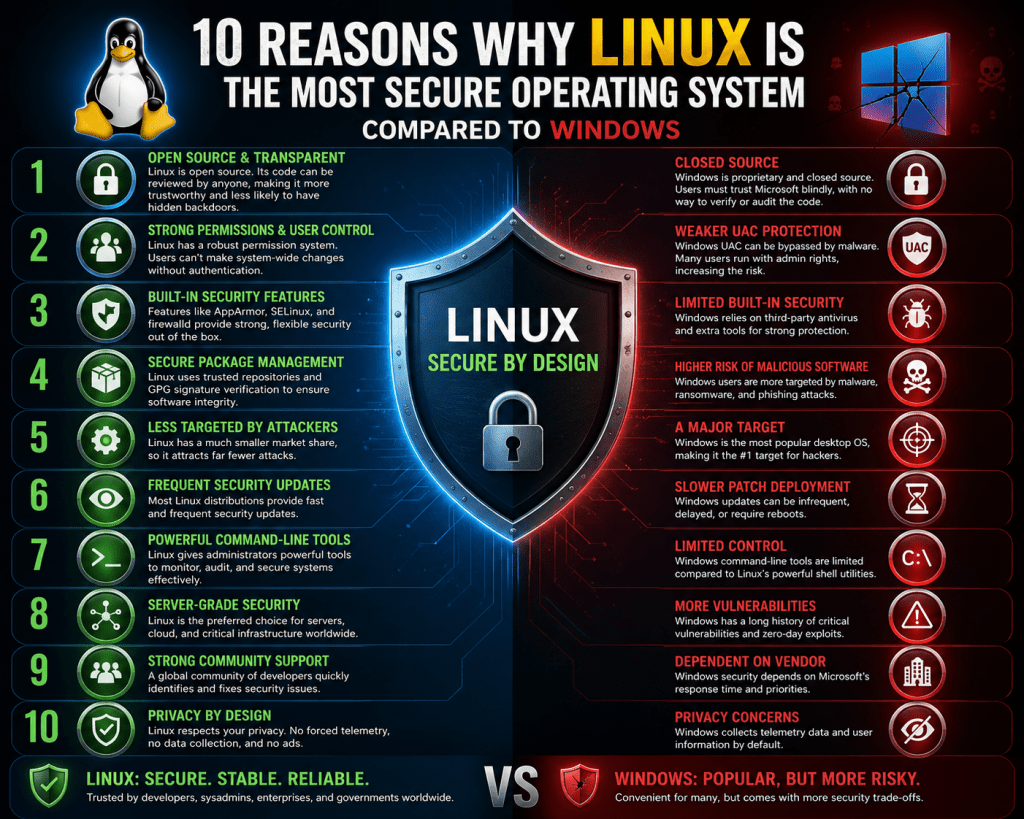
The idea that Linux is more secure than Windows is not based on a single factor but on a combination of architectural design, permission handling, system transparency, and operational philosophy. Linux was built with multi-user computing and system control in mind from the beginning, which naturally led to a security model that prioritizes restriction, accountability, and modularity. Unlike systems designed primarily for mass consumer usability, Linux emphasizes controlled access to system resources and predictable system behavior.
Security in modern computing is not only about preventing external attacks but also about minimizing internal risks, misconfigurations, and accidental user actions. Linux achieves this through layered protections that work together rather than relying on a single security mechanism.
Core Architecture and Security Design Principles of Linux
Linux is structured around a kernel-based architecture that separates system-level operations from user-level activity. The kernel acts as the central component responsible for managing memory, hardware interactions, process execution, and system scheduling. Everything outside the kernel operates in user space with limited privileges.
This separation is fundamental to Linux security. Applications running in user space cannot directly modify kernel operations or access critical system memory without explicit permission. This isolation reduces the risk that a compromised application can take control of the entire system.
Another important design principle is modularity. Linux systems are built using components that can be loaded or removed depending on system requirements. Drivers, services, and kernel modules are not permanently fixed into the system. Instead, they can be enabled only when needed. This reduces unnecessary exposure and limits the number of active components that could potentially contain vulnerabilities.
Linux systems are also highly configurable at installation and deployment time. Administrators can choose minimal installations for servers or full-featured environments for desktops. This flexibility ensures that only required services are active, which directly reduces attack surfaces and improves system resilience.
User Privileges and the Principle of Least Privilege
One of the most critical security mechanisms in Linux is its strict user privilege model. Every user and process operates under defined permission boundaries. At the top level is the root user, who has complete control over the system. However, regular users operate with limited access rights.
This structure enforces the principle of least privilege. Users are given only the permissions they need to perform their tasks. They cannot modify system-wide configurations, install system-level software, or access restricted directories without explicit authorization.
When administrative actions are required, Linux uses controlled privilege escalation mechanisms. These mechanisms require authentication and often temporary elevation rather than permanent access. This ensures that high-level system control is only used intentionally and under supervision.
This model significantly reduces risk. Even if a user account is compromised, the attacker is restricted by the same limited permissions as the user. This containment prevents widespread system damage and limits escalation opportunities.
Controlled File Execution and Malware Resistance
Linux uses strict execution permissions that play a major role in preventing malware execution. Unlike systems where downloaded files can often be executed directly, Linux requires explicit permission changes before a file can run as a program.
Every file in Linux has defined permission attributes that determine whether it can be read, modified, or executed. By default, files do not have execution rights. Users must manually assign execution permission, which creates an intentional step before running any program.
This design reduces accidental execution of malicious files. Even if a harmful file is downloaded, it remains inactive until execution rights are granted. This introduces a deliberate barrier between file acquisition and execution.
Additionally, Linux systems often rely on structured software distribution models. Applications are typically installed through verified repositories that maintain integrity checks and controlled updates. This reduces exposure to untrusted software sources, which are a common vector for malware in other environments.
These mechanisms collectively ensure that malicious code faces multiple barriers before it can execute or spread within the system.
Market Distribution and Its Influence on Targeted Attacks
The distribution of operating systems plays an indirect but important role in cybersecurity. Linux has a smaller share in general desktop environments compared to more widely used systems. This affects how attackers prioritize targets.
Cyber attackers often focus on platforms that provide maximum reach. Systems with large user bases offer higher potential returns for malicious campaigns. As a result, widely used operating systems tend to attract more automated malware and large-scale attacks.
Linux, however, is more commonly used in servers, cloud infrastructure, and enterprise systems rather than personal desktops. While these environments are highly critical, they are also more tightly managed and secured by professionals.
This reduces exposure to mass-targeted consumer attacks. Instead, Linux environments are more likely to face targeted attacks that require higher technical expertise. These attacks are typically more sophisticated but less widespread.
It is important to understand that reduced targeting does not mean reduced security capability. Instead, it reflects how Linux’s architecture and usage patterns influence the nature of threats it faces.
Community-Driven Development and Security Response Speed
Linux benefits from a global, open-source development ecosystem. Unlike proprietary systems controlled by a single organization, Linux is maintained by thousands of contributors worldwide, including developers, researchers, and security experts.
This distributed development model significantly improves security visibility. Because the source code is open, it can be examined by anyone. This increases the likelihood that vulnerabilities are discovered early, often before they can be widely exploited.
When security issues are identified, fixes are developed rapidly and shared across the community. Different Linux distributions integrate these updates according to their release models, allowing users to receive patches quickly.
This decentralized approach reduces dependency on a single vendor’s release cycle. Security improvements are not delayed by centralized approval processes, which allows faster response to emerging threats.
The collaborative nature of Linux development also leads to continuous improvement. Security enhancements are frequently introduced based on real-world usage, making the system increasingly resilient over time.
System Stability and Reduced Attack Surface
System stability plays a direct role in security effectiveness. Linux is widely recognized for its stability across different environments, including servers, embedded systems, and enterprise infrastructure.
A stable system reduces unexpected behavior, which is often exploited in attacks. System crashes, memory corruption, or unhandled errors can create opportunities for exploitation. Linux minimizes these risks through efficient resource management and controlled system processes.
Another key factor is the reduced attack surface. Linux systems typically run only essential services, especially in production environments. Each active service represents a potential entry point for attackers. By minimizing unnecessary services, Linux reduces the number of exploitable components.
This minimalistic approach improves both performance and security. Fewer active processes mean fewer vulnerabilities and simpler system monitoring. Administrators can also disable unused features entirely, further tightening system security.
Configuration Control and Security Customization
Linux provides deep configuration control, allowing administrators to tailor security settings based on specific requirements. This flexibility is one of its strongest advantages in professional environments.
Access controls can be defined at multiple levels, restricting user actions with precision. Network configurations can be hardened to limit exposure. Firewall rules can be customized to control traffic flow. System services can be enabled or disabled depending on operational needs.
Linux also supports advanced security frameworks that go beyond basic permissions. These frameworks enforce mandatory policies on how applications interact with system resources. This ensures that even compromised applications cannot freely access sensitive areas of the system.
This level of customization allows organizations to build security models aligned with their operational risk profiles. Instead of relying on fixed security settings, Linux enables adaptive security configurations that evolve with changing requirements.
Expanding Linux Security: Deep System Behavior and Attack Resistance
Linux security is not only defined by surface-level permissions or market share advantages but also by deeper system behaviors that influence how processes interact, how memory is managed, and how isolation is enforced at runtime. These internal mechanisms create a layered defense model that reduces exploitability even when vulnerabilities exist at the application level. Understanding these deeper layers is essential to fully appreciate why Linux is widely adopted in environments where security and reliability are critical.
Unlike operating systems that prioritize convenience-first design, Linux often prioritizes predictable system behavior and controlled execution flow. This makes it less forgiving in some cases for inexperienced users, but significantly more resilient against automated exploitation techniques commonly used in modern cyberattacks.
Process Isolation and Execution Control in Linux Systems
One of the most important aspects of Linux security is process isolation. Every program running in Linux operates as an independent process with its own memory space. This separation ensures that one application cannot directly interfere with the memory of another application without explicit permission or elevated privileges.
The kernel enforces strict boundaries between processes using memory management techniques such as virtual memory segmentation. Each process sees its own isolated view of system memory, which prevents unauthorized reading or modification of data belonging to other applications.
This isolation becomes especially important in multi-user or multi-service environments where many applications run simultaneously. Even if one process becomes compromised, its ability to affect other processes is heavily restricted. This containment model significantly reduces the spread of malware and limits lateral movement within a system.
Linux also uses controlled process scheduling to manage how CPU resources are allocated. This ensures that no single process can monopolize system resources indefinitely. From a security perspective, this prevents denial-of-service conditions caused by runaway processes or malicious resource exhaustion attempts.
Memory Protection Mechanisms and Kernel Safeguards
Memory protection is another critical layer of Linux security. The operating system uses hardware-assisted memory management features provided by modern processors to enforce strict separation between user space and kernel space.
User applications cannot directly access kernel memory. Any attempt to do so results in a controlled failure, preventing unauthorized escalation. This boundary is enforced at the hardware level, making it extremely difficult for attackers to bypass without exploiting highly specific vulnerabilities.
Additionally, Linux employs techniques such as address space layout randomization (ASLR), which randomizes the memory locations of system components and processes. This makes it significantly harder for attackers to predict memory structures and execute reliable exploits.
Kernel-level protections further strengthen system integrity by validating system calls and restricting unsafe operations. Every interaction between user applications and the kernel must pass through controlled interfaces, ensuring that only valid and authorized requests are processed.
These memory protection mechanisms collectively reduce the likelihood of successful exploitation through buffer overflows, memory corruption, and other low-level attack techniques commonly used in system compromise attempts.
File System Permissions and Hierarchical Access Structure
Linux file systems are built on a strict permission hierarchy that governs how files and directories are accessed. Every file is associated with an owner, a group, and a set of permission rules that define read, write, and execute capabilities.
This structure ensures that users can only interact with files they are authorized to access. System-critical files are protected through restricted permissions that prevent modification or deletion by non-administrative users.
Directories also follow the same permission model, which controls navigation and visibility within the file system. This prevents unauthorized users from even listing or exploring sensitive system areas.
The hierarchical structure of Linux file systems also contributes to security by enforcing clear boundaries between system-level data and user-level data. Critical system directories are isolated from user directories, reducing the risk of accidental or malicious interference.
In addition, Linux supports advanced permission models such as access control lists (ACLs), which allow more granular control over file access. This enables administrators to define precise permission rules beyond traditional user-group-owner structures, further strengthening security enforcement.
Network Security Controls and Traffic Management
Linux systems often serve as the backbone of network infrastructure, which makes network security controls a vital part of their security model. The operating system provides built-in mechanisms for managing network traffic, controlling access points, and filtering incoming and outgoing connections.
Firewall systems integrated into Linux allow administrators to define rules that regulate network communication at a highly granular level. These rules can restrict traffic based on IP addresses, ports, protocols, or application-level behavior.
This level of control reduces exposure to unauthorized network access and limits the potential for external exploitation. Only explicitly allowed traffic is permitted, while all other connections can be blocked by default configurations.
Linux also supports network segmentation, allowing systems to be divided into isolated zones. This is particularly useful in enterprise environments where different services must operate independently without cross-access.
In addition to firewalls, Linux supports secure networking protocols that encrypt data in transit. This ensures that sensitive information cannot be easily intercepted or modified during communication between systems.
Authentication Mechanisms and Identity Control
Authentication in Linux is built around strong identity verification principles. Users must provide valid credentials before accessing system resources, and authentication processes are tightly integrated with system permissions.
Password-based authentication remains common, but Linux also supports more advanced methods such as key-based authentication and multi-factor authentication systems. These methods provide stronger protection against unauthorized access attempts.
Authentication systems in Linux are modular, allowing integration with centralized identity management systems in enterprise environments. This enables consistent access control policies across multiple systems and services.
Once authenticated, users are still subject to permission-based restrictions. Authentication does not grant unrestricted access; instead, it establishes identity, while permissions define what that identity is allowed to do.
This separation between authentication and authorization adds a layer of security. Even if credentials are compromised, the attacker is still limited by system-level permissions and access controls.
Logging, Auditing, and Security Monitoring Capabilities
Linux provides extensive logging and auditing capabilities that allow system administrators to track activity at both the user and system levels. These logs capture information about login attempts, file access, system changes, and process execution.
This level of visibility is critical for detecting suspicious behavior and identifying potential security incidents. Logs can be analyzed to trace unauthorized access attempts or unusual system activity patterns.
Auditing tools in Linux can be configured to monitor specific actions or system events in real time. This enables proactive security monitoring rather than reactive incident response.
The ability to maintain detailed logs also supports compliance requirements in regulated industries. Organizations can demonstrate accountability and traceability of system activity through structured logging mechanisms.
Because logs are stored separately from active system processes, they are more resistant to tampering. Access to log files is restricted, ensuring that only authorized users can modify or view them.
Software Distribution Integrity and Package Management Security
Linux systems typically rely on structured package management systems for software installation and updates. These systems provide controlled environments where software is distributed through verified repositories.
Each package is typically signed and verified before installation, ensuring integrity and authenticity. This reduces the risk of installing tampered or malicious software from untrusted sources.
Package managers also handle dependency resolution automatically, ensuring that all required components are installed securely and consistently. This reduces the likelihood of incomplete or insecure installations.
Software updates are delivered through the same controlled channels, allowing administrators to maintain consistent security across the entire system. Security patches are often prioritized and distributed quickly once vulnerabilities are identified.
This structured approach to software management significantly reduces the risks associated with manual software installation, which is a common attack vector in less-controlled environments.
Kernel Hardening Techniques and System-Level Protections
The Linux kernel includes multiple hardening techniques designed to increase resistance against exploitation. These include restrictions on memory access, system call filtering, and protection against privilege escalation attempts.
Kernel hardening reduces the ability of attackers to exploit low-level vulnerabilities by enforcing stricter validation of system operations. This includes checking the legitimacy of process actions before they are executed at the kernel level.
Security modules can also be integrated into the kernel to enforce additional policies. These modules allow administrators to define strict rules governing process behavior, file access, and network interactions.
Kernel-level protections are especially important because the kernel represents the most privileged part of the operating system. Any compromise at this level can lead to full system control, making its protection a critical priority.
By continuously improving kernel security features, Linux maintains resilience against evolving attack techniques targeting low-level system weaknesses.
Environmental Hardening and Minimal System Exposure
Linux systems are often deployed in hardened configurations where only essential components are active. This approach reduces system exposure by eliminating unnecessary services, applications, and background processes.
Environmental hardening is commonly used in server and enterprise deployments where security is a priority. By minimizing active components, administrators reduce the number of potential vulnerabilities that can be exploited.
This approach also simplifies system monitoring and maintenance. With fewer active elements, it becomes easier to detect abnormal behavior or unauthorized changes.
Minimal system exposure is a key principle in Linux security strategy. Instead of relying on reactive defenses, Linux systems are often proactively configured to reduce risk from the outset.
Advanced Linux Security Ecosystem and Real-World Defense Mechanisms
Linux security does not exist as a single feature or isolated mechanism. Instead, it functions as an interconnected ecosystem of controls that work together at different layers of the system. These layers include the kernel, user space, networking stack, authentication systems, and administrative controls. What makes Linux particularly strong in real-world environments is not only its design but also how these components interact under operational conditions.
In modern enterprise and cloud environments, Linux systems are often exposed to complex threat models, including automated scanning, privilege escalation attempts, lateral movement within networks, and targeted intrusion campaigns. The strength of Linux lies in its ability to maintain consistent security behavior across all these scenarios without relying on a single protective layer.
Mandatory Access Control Systems and Policy Enforcement
Beyond traditional user and group permissions, Linux supports advanced security frameworks known as Mandatory Access Control systems. These systems enforce security policies that cannot be overridden by individual users, including administrators. This creates an additional enforcement layer above standard permission models.
Mandatory Access Control systems define how processes can interact with files, memory, network resources, and other processes. Even if a user has administrative privileges, these policies can still restrict actions that violate defined security rules. This reduces the risk of internal misconfiguration and limits damage caused by compromised privileged accounts.
Policy-based enforcement is particularly important in environments where multiple services run simultaneously. It ensures that each service operates within a defined security boundary and cannot exceed its intended scope of access.
These controls are especially valuable in high-security environments such as financial systems, government infrastructure, and cloud platforms where strict operational boundaries are required.
Container Isolation and Lightweight Virtualization Security
Linux plays a foundational role in modern containerization technologies, which introduce another layer of security through process isolation. Containers operate as isolated environments that share the same kernel but maintain separate user spaces, file systems, and process trees.
This isolation ensures that applications running inside containers cannot directly interfere with the host system or other containers. Even if a containerized application is compromised, its ability to access underlying system resources is heavily restricted.
Linux kernel features such as namespaces and control groups enable this isolation. Namespaces separate system resources so that each container sees only its own environment. Control groups manage resource allocation, preventing any single container from consuming excessive CPU, memory, or I/O bandwidth.
This model improves security by limiting the blast radius of potential attacks. Instead of compromising an entire system, attackers are confined to isolated environments with restricted access.
Container-based security is widely used in cloud computing and microservices architectures, where scalability and isolation are both essential requirements.
Secure Boot Processes and System Integrity Verification
System integrity begins at the boot level, and Linux environments often implement secure boot mechanisms to ensure that only trusted software is loaded during system startup. Secure boot processes verify the authenticity of system components before execution.
This verification process prevents unauthorized or tampered bootloaders and kernel modules from being executed. By validating digital signatures and system integrity at startup, Linux systems reduce the risk of root-level persistent malware.
Boot-level security is especially important because attackers who gain control at this stage can bypass most runtime security mechanisms. Linux mitigates this risk by integrating verification processes that validate each stage of system initialization.
Additionally, some Linux distributions support measured boot processes, where each step of the boot sequence is recorded and verified. This creates a chain of trust that extends from firmware to the operating system.
Encryption Systems and Data Protection at Rest and in Transit
Linux provides extensive support for encryption technologies that protect data both at rest and during transmission. Disk encryption mechanisms ensure that stored data remains inaccessible without proper authentication credentials.
This means that even if physical storage devices are removed or stolen, the data remains protected. Encryption is often applied at the installation level or configured post-deployment, depending on security requirements.
For data in transit, Linux supports secure communication protocols that encrypt network traffic between systems. This prevents interception, modification, or replay attacks during data exchange.
Encryption in Linux is not limited to file systems or network traffic. It can also be applied at the application level, ensuring that sensitive data remains protected throughout its lifecycle.
These encryption capabilities are deeply integrated into the operating system, allowing administrators to implement consistent security policies without relying on external tools.
Exploit Mitigation Techniques and Kernel-Level Defenses
Linux incorporates multiple exploit mitigation techniques designed to reduce the effectiveness of common attack methods. These techniques operate at both the kernel and user levels, providing layered protection against vulnerabilities.
One important mitigation strategy is address space randomization, which makes it difficult for attackers to predict memory locations of system components. This reduces the success rate of memory-based exploits such as buffer overflows.
Another defense mechanism involves restricting executable memory regions. This prevents attackers from injecting and executing malicious code in memory areas not intended for execution.
System call filtering further strengthens security by limiting the types of operations processes can perform. Only authorized system calls are allowed, reducing the attack surface available to malicious programs.
Kernel protections also include safeguards against privilege escalation attempts. These mechanisms ensure that processes cannot arbitrarily elevate their permissions without passing strict validation checks.
Distributed Responsibility Model and Security Accountability
Linux security is also strengthened by its distributed responsibility model. Unlike centralized systems,s where security decisions are controlled by a single entity, Linux distributes responsibility across users, administrators, and maintainers.
This model encourages accountability at every level of system usage. Users are responsible for managing their own permissions and system interactions, while administrators define security policies and maintain system integrity.
Developers and maintainers contribute to the ongoing improvement of security features, ensuring that vulnerabilities are addressed quickly and effectively. This shared responsibility creates a more resilient security ecosystem.
Because no single entity controls the entire system, Linux benefits from diverse perspectives in identifying and resolving security issues. This reduces the likelihood of systemic blind spots that can exist in more centralized architectures.
System Recovery, Resilience, and Fault Isolation
Linux systems are designed with strong recovery and resilience capabilities. In the event of system failure or compromise, recovery mechanisms allow administrators to restore functionality without complete system rebuilds.
File system integrity checks help detect and repair corruption, while modular system design allows damaged components to be replaced without affecting the entire environment.
Fault isolation ensures that failures in one part of the system do not cascade into complete system breakdowns. Services are designed to operate independently, so a failure in one service does not necessarily impact others.
This resilience is particularly important in production environments where downtime must be minimized. The ability to recover quickly from failures contributes indirectly to security by reducing exposure during recovery periods.
Security in Enterprise and Cloud Deployment Environments
Linux dominates enterprise and cloud environments due to its scalability, flexibility, and strong security foundation. In these environments, systems often operate at a large scale, managing sensitive data and critical infrastructure.
Security in such environments depends heavily on consistent configuration management, automation, and policy enforcement. Linux integrates well with these requirements due to its scriptable nature and strong command-line tooling.
Automation tools can enforce security policies across thousands of systems, ensuring consistent configuration and rapid deployment of updates. This reduces the risk of human error and configuration drift.
Cloud environments also benefit from Linux’s lightweight architecture, which allows efficient resource usage while maintaining strong isolation between workloads.
Human Factor Mitigation and Operational Discipline
While technical controls are essential, Linux also indirectly reduces risks associated with human error through its operational design. Many administrative actions require explicit commands, authentication, and awareness of system impact.
This reduces the likelihood of accidental misconfigurations or unintended system changes. Users must actively engage with system controls rather than relying on automated or hidden processes.
Command-line interactions, while more technical, encourage deliberate system usage. This reduces impulsive actions that often lead to security breaches in more automated environments.
Operational discipline is further reinforced through logging, auditing, and permission checks, which create accountability for all system actions.
Evolving Threat Landscape and Adaptive Security Design
Cybersecurity threats continue to evolve, becoming more sophisticated and targeted. Linux security remains effective because it is built on principles that adapt to changing conditions rather than relying on static defenses.
Its modular architecture allows new security features to be integrated without disrupting existing systems. This ensures that Linux can respond to emerging threats while maintaining operational stability.
Continuous updates, community involvement, and open development practices ensure that Linux evolves alongside the threat landscape. This adaptability is one of its strongest long-term advantages in cybersecurity.
Linux security is not defined by a single mechanism but by the interaction of many systems working together. This layered, adaptable, and transparent approach is what allows it to remain resilient in complex and high-risk environments.
Conclusion
Linux has established itself as one of the most secure operating systems, not because it relies on a single protective feature, but because it is built on a layered and disciplined security philosophy. Across all its architectural components, permission systems, execution controls, and community-driven development model, Linux consistently prioritizes controlled access, transparency, and system integrity. When these elements are combined, they form a security posture that is inherently resilient against a wide range of modern threats.
A key reason Linux maintains this reputation is its strict enforcement of user privilege separation. By default, users operate with limited permissions and cannot access or modify critical system components without explicit authorization. This alone drastically reduces the impact of malicious software or accidental misconfigurations. Even in scenarios where an attacker gains access to a user account, the damage is often contained within that restricted environment. The system does not assume trust; instead, it enforces verification at every level of interaction.
Another important factor is the controlled execution environment. Linux does not automatically allow downloaded or transferred files to execute without explicit permission changes. This simple but powerful design choice introduces a deliberate barrier between file acquisition and execution. It forces intentional user action before any program can run, reducing the likelihood of accidental malware execution. Combined with structured software installation methods that rely on verified repositories, this significantly reduces exposure to untrusted code.
The architectural separation between user space and kernel space further strengthens Linux security. The kernel operates as the core of the system, managing hardware and system-level operations, while user applications run in isolated environments. This separation ensures that even if an application becomes compromised, it cannot directly interfere with critical system processes. Memory protection mechanisms reinforce this isolation by preventing unauthorized access to kernel memory and other process spaces.
Linux also benefits from a reduced attack surface in many real-world deployments. Systems are often configured to run only essential services, especially in server and enterprise environments. By limiting active processes, open ports, and unnecessary features, administrators reduce the number of potential entry points available to attackers. A smaller attack surface naturally leads to fewer vulnerabilities that can be exploited.
The open-source nature of Linux plays a major role in its security strength. Because the source code is publicly available, it is continuously reviewed by a global community of developers, security researchers, and system administrators. This constant scrutiny increases the likelihood that vulnerabilities are identified and addressed quickly. Unlike closed systems where vulnerabilities may remain hidden for longer periods, Linux benefits from collective oversight and rapid response.
When vulnerabilities are discovered, fixes are typically developed and distributed quickly across various Linux distributions. This decentralized update model allows users and organizations to apply security patches without waiting for long release cycles. The ability to respond rapidly to emerging threats is a critical advantage in today’s fast-changing cybersecurity landscape, where delays in patching can lead to widespread exploitation.
Another important aspect of Linux security is its adaptability. The system is highly configurable, allowing administrators to tailor security settings based on specific operational requirements. Access controls can be finely tuned, network traffic can be restricted, and system services can be hardened according to need. This flexibility enables organizations to build security models that align with their unique risk profiles rather than relying on fixed, one-size-fits-all configurations.
Logging and auditing capabilities also contribute significantly to Linux security. The system maintains detailed records of user activity, system changes, and access attempts. These logs provide visibility into system behavior and help identify suspicious activity. In enterprise environments, this level of transparency is essential for detecting breaches, investigating incidents, and maintaining compliance with security standards.
Linux also incorporates multiple layers of exploit mitigation techniques that reduce the effectiveness of common attack methods. Memory randomization makes it difficult for attackers to predict system memory locations, while execution restrictions prevent unauthorized code from running in protected memory regions. These mechanisms do not eliminate vulnerabilities, but they make exploitation significantly more difficult and less reliable.
In addition, Linux supports advanced security frameworks that enforce mandatory access control policies. These systems go beyond traditional permission models by restricting how processes interact with system resources, even if those processes have elevated privileges. This adds another layer of defense that helps contain potential damage from compromised applications or services.
Encryption capabilities further strengthen Linux security by protecting data both at rest and in transit. Sensitive information stored on disk can be encrypted to prevent unauthorized access in case of physical theft or system compromise. Network communication can also be encrypted to prevent interception or tampering. These protections ensure that data remains secure throughout its lifecycle.
The role of system stability should not be overlooked when evaluating Linux security. A stable system is less prone to crashes, unexpected behavior, and memory corruption, all of which can create opportunities for exploitation. Linux is widely recognized for its stability, especially in server and enterprise environments where reliability is critical. This stability reduces system unpredictability and contributes to a more secure operational environment.
Another important strength lies in Linux’s approach to authentication and identity management. Users must verify their identity before accessing system resources, and authentication does not automatically grant broad access. Instead, it works in combination with permission systems that define what actions are allowed. This separation ensures that even authenticated users remain within controlled boundaries.
Containerization and virtualization technologies built on Linux further enhance its security model. These technologies allow applications to run in isolated environments, preventing them from interfering with the host system or other applications. Even if a container is compromised, its impact is limited to that isolated environment. This containment strategy is widely used in cloud computing and modern infrastructure deployments.
The distributed responsibility model of Linux also contributes to its security strength. Security is not controlled by a single organization but shared among developers, administrators, and users. This distribution encourages accountability and reduces the risk of centralized weaknesses. It also fosters continuous improvement as different contributors identify and address potential issues from multiple perspectives.
Ultimately, Linux security is not defined by a single feature but by the interaction of many carefully designed systems. Its strength lies in layered defenses, strict permission control, transparency, and continuous evolution. While no operating system is completely immune to threats, Linux minimizes risk through structural design choices that prioritize control, isolation, and accountability.
In modern computing environments where threats are increasingly sophisticated and persistent, Linux continues to stand out as a system that balances flexibility with strong security foundations. Its approach does not rely on obscurity or convenience but on clear rules, enforceable boundaries, and collaborative improvement. This combination is what makes it a preferred choice in environments where security is not optional but essential.