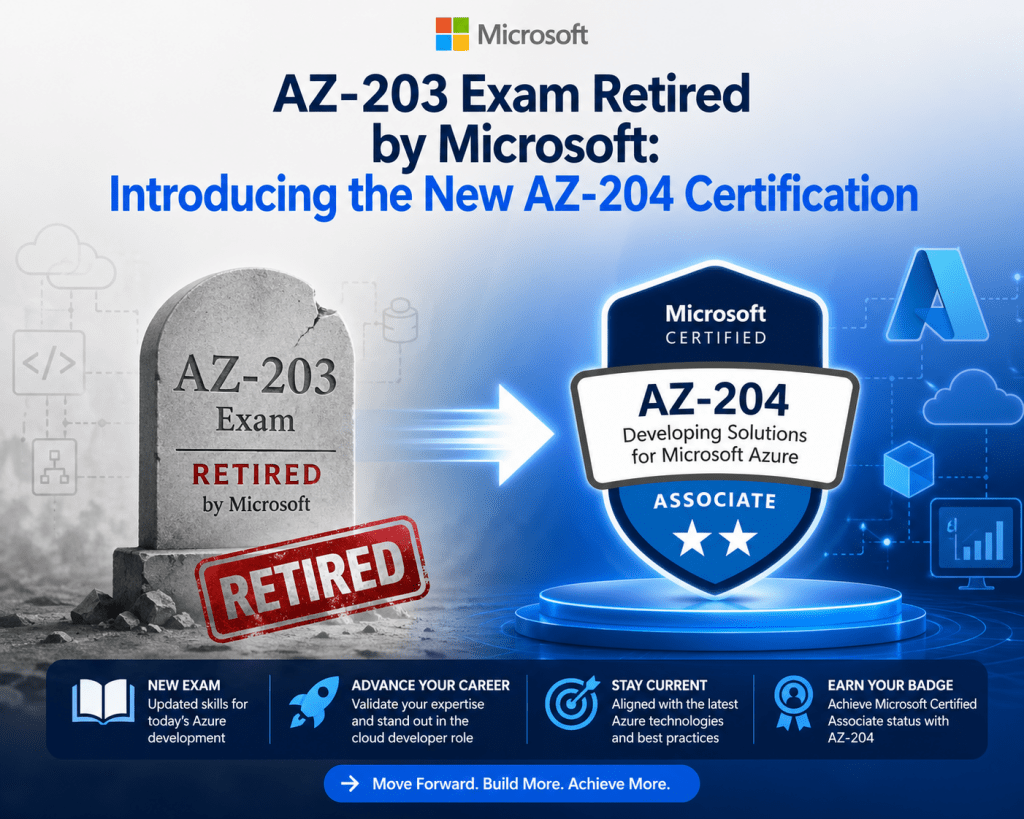
Microsoft Azure certification structure has undergone sustained transformation driven by the rapid expansion of cloud computing ecosystems and the increasing complexity of enterprise application development. Unlike static certification systems that remain unchanged for long cycles, Azure certifications are continuously redefined to match the pace of technological advancement. This ongoing evolution reflects a strategic effort to ensure that developer certifications remain relevant to real-world cloud engineering environments where services, deployment models, and architectural patterns evolve frequently.
The Azure developer certification pathway has not followed a linear progression but instead has shifted through multiple redesign phases. Each phase has introduced structural refinements intended to improve alignment between certification outcomes and practical job requirements. These refinements have gradually transitioned the certification model from product-centered validation to role-based competency assessment, which has become the foundation of the modern Azure certification ecosystem.
Transition from Product-Centric to Role-Based Certification Models
Earlier certification frameworks in Microsoft’s ecosystem primarily focused on validating knowledge of specific products and isolated technical features. However, as cloud computing environments matured, this approach became less effective in evaluating real-world capabilities. Developers were no longer working with single technologies in isolation but were instead required to design and maintain integrated cloud solutions involving multiple services working together.
To address this gap, Microsoft shifted toward a role-based certification model. This approach focuses on the responsibilities associated with specific job roles such as developer, administrator, and solution architect. In this model, certification exams are designed to measure how effectively a professional can perform tasks aligned with their role in a cloud environment rather than testing narrow product knowledge. This shift significantly influenced the structure of Azure developer certifications and laid the foundation for successive exam revisions.
Early Azure Developer Certification Structure and Legacy Foundations
Before the introduction of AZ-series exams, Azure developer certification was tied to earlier exam frameworks that evaluated cloud development skills through broad and foundational assessments. These earlier certifications focused on core cloud concepts such as virtual machine deployment, application hosting, storage configuration, and basic security implementation.
At that stage, cloud computing was still emerging as a dominant enterprise technology, and certification structures reflected a more generalized understanding of cloud application development. As cloud adoption increased across industries, it became evident that developers required more specialized validation of skills related to distributed systems, scalability, and integrated service architectures. This realization led to a gradual restructuring of the certification framework.
Introduction of Modular Certification Approach with AZ-200 and AZ-201
A significant transformation occurred when Microsoft introduced a modular certification structure that divided Azure developer validation into two separate examinations. This change was intended to provide a more granular assessment of developer capabilities by separating foundational knowledge from advanced implementation skills.
The first module focused on core development concepts, including application design principles, cloud storage configuration, and basic service deployment strategies. It emphasized the ability to select appropriate cloud technologies based on specific use cases. The second module concentrated on advanced development scenarios involving integration of cloud services, complex application logic, and deeper implementation of distributed systems.
This modular approach allowed for a more comprehensive evaluation of a developer’s skill set. It also reflected the increasing complexity of cloud environments, where developers were expected to work across multiple service layers rather than focusing on isolated components.
Consolidation into AZ-203 as a Unified Certification Framework
Following the modular phase, Microsoft transitioned toward a unified certification model with the introduction of AZ-203. This consolidation aimed to simplify the certification journey while maintaining a comprehensive assessment of developer competencies. Instead of requiring candidates to complete multiple exams, AZ-203 combined all relevant skill domains into a single certification framework.
AZ-203 evaluated a broad range of capabilities, including cloud application development, compute resource management, storage integration, security implementation, monitoring, and troubleshooting. It also assessed a developer’s ability to connect and consume external services, reflecting the increasing importance of interoperability in modern cloud ecosystems.
This consolidation represented a strategic shift toward efficiency in certification design. By integrating multiple skill areas into one exam, Microsoft reduced fragmentation in the certification process while ensuring that candidates demonstrated end-to-end development capabilities within Azure environments.
Rationale Behind Frequent Certification Updates in the Azure Ecosystem
The rapid pace of change in cloud computing is one of the primary reasons behind frequent updates to Azure certification structures. Unlike traditional IT systems, cloud platforms evolve continuously, with new services, features, and architectural patterns being introduced regularly. This dynamic environment requires certification frameworks to be equally adaptive.
Another contributing factor is the increasing specialization of IT roles. Modern cloud environments require professionals to focus on specific responsibilities such as application development, infrastructure management, security engineering, or data analytics. Certification updates ensure that each role is accurately represented in exam content and assessment criteria.
Additionally, enterprise adoption of cloud computing has created demand for certifications that reflect real operational environments rather than theoretical knowledge. This has led to continuous refinement of certification objectives to ensure alignment with industry expectations.
Evolution of Azure Developer Exam Objectives Over Time
As Azure developer certifications evolved, the structure of exam objectives also underwent significant refinement. Earlier versions focused on broad categories such as application development and basic cloud service integration. Over time, these objectives became more detailed and aligned with specific functional responsibilities.
Core areas such as compute solution development, storage integration, and security implementation remained consistent across certification versions. However, the depth of evaluation within each category increased significantly. For example, compute-related objectives evolved from basic virtual machine deployment to include advanced workload orchestration and scalable application hosting.
Similarly, storage-related objectives expanded from simple data storage configuration to include performance optimization, data consistency management, and integration with multiple storage services. Security objectives also evolved to incorporate identity management, authentication mechanisms, and secure service communication.
Impact of Cloud Industry Growth on Certification Complexity
The rapid expansion of cloud adoption across industries has directly influenced the complexity of Azure certification frameworks. Organizations now rely on cloud platforms to support mission-critical applications, requiring developers to possess advanced technical capabilities.
This increased dependency on cloud infrastructure has driven the need for certifications that validate not only theoretical understanding but also practical implementation skills. As a result, certification exams have become more scenario-based, requiring candidates to apply knowledge in realistic development environments.
The growing complexity of cloud architectures, including microservices, containerization, and distributed computing models, has further contributed to the evolution of certification content. Developers are now expected to understand how different services interact within a cloud ecosystem and how to optimize performance across interconnected systems.
Alignment of Certification Framework with Developer Role Expectations
Modern Azure certification design is closely aligned with job role expectations in enterprise environments. The Azure Developer Associate certification, which includes AZ-204, is specifically structured for professionals involved in designing, building, testing, and maintaining cloud applications.
This alignment ensures that certified individuals possess skills directly applicable to real-world development scenarios. It also allows organizations to better evaluate candidate capabilities based on standardized benchmarks that reflect actual job responsibilities.
The role-based structure emphasizes practical expertise over memorization, encouraging developers to develop a deeper understanding of cloud architecture and service integration. This approach improves workforce readiness and enhances the overall effectiveness of certification programs in supporting enterprise cloud adoption.
Structural Stability Challenges in Rapidly Changing Certification Systems
Despite improvements in alignment and relevance, frequent updates to certification structures introduce challenges related to stability and long-term planning. Professionals pursuing Azure certifications must continuously adapt to changes in exam objectives and structure.
This dynamic environment can create uncertainty for individuals planning long-term certification pathways. However, it also encourages continuous learning and skill development, which is essential in fast-evolving cloud environments.
The iterative nature of certification updates ensures that outdated knowledge is gradually phased out while newer technologies and practices are incorporated into exam frameworks. This balance between stability and adaptability is a defining characteristic of Azure certification evolution.
Emerging Trends in Azure Developer Certification Design
The ongoing transformation of Azure certifications suggests a continued shift toward deeper integration of practical, scenario-based evaluation methods. Future certification models are expected to place greater emphasis on real-world application development, automation practices, and cross-platform integration.
As cloud ecosystems expand further, certification frameworks are likely to incorporate emerging domains such as intelligent application development, event-driven architectures, and advanced distributed system design. These trends reflect the increasing sophistication of cloud environments and the need for developers to possess broader and more adaptable skill sets.
The evolution leading up to AZ-204 represents a foundational stage in this ongoing transformation, establishing a framework that continues to adapt alongside advancements in cloud technology and enterprise application development practices.
Refinement of Azure Developer Certification Through Incremental Evolution
The transition from AZ-203 to AZ-204 is not an isolated update but part of a continuous refinement cycle in Microsoft’s Azure certification ecosystem. This cycle reflects an adaptive response to evolving cloud development practices, enterprise architecture demands, and the increasing sophistication of distributed application systems. Rather than introducing abrupt changes, Microsoft has progressively adjusted certification structures to better align with real-world developer responsibilities.
AZ-203 already represented a consolidated approach, merging multiple skill domains into a unified evaluation model. However, as cloud technologies matured further, the need emerged for clearer alignment between exam objectives and modern application development workflows. AZ-204 was introduced as a refined successor, preserving foundational concepts while updating structural emphasis to match current industry expectations.
Continuity of Core Development Domains Across AZ-203 and AZ-204
A notable aspect of the transition is the continuity of core technical domains between AZ-203 and AZ-204. Both certifications assess essential areas such as compute resource management, cloud storage implementation, application security, monitoring, and integration with external services. This continuity ensures that foundational Azure development knowledge remains stable despite certification restructuring.
Compute-related competencies continue to focus on designing and deploying scalable applications within Azure environments. Storage-related competencies emphasize data persistence strategies, performance considerations, and service integration. Security remains a central domain, reflecting the increasing importance of identity management, secure communication channels, and application-level protection mechanisms.
Despite this continuity, the depth of evaluation within each domain has been subtly adjusted in AZ-204 to reflect modern development practices more accurately.
Shift Toward Application-Centric Cloud Development Evaluation
One of the most significant changes introduced with AZ-204 is the stronger emphasis on application-centric evaluation. Rather than focusing solely on service configuration or isolated technical tasks, the updated certification framework evaluates how developers design, build, and maintain complete cloud-based applications.
This shift reflects the broader transformation of software engineering practices, where applications are no longer monolithic systems but distributed, service-oriented architectures. Developers are expected to understand how individual Azure services interact within a complete application ecosystem, including compute, storage, messaging, and external APIs.
The AZ-204 structure encourages a holistic understanding of application lifecycle management in cloud environments. This includes development, deployment, monitoring, optimization, and troubleshooting within integrated systems.
Alignment with Modern Cloud-Native Development Practices
AZ-204 aligns more closely with cloud-native development methodologies, which emphasize scalability, resilience, and modular architecture design. Cloud-native applications are built to operate in dynamic environments where resources can scale automatically based on demand.
This requires developers to adopt practices such as stateless application design, containerized deployment models, and event-driven processing workflows. AZ-204 reflects these expectations by focusing on how developers implement solutions that are inherently adaptable to changing workloads.
The certification also emphasizes integration with platform services that support automation, orchestration, and continuous delivery pipelines, which are essential components of modern cloud development ecosystems.
Evolution of Monitoring and Diagnostic Expectations in AZ-204
Monitoring and troubleshooting have become increasingly critical components of cloud application management. AZ-204 expands on these areas by emphasizing not only the ability to identify issues but also the ability to proactively optimize application performance.
Modern cloud environments generate large volumes of telemetry data, including performance metrics, logs, and diagnostic signals. Developers must be able to interpret this data to identify bottlenecks, detect anomalies, and ensure system reliability.
The updated certification framework reflects this reality by requiring a deeper understanding of monitoring strategies, observability principles, and performance tuning techniques. This represents a shift from reactive troubleshooting toward proactive system optimization.
Strengthened Focus on Service Integration and Interoperability
Another key enhancement in AZ-204 is the increased focus on service integration. Cloud applications rarely operate in isolation; they depend on multiple interconnected services that communicate through APIs, messaging systems, and event-driven architectures.
AZ-204 evaluates a developer’s ability to design and implement solutions that consume both native cloud services and external third-party systems. This includes managing authentication flows, data exchange formats, and service communication protocols.
Interoperability has become a critical skill in modern cloud environments, where applications must integrate across hybrid and multi-cloud ecosystems. The certification framework reflects this by emphasizing seamless connectivity between distributed components.
Security Implementation as a Core Development Responsibility
Security has transitioned from a specialized domain to a fundamental responsibility for all cloud developers. AZ-204 reflects this shift by embedding security considerations across multiple exam domains rather than isolating them as a separate topic.
Developers are expected to implement secure authentication mechanisms, manage identity and access control, and ensure secure communication between services. This includes understanding encryption techniques, token-based authentication systems, and secure configuration practices.
The integration of security into core development workflows reflects the increasing complexity of cloud threats and the need for security-by-design principles in application development.
Impact of Microservices and Distributed Systems on Certification Structure
The rise of microservices architecture has significantly influenced the design of Azure certification frameworks. Applications are increasingly built as collections of loosely coupled services that communicate over networks rather than as single unified systems.
AZ-204 reflects this architectural shift by evaluating how developers design and manage distributed components within Azure environments. This includes service decomposition, inter-service communication, and scalable deployment strategies.
Distributed systems introduce challenges such as latency management, data consistency, and fault tolerance. The certification framework incorporates these considerations into its evaluation model to ensure developers are prepared for real-world architectural complexities.
Enhanced Emphasis on Cloud Storage Optimization Strategies
Cloud storage remains a foundational component of Azure development, but its role has evolved significantly. AZ-204 expands on storage-related competencies by focusing not only on data storage configuration but also on optimization, scalability, and performance management.
Developers are expected to understand different storage models and select appropriate solutions based on application requirements. This includes structured data storage, unstructured data handling, and high-performance data access strategies.
The certification also emphasizes efficient data access patterns and cost optimization techniques, reflecting the operational realities of large-scale cloud deployments.
Integration of Automation and Deployment Workflows
Automation plays a critical role in modern cloud development environments. AZ-204 incorporates expectations related to automated deployment pipelines, infrastructure provisioning, and continuous integration workflows.
Developers must understand how to implement automated processes that reduce manual intervention and improve deployment consistency. This includes managing version control integration, deployment orchestration, and environment configuration automation.
The inclusion of automation reflects the broader industry shift toward DevOps practices, where development and operations responsibilities are closely integrated.
Adaptation to Real-Time Cloud Application Requirements
Modern applications often operate in real-time environments where responsiveness and scalability are critical. AZ-204 reflects this by evaluating a developer’s ability to design applications capable of handling dynamic workloads and real-time data processing.
This includes event-driven architectures, asynchronous processing models, and real-time communication systems. Developers are expected to understand how to design systems that maintain performance under fluctuating demand conditions.
The certification framework emphasizes responsiveness and efficiency as key indicators of application quality in cloud environments.
Standardization of Azure Developer Skill Expectations
One of the long-term outcomes of the AZ-203 to AZ-204 transition is the standardization of developer skill expectations across industries. By refining certification objectives, Microsoft has created a more consistent benchmark for evaluating Azure development capabilities.
This standardization benefits both organizations and professionals by establishing clear expectations for cloud development roles. It also enhances the reliability of certification outcomes as indicators of practical job readiness.
Standardization ensures that certified developers possess a consistent level of competency regardless of their training background or prior experience.
Influence of Industry Cloud Adoption on Certification Redesign
The widespread adoption of cloud technologies across industries has significantly influenced certification redesign efforts. Organizations now rely heavily on cloud platforms for mission-critical operations, requiring developers to possess advanced and adaptable skill sets.
This demand has driven the need for certifications that reflect real-world scenarios rather than theoretical knowledge. AZ-204 incorporates this requirement by focusing on practical implementation skills and scenario-based evaluation structures.
The certification redesign process is therefore closely linked to industry adoption trends and evolving enterprise requirements.
Shift Toward Continuous Skill Validation Models
The evolution from AZ-203 to AZ-204 also reflects a broader shift toward continuous skill validation models in IT certification systems. Instead of static certification structures, modern frameworks emphasize ongoing learning and adaptation.
This approach ensures that developers remain aligned with current technologies and best practices throughout their careers. It also reflects the reality that cloud technologies evolve too rapidly for static certification models to remain effective over extended periods.
Continuous validation supports long-term professional development in rapidly changing technological environments.
Expansion of Developer Responsibility Scope in Cloud Ecosystems
The role of cloud developers has expanded significantly over time, moving beyond application coding to include system design, integration, optimization, and operational management.
AZ-204 reflects this expanded responsibility scope by evaluating a broader range of competencies. Developers are now expected to understand how their applications interact within larger ecosystem architectures and how to maintain performance, security, and reliability across distributed systems.
This expansion represents a fundamental shift in how developer roles are defined within cloud environments.
Increasing Complexity of Azure Certification Ecosystem
As Azure services continue to expand, the certification ecosystem has also become more complex. This complexity reflects the growing number of services, architectural patterns, and integration possibilities available within the platform.
AZ-204 represents an effort to manage this complexity by focusing on structured skill domains that align with practical development workflows. Rather than overwhelming candidates with isolated technical details, the certification organizes knowledge into functional categories that mirror real-world development tasks.
This structured approach improves clarity while maintaining depth of assessment.
Ongoing Evolution of Developer Skill Benchmarks in Cloud Computing
The transition from AZ-203 to AZ-204 is part of an ongoing evolution in how developer skills are defined and evaluated in cloud computing environments. As technology continues to advance, certification frameworks will likely continue to evolve to reflect new architectural patterns, service models, and development methodologies.
This evolution ensures that certification remains relevant to industry needs while supporting the continuous development of cloud engineering expertise across the global technology workforce.
Ongoing Transformation of Azure Certification Philosophy
The evolution of Azure certifications reflects a deeper structural shift in how cloud competencies are defined, measured, and validated within the global IT ecosystem. Over time, Microsoft has progressively moved away from static, product-bound certification models toward dynamic frameworks that mirror real-world job functions. This transformation is not limited to technical updates in exam content but extends to the underlying philosophy of certification design itself.
AZ-204 sits within this evolving framework as a stabilized yet adaptive certification model that captures the current expectations of Azure developers. It represents a midpoint between foundational cloud knowledge and advanced architectural expertise, serving as a standardized benchmark for professionals working in cloud-native environments.
Transition Toward Continuous Cloud Skill Validation Models
Traditional certification systems were historically designed as one-time validation mechanisms. Once an individual passed an exam, their certification remained valid without requiring frequent reassessment of evolving skills. However, cloud computing has fundamentally disrupted this model due to its continuous release cycles, rapid feature expansion, and evolving architectural paradigms.
In response, Azure certification structures increasingly reflect a continuous learning model. This approach emphasizes ongoing skill refinement rather than static certification achievement. AZ-204 is positioned within this model as a recurring benchmark that aligns developer capabilities with current Azure service capabilities and industry practices.
This shift ensures that certified professionals remain aligned with modern development environments, where outdated knowledge can quickly become irrelevant due to rapid platform evolution.
Role of AZ-204 in Standardizing Cloud Development Competency
AZ-204 plays a critical role in standardizing expectations for Azure developers across industries and geographic regions. As organizations increasingly adopt cloud-first strategies, there is a growing need for consistent benchmarks that define what it means to be a competent cloud developer.
The certification establishes a structured competency framework that includes application development, cloud integration, storage management, security implementation, monitoring, and service interoperability. By consolidating these domains into a single certification, AZ-204 provides a unified measure of developer capability.
This standardization benefits organizations by reducing variability in skill assessment and improving hiring accuracy for cloud development roles. It also benefits professionals by providing a clear and recognized validation of their technical expertise.
Expansion of Developer Responsibilities in Cloud Ecosystems
The role of a cloud developer has expanded significantly beyond traditional coding responsibilities. Modern developers are expected to engage in multiple layers of the application lifecycle, including design, deployment, optimization, and operational monitoring.
AZ-204 reflects this expanded role by evaluating not only programming skills but also architectural understanding and system-level thinking. Developers are expected to understand how their applications function within larger cloud ecosystems that include distributed services, external APIs, and automated infrastructure components.
This expansion of responsibilities highlights the increasing complexity of cloud environments and the need for developers to adopt a more holistic perspective when building applications.
Influence of Distributed Architecture on Certification Design
The widespread adoption of distributed system architectures has had a major impact on how Azure certifications are structured. Modern applications are rarely monolithic; instead, they are composed of multiple independent services that communicate over network-based protocols.
AZ-204 incorporates this reality by emphasizing service integration, modular application design, and inter-service communication patterns. Developers must understand how to design applications that remain reliable, scalable, and maintainable within distributed environments.
This includes managing asynchronous workflows, handling service dependencies, and ensuring data consistency across multiple system components. These architectural considerations are central to modern cloud application development.
Cloud-Native Development as a Core Certification Theme
Cloud-native development has become a foundational concept in modern Azure certification frameworks. This approach focuses on building applications specifically designed for cloud environments rather than adapting traditional software systems to the cloud.
AZ-204 aligns with this paradigm by emphasizing scalability, resilience, and dynamic resource allocation. Cloud-native applications are expected to adapt automatically to changing workloads and operate efficiently across distributed infrastructures.
This requires developers to understand concepts such as stateless design, container orchestration, and event-driven processing. The certification framework evaluates how effectively developers can implement these principles in real-world scenarios.
Evolution of Security Expectations in Azure Development Roles
Security has evolved from a specialized discipline into an integral part of cloud application development. In modern Azure environments, developers are expected to implement security controls directly within application architecture rather than relying solely on external security teams.
AZ-204 reflects this shift by embedding security considerations across multiple domains. Developers must understand authentication mechanisms, identity management systems, and secure communication protocols.
This includes implementing secure access policies, managing credentials effectively, and ensuring compliance with security best practices throughout the application lifecycle. The integration of security into core development responsibilities reflects the increasing complexity of cloud threat landscapes.
Integration of Observability and System Monitoring Practices
Observability has become a critical aspect of modern cloud application management. Unlike traditional monitoring, which focuses on predefined metrics, observability involves analyzing logs, metrics, and traces to gain deeper insight into system behavior.
AZ-204 incorporates these principles by evaluating a developer’s ability to implement monitoring and diagnostic solutions within Azure environments. Developers must be able to identify performance bottlenecks, detect anomalies, and optimize system behavior based on telemetry data.
This reflects a shift toward proactive system management, where developers are responsible for maintaining application performance and reliability in real time.
Importance of Service Interoperability in Modern Cloud Systems
Modern cloud applications frequently rely on integration between multiple services, both internal and external. This requires strong interoperability skills to ensure seamless communication across diverse systems.
AZ-204 emphasizes the ability to connect and consume services effectively, including REST-based APIs, messaging systems, and third-party integrations. Developers must understand how to manage authentication, data exchange formats, and service dependencies.
Interoperability has become a key requirement in cloud development due to the increasing complexity of enterprise ecosystems that span multiple platforms and service providers.
Impact of Automation and DevOps Practices on Certification Structure
Automation has become a defining characteristic of modern software development workflows. In Azure environments, automation is essential for deployment, scaling, configuration management, and operational consistency.
AZ-204 reflects this reality by incorporating expectations related to automated deployment pipelines and continuous integration processes. Developers are expected to understand how to streamline application delivery using automated workflows.
This aligns closely with DevOps principles, which emphasize collaboration between development and operations teams to improve efficiency and reduce deployment friction.
Real-Time Application Processing in Cloud Environments
The rise of real-time applications has introduced new challenges for cloud developers. Applications must now process data with minimal latency while maintaining scalability and reliability under varying workloads.
AZ-204 evaluates a developer’s ability to design systems capable of handling real-time data streams and event-driven processing models. This includes asynchronous communication patterns and distributed event handling systems.
Real-time processing requirements are increasingly common in industries such as finance, e-commerce, and logistics, where rapid data processing is critical for operational success.
Shift Toward Scenario-Based Skill Evaluation Models
Modern Azure certification frameworks increasingly rely on scenario-based evaluation methods rather than isolated theoretical questions. This approach requires developers to apply their knowledge to realistic development situations.
AZ-204 reflects this trend by assessing how well candidates can solve practical problems involving integrated cloud systems. This includes designing solutions that meet performance, security, and scalability requirements simultaneously.
Scenario-based evaluation ensures that certification outcomes are closely aligned with real-world job performance expectations.
Alignment of Certification Design with Enterprise Cloud Adoption Trends
Enterprise adoption of cloud computing has been a major driving force behind certification evolution. Organizations now depend heavily on cloud platforms for mission-critical applications, requiring highly skilled developers who can operate within complex environments.
AZ-204 is designed to reflect these enterprise requirements by focusing on practical application development skills that directly support business operations. This alignment ensures that certified professionals are capable of contributing effectively to large-scale cloud deployments.
As enterprise cloud adoption continues to expand, certification frameworks will likely continue evolving to reflect emerging operational needs.
Increasing Complexity of Azure Service Ecosystem
The Azure platform continues to expand with new services, tools, and capabilities being introduced regularly. This growing complexity presents both opportunities and challenges for certification design.
AZ-204 addresses this complexity by organizing skills into structured domains that reflect common development workflows. Rather than requiring memorization of individual services, the certification emphasizes functional understanding of how services interact within application architectures.
This approach helps maintain clarity while ensuring comprehensive coverage of essential development competencies.
Shift Toward Modular Cloud Skill Development Paths
Modern certification structures increasingly support modular skill development, allowing professionals to build expertise incrementally across multiple domains. AZ-204 serves as a key component within this modular ecosystem, bridging foundational knowledge and advanced specialization.
This modular approach enables developers to progress through structured learning pathways that align with their career goals and technical interests. It also supports long-term skill development in rapidly evolving cloud environments.
By providing a clear progression framework, AZ-204 contributes to a more organized and scalable certification ecosystem.
Long-Term Impact of Certification Evolution on Cloud Workforce Development
The continuous evolution of Azure certifications has a significant impact on global cloud workforce development. By regularly updating certification structures, Microsoft ensures that professionals remain aligned with current technological standards and industry practices.
AZ-204 represents a stable yet adaptable benchmark within this ecosystem, providing a consistent measure of developer capability while accommodating ongoing technological change.
This balance between stability and adaptability is essential for maintaining the relevance of certification systems in rapidly evolving cloud environments.
Future Direction of Azure Developer Certification Frameworks
Looking forward, Azure certification frameworks are expected to continue evolving in response to emerging technologies such as artificial intelligence integration, edge computing, and advanced automation systems.
Future certifications will likely place greater emphasis on intelligent application development, distributed computing optimization, and multi-cloud interoperability. These trends reflect the increasing complexity of cloud ecosystems and the growing demand for highly adaptable development skills.
AZ-204 serves as a foundational step within this long-term evolution, establishing core principles that will continue to influence future certification design and cloud skill validation strategies.
Conclusion
The evolution of Microsoft Azure developer certification from earlier exam structures to AZ-204 reflects a broader shift in how cloud expertise is defined, measured, and maintained in modern IT ecosystems. Rather than functioning as a static credential, Azure certifications have increasingly become adaptive frameworks designed to mirror the pace of technological change in cloud computing. This transformation is not simply administrative; it represents a fundamental redesign of how professional competency is validated in a domain where services, architectures, and development practices evolve continuously.
One of the most important underlying drivers of this evolution is the nature of cloud technology itself. Unlike traditional IT systems, cloud platforms are not released in slow, periodic cycles. Instead, they are updated continuously with new services, performance enhancements, security features, and architectural capabilities. This constant state of innovation creates a challenge for certification systems that must remain relevant without becoming outdated. AZ-204 exists within this context as a response to the need for a more stable yet adaptable validation model that reflects current development practices while still allowing room for future expansion.
The transition from AZ-203 to AZ-204 demonstrates how certification frameworks are refined rather than completely replaced. Although both exams share significant overlap in core domains such as compute resources, storage solutions, security implementation, monitoring, and service integration, AZ-204 introduces a more refined structure that aligns more closely with modern application development patterns. The emphasis has shifted from isolated technical tasks to integrated system design, where developers are expected to understand how multiple services interact within complex cloud environments.
This shift is particularly important because the role of a cloud developer has expanded significantly over time. Developers are no longer limited to writing application logic; they are now responsible for designing scalable architectures, ensuring secure communication between services, optimizing performance under dynamic workloads, and maintaining system reliability across distributed environments. AZ-204 reflects this expanded responsibility by evaluating skills in a more holistic and application-centric manner. It emphasizes not only what developers build but also how their solutions operate within broader cloud ecosystems.
Another key dimension of this evolution is the increasing importance of cloud-native development principles. Modern applications are designed to operate in highly dynamic environments where resources must scale automatically based on demand. This requires developers to adopt architectural patterns that prioritize flexibility, resilience, and modularity. AZ-204 aligns with these principles by focusing on distributed application design, service-based architecture, and event-driven processing models. These concepts are essential for building applications that can operate efficiently in large-scale cloud infrastructures.
Security has also become a deeply integrated component of Azure developer certification. In earlier models, security was often treated as a separate domain, evaluated independently from application development. However, in modern cloud environments, security is embedded into every stage of the development lifecycle. Developers are expected to implement secure authentication mechanisms, manage identity and access controls, and ensure encrypted communication between services. AZ-204 reflects this reality by integrating security expectations across multiple areas of the exam, reinforcing the idea that secure design is not optional but foundational.
Monitoring and observability represent another area where certification expectations have evolved significantly. In traditional systems, monitoring was often limited to basic performance tracking. In cloud environments, however, applications generate vast amounts of telemetry data, including logs, metrics, and distributed traces. Developers must be able to interpret this data to understand system behavior, identify performance issues, and optimize application performance. AZ-204 incorporates these requirements by emphasizing proactive system analysis rather than reactive troubleshooting, aligning with modern observability practices.
Service integration has also become a central focus of Azure development certification. Today’s applications rarely operate in isolation; they depend on a wide range of internal and external services that must communicate seamlessly. This includes REST APIs, messaging systems, authentication services, and third-party platforms. AZ-204 evaluates a developer’s ability to design and implement solutions that integrate these services effectively while maintaining reliability and security. This reflects the interconnected nature of modern cloud ecosystems, where interoperability is essential for system functionality.
Automation and deployment practices further highlight the evolution of certification expectations. In contemporary cloud development environments, manual deployment processes are no longer sufficient. Instead, automation plays a critical role in ensuring consistency, scalability, and efficiency. Developers are expected to understand automated deployment pipelines, continuous integration workflows, and infrastructure provisioning processes. AZ-204 incorporates these expectations to align with DevOps-oriented development practices, where development and operations responsibilities are closely integrated.
Another significant aspect of this evolution is the increasing emphasis on real-world scenario-based evaluation. Rather than focusing solely on theoretical knowledge, modern certification frameworks assess how well developers can apply their skills to practical situations. This approach ensures that certified professionals are capable of solving complex problems that mirror actual enterprise environments. AZ-204 adopts this methodology by evaluating integrated development scenarios that require cross-domain knowledge and practical decision-making.
The continuous expansion of Azure services has also contributed to the need for structured certification frameworks. As the platform grows, the number of available services and features increases, creating potential complexity for developers. AZ-204 addresses this by organizing knowledge into functional domains rather than service-specific lists. This approach helps maintain clarity while ensuring that developers understand how services function together within application architectures.
From a broader perspective, the evolution toward AZ-204 reflects the increasing maturity of cloud computing as an industry. Cloud platforms are no longer emerging technologies; they are foundational infrastructure components that support critical business operations across industries. As a result, certification systems must evolve to reflect enterprise-grade expectations, ensuring that developers are prepared to contribute effectively in high-stakes environments.
The long-term impact of this evolution extends beyond certification itself. It influences how developers approach learning, skill development, and career progression. Instead of pursuing static credentials, professionals are now encouraged to engage in continuous learning processes that align with evolving technologies. This shift reinforces the idea that cloud expertise is not a fixed achievement but an ongoing development journey.
AZ-204 plays a central role in this ecosystem by serving as a stable yet adaptable benchmark for developer competency. It provides a clear definition of core skills while remaining flexible enough to accommodate future updates and technological advancements. This balance between stability and adaptability is essential in a rapidly changing technological landscape where new services and architectural patterns emerge regularly.
Ultimately, the transition from AZ-203 to AZ-204 represents more than a certification update. It reflects a broader transformation in how cloud development skills are conceptualized and validated. It demonstrates a move toward integrated, role-based, and continuously evolving competency frameworks that align closely with real-world enterprise requirements. As cloud computing continues to advance, certification systems will likely continue to evolve in similar ways, further refining how technical expertise is defined and measured in modern IT environments.