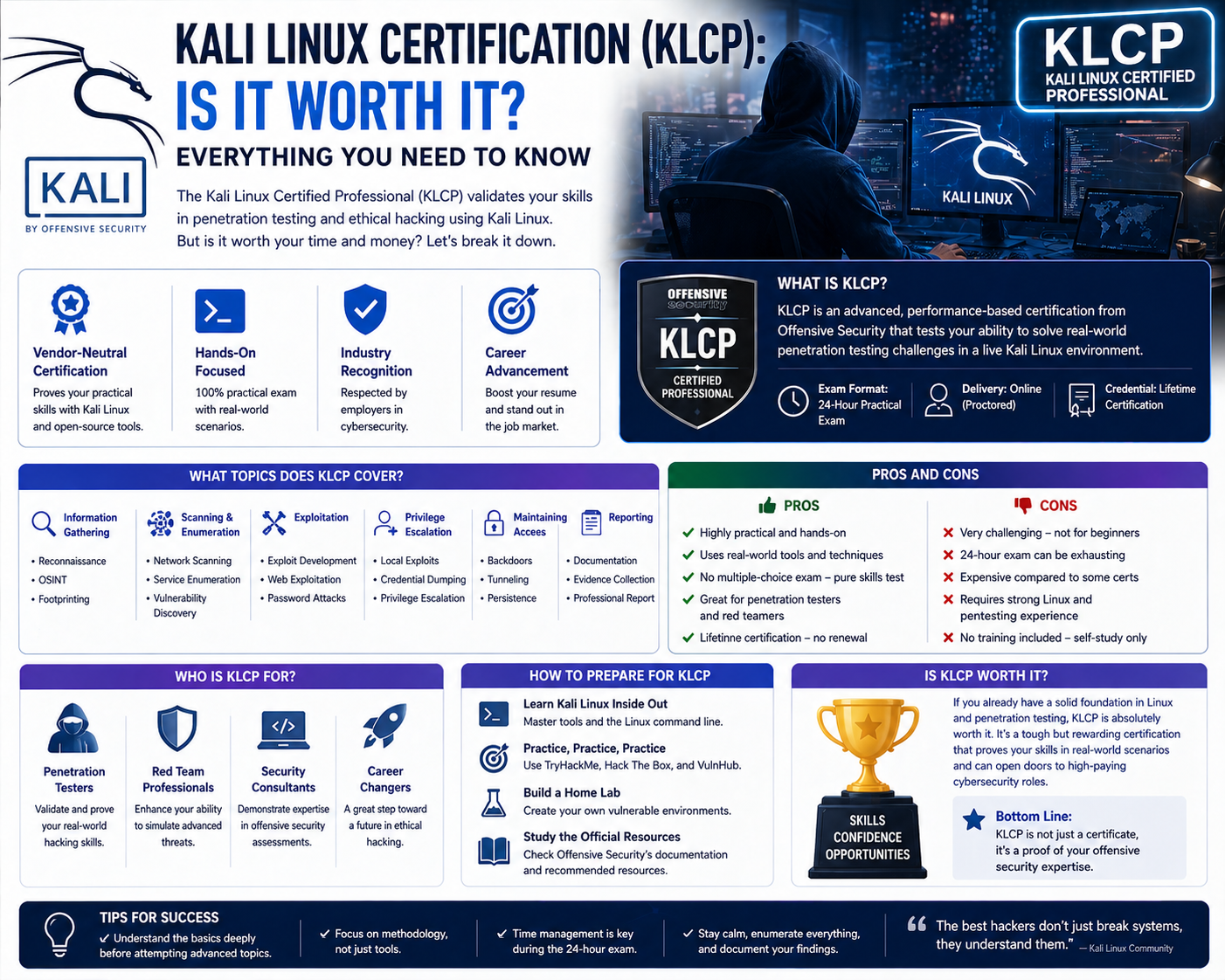
Kali Linux is a specialized Linux distribution designed specifically for cybersecurity operations, particularly penetration testing, security auditing, and digital forensics. It is built on a Debian foundation and is widely adopted in both professional and educational environments where security assessment and system analysis are required. Unlike general-purpose operating systems, Kali Linux is structured around a security-first philosophy, meaning it includes a curated set of tools and configurations intended for ethical hacking, vulnerability analysis, and defensive security evaluation.
In modern cybersecurity landscapes, Linux systems form the backbone of most servers, cloud infrastructures, and security appliances. Because of this, professionals working in cybersecurity must have strong command over Linux environments. Kali Linux, in particular, provides a practical learning ground where users can understand how operating systems behave under security testing conditions. It is not just a toolset but an ecosystem that simulates real-world attack and defense scenarios within a controlled environment.
The increasing demand for cybersecurity professionals has led to the development of structured learning pathways that validate Linux and security knowledge. Within this context, Kali Linux certification frameworks are designed to bridge the gap between theoretical understanding and practical system administration. These certifications focus on ensuring that learners are capable of navigating Linux systems efficiently while also understanding how security tools integrate with system-level operations.
Foundational Purpose of Kali Linux Certification
A Kali Linux certification is primarily designed to establish foundational proficiency in Linux system administration with an emphasis on security-oriented usage. It is not an advanced penetration testing credential but rather an entry-level validation of essential operating system skills. The purpose is to ensure that learners understand how Linux systems function at a core level before moving into more complex cybersecurity disciplines.
The certification typically evaluates knowledge across several domains, including system navigation, file system structure, user and permission management, package handling, and network configuration. These foundational areas are critical because they form the basis upon which all advanced cybersecurity tasks are built. Without a strong understanding of these fundamentals, it becomes difficult to effectively operate security tools or interpret system behavior during security assessments.
What makes Kali Linux-based certification frameworks unique is their integration of security context into general Linux administration. Instead of teaching Linux in isolation, the learning process is embedded within a security-focused environment. This ensures that learners not only understand how to use Linux but also why certain configurations matter from a security perspective.
Linux Operating System Fundamentals in Security Context
At the core of any Kali Linux certification is a strong emphasis on Linux operating system fundamentals. Linux is widely used in enterprise environments due to its stability, flexibility, and open-source nature. Understanding how it operates is essential for anyone pursuing a career in cybersecurity or system administration.
One of the primary areas of focus is the Linux file system structure. Linux organizes files and directories in a hierarchical structure that begins at the root directory. Each directory serves a specific function, such as storing system configurations, user data, or executable binaries. Understanding this structure is crucial because security configurations and system operations depend heavily on correct file placement and permissions.
Another key concept is user and permission management. Linux systems are multi-user environments, meaning multiple users can operate on the same system simultaneously. Each user has a specific permission level that determines what actions they can perform. This includes read, write, and execute permissions on files and directories. Proper management of these permissions is essential for maintaining system security and preventing unauthorized access.
Process management is also a fundamental component of Linux administration. Every application and system service runs as a process, and understanding how to monitor, control, and terminate processes is critical for maintaining system stability. In cybersecurity contexts, process monitoring can also help identify suspicious activity or unauthorized operations running on a system.
Command-Line Operations and System Interaction
A defining characteristic of Linux systems, especially Kali Linux, is the heavy reliance on command-line interfaces. Unlike graphical user interfaces, the command line allows users to interact directly with the operating system through text-based commands. This provides a higher level of control and precision, which is essential in cybersecurity environments.
Command-line proficiency involves understanding how to navigate the file system, manipulate files, manage processes, and configure system settings using terminal commands. This includes basic commands such as listing directory contents, changing directories, copying and moving files, and modifying permissions. Over time, users develop fluency that allows them to perform complex operations efficiently without relying on graphical tools.
In cybersecurity workflows, command-line skills are particularly valuable because many security tools are designed to operate through terminal interfaces. These tools often require specific parameters and configurations that are best managed through command-line input. As a result, developing strong command-line skills is a foundational requirement for anyone working in security-related roles.
Package Management and Software Control in Linux
Package management is another essential component of Linux system administration. In Debian-based systems like Kali Linux, software is managed through package managers that handle installation, updates, and removal of applications. This system ensures that software dependencies are properly maintained and that system integrity is preserved.
Understanding package management involves knowing how software repositories function, how packages are installed and updated, and how system updates are applied. Proper package management is critical for maintaining system security because outdated or misconfigured software can introduce vulnerabilities.
In cybersecurity contexts, package management also plays a role in ensuring that security tools are up to date. Many security tools rely on frequent updates to remain effective against evolving threats. Therefore, understanding how to manage these tools through package systems is an important skill for security practitioners.
Networking Fundamentals in Linux Environments
Networking is a core component of both Linux administration and cybersecurity. A Kali Linux certification typically includes foundational networking concepts that are essential for understanding how systems communicate within a network.
This includes understanding IP addressing, subnetting, and network interfaces. IP addressing allows systems to identify and communicate with each other across networks, while subnetting helps organize networks into manageable segments. Network interfaces act as the connection points between a system and a network, and configuring them correctly is essential for system communication.
Basic network troubleshooting is also an important skill. This involves identifying connectivity issues, diagnosing network configuration problems, and verifying communication between systems. In cybersecurity environments, network troubleshooting is often the first step in identifying potential security incidents or misconfigurations.
Security Configuration and System Hardening Principles
Security configuration is a critical aspect of Linux system administration, particularly in environments where systems are exposed to external networks. System hardening refers to the process of securing a system by reducing its attack surface and minimizing vulnerabilities.
This includes disabling unnecessary services, configuring firewalls, enforcing strong password policies, and restricting user permissions. Each of these steps contributes to reducing the risk of unauthorized access or system compromise.
Understanding system services is also important. Services are background processes that perform specific functions on a system, such as handling network requests or managing system logs. Proper configuration and monitoring of these services are essential for maintaining system security and stability.
Role of System Monitoring and Logging
System monitoring and logging are essential components of Linux administration and cybersecurity operations. Logs provide detailed records of system activity, including user actions, system events, and application behavior. These logs are critical for identifying security incidents, diagnosing system issues, and maintaining operational awareness.
In a cybersecurity context, logs are often the first source of information when investigating suspicious activity. Understanding how to read and interpret logs allows security professionals to detect anomalies and respond to potential threats effectively.
System monitoring tools also provide real-time insights into system performance and activity. These tools help administrators track resource usage, identify performance bottlenecks, and detect unusual behavior that may indicate a security issue.
Scripting and Automation Fundamentals in Linux
While not a primary focus of entry-level certifications, basic scripting knowledge is often introduced as part of Linux learning. Scripting allows users to automate repetitive tasks, streamline system administration processes, and improve operational efficiency.
In Linux environments, scripting is commonly used for tasks such as system backups, log analysis, and configuration management. Even basic scripting knowledge can significantly improve productivity and reduce the risk of human error in system administration tasks.
Automation is particularly important in cybersecurity environments where large-scale systems must be managed efficiently. By automating routine tasks, security professionals can focus on more complex analysis and threat detection activities.
Integration of Security Tools Within Linux Systems
Kali Linux is widely recognized for its integration of security tools within the operating system. These tools are designed to support various aspects of cybersecurity testing, including vulnerability assessment, network analysis, and system evaluation.
However, effective use of these tools requires a strong understanding of the underlying operating system. Tools do not operate in isolation; they interact directly with system resources, network interfaces, and configuration settings. Understanding this interaction is essential for interpreting tool output and making informed security decisions.
Rather than focusing solely on tool usage, Kali Linux certification frameworks emphasize system awareness. This ensures that learners understand how tools function within the broader context of the operating system, rather than treating them as standalone utilities.
Importance of Linux Foundations in Cybersecurity Progression
A strong foundation in Linux is essential for anyone pursuing a career in cybersecurity. Many advanced security concepts assume familiarity with system administration, networking, and command-line operations. Without this foundation, it becomes difficult to progress into more specialized areas such as penetration testing, incident response, or security engineering.
Kali Linux-based learning provides a structured pathway for developing these foundational skills. By combining Linux administration with security awareness, it prepares learners for more advanced certifications and professional roles in cybersecurity.
As cybersecurity threats continue to evolve, the demand for professionals with strong technical foundations continues to grow. Linux remains a central component of modern IT infrastructure, making it a critical area of expertise for security professionals.
Understanding the Purpose of the Exam Framework
The Kali Linux certification framework is designed to evaluate more than memorization of commands or theoretical awareness of Linux systems. Its primary objective is to measure whether a learner can demonstrate functional understanding of Linux environments in a security-oriented context. This includes the ability to interpret system behavior, understand configuration logic, and apply foundational Linux knowledge in scenarios that resemble real operational environments.
Unlike highly specialized cybersecurity certifications that focus on advanced exploitation techniques or deep forensic investigation, this certification remains centered on structured system knowledge. It ensures that candidates are comfortable navigating Linux systems, understanding how system components interact, and applying basic administrative principles in environments that simulate security-focused workflows.
The exam structure reflects this philosophy by emphasizing conceptual clarity and practical reasoning rather than purely hands-on exploitation. This makes it particularly suitable for individuals at the beginning stage of cybersecurity learning, where building strong foundational understanding is more important than mastering advanced attack methodologies.
Exam Format and Cognitive Expectations
The Kali Linux certification exam typically follows a structured multiple-choice format designed to assess both conceptual understanding and applied reasoning. Although it does not require direct system manipulation during the exam, the questions are structured in a way that requires candidates to think as if they are working within a live Linux environment.
The exam generally includes a fixed number of questions to be completed within a limited timeframe. This time constraint is not intended to pressure candidates into guessing but rather to evaluate their ability to recall and apply knowledge efficiently. The questions are often scenario-based, meaning they present a system situation and ask the candidate to determine the most appropriate command, configuration, or outcome.
This structure reflects real-world cybersecurity environments where professionals must quickly interpret system conditions and decide on appropriate actions. Rather than focusing on rote memorization, the exam rewards understanding of how Linux systems behave under different conditions.
Linux System Navigation and Operational Logic
A significant portion of the knowledge assessed in the certification revolves around system navigation. Linux systems are structured hierarchically, and understanding this structure is essential for effective system management. Candidates are expected to understand how directories are organized, how files are accessed, and how system paths function.
In practical environments, system navigation is not simply about moving between folders. It involves understanding how system files are distributed across different directories, how configuration files influence system behavior, and how user environments are structured. For example, system-wide configurations differ from user-specific configurations, and recognizing this distinction is essential for troubleshooting and system administration.
The exam often tests whether candidates understand the implications of navigating and modifying system directories. This includes recognizing sensitive system paths, identifying where logs are stored, and understanding how system binaries are executed. These concepts are critical because mismanagement of system navigation can lead to configuration errors or unintended system behavior.
User Management and Permission-Based Security Model
Linux systems operate on a strict permission-based model that governs how users interact with files, directories, and system processes. This model is a core component of the certification because it directly relates to system security.
Candidates are expected to understand how users are created, how groups function, and how permissions are assigned. Permissions in Linux are divided into read, write, and execute categories, each of which determines the level of access a user has over a resource. Understanding how these permissions interact is essential for maintaining system integrity.
The exam also emphasizes the concept of privilege separation. In Linux, administrative tasks are typically restricted to privileged users to prevent unauthorized system modifications. Understanding how privilege escalation works, and how administrative commands are executed securely, is a key part of system administration knowledge.
In real-world cybersecurity environments, improper permission configuration is one of the most common sources of vulnerabilities. Therefore, the certification ensures that learners understand how to properly assign and manage permissions to minimize security risks.
Process Management and System Behavior Interpretation
Another critical area covered in the certification is process management. Every application and service running on a Linux system is represented as a process. These processes consume system resources such as memory and CPU, and they operate under specific user permissions.
Understanding how to monitor and manage processes is essential for maintaining system stability. Candidates are expected to recognize how processes are initiated, how they can be terminated, and how system resources are allocated among them. This includes understanding parent and child process relationships and how system services operate in the background.
From a cybersecurity perspective, process management also plays a role in identifying suspicious activity. Unauthorized or unexpected processes may indicate system compromise or malicious activity. Being able to interpret process behavior is therefore an important skill for both system administrators and security analysts.
The exam may include scenarios where candidates must determine which process is responsible for a system issue or identify how a system service should be managed under specific conditions.
Networking Concepts and System Communication Flow
Networking is a foundational component of Linux system operation and is heavily emphasized in the certification. Linux systems are often deployed in networked environments, making it essential to understand how systems communicate with each other.
Key networking concepts include IP addressing, subnetting, routing, and network interface configuration. IP addressing allows systems to identify each other on a network, while subnetting helps organize networks into logical segments for better management and security control.
Network interfaces act as communication points between a system and the external network. Understanding how to configure and troubleshoot these interfaces is critical for ensuring system connectivity. Candidates are expected to understand how network configurations affect system communication and how to diagnose connectivity issues.
The certification also emphasizes basic network troubleshooting skills. This includes identifying misconfigured IP addresses, resolving DNS-related issues, and verifying connectivity between systems. In cybersecurity environments, network troubleshooting is often the first step in identifying potential security incidents or communication failures.
System Services and Background Operations
Linux systems rely heavily on background services to perform essential system functions. These services run independently of user interaction and are responsible for tasks such as logging, networking, and system monitoring.
Understanding how services operate is an important part of system administration. Candidates are expected to know how services are started, stopped, and configured. They must also understand how services interact with system resources and how they can impact overall system performance.
In cybersecurity contexts, service management is particularly important because misconfigured services can expose systems to vulnerabilities. For example, unnecessary services running in the background may create additional attack surfaces that can be exploited.
The certification ensures that learners understand how to identify active services, evaluate their necessity, and configure them appropriately to maintain system security.
Firewall Concepts and Basic Security Enforcement
Firewall configuration is another key concept covered in the certification. Firewalls act as a barrier between a system and external networks, controlling incoming and outgoing traffic based on predefined rules.
Candidates are expected to understand the purpose of firewalls and how they contribute to system security. This includes understanding how rules are defined, how traffic is filtered, and how exceptions are managed.
While the certification does not focus on advanced firewall engineering, it emphasizes the importance of basic firewall configuration in securing Linux systems. Understanding how to allow or block specific traffic is essential for maintaining controlled network access.
In practical environments, firewalls are often the first line of defense against unauthorized access attempts. Therefore, foundational knowledge of firewall concepts is critical for anyone working in system administration or cybersecurity.
Scripting Fundamentals and Automation Logic
Although the certification is not focused on programming, it introduces basic scripting concepts to help learners understand automation in Linux environments. Scripting allows repetitive tasks to be executed efficiently without manual intervention.
Automation plays a significant role in system administration because it reduces workload and minimizes human error. Tasks such as file management, system updates, and log processing can be automated using simple scripts.
Candidates are expected to understand the logic behind scripting, including how commands can be combined to perform sequential operations. Even a basic understanding of scripting enhances a learner’s ability to manage systems efficiently.
In cybersecurity environments, automation is particularly valuable for monitoring system activity, analyzing logs, and responding to security events. This makes scripting an important foundational skill for long-term career development.
System Configuration and Customization in Kali Environment
Kali Linux environments are highly customizable, allowing users to configure the system based on specific operational needs. This includes modifying system settings, adjusting user environments, and configuring security tools.
System configuration knowledge is essential because it directly affects how the operating system behaves. Candidates are expected to understand how configuration files influence system operations and how changes to these files impact overall system performance.
Customization also includes understanding how system resources are allocated and how performance can be optimized. In security environments, system performance is important because security tools often require significant computational resources.
The certification ensures that learners understand how to balance system usability with security considerations, which is a critical skill in real-world environments.
Security Awareness and Operational Thinking
Beyond technical knowledge, the certification also encourages security-oriented thinking. This involves understanding how system configurations impact security posture and how vulnerabilities can arise from misconfigurations.
Candidates are expected to think about systems from a defensive perspective, considering how different configurations might be exploited or secured. This type of thinking is essential for transitioning from basic system administration to cybersecurity roles.
Security awareness includes recognizing potential risks, understanding system exposure points, and applying best practices to reduce vulnerabilities. While the certification does not focus on advanced attack techniques, it lays the groundwork for understanding how systems can be protected.
Integration of Knowledge into Practical Scenarios
One of the most important aspects of the certification is the integration of theoretical knowledge into practical understanding. Instead of isolating topics, the exam encourages learners to understand how different system components interact.
For example, understanding how user permissions affect file access, how network configurations impact connectivity, and how system services influence performance are all interconnected concepts. This integrated approach reflects real-world system administration, where multiple factors must be considered simultaneously.
By developing this holistic understanding, learners are better prepared to transition into more advanced cybersecurity roles where systems must be analyzed as complete environments rather than isolated components.
Position of Kali Linux Certification in the Cybersecurity Career Path
Kali Linux certification occupies a specific entry-level position within the broader cybersecurity career structure. It is not designed to compete with advanced offensive security or enterprise-level security certifications. Instead, it functions as a foundational credential that establishes baseline competency in Linux systems with a security-oriented perspective. This positioning is important because modern cybersecurity roles are heavily dependent on operating system knowledge, particularly Linux-based environments that dominate servers, cloud infrastructure, and security tooling ecosystems.
In practical career progression, this type of certification typically serves as a stepping stone. Individuals often pursue it before advancing into more specialized domains such as penetration testing, incident response, security engineering, or cloud security architecture. The value of the certification lies in its ability to create a structured learning path where foundational Linux knowledge is developed in a security context rather than a purely administrative one.
Employers in cybersecurity-related fields generally expect candidates to understand Linux fundamentals, even for entry-level positions. This includes familiarity with system navigation, permissions, networking basics, and command-line usage. A Kali Linux-focused certification signals that the individual has been exposed to these core concepts in a structured learning environment, which can reduce onboarding time and training overhead in professional settings.
Relevance of Linux Skills in Modern Cybersecurity Environments
Linux remains one of the most widely used operating systems in enterprise and cloud environments. A significant portion of web servers, cloud instances, containerized applications, and security appliances run on Linux-based systems. As a result, cybersecurity professionals must be able to operate confidently within Linux environments to effectively manage, secure, and analyze systems.
Kali Linux certification reinforces this requirement by focusing on practical Linux usage within a security framework. Unlike general IT certifications that may treat Linux as one of many topics, this certification places Linux at the center of the learning experience. This approach ensures that learners develop fluency in system-level operations that directly translate to real-world cybersecurity tasks.
In professional environments, Linux skills are applied across multiple domains. Security analysts use Linux to investigate logs and monitor system activity. Penetration testers rely on Linux environments to simulate attacks and evaluate system defenses. System administrators use Linux to configure servers and maintain infrastructure stability. Cloud engineers use Linux to manage virtual machines and containerized workloads. In all these roles, Linux serves as a foundational technology layer.
Foundational Role in Ethical Hacking and Penetration Testing
One of the most recognized associations with Kali Linux is its use in ethical hacking and penetration testing. While Kali Linux certification itself is not an advanced hacking credential, it provides the necessary foundation for understanding how penetration testing environments operate.
Ethical hacking involves simulating real-world attacks in a controlled environment to identify vulnerabilities before malicious actors can exploit them. This process requires a deep understanding of operating systems, networking, and system configurations. Without a strong Linux foundation, it becomes difficult to interpret system responses or understand how security tools interact with target environments.
Kali Linux certification helps bridge this gap by introducing learners to the operating system that is commonly used in penetration testing workflows. It ensures that individuals are comfortable navigating security-focused environments before moving into more advanced exploitation techniques. This foundational understanding is critical because penetration testing is not just about using tools but about understanding how systems behave under different conditions.
In advanced cybersecurity training paths, learners are often expected to already possess Linux proficiency. This makes foundational certifications particularly valuable as preparatory steps. They reduce the learning curve when transitioning into more complex offensive security methodologies.
Value for System Administration and Infrastructure Roles
Beyond cybersecurity-specific careers, Kali Linux certification also holds value for system administration roles. System administrators are responsible for managing servers, maintaining system stability, and ensuring secure operation of IT infrastructure. Since many enterprise systems run on Linux, strong familiarity with Linux administration is essential.
The certification provides exposure to key system administration concepts such as user management, file system organization, service configuration, and network setup. These skills are directly applicable to real-world infrastructure management tasks. For example, understanding how to configure user permissions helps prevent unauthorized access, while knowledge of system services ensures proper application deployment and maintenance.
In infrastructure-heavy environments, administrators are also responsible for maintaining system security. This includes applying updates, configuring firewalls, monitoring logs, and ensuring system hardening practices are followed. Kali Linux certification introduces these concepts in a structured way, helping learners understand not only how to perform tasks but also why they are important from a security perspective.
Entry-Level Accessibility and Learning Curve
One of the defining characteristics of Kali Linux certification is its accessibility to beginners. Unlike advanced cybersecurity certifications that require extensive experience or prerequisite knowledge, this certification is designed to be approachable for individuals with minimal prior exposure to Linux.
The learning curve is structured in a way that gradually introduces foundational concepts before moving into more complex topics. This ensures that learners are not overwhelmed by technical complexity early in the process. Instead, they build confidence through incremental skill development.
However, despite its accessibility, the certification still requires consistent effort and hands-on practice. Linux environments are fundamentally different from graphical operating systems, and developing fluency in command-line usage requires repetition and familiarity. Learners who invest time in practicing commands, exploring system structures, and experimenting with configurations tend to perform better in both certification exams and real-world applications.
Role in Academic and Self-Directed Learning Paths
Kali Linux certification is also widely used in academic and self-directed learning environments. Many students and independent learners use it as a structured entry point into cybersecurity education. Its focus on foundational Linux skills makes it suitable for individuals who are exploring technical fields for the first time.
In academic contexts, it can complement broader IT curricula by providing practical exposure to operating systems and security concepts. Students who complete such certifications often gain a better understanding of how theoretical concepts apply in real-world systems.
For self-directed learners, the certification provides a clear roadmap for skill development. Instead of navigating fragmented learning resources, individuals can follow a structured path that gradually builds technical competence. This structured approach is particularly valuable in cybersecurity, where fragmented knowledge can lead to gaps in understanding system behavior.
Skill Transferability Across Technology Domains
One of the most important advantages of Kali Linux certification is the transferability of skills across different technology domains. Linux knowledge is not limited to cybersecurity; it is applicable across cloud computing, software development, DevOps, and network administration.
In cloud computing environments, Linux is the dominant operating system used for virtual machines and containerized services. Understanding Linux fundamentals allows professionals to efficiently manage cloud resources, configure deployments, and troubleshoot system issues.
In software development environments, Linux is often used for backend services, development servers, and build pipelines. Developers with Linux knowledge are better equipped to manage development environments and understand system-level dependencies.
In DevOps practices, Linux plays a central role in automation, continuous integration, and system orchestration. Skills learned through Kali Linux certification, such as command-line usage and scripting basics, directly support these workflows.
This cross-domain applicability increases the long-term value of the certification, even though it is considered entry-level in nature.
Long-Term Skill Development and Career Progression
Kali Linux certification is best understood as the beginning of a structured skill development journey rather than a final destination. It provides the foundational knowledge required to progress into more advanced technical roles.
After gaining proficiency in Linux fundamentals, learners typically move toward specialized certifications and skills in areas such as penetration testing, cloud security, network defense, or incident response. Each of these domains builds upon the foundational understanding developed through initial Linux training.
For example, advanced penetration testing requires deep knowledge of system vulnerabilities, exploitation techniques, and network behavior. Without a strong Linux foundation, these concepts become significantly more difficult to understand and apply effectively.
Similarly, advanced system administration and DevOps roles require automation skills, infrastructure management capabilities, and security awareness. The foundational skills developed through Kali Linux certification provide the necessary base for these advanced competencies.
Industry Perception and Practical Recognition
In terms of industry recognition, Kali Linux certification is generally viewed as an introductory credential. It is not intended to replace advanced certifications or professional experience, but it does serve as evidence of foundational knowledge.
Employers often value certifications that demonstrate initiative and structured learning. Even at an entry-level stage, having formal recognition of Linux and security fundamentals can differentiate candidates in competitive job markets.
However, its primary value lies in skill validation rather than direct job qualification. It shows that the individual has taken steps to understand Linux systems in a structured and security-aware manner. This can be particularly useful in interviews for junior IT or cybersecurity positions, where foundational knowledge is often evaluated.
Integration into Broader Cybersecurity Learning Ecosystem
Kali Linux certification fits into a broader ecosystem of cybersecurity education that includes networking fundamentals, system administration, ethical hacking, and security analysis. It acts as a foundational layer upon which more complex skills are built.
This layered approach to learning is essential in cybersecurity because the field requires both depth and breadth of knowledge. Professionals must understand systems at multiple levels, from hardware and operating systems to applications and network infrastructure.
By starting with Linux-focused certification, learners establish a strong technical base that supports future specialization. This structured progression reduces knowledge gaps and improves overall competency in advanced cybersecurity roles.
Sustainable Learning Mindset and Technical Growth
Beyond technical skills, Kali Linux certification encourages the development of a sustainable learning mindset. Cybersecurity is a constantly evolving field, and professionals must continuously update their knowledge to keep pace with emerging threats and technologies.
Learning Linux within a security context helps develop analytical thinking, problem-solving abilities, and system awareness. These cognitive skills are essential for long-term success in technical fields.
As learners progress beyond foundational certifications, they often find that the habits developed during early Linux training—such as command-line fluency, system exploration, and structured problem-solving—remain valuable throughout their careers.
This long-term impact is one of the most significant benefits of starting with a structured Linux-based certification path.
Conclusion
The Kali Linux certification represents a structured entry point into the broader landscape of Linux systems and cybersecurity fundamentals. Its value does not come from positioning itself as an advanced or highly specialized credential, but rather from its ability to establish technical clarity at the foundational level. In an industry where systems are increasingly complex and interconnected, this kind of grounding is essential before moving into more specialized domains such as penetration testing, security engineering, cloud infrastructure security, or incident response.
One of the most important takeaways from this certification pathway is the emphasis on understanding how operating systems actually function under the surface. Modern cybersecurity work is rarely isolated to a single tool or technique. Instead, it requires a layered understanding of how users, processes, permissions, services, and networks interact within a system. Kali Linux as a learning environment reinforces this interconnected perspective by embedding security concepts directly into operating system usage rather than treating them as separate disciplines. This creates a more realistic learning experience that reflects how systems behave in real operational environments.
Another important aspect is the development of command-line fluency. In many entry-level IT roles, users can often rely on graphical interfaces to complete tasks. However, in cybersecurity and infrastructure roles, the command line becomes a central interface for control, automation, and investigation. The ability to navigate systems efficiently using terminal commands is not simply a convenience skill but a functional requirement. Through structured exposure, learners gradually develop familiarity with this environment, reducing hesitation and improving operational confidence when working on real systems.
The certification also reinforces the importance of disciplined system thinking. Linux environments require users to understand structure, hierarchy, and strict permission models. Unlike more abstracted operating systems, Linux exposes much of its internal behavior directly to the user. This transparency is powerful, but it also demands responsibility. Misconfiguration or misunderstanding of system behavior can lead to instability or security vulnerabilities. By engaging with these concepts early, learners begin to develop a more careful and analytical approach to system interaction.
From a career development perspective, this certification is best viewed as a preparatory stage rather than a final qualification. It helps bridge the gap between theoretical IT knowledge and practical cybersecurity readiness. Many learners enter cybersecurity fields with fragmented exposure to systems, often through informal learning or limited academic coverage. A structured certification helps unify this knowledge into a coherent foundation that can support more advanced study. This is particularly important in cybersecurity, where advanced topics often assume prior familiarity with operating systems, networking, and basic system administration.
The value of this certification also extends into adjacent fields such as cloud computing and DevOps. Modern infrastructure environments heavily rely on Linux-based systems, whether in virtual machines, containers, or serverless platforms. Understanding how Linux behaves at a fundamental level makes it significantly easier to adapt to cloud environments where similar principles apply at scale. Concepts such as process management, file permissions, service configuration, and network connectivity remain consistent across both local and cloud-based systems. This transferability increases the long-term relevance of the skills developed through this learning path.
It is also important to consider the role of confidence in technical development. Many learners struggle not because of lack of intelligence, but because of lack of structured exposure to systems. Linux environments can initially feel unfamiliar due to their reliance on text-based interaction and strict operational rules. However, repeated exposure reduces this barrier over time. As users become more comfortable with system navigation and command execution, they begin to shift from reactive learning to exploratory learning. This transition is critical because cybersecurity and system administration both require proactive investigation rather than passive task execution.
The certification further supports the development of analytical thinking. Working within Linux environments encourages users to interpret system output, understand error messages, and logically deduce system behavior. These cognitive skills are essential in cybersecurity roles where problems are rarely presented in a straightforward manner. Instead, professionals must piece together information from logs, system states, and network behavior to understand what is happening within a system. Early exposure to this type of reasoning builds a foundation that becomes increasingly valuable as complexity increases.
Another key point is that this certification helps establish a realistic expectation of cybersecurity work. There is often a misconception that cybersecurity is primarily focused on tools or dramatic scenarios involving attacks and defenses. In reality, a significant portion of the work involves system maintenance, configuration, monitoring, and analysis. Understanding Linux systems provides a more grounded view of how security operations actually function on a day-to-day basis. This helps learners make more informed decisions about their career direction and specialization.
In terms of long-term progression, the skills developed through this certification naturally lead into more advanced technical domains. Once foundational Linux knowledge is established, learners are better prepared to understand topics such as network security, vulnerability analysis, and system exploitation. Without this foundation, these advanced topics can become difficult to interpret because they rely heavily on understanding system behavior. As a result, this certification functions as a stabilizing layer in the learning journey, ensuring that future knowledge is built on a solid base.
It also encourages consistency in learning. Cybersecurity is not a field that can be mastered through short bursts of study alone. It requires continuous engagement with systems, tools, and concepts. By following a structured certification path, learners are encouraged to maintain discipline and progression rather than jumping directly into advanced topics without sufficient preparation. This reduces knowledge gaps and improves long-term retention of technical concepts.
Ultimately, the broader significance of Kali Linux certification lies in its ability to transform abstract technical concepts into practical understanding. It introduces learners to the real mechanics of operating systems, not in a simplified or abstracted form, but in a way that reflects actual system behavior. This experience is foundational for anyone who intends to work in cybersecurity, infrastructure management, or any role that involves direct interaction with Linux-based systems.
As the technology landscape continues to evolve, the importance of strong foundational knowledge becomes even more pronounced. New tools, frameworks, and security challenges will continue to emerge, but the underlying principles of operating systems will remain consistent. Certifications that focus on these core principles provide lasting value because they build adaptability rather than dependence on specific tools or technologies.
In this sense, Kali Linux certification should be viewed not as an endpoint but as an entry into a larger technical ecosystem. It establishes the mindset, discipline, and foundational knowledge required to navigate complex systems effectively. For learners who approach it with consistency and practical engagement, it becomes a meaningful step toward long-term technical competence and professional growth in cybersecurity and related fields.