
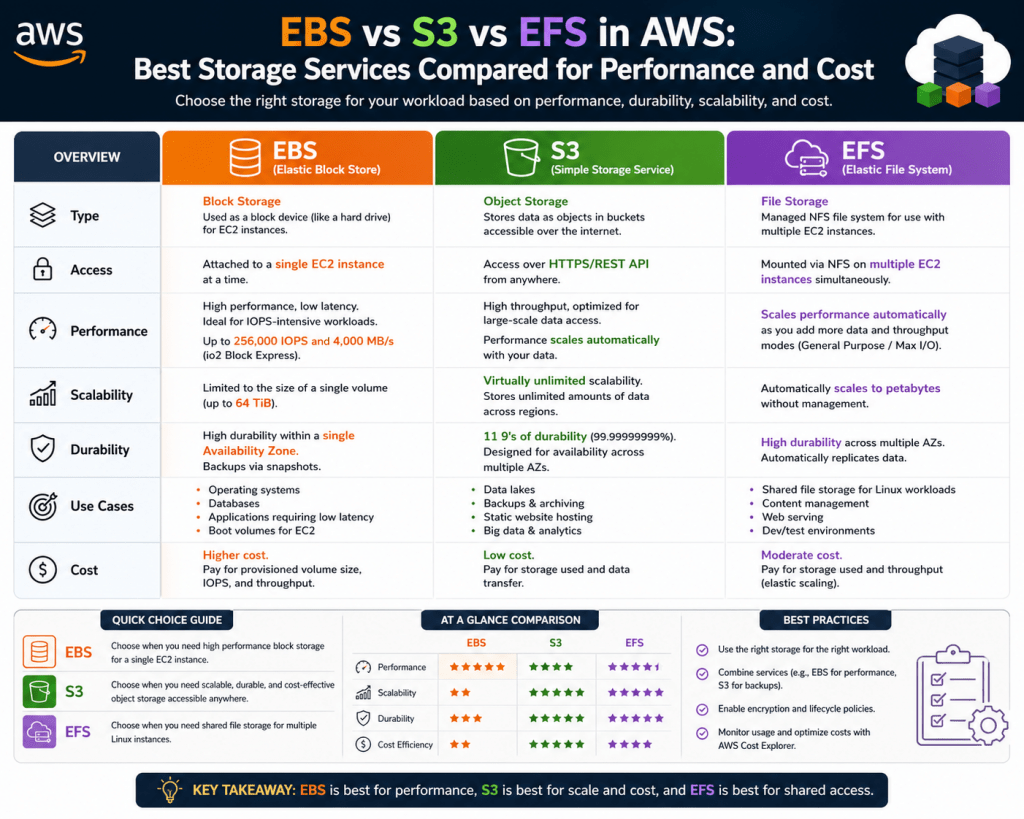
Cloud storage in modern distributed systems is built as a layered architecture where different storage models serve different workload requirements. AWS organizes storage into three primary paradigms: block storage, object storage, and file storage. Each model is optimized for a specific access pattern and performance expectation. Block storage is designed for low-level, direct disk access where data is handled in fixed-size units called blocks. Amazon Elastic Block Store represents AWS’s implementation of this model and is tightly integrated with virtual compute services. It is primarily used for workloads that require consistent latency, predictable input/output performance, and direct operating system-level control over storage devices. This makes it essential for enterprise applications, databases, and system boot volumes.
Fundamental Architecture of Amazon EBS and Block-Level Data Handling
Amazon EBS operates on a block-level architecture where data is divided into independent units called blocks. Each block can be accessed separately, enabling efficient read and write operations without needing to process entire files. This structure is similar to traditional storage area networks used in physical data centers. When an EBS volume is created, it is presented to the operating system as a raw disk that can be formatted with file systems such as ext4 or NTFS. This allows applications to interact with it as if it were a physical hard drive. The block-level design improves performance for transactional workloads because small data modifications can be processed quickly without scanning large datasets.
Integration of Amazon EBS with Compute Instances and Virtual Machines
Amazon EBS is closely integrated with compute services, particularly virtual machines. Each compute instance typically uses an EBS volume as its root storage, which contains the operating system and essential system files required for booting. Additional volumes can be attached to the same instance for application data, logs, or database storage. This separation allows better organization and performance isolation within a single system. EBS volumes can also be detached from one instance and attached to another within the same availability boundary, enabling flexible workload migration and recovery strategies. This tight integration ensures low-latency communication between compute and storage layers.
Data Persistence Model and Independence from Compute Lifecycle
One of the key advantages of Amazon EBS is its persistent storage model. Unlike temporary instance storage, EBS volumes continue to exist even if the associated compute instance is stopped or terminated. This separation between compute and storage allows data to survive system restarts, failures, or replacements. The persistence model is critical for applications that require long-term data retention and system reliability. It also supports modern cloud design principles where compute resources are treated as temporary while storage remains durable and independent. This architecture allows organizations to rebuild compute environments without losing stored information.
EBS Volume Types and Performance Optimization Strategies
Amazon EBS provides multiple volume types designed to support different performance and cost requirements. General-purpose volumes are optimized for balanced workloads such as small databases and development environments. Provisioned performance volumes are designed for high-throughput applications that require consistent input/output operations per second, such as large transactional systems. Throughput optimized volumes are suitable for sequential workloads like log processing and data streaming. Cold storage options are used for infrequent access data where cost efficiency is more important than performance. Each volume type is defined by its performance characteristics, allowing users to match storage behavior with application needs.
Performance Characteristics and Input Output Behavior in EBS
EBS performance is measured using input/output operations per second, throughput, and latency. Input/output operations refer to the number of read and write requests that can be processed per second. Latency refers to the time taken to complete each operation, which is critical for real-time applications. Consistency of performance is often more important than peak speed in enterprise environments. Provisioned performance configurations allow users to define exact performance limits, ensuring predictable behavior under heavy workloads. Burst-based models allow temporary increases in performance to handle short spikes in demand without degradation.
Availability Design and Redundancy Within a Single Boundary
Amazon EBS operates within a single availability boundary where data is automatically replicated across multiple underlying storage systems. This internal redundancy ensures durability even if hardware components fail. Although EBS does not span multiple regions by default, it provides high reliability within its operational scope. For cross-region resilience, additional strategies such as snapshot replication must be used. The single-boundary design allows optimized performance while maintaining strong fault tolerance within a localized infrastructure environment.
Snapshot Mechanism and Incremental Backup System
EBS snapshots provide a method for creating point-in-time backups of storage volumes. The initial snapshot captures the full state of a volume, while subsequent snapshots store only incremental changes. This reduces storage costs and improves efficiency. Snapshots are stored independently of active volumes and can be used to restore data, create new volumes, or replicate environments. This mechanism is widely used in disaster recovery, system duplication, and testing scenarios where consistent copies of production data are required. Snapshots also improve operational flexibility by allowing quick recovery from system failures.
Security Framework and Access Control Mechanisms in EBS
Security in EBS is implemented through multiple layers of control. Access to storage volumes is managed using identity-based policies that define who can create, attach, or modify storage resources. Data encryption can be applied to protect information at rest, ensuring that stored data remains secure even if physical storage hardware is compromised. Encryption keys are managed through centralized key management systems, allowing organizations to maintain strict control over security policies. In addition, virtual network isolation ensures that only authorized compute instances can access attached volumes, adding another layer of protection.
Elastic Scalability and Dynamic Storage Expansion Capabilities
EBS supports elastic scalability, allowing storage volumes to be expanded without downtime. This feature is essential for applications that experience unpredictable or growing data requirements. When a volume is resized, the additional capacity becomes available after minimal system configuration changes. This eliminates the need for system migration or downtime during expansion. Elastic storage scaling aligns with cloud computing principles where resources are dynamically adjusted based on workload demands. This flexibility helps maintain system efficiency and reduces operational complexity.
Architectural Constraints and Design Limitations of Block Storage
Despite its flexibility, EBS has certain limitations that must be considered in system design. Each volume is restricted to a single availability boundary, which limits native multi-zone redundancy. Storage capacity is also subject to maximum volume limits, requiring planning for large datasets. Performance is dependent on volume type selection, meaning improper configuration can lead to inefficiencies or bottlenecks. These constraints require careful workload analysis before deployment to ensure optimal performance and scalability.
Common Workload Scenarios and Enterprise Use Cases
EBS is widely used for workloads that require persistent, low-latency storage. This includes relational databases, enterprise applications, and system boot volumes. It is also used for analytics workloads that require temporary high-speed storage during processing tasks. Applications that depend on structured data and consistent performance benefit significantly from block storage architecture. The direct attachment model ensures minimal latency and reliable performance, making it suitable for mission-critical systems.
Role of Block Storage in Modern Cloud Infrastructure Design
In modern cloud architectures, block storage plays a foundational role by bridging traditional computing systems with cloud-native environments. It allows legacy applications to operate in virtualized environments without modification while also supporting modern distributed architectures. This dual compatibility makes it a key component in hybrid cloud strategies where different system types coexist. By providing persistent, high-performance storage directly attached to compute resources, block storage ensures stability, reliability, and consistency across diverse workloads.
Understanding Amazon S3 in the AWS Storage Ecosystem
Amazon Simple Storage Service (S3) represents the object storage layer within the AWS storage architecture. Unlike block storage systems that operate at the disk level, object storage is designed to manage data as discrete objects rather than blocks or file hierarchies. Each object consists of data, metadata, and a unique identifier, which allows it to be retrieved independently of physical location. This design makes S3 highly scalable and suitable for storing large volumes of unstructured data such as images, videos, backups, logs, and machine-generated datasets. The system is built to operate at internet scale, meaning it can handle virtually unlimited storage demands while maintaining consistent durability and accessibility.
Object Storage Model and Structural Design of Amazon S3
The core principle of Amazon S3 is object-based storage, where data is stored as self-contained units rather than being split into blocks. Each object is placed inside a logical container called a bucket, which acts as the top-level namespace for storage organization. Unlike traditional file systems, S3 does not rely on hierarchical directory structures. Instead, it uses flat storage with key-based addressing, where objects are retrieved using unique identifiers. This design eliminates the limitations of directory depth and allows seamless horizontal scaling. The object storage model is particularly effective for distributed systems because it decouples data storage from compute and enables direct access over network protocols.
S3 Buckets and Logical Data Organization Model
Buckets serve as the primary organizational unit in Amazon S3. Each bucket functions as a container for storing objects and must have a globally unique name within the system. While buckets may appear similar to folders in traditional file systems, they are fundamentally different because they do not enforce hierarchical relationships. Instead, pseudo-folder structures can be simulated using naming conventions and prefixes. This flat structure allows S3 to scale efficiently without the complexity of maintaining directory trees. Buckets also serve as the foundation for applying policies, access controls, and lifecycle rules, making them central to storage governance.
Scalability and Elastic Storage Architecture in S3
Amazon S3 is designed to provide virtually unlimited scalability. Users do not need to provision storage capacity in advance because the system automatically scales as data is added. This elasticity is achieved through a distributed architecture that spreads data across multiple storage nodes and availability domains. As data grows, S3 dynamically allocates resources without requiring user intervention. This makes it ideal for workloads with unpredictable or rapidly increasing data volumes. The architecture also ensures that performance remains consistent regardless of storage size, which is a key advantage over traditional storage systems that degrade under high capacity.
Data Durability and Replication Mechanisms in S3
Durability is a core design principle of Amazon S3. The system is engineered to maintain extremely high data durability by automatically replicating objects across multiple physical locations within an infrastructure boundary. This redundancy ensures that data remains accessible even in the event of hardware failure or localized disruptions. The replication process is transparent to the user and does not require manual configuration. This multi-layered protection model significantly reduces the risk of data loss and makes S3 suitable for mission-critical storage workloads. Durability is maintained independently of availability zones, providing resilience at scale.
S3 Storage Classes and Lifecycle Optimization Models
Amazon S3 offers multiple storage classes designed to optimize cost and performance based on data access patterns. Frequently accessed data is stored in high-performance tiers that provide low-latency retrieval. Infrequently accessed data can be moved to lower-cost storage tiers that reduce operational expenses while maintaining accessibility. Archival storage classes are designed for long-term data retention with minimal access frequency, offering the lowest storage costs but higher retrieval latency. Lifecycle policies allow automated movement of data between these storage classes based on predefined rules, enabling intelligent cost optimization without manual intervention.
Data Lifecycle Management and Automated Transition Rules
Lifecycle management in Amazon S3 allows data to transition between storage classes based on time, usage patterns, or custom policies. For example, newly created data may reside in a high-performance tier during active usage and later transition to lower-cost storage as access frequency decreases. This automated movement reduces storage costs while maintaining accessibility when needed. Lifecycle rules can also be configured to delete outdated or unnecessary data after a defined period, supporting compliance requirements and data governance policies. This system ensures that storage resources are continuously optimized without manual management overhead.
Performance Characteristics and Data Access Behavior in S3
Amazon S3 is optimized for high throughput and large-scale data access rather than low-latency transactional operations. Data retrieval is performed over network-based APIs, allowing access from virtually any location. While latency is higher compared to block storage systems, S3 compensates with massive parallelism and scalability. The system is capable of handling millions of requests simultaneously, making it suitable for distributed applications, content delivery systems, and big data analytics pipelines. Performance remains stable regardless of data size due to the distributed nature of the underlying architecture.
Security Architecture and Access Control in Object Storage
Security in Amazon S3 is implemented through multiple layers, including identity-based access control, bucket-level policies, and encryption mechanisms. Access permissions define who can read, write, or modify objects within a bucket. Encryption can be applied both at rest and in transit, ensuring that data remains protected during storage and transmission. Key management systems are used to control encryption keys and enforce cryptographic policies. Network-level restrictions can also be applied to limit access based on source identity or network boundaries. This multi-layered approach ensures strong protection for sensitive data stored in object storage environments.
Data Versioning and Object Change Tracking Systems
Amazon S3 supports versioning, which allows multiple versions of an object to be stored within the same bucket. When versioning is enabled, every modification to an object creates a new version rather than overwriting existing data. This provides a mechanism for data recovery, audit tracking, and change management. Versioning is particularly useful in environments where accidental deletion or modification must be recoverable. It also supports compliance requirements by maintaining historical records of data changes. Version control adds an additional layer of data protection beyond basic storage durability.
Event-Driven Integration and Serverless Computing Connectivity
S3 integrates closely with event-driven computing systems, enabling automated responses to data changes. When an object is created, modified, or deleted, it can trigger downstream processes such as data transformation, indexing, or analytics workflows. This integration allows S3 to function as both a storage system and an event source within modern cloud architectures. Serverless computing models often rely on S3 as a primary data ingestion point, where incoming data triggers automated processing pipelines. This event-driven design supports scalable and decoupled system architectures.
Data Accessibility and Global Distribution Capabilities
Amazon S3 is designed for global accessibility, allowing data to be retrieved from any location with internet connectivity. Objects are accessed using standardized APIs, which makes integration with applications, analytics tools, and external systems straightforward. Data can also be replicated across geographic regions to support disaster recovery and global distribution use cases. This capability is essential for applications that serve users across multiple continents or require low-latency access in different regions. The distributed nature of S3 ensures consistent availability regardless of geographic location.
Use Cases in Large-Scale Data Storage and Analytics Systems
S3 is widely used for storing large-scale datasets used in analytics, machine learning, and data warehousing systems. Its ability to store vast amounts of unstructured data makes it ideal for data lakes, where raw data from multiple sources is aggregated for processing. It is also commonly used for backup and archival storage due to its durability and cost efficiency. Media storage, log aggregation, and content distribution are additional common use cases. The system’s scalability allows it to support both small applications and enterprise-scale workloads without architectural changes.
Architectural Constraints and Operational Considerations
Despite its scalability, S3 has certain design constraints that must be considered. It does not support traditional hierarchical file system semantics, which may require application-level adaptation. Retrieval latency is higher compared to block storage, making it less suitable for real-time transactional systems. Object size limits also exist, although they are significantly larger than traditional file system constraints. Additionally, cost varies based on storage class and access frequency, requiring careful planning for large-scale deployments. These constraints highlight the importance of selecting appropriate storage models based on workload behavior.
Role of Object Storage in Modern Cloud Architectures
Object storage plays a central role in modern cloud-native systems by enabling scalable, durable, and distributed data storage. It decouples storage from compute, allowing systems to scale independently and efficiently. This separation is fundamental to microservices architectures, big data platforms, and serverless computing models. By providing a highly durable and globally accessible storage layer, object storage supports a wide range of applications that require flexibility, scalability, and long-term data retention.
Understanding Amazon EFS in the AWS Storage Ecosystem
Amazon Elastic File System (EFS) represents the file storage layer in the AWS storage architecture, positioned between block storage systems like Amazon EBS and object storage systems like Amazon S3. Unlike block storage, which provides raw disk access, and object storage, which manages data as independent objects, file storage maintains a hierarchical structure similar to traditional operating systems. EFS is designed to provide a fully managed, scalable, and shared file system that multiple compute resources can access simultaneously. It is commonly used in environments where applications require shared directories, POSIX-compliant file behavior, and concurrent access across multiple instances. This makes it suitable for workloads such as content management systems, shared application storage, and distributed processing systems.
File Storage Architecture and POSIX Compliance in EFS
Amazon EFS is built on a network file system model that follows POSIX standards, meaning it behaves like a traditional Linux-based file system. This allows applications to interact with it using standard file operations such as read, write, open, and close. Unlike object storage systems that rely on API-based access, EFS supports direct file system mounting on compute instances. This makes it appear as a local directory to the operating system while physically being distributed across multiple storage nodes. The POSIX compliance ensures compatibility with legacy applications that depend on traditional file system semantics, reducing the need for application redesign during cloud migration.
Shared File System Design and Multi-Instance Access Model
One of the defining characteristics of Amazon EFS is its ability to support concurrent access from multiple compute instances. This shared access model allows multiple systems to read and write to the same file system simultaneously without data corruption. This capability is essential for distributed applications where multiple servers must access common data sets. Unlike block storage, which is attached to a single instance at a time, EFS is designed for parallel access across multiple compute resources. This makes it highly effective for workloads such as web serving clusters, containerized applications, and collaborative data processing systems.
Elastic Scaling and Dynamic Capacity Expansion in EFS
Amazon EFS is designed to automatically scale storage capacity as data is added or removed. There is no requirement for manual provisioning or predefined storage limits. The file system expands and contracts dynamically based on actual usage, allowing users to focus on application logic rather than infrastructure management. This elasticity ensures that storage capacity is always aligned with workload demands, eliminating the risk of over-provisioning or running out of storage space. The system is capable of handling petabyte-scale datasets while maintaining consistent performance characteristics.
Storage Classes and Cost Optimization in EFS
Amazon EFS provides multiple storage classes designed to balance cost and performance based on access frequency. Frequently accessed data is stored in high-performance tiers optimized for low latency and high throughput. Infrequently accessed data can be moved to lower-cost tiers that reduce storage expenses while still maintaining availability. Lifecycle management policies allow automatic transition of data between these tiers based on usage patterns. This ensures that storage costs are optimized without requiring manual intervention. Archival-like tiers are also available for long-term retention of rarely accessed data, further extending cost efficiency options.
Performance Characteristics and Throughput Behavior in EFS
Performance in Amazon EFS is measured primarily in terms of throughput and I/O operations. The system is designed to provide consistent performance across multiple concurrent connections, making it suitable for distributed workloads. Throughput scales automatically based on stored data size and workload demand. Unlike block storage systems that focus on latency optimization, EFS prioritizes shared access and scalability. This makes it ideal for workloads where multiple systems need simultaneous access to shared datasets. Performance behavior is influenced by workload type, file size distribution, and concurrency levels.
Data Consistency Model and File System Integrity
Amazon EFS provides strong consistency across file operations, ensuring that changes made by one instance are immediately visible to all other connected instances. This consistency model is essential for applications that rely on shared state or synchronized data access. File locking mechanisms help prevent conflicts during concurrent write operations, maintaining data integrity across distributed environments. This behavior aligns with traditional file system expectations, making it easier for developers to migrate existing applications without modifying their data access logic.
Network-Based Access and Mounting Architecture
EFS operates as a network-based file system that is mounted onto compute instances using standard network protocols. Once mounted, it appears as a local directory within the operating system, even though data is stored in a distributed backend. This architecture allows seamless integration with existing applications without requiring changes to file access methods. Multiple instances can mount the same file system simultaneously, enabling shared data access across distributed environments. The network-based design ensures flexibility and scalability while maintaining compatibility with traditional file system operations.
Security Controls and Access Management in EFS
Security in Amazon EFS is implemented through multiple layers, including identity-based access control, network-level restrictions, and encryption mechanisms. Access permissions determine which compute resources can mount and interact with the file system. Encryption can be applied to data both at rest and in transit, ensuring protection during storage and communication. Network isolation ensures that only authorized systems within defined boundaries can access the file system. These security measures ensure that shared access does not compromise data integrity or confidentiality.
Use of EFS in Containerized and Microservices Architectures
Amazon EFS is widely used in containerized environments where multiple containers require shared storage access. In microservices architectures, different services often need to access common configuration files, shared assets, or persistent application data. EFS provides a centralized storage layer that supports these requirements without requiring complex data synchronization mechanisms. Its ability to scale automatically and support concurrent access makes it suitable for dynamic environments where services are frequently scaled up or down based on demand.
Integration with Distributed Computing and Parallel Processing Systems
EFS is commonly used in distributed computing environments where multiple compute nodes process shared datasets. This includes big data processing frameworks, scientific computing workloads, and machine learning pipelines. The shared file system model allows compute nodes to access input data and store output results in a centralized location. This simplifies data coordination and reduces the need for complex data transfer mechanisms between systems. The scalability of EFS ensures that it can handle large-scale parallel processing workloads efficiently.
Data Lifecycle Management and Storage Optimization in EFS
Lifecycle management in Amazon EFS allows data to transition between different storage classes based on access patterns. Frequently used data remains in high-performance storage tiers, while older or less frequently accessed data is moved to lower-cost tiers. This automatic transition helps optimize storage costs without affecting application performance. Policies can be defined to determine when data should be moved or archived, enabling efficient long-term data management. This approach ensures that storage resources are used efficiently while maintaining accessibility when needed.
Availability Model and Fault Tolerance in EFS Architecture
Amazon EFS is designed for high availability by distributing data across multiple storage systems within an infrastructure boundary. This ensures that the file system remains accessible even if individual components fail. The distributed architecture eliminates single points of failure and provides continuous availability for connected compute instances. While EFS does not inherently span multiple geographic regions, it provides strong resilience within its operational scope. This makes it suitable for production workloads that require consistent uptime and reliability.
Performance Scaling and Throughput Modes
EFS supports multiple performance modes that allow users to optimize throughput based on workload requirements. General-purpose mode is suitable for latency-sensitive applications with moderate concurrency. Max I/O mode is designed for highly parallel workloads that require increased throughput and scalability. Throughput can also be provisioned or burst-based depending on application demand. These options allow users to fine-tune performance characteristics based on specific workload requirements, ensuring efficient resource utilization.
Limitations and Architectural Constraints of File Storage Systems
Despite its flexibility, EFS has certain limitations that must be considered during system design. It typically has higher latency compared to block storage systems, making it less suitable for high-frequency transactional workloads. Cost can also be higher for large-scale deployments depending on storage class usage. Additionally, performance may vary based on concurrency levels and file access patterns. These constraints require careful workload analysis to ensure that EFS is used appropriately within a broader storage strategy.
Role of File Storage in Hybrid Cloud and Modern Application Design
File storage plays a critical role in hybrid cloud architectures by providing a shared data layer that bridges traditional and modern applications. EFS enables legacy applications that rely on file-based access to operate in cloud environments without modification. At the same time, it supports modern distributed systems that require shared storage for coordination and data exchange. This dual compatibility makes it an important component in multi-tier architectures where different storage models are used together to optimize performance, scalability, and cost efficiency.
Conclusion
AWS storage architecture is built around three core models: block storage, object storage, and file storage. Each of these models is designed for fundamentally different workload patterns, and understanding their differences is essential for designing efficient cloud systems. Rather than being interchangeable, these storage types complement each other, forming a layered ecosystem that supports everything from high-performance databases to large-scale analytics platforms and shared application environments. Choosing the correct storage type is not just a technical decision but an architectural one that directly affects performance, scalability, cost, and operational complexity.
Amazon Elastic Block Store represents the block storage layer and is primarily used for workloads that require low-latency, consistent disk performance. It behaves like a virtual hard drive attached to compute instances, allowing operating systems and applications to perform direct read and write operations at the block level. This makes it highly suitable for transactional databases, enterprise applications, and system boot volumes. Its tight coupling with compute resources ensures predictable performance, but it also introduces design limitations such as confinement within a single availability boundary. Because of this, it often needs to be combined with other storage services to achieve broader redundancy and multi-region resilience.
Amazon Simple Storage Service represents the object storage layer and is optimized for scalability, durability, and distributed data access. Instead of managing data as blocks or files, it stores data as objects inside logical containers. Each object contains data, metadata, and a unique identifier, allowing it to be retrieved independently over network-based APIs. This design allows virtually unlimited scaling without requiring users to manage underlying infrastructure. It is widely used for unstructured data such as backups, media files, logs, and data lakes. While it does not provide the low-latency characteristics of block storage, it excels in handling massive volumes of data across distributed systems.
Amazon Elastic File System represents the file storage layer and provides a shared hierarchical file system that multiple compute instances can access simultaneously. It follows traditional file system behavior, making it compatible with applications that rely on POSIX standards. This allows it to function like a network-attached drive that is mounted across multiple servers at the same time. Its primary advantage lies in enabling shared data access across distributed applications, which is essential for containerized workloads, content management systems, and collaborative processing environments. It automatically scales based on usage, removing the need for manual capacity planning.
When comparing these three storage models, the most important distinction lies in how they handle data access. Block storage focuses on performance and direct disk-level interaction, object storage focuses on scale and durability through API-driven access, and file storage focuses on shared access and hierarchical organization. These differences make each model suitable for specific scenarios rather than general-purpose replacement. In many real-world architectures, all three are used together to form a complete storage strategy.
Performance behavior also varies significantly across these systems. Block storage delivers the lowest latency because it is directly attached to compute instances and optimized for frequent read and write operations. Object storage introduces higher latency due to its network-based access model but compensates with massive scalability and parallel request handling. File storage sits in between, offering moderate latency with the added benefit of shared access. These performance differences influence system design decisions, especially in applications where response time and throughput are critical factors.
Durability and reliability are core principles across all AWS storage systems, but they are implemented differently. Object storage typically offers the highest inherent durability due to extensive replication across infrastructure layers. Block storage achieves durability through redundant storage within an availability boundary, while file storage relies on distributed architecture to maintain availability and data integrity. Although all three are highly resilient, their durability mechanisms reflect their underlying design philosophies.
Cost structure is another major differentiator. Block storage costs are generally tied to provisioned capacity and performance levels, making it suitable for predictable workloads. Object storage introduces tiered pricing models that allow data to be stored at different cost levels based on access frequency, enabling long-term cost optimization. File storage combines elements of both, with pricing influenced by storage usage and performance characteristics. Effective cost management requires aligning data usage patterns with the appropriate storage class and access model.
Scalability further distinguishes these storage types. Object storage offers virtually unlimited scalability without requiring manual provisioning, making it ideal for rapidly growing datasets. File storage also scales automatically but is more structured due to its hierarchical nature. Block storage, while scalable, requires explicit volume management and is more constrained in comparison. These differences make object storage the preferred choice for large-scale data lakes and analytics systems, while block storage remains focused on performance-driven applications.
Security is implemented across all storage types using layered mechanisms that include identity-based access control, encryption, and network isolation. Each system ensures that data is protected both at rest and in transit. Access policies define who can interact with storage resources, while encryption ensures that stored data remains secure even if underlying infrastructure is compromised. Despite differences in architecture, all three storage models adhere to a consistent security framework designed to meet enterprise-level requirements.
From an architectural perspective, modern cloud systems rarely rely on a single storage model. Instead, they combine block, object, and file storage to meet different functional requirements within the same application ecosystem. For example, a typical enterprise system may use block storage for its database layer, object storage for backups and analytics data, and file storage for shared application assets. This multi-layered approach allows systems to balance performance, scalability, and cost efficiency without compromising functionality.
Ultimately, AWS storage design reflects a shift away from monolithic storage systems toward specialized, purpose-built models. Each storage type addresses a specific dimension of modern computing challenges, whether it is speed, scale, or shared accessibility. Understanding how these systems differ and complement each other is essential for building efficient, resilient, and scalable cloud architectures that can adapt to evolving workload demands.