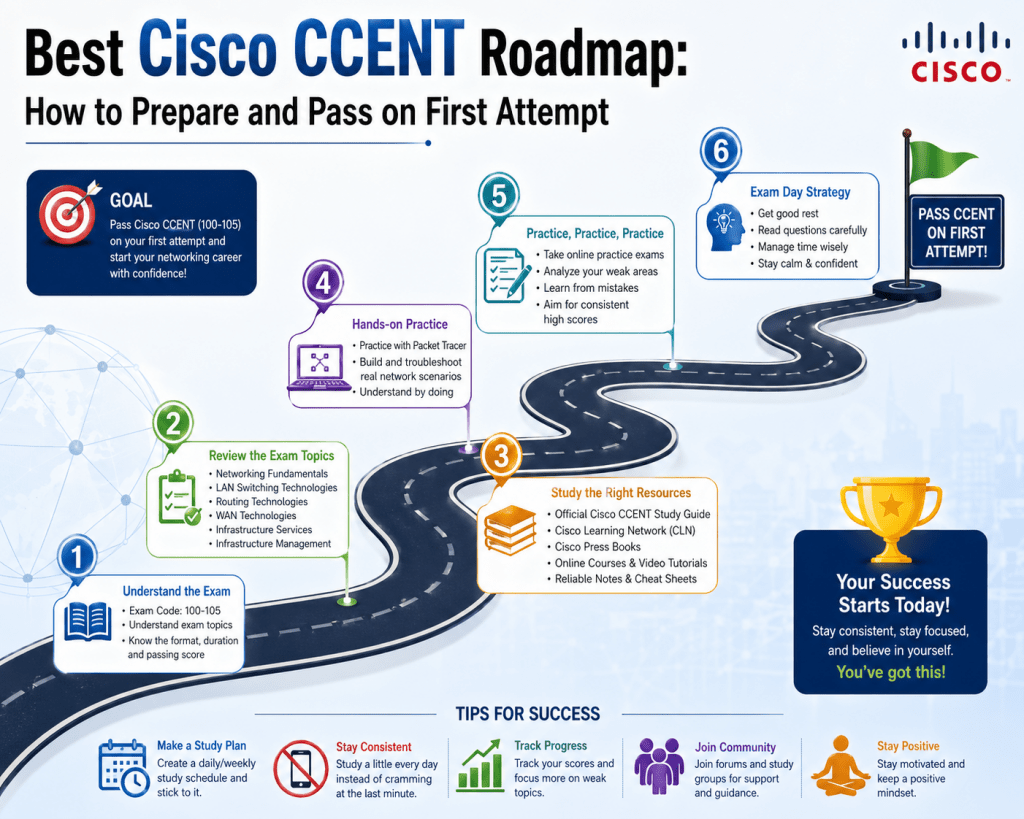
The journey into networking often begins with foundational certifications that establish core technical competencies and introduce learners to real-world infrastructure concepts. Among entry-level networking certifications, the Cisco Certified Entry-level Network Technician credential has historically served as a structured gateway into the broader ecosystem of networking technologies. It is designed to equip individuals with the essential knowledge required to understand how networks function, how devices communicate, and how to support small-scale enterprise environments.
This certification represents more than just an introductory badge. It builds a structured understanding of networking principles, making it easier for learners to transition into more advanced roles and certifications. For individuals entering the IT field, it provides clarity on career direction while also offering practical exposure to networking tools, protocols, and troubleshooting methodologies.
Role of Entry-Level Certifications in Networking Careers
Entry-level certifications play a critical role in shaping early career trajectories. They bridge the gap between theoretical knowledge and applied skills by introducing structured learning paths that align with industry expectations. In the context of networking, this means understanding how data flows across networks, how devices interact within different topologies, and how configurations impact performance and security.
The CCENT certification specifically targets individuals who are either new to IT or have limited exposure to networking concepts. It provides a controlled environment to explore networking fundamentals without overwhelming learners with advanced configurations. This approach ensures that foundational gaps are addressed early, reducing the learning curve for more complex certifications later.
Additionally, entry-level certifications often validate a candidate’s ability to perform basic operational tasks. These include configuring simple networks, identifying connectivity issues, and implementing basic security measures. Such competencies are highly relevant for junior roles, making certification holders more competitive in the job market.
Core Objectives of the CCENT Certification
The CCENT certification is structured around a single examination that evaluates a candidate’s understanding of essential networking topics. The scope of the exam is carefully designed to cover a broad range of foundational concepts while maintaining a focus on practical application.
One of the primary objectives is to ensure that learners understand how IP-based networks operate. This includes familiarity with addressing schemes, subnetting concepts, and the role of protocols in enabling communication between devices. Understanding these principles is crucial because they form the backbone of all modern networks.
Another key objective is to introduce learners to switching technologies used in local area networks. This involves understanding how switches forward frames, how VLANs segment networks, and how broadcast domains are managed. These concepts are essential for designing efficient and scalable network infrastructures.
Routing is also introduced at a foundational level. Learners are expected to understand how routers make forwarding decisions, how routing tables are constructed, and how basic routing protocols function. While the depth is limited compared to advanced certifications, this foundational knowledge is critical for future learning.
Networking Fundamentals and Protocol Awareness
A strong emphasis is placed on understanding networking fundamentals. This includes the OSI model, which provides a conceptual framework for how data moves through a network. Each layer of the model has specific responsibilities, and understanding these layers helps in diagnosing network issues and designing solutions.
Protocol awareness is another important component. Protocols such as TCP and UDP define how data is transmitted across networks. Learners are expected to understand the differences between these protocols, including their use cases and performance characteristics.
In addition to transport protocols, application-layer protocols such as HTTP, FTP, and DNS are also introduced. These protocols enable common network services and are essential for everyday operations. Understanding how they function helps learners troubleshoot issues related to connectivity and service availability.
Introduction to IP Addressing and Subnetting
IP addressing is a fundamental concept that underpins all networking activities. The CCENT certification ensures that learners develop a strong understanding of both IPv4 and IPv6 addressing schemes. This includes learning how addresses are structured, how they are assigned, and how they are used to identify devices on a network.
Subnetting is a critical skill that allows network administrators to divide larger networks into smaller, more manageable segments. This improves efficiency, enhances security, and optimizes resource utilization. Learners are expected to perform basic subnetting calculations and understand how subnet masks influence network design.
IPv6 is also introduced as part of the certification. As the successor to IPv4, IPv6 addresses the limitations of address exhaustion and introduces new features for improved performance and scalability. Understanding IPv6 concepts ensures that learners are prepared for modern networking environments.
Basic Network Security Concepts
Security is an integral part of networking, even at the entry level. The CCENT certification introduces learners to fundamental security concepts that help protect network infrastructure from unauthorized access and threats.
This includes understanding how to secure network devices through basic configurations such as password protection and access control. Learners are also introduced to concepts like firewalls and access control lists, which help regulate traffic flow and prevent malicious activity.
Awareness of common vulnerabilities and threats is also emphasized. This ensures that learners can identify potential risks and take appropriate measures to mitigate them. While the depth of security coverage is limited, it provides a solid foundation for more advanced security certifications.
Troubleshooting and Operational Skills
One of the most valuable aspects of the CCENT certification is its focus on troubleshooting. Networking environments are dynamic, and issues can arise due to misconfigurations, hardware failures, or external factors. The ability to diagnose and resolve these issues is a critical skill for any network professional.
Learners are introduced to systematic troubleshooting methodologies that involve identifying symptoms, isolating causes, and implementing solutions. This structured approach ensures efficiency and reduces downtime in real-world scenarios.
Operational skills are also emphasized, including the use of command-line interfaces to configure and monitor network devices. These skills are essential for managing network infrastructure and ensuring optimal performance.
Preparation Strategy and Learning Approach
Preparing for the CCENT certification requires a balanced approach that combines theoretical study with practical application. Learners are encouraged to build a strong conceptual foundation while also gaining hands-on experience with networking tools and simulations.
Practical exposure is particularly important because it reinforces theoretical concepts and builds confidence. Working with simulated environments allows learners to experiment with configurations, test scenarios, and develop troubleshooting skills without the risk of impacting real networks.
Consistency in study habits is another important factor. Breaking down topics into manageable sections and setting realistic goals helps maintain progress and prevents burnout. A structured study plan ensures that all exam objectives are covered thoroughly.
Exam Structure and Expectations
The CCENT certification exam is designed to assess both knowledge and practical understanding. It typically includes a mix of question formats that evaluate different aspects of a candidate’s skills.
Multiple-choice questions test conceptual understanding, while simulation-based questions assess practical application. These simulations require candidates to interact with virtual network environments, making configuration changes and troubleshooting issues.
Time management is a critical factor during the exam. Candidates must balance accuracy with efficiency to complete all questions within the allotted time. Familiarity with the exam format and practice with similar questions can significantly improve performance.
Career Opportunities After CCENT
Earning the CCENT certification opens up a range of entry-level career opportunities in the IT industry. These roles typically involve supporting network operations, maintaining infrastructure, and assisting with troubleshooting tasks.
Common positions include network technician, where individuals are responsible for installing and maintaining network hardware. Another role is systems administrator, which involves managing servers and ensuring system availability. Network administrator roles may also be accessible, focusing on configuring and monitoring network performance.
These roles provide valuable experience and serve as stepping stones for more advanced positions. As individuals gain experience and pursue higher-level certifications, they can transition into roles with greater responsibility and specialization.
Building a Foundation for Advanced Certifications
The CCENT certification is not an endpoint but rather a starting point. It lays the groundwork for more advanced certifications that delve deeper into networking concepts and technologies.
By mastering the fundamentals covered in CCENT, learners are better prepared to tackle associate-level certifications. These certifications expand on the knowledge gained and introduce more complex topics such as advanced routing, network design, and security implementation.
This progression ensures a structured learning path that aligns with career growth. Each certification builds upon the previous one, creating a comprehensive skill set that is highly valued in the industry.
Importance of Continuous Learning in Networking
The field of networking is constantly evolving, with new technologies and standards emerging regularly. Continuous learning is essential to stay relevant and maintain a competitive edge.
The CCENT certification instills a mindset of ongoing development. It encourages learners to explore new concepts, stay updated with industry trends, and continuously refine their skills. This approach ensures long-term success in the networking domain.
As learners progress in their careers, they will encounter more complex challenges that require advanced knowledge and problem-solving abilities. Building a strong foundation through certifications like CCENT ensures that they are well-equipped to handle these challenges effectively.
Expanding Network Knowledge Beyond Foundational Concepts
As learners move beyond introductory networking principles, the focus shifts from basic understanding to applied knowledge in real-world environments. Entry-level certifications establish the groundwork, but deeper comprehension is built through exposure to more complex network behaviors, configurations, and operational scenarios. At this stage, networking knowledge becomes less about memorization and more about interpretation, analysis, and decision-making in dynamic systems.
A critical aspect of this progression is the ability to understand how multiple networking components interact simultaneously. Instead of viewing devices and protocols in isolation, learners begin to see networks as integrated systems where changes in one area can influence performance across the entire infrastructure. This systems-thinking approach is essential for anyone aiming to advance in networking roles.
Understanding Network Architecture in Enterprise Environments
Enterprise networks are structured with multiple layers, each serving a specific purpose in maintaining performance, scalability, and security. Entry-level knowledge introduces basic LAN concepts, but advanced understanding requires familiarity with hierarchical network design models.
At the core of enterprise architecture is the concept of segmentation. Networks are divided into functional layers such as access, distribution, and core. The access layer connects end devices, the distribution layer handles routing and policy enforcement, and the core layer ensures high-speed data transfer between different parts of the network. Understanding how these layers interact helps in designing efficient infrastructures that minimize latency and improve reliability.
Another important aspect is redundancy. Enterprise networks are designed to avoid single points of failure. This includes redundant links, multiple routing paths, and backup systems that ensure continuity of service in case of hardware or software failure. Learners must understand how redundancy protocols operate and how failover mechanisms maintain uptime.
Advanced Switching Concepts and Their Practical Implications
Switching is one of the most fundamental functions in networking, and deeper exploration reveals its complexity. While basic concepts involve frame forwarding and MAC address tables, advanced switching introduces technologies that optimize performance and enhance segmentation.
Virtual Local Area Networks (VLANs) play a central role in modern switching environments. VLANs allow logical segmentation of networks, enabling administrators to group devices regardless of physical location. This improves security by isolating traffic and enhances performance by reducing broadcast domains.
Trunking is another important concept that allows multiple VLANs to traverse a single physical link. This is achieved through tagging protocols that identify VLAN membership across switches. Understanding trunk configuration is essential for maintaining communication between segmented network areas.
Spanning Tree Protocol is also critical in switching environments. It prevents loops in redundant network topologies by selectively blocking certain paths. Without this mechanism, broadcast storms could disrupt network performance. Learners must understand how spanning tree elections occur and how root bridges are determined within a network.
Deep Dive into Routing Mechanisms and Path Selection
Routing is the process that determines how data travels between different networks. While basic routing concepts involve static and dynamic routes, advanced understanding requires knowledge of how routing protocols make intelligent decisions.
Dynamic routing protocols such as distance-vector and link-state protocols are designed to adapt to network changes automatically. Distance-vector protocols rely on hop counts to determine the best path, while link-state protocols build a complete map of the network topology before making decisions. Each approach has advantages and trade-offs in terms of convergence speed and scalability.
Route selection is influenced by multiple factors including metrics, administrative distance, and policy configurations. Understanding how these elements interact allows network professionals to optimize traffic flow and ensure efficient data delivery.
Another important concept is route redistribution, which enables communication between different routing protocols. This is often required in complex environments where multiple protocols coexist. Proper configuration is essential to avoid routing loops and inconsistencies.
IP Addressing Strategies in Large-Scale Networks
As networks scale, IP addressing becomes increasingly complex. Efficient address management is essential for maintaining order and avoiding conflicts. Subnetting, which is introduced at a basic level in entry-level learning, becomes a strategic tool in large environments.
Hierarchical addressing schemes are used to organize IP space logically. This allows for efficient routing and easier network management. Instead of assigning addresses randomly, organizations design structured addressing plans that align with physical and logical network layouts.
Variable Length Subnet Masking (VLSM) is another advanced concept that allows subnets of different sizes within the same network. This optimizes address utilization and reduces waste. Understanding how to calculate and implement VLSM is essential for designing scalable networks.
IPv6 addressing introduces even greater complexity due to its expanded address space. Instead of focusing on scarcity, IPv6 allows for hierarchical allocation and auto-configuration features. Learners must understand how IPv6 addresses are structured and how they differ from IPv4 in terms of notation and functionality.
Network Services and Infrastructure Components
Modern networks rely on a variety of services that support communication, security, and resource management. These services operate behind the scenes but are critical to network functionality.
Domain Name System services translate human-readable domain names into IP addresses. Without this service, users would need to remember numerical addresses for every resource. Understanding how DNS queries are resolved helps in troubleshooting connectivity issues.
Dynamic Host Configuration services automate IP address assignment. This reduces administrative overhead and ensures consistent configuration across devices. Learners must understand how lease allocation works and how conflicts are resolved.
Network Address Translation plays a key role in conserving public IP addresses. It allows multiple devices on a private network to share a single public address. Understanding NAT behavior is essential for configuring internet connectivity in enterprise environments.
Security Implementation in Network Environments
As networks grow in complexity, security becomes increasingly important. Entry-level concepts introduce basic protections, but advanced security involves layered defense strategies.
Access control mechanisms are used to regulate traffic flow based on predefined rules. These rules determine which devices or users can access specific network resources. Proper configuration ensures that only authorized traffic is permitted.
Network segmentation is another important security strategy. By isolating sensitive systems from general traffic, organizations reduce the risk of unauthorized access and lateral movement within the network.
Encryption is used to protect data in transit. This ensures that even if data is intercepted, it cannot be interpreted without the appropriate decryption key. Understanding encryption protocols is essential for securing communication channels.
Monitoring and logging systems provide visibility into network activity. These tools help detect anomalies and identify potential security threats. Continuous monitoring is a key component of modern cybersecurity strategies.
Troubleshooting Complex Network Issues
As networks become more advanced, troubleshooting also becomes more sophisticated. Issues are rarely isolated and often involve multiple components interacting in unexpected ways.
A structured troubleshooting approach is essential. This involves identifying symptoms, isolating affected areas, analyzing potential causes, and implementing corrective actions. Each step must be performed methodically to avoid overlooking critical details.
Performance issues are often caused by congestion, misconfigurations, or hardware limitations. Understanding how to analyze network traffic helps in identifying bottlenecks and optimizing performance.
Connectivity issues may arise from routing errors, incorrect IP configurations, or physical layer problems. Diagnosing these issues requires familiarity with diagnostic tools and command-line utilities.
Security-related issues may involve unauthorized access attempts, misconfigured policies, or outdated software. Identifying these problems requires a combination of monitoring and analytical skills.
Role of Simulation and Practical Labs in Skill Development
Hands-on experience is essential for developing real-world networking skills. Simulation environments allow learners to experiment with configurations without affecting production systems.
These environments replicate real network behavior, enabling learners to test scenarios such as routing changes, VLAN configurations, and security implementations. This practical exposure reinforces theoretical knowledge and builds confidence.
Lab exercises also help learners understand the consequences of configuration errors. By observing how networks respond to changes, they develop a deeper understanding of system behavior.
Repetition is important in skill development. Repeated practice helps reinforce concepts and improves speed and accuracy in configuration tasks.
Transitioning Toward Associate-Level Networking Knowledge
After mastering intermediate concepts, learners naturally progress toward more advanced certifications. This transition involves deeper exploration of routing protocols, network automation, and infrastructure design.
Associate-level knowledge builds upon foundational principles but introduces greater complexity and specialization. Learners are expected to understand not only how networks operate but also how to optimize and scale them effectively.
This stage also introduces more responsibility in terms of network design and decision-making. Professionals are expected to evaluate different solutions and choose the most effective approach based on organizational requirements.
Evolving Career Pathways in Networking Roles
As technical knowledge expands, career opportunities also grow. Entry-level roles evolve into more specialized positions that require deeper expertise and problem-solving abilities.
Network support roles transition into engineering positions where individuals are responsible for designing and implementing network solutions. Systems administration roles expand into infrastructure management, covering both hardware and software components.
Security-focused roles also become more prominent as organizations prioritize data protection and risk mitigation. Understanding networking fundamentals provides a strong foundation for these specialized career paths.
Importance of Analytical Thinking in Networking
Networking is not just a technical discipline; it also requires strong analytical thinking. Professionals must evaluate complex systems, identify patterns, and predict outcomes based on configuration changes.
Analytical thinking helps in troubleshooting, design, and optimization. It allows professionals to move beyond reactive problem-solving and adopt a proactive approach to network management.
This mindset is essential for handling large-scale environments where small changes can have significant impacts. Developing this skill is just as important as learning technical concepts.
Building Long-Term Competence in Networking
Long-term success in networking depends on continuous skill development. Technology evolves rapidly, and professionals must adapt to new tools, protocols, and methodologies.
Building competence involves more than passing exams. It requires practical experience, ongoing learning, and exposure to diverse networking environments. This combination ensures adaptability and long-term career growth.
As learners progress, they develop not only technical expertise but also strategic thinking abilities. This allows them to contribute to broader organizational goals and take on leadership roles within IT infrastructure teams.
Transitioning from Foundational Networking to Advanced Cisco Learning Paths
As networking learners progress beyond entry-level knowledge, the focus naturally shifts toward more structured and advanced learning pathways. The early stage of certification introduces essential concepts such as IP addressing, switching behavior, and basic routing logic. However, advanced progression requires a deeper understanding of how these components interact in large-scale, dynamic environments.
At this stage, networking becomes less about isolated commands or configurations and more about architectural thinking. Learners begin to evaluate how networks are designed, how scalability is achieved, and how resilience is maintained under load. This transition marks a shift from operational familiarity to engineering-level reasoning.
Understanding this shift is important because modern network environments are not static. They evolve continuously due to cloud adoption, virtualization, automation, and security requirements. As a result, professionals must adapt their mindset from simply configuring devices to designing and maintaining interconnected systems that support business-critical operations.
Developing a Strong Foundation in Network Design Principles
Network design is one of the most important competencies for anyone moving beyond entry-level certification. It involves structuring networks in a way that ensures performance, reliability, and scalability while maintaining security and manageability.
A key principle in network design is hierarchy. Hierarchical design divides networks into structured layers, allowing each layer to perform specific functions. This approach simplifies troubleshooting, improves scalability, and enhances performance by reducing unnecessary traffic propagation.
Another important principle is modularity. Modular design breaks networks into functional components that can be independently managed and upgraded. This reduces complexity and allows organizations to scale their infrastructure without disrupting existing services.
Redundancy is also a core design principle. Networks must be built with failover mechanisms that ensure continuity in case of hardware or link failures. This includes redundant pathways, backup devices, and automatic failover protocols that maintain uptime.
Understanding these principles helps learners move from reactive troubleshooting to proactive design thinking.
Advanced Routing Concepts and Traffic Engineering
Routing at an advanced level involves more than simply forwarding packets between networks. It requires an understanding of how traffic is influenced, optimized, and controlled across complex infrastructures.
Dynamic routing protocols play a significant role in this process. Unlike static routes, dynamic protocols adjust automatically based on network conditions. This adaptability ensures efficient traffic flow even when network topologies change.
Link-state protocols provide a detailed view of the entire network, allowing routers to make informed decisions based on complete topology data. Distance-vector protocols, while simpler, rely on periodic updates and hop-based metrics to determine paths.
Beyond basic routing behavior, traffic engineering becomes a critical concept. Traffic engineering involves controlling the flow of data to optimize performance and avoid congestion. This may include route manipulation, policy-based routing, and load balancing strategies.
Policy-based routing allows administrators to override default routing decisions based on specific criteria. This enables more granular control over traffic flow, ensuring that certain types of traffic follow predefined paths.
Scalability Challenges in Large Network Environments
As networks grow, scalability becomes a major concern. A design that works efficiently at a small scale may fail when applied to larger environments. Understanding scalability challenges is essential for advanced networking roles.
One of the primary challenges is routing table growth. As networks expand, routers must maintain larger and more complex routing tables. This increases processing overhead and can impact performance.
Another challenge is broadcast traffic management. In large networks, excessive broadcast traffic can lead to congestion and reduced efficiency. Techniques such as segmentation and VLAN design help mitigate this issue.
Address management also becomes more complex at scale. Without proper planning, IP conflicts and inefficiencies can arise. Structured addressing schemes and hierarchical allocation strategies help maintain order.
Scalability also requires consideration of hardware limitations. Devices must be capable of handling increased loads without degradation in performance.
Deep Dive into Switching Optimization Techniques
Switching at an advanced level involves optimizing how data is forwarded within local networks. While basic switching focuses on MAC address learning and frame forwarding, advanced switching introduces performance optimization techniques.
One such technique is port aggregation. This allows multiple physical links to be combined into a single logical connection, increasing bandwidth and providing redundancy. If one link fails, traffic continues through the remaining links.
Another optimization technique is advanced VLAN design. Instead of simple segmentation, VLANs are strategically designed to align with organizational structure, security requirements, and traffic patterns.
Quality of Service mechanisms are also introduced at this level. QoS allows prioritization of traffic based on importance, ensuring that critical applications receive sufficient bandwidth even during congestion.
Spanning Tree optimization is another important area. While Spanning Tree Protocol prevents loops, advanced configurations reduce convergence time and improve efficiency in redundant topologies.
Introduction to Network Automation Concepts
Modern networking increasingly relies on automation to reduce manual configuration and improve efficiency. Automation allows repetitive tasks to be executed consistently and accurately without human intervention.
At a conceptual level, automation involves scripting and programmatic control of network devices. This reduces the likelihood of configuration errors and speeds up deployment processes.
Automation also enables dynamic network adjustments. Instead of manually reconfiguring devices, networks can respond automatically to changes in traffic patterns or system conditions.
Understanding automation concepts is becoming essential in advanced networking roles. It represents a shift from manual configuration to intelligent infrastructure management.
Virtualization and Its Impact on Networking
Virtualization has transformed the way networks are designed and operated. Instead of relying solely on physical hardware, networks can now be created and managed in virtual environments.
Virtual networks allow multiple isolated environments to operate on shared physical infrastructure. This improves resource utilization and reduces costs.
Virtual switches, virtual routers, and virtual firewalls replicate traditional network functions in software-defined environments. This enables greater flexibility and scalability.
Understanding virtualization is critical because many modern networks operate in hybrid environments that combine physical and virtual components.
Cloud Networking Fundamentals and Integration
Cloud computing has introduced new paradigms in networking. Traditional network boundaries are no longer fixed, and resources are often distributed across multiple geographic locations.
Cloud networking involves connecting on-premises infrastructure with cloud-based services. This requires secure and efficient communication channels between different environments.
Virtual private networks are commonly used to establish secure connections between local networks and cloud platforms. These connections ensure data privacy and integrity during transmission.
Understanding cloud networking is essential because most modern organizations rely on hybrid or fully cloud-based infrastructures.
Security Architecture in Modern Networks
Security in advanced networking environments is no longer a single layer but a multi-layered architecture. Each layer of the network incorporates specific security controls to mitigate risks.
Perimeter security focuses on controlling access to the network from external sources. Internal security focuses on preventing unauthorized lateral movement within the network.
Segmentation plays a key role in limiting exposure. By dividing networks into smaller segments, organizations can isolate sensitive systems and reduce attack surfaces.
Encryption is used extensively to protect data both in transit and at rest. Secure communication protocols ensure that sensitive information remains confidential.
Continuous monitoring is also essential. Security systems must detect anomalies and respond to potential threats in real time.
Troubleshooting in Complex, Multi-Layered Networks
Troubleshooting in advanced environments requires a structured and analytical approach. Issues often span multiple layers of the network, making diagnosis more complex.
Layered troubleshooting involves analyzing problems at each level of the network model. This helps isolate issues more effectively and reduces diagnostic time.
Performance issues may be caused by congestion, misconfiguration, or hardware limitations. Identifying the root cause requires careful analysis of traffic patterns and system behavior.
Connectivity issues may involve routing errors, VLAN misconfigurations, or physical connectivity failures. Each potential cause must be systematically evaluated.
Security-related issues require additional scrutiny, as they may involve unauthorized access attempts or policy violations.
Evolving Role of Networking Professionals in Modern IT
The role of networking professionals has evolved significantly over time. In modern IT environments, networking is closely integrated with security, cloud computing, and automation.
Professionals are expected to understand not only how networks function but also how they support business objectives. This requires a combination of technical expertise and strategic thinking.
Networking roles now often involve collaboration with multiple teams, including security, development, and infrastructure operations. This interdisciplinary approach ensures that networks align with organizational goals.
As a result, networking professionals must continuously expand their skill sets to remain relevant in a rapidly changing industry.
Long-Term Skill Development and Career Progression
Career progression in networking is built on continuous learning and skill refinement. Entry-level knowledge provides the foundation, but long-term success depends on ongoing development.
Advanced certifications and practical experience help professionals move into specialized roles such as network engineering, infrastructure design, and security architecture.
Each stage of progression builds on previous knowledge, creating a layered understanding of networking systems. This cumulative learning approach ensures depth and versatility.
Over time, professionals develop the ability to design, manage, and optimize complex network infrastructures that support modern digital ecosystems.
Strategic Thinking in Network Evolution and Design
At the highest level of networking expertise, strategic thinking becomes essential. Professionals must anticipate future requirements and design networks that can adapt to changing technologies.
This includes planning for scalability, integrating emerging technologies, and ensuring long-term sustainability. Strategic design decisions impact not only technical performance but also business efficiency.
Networking is no longer just a technical discipline but a strategic function that supports organizational growth and innovation.
Conclusion
The progression through networking knowledge represents a structured and cumulative journey where each stage builds directly on the previous one. Entry-level understanding introduces the essential building blocks of how networks function, including addressing, basic switching behavior, routing principles, and protocol interaction. These concepts are not isolated topics but interconnected mechanisms that form the operational foundation of all modern communication systems. Without a clear grasp of these fundamentals, it becomes significantly more difficult to interpret advanced networking behavior or troubleshoot complex environments effectively.
As learners advance, the role of structured learning becomes increasingly important. Networking is inherently layered, and each layer depends on the correct functioning of the one below it. This layered structure means that gaps in foundational knowledge often surface later as confusion when dealing with advanced configurations or unexpected system behavior. A strong conceptual base ensures that learners can logically connect new information to what they already understand, reducing cognitive overload and improving long-term retention. This is especially important in a field where technologies evolve rapidly but underlying principles remain consistent.
Entry-level certifications play a significant role in shaping early career development by providing a clear framework for skill acquisition. They validate that an individual understands core networking principles and can apply them in controlled environments. While often viewed as introductory, these certifications carry long-term value because they establish both confidence and direction. Many learners entering the IT field initially face uncertainty due to the complexity of networking systems. Structured certification paths help simplify this complexity by breaking it into manageable learning objectives, allowing gradual progression without overwhelming the learner.
Another key contribution of early certification stages is accessibility to practical experience. Entry-level roles that follow certification often expose individuals to real-world environments where theoretical knowledge is tested against operational challenges. This transition from learning to application is essential because real networks behave dynamically and often unpredictably. Issues may arise due to configuration errors, hardware limitations, traffic congestion, or external disruptions. Exposure to these environments allows learners to develop problem-solving skills that cannot be fully gained through theory alone.
As experience grows, learners begin to shift from knowledge acquisition to knowledge application. This transition marks a critical turning point in professional development. Instead of focusing solely on memorizing protocols or commands, individuals start interpreting system behavior and understanding how different components interact. Networking becomes less about isolated technical tasks and more about evaluating systems holistically. This analytical approach is essential for diagnosing issues, optimizing performance, and designing scalable solutions.
Modern network environments further increase the importance of this analytical mindset. Networks today are significantly more complex than in the past due to the integration of virtualization, cloud computing, and automation. Infrastructure is no longer confined to physical devices within a single location but is distributed across hybrid environments that span multiple platforms and geographic regions. This distribution introduces new challenges in visibility, control, and coordination, requiring professionals to adapt their understanding of how networks operate.
Cloud integration, in particular, has changed traditional networking models. Resources are now frequently hosted externally, requiring secure and efficient communication between on-premises systems and cloud-based services. This has expanded the scope of networking responsibilities to include hybrid connectivity, secure tunneling, and distributed resource management. As a result, networking professionals must understand both traditional infrastructure and modern cloud-based architectures to remain effective in their roles.
Automation adds another layer of complexity and opportunity. While it reduces the need for manual configuration and repetitive tasks, it also requires a deeper understanding of system logic and behavior. Automated systems must be designed carefully to ensure consistency and reliability. This shift from manual control to programmatic management represents a significant evolution in networking practices, emphasizing the need for both technical and logical thinking.
Security considerations are also deeply embedded within modern networking environments. Every network decision has potential security implications, from access control and segmentation to encryption and monitoring. As networks expand and become more interconnected, the importance of securing data and infrastructure increases. Professionals must understand how to design systems that not only function efficiently but also protect against unauthorized access and potential threats.
Troubleshooting in such complex environments requires a structured and methodical approach. Problems rarely exist in isolation and often involve multiple interacting factors. Effective troubleshooting involves identifying symptoms, narrowing down potential causes, and systematically testing hypotheses. This process requires patience, attention to detail, and a strong understanding of how different network layers interact. Over time, this skill becomes one of the most valuable assets in a networking career.
Career progression in networking is closely tied to continuous learning and adaptation. The field evolves rapidly, and professionals must consistently update their knowledge to remain relevant. Early roles typically focus on support and operational tasks, while more advanced positions involve design, optimization, and strategic planning. As individuals gain experience, they often specialize in specific areas such as routing, security, infrastructure design, or automation.
This specialization allows professionals to develop deeper expertise and take on more complex responsibilities. It also opens opportunities for leadership roles where technical knowledge is combined with strategic decision-making. In these positions, professionals contribute not only to the technical functioning of networks but also to broader organizational objectives.
Despite technological advancements, foundational networking knowledge remains consistently relevant. Core principles such as IP addressing, routing logic, switching behavior, and protocol interaction continue to form the backbone of all modern systems. While tools and technologies may evolve, these underlying concepts remain stable. Professionals who have a strong understanding of fundamentals are better equipped to adapt to new technologies because they can relate unfamiliar systems to established principles.
Ultimately, networking is a discipline that combines technical skill, analytical thinking, and continuous development. It requires individuals to understand both the detailed mechanics of how systems operate and the broader context of how those systems support organizational needs. Success in this field is not defined solely by certification or technical knowledge but by the ability to apply that knowledge effectively in real-world environments.
As digital infrastructure continues to expand, the role of networking professionals becomes increasingly important. They are responsible for ensuring connectivity, maintaining performance, and securing communication across complex systems. This responsibility demands a balance of foundational knowledge, practical experience, and adaptive thinking. Those who invest in continuous learning and skill development are best positioned to grow within this evolving field and contribute meaningfully to modern technological ecosystems.