
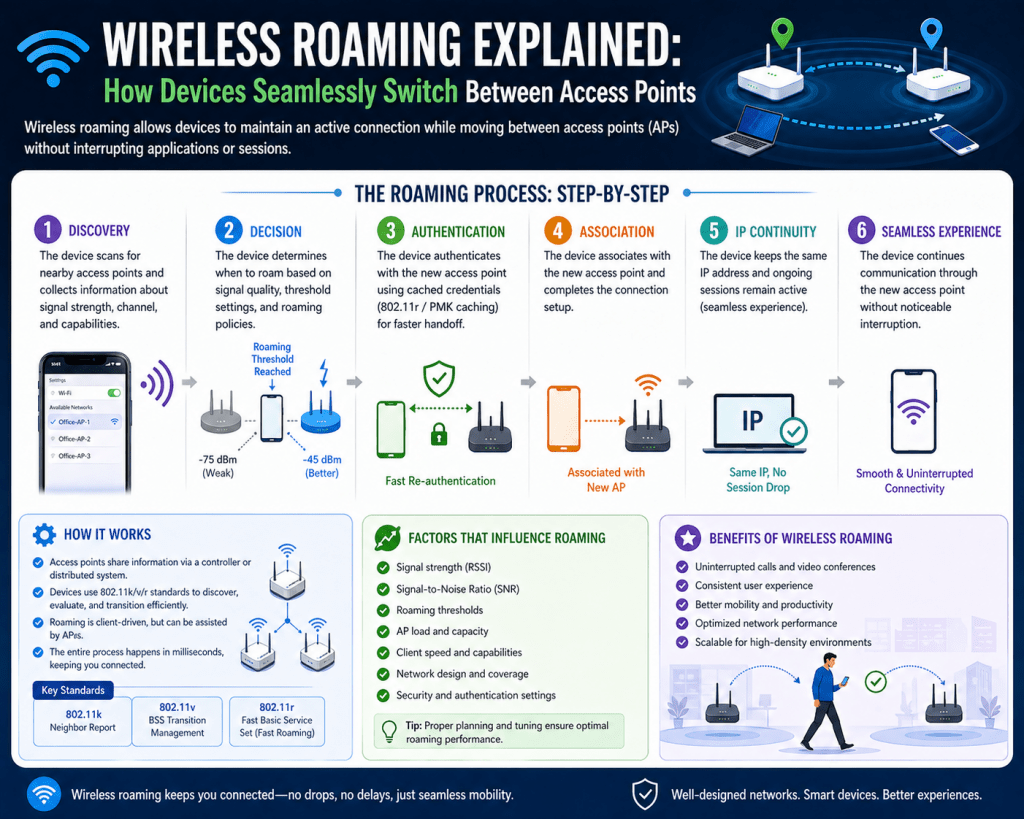
Wireless roaming is a foundational concept in modern networking that ensures uninterrupted connectivity as devices move across different coverage areas. In practical environments such as offices, campuses, hospitals, and even large homes, multiple access points are deployed to extend wireless coverage. Without roaming, a device would lose connectivity every time it moved out of range of a single access point, making mobility nearly impossible. Roaming solves this limitation by allowing a device to transition smoothly between access points within the same network infrastructure.
At its core, roaming is not about switching between completely different networks. Instead, it operates within a unified wireless environment where multiple access points share the same network identity. These access points collectively form what is known as an Extended Service Set, allowing devices to maintain continuous sessions such as video calls, file transfers, or browsing activities without manual reconnection.
Understanding how roaming works requires a shift in perspective. Many assume that access points or controllers dictate when a device moves, but in reality, the client device plays the dominant role. This client-centric behavior is one of the most important principles in wireless networking and explains why roaming performance can vary significantly between devices, even on the same network.
Core Concept of Client-Controlled Roaming Behavior
In wireless networking, the client device holds the decision-making authority regarding when and where to roam. This means that smartphones, laptops, and tablets independently evaluate their connection quality and determine whether to remain connected to the current access point or switch to another. This behavior is driven by internal algorithms embedded within the device’s wireless driver and firmware.
Because each manufacturer designs these algorithms differently, roaming behavior is not standardized across all devices. Some devices prefer stability and delay roaming decisions, resulting in what is commonly referred to as sticky client behavior. These devices remain connected to a weaker access point even when a stronger one is available nearby. On the other hand, some devices aggressively switch between access points, leading to hopping behavior, where frequent transitions can disrupt performance.
This variability introduces complexity for network engineers. Even with a well-designed wireless infrastructure, inconsistent client behavior can lead to unpredictable user experiences. As a result, understanding roaming requires not only knowledge of network design but also insight into how client devices interpret signal conditions and performance metrics.
Basic Service Set and Extended Service Set Architecture
To fully grasp roaming, it is essential to understand the structure of wireless networks. A Basic Service Set refers to a single access point and all the devices connected to it. It represents the smallest unit of a wireless network. When multiple access points are interconnected and configured with the same network name, they form an Extended Service Set.
The Extended Service Set is what enables roaming. It provides a continuous coverage area where devices can move freely without needing to disconnect and reconnect manually. Each access point within this structure broadcasts the same network identifier, allowing devices to perceive the entire network as a single entity.
Despite this unified appearance, each access point operates independently in terms of radio coverage and signal strength. As a device moves physically through space, the signal from one access point weakens while another becomes stronger. This dynamic environment is what triggers the roaming process.
The Scanning Process in Wireless Roaming
The first step in roaming is scanning. During this phase, the client device searches for available access points within range. This scanning can occur in two primary ways: passive scanning and active scanning.
Passive scanning involves the device listening for periodic beacon frames transmitted by access points. These beacons contain essential information such as network name, capabilities, and signal strength. Passive scanning is less intrusive and consumes less power, making it the preferred method in many scenarios.
Active scanning, on the other hand, involves the device sending probe requests to actively discover nearby access points. This method is faster but can generate additional network traffic. Devices may switch between passive and active scanning depending on their configuration and current conditions.
The scanning process is continuous, even when the device is already connected to an access point. This allows the device to maintain awareness of alternative access points that may provide better performance. The information gathered during scanning is used to build a list of candidate access points for potential roaming.
Decision-Making Criteria for Roaming
Once the device has identified nearby access points, it evaluates them based on several criteria. Signal strength is one of the most significant factors. Devices measure signal strength using metrics such as received signal strength indicator. When the signal from the current access point drops below a certain threshold, the device begins considering a transition.
However, signal strength alone is not sufficient. Devices also consider factors such as signal quality, error rates, retransmissions, and overall network performance. For example, a strong signal with high interference may be less desirable than a slightly weaker signal with better reliability.
Another important factor is the difference in signal strength between the current access point and potential candidates. Many devices require a significant improvement before initiating a roam. This prevents unnecessary transitions and helps maintain stability.
Advanced devices may also consider additional parameters such as network load, supported data rates, and historical performance. These factors contribute to a more intelligent roaming decision, although they also increase complexity.
The Transition Process Between Access Points
When a device decides to roam, it initiates a transition process that involves disconnecting from the current access point and connecting to a new one. This process must be executed quickly to minimize disruption.
The transition typically begins with a disassociation or deauthentication from the current access point. This step signals the end of the existing connection. Immediately afterward, the device sends a reassociation request to the new access point. This request includes information about the previous connection, allowing the network to maintain continuity.
The reassociation process is similar to the initial connection process but is optimized for speed. In well-configured networks, this transition can occur within milliseconds, making it nearly invisible to the user. However, delays or failures during this process can result in noticeable interruptions.
Impact of Sticky Clients on Network Performance
Sticky client behavior is one of the most common challenges in wireless roaming. Devices exhibiting this behavior remain connected to an access point even when the signal becomes weak. This can lead to poor performance, including slow data rates, increased latency, and higher error rates.
Sticky clients consume more network resources because they require additional retransmissions and operate at lower data rates. This not only affects the individual device but also impacts other devices sharing the same access point.
Network engineers often attempt to mitigate sticky client behavior through careful design and configuration. Techniques such as adjusting transmit power, optimizing access point placement, and enabling advanced features can encourage devices to roam more effectively. However, since the client ultimately controls the decision, these measures have limitations.
Hopping Clients and Their Effects
While sticky clients delay roaming, hopping clients represent the opposite extreme. These devices frequently switch between access points, even when the current connection is adequate. This behavior can cause instability and disrupt ongoing sessions.
Frequent roaming introduces overhead because each transition involves signaling and authentication processes. In applications that require consistent connectivity, such as voice or video communication, excessive roaming can degrade the user experience.
Balancing roaming behavior is therefore critical. Devices should roam when necessary but avoid unnecessary transitions. Achieving this balance requires a combination of client optimization and network design.
Role of Signal Strength and Thresholds
Signal strength plays a central role in roaming decisions. Devices continuously monitor the strength of their current connection and compare it with nearby access points. When the signal drops below a predefined threshold, the device begins evaluating alternatives.
These thresholds are not fixed and can vary between devices and manufacturers. Some devices use conservative thresholds to prioritize stability, while others use aggressive thresholds to maintain optimal performance.
In addition to absolute signal strength, devices often consider relative differences. For example, a device may only roam if another access point offers a significantly stronger signal. This prevents frequent switching in environments where signal levels fluctuate.
Environmental factors such as walls, obstacles, and interference also influence signal strength. These factors can create complex scenarios where the optimal roaming decision is not immediately obvious.
Understanding Retransmissions and Error Rates
Wireless communication is inherently probabilistic, meaning that not every transmitted frame is successfully received. When a frame is not acknowledged, it must be retransmitted. High retransmission rates indicate poor link quality and can trigger roaming decisions.
Devices monitor retransmission counters to assess the reliability of their connection. When these counters exceed certain thresholds, the device may attempt to find a better access point. This mechanism ensures that roaming decisions are based not only on signal strength but also on actual performance.
Error rates can be influenced by various factors, including interference, congestion, and physical obstructions. By considering these factors, devices can make more informed roaming decisions and maintain better overall performance.
Network Influence on Roaming Behavior
Although the client device controls roaming decisions, the network can influence this behavior to some extent. Access points and controllers can use various techniques to encourage or discourage roaming.
One common approach is to disconnect underperforming clients. By sending deauthentication frames or reducing responsiveness, the network can prompt the device to seek a better connection. While this does not directly control the roaming decision, it creates conditions that make roaming more likely.
Another approach involves providing information about neighboring access points. This allows devices to make more informed decisions and reduces the time required for scanning and transition.
These techniques highlight the collaborative nature of roaming. While the client is in control, the network plays a supporting role in optimizing the process.
Importance of Seamless Connectivity in Modern Networks
Seamless connectivity is a critical requirement in modern wireless environments. Users expect uninterrupted access to applications and services, regardless of their physical location. Roaming enables this mobility by ensuring that devices can move freely without losing connectivity.
In enterprise environments, seamless roaming is essential for productivity. Employees rely on wireless connectivity for communication, collaboration, and access to resources. Any disruption can impact efficiency and user satisfaction.
In addition to enterprise use cases, roaming is also important in public spaces such as airports, shopping centers, and educational institutions. These environments require robust wireless networks that can support large numbers of users moving simultaneously.
Challenges and Considerations in Wireless Roaming
Despite its benefits, roaming introduces several challenges. The variability in client behavior, environmental factors, and network design can all impact performance. Achieving optimal roaming requires careful planning and continuous monitoring.
Network designers must consider factors such as access point placement, channel selection, and transmit power. These elements influence coverage and signal quality, which in turn affect roaming decisions.
Client diversity adds another layer of complexity. Different devices may respond differently to the same conditions, making it difficult to achieve consistent performance across all users.
Understanding these challenges is essential for anyone working with wireless networks. By gaining a deeper insight into how roaming works, it becomes possible to design and manage networks that deliver reliable and seamless connectivity.
Advanced Mechanics of Wireless Roaming in Modern Wi-Fi Systems
Wireless roaming becomes significantly more complex when moving beyond basic connectivity concepts and into real-world enterprise-scale behavior. In large wireless deployments, roaming is not just a simple transition between access points; it is a continuous optimization process influenced by RF conditions, client intelligence, network configuration, and environmental dynamics. The underlying goal remains consistent: maintain uninterrupted connectivity while minimizing latency, packet loss, and session disruption.
In advanced wireless environments, roaming is shaped by how effectively a network distributes coverage and how intelligently client devices interpret that coverage. Even when access points are properly configured, roaming behavior can vary widely due to differences in hardware, firmware, and driver-level decision-making. This makes roaming both a design challenge and a performance tuning discipline.
Role of RF Design in Roaming Efficiency
Radio frequency design is one of the most critical factors influencing roaming behavior. A well-designed RF environment ensures that coverage areas from adjacent access points overlap in a controlled and predictable way. This overlap is necessary to allow clients to detect and transition between access points without losing signal continuity.
However, excessive overlap can create interference, while insufficient overlap can cause coverage gaps. Both conditions negatively affect roaming performance. If overlap is too strong, clients may struggle to decide when to roam because multiple access points appear equally viable. If overlap is too weak, clients may experience abrupt disconnections before they can transition.
RF planning typically involves adjusting transmit power levels, selecting appropriate channels, and positioning access points strategically within a physical space. These decisions directly influence signal propagation and therefore determine how smoothly clients can roam across the network.
Client Intelligence and Roaming Algorithms
Each wireless client contains internal logic that governs how it evaluates and responds to network conditions. This logic is embedded within the device’s wireless driver and operating system. It determines when a device should scan for new access points, how it ranks available candidates, and what thresholds must be met before initiating a roam.
Some clients use conservative algorithms that prioritize connection stability over performance. These devices tend to remain connected to their current access point until the signal degrades significantly. Others use aggressive algorithms that prioritize performance and switch access points more frequently in search of optimal conditions.
This variation in client intelligence explains why two devices in the same location may behave differently. One device may maintain a stable connection, while another may continuously roam between access points. This inconsistency is a major challenge in wireless optimization.
Impact of Signal-to-Noise Ratio in Roaming Decisions
While signal strength is commonly referenced in roaming discussions, signal-to-noise ratio is often a more accurate indicator of link quality. Signal strength measures the power of the received signal, while signal-to-noise ratio measures how clearly that signal can be distinguished from background interference.
A strong signal with high noise may perform worse than a weaker signal with low noise. As a result, modern roaming algorithms increasingly rely on signal quality metrics rather than raw signal strength alone.
Devices that incorporate signal-to-noise ratio into their roaming decisions are better able to maintain stable connections in noisy environments. This is particularly important in areas with high device density, such as offices, stadiums, and public venues, where interference is common.
802.11k and Neighbor Awareness Optimization
One of the key advancements in wireless roaming is the introduction of neighbor awareness mechanisms. These mechanisms allow access points to share information about nearby access points with connected clients. This reduces the need for continuous scanning and speeds up the roaming process.
Instead of actively searching for available access points, a client can rely on a pre-constructed neighbor list provided by the network. This list includes details such as channel information and signal characteristics of nearby access points.
By using this information, clients can make faster and more efficient roaming decisions. This reduces latency during transitions and improves overall user experience, especially for real-time applications.
Neighbor awareness also reduces unnecessary radio usage, which helps conserve device battery life and reduces network congestion caused by scanning traffic.
802.11r and Fast Transition Mechanisms
Fast transition protocols were introduced to address latency issues during roaming. Traditional roaming involves a full authentication process each time a device switches access points. This process can introduce noticeable delays, particularly for latency-sensitive applications.
Fast transition mechanisms streamline this process by allowing authentication information to be reused or pre-negotiated. As a result, devices can move between access points with minimal interruption.
This is especially important for voice over IP, video conferencing, and real-time collaboration tools. Even small delays during roaming can result in dropped audio, frozen video, or session interruptions.
Fast transition technologies significantly reduce these disruptions by ensuring that authentication and security negotiations do not become bottlenecks during roaming events.
802.11v and Network-Assisted Roaming Guidance
In addition to client-driven roaming decisions, modern networks can provide guidance to clients regarding optimal access points. This is achieved through network-assisted roaming mechanisms that allow infrastructure to influence client behavior without forcing disconnections.
In this model, the network can suggest a preferred access point based on factors such as load balancing, signal quality, and overall network efficiency. The client retains final control but is more likely to follow the recommendation if conditions align.
This approach improves overall network performance by distributing clients more evenly across available access points. It also reduces congestion on individual access points, leading to better user experiences.
Network-assisted roaming represents a shift toward collaborative decision-making between clients and infrastructure, rather than purely client-driven behavior.
Load Balancing and Its Effect on Roaming Patterns
Load balancing is another important factor that indirectly influences roaming behavior. When an access point becomes heavily loaded with clients, its performance may degrade due to limited available resources. In such cases, networks may encourage clients to roam to less congested access points.
This is achieved through a combination of reduced response priority, adjusted transmission power, or explicit steering mechanisms. As a result, clients may detect weaker signals from overloaded access points and stronger signals from underutilized ones, prompting a natural redistribution of devices.
Effective load balancing ensures that no single access point becomes a performance bottleneck. It also improves overall network stability and reduces the likelihood of congestion-related roaming issues.
Sticky Roaming Behavior and Threshold Tuning
Sticky roaming occurs when a client remains connected to an access point longer than optimal. This behavior is often caused by conservative roaming thresholds or poorly tuned client algorithms. While it may improve stability in some cases, it often results in degraded performance when the client is far from the optimal access point.
Threshold tuning is a method used to adjust roaming sensitivity. By modifying parameters such as minimum signal strength, difference thresholds between access points, and scan frequency, devices can be encouraged to roam more effectively.
However, overly aggressive tuning can lead to the opposite problem, where clients roam too frequently. This highlights the importance of balance in roaming configuration.
Environmental Interference and Its Influence on Roaming
Wireless signals are highly sensitive to environmental conditions. Physical obstacles such as walls, furniture, and human bodies can significantly affect signal propagation. In addition, electronic interference from other devices can introduce noise that degrades connection quality.
These environmental factors create dynamic conditions where signal quality can change rapidly even without client movement. As a result, roaming decisions must account for fluctuating conditions rather than static measurements.
In some cases, a client may interpret temporary interference as a sustained degradation in quality and initiate a roam unnecessarily. This can lead to instability if the new access point is also affected by similar conditions.
Understanding environmental impact is essential for designing robust wireless networks that minimize unnecessary roaming events.
Role of Application Sensitivity in Roaming Performance
Not all applications respond to roaming in the same way. Real-time applications such as voice calls and video conferencing are highly sensitive to latency and packet loss. Even brief interruptions during roaming can cause noticeable quality degradation.
In contrast, non-real-time applications such as file downloads or web browsing are more tolerant of brief interruptions. These applications can often recover seamlessly from short connectivity gaps.
Some modern operating systems and applications attempt to compensate for roaming by buffering data or maintaining session continuity at higher protocol layers. However, the effectiveness of these techniques varies depending on network conditions and application design.
Hidden Complexity of Reassociation Timing
The timing of reassociation is a critical factor in roaming performance. When a client disconnects from one access point and connects to another, even small delays can affect session continuity.
During this transition, the client must complete several steps including authentication, key exchange, and network validation. Each of these steps introduces potential delay points.
Optimized networks reduce these delays through pre-authentication mechanisms and fast transition protocols. However, in less optimized environments, these delays can accumulate and become noticeable to users.
The challenge lies in minimizing these timing gaps without compromising security or stability.
Multi-Band Roaming Across Frequency Layers
Modern wireless networks often operate across multiple frequency bands, such as 2.4 GHz and 5 GHz. Some advanced environments also include additional bands depending on available technology.
Roaming between access points is not limited to movement within a single frequency band. Clients may also switch between bands depending on performance conditions. This adds another layer of complexity to roaming behavior.
Higher frequency bands typically offer better performance but shorter range, while lower frequency bands provide broader coverage but lower throughput. Clients must balance these trade-offs when deciding which band to connect to during roaming events.
Band steering techniques are sometimes used to guide clients toward optimal frequency bands, improving overall network efficiency.
Impact of Device Mobility Speed on Roaming Behavior
The speed at which a device moves through a wireless environment significantly affects roaming performance. Slow-moving devices have more time to evaluate available access points and make informed decisions. Fast-moving devices, such as those in vehicles or on transport systems, require rapid roaming decisions to maintain connectivity.
In high-mobility scenarios, roaming algorithms must prioritize speed over precision. This often results in simplified decision-making processes that focus primarily on signal thresholds and availability.
If roaming cannot occur quickly enough, devices may experience brief disconnections before reconnecting to a new access point. This is particularly challenging in environments with limited overlap between coverage areas.
Coordination Between Access Points in Dense Networks
In dense wireless deployments, coordination between access points becomes essential. Without coordination, overlapping signals can create confusion for clients and lead to inefficient roaming behavior.
Access points may share load information, channel utilization data, and client statistics to improve overall network performance. This coordination allows the network to present a more consistent experience to connected devices.
By working together, access points can reduce interference, improve coverage balance, and support more predictable roaming behavior across the entire environment.
Enterprise-Scale Wireless Roaming and Large-Environment Behavior
At enterprise scale, wireless roaming stops being a simple client-to-access-point transition and becomes a distributed coordination problem across hundreds or even thousands of endpoints. In such environments, roaming behavior is influenced not only by signal strength and client logic but also by network architecture, controller intelligence, RF density planning, and real-time load distribution strategies. The objective is no longer just maintaining connectivity, but ensuring predictable performance under high user density and dynamic mobility conditions.
In large deployments such as universities, hospitals, industrial campuses, and transportation hubs, roaming must function under constant contention. Multiple devices compete for airtime, access points overlap heavily, and environmental conditions shift rapidly. These factors create a highly dynamic RF ecosystem where even small inefficiencies in roaming logic can scale into noticeable performance degradation.
Controller-Based Architecture and Centralized Roaming Control
Modern enterprise wireless systems often rely on centralized controllers or cloud-managed coordination layers. These systems do not directly force roaming in most cases but significantly influence it by shaping the radio environment and guiding client behavior.
Controllers maintain a global view of the wireless infrastructure, including access point utilization, channel distribution, and client load. This visibility allows them to implement policies that indirectly optimize roaming outcomes. For example, if one access point becomes overloaded, the controller can adjust transmit power levels or suggest alternative access points to nearby clients.
This centralized awareness allows for more intelligent roaming ecosystems compared to standalone access point deployments. Instead of each access point operating in isolation, the network behaves as a coordinated system that actively manages coverage overlap and client distribution.
Client Steering and Indirect Roaming Influence
Client steering is a technique used to influence which access point a device connects to without explicitly forcing a disconnection. Instead of directly controlling the client, the network adjusts environmental factors that guide the client toward a preferred access point.
This may include reducing the response strength of overloaded access points or promoting stronger beacon visibility from underutilized ones. As a result, clients naturally interpret certain access points as better candidates for connection or roaming.
This indirect control is important because wireless standards prioritize client autonomy. The infrastructure cannot fully override client decisions, but it can shape the conditions under which those decisions are made. This creates a balance between control and flexibility in roaming behavior.
Roaming Latency and Session Continuity Challenges
One of the most critical performance factors in wireless roaming is latency during transition. Even when roaming occurs successfully, delays in authentication, reassociation, or IP session continuity can disrupt user experience.
Latency-sensitive applications such as voice communication, video conferencing, and remote desktop sessions are particularly vulnerable. Even a few hundred milliseconds of interruption can result in noticeable degradation, including audio gaps, video freezing, or session resets.
Session continuity mechanisms attempt to mitigate these issues by preserving network state across access points. This allows devices to maintain logical connections even while physically switching wireless associations. However, implementation varies widely depending on infrastructure design and client capabilities.
Impact of Authentication Methods on Roaming Speed
Authentication plays a significant role in roaming performance. Each time a device connects to a new access point, it must validate its identity and establish secure encryption parameters. The complexity of this process directly impacts roaming speed.
In traditional authentication models, full reauthentication is required at each transition, which introduces delay. In optimized environments, pre-authentication or cached credentials are used to reduce overhead.
Security protocols must balance speed and protection. Faster authentication improves roaming performance but must still ensure that unauthorized devices cannot exploit the network. This trade-off is a core consideration in wireless design.
Role of Dynamic Frequency Selection in Roaming Stability
Dynamic frequency selection mechanisms help improve roaming stability in environments where interference is present. By automatically selecting cleaner channels, access points reduce the likelihood of congestion and improve signal clarity.
When roaming occurs in such environments, clients benefit from more consistent signal quality across access points. This reduces abrupt performance changes during transitions and leads to smoother roaming experiences.
However, dynamic frequency changes can also introduce unpredictability if not carefully managed. Sudden channel shifts may temporarily disrupt client connectivity, especially for devices that are slow to adapt to new RF conditions.
High-Density Environment Challenges and Roaming Congestion
In high-density environments, roaming behavior becomes significantly more complex due to competition for airtime and overlapping coverage zones. Thousands of devices may be actively scanning, transmitting, and roaming simultaneously.
This creates congestion not only at the data level but also at the management frame level. Beacon frames, probe requests, and reassociation attempts all contribute to channel utilization.
As congestion increases, roaming decisions become less reliable. Clients may struggle to identify optimal access points due to noise and interference. This can lead to delayed roaming or incorrect roaming decisions, where devices connect to suboptimal access points.
Airtime Utilization and Its Effect on Roaming Decisions
Airtime utilization is a key metric in wireless performance that reflects how much time a channel is occupied by transmissions. High airtime utilization indicates congestion and reduced availability for additional traffic.
Clients may indirectly consider airtime conditions when evaluating roaming candidates. Access points with lower utilization provide more available capacity and better performance potential.
However, clients do not always have direct visibility into airtime metrics. Instead, they infer network conditions based on observed performance indicators such as throughput, delay, and retransmissions.
Hidden Node Problems and Roaming Instability
The hidden node problem occurs when two devices are within range of an access point but not within range of each other. This leads to transmission collisions that degrade network performance.
In roaming contexts, hidden node conditions can create misleading signal evaluations. A client may perceive strong signal strength from an access point but experience poor performance due to collision-heavy environments.
This can trigger unnecessary roaming events or cause clients to remain connected to suboptimal access points. Addressing hidden node issues requires careful RF planning and channel separation strategies.
Impact of Beacon Intervals on Roaming Responsiveness
Beacon frames are periodic transmissions sent by access points to announce their presence and network characteristics. The interval at which these beacons are sent directly affects how quickly clients can detect changes in the network environment.
Shorter beacon intervals allow clients to discover access points more quickly, improving roaming responsiveness. However, they also increase overhead on the network. Longer intervals reduce overhead but can delay roaming detection.
Balancing beacon intervals is therefore an important design consideration, particularly in environments where mobility is frequent.
Power Save Modes and Their Influence on Roaming
Many wireless devices operate in power-saving modes to extend battery life. These modes affect how frequently devices scan for new access points and how quickly they respond to changes in signal quality.
In power-saving states, scanning intervals may be reduced, which can delay roaming decisions. While this improves battery efficiency, it can negatively impact connectivity in highly mobile environments.
Modern devices attempt to balance power efficiency with performance by dynamically adjusting scanning behavior based on activity levels and application requirements.
Transition from Legacy Roaming to Modern Intelligent Roaming Systems
Older wireless systems relied on simpler roaming mechanisms that primarily used signal strength thresholds. These systems often resulted in unstable behavior in complex environments.
Modern roaming systems incorporate multiple inputs, including signal quality, error rates, load conditions, and predictive modeling. This allows for more intelligent decision-making and smoother transitions.
Machine-assisted roaming is increasingly being explored, where devices use historical data and predictive analytics to anticipate movement and preemptively select optimal access points.
Role of Predictive Roaming in Mobility Optimization
Predictive roaming involves anticipating client movement based on observed behavior patterns. Instead of reacting to degraded signal conditions, the system attempts to predict when a device will move out of range and proactively prepare a transition.
This can include pre-authenticating with nearby access points or pre-loading configuration parameters. The goal is to reduce transition latency and improve session continuity.
Predictive approaches are particularly useful in environments with predictable movement patterns, such as warehouses, transportation systems, or structured office layouts.
Interference Mitigation and Roaming Stability Improvements
Interference remains one of the most significant challenges in wireless roaming. Sources of interference include neighboring wireless networks, non-Wi-Fi devices, and environmental noise.
Mitigation techniques include channel planning, frequency separation, and adaptive power control. These strategies help reduce noise levels and improve the reliability of roaming decisions.
When interference is minimized, clients are better able to distinguish between access points and make more accurate roaming decisions based on real performance conditions rather than distorted signal readings.
Mesh Network Influence on Roaming Behavior
In mesh network architectures, access points communicate with each other to extend coverage without requiring wired backhaul connections for every node. This introduces additional complexity into roaming behavior.
Clients may roam not only between access points but also across mesh nodes that dynamically route traffic through different paths. This creates a multi-layered roaming environment where both RF conditions and backhaul performance influence connectivity.
Mesh networks attempt to maintain consistent performance across all nodes, but backhaul congestion or routing inefficiencies can still impact roaming quality.
Evolution of Roaming in Future Wireless Standards
Future wireless standards continue to evolve toward more intelligent and autonomous roaming systems. These systems aim to reduce reliance on client-side decision-making by increasing infrastructure awareness and predictive coordination.
Emerging technologies focus on real-time analytics, AI-driven optimization, and cross-layer communication between devices and infrastructure. These advancements aim to eliminate traditional roaming inefficiencies such as latency spikes, sticky behavior, and unnecessary transitions.
As wireless networks become more complex and densely populated, roaming will increasingly depend on collaborative intelligence between clients and infrastructure rather than isolated decision-making.
Conclusion
Wireless roaming is one of the most essential yet least visible processes in modern Wi-Fi networking. Although users experience it simply as uninterrupted connectivity while moving, the underlying mechanisms involve a complex interaction between client intelligence, access point behavior, RF design, and network-level coordination. Across this discussion, the consistent theme has been that roaming is not a single event but a continuous evaluation process driven primarily by the client device, shaped by the surrounding wireless environment, and influenced indirectly by infrastructure design.
At a fundamental level, roaming exists to solve a mobility problem. A single access point cannot realistically cover large or obstructed environments without signal degradation. By deploying multiple access points under a unified network structure, wireless systems extend coverage while allowing devices to transition seamlessly between coverage zones. However, this seamless experience is not automatic. It depends on how well both the network and the client manage decision-making under constantly changing radio conditions.
One of the most important takeaways is the dominant role of the client in roaming decisions. Devices continuously scan for alternative access points, evaluate signal quality, and determine whether a transition is necessary. This evaluation is not standardized across all devices, which introduces variability in real-world behavior. Some clients prioritize stability and remain connected longer than optimal, while others switch too aggressively, leading to instability. This inconsistency is one of the core challenges in wireless optimization because it places a significant portion of control outside the network engineer’s direct influence.
Signal strength alone does not define roaming behavior, even though it is often the most visible metric. Modern devices also consider retransmission rates, error conditions, interference levels, and signal-to-noise ratio. These additional parameters provide a more accurate picture of link quality, especially in environments where raw signal strength can be misleading. For example, a strong signal in a noisy or congested channel may perform worse than a weaker signal in a cleaner RF environment. This complexity ensures that roaming decisions are not purely based on distance, but on actual usability of the connection.
Another critical aspect of roaming is timing. The transition between access points must happen quickly enough to avoid disrupting active sessions. This includes authentication, reassociation, and potential encryption renegotiation. Even small delays can affect real-time applications such as voice and video communication. This is why modern wireless systems introduce optimizations like fast transition mechanisms and pre-authentication techniques. These improvements reduce latency during roaming and help maintain session continuity across movement.
Network infrastructure plays a supporting but influential role in roaming behavior. While it does not directly control client decisions in most cases, it can shape the conditions under which those decisions are made. Techniques such as load balancing, transmit power adjustment, and neighbor reporting help guide clients toward more optimal access points. This creates a collaborative environment where both client and infrastructure contribute to overall performance outcomes.
Environmental factors also have a significant impact on roaming performance. Physical obstructions, building materials, human movement, and external interference all affect signal propagation. These factors can cause rapid fluctuations in perceived signal quality, sometimes triggering unnecessary roaming events or delaying necessary ones. As a result, wireless environments are inherently dynamic, and roaming systems must constantly adapt to changing conditions rather than relying on static thresholds.
In enterprise and high-density deployments, roaming becomes even more complex due to scale. Thousands of devices may be scanning, transmitting, and roaming simultaneously, creating contention not only for data traffic but also for management frames used in the roaming process. This congestion can influence decision accuracy and transition speed, especially when multiple access points overlap heavily. Proper RF design, channel planning, and access point coordination are essential to maintaining stability in such environments.
Advanced wireless technologies have significantly improved roaming behavior by introducing structured enhancements to traditional processes. Neighbor awareness systems reduce scanning overhead by providing clients with pre-identified access point information. Fast transition mechanisms reduce authentication delays, enabling quicker handoffs between access points. Network-assisted guidance systems further improve efficiency by influencing client selection decisions without enforcing direct control. These technologies collectively reduce latency, improve stability, and enhance user experience.
Despite these advancements, roaming remains inherently client-dependent. This means that even in highly optimized networks, user experience can vary depending on device type, operating system behavior, and driver implementation. This diversity is both a strength and a challenge of wireless ecosystems. It allows flexibility across devices but also introduces unpredictability that must be managed through design rather than control.
Another important dimension of roaming is application sensitivity. Not all network traffic responds equally to transitions between access points. Real-time applications are highly sensitive to even brief interruptions, while non-real-time applications are more tolerant of temporary disruptions. This difference influences how critical roaming optimization becomes in environments that rely heavily on continuous communication services.
Looking at the broader evolution of wireless systems, roaming has progressed from simple signal-based switching to a multi-factor decision-making process involving predictive analytics, network collaboration, and real-time performance evaluation. Future developments are likely to further enhance this intelligence by integrating machine learning techniques that anticipate movement patterns and optimize transitions before signal degradation occurs.
In summary, wireless roaming represents a dynamic equilibrium between mobility, performance, and coordination. It is not a single mechanism but a layered process involving continuous evaluation and adaptation. Understanding roaming requires looking beyond basic signal metrics and recognizing the interplay between client behavior, network design, environmental conditions, and protocol-level optimizations. As wireless networks continue to evolve in scale and complexity, the importance of efficient roaming will only increase, making it a foundational concept in modern connectivity design.