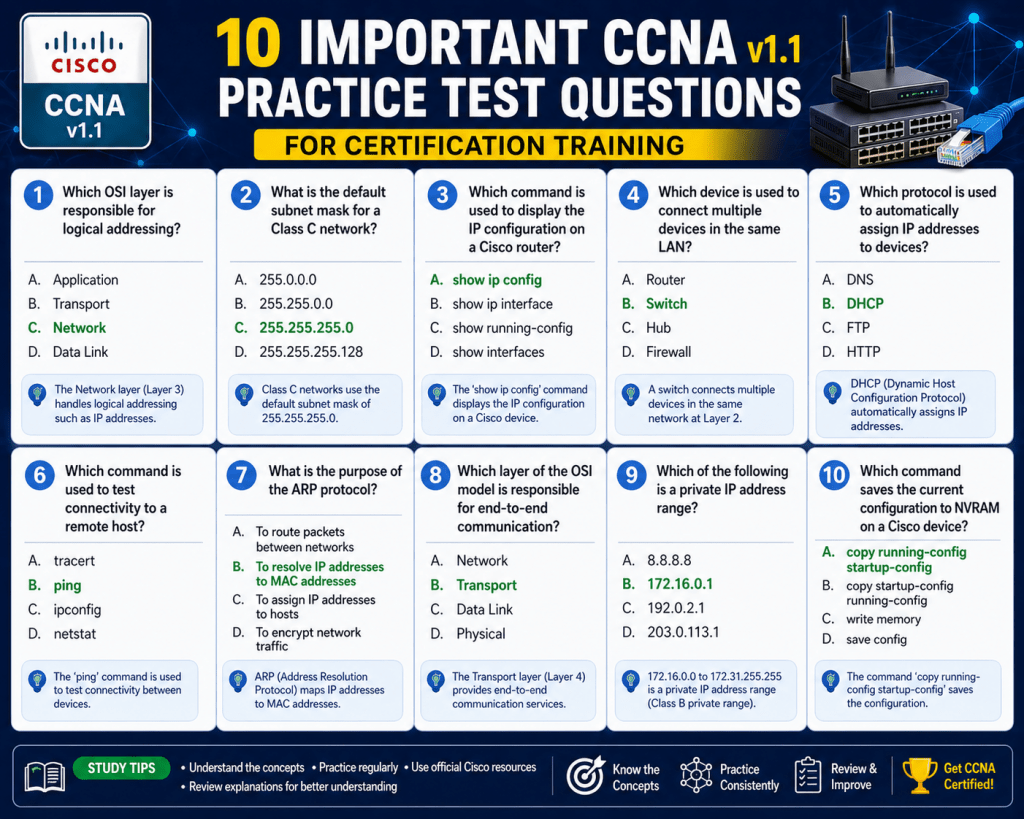
The CCNA v1.1 certification is designed to evaluate both conceptual understanding and practical networking ability across enterprise-style environments. It is not limited to memorization but instead focuses on how well a candidate can interpret network behavior, configure essential services, and troubleshoot connectivity issues under realistic conditions. The exam typically includes a broad mix of scenario-based items that reflect real network operations, requiring familiarity with routing behavior, switching logic, addressing systems, and basic security enforcement. A strong foundation in these areas is essential before progressing into more advanced troubleshooting or configuration topics. The exam also emphasizes time management and decision-making, as candidates must interpret network requirements quickly and accurately within a limited time window. Understanding how different networking layers interact forms the basis for all other topics, making it the first critical area of focus.
Understanding the OSI Model in Practical Networking Contexts
The OSI model serves as a conceptual framework for understanding how data moves through a network, but in CCNA-level scenarios, it is primarily used for troubleshooting and protocol identification. The Transport layer is particularly significant because it governs end-to-end communication reliability between devices. This layer is responsible for segmentation, flow control, and error recovery, ensuring that transmitted data reaches its destination accurately. Protocols operating here differentiate between reliable and unreliable communication, which directly impacts application behavior in real-world environments. In troubleshooting scenarios, identifying whether a problem exists at the Transport layer helps isolate issues such as failed sessions, incomplete data transfers, or connection resets. Understanding how each OSI layer interacts allows network engineers to systematically eliminate potential failure points instead of guessing the cause of a connectivity issue.
Network Access and Switching Fundamentals in VLAN-Based Environments
Modern enterprise networks rely heavily on segmentation techniques such as VLANs to logically divide broadcast domains without changing physical infrastructure. VLAN configuration on switches plays a critical role in controlling traffic flow between departments or functional groups. When a switch port is assigned to a VLAN, it determines which broadcast domain the connected device belongs to, effectively isolating or grouping traffic based on configuration. Access ports are typically used for end devices, while trunk ports carry multiple VLANs between network devices. Proper VLAN assignment ensures efficient traffic management and reduces unnecessary broadcast propagation across the network. Misconfiguration at this level often leads to communication failures between devices that are physically connected but logically separated. Understanding VLAN behavior is essential for interpreting connectivity issues and ensuring proper segmentation in enterprise environments.
IP Addressing and Static Routing Principles
IP connectivity forms the backbone of all network communication, and understanding how routing decisions are made is essential for CCNA-level proficiency. Static routing is one of the foundational methods used to direct traffic between networks without relying on dynamic routing protocols. In static routing, administrators manually define destination networks, subnet masks, and next-hop addresses. This approach is often used in smaller or controlled environments where network paths remain stable. The router uses these entries to determine where packets should be forwarded based on the destination IP address. Incorrect configuration in static routing often results in unreachable networks or incomplete routing tables, which directly affects end-to-end communication. A clear understanding of how routing tables are constructed and used is necessary to diagnose path selection issues effectively.
Subnetting and Host Allocation in IPv4 Networks
Subnetting is a critical skill in networking because it determines how IP address space is divided and utilized within an organization. A subnet defines both network boundaries and host availability, ensuring efficient IP address usage while maintaining logical separation. In a /26 subnet, the address space is divided into smaller segments, allowing a limited number of usable host addresses after accounting for network and broadcast reservations. Understanding how to calculate usable hosts helps in planning scalable network architectures and avoiding address exhaustion. Subnet masks play a key role in defining the size of each network segment, influencing how routing decisions are made across interconnected devices. Efficient subnet design improves performance by reducing broadcast traffic and enhancing network organization.
Dynamic Host Configuration and Network Initialization Flow
The DHCP process automates IP address assignment, reducing manual configuration overhead in large-scale networks. It follows a structured exchange of messages that ensures each device receives a valid and unique IP configuration. The process begins with a discovery phase where a client broadcasts a request for network configuration. The server responds with an offer, proposing an available IP address. The client then formally accepts the offer through a request message, after which the server confirms the assignment. This structured communication ensures efficient allocation and prevents IP conflicts. Understanding this sequence is important for diagnosing connectivity issues, especially when devices fail to obtain proper network configuration or experience intermittent connectivity.
Security Fundamentals and Traffic Filtering Concepts
Network security at the CCNA level focuses on controlling traffic flow and mitigating unauthorized access through filtering mechanisms. Access control policies allow administrators to define rules based on IP addresses, protocols, and traffic direction. Extended filtering mechanisms provide more granular control compared to basic filtering approaches, enabling decisions based on both source and destination information. This level of control is essential in enterprise environments where different applications and services must be isolated for security and performance reasons. Proper implementation of traffic filtering helps reduce exposure to malicious activity and ensures only authorized communication occurs across network boundaries. Security principles at this level are foundational for more advanced defense mechanisms used in modern infrastructures.
Introduction to Network Automation and Programmability Concepts
Network automation has become an essential component of modern infrastructure management, allowing repetitive configuration tasks to be executed efficiently and consistently. Automation tools enable centralized control of multiple devices, reducing human error and improving scalability. Instead of manually configuring each device, administrators can define structured instructions that are applied across the network. This approach is particularly useful in large environments where consistency and speed are critical. Automation also supports configuration auditing and rapid deployment of changes, making it easier to maintain network stability. Understanding basic automation concepts is increasingly important for CCNA candidates as networks continue to evolve toward programmable architectures.
Basic Wireless Networking Standards and Frequency Behavior
Wireless networking operates across different frequency bands, each offering distinct performance characteristics. Higher frequency bands typically provide faster data rates but reduced range, while lower frequencies offer broader coverage with lower throughput. Modern wireless standards operating in higher frequency ranges are designed to support high-bandwidth applications and dense environments. These standards improve network efficiency by reducing interference and increasing transmission capacity. Understanding wireless behavior is important for diagnosing connectivity issues in environments where both range and performance must be balanced. Frequency selection and protocol choice directly impact user experience in wireless deployments, especially in high-density usage scenarios.
Foundations of Network Troubleshooting Methodology
Effective troubleshooting in networking requires a structured approach that eliminates potential causes step by step. When connectivity issues occur, the first step is often to verify local configuration before examining external network paths. If a device can communicate with its default gateway but not external destinations, the issue may lie in routing, DNS resolution, or upstream connectivity. Tools and diagnostic techniques are used to trace packet flow and identify where communication breaks down. This systematic process ensures that problems are isolated efficiently rather than addressed through random testing. Developing strong troubleshooting logic is essential for handling real-world network failures in both small and enterprise environments.
Advanced CCNA v1.1 Networking Concepts and Enterprise Infrastructure Behavior
Modern enterprise networking environments require a deeper understanding of how multiple systems interact beyond basic connectivity. At the CCNA v1.1 level, emphasis shifts toward how routing decisions are influenced by multiple pathways, how switching behavior adapts under load, and how services like addressing, name resolution, and security policies integrate into a unified architecture. Network engineers are expected to interpret not only configuration commands but also the underlying logic that governs packet movement across complex topologies. This includes understanding redundancy, failover behavior, traffic optimization, and hierarchical network design principles that ensure scalability and reliability in production environments. The ability to analyze how different components behave together is a key differentiator at this stage of networking proficiency.
Advanced IP Routing Behavior and Path Selection Logic
Routing in enterprise environments extends beyond static configurations and requires awareness of dynamic decision-making processes within routers. When multiple paths exist toward a destination, routers evaluate metrics to determine the most efficient route. These metrics may include hop count, bandwidth considerations, or administrative preference depending on the routing approach in use. The routing table becomes a living structure that continuously adapts to network changes, ensuring that traffic is directed through the most optimal path available. When a primary route fails, alternative routes are immediately considered, allowing continuity of communication without manual intervention. Understanding how routers prioritize and update routing entries is essential for diagnosing asymmetric routing, suboptimal path selection, and intermittent connectivity issues that often occur in larger network topologies.
Hierarchical Network Design and Scalability Principles
Large-scale networks are structured using hierarchical design models that separate infrastructure into distinct functional layers. These layers typically include access, distribution, and core segments, each serving a specific role in traffic handling and policy enforcement. The access layer connects end devices and enforces basic policies, while the distribution layer aggregates traffic and applies routing decisions. The core layer focuses on high-speed data transfer between major network segments with minimal processing overhead. This structured approach improves scalability by allowing each layer to be optimized independently. It also enhances fault isolation, making it easier to identify and resolve issues without affecting the entire network. Proper hierarchical design reduces complexity and supports predictable performance in growing enterprise environments.
Spanning Tree Protocol and Loop Prevention Mechanisms
Switching environments must address the risk of network loops, which can cause broadcast storms and severely degrade performance. The Spanning Tree Protocol is used to prevent such loops by creating a logical topology that blocks redundant paths while maintaining backup links. It evaluates switch connections and determines which paths should remain active based on predefined rules. When a topology change occurs, the protocol recalculates the network structure to restore stability while preserving redundancy. This ensures that even if a primary link fails, an alternative path becomes active without introducing loops. Understanding how spanning tree operates is essential for diagnosing issues such as blocked ports, slow convergence, or unexpected topology changes in switched networks.
EtherChannel and Link Aggregation Optimization Techniques
EtherChannel technology allows multiple physical links to be combined into a single logical connection, increasing bandwidth and providing redundancy. This aggregation improves performance by distributing traffic across multiple links while maintaining logical simplicity in the network design. From a switching perspective, the bundled links appear as a single interface, reducing complexity in spanning tree calculations and improving overall efficiency. If one link within the bundle fails, traffic continues to flow through the remaining active links without interruption. Proper configuration of link aggregation ensures balanced load distribution and prevents bottlenecks in high-traffic environments. Understanding this mechanism is important for optimizing network throughput and ensuring resilience in enterprise architectures.
Dynamic Address Translation and Network Address Mapping
Network Address Translation plays a crucial role in enabling communication between private networks and external systems. It modifies IP address information within packet headers to allow multiple internal devices to share a limited number of external addresses. This process supports both security and address conservation by masking internal network structures from external visibility. NAT can operate in different modes depending on the environment, including static mappings and dynamic translations. Each mode serves a specific purpose in managing traffic flow between internal and external networks. Misconfiguration of translation rules can result in connectivity issues where internal devices are unable to reach external resources or receive incoming responses. Understanding how address translation modifies packet flow is essential for troubleshooting internet connectivity problems.
DHCP Advanced Behavior and Lease Management Dynamics
Beyond basic IP assignment, DHCP also manages address leases, renewal processes, and conflict resolution mechanisms. When a device receives an IP address, it does not retain it indefinitely; instead, it operates under a timed lease system. As the lease approaches expiration, the device initiates renewal requests to maintain continuity of connectivity. If renewal fails, the device may attempt to acquire a new address, potentially resulting in temporary disruption. DHCP servers also maintain records of assigned addresses to prevent duplication and ensure efficient utilization of address pools. Understanding lease behavior is important for diagnosing intermittent connectivity issues in dynamic environments where devices frequently join and leave the network.
Domain Name Resolution and Application Layer Dependencies
Name resolution is a critical function that translates human-readable domain identifiers into machine-readable IP addresses. This process is essential for enabling user-friendly access to network resources without requiring manual IP entry. When a device attempts to access a resource, it first queries a resolution system to obtain the corresponding address before establishing communication. Failures in this process can result in situations where network connectivity exists but services remain inaccessible. This creates scenarios where lower-layer connectivity is intact, but application-layer resolution fails. Understanding this dependency is essential for distinguishing between routing issues and name resolution failures during troubleshooting.
Advanced ACL Implementation and Traffic Control Strategies
Access control mechanisms provide granular control over how traffic is permitted or denied within a network. Extended filtering rules allow administrators to define conditions based on multiple parameters, including protocol type, source and destination addresses, and service ports. These rules are processed sequentially, meaning order and structure significantly impact behavior. Incorrect placement of rules can lead to unintended traffic blocking or exposure. Proper design of access policies ensures that only authorized communication is allowed while maintaining necessary functionality for critical services. ACL strategies are widely used in enterprise environments to enforce segmentation, security boundaries, and regulatory compliance requirements.
Wireless Networking Performance and Interference Considerations
Wireless communication performance is influenced by environmental factors, frequency selection, and protocol efficiency. Higher frequency bands provide increased throughput but are more susceptible to physical obstructions and signal attenuation. Lower frequency bands offer broader coverage but may experience congestion in dense environments. Interference from overlapping signals, physical barriers, and competing devices can significantly degrade performance. Wireless standards evolve to address these limitations by introducing improved modulation techniques and channel management strategies. Understanding these factors is essential for diagnosing connectivity inconsistencies and optimizing wireless deployment in both residential and enterprise environments.
Network Troubleshooting at Multi-Layer Complexity
Troubleshooting complex network issues requires a layered analytical approach that evaluates both physical and logical components of connectivity. Engineers typically begin by confirming local device configuration before examining network paths and external dependencies. When partial connectivity exists, such as reaching a gateway but not external services, the issue may reside in routing policies, translation mechanisms, or external network availability. Diagnostic tools help trace packet movement across the network, revealing where communication fails. Effective troubleshooting relies on isolating variables systematically rather than attempting multiple simultaneous changes. This structured methodology reduces resolution time and improves accuracy in identifying root causes of network disruptions.
Network Security Enforcement and Threat Mitigation Principles
Security within network environments is enforced through layered mechanisms designed to prevent unauthorized access and mitigate malicious activity. These mechanisms operate at different points in the network, from edge devices to internal segmentation layers. Traffic inspection systems analyze data flows in real time to identify suspicious patterns and block harmful activity before it spreads. Policy enforcement ensures that only authorized communication paths are available between network segments. Security design also includes redundancy and monitoring systems that provide visibility into potential threats. Understanding how these mechanisms interact is essential for maintaining a secure and stable network infrastructure.
CCNA v1.1 Enterprise Networking Operations, Automation, and Troubleshooting Mastery
Enterprise networking environments today are defined by scale, abstraction, and increasing reliance on automated systems that reduce manual configuration overhead while improving consistency and operational reliability. At the CCNA v1.1 level, candidates are expected to understand not only how individual technologies function but also how they interact in real production environments where thousands of devices may depend on shared infrastructure services. This includes routing optimization, advanced switching behavior, service dependencies, network programmability, and structured troubleshooting frameworks. The focus is shifting from isolated command knowledge to system-level thinking, where network behavior is interpreted as a dynamic ecosystem rather than a set of independent components.
IPv6 Addressing Architecture and Modern Network Transition Models
IPv6 introduces a fundamentally different addressing structure compared to IPv4, designed to solve address exhaustion while improving routing efficiency and network scalability. Instead of relying on limited address space, IPv6 provides an extensive hierarchical system that supports a virtually unlimited number of endpoints. Address representation is simplified through hexadecimal formatting, and automatic configuration mechanisms reduce dependency on manual assignment. Stateless address configuration allows devices to generate their own addresses based on network advertisements, minimizing administrative overhead. Transition mechanisms between IPv4 and IPv6 environments ensure interoperability during migration phases, where both protocols may operate simultaneously. Understanding how dual-stack environments function is essential for maintaining connectivity during infrastructure upgrades, especially in large-scale enterprise networks where full migration occurs gradually rather than instantaneously.
Dynamic Routing Protocol Behavior and Network Convergence Principles
Dynamic routing protocols play a critical role in maintaining efficient communication across complex and changing network topologies. These protocols continuously exchange information between routers to build and maintain accurate representations of the network. When changes occur, such as link failures or new route availability, routers recalibrate their routing tables to ensure optimal path selection. Convergence refers to the time it takes for all routers in the network to reach a consistent understanding of the topology after a change. Faster convergence improves network stability and reduces downtime during failures. Routing decisions are influenced by multiple factors including path cost, bandwidth availability, and administrative preferences. Understanding convergence behavior is essential for diagnosing routing instability and optimizing network performance in dynamic environments.
Open Shortest Path First and Link-State Network Intelligence
Link-state routing protocols operate by constructing a complete map of the network topology rather than relying solely on incremental distance information. Each router shares information about its directly connected links, allowing all participating devices to independently calculate the most efficient paths. This results in highly accurate routing decisions and faster adaptation to network changes. The algorithm used prioritizes shortest path calculations based on accumulated cost metrics, ensuring efficient data forwarding. Link-state databases must remain synchronized across all routers to maintain consistency. Any discrepancy can lead to routing inefficiencies or temporary communication failures. Understanding how link-state information is propagated and processed is essential for analyzing complex routing behavior in enterprise networks.
Advanced Switching Behavior and MAC Address Learning Processes
Switching devices operate by learning and maintaining MAC address tables that map physical device addresses to specific ports. When a frame enters a switch, it examines the source address to update its internal mapping database. This allows the switch to intelligently forward traffic only to the intended destination rather than broadcasting it across all ports. Over time, the MAC address table evolves dynamically as devices connect, disconnect, or move within the network. If a destination address is unknown, the switch floods the frame to all ports within the same VLAN until the correct location is identified. This learning behavior improves efficiency and reduces unnecessary traffic propagation. Understanding MAC address learning is essential for diagnosing switching anomalies and optimizing Layer 2 performance.
Network Redundancy Design and High Availability Principles
Enterprise networks are designed with redundancy to ensure continuous availability even in the event of hardware or link failures. Redundant pathways allow traffic to be rerouted automatically when primary connections become unavailable. This design principle is critical for maintaining uptime in environments where downtime can result in operational disruption or financial loss. Redundancy is implemented at multiple layers, including physical links, switching paths, and routing configurations. Load balancing techniques may also be used to distribute traffic across multiple active paths, improving performance while maintaining resilience. Proper redundancy design ensures that no single point of failure can compromise overall network functionality.
Network Automation Evolution and Infrastructure Programmability
Network automation has transformed traditional manual configuration processes into scalable, programmable workflows that reduce human error and increase operational efficiency. Instead of configuring devices individually, administrators define structured templates or scripts that are applied across multiple systems simultaneously. This approach ensures consistency in configuration and accelerates deployment of new services. Automation also enables rapid response to network changes, allowing systems to adapt dynamically to shifting requirements. Programmability introduces the concept of treating network infrastructure as code, where configurations are version-controlled and systematically deployed. Understanding automation principles is increasingly important as networks evolve toward software-driven architectures.
Telemetry and Network Monitoring Intelligence Systems
Modern networks rely heavily on telemetry systems that continuously collect performance data from devices across the infrastructure. This data includes metrics such as latency, packet loss, interface utilization, and error rates. By analyzing this information in real time, administrators can identify performance degradation before it impacts end users. Telemetry systems provide visibility into both historical trends and current network state, enabling proactive management rather than reactive troubleshooting. This continuous feedback loop improves network reliability and helps optimize resource allocation. Understanding how telemetry data is collected and interpreted is essential for maintaining high-performance enterprise environments.
Cloud Networking Integration and Hybrid Infrastructure Models
Cloud integration introduces additional complexity into traditional networking models by extending infrastructure beyond physical boundaries. Hybrid environments combine on-premises systems with cloud-based resources, requiring seamless connectivity and consistent policy enforcement across both domains. Network engineers must understand how routing, security, and access control extend into cloud environments. Virtual networks within cloud platforms operate similarly to traditional networks but are abstracted through software-defined constructs. Connectivity between environments must be secure, efficient, and scalable to support distributed applications. Understanding hybrid networking models is essential for supporting modern enterprise workloads that span multiple infrastructure domains.
Network Addressing Optimization and Subnet Design Strategy
Efficient IP addressing design is critical for maintaining scalable and manageable network structures. Subnetting allows networks to be divided into smaller logical segments, each with defined boundaries and address capacity. Proper subnet design ensures efficient utilization of address space while minimizing routing complexity. Larger networks require hierarchical addressing schemes that align with organizational structure and traffic patterns. Poor subnet planning can lead to inefficiencies such as wasted address space or excessive routing overhead. Strategic design improves both performance and administrative control, making it easier to manage growth and changes within the network environment.
Quality of Service and Traffic Prioritization Mechanisms
Quality of Service mechanisms ensure that critical applications receive priority over less time-sensitive traffic. In enterprise environments, different types of data compete for limited bandwidth resources, making prioritization essential for maintaining performance. Traffic classification allows networks to identify and categorize data based on application type, source, or destination. Once classified, traffic is assigned priority levels that determine how it is handled during congestion. High-priority traffic such as voice or real-time communication is given preferential treatment to minimize latency and jitter. Understanding QoS principles is essential for maintaining service quality in environments with diverse application requirements.
Advanced Troubleshooting Methodologies in Enterprise Networks
Complex network environments require structured troubleshooting approaches that systematically isolate potential causes of failure. This process begins with identifying the scope of the issue, whether it is localized or widespread. Engineers then evaluate each layer of the network stack to determine where communication breaks down. Physical connectivity issues are addressed first, followed by data link, network, and application layers. Diagnostic tools provide visibility into packet flow, enabling precise identification of failure points. Effective troubleshooting relies on logical elimination rather than random testing, ensuring efficient resolution of network issues in high-pressure environments.
Security Architecture Integration and Layered Defense Models
Modern network security relies on layered defense strategies that protect infrastructure at multiple points. Rather than relying on a single protective mechanism, security is distributed across devices, protocols, and policies. This includes perimeter defenses, internal segmentation controls, and real-time monitoring systems. Each layer contributes to overall security by addressing different types of threats and vulnerabilities. Integrated security models ensure that even if one layer is compromised, additional protections remain active. Understanding how these layers interact is essential for designing resilient network environments capable of withstanding evolving threats.
Conclusion
The CCNA v1.1 certification represents more than an entry-level validation of networking knowledge; it functions as a structured benchmark for evaluating whether an individual can think in terms of systems, interactions, and real-world network behavior. Across the domains of routing, switching, addressing, security, automation, and troubleshooting, the exam consistently emphasizes applied reasoning over memorization. Success depends on how well a candidate can interpret network conditions, recognize underlying patterns, and translate theoretical concepts into operational decisions within time-constrained environments. This shift toward applied understanding reflects the direction of modern networking itself, where infrastructure is no longer static but continuously evolving and increasingly abstracted through automation and software-defined systems.
A foundational takeaway from CCNA-level study is that networking is inherently layered, both in design and in problem-solving methodology. Each layer of the network stack introduces its own responsibilities, dependencies, and potential failure points. Physical connectivity issues differ fundamentally from routing misconfigurations, just as application-layer failures differ from transport-layer disruptions. Recognizing these distinctions allows for structured analysis rather than guesswork. This layered perspective becomes especially critical in enterprise environments where multiple technologies operate simultaneously, often interacting in ways that are not immediately visible through surface-level inspection.
Another central concept reinforced throughout CCNA preparation is the importance of structured thinking in troubleshooting. Real-world network issues rarely present themselves in isolation or with obvious symptoms. Instead, they manifest as partial failures, intermittent connectivity, or degraded performance. Effective troubleshooting requires a methodical approach that begins with validation of basic connectivity and gradually progresses toward more complex layers such as routing policies, name resolution systems, and security enforcement mechanisms. This disciplined process reduces diagnostic uncertainty and ensures that issues are resolved efficiently without introducing new instability into the environment.
Equally important is the role of addressing and segmentation in maintaining scalable network design. IP addressing is not merely a configuration requirement but a foundational design decision that influences routing efficiency, administrative control, and future expansion capabilities. Proper subnetting ensures that networks remain organized, predictable, and efficient as they grow. It also reduces unnecessary broadcast traffic and improves overall performance by containing communication within logical boundaries. In enterprise contexts, addressing strategies must align with organizational structure, application requirements, and long-term scalability objectives. Poor planning at this stage often leads to operational complexity that becomes increasingly difficult to resolve over time.
Switching behavior further reinforces the importance of intelligent infrastructure design. Modern switches operate dynamically, learning and adapting to network conditions as devices connect and communicate. MAC address learning, VLAN segmentation, and loop prevention mechanisms collectively ensure that Layer 2 networks remain stable and efficient. However, these mechanisms also introduce complexity, particularly in environments with redundant paths or misconfigured VLANs. Understanding how switching logic operates internally allows network engineers to diagnose issues such as broadcast storms, unintended segmentation, or traffic isolation failures. This knowledge is essential for maintaining predictable behavior in dense network environments.
Routing introduces an additional layer of complexity by enabling communication between distinct network segments. Whether static or dynamic, routing decisions determine how data traverses infrastructure and which paths are considered optimal under varying conditions. Dynamic routing protocols continuously exchange information to maintain updated views of network topology, ensuring resilience in the presence of failures or changes. However, this adaptability comes with its own challenges, including convergence delays, metric inconsistencies, and route instability. A strong conceptual understanding of routing behavior is essential for maintaining reliable connectivity across distributed systems.
Security considerations are embedded throughout all networking domains rather than existing as a separate discipline. Access control mechanisms, traffic filtering, and intrusion prevention systems collectively enforce boundaries that protect infrastructure from unauthorized access and malicious activity. Security in networking is fundamentally about control of communication flow, ensuring that only permitted traffic can traverse defined paths. As networks become more interconnected and exposed to external systems, the importance of layered security enforcement increases significantly. Understanding how security policies interact with routing and switching behavior is critical for maintaining both functionality and protection.
Automation and programmability represent a significant shift in how networks are managed and operated. Traditional manual configuration approaches are increasingly being replaced by automated systems that apply standardized configurations across multiple devices simultaneously. This evolution reduces human error, improves consistency, and enables rapid scaling of infrastructure. Automation also introduces the concept of treating network configurations as code, where changes are version-controlled, repeatable, and auditable. As networks continue to grow in size and complexity, the ability to leverage automation becomes not just beneficial but essential for sustainable operations.
Wireless networking adds another dimension of variability due to its dependence on environmental factors, frequency behavior, and interference conditions. Unlike wired networks, wireless communication is subject to physical constraints that can affect performance unpredictably. Signal attenuation, channel congestion, and interference all play roles in determining network quality. Understanding these factors allows engineers to design more resilient wireless deployments and diagnose performance issues effectively. Wireless standards continue to evolve to address these challenges, offering improved speed, reliability, and spectrum efficiency.
Ultimately, the CCNA v1.1 framework encourages a shift in mindset from isolated technical knowledge to integrated network reasoning. It requires understanding not only how individual technologies function but also how they interact within larger systems. This includes recognizing dependencies between layers, anticipating the impact of configuration changes, and interpreting network behavior under varying conditions. The most successful candidates are those who develop the ability to think like network systems architects rather than command operators.
As networking continues to evolve toward cloud integration, software-defined infrastructure, and automated operations, the foundational principles covered in CCNA remain highly relevant. Concepts such as routing logic, switching behavior, IP design, and security enforcement form the backbone of all modern network architectures, regardless of scale or complexity. Mastery of these fundamentals provides a strong platform for further specialization in areas such as network security, cloud engineering, and advanced infrastructure design.
In essence, CCNA v1.1 is not simply an examination of knowledge but a training ground for structured thinking in complex systems. It builds the analytical discipline required to understand how networks function, fail, and recover. This capability extends beyond certification itself, shaping how engineers approach real-world problems in dynamic and high-demand environments.