
Network systems are often discussed in terms of cloud computing, cybersecurity, virtualization, and artificial intelligence, but all of these technologies still depend on a physical foundation. That foundation is structured cabling, which carries data between endpoints such as computers, switches, servers, access points, and external networks. Even in highly virtualized environments, performance ultimately depends on how effectively signals travel through physical media. If cabling is poorly selected or incorrectly installed, the entire network can suffer from latency, packet loss, instability, or intermittent failures.
Cable selection is therefore not a secondary consideration but a core engineering decision. It influences not only speed and bandwidth but also safety, compliance, and long-term reliability. Different cable types are engineered for different environmental conditions, and using the wrong type in the wrong location can create operational risks. In structured cabling systems, classification is not just about performance categories like Cat5e, Cat6, or Cat6a, but also about safety ratings tied to building architecture. Among these safety classifications, plenum-rated and riser-rated cables are two of the most important distinctions in modern network infrastructure design.
Building Environment Zones That Determine Cable Requirements
Every building contains distinct structural zones that influence how cabling must be installed. These zones are defined by airflow patterns, vertical or horizontal routing paths, and fire safety considerations. The two most critical zones in cabling design are plenum spaces and riser pathways. These zones are not defined by network requirements but by how air and structural pathways behave within a building.
Plenum spaces are areas used for air circulation within heating, ventilation, and air conditioning systems. These include spaces above suspended ceilings and below raised floors. Because air moves freely through these areas, any fire event can result in rapid distribution of smoke and toxic gases across large sections of a building. This makes fire safety in these zones extremely important.
Riser pathways, on the other hand, are vertical sections of a building that connect multiple floors. These include shafts, conduits, and wall cavities that allow cables to travel up or down between levels. Unlike plenum spaces, riser areas do not typically involve active airflow systems. Instead, the primary risk in riser environments is vertical fire spread between floors through cable bundles or structural openings.
What Plenum Cable Is and Why It Exists in Network Installations
Plenum cable is a specialized type of network cable designed for use in air-handling spaces. Its primary purpose is to reduce fire hazards in areas where air circulation could spread smoke or toxic fumes throughout a building. Because plenum spaces are connected to HVAC systems, any fire-related emissions can quickly travel far beyond the original source of ignition.
To address this risk, plenum cables are manufactured with fire-retardant and low-smoke materials. These materials are engineered to resist ignition, slow flame propagation, and minimize the release of harmful gases when exposed to high temperatures. Unlike standard cable insulation, plenum-rated jackets are designed to perform safely under combustion stress conditions, making them suitable for high-risk airflow environments.
The purpose of plenum cable is not only to transmit data but also to act as a safety component within building infrastructure. In many cases, its use is mandated by building codes to ensure compliance with fire safety regulations in occupied structures.
Fire-Resistant Engineering Principles Behind Plenum Cable Design
Plenum cable construction is based on fire science principles that focus on controlling combustion behavior. When conventional cable materials burn, they can produce dense smoke and toxic gases that spread quickly through ventilation systems. Plenum cables are engineered to reduce both flame spread and emissions, ensuring that fire events remain localized and less hazardous to occupants.
One key design principle is self-extinguishing behavior. Plenum-rated materials are formulated to stop burning once the ignition source is removed. This prevents fire from traveling along long cable runs, especially in densely packed installations such as ceiling trays or overhead racks. Another principle is reduced smoke density, which improves visibility during evacuation and reduces toxic exposure risks.
The chemical composition of plenum cable jackets plays a major role in achieving these properties. Materials such as low-smoke PVC variants and fluorinated polymers are used because they maintain insulation integrity while resisting thermal breakdown. This combination of electrical performance and fire safety makes plenum cable suitable for critical infrastructure environments.
Material Composition and Structural Characteristics of Plenum Cabling
The materials used in plenum cable are significantly different from those used in standard network cables. The outer jacket is engineered using compounds that prioritize fire resistance over cost or flexibility. These materials are selected based on their ability to maintain structural stability under heat exposure while limiting toxic output during combustion.
In many cases, plenum jackets are denser and less flexible than standard cable insulation. This can make installation slightly more challenging, especially in tight conduits or complex routing systems. However, this stiffness is a trade-off for improved fire safety performance. Internally, the conductor structure remains similar to other Ethernet cables, ensuring that data transmission quality is not compromised.
Another important characteristic is thermal resistance. Plenum cables are designed to maintain insulation integrity at higher temperatures compared to non-rated cables. This ensures that even in adverse conditions, signal degradation is minimized and electrical performance remains stable.
Where Plenum Cable Must Be Used in Real Installations
Plenum cable is required in any environment where cabling is installed within air circulation spaces. These include suspended ceiling areas, raised floor systems with airflow, and HVAC-connected structural cavities. In commercial office buildings, hospitals, universities, and data centers, these spaces are common due to centralized air distribution systems.
When air is actively circulated through a building’s structural cavities, any fire-related emissions can quickly spread throughout multiple rooms or floors. For this reason, building codes often mandate the use of plenum-rated materials in these zones. Network designers must therefore identify plenum areas during the planning phase of installation to ensure compliance and safety.
In many infrastructure designs, plenum and non-plenum cables coexist within the same building. Plenum cable is used in airflow zones, while other rated cables are used in wall conduits or enclosed pathways where air circulation is not present. This segmentation ensures both safety compliance and cost efficiency.
Key Advantages of Using Plenum-Rated Cable Systems
Plenum-rated cabling provides several important advantages in structured network environments. The most significant advantage is improved fire safety performance in air-handling spaces. By reducing flame spread and smoke production, plenum cables help protect both infrastructure and building occupants in emergency situations.
Another advantage is compliance with building safety regulations. In many jurisdictions, plenum-rated materials are required by law in specific installation zones. Using the correct cable type ensures that network infrastructure meets inspection standards and avoids costly redesigns or replacements.
Plenum cable also contributes to long-term infrastructure reliability. Because it is designed to withstand higher thermal stress conditions, it performs consistently in environments where temperature and airflow variations are common. Although it is more expensive than other cable types, its safety and compliance benefits make it essential in critical installations.
Practical Limitations and Trade-Offs of Plenum Cable Usage
Despite its advantages, plenum cable has certain limitations that must be considered during planning and installation. The most notable limitation is cost, as plenum-rated materials are significantly more expensive than standard or riser-rated alternatives. This can increase total project costs, especially in large-scale deployments.
Another limitation is installation flexibility. The fire-resistant materials used in plenum jackets can make the cable stiffer, which may complicate routing through tight spaces or complex pathways. Installers often need to handle these cables more carefully to avoid unnecessary stress on the insulation.
Additionally, plenum cable may be unnecessary in environments where airflow is not present. Using it outside of required zones can lead to unnecessary expenses without providing additional functional benefits. For this reason, accurate environmental assessment is critical before selecting cable types.
Riser-Rated Cable and Its Role in Vertical Network Infrastructure
Riser-rated cable is a critical component in structured cabling systems designed for multi-story buildings. Unlike plenum cable, which is intended for air-handling spaces, riser-rated cable is specifically engineered for vertical pathways that connect one floor of a building to another. These vertical routes are typically found in wall cavities, elevator shafts, conduit systems, and dedicated riser shafts that run between floors in commercial and residential structures.
The primary function of riser-rated cable is to limit the spread of fire as it moves vertically through a building. Fire behavior in vertical shafts can be particularly dangerous because heat naturally rises, increasing the likelihood of rapid upward flame propagation. Riser-rated cables are therefore designed with fire-resistant jackets that slow down combustion and prevent fire from traveling quickly between floors. While they do not provide the same level of smoke control as plenum-rated cables, they are highly effective in enclosed vertical environments where airflow is limited.
In modern network architecture, riser cables serve as the backbone for inter-floor connectivity. They support communication between network switches, distribution frames, and telecommunications rooms located on different levels. Without riser cabling, large buildings would struggle to maintain consistent data flow across floors, leading to fragmented network performance and reduced operational efficiency.
Engineering Principles Behind Riser Cable Fire Resistance
Riser-rated cables are designed with a focus on vertical fire containment rather than airflow safety. The engineering objective is to slow flame spread along cable pathways and prevent fire from jumping between floors through structural openings. This is achieved through the use of flame-retardant materials in the cable jacket, which are formulated to resist ignition and reduce burn rate under heat exposure.
Unlike plenum cables, which prioritize low smoke emission, riser cables emphasize structural fire containment. This means that while they do resist burning, they are not optimized for minimizing toxic smoke production in air circulation systems. Instead, they are built to ensure that fire remains localized within a single vertical section for as long as possible, giving occupants more time to respond and evacuate if necessary.
The fire performance of riser cables is tested under specific standardized conditions that simulate vertical flame spread. These tests evaluate how quickly fire travels along bundled cables installed in enclosed shafts. The materials used in riser jackets are selected based on their ability to reduce flame propagation speed while maintaining electrical insulation integrity. This balance between safety and performance is essential in structured cabling systems.
Material Construction and Structural Properties of Riser Cabling
The materials used in riser-rated cables are engineered to provide moderate fire resistance while maintaining flexibility for installation. The outer jacket is typically made from flame-retardant polyvinyl chloride or similar compounds designed to resist ignition and slow combustion. These materials are less chemically complex than plenum-rated compounds, which is one reason riser cables are generally more cost-effective.
From a structural perspective, riser cables are often more flexible than plenum cables, making them easier to install in vertical pathways. This flexibility is particularly useful in tight conduit systems or wall cavities where cabling must navigate bends and directional changes. Despite this flexibility, riser cables still maintain sufficient mechanical strength to protect internal conductors from physical stress and environmental wear.
Internally, riser cables share similar conductor designs with other Ethernet cables. They include twisted pair configurations that reduce electromagnetic interference and maintain signal integrity across longer distances. The outer jacket, however, is the key differentiator, as it determines the cable’s fire resistance rating and installation suitability.
Vertical Fire Dynamics and Why Riser Ratings Matter
Fire behavior in vertical structures is fundamentally different from horizontal fire spread. In multi-story buildings, heat naturally rises due to convection, which increases the risk of fire moving upward through shafts and wall cavities. This makes vertical pathways one of the most critical areas for fire containment planning.
Riser-rated cables are specifically designed to address this risk by slowing flame progression along vertical routes. When installed inside enclosed shafts, these cables help limit how quickly fire can move between floors. This containment effect is essential in providing additional evacuation time and reducing structural damage during fire incidents.
Without proper riser-rated cabling, vertical pathways can act as conduits for rapid fire spread. Cable bundles installed without fire-resistant properties may allow flames to climb between floors, bypassing other fire containment measures. This is why riser-rated materials are commonly required in building codes for inter-floor cabling systems.
Common Installation Environments for Riser-Rated Cable
Riser-rated cables are widely used in multi-level buildings where network connectivity must be extended vertically. These include office towers, apartment complexes, hospitals, universities, and data centers with multiple floors. In these environments, communication systems depend on structured cabling that connects equipment rooms and distribution points across different levels.
Typical installation locations include vertical riser shafts, conduit systems embedded within walls, and dedicated cable pathways designed for inter-floor communication. These spaces are enclosed and do not involve active air circulation, which makes them suitable for riser-rated cabling rather than plenum-rated alternatives.
In enterprise environments, riser cables are often used to connect main distribution frames on lower floors to intermediate distribution points on upper floors. This hierarchical structure allows networks to scale efficiently while maintaining organized cable management across the building.
Advantages of Riser-Rated Cable in Network Deployments
One of the primary advantages of riser-rated cable is cost efficiency. Compared to plenum-rated cables, riser cables are generally less expensive to manufacture due to simpler material composition. This makes them a practical choice for large-scale installations where budget constraints are important.
Another advantage is installation flexibility. Riser cables typically have softer and more pliable jackets, making them easier to route through vertical pathways and confined spaces. This reduces installation time and labor complexity, especially in buildings with extensive vertical cabling requirements.
Riser cables also provide sufficient fire resistance for most inter-floor applications. While they are not designed for air-handling environments, they perform effectively in enclosed shafts where fire containment between floors is the primary concern. This makes them a balanced solution between safety performance and installation practicality.
Limitations of Riser Cable in Structured Cabling Systems
Despite their benefits, riser-rated cables have limitations that must be carefully considered. The most significant limitation is that they are not suitable for plenum spaces. Installing riser cables in air-handling zones violates building safety standards and increases fire risk due to higher smoke emission levels.
Another limitation is reduced smoke control compared to plenum-rated cables. While riser cables do resist flame spread, they are not optimized for low-smoke performance in ventilated environments. This makes them less suitable for areas where air circulation could distribute combustion byproducts throughout a building.
Additionally, riser cables provide moderate rather than high-level fire protection. In environments with elevated fire risk or strict safety regulations, plenum-rated or other enhanced fire-resistant solutions may be required instead.
Comparing Structural Roles of Plenum and Riser Cabling Systems
Plenum and riser cables serve fundamentally different roles within structured cabling systems. Plenum cables are designed for horizontal installation in air-handling environments, where smoke and fire can spread through ventilation systems. Their primary focus is minimizing toxic emissions and controlling fire in airflow zones.
Riser cables, in contrast, are designed for vertical installation between floors. Their primary function is to slow downward or upward fire spread within enclosed structural pathways. They are not concerned with air circulation but instead focus on fire containment in vertical shafts.
Together, these two cable types form a complementary safety system within building infrastructure. Plenum cables protect horizontal airflow zones, while riser cables protect vertical connectivity routes. Understanding this division is essential for designing compliant and efficient structured cabling systems.
Role of Building Codes and Compliance in Cable Selection
Building codes play a major role in determining where plenum and riser cables must be used. These regulations are designed to ensure fire safety and structural integrity in occupied buildings. Compliance requirements vary depending on region, building type, and occupancy classification, but the underlying principles remain consistent.
Engineers and network designers must evaluate each installation environment carefully before selecting cable types. This includes identifying airflow zones, vertical pathways, and enclosed structural cavities. Failure to comply with code requirements can result in safety hazards, inspection failures, or costly infrastructure modifications.
Proper cable selection ensures that network systems meet both performance and safety standards. It also reduces long-term operational risks by ensuring that cabling infrastructure behaves predictably under emergency conditions.
Installation Considerations in Vertical Cabling Systems
Installing riser-rated cable requires careful planning of vertical pathways to ensure efficient routing and safety compliance. Cable bundles must be organized within shafts or conduits to prevent overcrowding and maintain structural integrity. Proper separation between electrical and communication cables is also important to reduce interference and improve performance stability.
Technicians must also consider cable tension and bending radius during installation. Excessive bending can damage internal conductors or reduce signal quality over long distances. Vertical installations require secure anchoring to prevent cable movement, especially in tall buildings where gravitational stress can affect cable alignment.
Proper documentation of riser pathways is also essential for maintenance and future upgrades. Structured labeling and mapping allow technicians to identify cable routes quickly when troubleshooting or expanding network infrastructure.
Long-Term Performance Behavior of Riser Cabling Systems
Over time, riser-rated cables must maintain both electrical performance and physical integrity within enclosed vertical spaces. Environmental factors such as temperature changes, structural movement, and mechanical stress can influence cable durability. However, riser cables are designed to withstand typical building conditions without significant degradation.
Signal stability remains consistent as long as installation standards are followed. Proper termination, grounding, and pathway management ensure that riser cabling continues to support reliable data transmission across multiple floors. This makes riser-rated systems a dependable component of long-term network infrastructure planning.
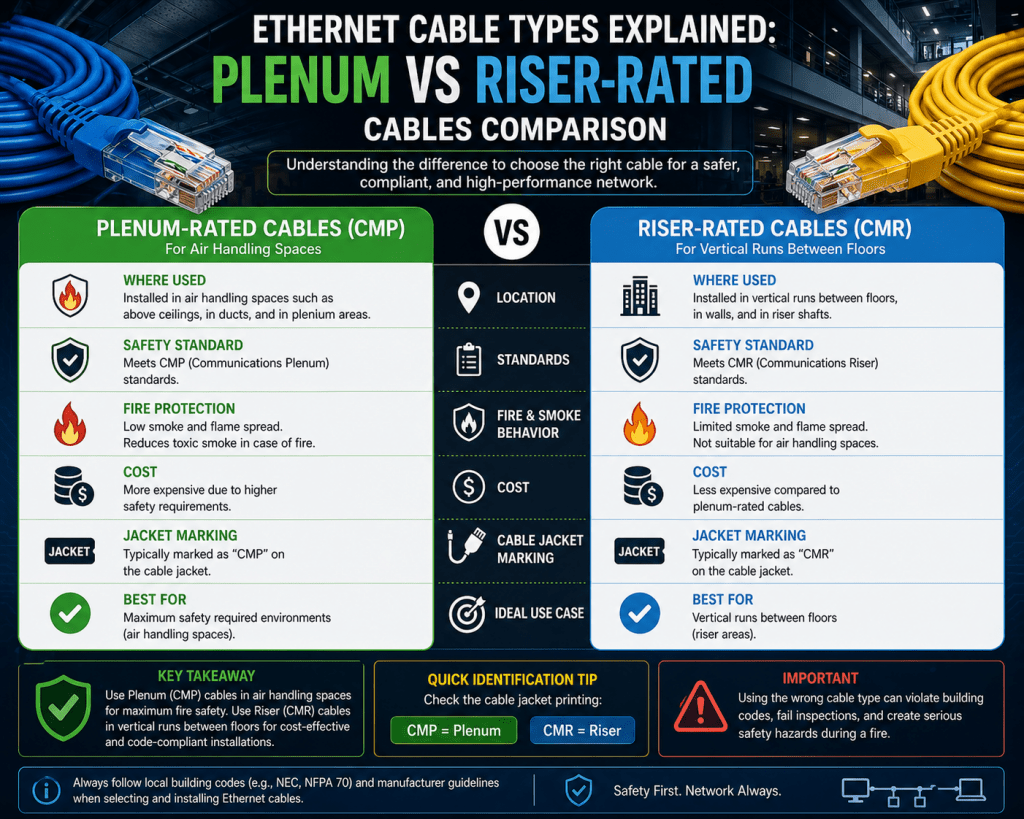
Direct Comparison Between Plenum and Riser-Rated Cables in Network Infrastructure Design
Plenum and riser-rated cables are often discussed together because they represent two essential safety classifications within structured cabling systems. However, they are designed for fundamentally different environmental conditions, and understanding their differences requires examining both fire safety engineering and installation context. Plenum cables are optimized for air-handling spaces where airflow can distribute smoke and toxic gases throughout a building. Riser cables, on the other hand, are designed for vertical pathways where the main concern is fire spreading between floors rather than through ventilation systems.
From a structural perspective, plenum cables are used in horizontal runs through ceiling cavities or raised floors, while riser cables are used in vertical shafts and conduit systems. This distinction alone determines where each cable type is permitted under building codes. The performance expectations also differ, with plenum cables emphasizing low-smoke emission and riser cables focusing on flame containment in enclosed vertical spaces. These differences shape how network engineers design infrastructure layouts in multi-story buildings.
Fire Safety Behavior and Regulatory Expectations for Each Cable Type
Fire safety performance is the most important factor separating plenum and riser-rated cables. Plenum cables are engineered to minimize both flame spread and smoke production because they operate in air circulation environments. When exposed to fire, they are designed to self-extinguish quickly and release minimal toxic gases. This is critical because HVAC systems can rapidly distribute combustion byproducts across large occupied spaces.
Riser-rated cables, in contrast, are designed to slow vertical fire propagation. Their primary goal is to prevent flames from moving between floors through cable pathways. While they do provide fire resistance, they are not optimized for smoke suppression in airflow environments. This makes them suitable for enclosed shafts but not for plenum spaces where air is actively circulated.
Building regulations reflect these differences by requiring plenum-rated materials in air-handling zones and riser-rated materials in vertical pathways. These requirements are enforced to ensure that fire containment strategies align with building architecture and airflow design. Compliance with these regulations is essential for safe and legally approved network installations.
Material Engineering Differences and Cable Construction Logic
The material composition of plenum and riser cables reflects their intended environments. Plenum cables are manufactured using low-smoke, fire-retardant compounds that reduce toxic emissions during combustion. These materials are chemically engineered to maintain insulation integrity while limiting smoke density and flame spread. Because of this advanced composition, plenum cables tend to be more expensive and slightly less flexible than other cable types.
Riser cables use simpler flame-retardant materials that focus on limiting vertical fire spread rather than controlling smoke in airflow systems. Their outer jackets are typically more flexible and easier to install in confined vertical spaces. While they still meet fire safety requirements for inter-floor cabling, their material design does not include the same level of chemical complexity found in plenum-rated insulation.
Internally, both cable types maintain similar conductor structures, often based on twisted-pair copper configurations used in Ethernet networking. The primary difference lies in the jacket materials, which determine environmental suitability rather than data transmission performance. This means both cable types can support similar network speeds when used within their correct installation environments.
Installation Environment Constraints and Structural Use Cases
Installation environment is the most practical factor in deciding between plenum and riser cables. Plenum cables are installed in spaces where air flows freely, such as ceiling cavities used for HVAC distribution or raised floors with air circulation systems. These environments require strict fire safety controls because smoke and toxic gases can spread rapidly through ventilation systems.
Riser cables are installed in vertical pathways that connect different floors of a building. These include wall cavities, conduit shafts, and dedicated riser spaces. Since these areas do not involve active airflow systems, the primary concern is preventing fire from traveling vertically between floors. Riser-rated cables are specifically designed to address this risk while maintaining installation flexibility.
In many structured cabling designs, both cable types are used within the same building. Plenum cables handle horizontal distribution in airflow zones, while riser cables manage vertical interconnections between floors. This combined approach ensures both safety compliance and efficient network design across complex building structures.
Cost Structure and Budget Impact in Network Deployment Planning
Cost is another important distinction between plenum and riser-rated cables. Plenum cables are more expensive due to the specialized materials used in their construction. The chemical compounds required for low-smoke and fire-retardant performance increase manufacturing complexity, which directly impacts pricing. This makes plenum cabling a higher-cost option in large-scale installations.
Riser cables are generally more cost-effective because they use simpler flame-retardant materials. This makes them a practical choice for vertical cabling in multi-story buildings where large quantities of cable are required. The reduced cost allows organizations to manage infrastructure budgets more efficiently without compromising fire safety in vertical pathways.
However, cost should never be the sole deciding factor. Using riser cables in plenum environments or vice versa can lead to safety violations and expensive rework. Proper environmental assessment ensures that cost savings do not compromise compliance or system integrity.
Performance Behavior in Real-World Network Conditions
From a data transmission perspective, both plenum and riser cables perform similarly when matched to the same category rating such as Cat6 or Cat6a. The key differences are not in speed or bandwidth but in how the cable behaves under environmental stress.
Plenum cables maintain performance stability in air-handling environments where temperature and airflow fluctuations may occur. Their insulation is designed to resist thermal degradation, ensuring consistent signal quality even under challenging conditions. This makes them suitable for critical infrastructure such as data centers and enterprise communication systems.
Riser cables maintain stable performance in vertical installations where mechanical stress and structural movement may occur. Their flexible design allows them to adapt to vertical routing without compromising signal integrity. As long as installation standards are followed, both cable types deliver reliable network performance within their intended environments.
Safety Compliance and the Role of Building Regulations in Cable Selection
Building regulations play a decisive role in determining where plenum and riser cables must be used. These regulations are based on fire safety engineering principles that take into account airflow behavior, structural design, and evacuation safety. Compliance is not optional in most commercial and institutional buildings.
Plenum-rated requirements are typically enforced in air-handling zones to reduce the risk of smoke spread through HVAC systems. Riser-rated requirements are enforced in vertical pathways to prevent fire from moving between floors. These regulations ensure that cabling infrastructure aligns with the building’s fire containment strategy.
Network designers must evaluate installation environments carefully before selecting cable types. Misclassification can lead to inspection failures, safety hazards, and costly infrastructure changes. Proper documentation and planning are essential to maintaining compliance throughout the lifecycle of a building’s network system.
Troubleshooting Considerations in Mixed Cable Environments
In real-world installations, networks often include both plenum and riser cables within the same infrastructure. This can introduce troubleshooting complexity, especially when diagnosing connectivity issues or performance inconsistencies. While both cable types support similar data transmission standards, environmental conditions can influence long-term behavior.
In plenum environments, issues may arise from improper installation, such as excessive bending or exposure to incompatible materials. In riser environments, vertical stress and physical strain can impact cable alignment over time. Identifying the source of a problem requires understanding both the cable type and its installation context.
Proper testing tools and structured diagnostic methods are essential for maintaining network reliability. Cable certification testing, continuity checks, and signal analysis help ensure that both plenum and riser installations continue to perform within expected parameters.
Long-Term Infrastructure Planning and Scalability Considerations
Structured cabling systems are designed for long-term use, often spanning decades of building operation. This makes initial cable selection a critical part of infrastructure planning. Plenum and riser cables must be chosen not only for current requirements but also for future scalability and potential building modifications.
As buildings evolve, network demands increase, and new technologies are introduced, cabling systems must be able to support additional load without requiring complete replacement. Proper segregation of plenum and riser zones ensures that upgrades can be performed without violating safety codes or disrupting existing infrastructure.
Long-term reliability also depends on proper installation practices, including cable management, labeling, and documentation. These practices ensure that future maintenance and expansion can be performed efficiently without compromising system integrity.
System Design Logic Behind Combining Plenum and Riser Cabling
Modern network architecture relies on a layered approach to cabling design. Plenum and riser cables are not competing solutions but complementary components within a unified system. Plenum cables handle horizontal distribution across airflow zones, while riser cables handle vertical interconnection between floors.
This division allows engineers to design structured cabling systems that align with both building architecture and fire safety requirements. It also improves scalability, as each cable type is optimized for its specific role within the infrastructure. By combining both systems correctly, organizations can achieve high-performance networks that are also safe and compliant.
Final Engineering Perspective on Cable Selection Strategy
Selecting between plenum and riser-rated cables is not a matter of preference but of environmental necessity. Each cable type exists to solve a specific fire safety and structural challenge within building design. Plenum cables protect air-handling environments where smoke distribution is a risk, while riser cables protect vertical pathways where fire can spread between floors.
A properly designed network considers both safety and performance at every stage of installation. Understanding the role of each cable type allows engineers to build systems that are not only efficient but also resilient under emergency conditions. This alignment between physical infrastructure and safety engineering is what ensures long-term reliability in modern network environments.
Conclusion
The foundation of every modern communication system is not only software, cloud architecture, or wireless connectivity but the physical cabling that quietly carries data across buildings. While often overlooked, cable selection plays a defining role in how stable, safe, and scalable a network truly is. Plenum and riser-rated cables represent two essential categories within structured cabling systems, and their correct use directly impacts both regulatory compliance and operational reliability. Understanding their differences is not just a technical detail but a practical requirement for anyone involved in network design, installation, or infrastructure management.
At a structural level, plenum and riser cables exist because buildings are not uniform environments. They are divided into airflow zones and vertical pathways, each presenting unique risks in the event of fire. Plenum spaces introduce the challenge of air circulation, where smoke and toxic gases can rapidly travel through HVAC systems and affect large occupied areas. Riser pathways, on the other hand, introduce the challenge of vertical fire movement between floors, where flames can spread upward through cable routes and structural openings. These two distinct risks require two different engineering solutions, which is why separate cable classifications exist in the first place.
Plenum-rated cables are designed with a strong emphasis on fire safety in air-handling environments. Their low-smoke, flame-retardant materials ensure that if ignition occurs, the resulting damage and smoke spread are minimized. This is particularly important in environments such as office buildings, hospitals, educational institutions, and data centers, where large numbers of people rely on uninterrupted airflow and where evacuation time is critical. The engineering behind plenum cables prioritizes controlled combustion behavior, reduced toxicity, and compliance with strict building codes. These characteristics make them indispensable in zones where air circulation and fire safety intersect.
Riser-rated cables serve a different but equally important function. They are engineered for vertical installations between floors, where the main concern is preventing fire from traveling upward through structured pathways. While they do not offer the same level of smoke suppression as plenum cables, they provide effective flame resistance in enclosed shafts and conduits. This makes them suitable for inter-floor network connections in multi-story buildings such as corporate offices, residential towers, universities, and healthcare facilities. Their flexibility and cost efficiency also make them practical for large-scale deployments where vertical cabling is extensive.
When evaluating both cable types together, it becomes clear that they are not competing technologies but complementary components of a larger system. Plenum cables manage horizontal distribution in airflow environments, while riser cables manage vertical connectivity between floors. This division allows structured cabling systems to align with the physical and safety architecture of modern buildings. Without this separation, network infrastructure would either become unnecessarily expensive or fail to meet critical safety standards.
One of the most important lessons in structured cabling design is that performance alone is not enough. A high-speed network built with improper cabling can still fail if it does not meet environmental and safety requirements. Fire behavior, smoke toxicity, airflow distribution, and structural layout all influence how cabling must be selected and installed. This means that network design is not purely an electrical or data engineering discipline but also a safety-critical architectural consideration.
Cost is often a factor in decision-making, but it should always be balanced against compliance and long-term risk. Plenum cables are more expensive due to their advanced material composition, but they provide essential protection in air-handling environments. Riser cables are more cost-effective, but they are limited to vertical installations where airflow risks are not present. Attempting to reduce costs by misusing cable types can lead to severe consequences, including safety violations, failed inspections, and expensive infrastructure rework. In professional environments, correct classification always outweighs short-term savings.
Installation planning is another critical aspect of successful cabling deployment. Proper identification of plenum zones and riser pathways must be done during the early stages of building design or network expansion. This ensures that cable routes are aligned with both structural constraints and safety requirements. In many real-world scenarios, both cable types are used within the same building, creating a layered infrastructure system. Horizontal runs in ceilings or floors use plenum-rated cabling, while vertical interconnections between floors rely on riser-rated cabling. This hybrid approach allows for efficient network design without compromising safety compliance.
Long-term reliability is also closely tied to correct cable selection. Structured cabling systems are expected to last for many years, often outliving multiple generations of active network equipment. During this time, environmental conditions, building usage, and technology demands may change. A properly designed cabling system anticipates these changes by ensuring that each cable type is used in its appropriate environment. This reduces the likelihood of degradation, performance issues, or safety concerns over time.
From a maintenance and troubleshooting perspective, understanding the distinction between plenum and riser cables also improves diagnostic efficiency. When network issues arise, technicians must consider not only electronic performance but also environmental factors such as installation location, cable routing, and physical stress. A well-documented cabling system that clearly separates plenum and riser zones allows for faster identification of issues and more efficient repairs.
Ultimately, the importance of plenum and riser-rated cables lies in their role as protective infrastructure elements. They are not simply data carriers but safety mechanisms integrated into the physical structure of a building. Their design reflects a careful balance between electrical performance and fire safety engineering, ensuring that networks remain functional under normal conditions and resilient under emergency conditions.
In modern infrastructure environments, where connectivity is essential to nearly every business and operational function, the physical layer cannot be ignored or underestimated. Cloud systems, enterprise applications, and digital communication platforms all depend on the stability of underlying cabling systems. By selecting the correct cable type for each environment, engineers and planners create networks that are not only efficient but also safe, compliant, and resilient over time.
Proper understanding of plenum and riser-rated cables ultimately represents a broader principle in network design: technology must always adapt to physical reality. Buildings have structure, airflow, and fire behavior that cannot be ignored, and cabling systems must be engineered to operate safely within those constraints. When this principle is followed correctly, the result is a network infrastructure that supports modern digital demands while maintaining the highest standards of safety and reliability.