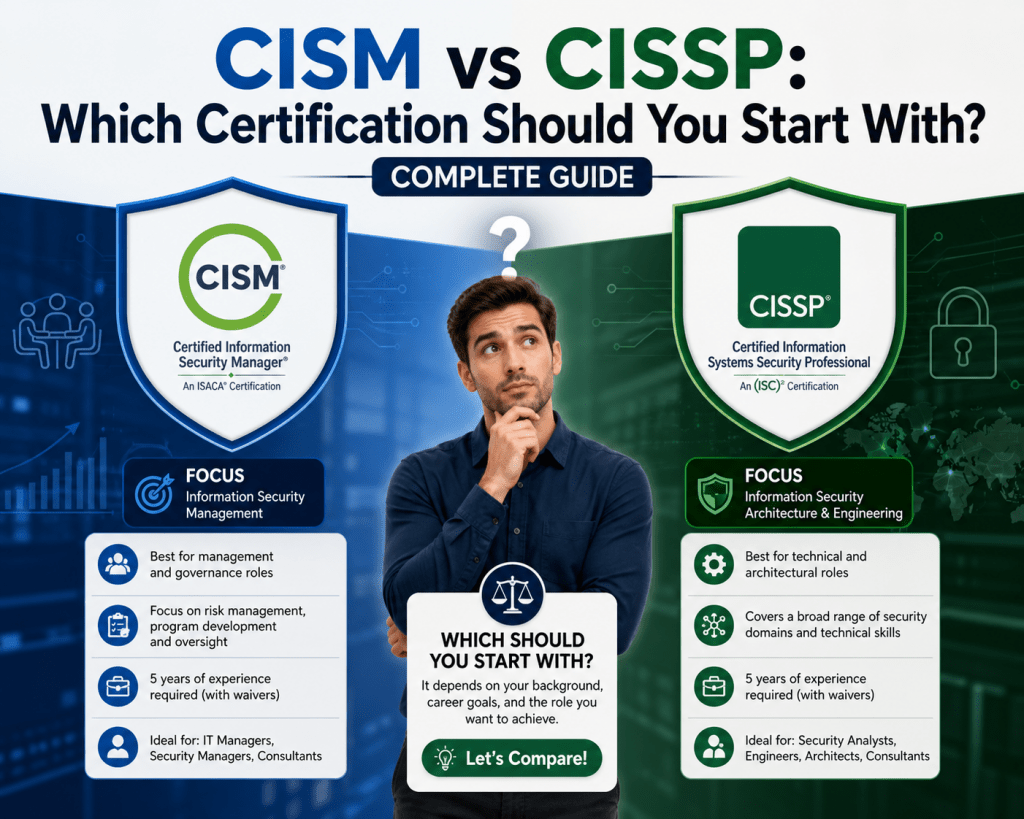
If cybersecurity is your long-term career direction, two advanced certifications often become central to professional growth: Certified Information Systems Security Professional (CISSP) and Certified Information Security Manager (CISM). Both are globally respected credentials and are widely associated with senior-level roles in information security, risk management, and enterprise protection strategy. While many professionals eventually pursue both, they are fundamentally independent certifications shaped around different career outcomes and responsibilities.
These certifications do not represent competing ideas but instead reflect two distinct approaches to cybersecurity leadership. One is more aligned with technical architecture and enterprise security design, while the other focuses on governance, risk, and management-driven security strategy. Understanding this distinction early allows professionals to build a more structured career roadmap, especially in a field where experience, specialization, and strategic direction matter significantly.
CISSP Certification and Its Role in Cybersecurity Architecture
CISSP is structured around the design and management of comprehensive security programs across large and complex environments. It is widely recognized for its depth and breadth across multiple security disciplines, requiring a strong understanding of how enterprise security systems operate as a unified structure.
The certification evaluates knowledge across eight major domains that collectively define modern cybersecurity architecture. These domains include security governance, asset protection, secure communication systems, identity management, and application-level security principles. Each domain contributes to a broader understanding of how organizations build resilient defense systems against evolving digital threats.
Professionals who pursue CISSP are generally expected to engage with both technical and strategic responsibilities. The certification is often associated with roles that require oversight of security infrastructure, planning secure system architectures, and ensuring alignment between technical controls and organizational risk requirements. It is commonly pursued by individuals aiming to transition into senior security engineering or architecture roles, where technical depth and strategic awareness intersect.
CISM Certification and Its Focus on Security Management
CISM takes a different approach by concentrating on governance, organizational alignment, and management-level decision-making in cybersecurity environments. Instead of focusing on system-level technical design, it emphasizes how security programs are structured, monitored, and aligned with business objectives.
The certification is built around four core domains that reflect its management orientation. These include information security governance, enterprise risk management, security program development, and incident response coordination. Each domain emphasizes decision-making, policy creation, and oversight responsibilities rather than hands-on technical execution.
Professionals who pursue CISM are typically those moving into leadership positions where they are responsible for managing teams, developing security policies, and ensuring compliance with organizational and regulatory requirements. The certification is particularly relevant for individuals aiming to step into roles that bridge cybersecurity operations and business strategy, especially where risk management and governance play a central role.
Structural Differences Between CISSP and CISM Domains
While both certifications operate within the cybersecurity field, their structural design reflects different professional expectations. CISSP is broad and technically diversified, covering a wide range of security disciplines that span infrastructure, applications, and operational controls. This makes it suitable for professionals who need a comprehensive understanding of how security systems are built and maintained across enterprise environments.
CISM, by contrast, is narrower in technical scope but deeper in managerial application. It focuses on how security initiatives are governed, how risk is evaluated at an organizational level, and how security programs are aligned with business priorities. Rather than emphasizing technical configuration or architecture, it focuses on leadership accountability and strategic oversight.
This structural difference influences how professionals apply each certification in real-world environments. CISSP-certified individuals often work closer to system design, implementation, and technical analysis, while CISM-certified professionals operate in governance frameworks where decision-making and policy direction are primary responsibilities.
Work Experience Expectations for Both Certifications
Both certifications require substantial professional experience, reinforcing their position as advanced credentials in cybersecurity. CISSP requires a minimum of five years of full-time experience in at least two of its eight domains. This ensures that candidates have practical exposure to multiple areas of security operations, rather than expertise in a single niche.
CISM also requires five years of professional experience, but with a stronger emphasis on information security management. At least three of those years must be in managerial or governance-related roles, ensuring that candidates have practical exposure to leadership responsibilities in security environments.
These experience requirements highlight an important aspect of both certifications: they are designed for professionals who are already established in the cybersecurity field. However, early-career individuals can still prepare strategically by gaining exposure to security tasks within broader IT roles, gradually building toward the required experience over time.
Career Direction and Professional Alignment
CISSP and CISM often align with different career trajectories in cybersecurity. CISSP tends to support roles that combine technical expertise with strategic oversight. Professionals with this certification are commonly found in positions that involve security architecture, system design, penetration testing oversight, and infrastructure protection strategy. These roles require a deep understanding of how systems operate and how security controls are implemented at scale.
CISM aligns more closely with leadership and governance roles. Individuals with this certification often work in positions responsible for developing organizational security policies, managing risk frameworks, and overseeing compliance structures. These roles are less focused on technical execution and more on ensuring that security practices support broader business objectives and regulatory requirements.
The distinction between these paths is not rigid, but it does influence long-term career direction. CISSP provides a strong foundation for technical leadership, while CISM supports advancement into executive-level security management roles.
Early Career Considerations in Certification Planning
For individuals early in their cybersecurity journey, choosing between CISSP and CISM is less about immediate certification and more about long-term direction. Both certifications require experience that typically develops over several years, meaning that early career professionals should focus on building foundational knowledge and practical exposure first.
Exposure to security-related responsibilities within IT roles can provide valuable experience. This may include working with access control systems, participating in risk assessments, assisting with security monitoring, or supporting compliance-related tasks. These experiences help build the practical background required for either certification path.
Over time, professionals often begin to identify whether they are more inclined toward technical system design or governance and leadership responsibilities. This self-awareness becomes an important factor in determining whether CISSP or CISM aligns more effectively with long-term goals.
Industry Relevance and Long-Term Professional Positioning
Both CISSP and CISM hold strong relevance in modern cybersecurity environments due to the increasing complexity of digital infrastructure and the growing importance of risk management. Organizations require professionals who can either design secure systems or govern security programs effectively, and these certifications reflect those two core needs.
CISSP remains highly relevant in environments where technical security expertise is critical for protecting distributed systems, cloud environments, and enterprise networks. It supports roles that require continuous engagement with evolving technologies and security frameworks.
CISM remains highly relevant in organizations where security must be aligned with regulatory requirements, business strategy, and enterprise risk management. It supports leadership roles that guide organizational security direction rather than execute technical implementations.
As cybersecurity continues to evolve, both certifications maintain strong professional value due to their alignment with real-world organizational needs.
CISM vs CISSP: Career Impact, Salary Growth, and Real-World Role Differences
The decision between CISM and CISSP becomes more meaningful when viewed through the lens of long-term career development rather than just exam preparation. Both certifications sit at an advanced level in cybersecurity, but their real value lies in how they shape professional identity, job responsibilities, and upward mobility within organizations.
As cybersecurity environments expand across cloud infrastructure, hybrid networks, and regulatory frameworks, organizations increasingly rely on professionals who can either architect secure systems or govern security programs at an executive level. CISSP and CISM reflect these two dimensions of cybersecurity leadership, and understanding how they influence real-world career paths is essential for strategic planning.
How CISSP Shapes Technical Leadership Careers
CISSP is widely associated with professionals who operate at the intersection of technical depth and strategic oversight. It is not limited to hands-on engineering work, but it strongly emphasizes the ability to design, evaluate, and manage complex security architectures across enterprise systems.
In real-world environments, CISSP-certified professionals often become responsible for structuring security frameworks that support large-scale operations. This includes designing secure network infrastructures, defining access control mechanisms, evaluating system vulnerabilities, and ensuring that security policies are properly implemented across multiple departments.
One of the most important aspects of CISSP is its influence on technical leadership progression. Professionals who hold this certification are frequently positioned in roles where they must translate business requirements into secure technical systems. This requires not only an understanding of cybersecurity tools and technologies but also the ability to assess risk at a system-wide level.
CISSP also strengthens credibility in roles that require cross-functional collaboration. Security architects and senior engineers often work with software development teams, infrastructure teams, and compliance departments. The certification signals that the professional has a holistic understanding of how security integrates with broader IT ecosystems.
Over time, CISSP tends to position individuals for roles such as senior security architect, enterprise security lead, or cybersecurity program manager. These roles are typically characterized by high responsibility, broad technical scope, and involvement in long-term security planning.
How CISM Shapes Security Management and Governance Careers
CISM takes a fundamentally different approach by focusing on leadership, governance, and organizational alignment rather than technical system design. Professionals who pursue CISM are typically moving toward roles where decision-making, policy development, and risk oversight are central responsibilities.
In practice, CISM-certified individuals often oversee entire security programs within organizations. Their work includes defining security governance structures, establishing risk management frameworks, and ensuring that security initiatives align with business objectives and regulatory expectations.
Unlike technical certifications that emphasize system-level configuration, CISM emphasizes organizational behavior and strategic execution. This makes it particularly valuable for professionals who want to transition into leadership roles such as security manager, risk director, or chief information security officer.
CISM also plays a critical role in environments where compliance and regulatory alignment are essential. Industries such as finance, healthcare, and government rely heavily on structured governance models, and CISM provides the conceptual foundation for managing these requirements effectively.
Professionals with CISM are often responsible for evaluating risk exposure at an organizational level rather than focusing on individual systems. This includes assessing the impact of security incidents on business continuity, managing incident response strategies, and ensuring that security policies remain aligned with evolving threats.
Salary Progression and Long-Term Financial Impact
Both CISSP and CISM are associated with high earning potential, but their salary trajectories differ based on job function and career progression.
CISSP is often linked to technical leadership roles that offer strong compensation due to the complexity of responsibilities involved. Professionals with CISSP frequently work in environments where they are responsible for securing critical infrastructure, managing enterprise security architecture, and overseeing large-scale technical systems. These responsibilities typically translate into competitive salaries that reflect both technical expertise and leadership capability.
CISM, on the other hand, is often associated with managerial and executive roles, which can lead to even higher compensation at senior levels. This is because CISM-certified professionals are frequently positioned in roles that influence organizational security strategy, manage risk at the enterprise level, and interact directly with executive leadership.
In many cases, CISSP serves as a stepping stone toward technical leadership compensation bands, while CISM often aligns with upper-tier management and executive salary structures. However, actual earnings depend heavily on industry, geographic region, years of experience, and organizational size.
It is also important to understand that salary growth for both certifications is not immediate. The certifications themselves do not guarantee instant financial change. Instead, they function as accelerators that unlock access to higher-level roles, which then influence long-term earning potential.
Organizational Value of CISSP in Security Architecture
From an organizational perspective, CISSP-certified professionals are highly valued for their ability to design resilient security systems that can withstand evolving threats. As organizations expand their digital infrastructure, the need for robust architecture becomes increasingly important.
CISSP contributes to this need by equipping professionals with the ability to evaluate security across multiple layers of an IT environment. This includes endpoint security, network defense mechanisms, application security controls, and identity management systems.
Organizations rely on CISSP-level expertise when building secure infrastructures for cloud environments, hybrid systems, and distributed networks. The certification ensures that professionals understand not only individual security technologies but also how they interact within a larger ecosystem.
This systemic perspective is critical in preventing security gaps that often arise from fragmented implementation strategies. CISSP-certified professionals are expected to identify such gaps and design solutions that ensure consistency across all layers of security architecture.
Organizational Value of CISM in Governance and Risk Management
CISM provides value at a different organizational level by focusing on governance, accountability, and strategic alignment. While CISSP ensures that systems are secure, CISM ensures that security programs are effectively managed and aligned with organizational goals.
One of the key contributions of CISM is its emphasis on risk management frameworks. Organizations must constantly evaluate potential threats, compliance requirements, and operational vulnerabilities. CISM-certified professionals are trained to structure these evaluations in a way that supports executive decision-making.
CISM also plays a critical role in incident management and response planning. In modern cybersecurity environments, incidents are inevitable, and organizations must be prepared to respond quickly and effectively. CISM provides the conceptual foundation for building structured response systems that minimize damage and ensure continuity.
Another major contribution of CISM is its role in policy development. Security policies define how organizations handle data, manage access, and respond to threats. CISM-certified professionals ensure that these policies are not only technically sound but also aligned with broader business objectives.
Career Mobility and Long-Term Advancement Paths
CISSP and CISM both offer strong long-term career mobility, but they lead in different directions.
CISSP often supports movement into technical leadership roles such as senior security architect, principal security engineer, or enterprise security consultant. These roles typically involve deep engagement with system design and technical decision-making.
CISM supports movement into managerial and executive roles such as security director, risk manager, or chief information security officer. These positions involve strategic oversight, organizational leadership, and high-level decision-making.
In many professional environments, individuals begin with CISSP to establish technical credibility and later pursue CISM to transition into leadership roles. This combination allows professionals to understand both the technical and managerial dimensions of cybersecurity, creating a more comprehensive skill set.
However, the order is not fixed. Some professionals begin with CISM if they are already working in management or compliance-focused roles. Others pursue both certifications to strengthen their ability to operate across both domains.
Evolving Industry Demand for Both Certifications
As cybersecurity threats continue to grow in complexity, organizations increasingly require professionals who can operate at both technical and strategic levels. This has led to sustained demand for both CISSP and CISM across industries.
CISSP remains essential in environments where technical security expertise is required to protect critical infrastructure. This includes cloud environments, financial systems, healthcare platforms, and enterprise networks.
CISM remains essential in environments where governance, compliance, and risk management are central to organizational operations. This includes regulated industries and large enterprises with complex operational structures.
The continued evolution of cybersecurity ensures that both certifications will remain relevant, as they address two fundamental needs within the field: securing systems and governing security programs.
As organizations mature their cybersecurity strategies, professionals who understand both perspectives are increasingly valued. This is why many experienced professionals eventually hold both certifications, allowing them to operate effectively across technical and managerial domains without limitation.
CISM vs CISSP: Exam Structure, Preparation Strategy, and Professional Readiness
The final dimension of understanding CISM and CISSP lies in how these certifications are approached, prepared for, and ultimately integrated into long-term professional development. Beyond career outcomes and salary impact, both certifications demand a structured preparation strategy, disciplined study approach, and strong conceptual understanding of cybersecurity principles.
Unlike entry-level certifications, CISM and CISSP are designed for professionals who already have practical exposure to security environments. As a result, preparation is less about memorizing concepts and more about understanding how security principles apply in real organizational contexts. This makes exam readiness a reflection of real-world experience as much as theoretical study.
CISSP Exam Structure and Cognitive Demands
The CISSP certification is structured to evaluate both technical knowledge and strategic thinking across a wide range of cybersecurity domains. It does not focus on isolated technical tasks but instead assesses how well a candidate understands interconnected security systems.
The exam covers eight domains that collectively represent enterprise-level cybersecurity architecture. These domains span governance, asset protection, communication security, identity management, system design, and software security principles. Each domain contributes to a broader understanding of how security is implemented across complex infrastructures.
One of the defining characteristics of CISSP is its adaptive testing format. The exam dynamically adjusts question difficulty based on candidate responses, meaning that performance is continuously evaluated throughout the test. This structure ensures that the assessment reflects both depth and consistency of knowledge.
The cognitive demand of CISSP is significant because it requires professionals to think beyond technical configurations. Candidates must evaluate scenarios, assess risk implications, and determine the most appropriate security strategies based on enterprise requirements. This scenario-based evaluation reflects real-world decision-making rather than isolated technical recall.
Preparation for CISSP often requires extensive review of security frameworks, architectural principles, and risk management methodologies. However, the most effective preparation strategy involves applying these concepts to practical environments, as the exam emphasizes analytical thinking over memorization.
CISM Exam Structure and Management-Oriented Thinking
CISM differs significantly in structure and focus. Instead of evaluating technical depth across multiple domains, it concentrates on how security programs are managed, governed, and aligned with business objectives.
The certification is built around four core domains that reflect its management orientation. These include governance, risk management, security program development, and incident management. Each domain emphasizes organizational decision-making rather than technical implementation.
The exam structure is designed to evaluate how candidates respond to management-level scenarios. This includes assessing risk, allocating resources, defining security policies, and coordinating incident response strategies. The focus is on judgment, prioritization, and alignment with business goals.
Unlike CISSP, which spans a wide technical scope, CISM requires deeper focus on organizational structure and strategic execution. Candidates must demonstrate the ability to evaluate security from a business perspective, ensuring that decisions support both operational efficiency and risk reduction.
Preparation for CISM often involves studying governance models, risk frameworks, and enterprise security program structures. However, success in the exam depends heavily on the ability to interpret scenarios in a management context rather than a technical one.
Preparation Strategy Differences Between CISSP and CISM
Although both certifications require professional experience, the preparation strategies for CISSP and CISM differ significantly due to their distinct focus areas.
CISSP preparation typically involves broad coverage of multiple technical domains. Candidates must understand how different security components interact within enterprise systems. This includes studying network architecture, identity management systems, cryptographic principles, and secure application design.
Because of the breadth of CISSP, preparation often requires structured learning over an extended period. Professionals must build conceptual connections between domains to understand how security decisions impact entire systems rather than isolated components.
CISM preparation, on the other hand, is more focused and conceptual. It requires understanding how security programs are governed and how risk is managed at an organizational level. Instead of technical depth, candidates must develop strong analytical skills related to decision-making and policy development.
The key difference lies in mindset. CISSP requires systems thinking across technical environments, while CISM requires strategic thinking within organizational structures. Both demand experience-based reasoning, but they apply it in different ways.
Real-World Application of CISSP Knowledge
CISSP knowledge is most visible in environments where technical security architecture is critical. Professionals with this certification are often involved in designing secure systems that operate across distributed environments, including cloud platforms, hybrid infrastructures, and enterprise networks.
In real-world scenarios, CISSP-certified individuals are responsible for ensuring that security controls are integrated into system design from the beginning. This includes defining access control models, implementing encryption strategies, and ensuring secure communication between systems.
Another key application of CISSP knowledge is risk assessment at the system level. Professionals evaluate how vulnerabilities in one part of the system may impact overall security posture. This requires a deep understanding of dependencies within complex IT environments.
CISSP also plays a major role in incident prevention. By designing secure systems and anticipating potential attack vectors, professionals reduce the likelihood of security breaches. This proactive approach is essential in modern cybersecurity environments where threats are constantly evolving.
Real-World Application of CISM Knowledge
CISM knowledge is applied at a higher organizational level, where security decisions impact entire business operations. Professionals with this certification are often responsible for managing security programs rather than designing technical systems.
One of the primary applications of CISM is governance. This involves establishing policies, defining roles and responsibilities, and ensuring that security objectives align with business goals. Governance structures provide the foundation for consistent security practices across organizations.
Risk management is another critical area where CISM is applied. Professionals evaluate potential threats, assess their impact on business operations, and prioritize mitigation strategies. This requires balancing security needs with operational efficiency and financial constraints.
CISM also plays a major role in incident management. When security incidents occur, professionals are responsible for coordinating response efforts, minimizing impact, and ensuring recovery processes are effective. This requires strong leadership and communication skills.
Unlike CISSP, which focuses on system-level security, CISM focuses on organizational resilience. It ensures that security programs are not only technically sound but also strategically aligned with business continuity requirements.
Long-Term Professional Development and Certification Integration
Over time, many cybersecurity professionals find value in understanding both CISSP and CISM perspectives. While each certification represents a distinct career path, their combined knowledge provides a more complete understanding of cybersecurity as a discipline.
CISSP strengthens technical credibility and provides the foundation for understanding how systems are secured at a structural level. CISM complements this by providing insight into how security programs are managed and aligned with organizational goals.
Professionals who integrate both perspectives are often able to operate effectively across multiple levels of cybersecurity environments. This includes contributing to technical design discussions while also participating in strategic planning and governance decisions.
This dual perspective becomes increasingly valuable as organizations adopt more complex digital infrastructures. Security decisions are no longer isolated to technical teams or management teams alone; they require collaboration across both domains.
Evolving Role of Certifications in Modern Cybersecurity Environments
The relevance of CISSP and CISM continues to grow as cybersecurity becomes more central to organizational success. Digital transformation, cloud adoption, and increasing regulatory requirements have expanded the scope of security responsibilities across industries.
CISSP remains essential in environments where technical expertise is required to secure complex systems. As infrastructures become more distributed, the need for professionals who understand system architecture and security design continues to increase.
CISM remains essential in environments where governance and risk management are critical. As organizations face increasing regulatory pressure and operational complexity, structured security management becomes a key requirement.
Both certifications reflect different but equally important aspects of cybersecurity maturity. Organizations require professionals who can either design secure systems or ensure that security programs are effectively managed at an enterprise level.
Final Perspective on Professional Direction in Cybersecurity
CISM and CISSP represent two foundational directions within cybersecurity careers. One focuses on technical architecture and system security, while the other focuses on governance, leadership, and risk management.
Neither path is superior; instead, each reflects a different dimension of cybersecurity responsibility. Professionals who understand these differences are better equipped to make informed career decisions and align their long-term development with industry needs.
As cybersecurity continues to evolve, the distinction between technical and managerial responsibilities may become more interconnected. However, the core principles behind CISSP and CISM will remain relevant because organizations will always require both secure systems and effective security governance.
Conclusion
Choosing between CISSP and CISM ultimately reflects a deeper decision about how a professional wants to operate within the cybersecurity ecosystem. Both certifications exist at an advanced level and are designed for individuals who already have significant experience in information security or IT environments. Rather than serving as entry points, they function as accelerators that refine direction, elevate responsibility, and expand long-term career potential.
Cybersecurity today is not a single-track discipline. It is a layered field where technical execution, strategic planning, governance, and risk management all intersect. CISSP and CISM represent two structured interpretations of this complexity. One focuses on how systems are designed, protected, and maintained at an architectural level. The other focuses on how security programs are governed, measured, and aligned with organizational objectives. Both are essential in modern enterprises, and both reflect different but equally important forms of leadership.
Professionals who pursue CISSP typically develop a mindset centered around systems thinking. This involves understanding how different components of an IT environment interact, how vulnerabilities propagate, and how layered defenses are constructed. Over time, this perspective builds strong analytical capability in evaluating technical risk. It also strengthens the ability to design secure environments that remain resilient under evolving threat conditions. CISSP professionals are often positioned where technical depth and strategic awareness converge, allowing them to influence both implementation and long-term architectural decisions.
On the other hand, CISM develops a mindset rooted in organizational governance and strategic control. Instead of focusing on how individual systems are secured, it emphasizes how entire security programs are structured and managed. This includes defining policies, managing enterprise risk, and ensuring that security initiatives align with broader business priorities. The strength of CISM lies in its ability to translate cybersecurity concepts into business language, enabling communication between technical teams and executive leadership. Professionals with this certification often become responsible for shaping security direction at an organizational level, where decisions impact entire operational ecosystems.
A major distinction between the two certifications lies in how success is measured within each role. CISSP-related roles often measure success through system resilience, reduced vulnerabilities, secure architecture implementation, and technical efficiency. In contrast, CISM-related roles measure success through governance effectiveness, risk reduction at the organizational level, compliance alignment, and strategic decision quality. These differences highlight how cybersecurity operates across both micro and macro levels, with each certification reinforcing expertise in one dimension.
From a career progression standpoint, CISSP often serves as a foundation for technical leadership roles that require deep understanding of infrastructure and security engineering. Professionals in these roles frequently engage with cloud systems, enterprise networks, identity management frameworks, and secure application development environments. Their responsibilities require continuous adaptation to emerging technologies and threat landscapes. This path tends to attract individuals who enjoy problem-solving at a technical level while still contributing to broader organizational strategy.
CISM, in contrast, aligns more closely with leadership trajectories that involve oversight, accountability, and strategic planning. Professionals in these roles are often responsible for managing security teams, designing governance frameworks, and ensuring that risk management practices are consistently applied across departments. They operate at a level where decisions influence not just technical outcomes but also organizational direction and compliance posture. This makes CISM particularly relevant for individuals aiming to move into executive-level positions where cybersecurity is integrated into business strategy.
Financial outcomes for both certifications tend to reflect their senior-level positioning. However, compensation is influenced more by role, experience, and organizational context than by certification alone. CISSP can lead to high-paying technical leadership roles due to the specialized knowledge required to design and maintain secure infrastructures. CISM, on the other hand, often leads to equally or higher-compensated management roles because of the strategic responsibility associated with enterprise risk and governance oversight. Over time, both certifications support strong earning potential, particularly when combined with extensive experience and leadership exposure.
Another important aspect is how both certifications influence professional credibility. In cybersecurity environments, credibility is often tied to demonstrated knowledge, consistent decision-making, and the ability to handle complex security challenges. CISSP establishes credibility in technical depth, signaling that a professional understands how security systems function at scale. CISM establishes credibility in governance and leadership, signaling that a professional can manage security programs in alignment with business priorities. Together, they represent complementary forms of authority within the cybersecurity field.
The relevance of both certifications continues to grow as organizations face increasingly sophisticated cyber threats. Modern security environments are no longer limited to traditional infrastructure. They now include cloud-native systems, hybrid architectures, distributed applications, and globally connected networks. This complexity requires professionals who can operate at both technical and strategic levels. CISSP addresses the need for secure design and technical resilience, while CISM addresses the need for structured governance and risk alignment. Together, they form a balanced response to the challenges of modern cybersecurity.
In long-term career development, professionals often find that their interests evolve over time. Some begin with a strong technical focus and gradually move toward leadership responsibilities. Others start in governance or compliance roles and later develop deeper technical understanding. CISSP and CISM support this natural evolution by providing structured frameworks that can be revisited and applied at different stages of a career. This flexibility is one of the reasons both certifications maintain strong relevance across the cybersecurity industry.
It is also important to recognize that neither certification should be viewed as a final destination. Instead, they function as part of an ongoing professional development journey. Cybersecurity is a constantly evolving field, and maintaining relevance requires continuous learning, adaptation, and engagement with emerging technologies and threats. Both certifications encourage this mindset by emphasizing experience, ongoing education, and practical application of knowledge.
Ultimately, the decision between CISSP and CISM is not about selecting a superior certification but about identifying the type of impact a professional wants to make within the cybersecurity landscape. Those who prefer working closely with technical systems, designing secure architectures, and solving complex engineering challenges may find CISSP more aligned with their goals. Those who prefer shaping organizational strategy, managing risk at an enterprise level, and guiding security governance may find CISM more suitable.
Both paths lead to influential roles within the cybersecurity industry, and both contribute significantly to organizational security maturity. The most important factor is clarity of direction, as this allows professionals to invest their time and effort into developing the skills that align with their long-term vision. Over time, either path can lead to senior leadership positions, industry recognition, and the ability to influence how organizations protect themselves in an increasingly digital world.