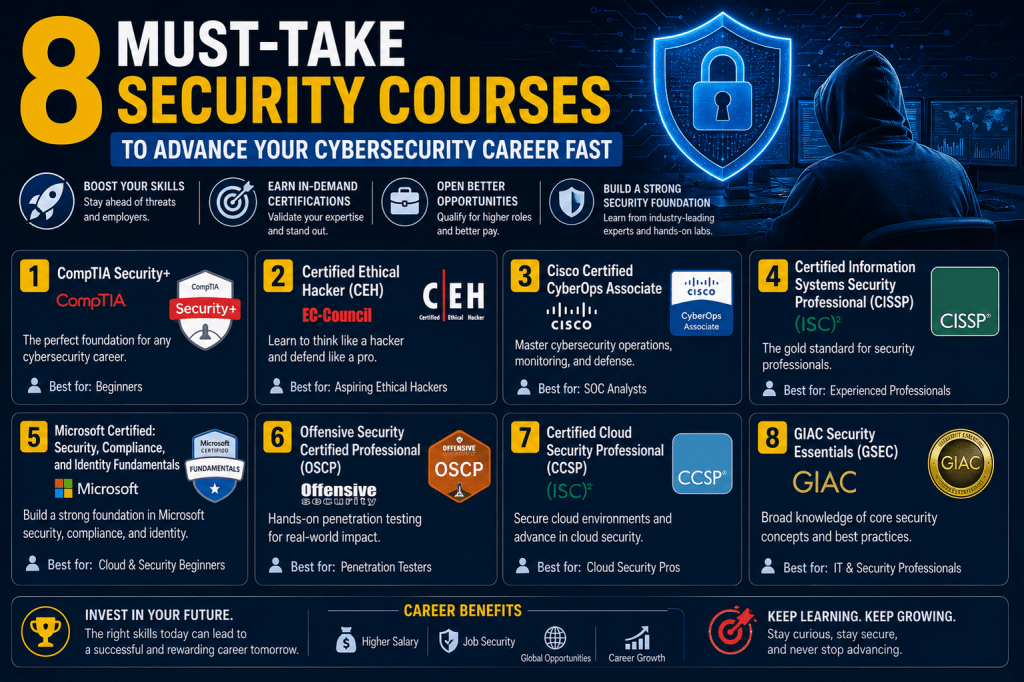
The modern digital environment has become increasingly dependent on interconnected systems, cloud infrastructure, and continuous data exchange. As organizations expand their reliance on technology, the attack surface for cyber threats also grows. This has made information security one of the most critical domains in IT today. Skilled professionals who can understand, prevent, detect, and respond to security incidents are in high demand across industries. This demand is not only driven by the complexity of modern threats but also by the need for structured security frameworks that protect sensitive data and maintain business continuity. Cybersecurity roles now span across multiple disciplines, including network defense, monitoring operations, forensic investigation, and governance practices. For individuals looking to enter or advance in this field, structured learning paths provide a clear way to build both foundational and advanced expertise. The following sections outline key areas of security training that represent essential knowledge domains for building a strong career in information security.
Foundational Cybersecurity Knowledge and Core Security Principles
A strong starting point in cybersecurity begins with understanding core security principles. These include confidentiality, integrity, and availability, which form the foundation of all security strategies. Entry-level training in this area focuses on how data is protected, how threats are identified, and how basic security controls are implemented across systems and networks. Learners are introduced to common vulnerabilities, social engineering tactics, malware types, and basic risk management practices. This foundational knowledge is essential for anyone entering the field, as it provides the vocabulary and conceptual framework used across all advanced security roles. It also helps professionals understand how security policies are applied within organizations and how different technologies work together to protect digital assets. Without this base understanding, it becomes difficult to effectively progress into specialized security domains.
Enterprise Network Security Concepts and Infrastructure Protection
Enterprise environments rely heavily on complex network architectures that connect users, applications, and data across multiple locations. Training in this area focuses on securing these large-scale infrastructures through segmentation, access control, and secure communication protocols. Key concepts include local area network security, routing behavior, switching logic, and traffic segmentation to reduce exposure to threats. Professionals learn how to design secure network topologies that minimize risk while maintaining performance and reliability. This includes understanding how internal traffic is managed, how unauthorized access is prevented, and how network devices enforce security rules. A strong emphasis is placed on protecting both internal and external communication channels, ensuring that data remains secure as it moves across distributed systems. These skills are essential for roles responsible for maintaining enterprise-level infrastructure security.
Security Operations and Threat Monitoring Environments
Security operations training focuses on the continuous monitoring of systems to detect and respond to suspicious activity. In this domain, professionals learn how to analyze logs, identify anomalies, and respond to potential security incidents in real time. Security operations centers serve as the central hub for monitoring organizational security posture, where analysts review alerts generated by various security tools. Training in this area covers incident detection methods, alert triage processes, and escalation procedures for confirmed threats. It also includes understanding attacker behavior patterns and recognizing indicators of compromise across networks and endpoints. The goal is to ensure rapid identification and containment of threats before they can escalate into major incidents. This area of security is highly analytical and requires attention to detail, as well as the ability to correlate data from multiple sources.
Advanced Network Defense and Security Architecture
As organizations grow, their security requirements become more advanced, requiring deeper architectural planning and defense strategies. This training area focuses on designing and implementing layered security models that protect against sophisticated attacks. Topics include secure access control frameworks, encryption methods, identity verification systems, and advanced firewall concepts. Professionals also learn how to integrate security into network architecture from the ground up, rather than treating it as an afterthought. This includes evaluating trust boundaries, enforcing strict authentication mechanisms, and ensuring secure communication between internal systems and external services. The emphasis is on building resilient infrastructure that can withstand both internal misconfigurations and external threats. This level of expertise is typically required for senior-level security engineers and architects.
Digital Forensics and Incident Investigation Techniques
Digital forensics is the process of identifying, preserving, analyzing, and presenting digital evidence following a security incident. Training in this area teaches professionals how to investigate breaches, track unauthorized activity, and reconstruct events leading up to a security compromise. It requires a careful and methodical approach to ensure that evidence remains intact and legally valid. Learners are introduced to techniques for analyzing system logs, recovering deleted data, and tracing network activity to its source. This field also involves understanding legal and regulatory considerations when handling digital evidence. Professionals in this area often support incident response teams by providing detailed insights into how an attack occurred and what systems were affected. Their findings are critical for preventing future incidents and improving organizational defenses.
Cybersecurity Governance, Risk, and Compliance Fundamentals
Security is not only a technical discipline but also a governance-driven function that ensures organizations meet regulatory and risk management requirements. Training in this area focuses on developing policies, assessing risks, and ensuring compliance with industry standards. Professionals learn how to evaluate organizational vulnerabilities from a business perspective and implement controls that align with regulatory frameworks. This includes conducting risk assessments, defining security policies, and establishing procedures for maintaining compliance. Governance training also emphasizes the importance of accountability and documentation in security practices. By understanding how risk is managed at an organizational level, professionals can contribute to strategic decision-making processes that balance security needs with business objectives.
Network Security Appliance Administration and Threat Mitigation Systems
Modern networks often rely on specialized security appliances designed to monitor and control traffic at various points in the infrastructure. Training in this area focuses on configuring, maintaining, and troubleshooting these systems to ensure effective protection against threats. Professionals learn how to implement rules that filter traffic, detect malicious behavior, and enforce security policies across network boundaries. This includes managing updates, monitoring system health, and responding to security alerts generated by these devices. A key aspect of this training is understanding how different security tools integrate into a broader defense strategy. Proper configuration and maintenance of these systems are essential for maintaining a strong security posture and preventing unauthorized access.
Application Delivery Security and Infrastructure Reliability
Application delivery systems play a critical role in ensuring that digital services remain available, secure, and performant. Training in this area focuses on managing traffic flow between users and applications while maintaining security controls. Professionals learn how to troubleshoot connectivity issues, optimize performance, and ensure secure communication between application layers. This includes understanding load balancing concepts, application routing, and failure recovery mechanisms. Security considerations include protecting applications from overload attacks, ensuring secure session handling, and maintaining consistent availability under varying traffic conditions. This domain is particularly important in environments where uptime and performance are critical to business operations.
Conclusion
The field of information security spans a wide range of disciplines, each contributing to the overall protection of digital systems and data. From foundational principles to advanced architectural design, each area of training builds upon the last to create a comprehensive understanding of cybersecurity. As threats continue to evolve, the need for skilled professionals who can operate across multiple domains becomes increasingly important. Whether working in monitoring operations, forensic investigation, governance, or infrastructure security, each specialization plays a vital role in maintaining organizational resilience. Developing expertise across these areas not only strengthens technical capability but also enhances strategic thinking in addressing modern security challenges.