
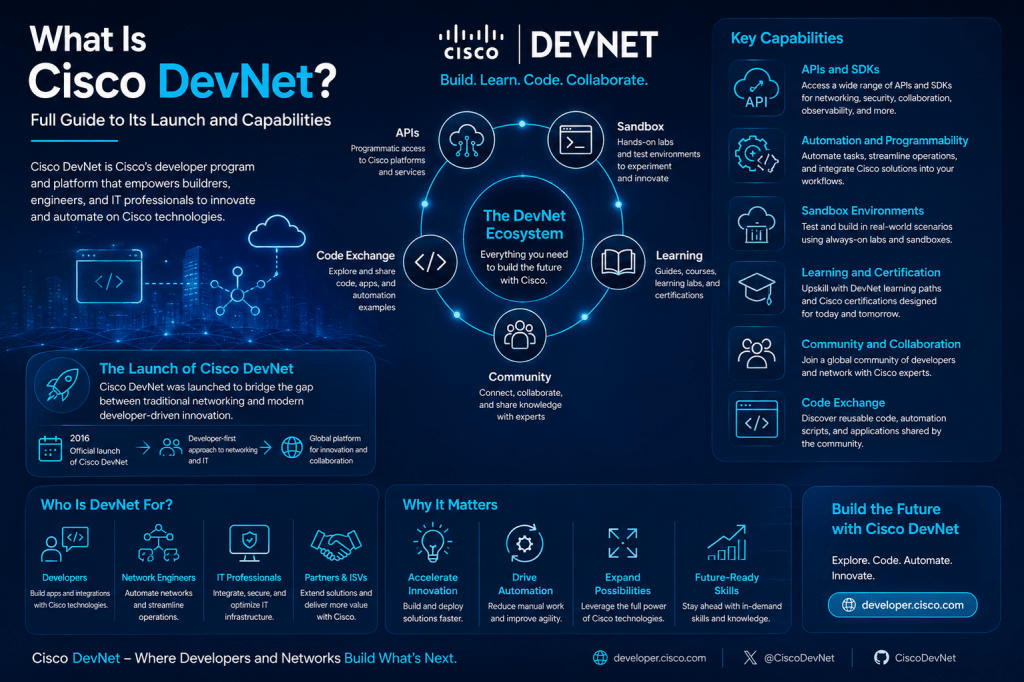
In recent years, the role of software development, automation, and infrastructure programmability has become deeply embedded in modern IT environments. Traditional network management is no longer sufficient on its own, as organizations increasingly rely on software-driven operations and automated workflows. In response to this shift, Cisco introduced a structured certification program focused on development and automation skills within networking and infrastructure ecosystems. This initiative is designed to align professional skills with current industry expectations where code, APIs, and automation frameworks play a central role in day-to-day operations. The program provides a structured pathway for individuals aiming to work in roles that blend networking knowledge with software development practices. It also reflects the growing importance of DevOps methodologies, where collaboration between development and operations teams is essential for faster and more reliable system delivery. The certification track is organized into multiple levels, each representing a different stage of expertise, from foundational understanding to advanced architectural and engineering capabilities. These levels are intended to support both newcomers and experienced professionals as they progress in their careers.
Industry Shift Toward Automation and Programmability
The introduction of a dedicated certification path for development-focused networking reflects a broader transformation in IT operations. Organizations are moving away from manual configuration processes toward automated systems that can scale efficiently and reduce human error. This shift is driven by the increasing complexity of modern infrastructure, which often spans hybrid environments, cloud platforms, and distributed systems. In such environments, traditional command-line management is insufficient, and professionals are expected to understand scripting, APIs, and automation frameworks. The rise of DevOps practices has further reinforced this change by emphasizing continuous integration, continuous deployment, and infrastructure as code. As a result, IT professionals are now required to have hybrid skill sets that combine networking knowledge with software development capabilities. This evolution has created demand for structured validation of skills that go beyond conventional networking certifications. The program is designed to meet this demand by offering a progressive learning path that aligns with real-world job roles in automation, software integration, and infrastructure management.
Cisco DevNet Associate Level
The entry point into this certification pathway is the associate level, which is designed to establish foundational knowledge in programming concepts and network automation principles. At this stage, individuals are expected to understand the basics of software development as it applies to networking environments. This includes familiarity with APIs, fundamental programming logic, and the interaction between software applications and network infrastructure. The associate level also introduces core networking concepts to ensure that candidates have a balanced understanding of both domains. Topics typically include network connectivity principles, basic security considerations, and the role of automation in simplifying operational tasks. While there are no strict prerequisites, practical experience with programming concepts, particularly in scripting languages, is highly beneficial. The associate certification is intended to validate that an individual can understand and work with automation tools in a structured environment. It serves as a foundation for more specialized learning paths and prepares candidates for more advanced technical responsibilities in real-world scenarios.
Cisco DevNet Specialist Level
The specialist level represents a deeper focus on specific domains within the broader field of network automation and programmability. At this stage, professionals are encouraged to align their certification path with their job roles or areas of interest. The specialization options cover various technology domains, including enterprise systems, data center environments, security automation, collaboration platforms, service provider infrastructures, and application development. Each specialization focuses on practical implementation of automation within that specific domain. This allows professionals to gain targeted expertise that is directly applicable to their work environments. The specialist level is designed for individuals who already have some experience in automation or development and want to strengthen their knowledge in a particular area. It also provides flexibility, as professionals can pursue multiple specializations over time to broaden their skill set. This level plays an important role in bridging foundational knowledge with advanced engineering capabilities by emphasizing real-world application of automation tools and programmable infrastructure concepts.
Cisco DevNet Professional Level
The professional level represents an advanced stage in the certification pathway and is designed for individuals who are capable of designing and implementing complex automation solutions. At this level, candidates are expected to demonstrate a deep understanding of software development principles, network architecture, and system integration. The structure typically includes a core component that evaluates broad knowledge across automation, application development, infrastructure design, and security integration. In addition to the core requirement, candidates must also complete a concentration component that allows them to specialize further in a chosen domain. This combination ensures both breadth and depth of knowledge. The professional level is intended for individuals working in roles that require them to design scalable systems, implement automation frameworks, and integrate multiple technologies into cohesive solutions. It reflects a higher level of responsibility where professionals are expected not only to understand systems but also to design and optimize them for efficiency, reliability, and scalability. This stage represents a significant milestone in technical career development within automation-focused IT roles.
Cisco DevNet Expert Level
The expert level is positioned as the highest stage within the certification structure and is intended for highly experienced professionals who operate at an architectural or strategic level. This level focuses on advanced problem-solving, system design, and the ability to build fully automated infrastructure solutions. Candidates are expected to demonstrate mastery in software development, network automation, and system integration across large-scale environments. The assessment at this level is significantly more rigorous and includes both theoretical and practical components. The practical component evaluates the ability to design and implement end-to-end solutions that automate complex network and infrastructure tasks. This requires not only technical knowledge but also the ability to apply that knowledge in real-world scenarios under time constraints. Professionals at this level are typically responsible for leading automation initiatives, designing enterprise-scale systems, and guiding technical strategy within organizations. The expert level represents a culmination of experience and technical mastery in the field of network automation and programmability.
Core Skills and Knowledge Areas
Across all levels of the certification pathway, several core skill areas remain consistently important. These include programming fundamentals, understanding of APIs, knowledge of network protocols, and familiarity with automation frameworks. Security is also a critical component, as automated systems must be designed with proper safeguards to protect data and infrastructure. Additionally, cloud computing concepts play an important role, as many modern systems operate in hybrid or fully cloud-based environments. Professionals are also expected to understand infrastructure as code principles, which allow systems to be defined and managed through software rather than manual configuration. Another key area is system integration, where different tools and platforms must work together seamlessly. These skills collectively form the foundation for effective automation and DevOps practices. As the industry continues to evolve, these competencies are becoming essential for a wide range of technical roles, not limited to traditional networking positions.
Career Relevance and Industry Impact
The structured certification pathway aligns closely with current industry demands for professionals who can bridge the gap between software development and infrastructure management. Organizations increasingly rely on automation to improve efficiency, reduce operational costs, and enhance system reliability. As a result, professionals with skills in both networking and software development are highly valued. This certification structure helps individuals demonstrate their capabilities in these areas in a standardized way. It also provides a clear progression path for career development, allowing professionals to build expertise gradually over time. In addition, the focus on real-world application ensures that skills gained through this pathway are directly relevant to industry needs. This makes it particularly useful for roles in DevOps engineering, network automation, infrastructure development, and systems integration. The emphasis on programmability also reflects the broader trend toward software-defined infrastructure, which continues to reshape how modern IT environments are designed and managed.
Conclusion
The introduction of a structured certification program focused on automation and programmability reflects the ongoing transformation of the IT industry. As organizations continue to adopt more software-driven approaches to infrastructure management, the demand for professionals with hybrid skills in networking and development continues to grow. The multi-level structure of this certification pathway provides a clear progression from foundational knowledge to advanced expertise, supporting career growth at different stages. Each level builds on the previous one, ensuring that professionals develop both theoretical understanding and practical application skills. The emphasis on automation, APIs, and system integration highlights the importance of adaptability in modern IT roles. Ultimately, this certification framework serves as a response to the evolving needs of the industry, where efficiency, scalability, and programmability are central to successful infrastructure management.