Over the past decade, the world of software development has undergone a major transformation. Organizations are no longer relying on slow, rigid development cycles that separate teams and delay releases. Instead, businesses now demand speed, flexibility, and continuous delivery of high-quality applications. This shift has created the need for a role that can unify development and operations into a seamless process. That role is the DevOps architect.
The rise of DevOps architecture is directly linked to the growing complexity of modern systems. Applications today are distributed across cloud platforms, rely on microservices, and must scale instantly to meet user demand. Managing such environments requires more than technical knowledge. It requires a strategic approach that connects tools, teams, and workflows into a unified system.
DevOps architects are responsible for building this connection. They ensure that every part of the software lifecycle works efficiently, from initial development to final deployment. Their work reduces delays, eliminates bottlenecks, and improves overall system reliability, making them essential in modern organizations.
Defining the Role of a DevOps Architect
A DevOps architect is a professional who designs and implements systems that enable efficient and reliable software delivery. Unlike traditional roles that focus on a single area, this position requires a broad understanding of both development and operations.
They are responsible for creating frameworks that support continuous integration, continuous delivery, and automated deployment. This involves selecting the right tools, designing workflows, and ensuring that systems are scalable and secure. Their role is not limited to technical tasks; they also focus on improving collaboration between teams.
DevOps architects analyze existing processes to identify inefficiencies and areas for improvement. They then design solutions that streamline operations and enhance productivity. This often includes integrating multiple tools into a single cohesive system that supports automation and monitoring.
The Core Purpose Behind DevOps Practices
The primary goal of DevOps is to improve collaboration and efficiency across teams. Traditional development models often created silos, where development and operations teams worked independently. This separation led to delays, miscommunication, and increased risk of errors.
DevOps eliminates these barriers by promoting shared responsibility and continuous communication. A DevOps architect plays a key role in implementing this approach by designing processes that encourage teamwork and transparency.
Automation is another critical component of DevOps practices. Manual processes are time-consuming and prone to mistakes. DevOps architects replace these processes with automated systems that increase speed and accuracy. This allows teams to focus on innovation rather than repetitive tasks.
The overall objective is to create a system where software can be developed, tested, and deployed quickly and reliably. This enables organizations to respond to market demands and deliver value to users more effectively.
Why DevOps Architects Are in High Demand
The demand for DevOps architects has increased significantly as organizations recognize the importance of efficient software delivery. Businesses across industries rely on technology to remain competitive, and they need professionals who can design systems that support rapid development and deployment.
DevOps architects bring a unique combination of technical and strategic skills. They understand how systems work and how teams interact, allowing them to create solutions that address complex challenges. Their ability to deliver measurable improvements makes them highly valuable.
The growing adoption of cloud computing has also contributed to this demand. Cloud environments require careful planning to ensure performance, security, and cost efficiency. DevOps architects are responsible for designing and managing these environments effectively.
Their expertise in automation, scalability, and system design makes them essential to modern organizations, leading to strong demand and competitive salaries.
Key Skills That Define a DevOps Architect
To succeed in this role, a DevOps architect must possess a wide range of skills. Technical expertise is important, but it must be combined with problem-solving abilities and strategic thinking.
A deep understanding of the software development lifecycle is essential. This includes knowledge of coding, testing, deployment, and maintenance. DevOps architects must design processes that optimize each stage of this lifecycle.
Automation skills are also critical. They must be familiar with tools and technologies that enable automated workflows. This includes scripting, configuration management, and deployment pipelines.
Communication is another key skill. DevOps architects work with multiple teams and must be able to explain complex concepts clearly. Strong communication helps ensure that everyone is aligned and working toward common goals.
The Importance of Cross-Functional Experience
DevOps architects often have experience in multiple areas of technology. This cross-functional background allows them to understand different perspectives and identify opportunities for improvement.
Many professionals in this role start their careers in software development, system administration, or network engineering. Over time, they gain experience in cloud computing, security, and infrastructure management. This diverse knowledge enables them to design systems that meet a wide range of requirements.
Cross-functional experience also improves problem-solving abilities. DevOps architects can draw on their knowledge from different areas to develop effective solutions. This makes them valuable contributors to any organization.
How DevOps Architects Drive Organizational Change
One of the most important aspects of this role is driving change within an organization. Implementing DevOps practices often requires a shift in both technology and culture. Teams must adopt new ways of working and embrace continuous improvement.
DevOps architects lead this transformation by introducing new tools and processes. They work closely with teams to ensure that changes are implemented successfully. This includes providing training, guidance, and ongoing support.
Change can be challenging, especially in organizations with established practices. DevOps architects must be able to build trust and encourage adoption of new methods. Their ability to influence others is critical to the success of DevOps initiatives.
The Role of Continuous Integration and Delivery
Continuous integration and continuous delivery are key components of DevOps architecture. These practices enable teams to integrate code changes frequently and deploy updates quickly and reliably.
A DevOps architect designs systems that support these practices by creating automated pipelines. These pipelines handle tasks such as building, testing, and deploying applications. This reduces manual effort and ensures consistency.
Continuous integration helps identify issues early by testing code changes before they are merged. Continuous delivery automates the deployment process, allowing updates to be released efficiently. Together, these practices improve both speed and quality.
Automation as a Foundation of DevOps
Automation is a central element of DevOps architecture. It allows organizations to streamline processes, reduce errors, and improve efficiency. DevOps architects design systems that incorporate automation at every stage of the development lifecycle.
Tasks such as code integration, testing, deployment, and infrastructure management can all be automated. This reduces the need for manual intervention and increases reliability.
Automation also supports scalability. As systems grow, they must be able to handle increased demand. DevOps architects design solutions that can scale effectively while maintaining performance.
The Strategic Value of DevOps Architects
DevOps architects play a vital role in shaping an organization’s technology strategy. Their work has a direct impact on business performance, customer satisfaction, and competitiveness.
By designing efficient systems, they enable organizations to deliver high-quality software quickly and consistently. This improves user experience and strengthens the organization’s position in the market.
Their strategic perspective allows them to identify opportunities for innovation. They work closely with leadership to align technology initiatives with business goals, ensuring that resources are used effectively.
The Long-Term Outlook for DevOps Careers
The future of DevOps architecture is strong as organizations continue to invest in digital transformation. The need for professionals who can manage complex systems and drive efficiency is expected to grow.
DevOps architects are well-positioned to take advantage of these opportunities. Their combination of technical expertise and strategic thinking makes them valuable in any industry.
As technology evolves, the role will continue to change. New tools and practices will emerge, requiring continuous learning and adaptation. Those who stay updated will remain competitive and advance their careers.
The increasing importance of cloud computing, automation, and scalable systems ensures that DevOps architects will remain in high demand, making it a stable and rewarding career path.
DevOps Architect Salary Trends and Market Overview
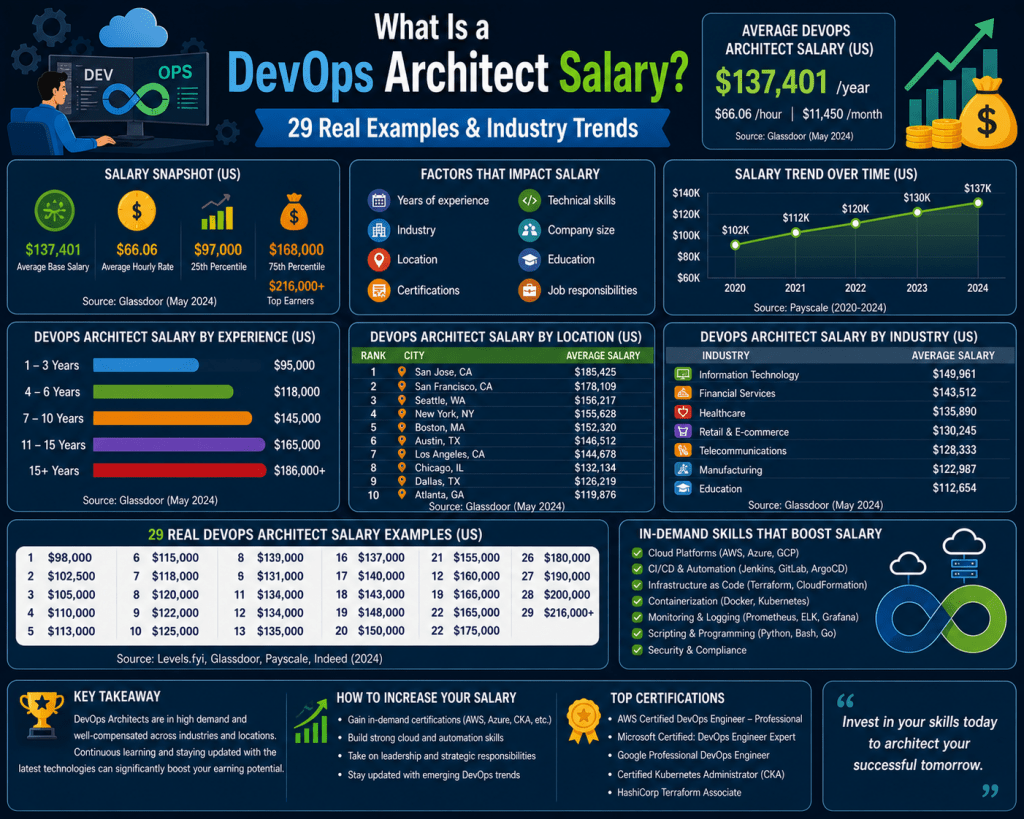
The salary of a DevOps architect reflects the importance and complexity of the role in modern organizations. As companies continue to adopt advanced development practices, the need for professionals who can design, manage, and optimize these systems has grown significantly. This demand has led to strong and consistent salary growth across the industry.
Unlike many traditional roles, DevOps architecture does not have a narrow salary band. Instead, compensation varies widely depending on several factors such as experience, geographic location, industry demand, and technical expertise. This variation makes it essential for professionals to understand the broader market rather than relying on a single average figure.
Organizations are willing to invest in DevOps architects because they directly contribute to faster delivery cycles, improved system reliability, and reduced operational costs. These benefits translate into measurable business outcomes, which justify the high salaries associated with the role.
Understanding Average Salary Ranges
DevOps architect salaries are typically categorized into three levels: lower range, mid-range, and high range. Each of these reflects a different level of experience and responsibility.
The lower range usually includes professionals who are transitioning into architecture roles. These individuals often have strong technical backgrounds but may still be developing their strategic and leadership skills. Even at this level, salaries remain competitive compared to many other technology roles.
The mid-range represents experienced professionals who have successfully designed and implemented DevOps solutions. They are capable of handling complex systems and leading teams, making them valuable assets to organizations.
The high range includes senior architects with extensive experience and proven success in large-scale environments. These professionals often lead major transformation initiatives and influence organizational strategy. Their expertise commands premium compensation, often significantly higher than the average.
The Role of Geographic Location in Salary Differences
Geographic location plays a major role in determining salary levels for DevOps architects. Regions with a high concentration of technology companies tend to offer higher salaries due to increased demand and talent competition.
Large metropolitan areas often provide the highest compensation. These regions typically have a strong presence of technology firms, startups, and innovation hubs. The cost of living in these areas is also higher, which contributes to increased salary levels.
Smaller cities and developing regions may offer lower salaries, but they can still provide strong earning potential. In many cases, the lower cost of living balances the difference in pay, allowing professionals to maintain a comfortable lifestyle.
Remote work has started to reshape this landscape. Many companies now hire talent from different regions, offering competitive salaries regardless of location. This trend has created new opportunities for professionals to access higher-paying roles without relocating.
Industry-Based Salary Variations
DevOps architects are needed in a wide range of industries, and each sector offers different salary levels based on its specific requirements and challenges.
Technology companies often provide the highest salaries because they rely heavily on continuous development and deployment. These organizations require advanced infrastructure and automation, making DevOps architects essential to their operations.
Financial services organizations also offer competitive compensation. They require highly secure and reliable systems to handle sensitive data and transactions. DevOps architects in this sector must balance performance with strict compliance requirements.
Healthcare is another growing field for DevOps professionals. As healthcare systems become more digital, the need for efficient and secure infrastructure increases. While salaries may vary, the demand for skilled professionals continues to rise.
Retail and e-commerce companies depend on scalable systems to manage high volumes of users and transactions. DevOps architects play a key role in ensuring these systems remain reliable, especially during peak demand periods.
Experience as a Key Salary Driver
Experience is one of the most influential factors in determining salary. DevOps architects are expected to have a deep understanding of both development and operations, which typically requires years of hands-on work.
Early in their careers, professionals focus on building foundational skills in coding, system administration, and cloud technologies. As they gain experience, they begin to take on more complex responsibilities, such as designing systems and managing workflows.
Senior professionals bring a wealth of knowledge and a proven track record of success. They are capable of leading large projects, mentoring teams, and making strategic decisions. This level of expertise significantly increases earning potential.
Continuous learning is essential for maintaining career growth. The technology landscape evolves rapidly, and professionals must stay updated to remain competitive in the job market.
Technical Skills That Impact Salary Growth
Technical expertise is a major factor in salary progression. DevOps architects must be proficient in a wide range of tools and technologies, each contributing to their overall value.
Version control systems are fundamental to modern development. They enable teams to manage code changes efficiently and support collaboration. Mastery of these systems is essential for any DevOps professional.
Containerization technologies allow applications to run consistently across different environments. This capability is critical for building scalable systems and is highly valued by employers.
Container orchestration platforms help manage complex applications by automating deployment, scaling, and maintenance. Knowledge of these tools is often required for higher-paying roles.
Infrastructure as code enables architects to define and manage infrastructure using code. This approach improves consistency and reduces manual effort, making it a key skill in modern DevOps practices.
Monitoring and logging tools provide visibility into system performance. They help identify issues early and ensure that systems remain reliable. Professionals who can implement effective monitoring solutions are in high demand.
The Importance of Soft Skills in Career Advancement
In addition to technical expertise, soft skills play a critical role in salary growth. DevOps architects often work in leadership positions, where they must coordinate teams and influence decisions.
Communication is essential for explaining complex concepts to different audiences. Clear communication ensures that all stakeholders understand the goals and processes involved.
Leadership skills are also important. DevOps architects are often responsible for guiding teams and managing projects. Strong leadership can significantly impact career progression and earning potential.
Problem-solving abilities are highly valued. The ability to identify challenges and develop effective solutions is a key part of the role. Employers look for professionals who can handle complex situations and deliver results.
Adaptability is another important skill. The technology landscape is constantly changing, and professionals must be able to learn new tools and adjust to new practices.
Understanding Market Variability and Salary Gaps
Salary variability is common in the DevOps field. Even within the same region, compensation can differ based on factors such as company size, project complexity, and individual performance.
Large organizations often offer higher salaries due to their resources and the scale of their operations. These companies require advanced systems and experienced professionals to manage them.
Smaller companies and startups may offer lower base salaries but provide other benefits such as flexibility or growth opportunities. These roles can still be valuable for gaining experience and building a career.
Market conditions also influence salary levels. Changes in technology, economic trends, and industry demand can all impact compensation. Staying informed about these factors can help professionals make better career decisions.
The Impact of Remote Work on Salary Structures
Remote work has become an important factor in the DevOps job market. It has expanded opportunities for professionals and changed how companies approach hiring.
Organizations can now access talent from around the world, increasing competition and raising salary standards. This has created more opportunities for DevOps architects to secure higher-paying roles.
Remote work also provides flexibility, allowing professionals to choose work environments that suit their preferences. This can improve job satisfaction and overall productivity.
However, remote work requires strong communication and collaboration skills. DevOps architects must be able to work effectively with distributed teams and manage projects across different time zones.
Strategies for Increasing Salary Potential
Increasing salary as a DevOps architect requires a combination of skill development, experience, and strategic career planning. Professionals must focus on continuous improvement and staying relevant in a rapidly changing field.
Gaining expertise in high-demand technologies is one of the most effective ways to increase earning potential. This includes cloud platforms, automation tools, and containerization systems.
Building a strong professional network can also open doors to new opportunities. Connections within the industry provide valuable insights and can lead to career advancement.
Taking on leadership roles and demonstrating the ability to manage projects can further enhance earning potential. Employers value professionals who can deliver results and drive organizational success.
Understanding market trends and salary benchmarks is also important. Knowing your value in the job market helps in negotiating better compensation.
Future Outlook for DevOps Architect Salaries
The future of DevOps architect salaries remains strong as organizations continue to invest in technology and digital transformation. The demand for professionals who can design and manage complex systems is expected to grow.
Emerging technologies will play a significant role in shaping the future of the field. DevOps architects who can integrate new tools and practices into their workflows will be highly sought after.
Security and compliance will also become increasingly important. Organizations need systems that are not only efficient but also secure and reliable. Professionals who can address these requirements will command higher salaries.
As the role continues to evolve, DevOps architects who focus on continuous learning and skill development will remain competitive and achieve long-term career success.
Certifications That Strengthen a DevOps Architect Career
Certifications play a significant role in validating the skills and expertise required for a DevOps architect. While hands-on experience is essential, certifications provide structured proof of knowledge that employers often look for when evaluating candidates. They demonstrate a professional’s commitment to learning and staying current with industry standards.
One of the key benefits of certifications is that they cover a wide range of topics, including cloud platforms, automation practices, and system design. This aligns closely with the responsibilities of a DevOps architect, who must understand both technical implementation and strategic planning. Certifications also help bridge knowledge gaps, ensuring that professionals are well-rounded in their approach.
In competitive job markets, certifications can set candidates apart. Employers often use them as a benchmark to assess expertise, especially when hiring for senior roles. Professionals with recognized credentials are more likely to secure higher-paying positions and advance more quickly in their careers.
Another advantage is the confidence that certifications bring. They allow professionals to approach complex challenges with a structured understanding of best practices. This confidence often translates into better performance, which in turn supports career growth and increased earning potential.
Cloud Platform Expertise and Its Impact on Careers
Cloud computing has become a central component of modern DevOps practices. Organizations rely on cloud platforms to build, deploy, and scale applications efficiently. As a result, DevOps architects must have a deep understanding of cloud environments.
Cloud expertise involves more than just deploying applications. It includes designing scalable architectures, managing resources efficiently, and ensuring security and compliance. DevOps architects must be able to create systems that adapt to changing demands without compromising performance.
Knowledge of cloud platforms also enables professionals to work with advanced tools and services. These platforms offer a wide range of capabilities, from automated deployment pipelines to monitoring and analytics solutions. Understanding how to leverage these tools effectively is essential for success.
The demand for cloud expertise continues to grow as organizations migrate their systems to cloud environments. DevOps architects who specialize in cloud technologies are often in high demand and command higher salaries. Their ability to design and manage complex systems makes them valuable assets to any organization.
The Importance of Containerization and Orchestration
Containerization has become a standard practice in modern software development. It allows applications to run consistently across different environments, reducing compatibility issues and improving efficiency. DevOps architects must understand how to design and manage containerized systems.
Containers package applications along with their dependencies, ensuring that they behave the same way regardless of where they are deployed. This consistency is critical for maintaining reliability and reducing errors. DevOps architects use containerization to simplify deployment and improve scalability.
Orchestration tools take this concept further by managing multiple containers at scale. They automate tasks such as deployment, scaling, and monitoring, making it easier to manage complex systems. DevOps architects must be proficient in these tools to design systems that can handle high levels of demand.
The combination of containerization and orchestration is a key driver of modern DevOps practices. Professionals who master these technologies are better equipped to build scalable and efficient systems, which enhances their career prospects and earning potential.
Infrastructure as Code and Automation Strategies
Infrastructure as code is a fundamental concept in DevOps architecture. It involves defining and managing infrastructure using code rather than manual processes. This approach improves consistency, reduces errors, and enables faster deployment.
DevOps architects use infrastructure as code to create repeatable and scalable systems. By defining infrastructure in code, they can ensure that environments are consistent across different stages of development. This eliminates many of the issues associated with manual configuration.
Automation is closely linked to infrastructure as code. It allows tasks such as provisioning, configuration, and deployment to be performed automatically. This reduces the need for manual intervention and increases efficiency.
Automation strategies also support continuous integration and delivery. By automating these processes, DevOps architects can ensure that code changes are tested and deployed quickly and reliably. This improves both speed and quality, making it a critical component of modern development practices.
Monitoring, Logging, and System Reliability
Monitoring and logging are essential for maintaining system reliability. DevOps architects must design systems that provide real-time insights into performance and identify potential issues before they become critical.
Monitoring involves tracking system metrics such as performance, availability, and resource usage. This information helps teams understand how systems are behaving and where improvements are needed. DevOps architects use monitoring tools to ensure that systems remain stable and efficient.
Logging provides detailed records of system activity. It allows teams to analyze events, troubleshoot issues, and understand the root cause of problems. Effective logging is essential for maintaining transparency and accountability.
Together, monitoring and logging contribute to system reliability. DevOps architects must design solutions that integrate these capabilities seamlessly, ensuring that systems can be maintained and improved over time.
Security Practices in DevOps Architecture
Security is a critical aspect of DevOps architecture. As systems become more complex and interconnected, the risk of vulnerabilities increases. DevOps architects must ensure that security is integrated into every stage of the development lifecycle.
This approach, often referred to as integrating security into development processes, involves implementing measures such as automated testing, access controls, and encryption. By addressing security early, DevOps architects can reduce the risk of breaches and protect sensitive data.
Security also involves compliance with industry standards and regulations. DevOps architects must design systems that meet these requirements while maintaining efficiency and performance. This requires a balance between security and usability.
The growing importance of security has made it a key factor in career advancement. Professionals who can design secure systems are highly valued and often command higher salaries.
Industries That Offer High Opportunities for DevOps Architects
DevOps architects are needed in a wide range of industries, each offering unique opportunities and challenges. Understanding these industries can help professionals identify areas where their skills are most valuable.
The technology sector remains one of the largest employers of DevOps architects. Companies in this field rely heavily on continuous development and deployment, making DevOps expertise essential.
Financial services organizations also offer significant opportunities. They require secure and reliable systems to handle sensitive transactions and data. DevOps architects in this sector must focus on both performance and compliance.
Healthcare is another growing field. As healthcare systems become more digital, the need for efficient and secure infrastructure increases. DevOps architects play a key role in supporting these systems.
Retail and e-commerce companies depend on scalable systems to manage high levels of traffic. DevOps architects ensure that these systems remain reliable, especially during peak periods.
The Role of Leadership in Career Advancement
Leadership is a critical factor in advancing a DevOps architect’s career. As professionals gain experience, they are often required to take on leadership roles and guide teams.
Leadership involves more than managing people. It includes setting direction, making strategic decisions, and ensuring that projects are completed successfully. DevOps architects must be able to inspire and motivate teams to achieve their goals.
Effective leadership also requires strong communication skills. DevOps architects must be able to explain complex concepts and align teams around shared objectives. This helps ensure that everyone is working toward the same goals.
Leadership skills can significantly impact earning potential. Professionals who demonstrate strong leadership are more likely to secure senior roles and higher salaries.
Building a Long-Term Career Strategy
A successful career as a DevOps architect requires careful planning and continuous development. Professionals must focus on building both technical and strategic skills to remain competitive.
One important aspect of career strategy is setting clear goals. This includes identifying the skills and experience needed to achieve desired positions. By focusing on these goals, professionals can make informed decisions about their career paths.
Continuous learning is also essential. The technology landscape is constantly evolving, and professionals must stay updated with the latest tools and practices. This ensures that they remain relevant and competitive in the job market.
Networking is another important factor. Building connections within the industry can lead to new opportunities and provide valuable insights. Professionals who actively engage with their peers are more likely to advance in their careers.
Adapting to Emerging Technologies
The field of DevOps is constantly evolving, with new technologies and practices emerging regularly. DevOps architects must be able to adapt to these changes and incorporate new tools into their workflows.
Emerging technologies such as advanced automation and intelligent systems are shaping the future of DevOps. These tools offer new ways to improve efficiency and performance, but they also require new skills and knowledge.
DevOps architects must stay informed about these developments and be willing to learn. This adaptability is essential for maintaining relevance and achieving long-term success.
The ability to integrate new technologies into existing systems is a valuable skill. It allows organizations to stay competitive and take advantage of new opportunities.
Maximizing Earning Potential Over Time
Maximizing earning potential requires a combination of experience, skill development, and strategic decision-making. DevOps architects must focus on continuous improvement and staying ahead of industry trends.
One effective approach is to specialize in high-demand areas such as cloud computing, automation, and security. These skills are highly valued and can lead to higher salaries.
Taking on challenging projects can also contribute to career growth. By demonstrating the ability to handle complex tasks, professionals can build a strong reputation and increase their value.
Negotiation skills are another important factor. Understanding market trends and salary benchmarks allows professionals to negotiate better compensation. This ensures that they are fairly rewarded for their contributions.
The Future of DevOps Architecture Careers
The future of DevOps architecture is promising, with strong demand expected to continue. As organizations invest in digital transformation, the need for skilled professionals will only increase.
DevOps architects will play a key role in shaping the future of technology. Their ability to design efficient systems and drive innovation makes them essential to modern organizations.
The role will continue to evolve as new technologies emerge. Professionals who focus on continuous learning and adaptability will be well-positioned to succeed.
The combination of high demand, strong salaries, and opportunities for growth makes DevOps architecture an attractive career path for those interested in technology and innovation.
Conclusion
The role of a DevOps architect represents one of the most impactful and strategically important positions in modern technology environments. As organizations continue to prioritize speed, efficiency, and reliability, the need for professionals who can design and manage integrated systems has only increased. DevOps architects stand at the intersection of development and operations, ensuring that workflows are streamlined, automated, and aligned with business goals.
Throughout this discussion, it becomes clear that the value of a DevOps architect goes far beyond technical execution. These professionals are responsible for shaping how software is built, tested, and delivered. They influence organizational culture by promoting collaboration, reducing silos, and encouraging continuous improvement. Their ability to connect technical processes with business outcomes makes them essential contributors to long-term success.
Salary trends strongly reflect this importance. DevOps architects consistently earn competitive compensation due to the complexity of their responsibilities and the measurable impact they bring to organizations. However, earning potential is not fixed. It is influenced by a combination of factors,s including experience, location, industry, and skill set. Professionals who invest in continuous learning, develop expertise in high-demand technologies, and build strong leadership capabilities are more likely to reach the higher end of the salary spectrum.
Technical skills remain a core requirement, but they are only part of the equation. Mastery of automation, cloud platforms, containerization, and infrastructure as code is essential for designing scalable and reliable systems. At the same time, soft skills such as communication, leadership, and problem-solving play a crucial role in career advancement. DevOps architects must be able to guide teams, influence decisions, and drive organizational change effectively.
Another key takeaway is the importance of adaptability. The technology landscape is constantly evolving, with new tools, platforms, and practices emerging regularly. DevOps architects who stay current with these changes and embrace continuous learning will maintain their relevance and competitive edge. This adaptability not only supports career growth but also opens doors to new opportunities and higher compensation.
The growing adoption of remote work has also expanded possibilities for DevOps professionals. It has made high-paying roles more accessible and allowed organizations to tap into a broader talent pool. This shift has created a more dynamic and competitive job market, benefiting those who are prepared to meet its demands.
Looking ahead, the future of DevOps architecture remains strong. As businesses continue to invest in digital transformation, the demand for skilled architects will continue to rise. Their role in enabling faster delivery, improving system reliability, and supporting innovation ensures that they will remain central to modern technology strategies.
In the end, a successful DevOps architect career is built on a combination of experience, technical expertise, strategic thinking, and continuous improvement. Those who focus on developing these areas will not only achieve strong financial rewards but also play a critical role in shaping the future of technology within their organizations.