
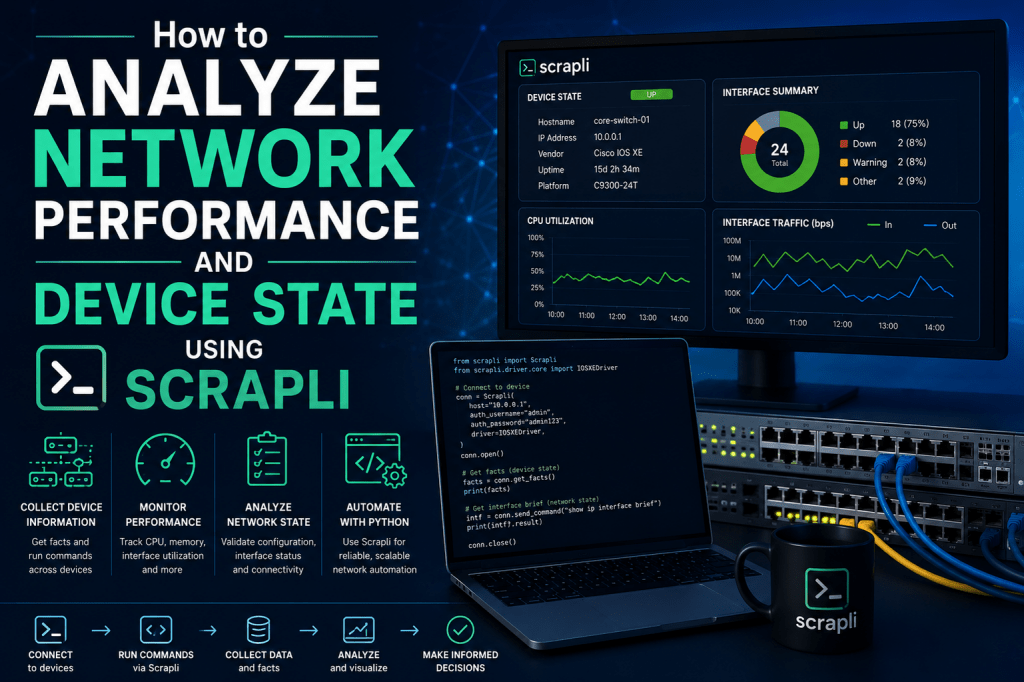
Network automation has transformed the way engineers manage infrastructure. Instead of manually logging into routers and switches to perform repetitive operational tasks, automation tools now allow engineers to control and monitor devices through scripts and APIs. This shift has improved efficiency, reduced operational errors, and made large-scale network management significantly easier. As enterprise environments continue to expand, automation is becoming a critical skill for every network professional. Scrapli is one of the most effective Python libraries for engineers who want to automate CLI-based network operations while maintaining flexibility and simplicity.
Why Scrapli Is Important for Engineers
Scrapli is a Python library designed specifically for interacting with network devices through command-line interfaces. It enables engineers to establish secure connections to routers and switches, execute commands, and retrieve operational information programmatically. The library supports multiple network operating systems including Cisco IOS XE, IOS XR, Juniper Junos, and Arista EOS. This broad compatibility makes Scrapli an excellent solution for environments containing equipment from different vendors. Because the library focuses on simplicity and performance, engineers can build automation workflows quickly without dealing with unnecessary complexity.
The Meaning Behind the Name Scrapli
The name Scrapli is derived from two concepts: “scrape” and “CLI.” The scraping component refers to reading and processing text output from device terminals, while CLI refers to the command-line interface used to manage network equipment. Together, these concepts describe exactly how Scrapli works. The library connects to devices, sends commands, captures CLI responses, and makes the returned information accessible through Python code. This approach allows engineers to automate operational tasks without requiring advanced APIs or telemetry systems.
How Network State Analysis Works
Analyzing network state means determining whether infrastructure components are functioning correctly. In most environments, the desired state is operational availability, meaning routers, switches, and interfaces remain active and reachable. A degraded state may include failed interfaces, disconnected devices, routing problems, or administrative shutdowns. Scrapli helps automate this analysis by retrieving operational command output directly from network devices. Engineers can then process the returned data to identify failures, monitor health, and generate alerts automatically.
Why Python Is Essential for Automation
Python has become the preferred programming language for network automation because of its readability and extensive ecosystem of libraries. Engineers can learn the basics relatively quickly while still building powerful automation workflows. Python also integrates well with networking tools, APIs, databases, and monitoring systems. Scrapli itself is built for Python, making knowledge of the language essential for using the library effectively. Even a basic understanding of variables, dictionaries, loops, and functions can dramatically improve an engineer’s ability to automate infrastructure operations.
Preparing a Python Environment
Before using Scrapli, engineers must ensure Python is installed on their systems. Most automation projects rely on Python 3 because it includes modern language features and improved package management support. Once Python is installed, the next step involves verifying pip availability. Pip is Python’s package manager and is responsible for installing external libraries such as Scrapli. Having a properly configured development environment ensures automation scripts run reliably and prevents dependency-related issues during development.
Understanding the Role of Pip
Pip is one of the most important utilities in the Python ecosystem. It allows developers to download, install, and manage external Python libraries from centralized repositories. Without pip, installing dependencies manually would be time-consuming and error-prone. For automation engineers, pip simplifies the process of expanding Python functionality. Whether installing Scrapli, Flask, Pandas, or Netmiko, pip provides a standardized installation method that works across different operating systems and environments.
Installing Scrapli Successfully
Installing Scrapli is typically done through a single pip command executed from the terminal or command prompt. Once executed, pip automatically downloads the required packages and configures them for use within Python. This process demonstrates one of Python’s greatest advantages: rapid extensibility. Engineers can gain access to sophisticated automation frameworks within minutes. After installation completes, Scrapli becomes available for import within any Python script on the system.
Verifying the Installation Process
After installation, it is important to verify that Scrapli is functioning correctly. Engineers can do this by opening a Python interpreter and attempting to import the library manually. If the import executes successfully without errors, the environment is properly configured. Testing installations immediately helps identify issues early and ensures the development environment is ready before writing larger automation scripts.
Choosing a Development Environment
A reliable code editor improves productivity significantly when working with automation projects. Many engineers prefer Visual Studio Code because it includes Python syntax highlighting, integrated terminals, debugging tools, and extension support. A proper development environment reduces coding mistakes and improves readability. Organizing automation projects within dedicated directories also helps maintain clean workflows and simplifies troubleshooting later.
Creating a Python Script File
Python scripts are stored using the .py file extension. Creating a dedicated script file is usually the first step in building an automation workflow. Engineers often use descriptive filenames to reflect the script’s purpose, making future maintenance easier. A well-organized project structure becomes increasingly important as automation projects expand and include multiple scripts, templates, or configuration files.
Importing Scrapli Into a Project
Once the script file is created, the next step involves importing the appropriate Scrapli driver. Drivers are specialized classes that understand how to communicate with different network operating systems. Selecting the correct driver is essential because each vendor uses unique CLI behavior and command structures. Importing the proper module ensures the automation script interacts with the device correctly and avoids compatibility issues.
Understanding Platform Drivers
Platform drivers are one of Scrapli’s most valuable features. Instead of requiring engineers to handle low-level SSH behavior manually, Scrapli abstracts those differences through vendor-specific drivers. Cisco IOS XE devices, for example, use a different driver than Juniper Junos devices. This abstraction simplifies automation significantly because engineers can focus on operational logic rather than connection handling details.
Representing Devices Using Dictionaries
Python dictionaries provide an efficient way to store device information. A dictionary contains key-value pairs that represent attributes such as hostnames, usernames, passwords, and authentication settings. This structure keeps scripts organized and readable while making device information easy to retrieve. Dictionaries also support scalability because engineers can create inventories containing multiple devices and iterate through them programmatically.
Why Dictionaries Are Useful in Automation
Dictionaries are widely used in automation because they allow rapid access to stored data. Engineers can quickly retrieve connection parameters using descriptive keys rather than relying on positional variables. This improves readability and reduces the likelihood of mistakes. Dictionaries also integrate naturally with JSON data structures, which are commonly used in APIs and automation platforms.
Defining Device Authentication Parameters
Authentication parameters are required for establishing secure connections to network devices. These parameters typically include the hostname or IP address, authentication username, password, and SSH verification settings. Properly defining these values allows Scrapli to establish communication with routers and switches successfully. Incorrect authentication parameters are one of the most common causes of connection failures during automation development.
Understanding SSH Verification Settings
SSH key verification helps ensure devices are authentic before connections are established. In lab environments, engineers often disable strict verification to simplify testing. However, production environments usually require stronger security controls. Understanding how SSH verification works is important because automation scripts frequently interact with sensitive infrastructure. Secure credential management and proper authentication handling should always remain priorities in enterprise automation workflows.
Connecting to Devices Programmatically
After defining device parameters, the automation script can establish a connection to the target router or switch. Scrapli creates a connection object that manages the SSH session and provides methods for interacting with the device. Through this object, engineers can send commands, retrieve output, and automate operational workflows efficiently. Establishing reliable connections is the foundation of all network automation activities.
Using Context Managers in Python
Python context managers provide a clean way to handle resources such as SSH sessions. By using a with statement, engineers allow Python to automatically open and close connections when needed. This reduces the risk of resource leaks or orphaned sessions. Context managers are considered best practice because they improve script reliability and simplify connection management significantly.
Why Proper Session Management Matters
Managing sessions correctly becomes increasingly important as automation projects scale. Scripts interacting with dozens or hundreds of devices must ensure sessions close properly after execution. Failure to manage connections efficiently can exhaust system resources or leave stale SSH sessions active on network devices. Using context managers helps prevent these problems automatically.
Understanding Object-Oriented Programming Concepts
Scrapli relies heavily on object-oriented programming principles. In Python, classes define reusable templates for creating objects. Scrapli drivers are examples of classes specifically designed for interacting with network devices. When engineers create a connection instance, they are creating an object based on that class. Understanding this relationship helps engineers use automation libraries more effectively and prepares them for larger software development concepts.
Why Object-Oriented Design Improves Automation
Object-oriented design promotes modularity and code reuse. Instead of rewriting connection logic repeatedly, engineers can rely on prebuilt classes optimized for networking tasks. This structure makes automation scripts cleaner, easier to maintain, and more scalable. As infrastructure projects grow more complex, object-oriented programming becomes increasingly valuable for organizing and managing automation code efficiently.
Building a Scrapli Connection Object
After importing the correct Scrapli driver and defining the target device information, the next step is creating the connection object. The connection object is responsible for handling communication between the Python script and the network device. In simple terms, this object acts as the bridge between your automation code and the router or switch you want to manage. Without the connection object, the script would have no way to send commands or retrieve operational data from the network infrastructure.
When engineers create a Scrapli connection object, they are essentially instructing Python to prepare an SSH session with the target device. The object contains all the methods necessary for opening sessions, sending commands, receiving responses, and closing connections properly. This process is one of the most important parts of network automation because reliable connectivity is the foundation for every automation workflow.
Understanding Driver Instantiation
In Python, creating an object from a class is known as instantiation. Scrapli uses platform-specific driver classes to establish communication with network operating systems. For example, Cisco IOS XE devices use the IOSXEDriver class. When the driver is instantiated, Scrapli prepares all the required communication settings for interacting with that particular device type.
The driver object inherits methods and properties designed specifically for network automation tasks. These built-in capabilities simplify development significantly because engineers do not need to manually code low-level SSH functionality. Scrapli handles the connection process internally while exposing easy-to-use methods for automation workflows.
Driver instantiation also improves consistency. Instead of writing unique SSH logic for every vendor platform, engineers can rely on Scrapli’s standardized architecture. This reduces complexity and makes automation scripts easier to maintain over time.
Why Context Managers Are Recommended
One of the most important best practices in Python automation is using context managers. Scrapli supports this functionality through the with statement. Context managers automatically handle resource allocation and cleanup, making scripts more reliable and easier to maintain.
When using a context manager, the SSH session opens automatically when the block begins execution and closes automatically when the block finishes. This prevents lingering connections from remaining active accidentally. In network automation, proper session cleanup is extremely important because unmanaged sessions can consume resources and create operational issues.
Context managers also improve readability. Engineers can clearly see where the connection begins and ends within the script. This structured approach helps reduce confusion and simplifies troubleshooting.
Understanding SSH-Based Connectivity
Scrapli primarily relies on SSH to communicate with network devices. SSH, or Secure Shell, is a cryptographic protocol used for secure remote access. Most enterprise routers and switches support SSH because it encrypts authentication credentials and session traffic.
Automation scripts using Scrapli behave similarly to manual SSH sessions. The script authenticates to the device, establishes a terminal session, and sends CLI commands programmatically. The difference is that automation allows this process to happen far more quickly and consistently than manual interaction.
SSH remains one of the most widely used management protocols in networking because it provides both security and compatibility. Since nearly every modern network device supports SSH, Scrapli can operate effectively in many different environments without requiring additional infrastructure changes.
Opening a Secure Session to a Router
Once the connection object is instantiated, Scrapli establishes a secure session to the target router or switch. During this process, the library authenticates using the provided credentials and negotiates session parameters with the device.
If the connection succeeds, the script gains access to the device CLI just as a human engineer would through a terminal emulator. From that point forward, automation scripts can execute operational commands, collect output, and perform administrative tasks automatically.
Connection failures typically occur because of incorrect credentials, unreachable devices, firewall restrictions, or SSH configuration issues. Troubleshooting these problems is an important skill for automation engineers because connectivity issues are common during initial deployment stages.
Sending Commands with Scrapli
After establishing connectivity, the next step is sending operational commands to the device. Scrapli provides a method specifically designed for this purpose. Engineers can send standard CLI commands exactly as they would during manual administration.
One of the most commonly used commands for network state analysis is the interface status command. This command displays interface IP addresses, operational states, protocol status, and administrative settings. By retrieving this information programmatically, engineers can automate health checks across the network.
Sending commands through Scrapli is straightforward because the library abstracts session handling internally. Engineers only need to specify the desired CLI command while Scrapli manages communication details automatically.
Understanding Router Responses
When a command is sent to the network device, the router returns output through the active SSH session. Scrapli stores this returned information in a response object. The response object contains the raw CLI output as well as additional metadata related to the command execution.
The response object is critical because it allows automation scripts to analyze operational data programmatically. Engineers can extract specific fields, search for patterns, validate operational states, or generate alerts based on the returned information.
Instead of manually reading command output line by line, automation scripts can process data instantly and consistently. This dramatically improves operational efficiency in large-scale environments.
How Response Objects Improve Automation
Response objects simplify automation workflows because they organize returned data in a structured way. Engineers can access the CLI output directly while also leveraging built-in methods for parsing and validation.
For example, a script may retrieve interface status information and then check whether specific interfaces are operationally up. If an interface is down unexpectedly, the script could generate a notification automatically.
This capability transforms network monitoring from a reactive process into a proactive one. Instead of waiting for users to report problems, automation systems can identify failures immediately and alert administrators before business services are impacted.
Using Show Commands for Network Analysis
Operational show commands are the backbone of network state analysis. These commands provide visibility into routing tables, interfaces, neighbor relationships, VLAN configurations, and hardware status.
Scrapli enables engineers to execute these commands at scale across multiple devices simultaneously. Rather than manually logging into each router individually, automation scripts can retrieve information from entire environments within seconds.
The interface brief command is particularly useful because it provides a concise overview of interface operational status. Engineers can quickly determine whether links are active, administratively disabled, or experiencing protocol failures.
Analyzing Interface Status Information
Interface status analysis is one of the most common operational tasks in networking. Interfaces represent the physical and logical connections through which network traffic flows. If an interface fails, connectivity problems may occur across the environment.
The operational state typically includes two important indicators: the administrative state and the protocol state. An interface may be administratively down if disabled intentionally, while a protocol-down state may indicate physical connectivity problems.
By automating interface analysis with Scrapli, engineers can continuously monitor infrastructure health without manually inspecting every device. This improves response times and reduces operational overhead.
Understanding the Difference Between Up and Down States
In networking, operational state information is essential for troubleshooting. Interfaces marked as up indicate normal operation and active connectivity. Interfaces marked as down may indicate failures such as disconnected cables, hardware problems, or remote device outages.
Administratively down interfaces are usually disabled intentionally by administrators. These interfaces are not necessarily problematic because their inactive state may be expected.
Automation scripts must distinguish between operational failures and intentional shutdowns. This distinction prevents false alarms and ensures monitoring systems focus on genuine infrastructure issues.
Printing Output to the Console
After retrieving operational data from the router, engineers often print the results to the console for visibility. Console output allows developers to verify that commands executed correctly and that the returned data matches expectations.
Printing output is particularly useful during testing and development because it helps engineers understand the structure of CLI responses. Once the data format is understood, scripts can begin extracting specific information automatically.
Readable console output also improves troubleshooting by making it easier to identify unexpected command behavior or connection problems.
The Importance of Proper Python Indentation
Python relies heavily on indentation to define code structure. Unlike many programming languages that use braces or semicolons, Python uses whitespace to determine code blocks.
This means indentation errors can cause scripts to fail even when the syntax appears correct otherwise. Maintaining consistent spacing is extremely important in automation development.
Proper indentation also improves readability. Well-structured scripts are easier to troubleshoot, maintain, and expand over time. Engineers working collaboratively especially benefit from clean, consistent formatting practices.
Executing Python Automation Scripts
Once the script is complete, it can be executed from the command line. Running a Python script involves navigating to the appropriate directory and specifying the script filename with the Python interpreter.
During execution, the script establishes connectivity to the target device, sends commands, retrieves responses, and displays the output. This process demonstrates the full automation workflow from start to finish.
Successful script execution confirms that the development environment, credentials, and network connectivity are functioning correctly.
Understanding Real-Time Network Visibility
One of the greatest advantages of automation is real-time visibility into network operations. Scrapli allows engineers to gather operational data instantly from devices across the infrastructure.
This visibility improves troubleshooting because engineers can retrieve current device information without manually accessing each router individually. During outages or performance issues, rapid data collection becomes extremely valuable.
Real-time visibility also supports proactive monitoring strategies. Automation scripts can continuously collect operational metrics and identify anomalies before users experience service disruptions.
Scaling Automation Across Multiple Devices
Although initial Scrapli examples often involve a single router, the real power of automation emerges when scripts scale across multiple devices. Engineers can create inventories containing dozens or hundreds of routers and iterate through them programmatically.
This capability dramatically reduces operational workload. Tasks that once required hours of manual effort can now be completed automatically within minutes.
Scaling automation also improves consistency because every device receives identical operational checks and validation procedures. Standardization reduces human error and improves infrastructure reliability.
The Role of Parsing in Automation
Raw CLI output is useful for visibility, but advanced automation often requires structured data extraction. Parsing converts unstructured command output into organized data that scripts can process programmatically.
Engineers may parse interface states, IP addresses, routing entries, or neighbor relationships from router responses. Structured parsing allows automation workflows to make decisions dynamically based on network conditions.
Parsing is a foundational skill in network automation because most operational workflows depend on extracting meaningful information from device output.
Generating Alerts Automatically
One practical use case for Scrapli involves automated alerting systems. Scripts can analyze operational states continuously and notify engineers when problems occur.
For example, if a critical interface transitions to a down state unexpectedly, the automation system could send an email, generate a ticket, or trigger a messaging alert immediately.
Automated alerting reduces response times significantly and helps organizations maintain higher levels of service availability.
Creating Automated Health Reports
Another powerful use case involves automated reporting. Scrapli scripts can collect operational information from devices and generate health summaries automatically.
Reports may include interface status, CPU utilization, memory usage, routing stability, or neighbor relationships. Engineers can use this information to identify trends, validate infrastructure performance, and support operational decision-making.
Automated reporting eliminates repetitive manual documentation tasks and ensures infrastructure data remains current and accurate.
Why Scrapli Is Valuable for Future Automation Projects
Learning Scrapli provides a strong foundation for broader automation initiatives. The library introduces engineers to Python scripting, SSH automation, data collection, and operational analysis.
These skills transfer naturally into more advanced automation frameworks involving APIs, orchestration systems, infrastructure as code, and network validation pipelines. Engineers who master Scrapli gain practical experience that prepares them for larger automation responsibilities in enterprise environments.
As networks continue evolving, automation expertise will become increasingly important. Scrapli offers a practical and approachable way for network engineers to begin building those essential skills.
Understanding Data Collection in Network Automation
Data collection is one of the most important aspects of network automation. Without reliable operational data, engineers cannot accurately determine the health or performance of infrastructure devices. Scrapli simplifies this process by allowing Python scripts to gather information directly from routers and switches using CLI commands. Instead of manually checking interfaces, routing tables, or device resources, engineers can automate the entire workflow and retrieve large amounts of operational data within seconds.
Modern enterprise networks generate massive amounts of information every day. Manually reviewing this data is not practical in large-scale environments. Automation tools such as Scrapli help engineers collect and process information efficiently, enabling faster troubleshooting and better operational visibility.
How Scrapli Simplifies Network Visibility
Visibility is essential in networking because engineers need to understand what is happening inside the infrastructure at all times. Scrapli improves visibility by providing direct access to operational device data through automation scripts.
Using Python, engineers can connect to devices, execute commands, and collect outputs repeatedly without manual intervention. This consistent data retrieval process makes it easier to identify patterns, detect failures, and monitor infrastructure stability.
Because Scrapli interacts with devices using familiar CLI commands, network engineers can transition into automation without completely changing their existing workflows. The commands remain the same, but automation drastically improves speed and efficiency.
Why Operational Commands Matter
Operational commands are used to retrieve real-time information from routers and switches. These commands provide details about interfaces, routing protocols, CPU usage, memory consumption, VLANs, neighbors, and many other aspects of infrastructure behavior.
In manual operations, engineers type these commands directly into the CLI. With Scrapli, Python scripts can execute the same commands automatically and retrieve the results programmatically.
Operational commands are extremely valuable because they provide immediate insight into device health. Engineers can use this information to validate configurations, confirm connectivity, and troubleshoot problems across the network.
Understanding Interface Monitoring
Interfaces are among the most critical components in networking because they carry traffic between devices. Monitoring interface status helps engineers identify physical failures, protocol issues, and connectivity problems before they impact users.
A single failed interface can disrupt communication between departments, branch offices, or cloud environments. Automating interface monitoring with Scrapli allows engineers to detect these issues quickly and consistently.
Interface monitoring scripts typically collect operational states, IP addresses, speed information, and error statistics. These metrics provide valuable insight into overall network performance and reliability.
Using Scrapli to Retrieve Interface Information
One of the most common automation tasks involves retrieving interface details from routers and switches. Scrapli makes this process simple by allowing engineers to send operational show commands directly from Python scripts.
The returned information includes interface names, assigned IP addresses, operational status, and protocol conditions. By collecting this data automatically, engineers can build monitoring systems capable of analyzing infrastructure health continuously.
This process demonstrates the true power of automation. Instead of manually reviewing interfaces device by device, engineers can gather information from an entire infrastructure environment in just moments.
Analyzing Interface States Automatically
Automation becomes especially valuable when analyzing interface states across large environments. A script can examine the operational condition of every interface and identify unexpected failures immediately.
For example, engineers may define acceptable operational conditions such as interfaces remaining up and protocols remaining active. If the script detects an interface in a down state unexpectedly, it can generate a warning automatically.
This proactive approach reduces troubleshooting time significantly because engineers learn about failures immediately rather than waiting for user complaints.
The Importance of Protocol Status
Interface analysis usually involves two separate conditions: operational state and protocol state. An interface may appear physically active while the associated protocol remains down.
Protocol failures can indicate deeper connectivity problems such as mismatched configurations, cabling issues, or neighbor communication failures. Monitoring both operational and protocol status provides a more complete picture of infrastructure health.
Automation scripts using Scrapli can compare these values automatically and flag inconsistencies that require further investigation.
Understanding Administrative Shutdowns
Not every inactive interface represents a problem. Interfaces that are administratively down have been intentionally disabled by network administrators. This is often done for unused ports, maintenance windows, or security purposes.
Automation systems must distinguish between intentional shutdowns and unexpected operational failures. Without this distinction, monitoring systems may generate excessive false alarms.
Scrapli allows engineers to retrieve detailed interface information so scripts can identify the difference between legitimate administrative shutdowns and actual outages.
Collecting Routing Information with Scrapli
Routing tables are another important source of operational data. Routing information determines how traffic moves through the network and how devices reach remote destinations.
Engineers often analyze routing tables during troubleshooting because missing or incorrect routes can cause connectivity failures. Scrapli allows automation scripts to retrieve routing information from devices quickly and efficiently.
Automated route analysis helps engineers identify missing paths, unstable routing behavior, or unexpected route changes before they create major service disruptions.
Why Route Validation Is Important
Route validation ensures devices maintain the correct paths to remote networks. In large infrastructures, routing changes can occur frequently because of topology updates, protocol reconvergence, or administrative modifications.
Manually validating routes across many devices is difficult and time-consuming. Automation simplifies this process by checking routing tables automatically and comparing results against expected values.
By automating route validation, engineers can identify inconsistencies much faster and maintain more reliable network operations.
Using Scrapli for Neighbor Discovery
Network devices often maintain neighbor relationships with adjacent routers and switches. These neighbor relationships are essential for routing protocols, topology discovery, and infrastructure communication.
Scrapli can retrieve neighbor information using operational commands supported by the target platform. Engineers can analyze this data to verify connectivity between devices and confirm proper protocol operation.
Neighbor discovery automation is particularly useful in large environments where manually verifying device relationships would require significant effort.
Monitoring Device Resource Utilization
Resource utilization is another important component of network state analysis. Routers and switches rely on CPU, memory, and hardware resources to process traffic efficiently.
Excessive CPU utilization may indicate routing instability, traffic spikes, or software problems. High memory consumption could signal resource exhaustion or inefficient processes.
Scrapli enables automation scripts to retrieve these metrics automatically so engineers can monitor device health continuously and identify potential performance issues early.
Understanding the Value of Continuous Monitoring
Continuous monitoring is essential in modern enterprise networks because infrastructure conditions can change rapidly. Manual checks performed once or twice daily may not detect issues quickly enough to prevent service disruption.
Automation allows monitoring scripts to run repeatedly at scheduled intervals. Engineers can collect operational data continuously and track infrastructure behavior over time.
This approach improves operational awareness and enables proactive maintenance strategies rather than reactive troubleshooting.
Building Repeatable Automation Workflows
One of the greatest advantages of automation is repeatability. Manual processes often vary depending on the engineer performing the task, which increases the risk of inconsistency.
Automation workflows execute the same way every time. Scrapli scripts can retrieve operational data consistently across all devices, ensuring standardized monitoring and analysis procedures.
Repeatable workflows reduce human error and improve reliability across the infrastructure environment.
Why Scalability Matters in Automation
Scalability is a major consideration in enterprise networking. Small environments may contain only a few devices, but large organizations often manage thousands of routers and switches.
Manual operational analysis becomes impossible at this scale. Automation solves this problem by enabling scripts to interact with many devices simultaneously.
Scrapli supports scalable automation workflows that allow engineers to gather information efficiently across entire infrastructures without dramatically increasing operational workload.
Creating Device Inventories for Automation
Large-scale automation usually relies on device inventories. An inventory is a structured collection of routers, switches, and associated connection details used by automation scripts.
Instead of defining one device at a time, engineers can create centralized inventories containing all required infrastructure information. Scripts then iterate through the inventory automatically and perform operational checks on every device.
This approach improves efficiency and simplifies infrastructure management significantly.
Using Loops to Automate Repetitive Tasks
Python loops are commonly used in network automation because they allow scripts to repeat tasks automatically. Engineers can use loops to connect to multiple devices, send commands, and process responses efficiently.
Without loops, scripts would require repetitive code for every individual device. Automation becomes far more scalable when loops handle repetitive operational tasks dynamically.
Learning loops is an essential step for network engineers transitioning into Python automation because they dramatically improve script flexibility.
Why Error Handling Is Important
Automation scripts must handle failures gracefully. Devices may become unreachable, authentication may fail, or commands may return unexpected output.
Error handling ensures automation workflows continue functioning even when problems occur. Instead of terminating completely after one failed connection, scripts can log the issue and continue processing other devices.
Proper error handling improves reliability and makes automation systems more resilient in production environments.
Understanding Exception Handling in Python
Python uses exception handling mechanisms to manage runtime errors. Engineers can use try and except statements to capture failures and respond appropriately.
For example, a Scrapli script may attempt to connect to a router. If the connection fails, the script can record the error and move on to the next device rather than crashing entirely.
Exception handling is extremely important in network automation because infrastructure environments are rarely perfect. Devices may reboot, links may fail, and network conditions may change unexpectedly.
Automating Network Health Checks
Network health checks are one of the most practical applications of Scrapli. Engineers can build scripts that validate operational status automatically across routers and switches.
Health checks may include interface validation, routing verification, CPU monitoring, memory analysis, and neighbor inspection. By combining these checks, organizations gain comprehensive visibility into infrastructure health.
Automated health checks also reduce operational overhead because they eliminate repetitive manual inspection tasks.
Creating Automated Status Reports
Operational reports provide valuable insight into infrastructure conditions over time. Scrapli scripts can collect device information and organize it into readable summaries automatically.
Reports may include interface availability, routing stability, device uptime, or hardware resource utilization. Engineers can review these reports regularly to identify trends and maintain operational awareness.
Automated reporting also improves documentation because infrastructure information remains continuously updated.
Using Parsed Data for Advanced Analysis
Raw CLI output is useful, but structured parsed data enables more advanced automation workflows. Engineers often use parsing libraries to convert unstructured text into dictionaries or structured objects.
Structured data allows scripts to perform intelligent analysis such as identifying failed interfaces, detecting route inconsistencies, or comparing operational states against expected baselines.
Parsing transforms automation from simple command execution into sophisticated infrastructure analysis.
Why Baseline Validation Matters
Baseline validation involves comparing current operational conditions against predefined expected states. This helps engineers identify configuration drift, unexpected changes, or developing issues.
For example, if a critical interface unexpectedly changes from up to down, automation scripts can immediately detect the deviation from baseline expectations.
Baseline validation improves infrastructure consistency and helps organizations maintain reliable operations.
Integrating Scrapli with Monitoring Systems
Scrapli can integrate with broader monitoring and automation platforms. Engineers often combine Scrapli with databases, dashboards, ticketing systems, and messaging platforms.
For example, automation scripts may collect operational data and store it inside centralized monitoring tools for long-term analysis. Alerts generated by Scrapli workflows can also integrate with notification systems to inform engineers about infrastructure issues immediately.
Integration expands the value of automation by connecting operational analysis with broader infrastructure management processes.
The Future of Python-Based Network Automation
Python-based automation continues to reshape the networking industry. Organizations increasingly rely on automation tools to improve scalability, reduce operational costs, and accelerate troubleshooting.
Scrapli represents an important entry point into this automation ecosystem because it provides a practical and approachable framework for interacting with network devices programmatically.
Engineers who develop Python automation skills gain significant advantages in modern IT environments. As infrastructure continues evolving, automation knowledge will remain one of the most valuable technical skills in networking.
Expanding Network Automation Beyond Basic Monitoring
Once engineers become comfortable using Scrapli for basic operational checks, automation possibilities expand rapidly. The same techniques used to collect interface status can also retrieve routing information, VLAN configurations, neighbor relationships, hardware statistics, and software details. This flexibility allows automation scripts to evolve from simple monitoring tools into comprehensive infrastructure management solutions.
Modern enterprise environments require constant operational awareness. Engineers must verify connectivity, maintain security standards, monitor device performance, and respond quickly to failures. Performing these tasks manually across hundreds of devices is inefficient and increases the likelihood of human error. Scrapli helps solve this challenge by enabling repeatable and scalable automation workflows that improve consistency throughout the network.
Using Scrapli for Configuration Validation
Configuration validation is one of the most valuable applications of automation. Even small configuration inconsistencies can create significant operational problems in enterprise networks. Engineers often need to verify interface descriptions, routing parameters, access control lists, VLAN assignments, and protocol settings across many devices.
Scrapli allows engineers to retrieve configuration data programmatically and compare it against expected standards. This process helps identify configuration drift before it causes outages or security concerns. Automated validation scripts also improve operational consistency because every device can be checked using the same criteria.
Instead of manually reviewing configurations line by line, automation workflows can analyze infrastructure settings in seconds and report any deviations automatically.
Understanding Configuration Drift
Configuration drift occurs when devices gradually become inconsistent over time. Changes made during troubleshooting, maintenance, or emergency operations may not always follow organizational standards. As infrastructure evolves, these inconsistencies can create operational instability and make troubleshooting significantly more difficult.
Automation helps reduce drift by continuously validating device configurations against predefined baselines. If unexpected changes are detected, engineers can investigate and restore compliance quickly.
Scrapli simplifies this process because it can retrieve running configurations directly from devices and provide the data required for automated analysis.
Using Automation for Backup Operations
Configuration backups are critical in networking because they allow organizations to recover quickly after failures or accidental changes. Traditionally, engineers manually copied configurations from devices and stored them in centralized repositories.
Automation dramatically improves this process. Scrapli scripts can connect to devices automatically, retrieve configurations, and store backups without requiring manual intervention. This ensures backups remain current and reduces the risk of losing important configuration data.
Automated backups also improve disaster recovery capabilities because engineers always have access to recent device configurations if restoration becomes necessary.
How Scrapli Supports Network Documentation
Maintaining accurate documentation is one of the most difficult challenges in infrastructure management. Networks change constantly, and manually updating documentation often falls behind operational reality.
Automation can help solve this issue by collecting live infrastructure information directly from devices. Scrapli scripts can retrieve interface descriptions, IP addressing details, neighbor relationships, and hardware inventories automatically.
This information can then be used to generate updated documentation, topology maps, or inventory reports. Automated documentation improves accuracy while reducing the workload placed on engineering teams.
Improving Troubleshooting Efficiency
Troubleshooting is one of the most time-sensitive responsibilities in networking. During outages, engineers must collect operational information quickly to identify the root cause of the issue.
Scrapli accelerates troubleshooting by allowing scripts to gather diagnostic data from multiple devices simultaneously. Instead of manually logging into each router or switch individually, automation workflows can retrieve all necessary information automatically.
This rapid data collection process reduces mean time to resolution and helps restore services more quickly during incidents.
Automating Common Troubleshooting Commands
Many troubleshooting tasks involve repetitive operational commands. Engineers frequently check interfaces, routing tables, neighbor relationships, logs, and hardware statistics during investigations.
Scrapli makes it possible to automate these repetitive workflows. A single script can execute multiple commands across dozens of devices and consolidate the results into a centralized output.
This approach not only saves time but also ensures engineers collect consistent diagnostic information during every troubleshooting session.
Why Consistency Matters in Operations
Consistency is one of the greatest advantages of automation. Human operators may interpret procedures differently or accidentally skip important steps during repetitive tasks.
Automation workflows execute the same process every time, ensuring operational standards remain consistent across the infrastructure. This reduces variability and improves overall network reliability.
Scrapli contributes to operational consistency by providing a predictable framework for device communication and data collection.
Monitoring Large-Scale Infrastructure Environments
As organizations grow, network infrastructure becomes increasingly distributed and complex. Large enterprises may manage thousands of routers, switches, firewalls, and wireless devices across multiple geographic locations.
Manual monitoring methods cannot scale effectively in these environments. Automation becomes essential for maintaining visibility and operational control.
Scrapli supports large-scale infrastructure monitoring by allowing scripts to interact with many devices programmatically. Engineers can gather operational data from entire environments rapidly without increasing administrative workload dramatically.
Using Parallel Processing for Faster Automation
Large automation workflows often benefit from parallel processing techniques. Instead of connecting to devices sequentially, engineers can use concurrent operations to gather information from multiple devices simultaneously.
This significantly improves execution speed, especially in environments containing hundreds of network devices. Faster execution allows monitoring systems to provide more current operational visibility.
Scrapli supports asynchronous workflows that enable engineers to build highly efficient large-scale automation systems.
Understanding Structured Data Collection
Structured data collection is essential for advanced automation analysis. While raw CLI output is useful for human engineers, automation systems work more effectively with organized data structures.
Engineers often convert CLI output into dictionaries, lists, or JSON objects that scripts can analyze programmatically. Structured data allows automation workflows to perform filtering, comparisons, and conditional logic efficiently.
Scrapli provides the foundation for collecting operational information, while parsing techniques transform the data into structured formats suitable for advanced analysis.
The Role of Parsing Libraries
Parsing libraries help convert unstructured CLI output into organized data structures. Without parsing, automation scripts would struggle to analyze device responses consistently.
Libraries such as TextFSM, Genie, and TTP are commonly used alongside Scrapli to extract structured information from command output. Engineers can then process interface states, routing entries, or neighbor details programmatically.
Parsing dramatically improves the intelligence of automation workflows because scripts can make decisions based on extracted operational data.
Using Scrapli for Compliance Checks
Compliance verification is another important use case for network automation. Organizations often maintain strict operational standards related to security, configuration management, and infrastructure policies.
Scrapli scripts can validate devices against these standards automatically. Engineers may check password policies, SSH settings, interface configurations, or routing parameters across the environment.
Automated compliance validation reduces audit preparation time and helps organizations maintain operational consistency.
Automating Security Verification Tasks
Security verification is critical in enterprise networking because configuration weaknesses can expose infrastructure to risk. Engineers must regularly confirm devices follow approved security standards.
Scrapli can retrieve operational and configuration data required for automated security assessments. Scripts may verify secure management protocols, disabled unused services, or proper authentication configurations.
Automating these checks improves security visibility and reduces the likelihood of overlooked vulnerabilities.
Integrating Scrapli with Logging Systems
Operational logging is essential for tracking infrastructure events and troubleshooting problems. Automation scripts often generate logs documenting connection attempts, command execution results, and detected issues.
Integrating Scrapli workflows with centralized logging systems improves visibility into automation operations. Engineers can review historical execution data, investigate failures, and track infrastructure trends over time.
Comprehensive logging also improves accountability and supports operational auditing requirements.
Building Automated Alerting Systems
Automated alerting is one of the most practical applications of network automation. Engineers can create scripts that monitor infrastructure continuously and notify administrators when operational issues occur.
For example, a Scrapli workflow may detect failed interfaces, high CPU usage, or missing routing neighbors. The script can then generate alerts through email, messaging platforms, or ticketing systems automatically.
This proactive monitoring approach reduces downtime and improves infrastructure responsiveness.
Using Scrapli in Daily Network Operations
Scrapli is not limited to advanced automation projects. Even small daily operational tasks can benefit from automation. Engineers can create lightweight scripts for checking interface states, validating connectivity, or retrieving device information quickly.
These small automation workflows often save significant amounts of time over the course of daily operations. Repetitive tasks become faster, more reliable, and easier to manage.
As engineers gain confidence, these small scripts often evolve into more sophisticated automation systems supporting larger operational processes.
Learning Python Through Practical Networking Tasks
Many network engineers initially feel intimidated by programming concepts. However, practical automation projects provide an excellent learning path because engineers can immediately apply Python skills to familiar networking tasks.
Scrapli is particularly effective for beginners because it produces visible results quickly. Engineers can connect to devices, retrieve operational data, and automate useful workflows with relatively little code.
This hands-on experience reinforces both Python concepts and automation principles simultaneously.
The Importance of Experimentation in Automation
Automation skills improve through experimentation and practice. Engineers who test scripts in lab environments gain valuable experience with connectivity, parsing, troubleshooting, and workflow design.
Lab environments also provide a safe place to explore automation concepts without risking production infrastructure. Engineers can experiment with new commands, workflows, and operational checks while building confidence gradually.
Continuous experimentation helps develop deeper understanding and prepares engineers for more advanced automation responsibilities.
Why Network Engineers Should Learn Automation
The networking industry continues evolving toward automation-driven operations. Organizations increasingly expect engineers to understand scripting, infrastructure automation, and operational orchestration.
Engineers who develop automation skills become more efficient, more adaptable, and more valuable in modern IT environments. Automation also reduces repetitive manual work, allowing engineers to focus on architecture, optimization, and strategic planning.
Learning tools such as Scrapli provides an excellent starting point for this transition because the library combines familiar networking concepts with practical Python automation.
How Scrapli Fits Into Modern Infrastructure Management
Modern infrastructure management relies heavily on automation frameworks, orchestration platforms, and software-defined networking principles. Scrapli complements these technologies by providing reliable CLI-based automation capabilities.
Even as APIs and telemetry systems become more common, CLI automation remains extremely important because many devices still rely heavily on traditional command-line management.
Scrapli bridges the gap between traditional networking and modern automation practices, making it a valuable tool for engineers working in diverse environments.
Conclusion
Scrapli has become one of the most practical and accessible tools for network automation using Python. By simplifying SSH connectivity and command execution, it allows engineers to analyze network state, monitor infrastructure health, retrieve operational data, and automate repetitive tasks efficiently. From interface monitoring and routing analysis to compliance validation and automated reporting, Scrapli provides a flexible foundation for countless automation workflows.
For network engineers, learning Scrapli is more than simply learning a Python library. It represents an important step toward modern infrastructure management and operational scalability. Automation skills are increasingly essential in enterprise networking, and Scrapli offers an approachable way to begin building those capabilities.
As networks continue expanding in size and complexity, automation will play an even greater role in maintaining reliability, visibility, and operational efficiency. Engineers who invest time in learning Python and tools like Scrapli position themselves for long-term success in the evolving world of network engineering and automation.