
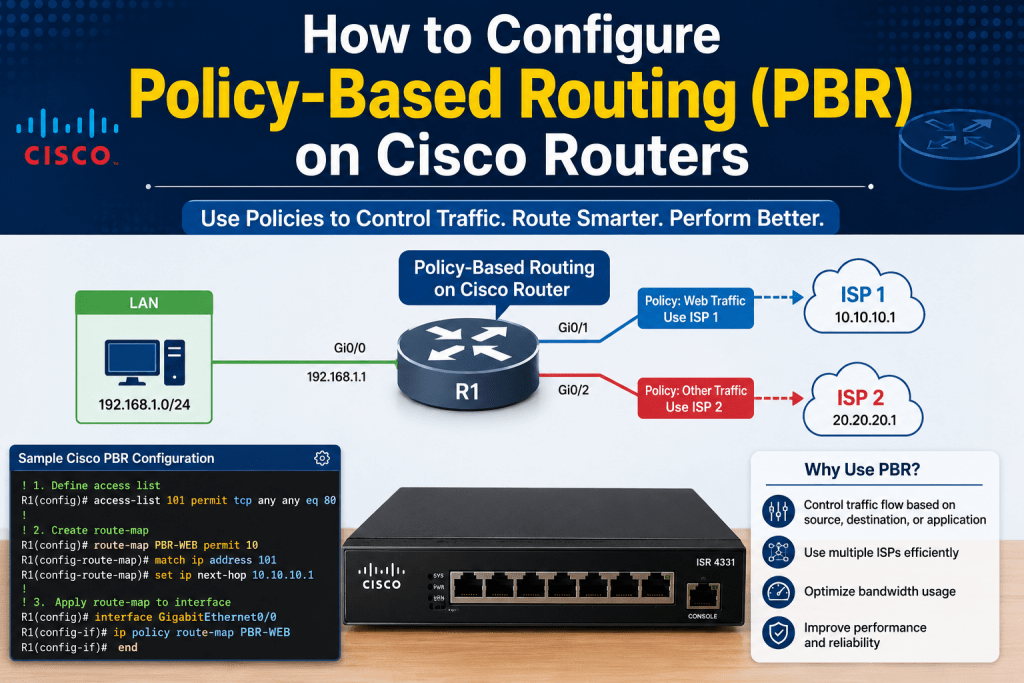
Modern networks handle enormous amounts of traffic every day. Organizations rely on cloud applications, voice services, video conferencing, remote access solutions, and online collaboration platforms to maintain business operations. As network traffic continues to grow, administrators need more control over how packets travel across the infrastructure. Traditional routing methods are often not flexible enough to manage different traffic priorities efficiently. This is where policy-based routing becomes extremely important in Cisco networking environments.
Policy-based routing, commonly known as PBR, is a routing technique that allows administrators to make forwarding decisions according to manually defined policies instead of relying entirely on routing tables. Rather than forwarding packets only based on the destination address, the router can examine additional information such as the source network, application type, protocol, or department. After identifying the traffic, the router applies a customized routing path according to the configured policies.
This feature gives organizations greater flexibility in traffic engineering and bandwidth management. Companies can prioritize critical business applications, separate user groups, improve WAN utilization, and optimize overall network performance. Cisco routers provide powerful PBR capabilities that are widely used in enterprise environments where intelligent traffic control is essential.
Why Traditional Routing Is Not Always Enough
Traditional routing protocols are designed to determine the best available path toward a destination network. Routers analyze routing metrics, path costs, and protocol information before selecting the preferred route. While this approach works effectively for many environments, it lacks the ability to make routing decisions based on business requirements or traffic characteristics.
For example, a company may have two internet connections. One connection may offer high bandwidth and low latency, while the other provides slower but less expensive connectivity. The organization may want critical departments such as IT or finance to use the faster link while normal office browsing uses the slower connection. Standard routing protocols cannot easily make decisions based on department or traffic type alone.
Policy-based routing solves this limitation by allowing administrators to override normal routing behavior. Instead of following only the routing table, the router evaluates policies that identify specific traffic patterns and then forwards those packets according to administrator-defined rules. This creates a much more intelligent and customizable routing environment.
The Main Purpose of Policy-Based Routing
The main purpose of policy-based routing is to provide advanced control over packet forwarding decisions. Rather than treating all traffic equally, PBR allows the network to prioritize and separate traffic based on organizational requirements.
This level of control is especially important in modern enterprise environments where multiple applications compete for network resources. Video conferencing traffic may require low latency, cloud applications may need reliable bandwidth, and guest internet traffic may need restricted access to high-speed resources.
With policy-based routing, administrators can create routing policies that align with business priorities. Traffic can be redirected to preferred interfaces, routed through specific gateways, or distributed across multiple WAN connections according to company needs. This flexibility improves network efficiency and helps organizations maximize available resources.
How Policy-Based Routing Works on Cisco Routers
Cisco routers process policy-based routing through a combination of access lists, route maps, and interface policies. These components work together to identify traffic and apply customized forwarding decisions.
When traffic enters a router interface, the device checks whether a policy routing configuration exists on that interface. If a route map has been applied, the router evaluates the incoming packets against the conditions defined within the policy.
The router first checks the match statements inside the route map. These statements identify whether the packet belongs to a specific traffic category. If the packet matches the conditions, the router applies the configured set actions, which determine how the traffic should be forwarded.
If the traffic does not match any policy conditions, the router typically forwards the packet according to the normal routing table unless a catch-all policy has been configured.
This process allows administrators to control specific traffic flows while leaving all other traffic unaffected.
Understanding Access Lists in Policy-Based Routing
Access lists are one of the most important elements in a PBR configuration. In standard security configurations, access lists are used to permit or deny traffic. However, in policy-based routing, access lists mainly function as traffic classifiers.
The administrator creates an access list that identifies the traffic requiring special routing treatment. This traffic can be based on source addresses, destination addresses, or other packet characteristics depending on the type of access list used.
For example, imagine an organization where the IT department uses the 10.1.0.0/16 subnet. The administrator can create an access list that matches all traffic originating from this network. Once identified, the router can apply special routing instructions to that traffic.
This method provides a flexible and scalable approach to traffic management because access lists can easily be modified without redesigning the entire routing policy.
Creating Traffic Identification Policies
The first stage in configuring policy-based routing involves identifying the traffic that requires customized forwarding behavior. Cisco routers commonly use standard access lists for simple PBR deployments.
An administrator may create a standard access list that identifies all traffic from the IT department subnet. The router later references this access list inside a route map.
The access list essentially tells the router which traffic should receive special treatment. Once the traffic has been identified, the route map determines how the packets will be forwarded.
This separation between traffic identification and forwarding actions makes policy-based routing highly modular and easier to manage.
Using Route Maps for Routing Decisions
Route maps are the core logic engine behind policy-based routing. A route map acts like a collection of conditional statements that evaluate traffic and apply actions based on matching conditions.
Each route map contains sequences. Every sequence can include match statements and set statements. Match statements identify the traffic conditions, while set statements define the forwarding action to apply if the traffic matches.
The router processes route map sequences in numerical order. When traffic matches a sequence, the corresponding forwarding action is applied.
This structure allows administrators to create detailed routing policies that handle multiple traffic categories efficiently.
Routing IT Department Traffic to the Fast Connection
In this example, the organization wants all IT department traffic to use a high-speed WAN connection. The fast connection is represented by Serial0/0, while the slower backup connection is represented by Serial0/1.
The administrator begins by identifying the IT department subnet using an access list. Once the traffic is identified, a route map sequence is created to direct that traffic toward the faster interface.
The route map evaluates packets entering the router. If the traffic matches the IT department subnet, the router forwards those packets through Serial0/0. This ensures that important technical operations receive the highest-performing network path available.
This approach improves application responsiveness and ensures that critical departments receive priority network treatment.
Understanding Match Statements in Route Maps
The match statement acts as the decision-making component within a route map sequence. It tells the router which traffic conditions must be met before a routing action can occur.
In this scenario, the match statement references the access list that identifies IT department traffic. When the router processes incoming packets, it compares the packet information against the access list entries.
If the traffic matches the conditions, the router proceeds to the set statement. If the packet does not match, the router moves to the next route map sequence.
This evaluation process creates a highly flexible routing framework capable of supporting complex enterprise requirements.
Understanding Set Statements in Policy Routing
The set statement defines the routing action applied to matched traffic. Once the router identifies packets that satisfy the match conditions, the set command determines where the traffic should go.
Cisco routers support multiple set options in policy-based routing. Administrators can define next-hop addresses, outbound interfaces, precedence values, or quality-of-service markings.
In this example, the set statement directs IT department traffic to the Serial0/0 interface. This forces the matched traffic to use the fast WAN connection instead of relying solely on routing table calculations.
The set statement is what transforms PBR from a monitoring tool into an active traffic-engineering solution.
The Importance of Route Map Sequences
Route map sequences determine the order in which policies are evaluated. Cisco routers process sequences from the lowest number to the highest number.
This processing order is critical because traffic stops processing after matching a valid sequence unless otherwise configured. Administrators must therefore carefully arrange route map entries to avoid unintended traffic behavior.
The first sequence in this example handles IT department traffic. However, all remaining traffic still requires routing instructions. To handle unmatched packets, the administrator creates an additional sequence.
This second sequence ensures that all remaining traffic uses the slower WAN connection.
Creating a Catch-All Routing Policy
A catch-all sequence is commonly used in policy-based routing to process traffic that does not match earlier conditions. Without this additional sequence, unmatched traffic would return to normal routing behavior.
In this example, the administrator creates a second route map sequence without any match conditions. Because no match statement exists, all remaining traffic automatically falls into this sequence.
The router then applies a set action that forwards the traffic through Serial0/1, the slower WAN connection.
This design creates a clean separation between priority traffic and standard network usage.
Why Policy-Based Routing Improves Traffic Management
Policy-based routing provides administrators with far greater control than traditional routing alone. Instead of treating every packet equally, the network can intelligently prioritize resources according to business needs.
Organizations often use PBR to separate voice traffic, prioritize cloud applications, control guest internet access, or manage WAN bandwidth utilization. These capabilities improve user experience and prevent critical services from being negatively affected by less important traffic.
By directing specific traffic types through dedicated paths, administrators can also reduce congestion and improve overall network reliability.
Applying Policy-Based Routing to Interfaces
After creating the route map, the administrator must apply it to an interface before the policy becomes active. Cisco routers process policy-based routing on incoming traffic, so the policy is usually attached to the ingress interface.
When packets arrive on the configured interface, the router evaluates them against the route map before making routing decisions.
This step activates the policy routing process and ensures that all incoming traffic is analyzed according to the administrator’s rules.
Without applying the route map to an interface, the router will ignore the policy entirely.
Why Inbound Policies Are Important
Inbound policy application allows the router to examine packets immediately after they enter the interface. This ensures that routing decisions are made before the packet enters the normal forwarding process.
Applying policies inbound also improves efficiency because the router handles traffic classification early in the packet-processing workflow.
Administrators must carefully select the correct ingress interfaces when deploying policy-based routing in production environments. Incorrect interface placement can prevent the policy from functioning properly.
Proper interface planning is therefore essential for successful PBR implementation.
Verifying Policy-Based Routing Configurations
After configuring policy-based routing, administrators should verify that the policies operate correctly. Cisco routers provide several verification commands that display route map information and traffic statistics.
These commands allow administrators to confirm that traffic matches the expected policies and follows the correct forwarding paths.
Verification is especially important during initial deployment because configuration mistakes can lead to connectivity problems or traffic loops.
Monitoring traffic counters also helps determine whether the policy is actively processing packets.
Monitoring Traffic Flow Through Route Maps
Traffic monitoring helps administrators understand how effectively policy-based routing is functioning. Cisco routers maintain counters that display the number of packets matching each route map sequence.
These counters provide valuable insight into traffic behavior and network utilization patterns. If certain sequences show no activity, administrators may need to troubleshoot access lists, interface assignments, or subnet configurations.
Consistent monitoring ensures that routing policies continue supporting organizational requirements as network traffic evolves over time.
Common Enterprise Uses for Policy-Based Routing
Policy-based routing is widely used in enterprise networking because it solves many real-world traffic management challenges. One common use case involves directing voice traffic through low-latency WAN links while standard data traffic uses secondary circuits.
Organizations also use PBR to balance traffic across multiple internet providers. Specific departments or applications can use preferred service providers while general traffic uses alternate connections.
Another popular use case involves backup connectivity. Critical applications can continue using premium WAN links while less important traffic moves to lower-priority connections during periods of congestion.
Security-focused organizations may also use policy routing to force sensitive traffic through firewalls, monitoring systems, or security inspection devices before reaching external destinations.
Benefits of Policy-Based Routing in Modern Networks
Policy-based routing offers several important benefits for modern network environments. One major advantage is improved bandwidth utilization. By separating traffic intelligently, organizations can maximize the efficiency of available WAN resources.
Another benefit is application prioritization. Business-critical services receive preferred routing treatment, improving performance and reliability.
PBR also increases network flexibility. Administrators can quickly adapt traffic flows according to changing business requirements without redesigning the entire routing infrastructure.
In addition, policy-based routing supports better user experiences by reducing congestion and improving response times for important applications.
Challenges and Considerations in Policy Routing
Although policy-based routing is extremely powerful, administrators must deploy it carefully. Poorly designed policies can create routing loops, asymmetric traffic paths, or unexpected forwarding behavior.
Complex route maps may also increase administrative overhead, especially in large enterprise environments with multiple WAN links and hundreds of routing policies.
Performance considerations are also important. Extensive policy evaluation can increase router CPU utilization, particularly on older hardware platforms.
Proper documentation, testing, and monitoring are essential for maintaining stable and efficient policy-based routing deployments.
The Growing Importance of Intelligent Routing
As enterprise networks continue evolving, intelligent routing technologies are becoming more important than ever. Organizations rely on cloud services, hybrid infrastructures, remote work environments, and real-time applications that require advanced traffic management capabilities.
Policy-based routing provides administrators with the flexibility needed to support these modern networking demands. By combining traditional routing with customized policy control, organizations can optimize network performance while maintaining efficient resource utilization.
Cisco policy-based routing remains one of the most valuable tools for administrators seeking greater visibility, flexibility, and control over enterprise traffic flows.
Advanced Policy-Based Routing Concepts in Cisco Routers
Policy-based routing becomes even more valuable when networks expand beyond simple branch connections and basic internet access. In large enterprise environments, traffic management requirements become more complicated because multiple departments, cloud applications, remote users, and WAN providers all compete for network resources. Cisco routers provide advanced policy routing features that help administrators maintain control over traffic flow while improving network efficiency and performance.
As organizations continue adopting hybrid infrastructures and cloud-based services, traditional routing methods alone are often insufficient. Administrators need the ability to make routing decisions according to business priorities instead of relying only on routing tables and protocol metrics. Policy-based routing allows engineers to create intelligent forwarding decisions that align with operational goals and application requirements.
Advanced PBR deployments often involve multiple route map sequences, extended access lists, backup routes, redundancy mechanisms, and traffic prioritization strategies. Understanding these concepts is essential for building scalable and reliable Cisco network infrastructures.
Using Extended Access Lists for Greater Traffic Control
Standard access lists identify traffic only by source IP address. While this method works well for basic routing policies, many enterprise environments require more detailed traffic matching capabilities. Cisco routers therefore support extended access lists for policy-based routing configurations.
Extended access lists allow administrators to match traffic according to multiple packet characteristics. These characteristics include source addresses, destination addresses, transport protocols, and port numbers. This level of granularity provides significantly greater control over traffic flows.
For example, an organization may want web browsing traffic to use one WAN link while voice traffic uses another. Using extended access lists, administrators can identify HTTP, HTTPS, or VoIP traffic separately and apply customized routing policies to each category.
This approach allows the network to prioritize critical applications more effectively while optimizing bandwidth usage across multiple connections.
Routing Traffic According to Applications
Modern enterprise networks carry many different application types simultaneously. Some applications require low latency, while others primarily consume large amounts of bandwidth. Policy-based routing helps administrators separate these traffic types and assign appropriate network paths.
Voice and video applications are common examples of latency-sensitive traffic. Delays or packet loss can significantly reduce communication quality. By using PBR, administrators can route voice traffic through low-latency WAN circuits while sending file downloads or software updates through alternate connections.
Cloud applications may also require dedicated routing paths. Businesses often rely heavily on cloud-based collaboration platforms, customer relationship management systems, and remote desktop services. Policy routing ensures that these applications receive optimal network treatment.
This application-aware approach improves user experience and increases overall network reliability.
Separating Departments Using Policy Routing
Many organizations use policy-based routing to separate traffic between departments. Certain teams may require premium connectivity because of their operational responsibilities, while standard office traffic may use less expensive WAN resources.
For example, the IT department may require direct access to cloud infrastructure, backup systems, and monitoring platforms. Finance departments may need highly secure routing paths for transaction processing. Meanwhile, guest users or general office browsing can use secondary internet links.
By separating departments using PBR, organizations gain greater control over bandwidth allocation and improve application performance for critical business units.
This approach also reduces congestion on premium WAN circuits by ensuring that only authorized traffic uses high-priority connections.
Using Multiple WAN Connections Efficiently
One of the most common enterprise uses for policy-based routing involves managing multiple WAN links. Organizations often maintain several internet or MPLS connections for redundancy, performance optimization, or cost control.
Without PBR, routers typically select paths according to routing metrics alone. This can result in uneven bandwidth utilization where one circuit becomes overloaded while another remains underused.
Policy-based routing allows administrators to distribute traffic intelligently across available WAN resources. Specific applications, departments, or user groups can use designated links according to organizational priorities.
For example, cloud traffic may use a fiber connection while software updates use a lower-cost broadband circuit. This improves resource utilization while maintaining high performance for important applications.
Primary and Backup Routing Strategies
Redundancy is a critical requirement in enterprise networking. Organizations cannot afford prolonged outages caused by failed WAN connections or service interruptions.
Policy-based routing supports primary and backup routing strategies by allowing administrators to define preferred forwarding paths while maintaining alternate routes for failover situations.
In a common deployment, important business traffic uses a high-speed primary WAN link during normal operations. If the primary circuit fails, the router automatically redirects traffic through a secondary backup connection.
This failover capability helps maintain business continuity and reduces downtime during network disruptions.
Properly designed backup routing strategies are essential for organizations that rely heavily on real-time communications and cloud-based services.
Understanding Next-Hop Routing in PBR
Earlier policy routing examples used outbound interfaces as forwarding actions. While interface-based forwarding is simple and useful for smaller environments, larger enterprise networks often prefer next-hop routing.
Next-hop routing directs traffic toward a specific gateway IP address instead of an interface. This approach provides greater flexibility because the router can verify next-hop availability and use recursive routing information.
Using next-hop addresses also improves scalability in complex environments with multiple routers and dynamic routing protocols.
Administrators commonly use next-hop routing when WAN connections terminate on provider-managed gateways or when multiple routers share interconnected paths.
This method creates a more reliable and adaptable forwarding structure.
Combining PBR with Dynamic Routing Protocols
Policy-based routing does not replace traditional routing protocols. Instead, it works alongside protocols such as OSPF, EIGRP, and BGP to provide additional traffic control capabilities.
Dynamic routing protocols continue maintaining routing tables and calculating optimal paths across the network. PBR selectively overrides those routing decisions for specific traffic categories.
This combination creates a powerful hybrid routing model. Standard traffic follows dynamically learned routes, while important applications receive customized forwarding treatment according to organizational policies.
Administrators must carefully design these environments to avoid conflicts between routing policies and protocol behavior.
When implemented correctly, the combination of PBR and dynamic routing creates a highly flexible enterprise infrastructure.
The Role of Route Map Logic in Traffic Processing
Route maps function similarly to logical decision trees. Each sequence acts like a checkpoint where traffic is evaluated according to specific conditions.
The router processes route map sequences in ascending numerical order. If traffic matches the first sequence, the associated forwarding action is applied. If no match occurs, the router moves to the next sequence.
This sequential processing allows administrators to build detailed routing policies that support multiple departments, applications, and traffic categories simultaneously.
Careful route map design is extremely important because improperly ordered sequences may cause unexpected routing behavior.
Administrators should always place the most specific routing policies before broader catch-all rules.
Using Match Conditions Effectively
Match conditions are the foundation of policy-based routing logic. These conditions determine which packets receive special forwarding treatment.
Cisco routers support multiple match options within route maps. Administrators can match traffic according to access lists, packet lengths, protocol types, or precedence values.
Combining multiple match conditions creates highly granular traffic identification policies. For example, administrators can identify HTTPS traffic from a specific department and direct it through a dedicated WAN circuit.
Effective use of match conditions allows organizations to align network behavior closely with business requirements.
Policy Routing and Quality of Service
Policy-based routing is often deployed alongside Quality of Service technologies. While PBR controls packet forwarding paths, QoS manages bandwidth allocation, packet prioritization, and congestion handling.
Together, these technologies create highly optimized traffic management systems. PBR ensures applications use the correct network path, while QoS guarantees appropriate bandwidth and latency treatment along that path.
Voice and video applications especially benefit from this combination because they require both intelligent routing and low-latency traffic prioritization.
Using PBR and QoS together significantly improves application performance in enterprise environments.
Monitoring Policy-Based Routing Performance
Effective monitoring is essential for maintaining stable policy routing deployments. Cisco routers provide several verification and troubleshooting tools that help administrators evaluate traffic behavior.
Route map counters display the number of packets matching each sequence. These counters help verify whether traffic is following expected paths.
Administrators also use debugging commands to monitor policy decisions in real time. These tools provide visibility into how the router processes incoming packets and applies forwarding actions.
Performance monitoring becomes especially important in large environments where multiple policies interact across different WAN circuits.
Regular monitoring helps identify congestion, policy conflicts, or routing anomalies before they impact users.
Common Troubleshooting Challenges in PBR
Although policy-based routing is powerful, configuration mistakes can create significant network issues. One common problem involves incorrectly configured access lists that fail to match the intended traffic.
Improper route map sequence ordering can also cause unexpected forwarding behavior. If a broad policy appears before a more specific sequence, traffic may never reach the intended rule.
Another common issue involves asymmetric routing. Traffic may leave the network through one path but return through another, creating problems for stateful firewalls or security systems.
Administrators must carefully test routing policies before deploying them into production environments.
Proper documentation and verification procedures help reduce troubleshooting complexity.
Policy-Based Routing in Branch Offices
Branch offices often rely heavily on policy-based routing because they commonly use multiple WAN connections with varying performance characteristics.
For example, a branch office may have both MPLS connectivity and broadband internet access. Critical business applications can use the MPLS circuit, while guest traffic and software updates use broadband connections.
This separation improves application reliability while reducing WAN costs.
Branch environments also benefit from PBR failover capabilities because uninterrupted connectivity is often essential for remote operations.
Policy routing helps branch offices maintain stable and efficient communications with headquarters and cloud services.
Cloud Connectivity and Policy Routing
Cloud adoption has dramatically increased the importance of intelligent routing strategies. Organizations frequently access cloud platforms, SaaS applications, and hybrid infrastructures through multiple internet connections.
Policy-based routing allows administrators to optimize cloud connectivity by directing specific cloud traffic through preferred WAN circuits.
For example, latency-sensitive cloud applications can use high-speed fiber connections while less critical traffic uses secondary broadband links.
This improves cloud application performance while reducing congestion across shared WAN resources.
As cloud dependence continues growing, policy routing becomes increasingly important for maintaining consistent user experiences.
Security Benefits of Policy-Based Routing
Policy-based routing can also improve network security by controlling how sensitive traffic moves through the infrastructure.
Organizations may route confidential data through dedicated inspection devices, intrusion prevention systems, or secure VPN gateways before allowing packets to reach external destinations.
Guest traffic can be isolated from internal resources by forcing it through restricted internet paths.
PBR also supports traffic segmentation strategies that improve compliance with organizational security policies.
By controlling traffic paths more precisely, administrators gain greater visibility and protection across the network.
Scalability Considerations in Large Networks
As networks grow larger, policy-based routing configurations can become increasingly complex. Large enterprises may require dozens or even hundreds of route map sequences to support various applications and departments.
Administrators must therefore design scalable policy structures that remain manageable over time.
Using descriptive naming conventions, organized access lists, and structured documentation helps simplify long-term administration.
Performance considerations are also important because extensive policy evaluation may increase router CPU utilization.
Modern Cisco platforms are optimized for large-scale policy routing deployments, but careful planning is still necessary to maintain efficient operation.
The Future of Intelligent Traffic Engineering
Enterprise networking continues evolving rapidly as organizations adopt cloud computing, remote work environments, and advanced collaboration technologies. These changes increase the demand for intelligent traffic engineering solutions.
Policy-based routing remains one of the most valuable tools for administrators seeking greater control over network behavior. By allowing traffic decisions based on business priorities rather than simple routing metrics, PBR helps organizations improve performance, optimize bandwidth usage, and support critical applications more effectively.
Cisco routers continue providing robust policy routing capabilities that adapt to modern networking requirements. As enterprise infrastructures become more dynamic and application-driven, intelligent routing technologies like PBR will remain essential components of successful network design.
Real-World Policy-Based Routing Deployment Scenarios
Policy-based routing becomes truly powerful when applied to real-world enterprise environments. While the basic configuration process is important, understanding how organizations actually use PBR in production networks helps administrators appreciate its flexibility and value. Cisco routers support a wide range of deployment models that allow businesses to optimize traffic flow, improve application performance, and maintain reliable connectivity across complex infrastructures.
Modern enterprises rarely rely on a single internet connection or a simple flat network design. Most organizations operate branch offices, cloud services, remote access solutions, voice systems, and multiple WAN links simultaneously. These environments require intelligent traffic management strategies that traditional routing protocols alone cannot provide. Policy-based routing helps solve these challenges by giving administrators precise control over packet forwarding behavior.
Many enterprise engineers consider PBR one of the most useful traffic engineering tools available because it allows routing decisions to align directly with business priorities.
Using Policy-Based Routing for Internet Load Distribution
One of the most common real-world uses of policy-based routing involves distributing traffic across multiple internet connections. Many businesses maintain connections from different internet service providers to improve redundancy and bandwidth availability.
Without policy routing, one WAN link may become heavily congested while another remains underutilized. Traditional routing protocols typically choose a single preferred route based on metrics rather than balancing traffic intelligently.
With policy-based routing, administrators can assign specific traffic categories to different internet links. For example, cloud applications may use a high-speed fiber connection while software updates and guest traffic use a lower-cost broadband provider.
This distribution strategy improves bandwidth efficiency and prevents important applications from competing with low-priority traffic.
Improving VoIP Performance with PBR
Voice over IP applications are extremely sensitive to latency, jitter, and packet loss. Poor network performance can lead to distorted audio, dropped calls, and communication delays that negatively impact business operations.
Policy-based routing helps improve VoIP quality by directing voice traffic through the most stable and lowest-latency WAN connection available. Administrators can identify voice traffic using access lists that match SIP, RTP, or other VoIP-related protocols.
Once identified, the traffic is forwarded through a dedicated high-performance link while noncritical traffic uses alternate paths.
This separation reduces congestion and improves communication reliability across enterprise voice systems.
Organizations that depend heavily on real-time communication often combine PBR with Quality of Service policies for even greater performance optimization.
Managing Video Conferencing Traffic
Video conferencing platforms generate large amounts of real-time traffic that require consistent bandwidth and low latency. Remote work environments have made video collaboration one of the most important enterprise applications in modern networks.
Policy-based routing allows administrators to prioritize video conferencing traffic by directing it through premium WAN circuits instead of shared internet paths.
For example, traffic from collaboration platforms can use dedicated MPLS links while regular web browsing uses broadband internet access.
This separation improves call quality, reduces buffering, and provides a smoother collaboration experience for remote employees and distributed teams.
As organizations continue expanding hybrid work environments, intelligent routing strategies become increasingly valuable.
Separating Guest and Corporate Traffic
Many organizations provide guest wireless access for visitors, contractors, or temporary users. However, guest traffic should never compete directly with internal business applications for critical network resources.
Policy-based routing provides an effective way to isolate guest internet traffic from corporate communications. Administrators can identify guest wireless subnets and route that traffic through separate internet circuits or restricted bandwidth paths.
Meanwhile, employee traffic continues using secure high-performance WAN links dedicated to business operations.
This approach improves security, reduces unnecessary congestion, and ensures that corporate applications maintain reliable performance levels.
Policy-Based Routing for Branch Office Optimization
Branch offices frequently operate with limited WAN resources compared to headquarters locations. These remote sites often depend on multiple connections such as MPLS circuits, broadband internet, or cellular backup links.
Policy-based routing helps branch offices optimize available bandwidth by assigning different applications to different WAN connections.
Critical business systems such as ERP applications, database access, and voice traffic may use the MPLS connection, while cloud backups or software updates use broadband internet.
This selective traffic forwarding maximizes network efficiency and ensures important services receive priority treatment.
Branch office optimization is one of the most practical and widely deployed PBR use cases in enterprise networking.
Using PBR with Cloud Services
Cloud adoption has significantly changed enterprise traffic patterns. Instead of communicating mainly with internal data centers, modern users frequently connect to external SaaS applications and cloud platforms.
Policy-based routing helps organizations manage cloud connectivity more effectively by directing specific cloud traffic through preferred WAN links.
For example, latency-sensitive cloud applications can use premium fiber circuits while general web browsing uses secondary internet connections.
This strategy improves cloud application responsiveness while reducing congestion across shared WAN resources.
As businesses continue relying more heavily on cloud infrastructure, intelligent routing policies become increasingly important.
Enhancing Security Through Traffic Segmentation
Security is another major reason organizations deploy policy-based routing. Administrators often need to ensure that sensitive traffic follows secure inspection paths before reaching external destinations.
Policy routing can direct confidential data through dedicated firewalls, intrusion prevention systems, monitoring appliances, or VPN gateways.
Guest users and untrusted devices can also be forced through isolated internet paths that restrict access to internal corporate resources.
This level of traffic segmentation improves network visibility and strengthens overall security posture.
Organizations operating in highly regulated industries often use PBR as part of broader compliance and data protection strategies.
Using PBR for Backup Connectivity
WAN redundancy is essential for maintaining business continuity during outages or service interruptions. Policy-based routing supports backup connectivity strategies by defining alternate forwarding paths for important traffic.
In many enterprise deployments, critical applications normally use a high-speed primary WAN connection. If the primary circuit fails, traffic automatically shifts to a secondary backup connection.
This failover capability minimizes downtime and allows users to maintain access to important services during network disruptions.
Backup routing strategies are especially important for businesses that rely heavily on cloud applications, remote communication, and online collaboration systems.
Combining Policy Routing with Dynamic Routing Protocols
Policy-based routing does not replace dynamic routing protocols such as OSPF, EIGRP, or BGP. Instead, it works alongside them to provide additional traffic control capabilities.
Dynamic routing protocols continue maintaining routing tables and calculating optimal network paths. Policy routing selectively overrides those decisions for specific traffic categories.
This hybrid approach creates a highly flexible routing environment where standard traffic follows normal protocol behavior while important applications receive customized forwarding treatment.
Administrators must carefully design these environments to avoid routing conflicts or asymmetric traffic patterns.
When implemented correctly, combining dynamic routing with PBR creates a scalable and efficient enterprise infrastructure.
Understanding Asymmetric Routing Challenges
One potential challenge in policy-based routing environments is asymmetric routing. This occurs when traffic leaves the network through one path but returns through another.
Asymmetric routing can create problems for stateful firewalls, security systems, and certain applications that expect bidirectional traffic consistency.
Administrators must carefully monitor routing behavior and ensure that traffic paths remain predictable.
Proper route map planning, traffic analysis, and WAN design help minimize asymmetric routing issues in enterprise deployments.
Understanding these challenges is important for maintaining stable and secure network operations.
Monitoring Policy-Based Routing Traffic
Monitoring is essential in policy-based routing environments because administrators need visibility into how traffic flows across the network.
Cisco routers provide route map counters, interface statistics, and debugging tools that help engineers evaluate policy effectiveness.
Monitoring tools allow administrators to confirm whether traffic matches expected policies and follows the intended forwarding paths.
If traffic counters remain inactive or unexpected congestion occurs, engineers can quickly identify and troubleshoot configuration issues.
Regular monitoring ensures that policy routing continues aligning with business requirements as network conditions evolve over time.
Troubleshooting Common PBR Problems
Although policy-based routing is highly flexible, configuration mistakes can cause major network problems if not addressed carefully.
One common issue involves incorrectly configured access lists that fail to match the intended traffic. Another problem occurs when route map sequences are arranged improperly, causing broad rules to override more specific policies.
Interface configuration mistakes can also prevent routing policies from functioning correctly.
Administrators should always verify route maps, access lists, and interface assignments during deployment.
Testing routing behavior in controlled environments before production implementation helps reduce operational risks.
Best Practices for Policy-Based Routing Deployments
Successful policy-based routing deployments require careful planning and documentation. Administrators should design route maps logically and use clear naming conventions for access lists and routing policies.
Specific traffic rules should appear before broader catch-all sequences to ensure accurate traffic matching.
Engineers should also avoid creating unnecessarily complex policies because excessive route map processing may increase router CPU utilization.
Regular monitoring, documentation updates, and configuration reviews help maintain long-term network stability.
Organizations that follow structured deployment practices typically experience fewer operational issues and better overall network performance.
The Growing Role of Intelligent Routing Technologies
Enterprise networks continue becoming more complex due to cloud computing, remote work, IoT devices, and high-bandwidth applications. These modern technologies require routing solutions that provide flexibility beyond traditional destination-based forwarding.
Policy-based routing remains one of the most valuable traffic engineering tools available in Cisco networking environments because it allows administrators to align network behavior directly with business priorities.
By intelligently controlling how traffic flows across WAN connections, organizations can improve performance, optimize bandwidth usage, strengthen security, and maintain reliable connectivity for critical services.
As enterprise infrastructures continue evolving, intelligent routing strategies such as policy-based routing will remain essential components of modern network design.
Conclusion
Policy-based routing is one of the most powerful features available on Cisco routers for managing enterprise traffic intelligently. Unlike traditional routing methods that rely only on destination addresses, PBR allows administrators to make forwarding decisions according to business needs, application requirements, and organizational priorities.
From separating departmental traffic and optimizing WAN bandwidth to improving voice performance and enhancing security, policy-based routing provides exceptional flexibility for modern network infrastructures. Organizations can create customized traffic paths that improve reliability, reduce congestion, and deliver better user experiences across cloud applications, voice systems, and branch office connections.
Cisco policy-based routing also works effectively alongside dynamic routing protocols, Quality of Service technologies, and security systems, making it a critical component of advanced enterprise network design. Although careful planning and monitoring are necessary to avoid configuration challenges, the benefits of intelligent traffic engineering far outweigh the complexity involved.
As networks continue growing in size and complexity, policy-based routing will remain an essential technology for administrators seeking greater visibility, control, and optimization across modern enterprise environments.