
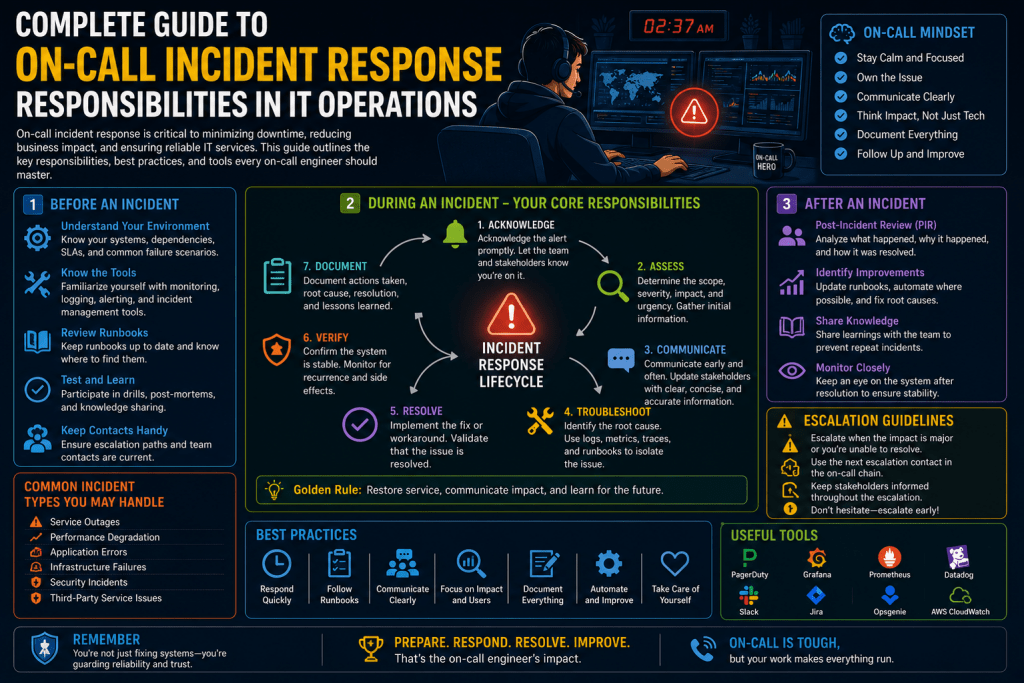
Incident response refers to the structured approach an organization uses to detect, manage, and recover from unexpected disruptions affecting systems, services, or data. These disruptions may include security breaches, system failures, service degradation, or complete outages. On-call responsibility is a key component of this structure, ensuring that trained personnel are available outside regular working hours to address critical incidents. This model is essential in environments where continuous service availability is required. It helps reduce downtime, limit financial losses, and maintain trust in IT systems. Understanding how on-call responsibility fits into incident response is important for anyone working in IT operations, cybersecurity, or infrastructure support roles. It also plays a major role in certification-level knowledge areas where operational readiness and response planning are evaluated.
Incident Response Framework and Its Importance
An incident response framework defines how an organization prepares for, detects, analyzes, contains, and recovers from incidents. It provides a standardized process that ensures consistency in handling unexpected events. Without a structured framework, responses can become chaotic, delayed, or ineffective. A well-designed framework also reduces confusion during high-pressure situations by clearly outlining roles, escalation paths, and communication methods. It helps organizations minimize damage and restore normal operations quickly. In addition, it supports continuous improvement by incorporating lessons learned after each incident. The framework is not limited to cybersecurity events; it also includes operational outages and performance failures. This broader scope ensures that all critical disruptions are treated with appropriate urgency and structured handling.
Meaning of On-Call in IT Operations
Being on-call means that an individual is designated to respond to incidents outside of standard working hours. This responsibility ensures that critical issues can be addressed immediately, regardless of when they occur. On-call professionals must remain reachable and ready to investigate and resolve incidents within defined response times. This may include responding to alerts, joining incident calls, or coordinating with other teams. On-call duties often require access to monitoring tools, administrative systems, and communication platforms. The role is not only technical but also operational, as it involves judgment on urgency and impact. Organizations may implement rotating schedules to distribute workload and reduce burnout. In some environments, multiple tiers of on-call support exist, ensuring that issues are handled by appropriately skilled personnel.
Structure of On-Call Rotations and Escalation Paths
On-call rotations are designed to distribute responsibility across a team, preventing overload on a single individual. These rotations may be weekly, daily, or based on shift patterns depending on operational requirements. In larger organizations, responsibilities are divided among specialized teams such as networking, security, applications, and infrastructure. Each team may have its own on-call schedule. Escalation paths define how incidents move from initial responders to higher-level experts when necessary. This structure ensures that complex issues receive appropriate attention without delay. A clear escalation hierarchy prevents confusion and reduces response time. It also helps maintain accountability by defining who is responsible at each stage of incident resolution. Proper design of rotations and escalation paths is essential for maintaining operational efficiency.
Roles Involved in Incident Handling
Incident handling involves multiple roles beyond the primary on-call engineer. First-line responders typically monitor alerts and perform initial triage. They determine whether an issue requires escalation or can be resolved immediately. Technical specialists may be engaged for deeper investigation or system-specific problems. Development teams may be involved if software defects or deployment issues are identified. Security teams respond to potential breaches or suspicious activity. In severe cases, leadership teams become involved to make business-impact decisions. Each role contributes to different stages of incident resolution. Coordination between these roles ensures that incidents are handled efficiently and with minimal disruption. Clear role definitions help avoid duplication of effort and reduce delays in communication.
Stakeholders and Communication Flow
Stakeholders in incident response are individuals or groups who need awareness of ongoing incidents but are not directly involved in technical resolution. These may include executives, legal teams, finance departments, customer support, and account managers. Communication flow is critical in ensuring that stakeholders receive timely and accurate updates. Proper communication prevents misinformation and helps manage expectations during disruptions. Regular updates are often provided through structured channels such as incident bridges or status reports. The communication strategy must balance transparency with clarity, ensuring that only relevant information is shared. Effective stakeholder management also supports decision-making during high-impact incidents, especially when business priorities need to be adjusted quickly.
Core Responsibilities During On-Call
On-call personnel are responsible for initial incident response activities, including acknowledgment of alerts, assessment of severity, and initiation of troubleshooting. Their primary responsibility is triage, which involves determining the scope and impact of an incident. They must decide whether immediate action is required or if the issue can be monitored or deferred. Communication is also a key responsibility, ensuring that relevant teams are informed promptly. On-call staff may coordinate incident response calls and document actions taken during the event. Another responsibility includes maintaining service continuity by applying temporary fixes or workarounds when permanent solutions are not immediately available. Proper prioritization and decision-making are essential during this phase.
Preparation Before Being On-Call
Effective on-call performance requires preparation. This includes ensuring access to necessary tools such as monitoring dashboards, authentication systems, and remote access capabilities. Engineers must be familiar with system architecture and common failure points. Understanding escalation procedures and communication protocols is also critical. Preparation involves reviewing documentation, incident playbooks, and known issues that may reoccur. Individuals should also ensure they are physically and mentally ready to respond during their assigned rotation. Organizations often provide training to improve readiness and reduce response time. Proper preparation reduces stress during incidents and increases the likelihood of fast and effective resolution.
Triage and Prioritization of Incidents
Triage is the process of evaluating and categorizing incidents based on severity and impact. Not all alerts require immediate action; therefore, prioritization is essential. Critical incidents typically involve system outages, security breaches, or significant business disruption. Lower priority issues may include minor performance degradation or isolated user impact. During triage, on-call engineers assess affected systems, user impact, and business criticality. They then assign severity levels that determine response urgency. Proper prioritization ensures that resources are focused on the most impactful problems first. It also prevents unnecessary escalation and helps maintain operational stability during multiple concurrent incidents.
Escalation and Collaboration Practices
Escalation occurs when an incident cannot be resolved within the initial response level or when specialized expertise is required. Effective escalation practices ensure that incidents are transferred quickly to the right teams without delay. Collaboration between teams is essential for resolving complex issues that span multiple systems. On-call personnel must communicate clearly when escalating, providing relevant details such as symptoms, logs, and initial troubleshooting steps. Collaboration tools and structured communication channels help streamline this process. Poor escalation practices can lead to delays and extended downtime, while well-defined processes improve resolution speed and reduce operational impact.
Recovery Actions and Service Restoration
Once the root cause or temporary workaround is identified, recovery actions are initiated to restore normal service. This may involve restarting services, applying configuration changes, rolling back deployments, or switching to backup systems. The primary goal is to restore functionality as quickly as possible while minimizing additional risk. In some cases, partial restoration is acceptable until a permanent fix is implemented. Recovery efforts must be carefully coordinated to avoid introducing new issues. Monitoring systems are used to confirm that services are stable after recovery actions. Documentation of all steps taken is also important for future analysis.
Post-Incident Review and Learning Process
After an incident is resolved, a review process is conducted to analyze what occurred, how it was handled, and what improvements can be made. This review focuses on identifying root causes, evaluating response effectiveness, and documenting lessons learned. The goal is not to assign blame but to improve future response capabilities. Findings from these reviews are often used to update procedures, improve monitoring, and enhance training. Knowledge sharing across teams ensures that similar incidents can be prevented or resolved more efficiently in the future. Continuous improvement is a core principle of effective incident management.
What On-Call Does Not Cover
On-call responsibility does not include handling every type of issue regardless of severity. Personal emergencies or situations where the on-call engineer is unavailable must be accounted for through backup systems. Not every minor issue requires immediate escalation or disruption of critical resources. On-call roles are focused on meaningful operational impact rather than routine maintenance or low-priority tasks. Organizations must ensure that expectations are realistic and sustainable to prevent burnout. Proper boundaries help maintain a healthy balance between operational readiness and workforce well-being.
Conclusion
On-call responsibilities are a fundamental part of modern IT operations and incident response strategies. They ensure that critical systems are supported at all times and that disruptions are handled efficiently. A well-structured on-call system relies on clear roles, strong communication, effective escalation paths, and proper preparation. When implemented correctly, it improves system reliability and reduces downtime. However, it also requires careful planning to avoid overload and maintain team sustainability. Understanding these responsibilities helps professionals contribute more effectively to incident management and supports the overall stability of organizational infrastructure.