
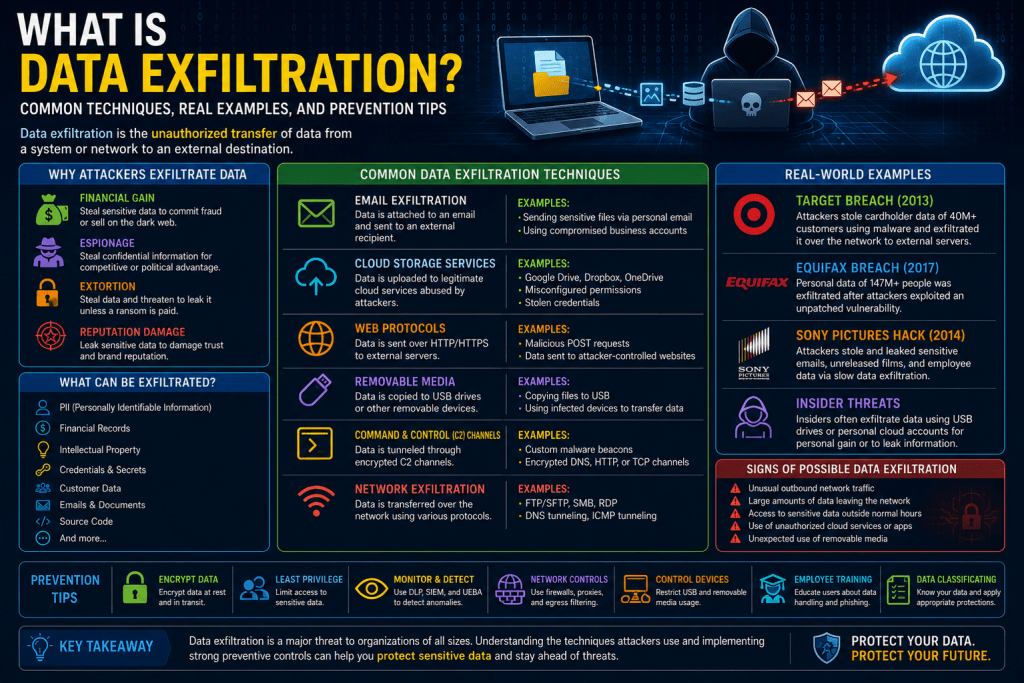
Data exfiltration refers to the process where unauthorized individuals transfer information out of a compromised environment. Once attackers gain access to a system, their objective often shifts from intrusion to extraction. This phase is critical in the lifecycle of a cyber incident because it determines the actual value an attacker derives from the breach. Exfiltration techniques are designed to be stealthy, efficient, and difficult to detect. Rather than relying on a single method, attackers frequently combine multiple channels to avoid triggering security controls. These methods are selected based on network architecture, available protocols, and the level of monitoring within the target environment. Understanding these techniques is essential for recognizing how data can silently leave an organization without immediate detection.
Understanding the Goal of Data Exfiltration
The primary objective of data exfiltration is to transfer sensitive information such as credentials, intellectual property, financial records, or internal communications from a secure environment to an external location controlled by the attacker. Unlike destructive attacks that aim to disrupt systems, exfiltration is usually subtle and prolonged. Attackers often prefer to remain undetected for as long as possible to maximize the amount of data collected. This requires careful planning, including mapping out network pathways, identifying allowed outbound traffic, and determining which protocols can be leveraged without raising suspicion. Many modern environments have strong perimeter defenses, but outbound traffic monitoring is often less strict, creating opportunities for covert data transfer.
DNS Tunneling as a Covert Channel
DNS tunneling is a method where attackers encode stolen data within DNS queries and responses. Since the Domain Name System is essential for normal internet functionality, its traffic is rarely blocked outright. Attackers exploit this trust by embedding information into domain name requests that appear legitimate but actually carry hidden payloads. The data is typically broken into small chunks and sent through multiple DNS queries to avoid detection. On the receiving end, an attacker-controlled server reconstructs the information. Because DNS traffic is often overlooked in deep inspection policies, this method provides a highly effective exfiltration channel. It is especially dangerous in environments where DNS queries are allowed to exit the network without strict filtering or logging.
HTTP and HTTPS-Based Exfiltration Methods
HTTP and HTTPS are among the most commonly abused protocols for data exfiltration. These protocols are generally permitted in most business environments because they are essential for web communication. Attackers take advantage of this by embedding stolen data within seemingly normal web traffic. HTTP-based exfiltration can involve sending data through POST requests, URL parameters, or disguised API calls. HTTPS further enhances stealth by encrypting the traffic, making it difficult for defenders to inspect the payload contents. Since encrypted traffic cannot be easily analyzed without decryption mechanisms, attackers benefit from an additional layer of concealment. This combination of ubiquity and encryption makes HTTP and HTTPS highly attractive channels for covert data transfer.
Outbound File Transfers and Common Channels
Outbound file transfers occur when attackers move data directly from a compromised system to an external destination. This can involve file transfer protocols, cloud storage services, or other external endpoints that support uploads. Attackers may use legitimate services to mask malicious activity, blending exfiltration traffic with normal user behavior. In some cases, compromised credentials are used to authenticate against trusted platforms, making the activity appear legitimate from a network perspective. These transfers may be automated or manually controlled depending on the sophistication of the attack. The key challenge for defenders is distinguishing between authorized file transfers and unauthorized data movement that follows similar patterns.
Use of Text-Based Protocols for Stealth
Text-based protocols such as SMTP, IRC, or custom messaging formats are sometimes used for data exfiltration because they resemble ordinary communication traffic. Attackers may encode sensitive information into email bodies, chat messages, or command sequences that are transmitted through these channels. Since these protocols are designed for human-readable content, malicious payloads can be disguised as normal text. This makes detection more challenging unless deep content inspection is performed. Additionally, text-based protocols often lack strict structure enforcement, allowing attackers to manipulate fields in creative ways to hide stolen data. The simplicity of these protocols becomes an advantage when used for covert communication.
Blending Malicious Traffic with Normal Network Activity
One of the most effective strategies in data exfiltration is blending malicious traffic with legitimate network activity. Attackers study typical usage patterns within an organization and mimic them to avoid detection. This includes matching request frequencies, payload sizes, and destination endpoints. By aligning exfiltration behavior with normal traffic baselines, attackers reduce the likelihood of triggering anomaly detection systems. For example, small data packets may be sent at irregular intervals to simulate user browsing behavior. This blending technique is especially effective in large organizations where network traffic volume is high and variability is expected.
Chunking and Compression Techniques in Data Theft
To avoid detection, attackers often break large datasets into smaller chunks before transmitting them. This approach reduces the visibility of unusual data spikes that might otherwise alert monitoring systems. Compression is also commonly applied to reduce the size of transferred data and to further obscure its content. When combined, chunking and compression make it significantly more difficult for defenders to identify meaningful patterns. The reconstructed data on the attacker’s side can be reassembled into its original form without losing integrity. These techniques are particularly useful when bandwidth monitoring or rate limiting is in place, as they help maintain a low profile during exfiltration.
Challenges in Detecting Encrypted Exfiltration Traffic
Encrypted traffic presents one of the greatest challenges in detecting data exfiltration. When attackers use secure communication channels, network defenders cannot easily inspect payload contents without decryption capabilities. This limitation allows malicious data to travel alongside legitimate encrypted traffic without raising immediate suspicion. Even advanced monitoring systems may struggle to differentiate between normal encrypted sessions and covert data transfers. As encryption becomes more widespread across internet communications, distinguishing malicious activity requires reliance on metadata analysis such as connection patterns, session duration, and endpoint reputation rather than content inspection alone.
Why HTTP Remains a Preferred Exfiltration Channel
HTTP remains a preferred method for data exfiltration because it is universally allowed and deeply integrated into nearly all network environments. Its flexibility allows attackers to structure data transfers in multiple ways, including disguised form submissions, API calls, and image-based payloads. Since web traffic is expected in almost every organization, HTTP-based communication rarely raises immediate concerns. When combined with encryption through HTTPS, the difficulty of detection increases significantly. Attackers also benefit from the distributed nature of web infrastructure, which allows them to route data through multiple intermediate endpoints, further complicating tracing efforts.
Techniques for Concealing Command and Control Communications
In addition to exfiltrating data, attackers often maintain communication with compromised systems through command and control channels. These channels are frequently hidden using the same techniques as data exfiltration, including DNS tunneling, HTTP requests, and encrypted sessions. The goal is to ensure continuous access while minimizing visibility. Commands may be embedded in seemingly harmless traffic, allowing attackers to remotely control infected systems without triggering alarms. This dual-use of communication channels for both control and data theft increases the complexity of detection and response efforts within security operations.
Final Thoughts
Data exfiltration techniques continue to evolve alongside improvements in network security defenses. Attackers rely heavily on legitimate protocols, encryption, and traffic obfuscation to remain undetected while transferring sensitive information. Methods such as DNS tunneling, HTTP-based transfers, text protocol abuse, and chunked data transmission demonstrate how adaptable these techniques have become. The core challenge for defenders lies in identifying subtle deviations in normal traffic patterns rather than relying solely on content inspection. As network environments grow more complex and encrypted traffic becomes the norm, detecting unauthorized data movement requires a combination of behavioral analysis, metadata monitoring, and continuous visibility into outbound communication patterns.