Salary averages often look straightforward on paper, but they can hide significant distortions when taken at face value. One of the biggest issues is geography. A compensation figure from a high-cost metropolitan area does not translate directly to a lower-cost region, even if the job title is identical. Another issue is statistical skew. Extremely high-paying cities can pull national averages upward, creating a picture that does not accurately reflect what most professionals actually earn in day-to-day roles. This is especially relevant in technical fields where demand is concentrated in specific hubs. When evaluating roles such as data center technicians, it becomes more useful to examine localized salary patterns rather than relying on a single national figure.
How Salary Data Was Evaluated Across Locations
To build a clearer picture of compensation, salary information was reviewed across multiple cities with significant data infrastructure presence. The focus was placed on roles explicitly labeled as data center technician positions rather than broader IT categories. This distinction matters because job titles such as systems analyst or senior engineer often carry different responsibilities and compensation structures. Information was gathered from commonly referenced salary reporting platforms and job postings to reflect real-world hiring conditions. The goal was to observe consistent patterns across regions rather than isolated or inflated figures.
Why Geography Has a Strong Impact on Pay
Location plays a major role in determining salary levels for technical positions. Cities with high costs of living generally offer higher wages to attract and retain skilled workers. At the same time, regions with large concentrations of infrastructure demand also tend to pay more due to competition among employers. However, higher pay does not always equate to greater purchasing power. In many cases, increased salaries are offset by housing costs, transportation expenses, and general cost-of-living differences. This creates a situation where comparing salaries without context can lead to misleading conclusions.
Data Center Hubs and Regional Demand Patterns
Certain regions have become major hubs for data infrastructure due to a combination of available land, reliable power supply, and favorable economic conditions. Northern Virginia stands out as one of the most prominent examples, often associated with extremely high concentrations of data facilities. Other cities across the United States have also attracted large-scale infrastructure investment for similar reasons. These locations typically offer stable job opportunities for technicians due to the continuous need for maintenance, expansion, and operational support. As a result, salaries in these regions often reflect sustained demand rather than temporary market fluctuations.
Understanding the Role of a Data Center Technician
A data center technician is responsible for maintaining the physical and operational integrity of computing environments that support digital services. The role is primarily hands-on and involves working directly with hardware systems. Technicians are involved in installing servers, organizing network cabling, and ensuring that equipment operates within required parameters. They also assist with troubleshooting hardware failures and supporting routine maintenance tasks.
In addition to hardware responsibilities, technicians often interact with basic networking systems and operating environments. Understanding how devices communicate within a network is important for identifying issues quickly. Familiarity with operating systems commonly used in enterprise environments also supports day-to-day troubleshooting tasks.
Physical conditions are another defining aspect of the role. Data centers are typically controlled environments with strict temperature and access regulations. Technicians often work in cold environments and may spend extended periods standing, lifting equipment, or working in confined spaces. Attention to detail is critical, particularly when handling equipment configurations or documenting infrastructure changes.
Core Skills Associated With the Role
The skill set required for data center technicians is diverse and blends technical knowledge with practical capability. Hardware troubleshooting is essential, as technicians must identify and resolve issues related to servers, storage devices, and other infrastructure components. Cable organization and management also play a significant role in maintaining system efficiency and preventing operational disruptions.
Basic networking knowledge is required to understand how systems communicate and how data flows through infrastructure layers. This includes awareness of addressing structures, switching behavior, and connectivity principles. Experience with server environments is also important, particularly in understanding how systems are deployed and maintained in enterprise settings.
Documentation is another key responsibility. Accurate record-keeping ensures that changes to infrastructure are tracked and systems remain compliant with operational standards. Without proper documentation, troubleshooting becomes significantly more difficult and system reliability can be impacted.
National Salary Overview and General Ranges
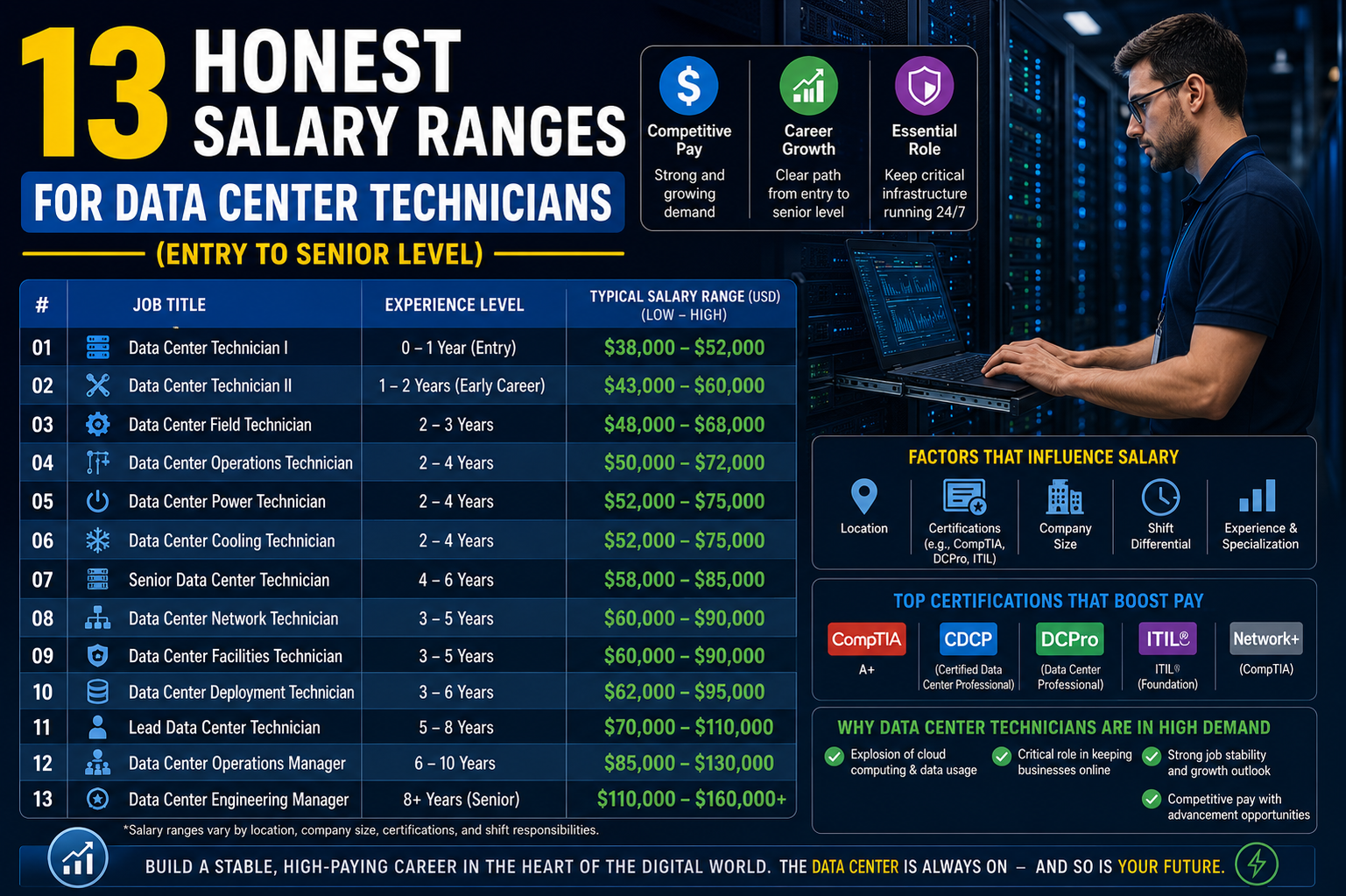
On a broad scale, data center technician salaries in the United States tend to fall within a moderate range typical of entry-level to mid-level technical roles. The national average sits around the mid-fifties in thousands annually. Entry-level positions often begin in the lower forty-thousand range, while more experienced technicians working in high-demand environments can earn closer to eighty thousand or more.
These figures highlight the variability of the role depending on experience, employer type, and especially location. While the national average provides a baseline, it does not fully represent the range of compensation experienced across different regions. This makes city-level analysis far more useful when evaluating earning potential.
High-Paying Regional Markets
Certain cities consistently offer higher compensation due to strong demand and concentrated infrastructure. In regions such as San Jose and Seattle, salaries tend to trend higher than the national average. These areas host major technology ecosystems, which increases the need for skilled technicians to support large-scale operations. New York also reflects higher compensation levels, influenced by both cost of living and enterprise demand.
In these markets, experienced technicians can reach upper salary ranges that significantly exceed entry-level expectations. However, these higher figures are often balanced by increased living costs, particularly in housing and transportation. Despite this, the concentration of opportunities makes these regions attractive for long-term career growth in technical infrastructure roles.
Mid-Range Salary Regions With Stable Demand
Cities such as Chicago, Dallas, Phoenix, and Atlanta tend to fall into a mid-range compensation category. These regions combine moderate cost of living with steady infrastructure growth. As a result, salaries remain competitive but generally do not reach the highest national levels.
These areas are often attractive to professionals seeking a balance between income and affordability. Infrastructure expansion in these cities continues to support stable job availability, particularly as organizations distribute data operations across multiple geographic locations. Technicians in these regions often experience consistent employment opportunities with predictable salary progression over time.
Lower-Cost Regions With Competitive Entry Salaries
Some cities offer lower nominal salaries but also feature significantly reduced living costs. Locations such as Albuquerque, Salt Lake City, and Council Bluffs fall into this category. While compensation figures are lower compared to major technology hubs, the cost-of-living adjustment can make these roles financially viable.
In these environments, data center technicians often play a critical role due to the presence of large infrastructure facilities in less densely populated regions. Employers in these areas may prioritize operational efficiency and long-term staffing stability over rapid salary escalation.
Emerging Infrastructure Regions and Growth Opportunities
Cities like Charlotte, Prineville, and similar developing infrastructure regions reflect growing demand for technical support roles. These areas often attract large facilities due to available land and energy resources. As infrastructure expands, demand for technicians increases, leading to gradual salary growth over time.
While starting salaries may appear modest compared to major metropolitan areas, long-term career prospects can improve as these regions continue to develop. Technicians who enter early in the growth cycle may experience increased opportunities for advancement as operations scale.
Career Development and Progression Factors
Advancement in this field is influenced by both technical experience and exposure to increasingly complex environments. Technicians who develop deeper understanding of networking systems, server architecture, and operational workflows tend to move into higher-paying roles over time.
Leadership responsibilities and specialized infrastructure knowledge can also contribute to salary progression. As professionals gain experience, they may transition into roles involving systems oversight, operational planning, or infrastructure coordination. Consistent documentation practices and problem-solving ability further support long-term career growth.
Work Environment Considerations
The working environment in data centers is highly controlled and structured. Temperature regulation, restricted access, and strict operational protocols are standard features. These conditions are necessary to ensure system reliability but can also influence day-to-day work experience.
Technicians must be comfortable working in environments that prioritize system uptime and precision over convenience. Physical activity, attention to detail, and adherence to procedures are essential components of the role.
Conclusion
Data center technician salaries cannot be fully understood through a single national average. Geographic location, infrastructure demand, and cost-of-living differences all play significant roles in shaping compensation. While some cities offer higher nominal salaries, others provide balanced earning potential when local expenses are considered. Regional analysis reveals a more accurate and practical view of earning potential across the field.
Ultimately, compensation in this profession is closely tied to where the work is performed and how critical the infrastructure is within that region. As digital systems continue to expand, the demand for skilled technicians remains steady across both established and emerging data center locations.