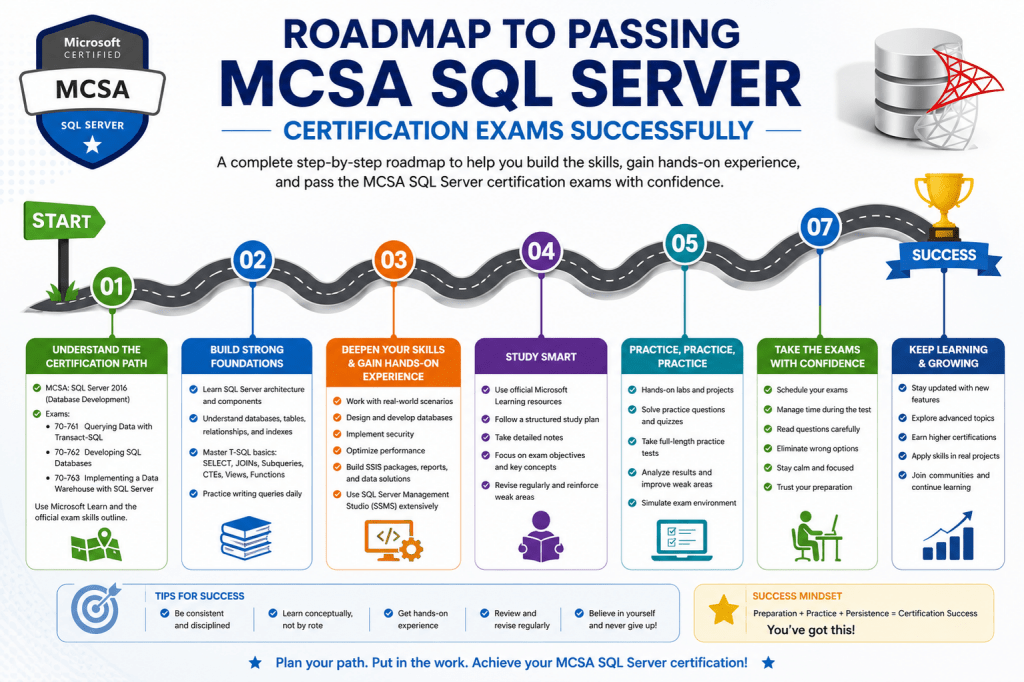
The Microsoft Certified Solutions Associate SQL Server Database Development certification represents a structured pathway for individuals aiming to build or strengthen expertise in relational database development using SQL Server technologies. It focuses on developing practical abilities required to manage, design, and query databases in both traditional and cloud-based environments. This certification is typically pursued by professionals who want to validate their ability to work with enterprise-level data systems and contribute to database-driven applications. It emphasizes real-world skills such as writing queries, building database structures, and ensuring efficient data management practices. The overall journey is not only about passing exams but also about developing a strong foundation in database concepts that can be applied in professional environments where data integrity, performance, and scalability are critical.
Understanding the Certification Structure and Purpose
The SQL Server Database Development certification is built around a two-exam structure designed to evaluate both theoretical understanding and practical application. The first focus area centers on querying and manipulating data using structured query techniques, while the second emphasizes designing and implementing database solutions. This dual-exam approach ensures that candidates are not only familiar with retrieving data but also capable of building and maintaining database systems. The certification is aligned with professional expectations for database developers who work in environments where data is continuously created, modified, and analyzed. It also reflects the growing importance of SQL Server technologies in supporting business applications, reporting systems, and cloud-integrated solutions. The structure is designed to gradually build competency, allowing learners to strengthen both foundational and advanced skills in a logical progression.
Prerequisites and Foundational Knowledge Requirements
Before pursuing this certification, candidates are expected to have a reasonable level of experience working with databases, particularly in writing queries and understanding relational database concepts. Typically, individuals benefit from having at least two years of hands-on experience in SQL-based environments. This experience helps in understanding key concepts such as data normalization, relationships between tables, indexing, and query optimization. A strong grasp of basic programming logic and familiarity with data structures also contributes to better preparation. Understanding how data flows within applications and how databases interact with software systems is essential. This foundational knowledge ensures that learners can transition smoothly into more advanced topics such as stored procedures, functions, and database design principles. Without this background, the learning curve can be significantly steeper, making practical experience a valuable asset.
Exam Format and Evaluation Approach
The certification consists of two separate exams that assess different aspects of SQL Server expertise. Each exam typically includes a range of question types designed to evaluate both conceptual understanding and practical application. These may include scenario-based questions, multiple-choice formats, and interactive problem-solving tasks that simulate real database challenges. The time allocated for each exam is generally sufficient to allow careful analysis of each question, requiring candidates to manage time effectively. The passing standard is set at a level that ensures a solid understanding of the subject matter rather than surface-level familiarity. The evaluation approach is designed to test not only memory but also analytical thinking and problem-solving ability. Candidates are expected to demonstrate competence in interpreting requirements and applying SQL solutions in realistic scenarios.
Core Skills in Data Querying and Management
A significant portion of the certification focuses on the ability to query data efficiently using structured query language. This includes selecting, filtering, aggregating, and transforming data from relational databases. Candidates must understand how to construct queries that retrieve accurate results while maintaining performance efficiency. Skills in joining multiple tables, using subqueries, and applying conditional logic are essential. In addition, understanding data modification techniques such as inserting, updating, and deleting records is important for maintaining database integrity. The ability to work with complex datasets and extract meaningful insights is a key expectation. These skills form the backbone of database interaction and are widely used in real-world business environments where data-driven decision-making is essential for operational success.
Database Development and Design Principles
Database design is a critical component of this certification, focusing on how data structures are created and maintained for optimal performance. This includes understanding normalization principles to reduce redundancy and improve data integrity. Candidates are expected to design tables, define relationships, and implement constraints that ensure consistency within the database. Knowledge of indexes and how they improve query performance is also important. Additionally, database development involves creating stored procedures, triggers, and functions that automate repetitive tasks and enforce business logic. Understanding how to structure a database for scalability and efficiency is essential, especially in environments where data volume grows over time. Proper design ensures that systems remain stable, maintainable, and capable of supporting evolving business requirements.
SQL Server Features and Functional Capabilities
SQL Server introduced several enhancements that improve performance, security, and integration capabilities. These include advanced in-memory processing features that accelerate data retrieval and processing tasks. Enhanced security features help protect sensitive data through encryption and controlled access mechanisms. The platform also supports better integration with cloud environments, allowing hybrid data solutions that combine on-premises and cloud resources. Built-in analytics capabilities enable more advanced data processing directly within the database engine. Understanding these features is important for candidates because they reflect modern database requirements in enterprise environments. The certification encourages familiarity with these capabilities to ensure that professionals can leverage the full potential of the platform in real-world scenarios.
Preparation Strategy and Learning Approach
Effective preparation for this certification requires a structured and consistent learning approach. Candidates typically begin by strengthening their understanding of relational database fundamentals before moving into more advanced SQL concepts. Practical experience plays a critical role, as hands-on practice helps reinforce theoretical knowledge. Working with sample databases and writing queries regularly improves confidence and accuracy. It is also important to focus on understanding how different SQL components interact with each other, such as how queries impact performance or how database design influences data retrieval. Time management during preparation is essential, as balancing theoretical study with practical exercises leads to better retention. A disciplined approach that gradually builds complexity ensures steady progress toward readiness.
Exam Readiness and Professional Considerations
Preparing for the exam involves more than just technical knowledge; it also requires familiarity with exam conditions and expectations. Candidates must be comfortable working within time constraints and interpreting complex scenarios quickly. Attention to detail is crucial, as small errors in queries or design decisions can significantly impact results. Understanding how to analyze requirements and translate them into SQL solutions is a key skill. On the day of the exam, maintaining focus and managing time effectively contributes to better performance. From a professional standpoint, achieving this certification demonstrates a commitment to developing database expertise and can enhance credibility in technical roles that involve data management and system development responsibilities.
Career Opportunities and Industry Relevance
Professionals who earn this certification can pursue a variety of roles within the IT and data management sectors. Common positions include database developer, database administrator, systems analyst, and data-focused engineering roles. These roles involve working with large datasets, ensuring database performance, and supporting applications that rely on structured data. Organizations across industries such as finance, healthcare, technology, and retail depend heavily on database professionals to manage critical information systems. As data continues to grow in importance, the demand for skilled individuals who can design and maintain efficient database systems remains strong. This certification helps validate the skills required to contribute effectively in such environments and supports long-term career development in data-centric roles.
Advancing Beyond the Certification Pathway
After completing this certification, individuals often continue developing their skills by pursuing more advanced credentials and specialized knowledge areas. The broader certification structure in this field is designed to support continuous professional growth, moving from foundational knowledge to more advanced and specialized expertise. Progression typically involves deeper exploration of data management, analytics, and system architecture concepts. This allows professionals to expand their capabilities beyond basic database development into more strategic and complex responsibilities. Continuous learning is important in this field due to evolving technologies and increasing data complexity. Advancing beyond the initial certification helps professionals remain competitive and adaptable in a rapidly changing technological environment.
Conclusion
The SQL Server Database Development certification provides a structured pathway for developing essential database skills that are widely applicable across many industries. It combines theoretical understanding with practical application, ensuring that candidates are prepared for real-world data challenges. From querying and database design to understanding platform features and performance optimization, the certification builds a comprehensive skill set for database professionals. It also serves as a stepping stone for further advancement in the broader certification ecosystem, supporting long-term career growth. By focusing on both foundational and advanced concepts, it equips learners with the ability to work effectively in data-driven environments where accuracy, efficiency, and system reliability are essential.