The Certified Kubernetes Application Developer exam is designed for professionals who work closely with containerized applications in Kubernetes environments. It validates practical skills related to deploying, configuring, troubleshooting, and managing applications running inside Kubernetes clusters. Unlike many traditional certification exams that rely on multiple-choice questions, this certification focuses entirely on hands-on tasks performed through the command line. Candidates are expected to demonstrate real operational knowledge by solving problems in a live environment rather than simply recognizing theoretical answers.
This certification is widely respected because it tests practical ability under pressure. Individuals preparing for the exam must understand how Kubernetes resources interact, how workloads behave, and how application components communicate inside a cluster. The exam environment mirrors real-world operational scenarios, making preparation much more focused on actual experience than memorization.
Because the exam is performance-based, candidates are evaluated on their ability to complete tasks accurately within a limited amount of time. Every action matters. A simple mistake such as deploying resources in the wrong namespace or missing a required configuration detail can result in lost points. Success depends heavily on familiarity with Kubernetes commands, YAML configurations, troubleshooting methods, and workload management.
Many developers, cloud engineers, DevOps professionals, and system administrators pursue this certification to validate their Kubernetes expertise. Organizations increasingly rely on Kubernetes to manage scalable applications, making professionals with verified container orchestration skills highly valuable in modern IT environments. The certification demonstrates that a candidate can work confidently with Kubernetes applications in production-like conditions.
Why the CKAD Certification Matters
Kubernetes has become one of the most important technologies in cloud-native computing. Organizations across industries use it to automate deployment, scaling, and management of containerized applications. As adoption continues to grow, employers seek professionals who understand how to develop and maintain workloads within Kubernetes clusters efficiently.
The certification helps professionals prove that they understand Kubernetes from an application development perspective rather than purely from an administrative viewpoint. While some certifications focus heavily on infrastructure and cluster management, this exam emphasizes how applications are built, deployed, configured, exposed, and maintained within Kubernetes environments.
Earning this certification can improve career opportunities for developers transitioning into cloud-native environments. It also benefits engineers already working with Kubernetes who want formal validation of their skills. Since the exam is practical and hands-on, many hiring managers consider it strong evidence of real operational ability.
The certification also encourages deeper understanding of Kubernetes best practices. Preparing for the exam pushes candidates to learn efficient command-line usage, workload troubleshooting, service exposure, security configuration, and application observability. These skills extend well beyond the exam itself and become valuable in day-to-day engineering work.
Another reason the certification carries weight is the difficulty level. Candidates cannot rely on memorization alone. They must know how to work quickly and accurately under time pressure while navigating real Kubernetes resources. This practical focus increases the credibility of the certification in professional environments.
Exam Structure and Performance Expectations
The exam consists of practical tasks performed in a terminal-based environment. Candidates receive objectives that require creating, modifying, troubleshooting, or configuring Kubernetes resources. Each task is weighted differently depending on complexity and importance.
Because the exam is entirely hands-on, time management becomes one of the biggest challenges. Candidates must move efficiently between questions while maintaining accuracy. The environment tests not only technical knowledge but also operational discipline and workflow optimization.
A strong understanding of kubectl commands is essential. Candidates who rely too heavily on manually writing long YAML files may struggle with time constraints. Efficient use of imperative commands can significantly improve speed during the exam. However, candidates must still understand declarative configurations because many tasks involve modifying or troubleshooting existing YAML manifests.
The exam also requires familiarity with namespaces, pods, deployments, services, ingress resources, ConfigMaps, Secrets, and troubleshooting tools. Candidates are expected to know how these components interact inside Kubernetes clusters and how to configure them correctly.
Attention to detail plays a major role in exam success. Small configuration errors can prevent workloads from functioning correctly. Missing a label selector, exposing the wrong port, or using an incorrect namespace can cause an otherwise correct solution to fail validation.
Practical experience is one of the strongest predictors of success. Candidates who regularly use Kubernetes in real environments often adapt more quickly to the exam format than those who rely only on theoretical study materials.
Core Knowledge Areas Covered in the Exam
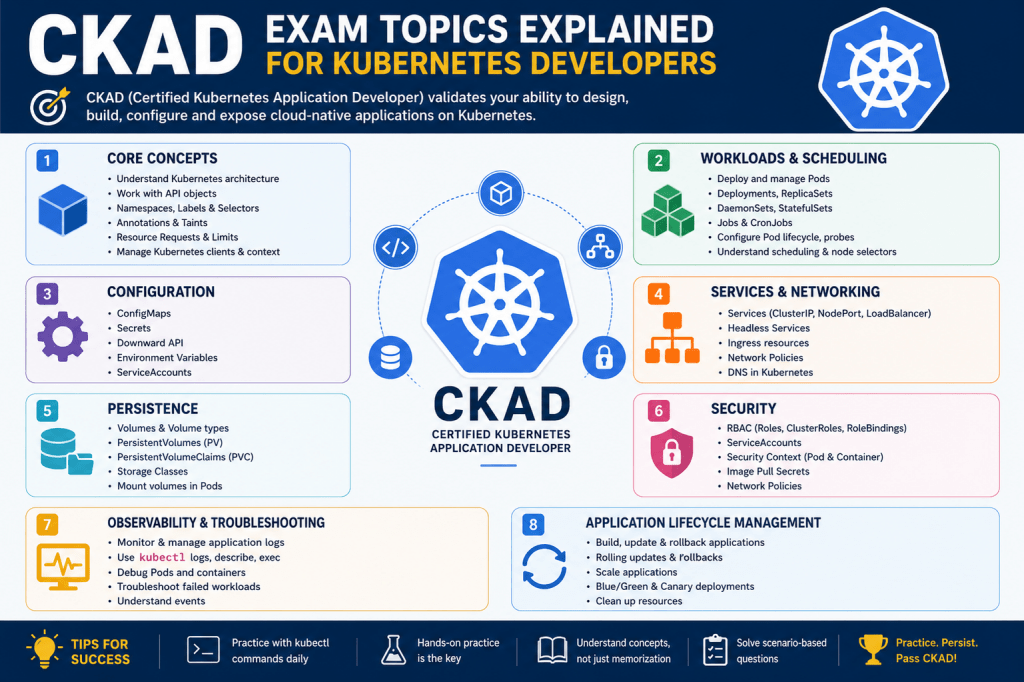
The exam is divided into several major domains that collectively represent the lifecycle of Kubernetes application management. These domains focus on application creation, deployment, observability, networking, and configuration management.
Each domain evaluates different aspects of Kubernetes operations. Candidates must demonstrate competence across all areas rather than specializing in only one section. Since the exam environment simulates real operational tasks, understanding how components interact is extremely important.
Application design and build topics focus heavily on pod configurations, resource management, and workload definitions. Candidates must understand how containers behave within pods and how Kubernetes schedules workloads across cluster resources.
Deployment-related topics evaluate understanding of scaling, rolling updates, rollback strategies, and workload availability. Candidates must know how deployments maintain application reliability while updates are applied.
Observability and maintenance tasks assess troubleshooting abilities, health monitoring configurations, and logging operations. Understanding how Kubernetes detects healthy and unhealthy containers is critical for maintaining stable applications.
Networking topics examine service exposure, internal communication, and traffic management. Candidates need to understand how applications communicate both internally within clusters and externally with users.
Configuration and security sections evaluate how applications manage environment variables, configuration files, secrets, and secure resource handling. These topics are extremely important because modern cloud-native applications rely heavily on dynamic configuration management.
Application Design and Build Concepts
One of the largest sections of the exam focuses on application design and resource creation. Candidates are expected to know how to build Kubernetes workloads efficiently while following best practices for containerized applications.
Pods form the foundation of Kubernetes workloads. Candidates must understand how pods are structured, how multiple containers interact within a pod, and how lifecycle management works. Since many exam questions revolve around pods, deep familiarity with pod behavior is essential.
Resource requests and limits are another critical topic. Kubernetes uses these configurations to allocate CPU and memory resources effectively. Candidates need to understand how improper resource allocation affects scheduling and application performance.
Container startup behavior is also commonly tested. This includes understanding command overrides, entry points, initialization procedures, and environment configuration during startup. Candidates should know how to customize container execution behavior without rebuilding container images.
Multi-container pod architecture is another important concept. Some applications require sidecar containers, logging agents, or helper services operating alongside primary containers. Understanding how these containers communicate and share resources within pods is valuable during exam scenarios.
Candidates should also understand labels, selectors, and annotations because these components help Kubernetes organize and manage workloads. Many Kubernetes resources depend on labels for communication and traffic routing.
Manifest editing skills are heavily tested throughout this domain. Candidates are often required to modify existing configurations rather than create entirely new resources from scratch. Efficient YAML editing therefore becomes an important practical skill.
Working Efficiently with Kubernetes Resources
Speed and accuracy are both essential during the exam. Candidates who spend too much time manually typing large configurations often struggle to complete all tasks within the time limit. Efficient workflow habits can therefore make a major difference.
Imperative commands allow candidates to generate Kubernetes resources quickly. These commands can create pods, deployments, services, and configuration templates without requiring complete YAML files from scratch. Understanding when to use imperative methods versus declarative methods is an important exam skill.
For example, generating a deployment quickly through kubectl commands and then exporting the configuration into YAML for editing can save significant time. Candidates who combine command-line efficiency with YAML editing flexibility often perform better under pressure.
Namespace management is another critical workflow consideration. Many exam tasks specify particular namespaces where resources must be created or modified. Forgetting to switch namespaces or incorrectly applying resources to the default namespace can lead to failed tasks.
Candidates should also become comfortable inspecting existing resources rapidly. Commands for describing pods, viewing logs, checking events, and inspecting deployments are frequently needed during troubleshooting scenarios.
Editing YAML files efficiently is equally important. Since the exam environment provides only terminal-based editors, familiarity with text editors becomes essential. Candidates who practice Kubernetes workflows directly in terminal environments often gain a strong advantage.
Another useful strategy involves understanding common YAML patterns. Many Kubernetes resource definitions follow predictable structures. Recognizing these patterns helps candidates identify mistakes and make modifications quickly without rereading entire files repeatedly.
The Importance of Hands-On Kubernetes Practice
Practical experience is the foundation of successful exam preparation. Reading documentation alone is rarely enough to build the operational confidence needed for a performance-based certification. Candidates benefit most from repeated hands-on interaction with Kubernetes clusters.
Building and deploying sample applications helps reinforce important concepts. Creating deployments, exposing services, configuring ingress rules, and troubleshooting failing workloads all contribute to stronger practical understanding.
Repeated exposure to kubectl commands improves speed and familiarity. Over time, candidates develop muscle memory for common operations, reducing hesitation during the exam. This becomes especially valuable under strict time constraints.
Troubleshooting exercises are particularly helpful because the exam frequently includes broken or incomplete configurations. Candidates must identify issues quickly and apply accurate fixes without extensive guidance.
Working with different Kubernetes resource types also builds confidence. Pods, deployments, ConfigMaps, Secrets, services, ingress controllers, and network policies all behave differently. Understanding their relationships helps candidates solve complex tasks more effectively.
Candidates should also practice working entirely from the terminal. Since the exam environment does not provide graphical management interfaces, command-line confidence is essential. Engineers accustomed only to dashboards may find the terminal-focused environment more challenging.
Consistency is one of the most important factors in preparation. Short daily practice sessions often provide better long-term retention than occasional intensive study sessions. Kubernetes concepts become easier to manage once candidates repeatedly interact with them in realistic scenarios.
Developing a Strong Kubernetes Mindset
Beyond memorizing commands, successful candidates develop a deeper understanding of how Kubernetes behaves as a platform. This mindset allows them to troubleshoot logically rather than relying solely on memorized procedures.
For example, when an application fails, candidates should naturally investigate pod status, container logs, events, resource limits, service mappings, and networking behavior. Developing systematic troubleshooting habits improves both speed and accuracy.
Understanding Kubernetes architecture also helps during complex scenarios. Knowing how the control plane schedules workloads, how services route traffic, and how kubelet manages containers provides useful context for problem-solving.
Candidates should think about applications from Kubernetes’ perspective. Kubernetes constantly evaluates desired state versus actual state. Many troubleshooting tasks involve identifying why the cluster cannot achieve the intended configuration.
Declarative infrastructure principles are another important concept. Kubernetes resources define desired outcomes, and the platform continuously attempts to maintain those states. Candidates who understand this philosophy often navigate configuration issues more effectively.
Adaptability is equally valuable. Exam tasks may vary significantly in complexity and structure. Candidates who remain calm and methodical under pressure typically perform better than those who panic when encountering unfamiliar scenarios.
Building confidence with Kubernetes takes time, repetition, and patience. However, the skills developed during exam preparation extend far beyond certification objectives. They become practical capabilities useful in real production environments where container orchestration and cloud-native applications continue to grow in importance.
Application Deployment Fundamentals in Kubernetes
Application deployment is one of the most important areas covered in the Certified Kubernetes Application Developer exam. This section evaluates a candidate’s ability to deploy, manage, scale, and update workloads inside Kubernetes clusters efficiently. Understanding deployment operations is essential because Kubernetes environments constantly change as applications evolve, scale, and receive updates.
A deployment in Kubernetes acts as a controller that manages application pods automatically. Rather than creating pods manually one by one, deployments allow engineers to define a desired state for an application. Kubernetes continuously works to maintain that desired state by creating, replacing, or scaling pods as needed.
Candidates preparing for the exam must understand how deployments behave during updates, failures, and scaling operations. Since modern applications require high availability and continuous delivery, deployment management is one of the most valuable operational skills in Kubernetes environments.
The exam frequently tests real-world deployment scenarios. Candidates may need to modify container images, scale replicas, troubleshoot rollout failures, or revert problematic updates. These tasks reflect practical operational responsibilities commonly encountered in production environments.
A strong understanding of deployments helps candidates move faster during the exam because many Kubernetes workloads are built around deployment resources. Efficient deployment management often becomes the foundation for solving larger application problems inside the cluster.
Understanding Kubernetes Deployments
Deployments provide declarative management for applications running in Kubernetes. Instead of manually creating individual pods, engineers define a deployment configuration that specifies how many replicas should exist, which container image should run, and what update strategy Kubernetes should follow.
Once a deployment is created, Kubernetes automatically manages the associated ReplicaSets and pods. If a pod crashes or becomes unavailable, Kubernetes immediately attempts to replace it. This self-healing behavior is one of the reasons Kubernetes is widely used in cloud-native environments.
Candidates should understand the relationship between deployments, ReplicaSets, and pods. A deployment manages ReplicaSets, while ReplicaSets manage pods. Whenever deployment changes occur, Kubernetes creates new ReplicaSets to represent updated application versions.
Rolling updates are another essential deployment concept. Kubernetes can gradually replace old application instances with new ones while keeping the application available during updates. Candidates must understand how rolling updates function because the exam often includes update and rollback tasks.
Deployment manifests also include selectors and labels that determine which pods belong to a particular workload. Improper selector configuration can cause deployments to behave incorrectly, so attention to detail is extremely important.
During exam preparation, candidates should practice creating deployments from scratch, modifying existing deployments, and troubleshooting failed deployment operations. Real familiarity with deployment behavior significantly improves confidence during practical tasks.
Scaling Applications in Kubernetes
Scaling applications is one of the most common operational responsibilities in Kubernetes environments. Applications may require additional replicas during periods of high traffic or reduced replicas during lower demand periods. Kubernetes deployments make scaling relatively simple, but candidates still need to understand the mechanics involved.
Scaling changes the number of pod replicas maintained by the deployment. When scaling upward, Kubernetes schedules additional pods across cluster nodes. When scaling downward, excess pods are terminated while maintaining application availability.
Candidates should practice both imperative and declarative scaling methods. Imperative scaling uses command-line instructions for immediate adjustments, while declarative scaling involves modifying YAML manifests to define the desired replica count.
Understanding how scaling affects application performance and availability is also important. Increasing replicas can improve load distribution and fault tolerance, while excessive scaling may consume unnecessary cluster resources.
The exam may include tasks requiring rapid scaling adjustments. Candidates who can perform these operations efficiently save valuable time during the certification process.
Horizontal scaling concepts are especially important in Kubernetes because applications are often designed to scale dynamically across multiple containers. Candidates should understand how Kubernetes distributes workload replicas and how services route traffic between them.
Resource allocation also affects scaling behavior. If cluster nodes lack sufficient CPU or memory resources, additional replicas may remain in pending status rather than running successfully. Recognizing these scheduling problems is an important troubleshooting skill.
Managing Rolling Updates and Rollbacks
Application updates are a critical part of modern software development. Kubernetes deployments support rolling updates, allowing applications to receive new versions gradually while remaining operational.
Rolling updates replace old pods incrementally rather than shutting down the entire application at once. This minimizes downtime and reduces risk during production deployments. Candidates preparing for the exam should understand how Kubernetes manages this update process automatically.
Deployment strategies define how updates occur. Kubernetes allows control over the number of unavailable pods during updates as well as the number of additional temporary pods created during rollout operations. These settings influence update speed and application stability.
Candidates must also understand deployment history and revision management. Kubernetes stores previous deployment revisions, enabling rollback functionality if new updates introduce problems.
Rollback operations are frequently tested in practical Kubernetes scenarios. Candidates may need to revert an application to a previous working state after a failed deployment update. Knowing how to inspect rollout history and restore earlier revisions is extremely important.
Monitoring rollout status is another key skill. Kubernetes provides commands for tracking deployment progress and identifying rollout failures. Candidates should become comfortable checking deployment events, pod states, and rollout conditions during troubleshooting exercises.
Failed updates may occur for many reasons, including invalid container images, application crashes, missing environment variables, or resource allocation problems. Understanding how Kubernetes responds to these failures helps candidates diagnose issues more effectively during the exam.
Working with Kubernetes YAML Manifests
YAML manifests are the backbone of declarative Kubernetes management. They define how resources should behave within the cluster and allow configurations to be version-controlled and reused.
Candidates preparing for the exam must become highly comfortable reading and editing YAML files. Even though imperative commands can save time, many exam tasks involve modifying existing manifests rather than creating resources entirely from scratch.
Understanding YAML structure is essential. Kubernetes manifests contain fields such as metadata, specifications, selectors, labels, container definitions, and resource requirements. Misplaced indentation or incorrect syntax can cause resource creation failures.
Efficient editing habits become extremely important during the exam. Candidates should practice quickly identifying required changes within manifests without getting overwhelmed by unnecessary configuration details.
Pod templates within deployments deserve special attention because they define the containers created by the deployment. Changes to pod templates trigger rollout operations automatically. Candidates must understand how modifications affect running workloads.
Environment variables, container ports, volume mounts, probes, and resource requests are commonly configured within manifests. Since these elements appear frequently throughout the exam, familiarity with their structure improves speed and accuracy.
Manifest troubleshooting is equally important. Candidates should practice identifying syntax mistakes, missing fields, incorrect indentation, and invalid resource definitions. Many operational problems stem from small configuration errors that are easy to overlook under pressure.
Understanding Kubernetes Services
Services are essential networking components in Kubernetes. They provide stable network access to applications even when individual pods are created or destroyed dynamically.
Because pod IP addresses change frequently, services create reliable communication endpoints for workloads. Candidates preparing for the exam must understand how services expose applications both internally and externally.
ClusterIP services provide internal communication within the cluster. These services allow workloads to communicate securely without exposing applications outside the Kubernetes environment. Candidates should understand how ClusterIP services route traffic between pods using selectors.
NodePort services expose applications externally through ports opened on cluster nodes. This allows external users or systems to access applications running inside Kubernetes clusters. Candidates should understand how NodePort mappings function and how traffic reaches backend pods.
LoadBalancer services integrate with cloud provider infrastructure to expose applications through external load balancers. While cloud integration details may vary, candidates should understand the purpose and behavior of this service type.
Service selectors are extremely important because they determine which pods receive network traffic. Incorrect labels or selectors can prevent applications from communicating properly.
The exam may require candidates to create or troubleshoot services quickly. Understanding how services connect to deployments and pods allows candidates to solve networking problems more efficiently.
Networking Relationships Between Pods and Services
Kubernetes networking revolves around communication between pods, services, and external clients. Understanding these relationships is essential for both deployment management and troubleshooting.
Pods communicate using flat networking principles, meaning every pod can typically communicate directly with other pods unless network policies restrict access. Services simplify this communication by providing stable endpoints that abstract away changing pod IP addresses.
Candidates should understand how DNS operates inside Kubernetes clusters. Services receive internal DNS names that allow workloads to locate each other dynamically without relying on hardcoded IP addresses.
Service discovery becomes especially important in microservices environments where multiple applications interact constantly. Kubernetes automates much of this discovery process, but candidates must still understand how components locate and communicate with one another.
Port mapping is another critical networking concept. Services expose ports that forward traffic to container ports running inside pods. Misconfigured port mappings can break application communication even when workloads themselves are healthy.
Candidates should also understand endpoint behavior. Kubernetes automatically updates service endpoints as pods are created or removed. This dynamic behavior allows services to continue functioning during scaling operations and rolling updates.
Networking troubleshooting often involves checking pod labels, service selectors, endpoint mappings, and port configurations. Developing systematic troubleshooting habits helps candidates identify problems more quickly during the exam.
Helm and Kubernetes Package Management
Helm is commonly described as a package manager for Kubernetes. It simplifies deployment and management of complex Kubernetes applications by using reusable templates called charts.
Although the exam does not focus heavily on Helm, candidates should still understand its core concepts and basic operations. Helm allows applications to be packaged, configured, and deployed consistently across environments.
Charts contain templates that define Kubernetes resources such as deployments, services, ingress configurations, and ConfigMaps. These templates use variables that allow customization without rewriting entire manifests.
Candidates should understand basic Helm workflows such as installing charts, upgrading releases, and viewing deployment status. Even limited familiarity with these operations can help during exam tasks involving package deployment.
Helm is valuable because it simplifies management of large applications containing many interconnected Kubernetes resources. Instead of maintaining multiple separate manifests manually, engineers can deploy entire application stacks using a single chart.
Version management is another important Helm feature. Helm tracks release history, allowing rollback operations similar to Kubernetes deployment rollbacks. Understanding this concept helps candidates appreciate how Kubernetes ecosystems handle application lifecycle management.
Even though Helm may represent a smaller portion of the exam, it remains an important part of modern Kubernetes environments. Basic competency with Helm contributes to broader cloud-native operational understanding.
Efficient Command-Line Usage During the Exam
Since the certification environment is entirely terminal-based, command-line efficiency directly impacts performance. Candidates who navigate kubectl commands smoothly often complete tasks much faster than those who hesitate or rely heavily on documentation.
Kubectl supports both imperative and declarative workflows. Imperative commands allow fast resource creation and management, while declarative methods provide greater configuration flexibility through YAML manifests.
Candidates should practice generating resource templates quickly using dry-run functionality combined with YAML output. This approach helps create manifests rapidly without typing every field manually.
Aliases and shortcuts can also improve efficiency. Shortening commonly used commands reduces typing time and minimizes errors during stressful situations.
Context and namespace management are especially important. Many exam tasks require working in specific namespaces, and forgetting to switch contexts can lead to failed solutions even when configurations themselves are correct.
Candidates should also become comfortable using resource inspection commands rapidly. Describing deployments, checking pod logs, viewing events, and monitoring rollout status are common troubleshooting operations throughout the exam.
Text editor proficiency matters as well. Since the exam environment provides terminal-based editors only, candidates should practice editing manifests directly within command-line environments rather than relying on graphical tools.
Developing muscle memory through repetition is one of the best preparation strategies. The more familiar candidates become with Kubernetes workflows, the more confidently they can handle practical tasks under exam pressure.
Application Observability and Maintenance in Kubernetes
Application observability and maintenance is a core area in the Certified Kubernetes Application Developer exam, focusing on how well candidates can monitor, troubleshoot, and maintain running applications inside a Kubernetes cluster. In real-world environments, applications do not always run perfectly after deployment, so engineers must continuously observe system behavior and ensure workloads remain healthy and responsive.
This section evaluates practical skills related to logs, health checks, debugging techniques, and application monitoring. Candidates are expected to quickly identify issues in running workloads and apply corrective actions using Kubernetes-native tools. Since the exam is entirely hands-on, understanding observability tools is essential for solving time-sensitive tasks.
Kubernetes provides multiple mechanisms to observe application behavior, including logs, events, probes, and status checks. Each of these plays a different role in understanding system health. Candidates must know when and how to use each method effectively during troubleshooting scenarios.
A strong grasp of observability also improves efficiency in other exam domains. Many deployment and networking issues can only be resolved by examining logs or checking runtime behavior. Therefore, observability skills are deeply interconnected with all other Kubernetes concepts tested in the exam.
Working with Kubernetes Logs
Logs are one of the most important tools for understanding what is happening inside a running application. Kubernetes captures output generated by containers and makes it accessible through the command line. Candidates must know how to retrieve and interpret these logs quickly during the exam.
Each container running inside a pod generates its own log stream. When multiple containers exist within a single pod, logs must be accessed individually for each container. This requires candidates to understand how to specify container names when viewing logs.
Logs are especially useful for diagnosing application failures. If a pod is not behaving as expected, logs often reveal error messages, configuration issues, or runtime exceptions that help identify the root cause.
In many exam scenarios, candidates will need to debug broken applications using logs alone. This requires not only technical knowledge but also the ability to interpret output quickly under time pressure.
Another important concept is log streaming. Kubernetes allows real-time viewing of logs as applications run. This is useful for monitoring behavior during startup or when testing changes to configurations.
Candidates should also understand how logs behave when pods restart or are recreated. Since Kubernetes may terminate and replace pods automatically, log access patterns can change depending on pod lifecycle events.
Efficient log navigation is critical for exam success. Candidates who can quickly locate relevant log information often solve troubleshooting tasks much faster than those who rely on trial-and-error methods.
Probes and Application Health Monitoring
Kubernetes uses probes to determine whether applications are running correctly. These probes help the system decide when to restart containers, send traffic to pods, or mark workloads as unhealthy. Understanding probes is extremely important for both exam success and real-world application stability.
There are two primary types of probes used in Kubernetes: readiness probes and liveness probes. Each serves a different purpose in monitoring application health.
Readiness probes determine whether a container is ready to accept traffic. If a readiness probe fails, Kubernetes temporarily removes the pod from service endpoints until it becomes healthy again. This ensures that only fully functional applications receive user traffic.
Liveness probes, on the other hand, determine whether a container is still running correctly. If a liveness probe fails, Kubernetes restarts the container to recover from potential failure states. This helps maintain long-term application stability.
Candidates must understand how to configure both probe types inside pod specifications. These configurations may include HTTP checks, command execution checks, or TCP socket checks depending on the application design.
Probe timing settings are also important. Kubernetes allows configuration of delay times, intervals, and failure thresholds. Incorrect probe configuration can lead to unnecessary restarts or premature traffic removal.
During the exam, candidates may need to troubleshoot applications that fail due to incorrect probe settings. Understanding how probes influence pod lifecycle behavior is essential for diagnosing such issues.
Observability through probes ensures applications behave reliably under different conditions. Candidates who understand probe mechanics are better equipped to maintain stable workloads in Kubernetes environments.
Debugging Running Applications in Kubernetes
Debugging is a critical skill tested throughout the exam. Candidates must be able to identify why applications are not functioning correctly and apply appropriate fixes quickly.
Kubernetes provides several tools for debugging, including pod descriptions, event logs, container logs, and status checks. Each tool provides different levels of detail about application behavior.
Describing a pod is often the first step in debugging. This command reveals detailed information about pod status, events, and configuration issues. It helps candidates quickly identify whether the problem is related to scheduling, configuration, or runtime behavior.
Events are especially useful because they show real-time cluster activity. These events can indicate why a pod failed to start, why it was terminated, or why it is stuck in a pending state.
Container state information also plays an important role in debugging. Pods may exist in states such as running, pending, or crash loop backoff. Each state indicates a different type of problem that must be analyzed separately.
Crash looping containers are particularly common in exam scenarios. These occur when a container repeatedly starts and fails. Understanding how to inspect logs and identify failure causes is essential for resolving these issues.
Another important debugging technique involves checking resource constraints. If a pod cannot schedule due to insufficient CPU or memory, Kubernetes will provide events indicating scheduling failure. Candidates must recognize these signals quickly.
Debugging also involves validating configuration correctness. Missing environment variables, incorrect image names, or misconfigured volumes can all cause application failures. Careful inspection of YAML manifests is often required.
Efficient debugging requires a systematic approach. Candidates who follow a structured process—starting from pod status, then logs, then events—tend to resolve issues faster and more accurately during the exam.
Understanding Kubernetes Maintenance Tasks
Maintenance in Kubernetes involves ensuring applications continue to run smoothly over time. This includes monitoring health, updating configurations, managing logs, and responding to system changes.
One of the key maintenance tasks is monitoring application stability. Kubernetes continuously evaluates workloads and takes corrective actions when necessary. However, engineers must still intervene when issues cannot be automatically resolved.
Updating configurations is another important maintenance activity. Applications often require changes to environment variables, resource limits, or configuration files. Kubernetes allows these updates without fully redeploying applications in many cases.
Rolling updates also play a role in maintenance. As applications evolve, new versions must be deployed while minimizing downtime. Understanding how to manage updates without disrupting service is a key operational skill.
Resource optimization is another maintenance responsibility. Applications must be monitored to ensure they are not consuming excessive CPU or memory resources. Adjustments may be needed to maintain cluster efficiency.
Log management is also part of maintenance tasks. While Kubernetes provides access to logs, engineers must know how to use them effectively for long-term monitoring and debugging.
Another important aspect of maintenance is ensuring application resilience. This includes verifying that restart policies, probes, and scaling configurations are properly defined to handle failures automatically.
Maintenance tasks often overlap with troubleshooting. Many issues discovered during maintenance require immediate debugging and resolution using observability tools.
Application Environment Configuration and Security
Application configuration and security is one of the most important domains in the Certified Kubernetes Application Developer exam. It focuses on how applications manage sensitive data, environment variables, and configuration settings inside Kubernetes clusters.
Modern applications rely heavily on dynamic configuration rather than hardcoded values. Kubernetes provides ConfigMaps and Secrets to manage these configurations efficiently and securely.
ConfigMaps are used to store non-sensitive configuration data. These may include application settings, environment variables, or configuration files that applications need during runtime.
Secrets, on the other hand, are used to store sensitive information such as passwords, tokens, and keys. Kubernetes ensures that Secrets are handled securely, although they are not fully encrypted by default unless additional configurations are applied.
Candidates must understand how to create, update, and use both ConfigMaps and Secrets within pod specifications. These resources are frequently tested in exam scenarios.
Environment variables are commonly injected into containers using ConfigMaps or Secrets. Candidates should understand how to map configuration values into running applications.
Volume-based configuration is another important concept. Kubernetes allows ConfigMaps and Secrets to be mounted as files inside containers, enabling applications to read configuration data directly from the filesystem.
Understanding how applications consume configuration data is essential for troubleshooting environment-related issues. Missing or incorrect configuration values often cause application failures.
Security also involves controlling access to sensitive data. While the exam does not focus heavily on advanced security mechanisms, candidates should understand basic principles of data protection within Kubernetes.
Base64 encoding is used for storing secret data in Kubernetes manifests. Candidates must understand how encoding and decoding works when working with Secrets.
Proper configuration management ensures applications remain flexible, secure, and scalable across different environments. This is a key principle of cloud-native application development.
Working with ConfigMaps in Practice
ConfigMaps are widely used in Kubernetes environments to decouple configuration from application code. This makes applications more portable and easier to manage across different environments such as development, testing, and production.
Candidates should understand how to create ConfigMaps from literal values as well as from files. Each method serves different use cases depending on application requirements.
Once created, ConfigMaps can be injected into pods through environment variables or mounted as volumes. Understanding both methods is important for exam scenarios.
Environment variable injection is commonly used for simple key-value configurations. This method allows applications to access configuration values directly without modifying application code.
Volume mounting is more suitable for complex configuration files. In this approach, entire configuration files are made available inside containers as filesystem objects.
Candidates should also understand how updates to ConfigMaps affect running applications. Depending on how the ConfigMap is used, changes may require pod restarts or may be reflected automatically.
Troubleshooting ConfigMap issues is a common exam task. Missing keys, incorrect mappings, or misconfigured volumes can cause applications to behave unexpectedly.
Efficient use of ConfigMaps improves application flexibility and simplifies configuration management in Kubernetes environments.
Working with Secrets in Kubernetes
Secrets are designed to store sensitive information securely within Kubernetes clusters. These may include authentication credentials, API keys, and encryption tokens required by applications.
Candidates must understand how Secrets differ from ConfigMaps in terms of usage and security considerations. While both store configuration data, Secrets are intended for sensitive values.
Secrets are stored in base64-encoded format. Although this provides basic encoding, it is not true encryption. Candidates should understand how encoding and decoding processes work when handling Secrets.
Secrets can be injected into pods similarly to ConfigMaps. They can be exposed as environment variables or mounted as files depending on application requirements.
Security best practices involve limiting exposure of sensitive data and ensuring only required applications have access to Secrets. Kubernetes provides mechanisms to control access at the resource level.
During the exam, candidates may be required to create Secrets and use them within application deployments. Understanding how to reference Secret keys correctly is essential for successful configuration.
Troubleshooting Secret-related issues often involves verifying encoding, checking key names, and ensuring correct mounting inside containers.
Proper handling of Secrets is critical for maintaining application security in Kubernetes environments.
Services, Networking, and Application Exposure in Kubernetes
Services and networking form the backbone of communication in Kubernetes environments, and this section of the Certified Kubernetes Application Developer exam evaluates how effectively a candidate can expose applications, manage traffic flow, and understand how workloads communicate inside a cluster. Kubernetes applications rarely operate in isolation, so networking ensures that different components can interact reliably and securely.
A service in Kubernetes provides a stable endpoint for accessing a set of pods, even when those pods are created, destroyed, or replaced dynamically. Since pod IP addresses change frequently, services act as an abstraction layer that ensures consistent connectivity. Candidates must understand how services use labels and selectors to route traffic to the correct backend pods, as well as how different service types—such as ClusterIP, NodePort, and LoadBalancer—control accessibility inside and outside the cluster.
Networking also includes understanding how applications communicate internally through DNS-based service discovery. Kubernetes automatically assigns DNS names to services, allowing pods to locate each other without hardcoded IP addresses. This makes microservice communication flexible and scalable. Candidates are expected to understand how traffic flows between services, pods, and external clients, and how incorrect configurations in selectors, ports, or labels can break connectivity.
Another important aspect is exposing applications using imperative commands and YAML configurations. Candidates may be asked to quickly create or modify services to ensure applications are reachable. This requires strong familiarity with port mapping, target ports, and service definitions. In exam scenarios, even small mistakes in networking configuration can lead to failed connectivity, making attention to detail extremely important.
Network policies may also appear as part of the exam. These policies control how traffic flows between pods by allowing or restricting communication based on rules. Understanding the basics of traffic control helps candidates secure applications and troubleshoot connectivity issues effectively. Overall, this domain ensures that candidates can manage application exposure and communication in real Kubernetes environments with confidence.
Conclusion
The Certified Kubernetes Application Developer exam is a practical, hands-on certification that tests real-world skills in building, deploying, managing, and troubleshooting containerized applications in Kubernetes. It goes far beyond theoretical knowledge and focuses on how well a candidate can operate within a live cluster environment under time pressure. Success in this exam depends heavily on consistent practice, strong command-line proficiency, and deep familiarity with Kubernetes core concepts.
Candidates who develop a structured approach to learning Kubernetes—covering deployments, networking, observability, configuration, and security—are far more likely to perform well. The exam rewards speed, accuracy, and the ability to think logically under pressure. Every domain is interconnected, meaning that strong understanding in one area often supports performance in others.
Ultimately, this certification demonstrates that a professional can confidently work with Kubernetes applications in real production-like environments. It reflects not only technical knowledge but also practical problem-solving ability, making it a valuable credential for developers, DevOps engineers, and cloud professionals working in modern cloud-native ecosystems.