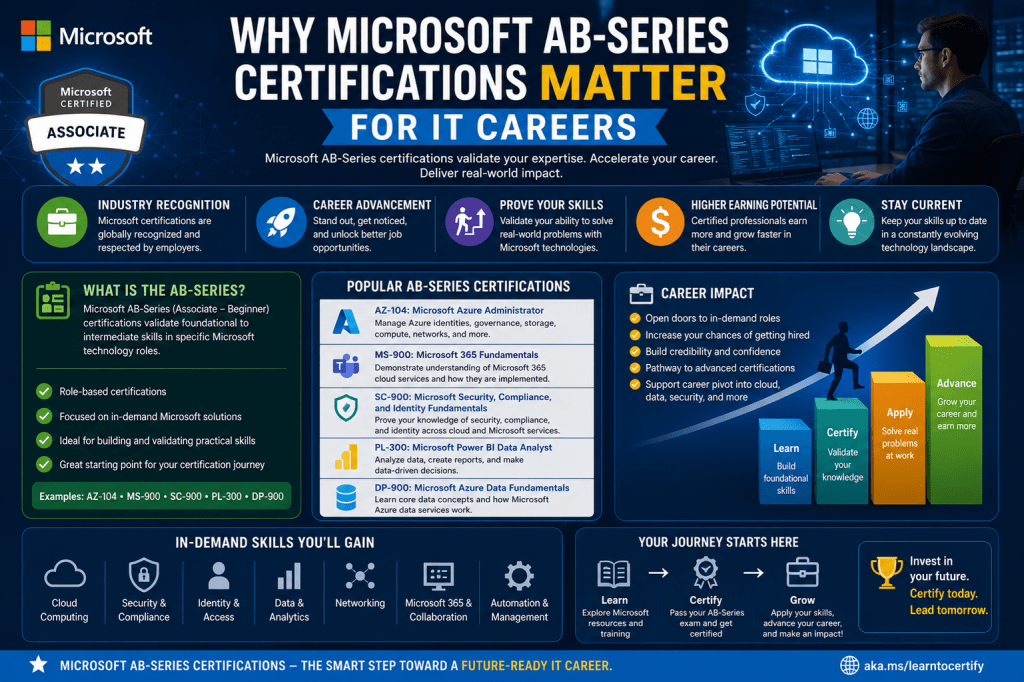
Microsoft has introduced a completely new certification direction focused on artificial intelligence, enterprise automation, and intelligent business operations. The launch of the AB certifications represents one of the biggest changes in Microsoft’s professional learning ecosystem in recent years. Instead of concentrating only on product-specific administration skills, the company is now prioritizing certifications that prepare professionals for broader AI-centered responsibilities inside modern organizations.
Why Microsoft Changed Its Certification Strategy
The technology industry is evolving rapidly as artificial intelligence becomes deeply integrated into daily business operations. Organizations are no longer searching only for professionals who can manage cloud services or maintain productivity platforms. Businesses now want experts who understand how AI systems interact across departments, automate workflows, improve decision-making, and support long-term business goals. Microsoft updated its certification structure to reflect these changing workforce demands.
The Growing Importance of Enterprise AI
Artificial intelligence has moved beyond experimental projects and become a core business technology. Companies across multiple industries are adopting AI-powered tools to improve efficiency, reduce operational costs, and enhance customer experiences. This rapid adoption has created a growing demand for professionals who can design, manage, and govern intelligent systems securely and effectively. Microsoft’s new certification path aims to prepare professionals for these responsibilities.
The Shift Away From Product-Centered Learning
Traditional Microsoft certifications often focused on individual products or isolated technical skills. Professionals usually specialized in areas such as server administration, messaging systems, endpoint management, or productivity applications separately. While these skills still matter, organizations increasingly need employees who understand how multiple technologies work together inside connected enterprise environments. The AB certifications focus on broader solution design instead of narrow product expertise.
How AI Is Reshaping IT Careers
Modern IT roles are changing because artificial intelligence is now integrated into many business processes. Professionals who once focused mainly on technical maintenance are now expected to understand automation, AI governance, workflow optimization, and intelligent business operations. Microsoft’s updated certifications reflect this reality by emphasizing skills that support enterprise-wide digital transformation.
The Role of Intelligent Automation in Businesses
Businesses are using intelligent automation to reduce repetitive tasks and improve operational efficiency. AI systems can now manage scheduling, analyze reports, process customer requests, generate content, and assist employees with complex workflows. Organizations need professionals who understand how to deploy and manage these systems effectively. Microsoft’s new certifications are designed to build these capabilities.
Understanding Agentic AI Systems
One of the most important concepts behind the AB certifications is agentic AI. Agentic AI refers to intelligent systems capable of performing actions, making decisions, and interacting autonomously with users or other systems. These technologies are becoming increasingly important in enterprise environments because they can automate large portions of business operations while improving productivity and consistency.
The Rise of Multi-Agent Workflows
Many organizations are moving toward multi-agent environments where different AI systems collaborate together to complete tasks. These workflows allow intelligent systems to share information, coordinate operations, and support complex business activities. Managing these environments requires advanced technical and operational knowledge. Microsoft’s certifications focus heavily on preparing professionals for this new era of enterprise AI.
The Importance of AI Governance
As businesses adopt artificial intelligence more aggressively, governance becomes a major concern. Organizations must ensure AI systems operate securely, ethically, and in compliance with company policies and industry regulations. Microsoft’s updated certifications place strong emphasis on governance because businesses need professionals who can manage risks while maintaining operational efficiency.
Security Challenges in AI Environments
AI systems often process sensitive business information and interact with critical enterprise operations. This creates new security challenges for organizations. Professionals working with AI technologies must understand identity management, access controls, monitoring systems, and compliance standards. Microsoft’s AB certifications help learners build knowledge in these important security areas.
The Growing Demand for AI Specialists
The demand for AI-skilled professionals continues to grow across nearly every industry. Companies are searching for individuals who can connect business goals with intelligent technologies. Employers want professionals who understand both technical implementation and strategic planning. Microsoft’s certification updates aim to prepare learners for these high-demand roles.
How Businesses Benefit From AI Integration
Organizations adopting AI technologies often experience improvements in productivity, efficiency, and operational accuracy. Intelligent systems can automate routine tasks, reduce manual errors, and improve decision-making speed. Businesses also use AI to enhance customer support, analyze large datasets, and optimize workflows. Professionals capable of supporting these initiatives are becoming increasingly valuable.
The Expansion of Cloud-Based AI Services
Cloud computing platforms now provide businesses with powerful AI services that can be integrated into existing systems. Organizations use cloud-based AI tools for analytics, automation, collaboration, and intelligent application development. Microsoft’s certifications help professionals understand how these technologies fit into broader enterprise architectures.
The Role of Copilot Technologies in Modern Workflows
AI-powered assistant technologies are transforming workplace productivity. Intelligent copilots can summarize meetings, generate reports, organize information, and automate communication tasks. Businesses are rapidly adopting these solutions to improve efficiency and support employees. Microsoft’s updated certification path reflects the growing importance of these technologies within enterprise environments.
Why Businesses Need AI Architects
As AI systems become more advanced, organizations need professionals capable of designing intelligent infrastructures that remain secure, scalable, and manageable. AI architects play a critical role in planning how automation, data systems, and intelligent services interact across business operations. Microsoft’s certifications are designed to support the development of these advanced architectural skills.
The Evolution of Business Operations Through AI
Artificial intelligence is changing how organizations operate on a daily basis. Businesses now use AI systems for inventory management, customer engagement, workflow approvals, reporting automation, and predictive analytics. This transformation requires professionals who understand both operational processes and intelligent technologies.
The Importance of Cross-Platform Integration
Modern enterprises rely on multiple technologies working together seamlessly. AI systems often connect with collaboration tools, analytics platforms, cloud services, customer relationship systems, and productivity applications. Professionals managing these environments need broad technical understanding rather than isolated product knowledge.
How AI Supports Business Decision-Making
AI technologies help organizations process large amounts of information quickly and efficiently. Intelligent systems can identify patterns, generate insights, and support strategic planning. Businesses increasingly depend on AI-assisted analytics to improve decision-making accuracy and operational performance.
The Need for Strategic AI Planning
Implementing artificial intelligence successfully requires more than technical deployment. Organizations must align AI strategies with long-term business objectives, workforce planning, operational requirements, and governance standards. Microsoft’s certification updates encourage professionals to think strategically about AI adoption rather than focusing only on technical implementation.
The Impact of AI on Workforce Development
Many organizations are restructuring employee training programs to prepare teams for AI-driven operations. Companies want workers who can adapt to intelligent technologies and support digital transformation initiatives. The AB certifications provide structured learning paths that align with these workforce development goals.
Why AI Knowledge Is Becoming Essential
Artificial intelligence is rapidly becoming a standard component of enterprise technology environments. Professionals without AI-related knowledge may struggle to keep pace with evolving industry demands. Microsoft’s updated certifications help learners build skills that remain relevant as businesses continue investing in intelligent systems.
The Growing Importance of Automation Skills
Automation technologies are reshaping many traditional business processes. Organizations now automate reporting, customer interactions, communication workflows, and operational approvals. Professionals who understand automation platforms and AI-driven workflows are increasingly valuable to employers.
How AI Improves Customer Experiences
Businesses use AI systems to personalize customer interactions, respond to inquiries faster, and provide intelligent recommendations. AI-powered customer support tools can improve satisfaction while reducing operational workloads. Professionals who understand these technologies can help organizations deliver better service experiences.
The Relationship Between AI and Productivity
Artificial intelligence can significantly improve workplace productivity by reducing repetitive tasks and assisting employees with daily responsibilities. Intelligent systems help teams process information faster, organize workloads efficiently, and improve collaboration across departments.
Why Organizations Are Investing in AI Transformation
Businesses view artificial intelligence as a long-term strategic investment rather than a temporary trend. Companies want intelligent systems capable of supporting innovation, operational growth, and competitive advantage. Microsoft’s new certifications reflect this growing focus on enterprise AI transformation.
The Role of AI in Digital Transformation
Digital transformation initiatives increasingly depend on artificial intelligence to modernize operations and improve efficiency. Organizations are combining cloud services, automation platforms, analytics tools, and AI technologies to create connected digital ecosystems. Professionals who understand these systems are critical to successful transformation projects.
The Importance of Scalable AI Infrastructure
Organizations implementing AI technologies at scale need infrastructures that remain secure, reliable, and manageable. Professionals responsible for these environments must understand scalability planning, governance standards, and intelligent workflow architecture. Microsoft’s certifications help learners develop these enterprise-level capabilities.
How AI Is Changing Collaboration Tools
Modern collaboration platforms increasingly include AI-powered features such as automated meeting summaries, task recommendations, intelligent scheduling, and workflow assistance. These tools improve productivity while simplifying communication across teams. Businesses need professionals capable of managing these intelligent collaboration environments.
The Future of Enterprise Technology Careers
Technology careers are evolving as artificial intelligence becomes central to business operations. Professionals who understand AI architecture, automation strategies, governance frameworks, and intelligent workflows are likely to remain in high demand. Microsoft’s AB certifications aim to prepare learners for these future-focused career opportunities.
Why Continuous Learning Matters in AI Careers
Artificial intelligence technologies continue evolving rapidly. Professionals working in modern enterprise environments must commit to continuous learning to remain competitive. Microsoft’s updated certification paths encourage ongoing skill development in automation, intelligent systems, and enterprise AI management.
The Long-Term Impact of Microsoft’s Certification Updates
Microsoft’s new certification direction reflects a broader transformation happening across the technology industry. AI is becoming a core business capability rather than a specialized technical niche. The AB certifications are designed to help professionals build the knowledge and practical understanding required for the next generation of enterprise technology roles.
Understanding the AB-900 Certification Path
The AB-900 certification serves as the foundation for Microsoft’s new AI-focused certification structure. It is designed for professionals who are beginning their journey into AI administration, intelligent automation, and enterprise agent management. This certification introduces learners to the core concepts behind Microsoft’s AI ecosystem while helping them understand how intelligent systems operate inside modern organizations.
The Purpose of the AB-900 Certification
Microsoft created the AB-900 certification to help organizations build a workforce capable of supporting AI-powered environments. Businesses adopting intelligent systems require professionals who understand the fundamentals of AI administration, governance, access management, and operational monitoring. The certification focuses on preparing learners for these practical responsibilities.
Why Entry-Level AI Certifications Matter
Many professionals are interested in artificial intelligence but do not know where to begin. The AB-900 certification provides a structured starting point that introduces important AI concepts without requiring advanced architectural knowledge. It helps learners build confidence while developing foundational skills that support future career growth.
The Growing Need for AI Administrators
As organizations deploy intelligent systems across departments, the demand for AI administrators continues to increase. Businesses need professionals who can manage AI tools securely, monitor their usage, maintain compliance, and ensure smooth operations. The AB-900 certification helps learners understand these important responsibilities.
The Role of Copilot Technologies in Business Operations
AI-powered copilots are becoming common across enterprise environments. These intelligent assistants help employees automate tasks, organize workflows, generate reports, summarize information, and improve productivity. Businesses require professionals who understand how to manage these tools effectively and securely.
How Copilot Systems Improve Workplace Efficiency
Modern AI copilots reduce the amount of repetitive work employees perform daily. They assist with communication, scheduling, information retrieval, document generation, and workflow management. Organizations implementing these technologies often experience improvements in operational speed and employee productivity.
Understanding Agent Administration Fundamentals
One of the key focuses of the AB-900 certification is agent administration. AI agents are intelligent systems capable of performing tasks, interacting with users, and supporting workflows automatically. Managing these systems requires knowledge of permissions, governance, monitoring, and operational policies.
The Importance of AI Access Management
AI systems often interact with sensitive business information, making access management extremely important. Organizations must ensure that users only access the information and capabilities necessary for their roles. The AB-900 certification introduces learners to the principles of identity management and secure AI access control.
Why Governance Is Critical in AI Environments
AI governance refers to the policies and controls organizations use to manage intelligent systems responsibly. Businesses must ensure that AI technologies operate ethically, securely, and according to compliance standards. The AB-900 certification teaches professionals how governance supports safe AI adoption.
The Basics of AI Monitoring and Oversight
Organizations need visibility into how AI systems operate within their environments. Monitoring tools help businesses track usage patterns, detect unusual activity, and ensure operational stability. Professionals working with AI systems must understand how monitoring contributes to security and performance management.
How Businesses Use AI Automation
Automation is one of the biggest reasons organizations invest in AI technologies. Businesses use intelligent automation to simplify repetitive processes such as approvals, scheduling, customer support, reporting, and communication management. The AB-900 certification introduces learners to the role automation plays in modern operations.
The Connection Between AI and Productivity Tools
AI technologies are increasingly integrated into workplace productivity platforms. Employees now use intelligent assistants to organize meetings, summarize discussions, generate presentations, and automate workflows. Professionals managing these environments need foundational knowledge of AI-powered productivity systems.
Why Organizations Need AI Governance Policies
Without clear governance policies, AI systems can create operational and security risks. Organizations must establish rules regarding data access, responsible usage, compliance requirements, and monitoring practices. The AB-900 certification helps learners understand how governance frameworks support enterprise AI operations.
The Importance of Responsible AI Practices
Responsible AI practices ensure intelligent systems are deployed ethically and fairly. Businesses must consider transparency, accountability, privacy, and security when implementing AI technologies. Microsoft’s certification approach emphasizes these principles because they are essential for long-term enterprise success.
How AI Is Transforming Workplace Collaboration
Collaboration platforms now include intelligent features capable of assisting teams with communication, scheduling, document management, and workflow coordination. AI systems help employees work more efficiently while improving information sharing across departments.
The Growing Role of AI in Daily Operations
Artificial intelligence is no longer limited to specialized technical projects. Many businesses now rely on AI technologies during everyday operations. Intelligent systems assist with reporting, customer interactions, project coordination, and operational planning across multiple business areas.
The Importance of Learning AI Fundamentals Early
Professionals who develop AI knowledge early are often better prepared for future career opportunities. The AB-900 certification helps learners build foundational understanding before moving into more advanced AI architecture or business transformation roles.
How AI Supports Operational Scalability
Businesses implementing AI systems often need environments capable of supporting large numbers of users, workflows, and operational tasks. Scalable AI infrastructures help organizations expand their operations while maintaining efficiency and consistency.
Why AI Skills Are Valuable Across Industries
Artificial intelligence is impacting nearly every industry, including finance, healthcare, retail, education, logistics, and manufacturing. Organizations across these sectors need professionals who understand intelligent systems and automation technologies.
The Relationship Between AI and Digital Transformation
Digital transformation projects increasingly rely on AI technologies to modernize operations and improve efficiency. Intelligent systems help organizations automate processes, analyze information, and enhance decision-making capabilities.
The Role of AI in Enterprise Communication
Businesses use AI-powered tools to improve communication across teams and departments. Intelligent assistants help summarize conversations, generate responses, schedule meetings, and organize collaborative tasks. Professionals managing these systems need strong foundational AI knowledge.
How AI Improves Data Management
Organizations process enormous amounts of information daily. AI systems help businesses organize, analyze, and interpret data more effectively. This allows companies to make faster decisions and improve operational performance.
The Importance of AI Compliance Awareness
Compliance is a major concern in AI-driven environments because intelligent systems often interact with regulated information. Organizations must ensure their AI operations follow legal, privacy, and industry requirements. The AB-900 certification introduces learners to these important considerations.
Why Businesses Need AI Monitoring Strategies
Monitoring helps organizations track AI performance, detect problems, and maintain operational reliability. Businesses need professionals who understand how monitoring tools support governance, security, and system optimization.
The Connection Between AI and Security Management
AI systems require strong security controls because they may process sensitive business information or interact with important operational systems. Professionals managing AI environments must understand identity protection, access controls, and monitoring practices.
The Growing Adoption of Intelligent Assistants
Intelligent assistants are becoming standard tools in modern workplaces. Businesses use these systems to improve efficiency, automate communication, and support employee productivity. Professionals with AI administration knowledge are increasingly valuable in these environments.
How AI Reduces Repetitive Workloads
Many employees spend significant amounts of time performing repetitive administrative tasks. AI technologies help reduce these workloads by automating routine activities and assisting with operational processes. This allows teams to focus on higher-value responsibilities.
The Importance of AI Workflow Management
AI systems often interact with multiple workflows across departments. Organizations need professionals who understand how to manage these interactions effectively while maintaining security and operational efficiency.
Why Businesses Are Prioritizing AI Training
Organizations recognize that AI adoption requires properly trained employees. Businesses are investing in certification programs and learning initiatives to ensure teams understand how intelligent systems operate and how they should be managed responsibly.
The Role of AI in Future Workforce Development
AI technologies are reshaping workforce expectations across the technology industry. Employers increasingly value professionals who understand automation, intelligent systems, and enterprise AI operations. The AB-900 certification supports these evolving workforce needs.
How AI Supports Decision-Making Processes
Businesses use AI systems to analyze information, identify patterns, and support operational planning. Intelligent technologies help organizations make faster and more informed decisions across multiple business areas.
The Benefits of Foundational AI Knowledge
Even professionals who do not plan to become AI architects benefit from understanding AI fundamentals. Foundational knowledge helps employees adapt to modern workplace technologies and collaborate more effectively in AI-driven environments.
The Growing Importance of AI Literacy
AI literacy is becoming an essential skill for technology professionals. Organizations want employees who understand how intelligent systems function, how they are governed, and how they support business operations.
How AI Is Changing Enterprise Software Platforms
Modern enterprise platforms increasingly include AI-powered features such as intelligent automation, predictive analytics, and workflow assistance. Professionals working with these systems benefit from understanding how AI capabilities integrate into business operations.
The Need for Adaptability in Modern IT Careers
Technology professionals must continuously adapt to changing industry trends. Artificial intelligence is one of the most significant technological shifts affecting enterprise environments today. Certifications such as AB-900 help professionals remain competitive in evolving job markets.
The Long-Term Value of AI Fundamentals
Foundational AI knowledge provides a strong starting point for future career development. Professionals who understand AI administration, governance, automation, and intelligent workflows are better prepared for advanced certifications and enterprise leadership opportunities.
The Future of AI Administration Roles
As AI technologies continue expanding across industries, administrative roles focused on intelligent systems will become increasingly important. Organizations need professionals capable of managing AI tools responsibly while supporting productivity and operational efficiency.
How AB-900 Supports Career Progression
The AB-900 certification serves as an entry point into Microsoft’s broader AI-focused learning ecosystem. Learners who complete this certification can continue developing their expertise in business AI strategy, enterprise architecture, and intelligent transformation initiatives.
The Importance of Building Strong AI Foundations
A strong understanding of AI fundamentals helps professionals navigate the rapidly changing technology landscape. Microsoft’s AB-900 certification provides foundational knowledge that supports long-term growth in enterprise AI careers and intelligent business operations.
Exploring the AI Business Professional Certification
The AI Business Professional certification is designed for individuals who work closely with business operations, workflow planning, and organizational strategy. Unlike purely technical certifications, this credential focuses on helping professionals understand how artificial intelligence can improve business performance, automate operational processes, and support long-term company goals. It bridges the gap between business decision-making and intelligent technology implementation.
Why Businesses Need AI-Focused Professionals
Organizations are increasingly adopting artificial intelligence to improve productivity, streamline operations, and create more efficient business models. However, successful AI implementation requires more than technical deployment. Companies need professionals who understand business challenges, operational goals, and workflow inefficiencies so they can identify where AI technologies deliver the greatest value.
The Connection Between AI and Business Strategy
Artificial intelligence is becoming deeply connected to business strategy across industries. Companies are no longer using AI only for experimental projects or technical demonstrations. Businesses now rely on intelligent systems to improve customer experiences, automate internal operations, support analytics, and optimize decision-making processes. Professionals who understand both business operations and AI capabilities are becoming essential.
The Role of Business Professionals in AI Adoption
Business professionals play a major role in helping organizations adopt artificial intelligence successfully. They help identify operational problems, evaluate workflow inefficiencies, and determine where intelligent automation can create measurable improvements. Their ability to connect technology solutions with organizational objectives makes them highly valuable during AI transformation initiatives.
How AI Supports Workflow Optimization
One of the most important benefits of artificial intelligence is workflow optimization. AI technologies can automate repetitive processes, organize information more efficiently, improve communication, and reduce manual workloads. Businesses implementing intelligent workflows often experience higher productivity and improved operational accuracy.
Why Organizations Focus on Operational Efficiency
Operational efficiency has become a major priority for organizations trying to remain competitive in rapidly changing markets. Businesses want systems that reduce delays, improve collaboration, and increase productivity without creating unnecessary complexity. Artificial intelligence helps organizations achieve these goals by supporting automation and intelligent process management.
The Growing Demand for AI Business Analysts
Companies increasingly need professionals capable of analyzing business operations through the lens of artificial intelligence. AI business analysts help organizations understand how intelligent systems can improve processes, reduce costs, and support innovation. These professionals often act as communication bridges between technical teams and executive leadership.
Understanding Business-Centered AI Solutions
Business-centered AI solutions focus on practical outcomes rather than technical complexity alone. Organizations want intelligent systems that improve employee productivity, enhance customer experiences, simplify reporting, and support operational planning. Professionals working in AI business roles must understand how to evaluate these solutions effectively.
The Importance of Identifying AI Use Cases
Not every business process benefits equally from artificial intelligence. One of the key responsibilities of AI business professionals is identifying the right use cases for intelligent technologies. This requires understanding operational workflows, employee responsibilities, customer interactions, and business objectives.
How AI Improves Business Decision-Making
Artificial intelligence helps organizations process large volumes of information quickly and accurately. AI-powered analytics systems can identify patterns, generate insights, and support strategic planning. Businesses use these capabilities to make more informed decisions regarding operations, customer engagement, financial planning, and productivity management.
The Role of AI in Customer Experience Improvement
Many organizations use artificial intelligence to improve customer interactions and service delivery. Intelligent systems help businesses respond to customer requests faster, personalize communication, and provide more efficient support experiences. AI business professionals often help organizations identify opportunities to enhance customer engagement through intelligent technologies.
Why AI Collaboration Skills Matter
Successful AI implementation requires collaboration between multiple departments, including operations, technology, compliance, analytics, and leadership teams. Business professionals working with AI technologies must communicate effectively with both technical and non-technical stakeholders.
The Importance of Communication in AI Projects
Communication plays a critical role in AI transformation projects because organizations often involve multiple teams with different priorities and expertise. Business professionals help ensure technical solutions align with operational goals while maintaining clear communication between departments.
How AI Supports Productivity Improvements
Artificial intelligence helps organizations reduce repetitive workloads, simplify task management, and improve operational coordination. Intelligent systems can automate scheduling, reporting, information retrieval, and workflow approvals, allowing employees to focus on higher-value activities.
The Connection Between AI and Digital Transformation
Digital transformation initiatives increasingly depend on artificial intelligence to modernize business operations. Companies use AI technologies to improve efficiency, enhance collaboration, and create more adaptive operational environments. AI business professionals help organizations integrate these technologies strategically.
Why Businesses Need AI Planning Expertise
Implementing AI technologies without proper planning can create operational challenges and security risks. Organizations need professionals who understand how to evaluate business readiness, define implementation goals, and support long-term AI strategies.
The Importance of AI Governance Awareness
Business professionals working with AI technologies must understand governance principles because intelligent systems often process sensitive information and influence important operational decisions. Governance ensures AI systems operate securely, ethically, and according to organizational policies.
How AI Helps Organizations Scale Operations
Artificial intelligence allows organizations to manage larger workloads without significantly increasing operational complexity. Intelligent systems support scalability by automating tasks, improving coordination, and reducing manual intervention across departments.
The Growing Role of AI in Enterprise Planning
Organizations increasingly rely on AI technologies during strategic planning and operational forecasting. Intelligent systems help businesses analyze trends, evaluate performance, and identify growth opportunities more effectively.
The Importance of Business Workflow Analysis
Understanding workflows is essential for successful AI implementation. Business professionals must evaluate how information moves through organizations, where delays occur, and which processes can benefit from intelligent automation.
How AI Supports Data-Driven Organizations
Modern businesses generate enormous amounts of operational and customer data. Artificial intelligence helps organizations process this information efficiently while identifying patterns that support decision-making and business strategy.
The Relationship Between AI and Innovation
Artificial intelligence encourages innovation by enabling businesses to automate processes, improve operational flexibility, and explore new service opportunities. Organizations investing in AI often gain competitive advantages through improved efficiency and smarter decision-making.
Why Organizations Prioritize Intelligent Automation
Intelligent automation helps businesses reduce operational costs while improving productivity and consistency. Organizations use AI systems to automate approvals, communication tasks, reporting workflows, and customer interactions.
The Need for AI-Aware Business Leaders
Business leaders increasingly need foundational AI knowledge to support organizational transformation efforts. Understanding how AI technologies affect operations, productivity, and workforce planning is becoming an important leadership skill.
How AI Supports Cross-Department Collaboration
AI technologies often connect multiple business systems and departments together. Successful implementation requires professionals who understand how operations, analytics, compliance, and technology teams interact within intelligent environments.
The Importance of Measuring AI Business Outcomes
Organizations want measurable results from their AI investments. Business professionals help evaluate productivity improvements, operational efficiencies, customer satisfaction, and financial benefits generated through intelligent technologies.
Why AI Is Becoming Central to Enterprise Operations
Artificial intelligence is increasingly integrated into daily business activities such as communication management, workflow coordination, customer service, and operational analytics. This growing integration creates demand for professionals who understand enterprise AI operations.
The Relationship Between AI and Workforce Productivity
AI technologies support employees by reducing repetitive tasks and simplifying information management. Businesses use intelligent systems to improve collaboration, automate routine operations, and increase workplace efficiency.
The Importance of Strategic AI Adoption
Organizations achieve better results when AI adoption aligns with long-term business strategies. Business professionals help ensure intelligent technologies support operational objectives instead of creating disconnected or inefficient systems.
How AI Improves Information Accessibility
Intelligent systems help employees retrieve, organize, and process information more efficiently. AI-powered search and automation tools reduce time spent locating data and improve workplace productivity.
The Role of AI in Process Simplification
Many business operations involve repetitive or time-consuming processes. Artificial intelligence helps simplify these activities by automating workflows and improving coordination across teams.
Why AI Skills Benefit Non-Technical Professionals
AI knowledge is no longer limited to technical specialists. Business professionals who understand intelligent systems are increasingly valuable because they can help organizations align AI capabilities with operational priorities.
The Growing Need for AI Change Management
AI transformation often changes how employees work and interact with technology. Organizations need professionals who can support change management efforts while helping teams adapt to intelligent workflows.
How AI Supports Organizational Agility
Businesses operating in competitive markets need flexibility and responsiveness. Artificial intelligence helps organizations adapt more quickly by automating processes, improving analytics, and supporting faster decision-making.
The Importance of AI Education in Modern Business
As artificial intelligence becomes more common across industries, organizations are investing heavily in employee education and certification programs. Businesses want teams capable of understanding and managing AI-powered operations effectively.
Why Businesses Value AI-Driven Efficiency
Efficiency improvements are one of the main reasons organizations invest in artificial intelligence. Intelligent systems reduce operational delays, improve coordination, and help businesses allocate resources more effectively.
The Role of AI in Enterprise Communication Systems
Organizations increasingly use AI-powered communication tools to summarize meetings, organize information, and support collaboration across departments. Business professionals help identify where these systems create the most operational value.
The Growing Importance of AI Literacy in Business Roles
AI literacy is becoming an essential skill for professionals across many industries. Understanding how intelligent systems function helps employees adapt to modern workplace technologies and support organizational innovation initiatives.
How AI Supports Long-Term Business Growth
Artificial intelligence helps organizations improve operational performance, support innovation, and respond more effectively to market changes. Businesses investing in AI often view intelligent systems as long-term strategic assets.
The Future of AI Business Careers
Professionals with AI business knowledge are likely to remain in high demand as organizations continue modernizing operations. Companies need individuals capable of connecting intelligent technologies with practical business outcomes and organizational strategy.
Why AI Business Certifications Matter
Certifications focused on AI business operations help professionals demonstrate their understanding of intelligent systems, workflow optimization, and enterprise transformation strategies. These credentials support career development while helping organizations identify skilled talent.
The Long-Term Value of Business AI Knowledge
As artificial intelligence continues reshaping enterprise operations, professionals who understand both business strategy and intelligent technologies will play increasingly important roles. The AI Business Professional certification helps learners develop the skills needed to support modern organizations in an AI-driven future.
Understanding the AI Transformation Leader Certification
The AI Transformation Leader certification is designed for professionals responsible for guiding organizations through large-scale artificial intelligence adoption and operational change. This certification focuses on leadership, governance, strategic planning, and enterprise-wide AI integration. It prepares decision-makers to manage the challenges that come with implementing intelligent technologies across business environments.
Why Organizations Need AI Leadership
Artificial intelligence initiatives often affect multiple departments, operational systems, and workforce structures. Without strong leadership, businesses may struggle to align AI projects with long-term organizational goals. Companies need leaders who understand both the business impact and operational requirements of intelligent technologies.
The Growing Importance of Enterprise AI Strategy
Modern organizations are treating AI as a long-term strategic investment rather than a short-term technology trend. Businesses are integrating intelligent systems into customer support, productivity platforms, workflow management, analytics, and operational planning. Effective leadership is necessary to ensure these initiatives produce measurable results.
How AI Is Reshaping Business Leadership Roles
Business leaders are increasingly expected to understand artificial intelligence and its impact on operations, workforce productivity, and organizational growth. Traditional leadership skills are no longer enough in technology-driven environments. Leaders must now understand how AI influences efficiency, decision-making, governance, and competitive positioning.
The Role of AI Transformation Leaders
AI transformation leaders guide organizations through the process of adopting intelligent technologies responsibly and effectively. Their responsibilities often include strategic planning, policy development, workforce coordination, risk management, and operational alignment.
Why Strategic Planning Matters in AI Adoption
Organizations that implement AI without clear strategic direction often face operational inefficiencies, governance problems, and inconsistent results. Strategic planning helps businesses define goals, prioritize initiatives, allocate resources, and ensure AI projects support long-term growth objectives.
The Importance of Organizational Readiness
Successful AI transformation depends heavily on organizational readiness. Businesses must evaluate their existing infrastructure, workforce capabilities, operational processes, and governance frameworks before implementing intelligent systems. AI transformation leaders help organizations assess these readiness factors.
How AI Changes Operational Structures
Artificial intelligence can significantly change how businesses operate internally. Automated workflows, intelligent decision systems, and AI-powered analytics often reshape employee responsibilities and operational processes. Leaders must understand how to manage these transitions effectively.
The Connection Between AI and Business Growth
Organizations increasingly view AI as a driver of growth and innovation. Intelligent systems can improve operational efficiency, support better customer experiences, enhance productivity, and create competitive advantages. Leaders responsible for AI transformation help organizations maximize these opportunities.
The Importance of Governance in AI Leadership
Governance is one of the most important responsibilities in enterprise AI adoption. Organizations need policies and frameworks that ensure intelligent systems operate securely, ethically, and in compliance with regulations. AI transformation leaders help establish and maintain these governance standards.
How AI Governance Supports Business Stability
Strong governance helps organizations reduce risks associated with artificial intelligence. Governance frameworks support security, operational consistency, data protection, and ethical AI usage. Businesses without proper governance structures may face compliance issues and operational disruptions.
The Role of Ethics in AI Transformation
Ethical AI practices are becoming increasingly important as intelligent systems influence business operations and decision-making. Organizations must ensure fairness, transparency, accountability, and responsible data usage when deploying AI technologies.
Why Businesses Need Responsible AI Policies
Responsible AI policies help organizations manage risks while maintaining trust among employees, customers, and stakeholders. Businesses need leaders who understand how to balance innovation with ethical and operational responsibilities.
The Impact of AI on Workforce Management
AI transformation often changes employee roles and workplace expectations. Intelligent systems can automate repetitive tasks, support collaboration, and improve operational efficiency. Leaders must manage workforce adaptation and help employees transition into AI-supported environments.
How AI Supports Operational Efficiency
Artificial intelligence allows organizations to simplify workflows, automate routine processes, and improve decision-making speed. Businesses implementing AI technologies often experience improvements in productivity, coordination, and resource management.
The Importance of Change Management in AI Projects
AI adoption frequently requires organizational change. Employees may need new training, updated workflows, and revised operational procedures. Effective change management helps organizations transition smoothly into AI-driven operations.
Why Communication Is Critical During AI Transformation
AI initiatives often involve multiple departments and stakeholders with different priorities. Leaders must communicate clearly about goals, expectations, timelines, and operational impacts to ensure successful implementation.
The Role of AI in Long-Term Business Planning
Organizations increasingly include artificial intelligence in long-term business strategies. Intelligent systems support operational growth, customer engagement, analytics, and innovation planning. Leaders responsible for AI transformation help align these technologies with future business objectives.
How AI Influences Competitive Advantage
Businesses that successfully integrate AI often gain advantages in productivity, efficiency, customer satisfaction, and operational agility. Organizations capable of using intelligent technologies strategically may respond faster to market changes and industry demands.
The Importance of Measuring AI Performance
Organizations need measurable outcomes from AI investments. Leaders responsible for transformation initiatives must evaluate productivity improvements, operational savings, workflow efficiency, and customer experience enhancements generated by intelligent systems.
Why Businesses Need AI Risk Management
Artificial intelligence introduces new operational and security risks. Organizations must manage concerns related to privacy, compliance, system reliability, and data protection. AI transformation leaders help identify and reduce these risks.
The Relationship Between AI and Organizational Culture
Successful AI adoption often depends on organizational culture. Businesses that encourage innovation, collaboration, and continuous learning are usually better prepared for AI transformation. Leaders play a major role in shaping these workplace environments.
How AI Supports Data-Driven Decision-Making
AI-powered analytics systems help organizations process large amounts of information quickly and accurately. Businesses use these systems to improve forecasting, operational planning, and strategic decision-making.
The Growing Importance of AI Education for Leaders
Modern business leaders increasingly need foundational knowledge of artificial intelligence. Understanding how intelligent systems affect operations, governance, and workforce management helps leaders make informed decisions during digital transformation initiatives.
Why AI Leadership Requires Cross-Department Knowledge
AI transformation projects often involve operations, technology, compliance, finance, analytics, and executive leadership teams. Leaders responsible for these initiatives need broad organizational understanding to coordinate efforts effectively.
The Role of AI in Innovation Strategies
Artificial intelligence supports innovation by enabling businesses to automate processes, improve analytics, and explore new service opportunities. Organizations investing in AI often use intelligent systems to accelerate modernization and improve operational flexibility.
How AI Impacts Customer Experience Strategies
Businesses increasingly use AI to personalize customer interactions, improve support services, and automate communication processes. Leaders managing AI initiatives must understand how these technologies affect customer satisfaction and engagement.
The Importance of Scalable AI Operations
Organizations implementing AI technologies at enterprise scale require infrastructures capable of supporting large operational environments. Leaders must ensure intelligent systems remain secure, reliable, and manageable as adoption grows.
Why Workforce Adaptation Is Essential in AI Transformation
Employees must adapt to changing technologies and operational processes as AI becomes more integrated into workplace environments. Organizations need leadership strategies that support employee learning and long-term workforce development.
The Connection Between AI and Operational Agility
Artificial intelligence helps businesses respond more quickly to operational challenges and market changes. Intelligent systems support faster decision-making, workflow optimization, and improved coordination across departments.
The Importance of AI Policy Development
Organizations need clear policies regarding AI usage, security, compliance, governance, and ethical standards. AI transformation leaders often oversee the creation and implementation of these policies.
How AI Supports Enterprise Modernization
Many organizations use artificial intelligence as part of broader modernization initiatives. Intelligent technologies help businesses improve operational processes, streamline communication, and increase overall efficiency.
Why AI Requires Long-Term Investment Planning
AI transformation is not a short-term process. Businesses often require long-term planning for infrastructure, workforce training, governance frameworks, and operational integration. Leaders play a critical role in guiding these investments.
The Role of Leadership in AI Adoption Success
Strong leadership often determines whether AI initiatives succeed or fail. Organizations need leaders who can balance innovation, operational stability, workforce management, and governance responsibilities during transformation projects.
How AI Influences Enterprise Decision Structures
Artificial intelligence changes how businesses collect, analyze, and use information. Leaders increasingly rely on intelligent systems to support strategic planning, operational forecasting, and performance analysis.
The Importance of AI Transparency
Transparency helps organizations build trust in intelligent systems. Businesses must understand how AI tools make decisions, process information, and influence operations. Leaders responsible for AI transformation help ensure these systems remain understandable and accountable.
Why AI Leadership Is Becoming a Critical Skill
As AI technologies become central to business operations, leadership skills related to intelligent systems are becoming increasingly valuable. Organizations want leaders capable of guiding digital transformation while maintaining governance, security, and operational efficiency.
The Future of Enterprise AI Leadership
AI leadership roles are expected to continue growing as businesses expand their intelligent technology initiatives. Organizations will increasingly depend on professionals capable of managing enterprise-wide AI strategies and transformation efforts.
How AI Transformation Certifications Support Career Growth
Certifications focused on AI leadership help professionals demonstrate their understanding of governance, strategic planning, organizational change, and enterprise AI operations. These credentials support career advancement in leadership and transformation-focused roles.
The Long-Term Value of AI Transformation Knowledge
Professionals who understand AI transformation strategies, governance principles, workforce adaptation, and operational planning are likely to remain highly valuable in modern enterprise environments. The AI Transformation Leader certification helps prepare individuals for these evolving leadership responsibilities.
Conclusion
Microsoft’s new AB certifications represent a major shift toward AI-focused enterprise skills and intelligent business operations. These certifications are designed to prepare professionals for the growing demand for automation expertise, AI governance, workflow management, and enterprise architecture knowledge. As organizations continue integrating artificial intelligence into daily operations, professionals with modern AI capabilities will become increasingly valuable across industries.
The updated certification path reflects the reality that artificial intelligence is no longer a specialized technology reserved for limited technical teams. AI is becoming a core component of business strategy, productivity, customer engagement, operational efficiency, and digital transformation. Microsoft’s certification approach aims to help professionals adapt to this evolving environment by developing practical and future-focused skills.
Businesses investing in AI technologies need employees capable of managing intelligent systems responsibly while supporting organizational growth and innovation. The AB certifications provide structured learning paths that align with these workforce demands. From foundational AI administration to enterprise-level architecture and transformation leadership, the certification structure supports professionals at multiple stages of their careers.
As artificial intelligence continues reshaping enterprise technology, professionals who understand intelligent workflows, automation systems, governance frameworks, and operational integration will remain highly valuable. Microsoft’s new certification direction reflects the future of modern IT careers, where AI knowledge, strategic thinking, and enterprise adaptability play central roles in long-term professional success.