
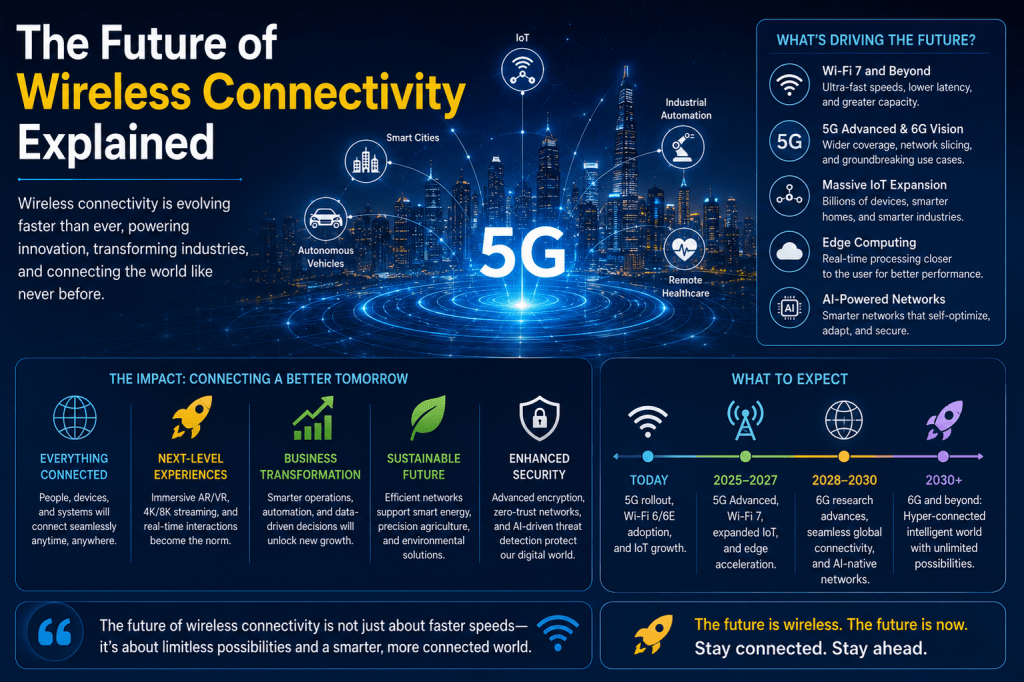
Wireless communication has long been seen as a convenience layer rather than a core infrastructure. In many environments, especially enterprise and systems administration contexts, wired connections are still considered more stable, more secure, and more predictable. Wireless networks, on the other hand, have often been associated with inconsistency, interference, and performance limitations.
However, this perception is gradually shifting. Wireless connectivity is no longer just an alternative option—it is becoming a foundational layer of modern digital ecosystems. The growing demand for mobility, remote access, smart devices, and always-connected systems is pushing wireless technologies beyond their traditional boundaries.
The future of wireless connectivity is not about replacing wired networks overnight, but about gradually redefining how data flows through everyday life. As infrastructure evolves, wireless systems are expected to support larger volumes of traffic, more devices, and more complex applications without sacrificing reliability.
Expanding Data Capacity and Network Throughput
One of the biggest historical challenges for wireless systems has been data capacity. Wired networks can handle large and continuous data streams with minimal interference, making them ideal for high-demand environments such as data centers, corporate systems, and streaming services.
Wireless networks, in contrast, have traditionally struggled with congestion and bandwidth limitations. When too many devices connect simultaneously, performance drops, latency increases, and user experience suffers. This has created the long-standing belief that wireless is inherently weaker than wired infrastructure.
That limitation is now being actively addressed through advancements in wireless architecture. Modern wireless systems are increasingly capable of handling significantly higher data throughput than earlier generations. This is achieved through more efficient spectrum usage, improved signal processing, and smarter network coordination techniques.
The real transformation comes from the ability to transmit large volumes of data with reduced delay and improved stability. High-capacity wireless networks are becoming capable of supporting activities that were once considered impractical, such as high-definition streaming, real-time collaboration tools, cloud-based applications, and large-scale device synchronization.
As these capabilities improve, wireless networks are gradually closing the gap with wired systems, especially in environments where mobility and flexibility are more important than physical cabling.
The Shift Toward Ultra-Fast Wireless Ecosystems
Another major direction in the evolution of wireless connectivity is speed. Historically, wireless speeds were significantly lower than wired alternatives. Even though wireless networks offered convenience, they often required trade-offs in performance.
That gap is rapidly narrowing. Modern wireless systems are now capable of delivering extremely high-speed connections under optimal conditions. In controlled environments and strong signal zones, wireless speeds can now approach or even match traditional broadband connections.
This shift is not just about raw speed—it is about consistency and reliability at scale. The ability to maintain high-speed connections across multiple users simultaneously is what makes next-generation wireless systems fundamentally different.
The improvement in speed also changes how networks are used. Applications that were once dependent on wired infrastructure can now operate efficiently over wireless connections. This includes cloud computing platforms, remote work environments, virtual collaboration tools, and advanced multimedia services.
As wireless speed continues to improve, the distinction between wired and wireless performance becomes less about capability and more about use case. In many situations, wireless will be preferred simply because it provides sufficient speed without physical constraints.
Increasing Network Density and Device Connectivity
The future of wireless connectivity is not only about speed and capacity but also about scale. The number of connected devices worldwide is growing rapidly, and this trend is expected to continue as more systems become digitized.
Modern wireless networks are required to support not only smartphones and laptops but also smart home devices, industrial sensors, wearable technology, autonomous systems, and interconnected infrastructure components.
This growing density creates a new challenge: maintaining stable performance in environments where thousands or even millions of devices may be connected at the same time.
To address this, wireless systems are evolving to support more efficient device management. Networks are becoming smarter in how they allocate resources, prioritize traffic, and manage congestion. Instead of treating all devices equally, modern systems dynamically adjust performance based on demand, usage patterns, and network conditions.
This shift is critical for the future of smart environments. Cities, industries, and homes will increasingly rely on continuous connectivity between multiple devices, all operating simultaneously without noticeable delays or disruptions.
Wireless as a Core Infrastructure Layer
Traditionally, wireless technology was considered secondary to wired infrastructure. However, this hierarchy is gradually changing. Wireless networks are increasingly being integrated into core infrastructure systems rather than functioning as extensions of them.
This transformation is driven by the need for flexibility, scalability, and rapid deployment. Wired infrastructure requires significant physical installation, maintenance, and regulatory coordination. Wireless systems, on the other hand, can be deployed more quickly and adapted more easily to changing demands.
This makes wireless connectivity especially valuable in environments where speed of deployment and adaptability are critical. Large-scale events, expanding urban areas, and remote regions are increasingly relying on wireless systems as primary connectivity solutions rather than backup options.
As this trend continues, wireless infrastructure is expected to become deeply embedded in essential services, including communication networks, transportation systems, emergency services, and public utilities.
Evolution of Internet Service Models Through Wireless Expansion
The traditional model of internet service delivery has been heavily dependent on fixed infrastructure providers. In many regions, users have limited options, often relying on a small number of providers for broadband access.
Wireless connectivity is beginning to reshape this structure. As wireless networks become more capable, they introduce alternative pathways for delivering internet services directly to homes and businesses without relying on extensive physical cabling.
This shift has significant implications for accessibility and competition. Wireless-based internet services can be deployed more rapidly and extended into areas where traditional infrastructure is limited or economically unfeasible.
It also introduces greater flexibility for users. Instead of being tied to a single physical provider, users may have multiple wireless-based service options depending on coverage, performance, and pricing.
This diversification of service delivery is expected to gradually reduce dependence on traditional wired broadband systems, especially in areas where wireless infrastructure becomes more dominant.
Rising Importance of Mobility and Always-Connected Systems
Modern digital lifestyles are increasingly mobile. Users expect seamless connectivity regardless of location, device, or application. This expectation is reshaping how wireless networks are designed and optimized.
The concept of being “always connected” is becoming a standard requirement rather than a premium feature. Whether for personal use, business operations, or industrial automation, uninterrupted connectivity is now essential.
Wireless systems are uniquely positioned to meet this demand. Unlike wired networks, which are fixed in location, wireless connectivity follows the user. This allows devices to remain connected while moving between environments without requiring manual reconfiguration.
This mobility is particularly important for emerging technologies such as autonomous systems, remote-controlled machinery, and real-time data applications. These systems depend on continuous communication between devices and centralized platforms.
As a result, wireless connectivity is evolving from a convenience feature into a critical enabler of modern digital ecosystems.
Preparing for a More Connected Digital Environment
The continued evolution of wireless connectivity points toward a future where digital interaction is seamless, continuous, and deeply integrated into everyday environments. The expansion of wireless systems will support not only communication but also computation, automation, and data exchange across multiple layers of society.
This transition requires more advanced network design, improved spectrum efficiency, and intelligent traffic management systems. It also demands a shift in how infrastructure is planned, moving away from rigid physical layouts toward flexible, adaptive wireless architectures.
As wireless networks become more capable, they will support increasingly complex applications, enabling environments where devices, systems, and users are constantly interconnected.
The foundation for this transformation is already being built through ongoing improvements in speed, capacity, and coverage, setting the stage for a fully wireless digital future.
Wireless Internet Services Expanding Beyond Traditional Broadband
The evolution of wireless connectivity is strongly tied to how internet services are delivered to homes and businesses. For decades, broadband access has been dominated by wired infrastructure such as cable and DSL systems. These systems, while reliable, are limited by physical deployment costs, geographic constraints, and long upgrade cycles.
Wireless internet services are now emerging as a serious alternative to traditional broadband models. Instead of relying on underground cables or fiber lines reaching every household, wireless systems transmit data through radio-based infrastructure. This allows service providers to bypass many of the physical limitations associated with wired networks.
The most significant advantage of wireless internet delivery is scalability. Once a wireless tower or base station is installed, it can serve multiple users over a wide geographic area without requiring individual physical connections. This makes expansion into suburban, rural, and underserved regions significantly more practical.
As wireless systems continue to improve, they are beginning to offer performance levels that rival traditional broadband connections. This includes higher speeds, lower latency, and more stable connections even under heavy usage conditions. While not yet universally superior, the gap is narrowing quickly.
The Rise of Fixed Wireless Access as a Broadband Alternative
Fixed wireless access is becoming one of the most important developments in modern connectivity. Unlike mobile wireless connections that move with the user, fixed wireless systems provide internet service to a specific location, such as a home or office, using wireless signals instead of physical cables.
This approach is particularly valuable in regions where laying fiber or cable infrastructure is expensive or impractical. Instead of digging trenches or installing miles of wiring, providers can deploy wireless base stations that cover large areas efficiently.
Fixed wireless systems also allow faster deployment compared to traditional broadband infrastructure. New service areas can be activated in a fraction of the time required for wired installation, enabling quicker access to high-speed internet in developing or remote regions.
Another important advantage is flexibility. Fixed wireless networks can be upgraded more easily than physical cable systems. Improvements in wireless technology can be implemented at the tower level, benefiting all connected users simultaneously without requiring individual household upgrades.
As demand for high-speed internet continues to grow, fixed wireless access is expected to play a major role in bridging the connectivity gap between urban and rural environments.
Wireless Internet in Rural and Underserved Regions
One of the most impactful applications of wireless connectivity is its ability to bring internet access to rural and underserved communities. In many parts of the world, building traditional broadband infrastructure is not economically viable due to low population density and high installation costs.
Wireless networks address this challenge by reducing the need for extensive physical infrastructure. A single wireless tower can serve a wide area, providing connectivity to multiple communities that would otherwise remain disconnected.
This expansion of access has significant social and economic implications. Reliable internet connectivity enables access to education, healthcare services, digital commerce, and remote employment opportunities. It also allows rural businesses to participate more effectively in the digital economy.
In many cases, wireless connectivity is not just an improvement but a transformation. Entire regions that previously had limited or no internet access are becoming integrated into the global digital network.
As wireless technology continues to advance, the quality of service in these areas is expected to improve further, narrowing the digital divide between urban and rural populations.
Competition Between Wireless Providers and Market Expansion
The growth of wireless internet services is also reshaping competition in the telecommunications industry. Traditionally, internet service markets have been dominated by a small number of large providers with significant control over infrastructure.
Wireless technologies introduce new opportunities for competition by lowering the barrier to entry. Unlike wired systems that require massive physical investment, wireless providers can enter markets with relatively lower infrastructure costs.
This shift encourages more competition, which can lead to better pricing, improved service quality, and greater innovation. As more providers enter the wireless space, consumers gain access to a wider range of options tailored to different performance needs and budgets.
In addition, wireless networks enable smaller regional providers to compete more effectively with large national companies. By leveraging shared infrastructure or leasing network capacity, smaller providers can offer competitive services without building entire networks from scratch.
This increased competition is expected to gradually reshape the structure of internet service markets, making them more dynamic and less centralized.
The Role of Wireless in Smart Home and Connected Living
Wireless connectivity is becoming a central component of modern smart home environments. As more devices become internet-enabled, the need for seamless and reliable wireless communication within homes is increasing rapidly.
Smart home systems rely on continuous communication between devices such as lighting systems, security cameras, thermostats, appliances, and entertainment systems. These devices must interact with each other and respond in real time to user inputs or automated triggers.
Wireless networks make this level of integration possible without requiring complex wiring or installation processes. Devices can be added, removed, or reconfigured easily, allowing homes to become more adaptable and intelligent over time.
The growth of smart home ecosystems also increases the demand for stable internal wireless networks. As the number of connected devices grows, network management becomes more important to ensure smooth performance and avoid congestion.
This trend is expected to continue as more household devices incorporate connectivity features, further embedding wireless communication into everyday life.
Enterprise Adoption of Wireless-First Infrastructure Models
Businesses are also increasingly adopting wireless-first approaches to network design. In many modern workplaces, wireless connectivity is no longer considered secondary but is instead the primary method of network access.
This shift is driven by the need for flexibility in workplace design. Employees now use mobile devices, laptops, and cloud-based applications that require constant connectivity without being tied to physical network ports.
Wireless-first environments also support more dynamic office layouts. Workspaces can be reorganized without needing to reconfigure physical cabling, allowing companies to adapt quickly to changing operational needs.
In addition, wireless systems support remote and hybrid work models, where employees may connect from different locations while maintaining access to corporate resources.
As enterprise applications become more cloud-based, the importance of reliable wireless connectivity within business environments continues to increase. This trend is expected to accelerate as organizations prioritize agility and mobility.
Integration of Wireless Networks With Cloud Computing Systems
The rise of cloud computing has significantly increased the importance of wireless connectivity. As more applications, storage systems, and processing tasks move to the cloud, reliable network access becomes essential.
Wireless networks serve as the primary connection point between end users and cloud infrastructure. Whether accessing documents, running applications, or streaming data, users depend on wireless systems to maintain continuous communication with remote servers.
This integration creates a highly interconnected digital environment where physical location becomes less relevant. Users can access the same services from multiple devices and locations without interruption.
However, this also increases demand on wireless networks. As more data flows through cloud-based systems, networks must handle higher traffic loads while maintaining low latency and high reliability.
To meet these demands, wireless systems are evolving to become more intelligent and adaptive, optimizing data flow based on usage patterns and network conditions.
Wireless Connectivity and the Growth of Data-Driven Applications
Modern digital applications are becoming increasingly data-intensive. From video streaming and online gaming to artificial intelligence and real-time analytics, the volume of data transmitted over networks continues to grow.
Wireless connectivity plays a critical role in supporting these applications. As bandwidth requirements increase, networks must be capable of delivering consistent performance even under heavy loads.
This has led to the development of more advanced wireless architectures that prioritize efficiency and scalability. Instead of simply increasing raw speed, modern systems focus on optimizing how data is transmitted and managed across the network.
This includes techniques such as traffic prioritization, dynamic bandwidth allocation, and intelligent routing. These improvements allow wireless networks to support complex applications that require continuous data exchange without interruption.
As data-driven technologies continue to expand, wireless connectivity will remain a fundamental enabler of innovation.
Wireless Networks as the Backbone of Future Digital Ecosystems
The long-term evolution of wireless connectivity suggests a future where wireless networks form the backbone of global digital infrastructure. Instead of acting as an alternative to wired systems, wireless technology will become the primary medium through which data is transmitted and managed.
This transformation will be driven by continued improvements in speed, coverage, and efficiency. As wireless systems become more capable, they will support an increasingly wide range of applications across personal, commercial, and industrial domains.
The transition will not happen instantly, but gradually as wireless reliability reaches levels comparable to or exceeding traditional wired systems in most environments.
In this future landscape, wireless connectivity will no longer be seen as an optional feature but as an essential component of all digital systems.
Mesh Networks as the Foundation of Large-Scale Wireless Coverage
As wireless connectivity continues to evolve, one of the most important architectural shifts is the growing reliance on mesh networking systems. Unlike traditional wireless setups that depend on a single centralized access point or a limited number of towers, mesh networks distribute connectivity across many interconnected nodes.
Each node in a mesh network acts both as a transmitter and a receiver, allowing data to travel through multiple pathways. This structure significantly improves coverage, especially in environments where direct connectivity to a central hub may be weak or inconsistent.
Mesh networking becomes particularly powerful in dense urban environments where obstacles such as buildings and interference can disrupt traditional signals. By creating multiple routes for data to travel, mesh systems reduce the likelihood of complete network failure and improve overall resilience.
Another key advantage is scalability. Mesh networks can be expanded simply by adding more nodes, making them highly adaptable to growing demand. This flexibility allows wireless infrastructure to evolve organically rather than requiring complete redesigns as usage increases.
As wireless demand grows globally, mesh-based architectures are expected to become a core component of both public and private network systems.
City-Wide Wireless Coverage and Smart Infrastructure Integration
The concept of fully connected cities is becoming increasingly realistic as wireless infrastructure advances. City-wide wireless networks aim to provide seamless connectivity across entire urban environments without requiring users to switch between different access points or service providers.
This type of infrastructure integrates wireless connectivity into the fabric of urban systems, including transportation, utilities, public safety, and communication services. The goal is to create an environment where connectivity is always available and seamlessly accessible.
In such systems, wireless networks are not just used for personal communication but also for managing city operations. Traffic systems, emergency response networks, environmental monitoring, and public services can all rely on continuous data exchange through wireless channels.
This level of integration requires highly dense and coordinated wireless infrastructure. Mesh networks, distributed antennas, and intelligent routing systems all play a role in ensuring that coverage remains consistent across complex urban landscapes.
As cities continue to grow and become more digitally dependent, wireless connectivity will become an essential layer of urban infrastructure rather than a supplementary feature.
Distributed Network Models and Shared Infrastructure Systems
A major transformation in wireless connectivity is the shift toward distributed network models. Instead of relying on a single provider to own and operate all infrastructure, future wireless systems are expected to function through shared and collaborative frameworks.
In these models, multiple providers may share access to a common physical network while delivering their own services to customers. This reduces duplication of infrastructure and increases overall efficiency in network deployment.
Shared infrastructure systems also lower the cost barrier for new entrants into the telecommunications market. Smaller providers can offer competitive services without needing to build entire networks from the ground up.
This approach is similar to how transportation or utility systems often operate in shared environments, where multiple service providers use the same underlying infrastructure to deliver services.
As wireless demand continues to increase, shared infrastructure models are expected to become more common, especially in densely populated areas where building multiple overlapping networks would be inefficient.
Wireless Network Densification and the Role of Small Cells
As wireless usage grows, traditional large tower-based systems are no longer sufficient to handle increasing data demand. This has led to the concept of network densification, which involves deploying a higher number of smaller wireless access points known as small cells.
Small cells are low-powered wireless transmitters that provide coverage over short distances. They are typically installed in locations such as streetlights, buildings, and utility poles to enhance network coverage in high-traffic areas.
The advantage of small cell deployment is improved capacity and reduced congestion. Instead of relying on a few large towers to serve a wide area, many smaller nodes distribute the load more evenly across the network.
This approach is especially useful in urban environments where network demand is extremely high due to population density and device concentration. Small cells help ensure that users experience consistent performance even during peak usage times.
As wireless connectivity becomes more deeply integrated into everyday life, small cell networks will play a critical role in maintaining reliable service quality.
Edge Computing and Its Relationship With Wireless Networks
Another key development shaping the future of wireless connectivity is the rise of edge computing. Edge computing refers to processing data closer to where it is generated rather than relying entirely on centralized data centers.
In traditional network models, data must travel long distances to centralized servers for processing, which can introduce latency and reduce performance. Edge computing reduces this delay by enabling local processing at or near the network edge.
Wireless networks and edge computing are closely connected because wireless devices often generate large amounts of real-time data. By processing this data closer to the source, networks can respond faster and more efficiently.
This is especially important for applications that require real-time decision-making, such as autonomous systems, industrial automation, and augmented reality environments.
Edge computing also reduces the strain on core network infrastructure by minimizing the amount of data that needs to be transmitted over long distances. This improves overall network efficiency and stability.
As wireless connectivity continues to expand, edge computing will become a critical component of next-generation network design.
Infrastructure Sharing Between Public and Private Networks
The future of wireless connectivity is likely to involve increased collaboration between public and private sectors. Governments, municipalities, and private companies may increasingly share responsibility for building and maintaining wireless infrastructure.
Public networks may focus on providing baseline connectivity for essential services, while private networks offer enhanced performance for commercial or specialized applications.
This hybrid model allows for more efficient use of resources while ensuring broad access to connectivity. It also enables more targeted network optimization depending on the needs of different user groups.
For example, emergency services may require dedicated high-priority network access, while general consumer traffic can be managed through shared infrastructure.
This type of layered network design improves overall system resilience and ensures that critical services remain operational even under heavy network load conditions.
Dynamic Spectrum Management and Efficient Frequency Use
Wireless communication relies on the use of electromagnetic spectrum, which is a limited resource. As demand for wireless services grows, efficient spectrum management becomes increasingly important.
Traditional spectrum allocation methods assign fixed frequency bands to specific services or providers. However, this approach can lead to inefficiencies when certain frequency bands are underutilized while others are congested.
Dynamic spectrum management introduces a more flexible approach, allowing networks to adjust frequency usage in real time based on demand. This improves overall efficiency and reduces congestion during peak usage periods.
By enabling more adaptive use of available spectrum, wireless systems can support a larger number of users and devices without requiring additional physical infrastructure.
This evolution in spectrum management is essential for supporting future wireless growth, particularly in environments with high device density and continuous data exchange.
Resilience and Redundancy in Modern Wireless Architecture
As wireless networks become more critical to daily life, ensuring reliability and resilience becomes a top priority. Modern wireless architectures are being designed with multiple layers of redundancy to prevent service disruptions.
This includes the use of multiple transmission paths, backup nodes, and automatic failover systems that activate when part of the network experiences failure.
Redundant design ensures that even if one part of the network becomes unavailable, data can still be routed through alternative pathways without significant interruption.
This is particularly important for critical applications such as emergency communication systems, financial transactions, and industrial control systems, where downtime can have serious consequences.
Resilient wireless architecture is becoming a defining feature of next-generation networks, ensuring that connectivity remains stable even under challenging conditions.
Transition Toward Fully Integrated Wireless Ecosystems
The long-term direction of wireless connectivity points toward fully integrated ecosystems where all devices, systems, and services operate within a unified wireless environment.
In such ecosystems, connectivity is continuous, adaptive, and deeply embedded into every layer of digital interaction. Devices automatically connect to the most optimal network available, and data flows seamlessly between local and cloud-based systems.
This level of integration eliminates traditional barriers between different types of networks and creates a more fluid digital experience. Users will no longer need to think about connectivity in terms of wired or wireless—it will simply be an always-available utility.
As infrastructure continues to evolve, wireless systems will become the central framework supporting communication, computation, and automation across all sectors.
Ultra-Dense Wireless Networks and Extreme Device Scaling
The next stage in wireless evolution is the rise of ultra-dense networks designed to support massive numbers of connected devices within very small geographic areas. As digital ecosystems expand, the number of devices requiring simultaneous connectivity continues to grow far beyond traditional expectations.
In ultra-dense environments, wireless systems must handle not only human-operated devices but also autonomous sensors, machine-to-machine communication, and embedded systems operating continuously in the background. This creates an environment where network density becomes a critical performance factor.
To manage this complexity, future wireless architectures rely on highly distributed infrastructure. Instead of depending on a few centralized access points, connectivity is spread across thousands or even millions of small nodes working together.
This distributed structure ensures that no single point becomes overloaded, allowing data traffic to be balanced dynamically across the network. It also improves resilience, as the failure of individual nodes has minimal impact on overall connectivity.
Ultra-dense networks represent a fundamental shift from traditional network design, where the focus was on coverage. The new focus is on capacity, efficiency, and simultaneous device management at scale.
Artificial Intelligence in Wireless Network Optimization
Artificial intelligence is becoming a core component in the management and optimization of wireless networks. As network complexity increases, manual configuration and static rules are no longer sufficient to maintain performance and stability.
AI-driven systems can analyze real-time network conditions and automatically adjust parameters such as bandwidth allocation, signal routing, and congestion control. This allows networks to respond dynamically to changing demand without human intervention.
One of the most important roles of AI in wireless systems is predictive optimization. By analyzing usage patterns, AI systems can anticipate network congestion and redistribute resources before performance degradation occurs.
AI also plays a key role in fault detection and self-healing capabilities. When network issues arise, intelligent systems can identify the problem, isolate it, and reroute traffic through alternative pathways.
This level of automation significantly improves efficiency and reduces downtime. It also allows wireless networks to scale more effectively as demand continues to grow.
In the long term, AI is expected to become deeply integrated into every layer of wireless infrastructure, transforming networks into adaptive systems that continuously optimize themselves.
Seamless Global Connectivity and Network Convergence
The future of wireless connectivity is moving toward global convergence, where different types of networks operate together as a unified system. Instead of separate cellular, WiFi, satellite, and local networks, future systems will integrate these technologies into a single seamless connectivity layer.
This convergence allows devices to switch between different network types automatically based on performance, availability, and location. Users will no longer need to manually select networks or experience interruptions when moving between coverage areas.
Global connectivity also means that devices can remain connected across vast distances, including remote and previously inaccessible regions. This is achieved through the combination of terrestrial wireless systems and space-based communication infrastructure.
The result is a continuous global network where connectivity is no longer limited by geography or infrastructure boundaries. Data can flow freely across regions, creating a more unified digital environment.
This level of integration represents one of the most significant transformations in communication history, moving toward a truly borderless connectivity model.
Wireless Networks Becoming Autonomous Systems
Another major development in wireless evolution is the transition toward autonomous network systems. In this model, wireless infrastructure is capable of self-management, self-optimization, and self-repair without requiring constant human oversight.
Autonomous networks use real-time data analysis to monitor performance, detect anomalies, and adjust configurations dynamically. This reduces operational complexity and allows networks to scale more efficiently.
Self-configuring networks can automatically adjust coverage areas based on demand. Self-optimizing systems can redistribute traffic to avoid congestion. Self-healing capabilities allow networks to recover from failures by rerouting data through alternative paths.
This autonomy is essential for managing the increasing complexity of future wireless environments, where millions of devices may be connected simultaneously.
As networks become more intelligent, human intervention will shift from manual management to high-level oversight and strategic planning.
Energy Efficiency and Sustainable Wireless Infrastructure
As wireless networks expand globally, energy consumption becomes an increasingly important consideration. Future wireless systems are being designed with a strong focus on energy efficiency and sustainability.
This includes optimizing power usage in network hardware, reducing unnecessary signal transmission, and implementing intelligent sleep modes for inactive components.
Energy-efficient network design is especially important in ultra-dense environments where thousands of devices and nodes operate continuously. Without optimization, energy consumption could become unsustainable at scale.
Renewable energy integration is also becoming more common in wireless infrastructure deployment. Network sites are increasingly powered by solar, wind, or hybrid energy systems to reduce environmental impact.
Sustainable wireless design ensures that connectivity expansion does not come at the cost of excessive resource consumption. It also supports long-term scalability as global demand continues to increase.
Integration of Wireless Connectivity With Emerging Technologies
Wireless connectivity is becoming deeply integrated with a wide range of emerging technologies. These include artificial intelligence systems, autonomous vehicles, augmented reality platforms, and industrial automation systems.
In each of these domains, wireless networks serve as the communication backbone that enables real-time data exchange and system coordination.
Autonomous vehicles, for example, rely on continuous wireless communication for navigation, safety, and traffic coordination. Augmented reality systems require low-latency wireless connections to deliver real-time visual overlays.
Industrial systems depend on wireless connectivity to monitor equipment, manage production lines, and optimize operational efficiency.
As these technologies continue to develop, their reliance on wireless infrastructure will increase significantly, making connectivity a critical enabler of technological innovation.
The Shift Toward Invisible and Ambient Connectivity
One of the most transformative aspects of future wireless systems is the concept of invisible connectivity. In this model, wireless networks become so seamlessly integrated into the environment that users are no longer consciously aware of them.
Connectivity becomes ambient, meaning it is always present and automatically available without manual configuration or interaction.
Devices connect instantly to the most appropriate network without user intervention. Data flows continuously in the background, supporting applications, services, and systems without interruption.
This level of seamless integration represents the ultimate goal of wireless evolution, where connectivity becomes as natural and essential as electricity or water.
Invisible connectivity also enables new forms of interaction between humans and digital systems, allowing for more intuitive and immersive experiences.
Evolution Toward a Fully Connected Digital World
The long-term future of wireless connectivity is a fully connected digital world where every device, system, and environment is linked through intelligent, adaptive networks.
In this world, physical boundaries become less relevant as digital interactions dominate communication, commerce, education, and entertainment.
Wireless networks will serve as the foundational infrastructure supporting this transformation, enabling constant data exchange across all layers of society.
As technologies continue to advance, wireless connectivity will evolve from a supporting system into the central framework of global digital life.
The shift toward this future is already underway, driven by improvements in network density, artificial intelligence, automation, and global integration.
Wireless Connectivity Evolving Into a Fully Autonomous Digital Layer
The next stage in the evolution of wireless connectivity is the transformation from managed infrastructure into fully autonomous digital ecosystems. In earlier phases of wireless development, networks required constant human oversight, manual configuration, and reactive troubleshooting. As systems scale, this model becomes increasingly unsustainable.
Future wireless environments are shifting toward self-governing architectures that operate continuously with minimal human intervention. These systems are designed to monitor their own performance, identify inefficiencies, and make real-time adjustments across multiple layers of connectivity.
Autonomous wireless networks rely on continuous feedback loops where data is constantly analyzed and used to refine network behavior. This creates a dynamic system that adapts instantly to changes in user demand, environmental conditions, and device density.
The significance of this evolution lies in its ability to support massive complexity without increasing operational burden. As billions of devices connect simultaneously, autonomy becomes not just an advantage but a necessity for stability and scalability.
Hyper-Personalized Connectivity Experiences Across Devices
Wireless connectivity is also moving toward a more personalized and context-aware model. Instead of providing uniform network behavior for all users, future systems will tailor connectivity experiences based on individual usage patterns, device types, and real-time requirements.
This personalization extends beyond simple bandwidth allocation. Networks will dynamically adjust latency, prioritization, and routing paths depending on the specific application being used. For example, a video call, a cloud gaming session, and a background file download may all receive different network treatment simultaneously.
This shift is driven by the increasing diversity of connected applications. Modern users no longer rely on a single type of digital interaction. Instead, they move between communication, entertainment, productivity, and automation tools within seconds.
To support this behavior, wireless systems must become intelligent enough to recognize context and respond accordingly. The result is a connectivity environment that feels seamless, responsive, and tailored to each user without manual configuration.
Expansion of Wireless Intelligence at the Network Edge
As wireless systems grow more advanced, intelligence is no longer confined to centralized systems. Instead, it is being distributed across the network edge, closer to where data is generated and consumed.
Edge-based intelligence allows wireless networks to make decisions locally without relying on distant data centers. This significantly reduces response time and improves overall system efficiency.
In practical terms, this means that devices, routers, and local nodes are becoming smarter and more capable of handling complex processing tasks independently. They can analyze traffic, detect anomalies, and optimize performance in real time.
This distributed intelligence model reduces dependency on centralized infrastructure and creates a more resilient network structure. Even if parts of the system become unavailable, local intelligence ensures continuity of service.
As edge capabilities continue to expand, wireless networks will become more decentralized, adaptive, and efficient in handling real-time demands.
Convergence of Physical and Digital Environments Through Wireless Systems
One of the most transformative outcomes of advanced wireless connectivity is the merging of physical and digital environments. As connectivity becomes more pervasive, the distinction between online and offline experiences continues to blur.
Wireless networks enable physical spaces to become digitally aware environments. Buildings, transportation systems, public spaces, and industrial facilities are increasingly embedded with sensors and connected systems that communicate continuously.
This creates environments that respond intelligently to human presence and activity. Lighting systems adjust automatically, transportation networks optimize flow in real time, and industrial systems self-regulate based on operational conditions.
The convergence of physical and digital spaces leads to environments that are more efficient, responsive, and adaptive. Wireless connectivity acts as the invisible layer that binds these systems together into a unified operational framework.
As this integration deepens, everyday environments will become increasingly interactive and data-driven, shaped continuously by wireless communication systems.
Security Transformation in Next-Generation Wireless Networks
As wireless connectivity becomes more deeply integrated into critical systems, security becomes a central focus of network design. Traditional security models, which rely heavily on perimeter-based protection, are no longer sufficient in highly distributed wireless environments.
Future wireless security systems are moving toward adaptive, behavior-based protection mechanisms. Instead of relying solely on static defenses, networks continuously monitor activity patterns to detect anomalies and potential threats in real time.
Security is becoming an embedded function of the network itself rather than an external layer. This means that every node, device, and connection contributes to overall system integrity.
Encryption, authentication, and access control mechanisms are becoming more dynamic and context-aware. Access permissions may change based on location, behavior, device trust level, and real-time risk analysis.
This shift is essential in environments where billions of devices are interconnected and traditional security boundaries no longer exist.
Wireless Connectivity as the Backbone of Global Digital Economies
The economic implications of advanced wireless connectivity are profound. As wireless systems become more capable and widespread, they are increasingly forming the backbone of global digital economies.
Businesses rely on constant connectivity for operations, communication, logistics, and customer engagement. Financial systems depend on real-time data transmission. Supply chains are coordinated through interconnected digital platforms.
Wireless networks enable all of these systems to function seamlessly across geographic boundaries. This creates a more integrated global economy where digital interaction is continuous and instantaneous.
As connectivity becomes more reliable and universally accessible, it reduces barriers to entry for businesses and individuals alike. This enables more inclusive participation in digital markets and accelerates innovation across industries.
Wireless infrastructure, in this sense, becomes not just a technological foundation but an economic enabler at a global scale.
Long-Term Vision of Fully Integrated Global Connectivity
Looking ahead, the ultimate vision of wireless connectivity is a fully integrated global system where communication is uninterrupted, adaptive, and universally accessible.
In this future state, connectivity is no longer dependent on physical infrastructure limitations or geographic boundaries. Instead, it becomes a continuous fabric that connects all devices, systems, and environments.
Users experience seamless transitions between locations, networks, and devices without disruption. Applications operate continuously across platforms, and data flows intelligently between local and global systems.
This level of integration creates a unified digital ecosystem where connectivity is always present, always optimized, and always responsive.
Such a system represents the culmination of decades of wireless innovation, bringing together advancements in speed, intelligence, scalability, and automation.
Final Conclusion
The evolution of wireless connectivity represents one of the most significant technological transformations in modern history. What began as a simple convenience for mobile communication is rapidly becoming the central infrastructure of global digital life.
Across every stage of its development, wireless technology has moved closer to greater intelligence, greater scale, and greater integration. From basic connectivity to autonomous networks, from isolated systems to global convergence, the trajectory is clear.
Future wireless systems will not simply support digital life—they will define it. They will power communication, enable economic systems, connect physical and digital environments, and support the next generation of intelligent technologies.
As this transformation continues, wireless connectivity will become invisible yet indispensable, forming the foundation upon which nearly all modern interactions are built.
The world is moving toward a state where connectivity is no longer something we access, but something that continuously surrounds and enables everything we do.