
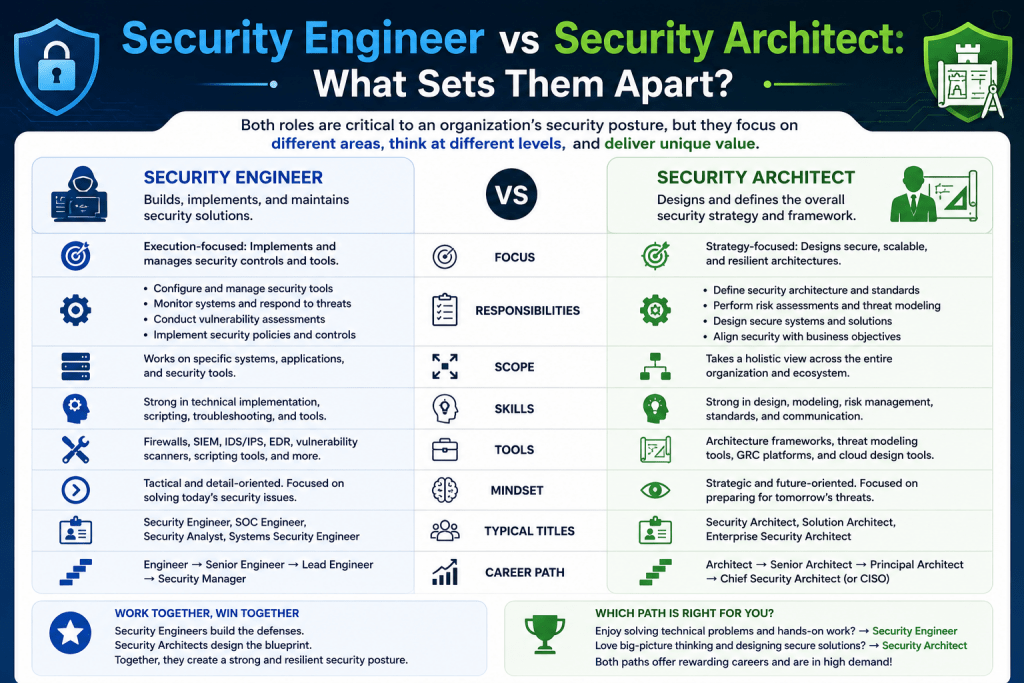
In modern cybersecurity environments, two critical roles often work side by side yet focus on very different layers of protection: the security architect and the security engineer. While both contribute to safeguarding systems and data, their responsibilities diverge significantly in terms of scope, execution, and strategic involvement. The security architect is primarily responsible for designing the overall security structure of an organization, ensuring that every system, process, and application aligns with a unified security vision. On the other hand, the security engineer focuses on implementing those designs, translating high-level security plans into functional, operational systems. Together, they form a complementary relationship where one defines the blueprint and the other builds and maintains the structure. Understanding this distinction is essential for organizations aiming to create resilient security ecosystems capable of withstanding evolving cyber threats.
Evolution of Cybersecurity and Expanding Threat Landscape
Cybersecurity has undergone a major transformation over the past decade. Earlier, organizations relied heavily on perimeter-based defenses, assuming that securing the network boundary would be sufficient to prevent unauthorized access. Firewalls, antivirus software, and intrusion detection systems were placed at the edges of networks to block external threats. However, as cybercriminals became more sophisticated, these traditional defenses proved insufficient. Modern attacks can originate from multiple vectors, including applications, internal systems, cloud environments, and even compromised user credentials. This shift has expanded the attack surface significantly, requiring organizations to rethink their entire security approach. Instead of relying on a single defensive perimeter, companies now deploy layered security mechanisms across every component of their infrastructure. This evolution has increased the demand for specialized professionals who can design and implement complex, multi-layered security systems.
Role of Security Architecture in Organizational Protection
Security architecture focuses on creating a comprehensive framework that defines how security controls are integrated across an organization’s entire IT ecosystem. It involves analyzing potential risks at every entry point and designing mechanisms that mitigate those risks before they can be exploited. A security architect evaluates how different systems interact and ensures that security policies are consistently applied across all platforms, applications, and departments. This role is not limited to technical design alone; it also includes establishing governance models, compliance standards, and operational procedures that guide security practices throughout the organization. By taking a holistic view, the security architect ensures that all components work together harmoniously rather than functioning as isolated security tools. This strategic oversight helps organizations anticipate vulnerabilities and build defenses that are both proactive and adaptive to emerging threats.
Strategic Responsibilities and Organizational Alignment
A security architect operates at a strategic level, often collaborating with leadership teams to align security initiatives with business objectives. They are responsible for defining security policies that govern how data is accessed, stored, and transmitted across systems. In addition, they play a key role in ensuring regulatory compliance and managing enterprise-wide risk. Their work extends beyond technology into organizational behavior, as they must ensure that employees understand and follow security protocols. This includes designing awareness programs and establishing clear procedures for handling sensitive information. Security architects also assess incident response strategies and disaster recovery plans to ensure business continuity in the event of a breach. Their decisions influence how resilient an organization is against cyber threats, making their role critical in shaping long-term security posture and risk management strategies.
Technical Foundations and Knowledge Requirements for Architects
Security architects require a broad and deep understanding of multiple domains within information technology and cybersecurity. Their expertise spans network security, identity management, application security, cloud architecture, and risk assessment methodologies. They must also be familiar with enterprise systems and how different technologies integrate within large-scale infrastructures. In addition to technical knowledge, they need strong analytical and communication skills to translate complex security concepts into business-friendly language. Certifications and structured learning paths are often pursued to validate their expertise and keep their knowledge aligned with industry standards. These professionals are expected to stay updated on evolving threat landscapes, emerging technologies, and regulatory changes. Their ability to anticipate risks and design scalable security frameworks makes them essential contributors to an organization’s strategic defense planning.
Role of Security Engineering in Practical Implementation
While security architects design the blueprint, security engineers are responsible for bringing that blueprint to life. Their primary focus is on implementation, configuration, and maintenance of security systems within real-world environments. They work directly with tools, platforms, and technologies to deploy security controls that align with architectural guidelines. This includes setting up firewalls, configuring intrusion prevention systems, managing encryption protocols, and securing cloud environments. Security engineers are deeply involved in day-to-day operations, ensuring that systems remain secure, functional, and resilient against attacks. They also troubleshoot security issues, respond to incidents, and perform system updates to address vulnerabilities. Their role is highly technical and hands-on, requiring strong problem-solving skills and the ability to work under pressure when dealing with security breaches or system failures.
Hands-On Technical Environment and Tool Expertise
Security engineers operate across a wide range of technologies and platforms, making versatility a key requirement for success. They work with operating systems, cloud infrastructures, and programming languages to develop and maintain secure environments. Their responsibilities often include conducting vulnerability assessments, performing penetration testing, and analyzing system logs to detect anomalies. Familiarity with cybersecurity tools and frameworks is essential, as these tools help identify weaknesses and strengthen defenses. Engineers must also understand network architecture and application development principles to ensure that security is embedded at every stage of the system lifecycle. In addition, they frequently collaborate with development teams to integrate security into software development processes, ensuring that applications are secure from the ground up rather than patched after deployment.
Operational Responsibilities and Incident Response
Security engineers play a critical role in monitoring and responding to security incidents. They are often the first line of defense when suspicious activity is detected within a system. Their responsibilities include investigating alerts, analyzing attack patterns, and implementing corrective measures to prevent further damage. Incident response requires a structured approach, where engineers must quickly identify the source of the problem, contain the threat, and restore normal operations. They also conduct forensic analysis to understand how breaches occurred and what vulnerabilities were exploited. This information is then used to strengthen existing defenses and prevent similar incidents in the future. Their ability to respond quickly and effectively is crucial in minimizing the impact of cyberattacks and maintaining system integrity.
Skill Sets and Professional Development for Engineers
Security engineers require a strong foundation in both theoretical knowledge and practical skills. They must be proficient in areas such as network security, system administration, cryptography, and ethical hacking. Hands-on experience is particularly important, as much of their work involves real-time problem-solving and system configuration. Engineers often participate in practical training exercises, simulations, and security challenges to sharpen their abilities. Certifications and professional credentials help validate their expertise and demonstrate their capability to handle complex security environments. Continuous learning is essential in this role, as cybersecurity threats evolve rapidly and require constant adaptation. Engineers must stay informed about new vulnerabilities, attack techniques, and defense strategies to remain effective in their roles.
Interdependence Between Security Architects and Engineers
Although security architects and engineers have distinct responsibilities, their roles are deeply interconnected. Architects provide the strategic vision and design framework, while engineers execute and maintain that vision in operational environments. Without architects, security systems may lack coherence and long-term planning. Without engineers, architectural designs would remain theoretical and unimplemented. Effective cybersecurity depends on strong collaboration between these roles, ensuring that security strategies are both well-designed and properly executed. Communication between architects and engineers is essential to ensure that design intentions are accurately translated into technical implementations. This partnership creates a layered and adaptive defense system capable of addressing both current and future security challenges.
Expanding the Security Landscape in Modern Enterprises
In today’s digital-first world, organizations operate in environments that are far more complex than traditional IT infrastructures. Cloud adoption, remote work models, mobile integration, and interconnected applications have significantly increased the number of potential entry points for cyber threats. This expansion has forced businesses to rethink how security is designed and implemented across all layers of technology. The distinction between security architects and security engineers becomes even more important in this environment because both roles address different dimensions of the same challenge. While architects focus on designing scalable and resilient frameworks that can handle evolving threats, engineers ensure that these frameworks are implemented effectively across real systems. The growing complexity of enterprise environments means that neither role can function in isolation; instead, both must work in coordination to ensure that security is comprehensive and adaptive.
Shifting from Perimeter Defense to Layered Security Models
Traditional cybersecurity strategies relied heavily on the idea of a secure perimeter, where organizations attempted to protect internal systems by controlling access at the network boundary. However, this model has become outdated due to the rise of cloud computing, mobile access, and distributed applications. Modern threats can bypass perimeter defenses through phishing attacks, compromised credentials, or vulnerabilities in applications themselves. As a result, organizations now rely on layered security models that protect data and systems at multiple levels. This shift requires security architects to design frameworks that integrate security controls across endpoints, networks, applications, and cloud environments. Security engineers then implement these controls, ensuring that each layer functions correctly and consistently. This layered approach reduces the likelihood of a single point of failure and strengthens overall resilience against attacks.
How Security Architects Shape Enterprise Security Strategy
Security architects play a central role in defining how an organization approaches cybersecurity at a strategic level. Their work begins with understanding business objectives, regulatory requirements, and potential risk exposure. Based on this understanding, they design security frameworks that align technology systems with organizational goals. This involves creating structured policies that define how data is protected, how access is controlled, and how incidents are managed. Architects also ensure that security is embedded into every stage of system design rather than being treated as an afterthought. They evaluate different technologies and determine how they should be integrated to form a cohesive defense strategy. Their decisions influence not only technical systems but also organizational processes, making their role critical in shaping long-term security direction.
Risk Management and Compliance Responsibilities of Architects
One of the most important responsibilities of a security architect is managing risk across the enterprise. This involves identifying potential threats, evaluating their impact, and designing controls to mitigate them effectively. Architects must consider both internal and external risks, including human error, system failures, and external cyberattacks. They also ensure that security frameworks comply with industry regulations and legal standards, which may vary depending on the sector and geographic location. Compliance is not just about meeting minimum requirements; it is about building systems that can withstand audits, investigations, and real-world threats. Security architects work closely with legal, audit, and compliance teams to ensure that security policies align with regulatory expectations. This cross-functional collaboration helps organizations avoid penalties while strengthening their overall security posture.
Security Engineers and the Execution of Security Strategies
Security engineers are responsible for transforming architectural designs into operational systems. They take the frameworks created by architects and implement them using real-world technologies and tools. This includes configuring security devices, deploying encryption systems, and integrating security controls into applications and infrastructure. Engineers must ensure that every component of the system functions according to the defined security architecture. Their work is highly technical and requires deep knowledge of operating systems, networking, and application security. Unlike architects, who focus on planning and design, engineers spend most of their time working directly with systems, solving technical problems, and ensuring that security measures are functioning as intended. Their role is essential for turning theoretical security models into practical defenses.
Hands-On Implementation and System Integration
Security engineers are deeply involved in system integration, ensuring that security tools and technologies work seamlessly within existing IT environments. This includes integrating firewalls, intrusion detection systems, endpoint protection tools, and identity management solutions. They must also ensure that cloud environments are properly secured, especially as organizations increasingly rely on platforms for storage and computing. Engineers often work with automation tools to streamline security processes and improve efficiency in large-scale environments. They are also responsible for testing security configurations to ensure they do not interfere with system performance or business operations. This balance between security and usability is critical, as overly restrictive controls can hinder productivity while weak controls can expose systems to risk.
Monitoring, Detection, and Continuous Security Operations
A significant part of a security engineer’s role involves continuous monitoring of systems to detect potential threats. They analyze logs, track system behavior, and use security tools to identify anomalies that may indicate malicious activity. When suspicious behavior is detected, engineers investigate the issue to determine its source and severity. This process requires strong analytical skills and the ability to interpret complex data from multiple sources. Security engineers also play a key role in maintaining security operations centers, where real-time monitoring and incident response take place. Their work ensures that threats are identified and addressed quickly, minimizing potential damage to systems and data. Continuous monitoring is essential in modern cybersecurity because threats can emerge at any time and evolve rapidly.
Incident Handling and Response Coordination
When a security incident occurs, security engineers are responsible for responding quickly and effectively. This involves identifying the nature of the attack, isolating affected systems, and implementing measures to contain the threat. Engineers must work under pressure to ensure that the impact of the incident is minimized. They also collaborate with other teams to restore systems to normal operation as quickly as possible. After the immediate threat is resolved, engineers conduct detailed investigations to understand how the breach occurred and what vulnerabilities were exploited. This analysis is critical for improving future defenses and preventing similar incidents. Incident response is not just about fixing problems; it is about learning from them and strengthening the overall security infrastructure.
Technical Depth and Practical Expertise Required for Engineers
Security engineers must possess a strong technical foundation that allows them to work across different systems and technologies. They need expertise in networking, operating systems, scripting languages, and security frameworks. Their role often requires them to work with complex environments that include cloud platforms, on-premises systems, and hybrid infrastructures. Engineers must also be familiar with cybersecurity tools used for penetration testing, vulnerability assessment, and threat detection. This hands-on expertise allows them to identify weaknesses and implement effective solutions. In addition to technical skills, engineers must also have strong problem-solving abilities and attention to detail, as even small configuration errors can lead to significant security vulnerabilities.
Continuous Adaptation in a Changing Threat Environment
Cybersecurity is a constantly evolving field, and both security architects and engineers must continuously adapt to new challenges. Attack techniques are becoming more sophisticated, and new vulnerabilities are discovered regularly. This requires professionals in both roles to stay updated with industry trends, emerging technologies, and evolving threat landscapes. Security architects must continuously refine their frameworks to address new risks, while security engineers must update their implementation strategies to handle new attack vectors. Continuous learning and adaptation are essential for maintaining strong security defenses in an environment where threats are constantly changing. Organizations that fail to adapt risk exposure to increasingly advanced cyberattacks.
The Growing Complexity of Enterprise Security Systems
As organizations expand their digital ecosystems, the complexity of securing those environments increases significantly. Modern enterprises no longer operate within isolated networks; instead, they depend on interconnected systems that span cloud platforms, hybrid infrastructures, remote endpoints, and third-party integrations. This interconnectedness introduces new vulnerabilities and makes security planning far more challenging. Security architects are responsible for understanding this complexity and designing frameworks that can handle diverse environments without creating weak points. They must anticipate how different systems interact and ensure that security controls remain consistent across all layers. Meanwhile, security engineers must implement these designs across real-world systems, often dealing with integration challenges, compatibility issues, and performance constraints. This growing complexity demands not only technical expertise but also strong coordination between planning and execution roles.
Integration of Cloud Technologies into Security Design
The widespread adoption of cloud computing has transformed how security is designed and implemented. Organizations now rely heavily on platforms that provide scalable infrastructure and services, but this shift also introduces new security challenges. Security architects must design frameworks that account for cloud-native risks such as misconfigurations, unauthorized access, and data exposure. They need to ensure that security policies are consistent across on-premises and cloud environments, creating a unified approach to protection. Security engineers, in turn, are responsible for implementing these controls within cloud platforms, configuring identity management systems, encryption protocols, and access controls. Their work ensures that cloud resources remain secure while still allowing flexibility and scalability for business operations. The integration of cloud technologies requires both roles to adapt their traditional approaches to meet modern demands.
Identity and Access Management as a Core Security Component
Identity and access management plays a critical role in modern cybersecurity strategies. It ensures that only authorized users can access specific systems and data, reducing the risk of unauthorized access. Security architects design identity management frameworks that define how authentication and authorization processes should function across the organization. These frameworks include policies for user roles, permissions, and access control mechanisms. Security engineers then implement these frameworks using identity management tools and technologies, configuring systems to enforce access rules consistently. They also monitor authentication processes to detect suspicious activity such as unauthorized login attempts or privilege escalation. Effective identity management is essential for maintaining control over sensitive data and preventing internal and external threats from compromising systems.
Security by Design Philosophy in Modern Systems
A key principle in modern cybersecurity is the concept of security by design, which emphasizes integrating security measures into systems from the very beginning rather than adding them later. Security architects are responsible for embedding this philosophy into system blueprints, ensuring that security is considered at every stage of development. This includes defining secure coding standards, selecting appropriate technologies, and ensuring that applications are built with built-in protection mechanisms. Security engineers support this approach by implementing security controls during development and deployment phases, ensuring that systems are tested for vulnerabilities before they go live. This proactive approach reduces the likelihood of security flaws and strengthens overall system resilience. By adopting security by design principles, organizations can minimize risks and create more robust digital environments.
Collaboration Between Development and Security Teams
In modern enterprises, collaboration between development teams and security professionals is essential. Security architects often work closely with software developers to ensure that applications are built in accordance with security standards. They provide guidance on secure design principles and help define requirements that must be followed during development. Security engineers collaborate more directly with development teams during implementation, assisting with integrating security tools, testing applications, and resolving vulnerabilities. This collaboration ensures that security is not treated as a separate function but as an integral part of the development lifecycle. It also helps reduce delays caused by security issues discovered late in the process. Effective communication between these teams leads to more secure and reliable software systems.
Threat Modeling and Risk Anticipation
Threat modeling is an essential activity in cybersecurity that involves identifying potential threats and evaluating how they could impact systems. Security architects typically lead this process by analyzing system designs and identifying possible attack vectors. They consider various scenarios, including external attacks, insider threats, and system failures. Based on this analysis, they design controls to mitigate identified risks. Security engineers support threat modeling efforts by providing technical insights into system behavior and potential vulnerabilities. They help validate whether proposed security controls can effectively address identified risks. This collaborative approach ensures that threats are anticipated and addressed before they can be exploited. Threat modeling helps organizations stay ahead of attackers by proactively identifying weaknesses.
Security Monitoring and Real-Time Threat Detection
Continuous monitoring is a critical aspect of modern cybersecurity operations. Security engineers are primarily responsible for implementing monitoring systems that track network activity, system behavior, and user actions in real time. These systems generate alerts when unusual activity is detected, allowing engineers to investigate potential threats immediately. Security architects contribute by designing monitoring frameworks that define what should be tracked and how alerts should be handled. Together, these roles ensure that organizations have visibility into their systems at all times. Real-time threat detection allows organizations to respond quickly to attacks, reducing potential damage and preventing data breaches. Monitoring systems also provide valuable insights that can be used to improve future security strategies.
Data Protection and Encryption Strategies
Protecting sensitive data is one of the most important goals of cybersecurity. Security architects design data protection strategies that define how information should be stored, transmitted, and accessed securely. This includes selecting encryption standards, defining data classification policies, and establishing access controls. Security engineers implement these strategies by configuring encryption tools, managing secure communication channels, and ensuring that data protection mechanisms are properly applied across systems. Encryption plays a crucial role in protecting data both at rest and in transit, making it unreadable to unauthorized users. Proper data protection ensures compliance with regulations and reduces the risk of data breaches that could compromise sensitive information.
Disaster Recovery and Business Continuity Planning
Another important aspect of cybersecurity is ensuring that organizations can recover from unexpected disruptions. Security architects design disaster recovery and business continuity plans that define how systems should respond to failures, attacks, or natural disasters. These plans include backup strategies, failover systems, and recovery procedures. Security engineers implement these plans by configuring backup systems, testing recovery processes, and ensuring that critical data can be restored quickly in case of an incident. The goal is to minimize downtime and ensure that business operations can continue even during emergencies. Effective disaster recovery planning is essential for maintaining organizational resilience and reducing the impact of security incidents.
Automation in Security Operations
Automation has become increasingly important in cybersecurity due to the scale and complexity of modern systems. Security engineers often use automation tools to streamline repetitive tasks such as monitoring, patch management, and incident response. This allows them to respond to threats more quickly and efficiently. Security architects design automation frameworks that define which processes can be automated and how automation should be integrated into the overall security strategy. Automation helps reduce human error, improve response times, and increase operational efficiency. However, it must be carefully designed to ensure that automated processes do not introduce new vulnerabilities or bypass critical security controls.
Incident Response Maturity and Security Operations Lifecycle
As cybersecurity programs mature, organizations place greater emphasis on structured incident response and continuous security operations. Security architects define the overall incident response framework, outlining how different types of security events should be categorized, escalated, and resolved. This includes establishing response timelines, defining roles during incidents, and ensuring coordination between technical and non-technical teams. Security engineers then operationalize these frameworks by actively participating in incident handling, executing response procedures, and restoring affected systems. Their work is highly time-sensitive, especially during active attacks where every second matters. A mature security operations lifecycle depends on clear processes, well-defined escalation paths, and the ability to adapt quickly to evolving attack patterns. Both roles contribute to ensuring that incidents are not only resolved but also analyzed for long-term improvements.
Security Tooling Ecosystem and Technology Stack Management
Modern cybersecurity environments rely on a wide range of tools that work together to detect, prevent, and respond to threats. Security architects are responsible for selecting and designing the overall security tooling ecosystem. They evaluate which technologies should be used for endpoint protection, network monitoring, identity management, vulnerability scanning, and threat intelligence. Their goal is to ensure that all tools integrate effectively and provide full visibility across the organization’s infrastructure. Security engineers handle the implementation and configuration of these tools, ensuring they function correctly within production environments. They manage updates, troubleshoot integration issues, and fine-tune configurations to reduce false positives while improving detection accuracy. A well-managed security stack is essential for maintaining operational efficiency and reducing gaps in visibility across systems.
Endpoint Security and Device-Level Protection Strategies
Endpoints such as laptops, mobile devices, and servers are often targeted by attackers because they serve as entry points into enterprise networks. Security architects design endpoint security strategies that define how devices should be protected, monitored, and managed. This includes policies for antivirus protection, device encryption, patch management, and remote access control. Security engineers implement these strategies by deploying endpoint protection solutions, configuring device policies, and ensuring compliance across all connected systems. They also monitor endpoint activity to detect suspicious behavior such as unauthorized software installations or unusual network connections. As remote work becomes more common, endpoint security has become even more critical, requiring continuous updates and monitoring to ensure devices remain secure regardless of location.
Network Security Architecture and Traffic Control Mechanisms
Network security remains a foundational element of cybersecurity design. Security architects define how network segments should be structured to minimize risk and limit lateral movement of threats. This involves designing secure zones, defining segmentation policies, and determining how traffic should flow between different parts of the network. Security engineers implement these designs by configuring firewalls, routing rules, intrusion prevention systems, and virtual private networks. They ensure that only authorized traffic is allowed between systems and that suspicious activity is blocked or flagged for investigation. Network monitoring tools are also deployed to analyze traffic patterns and detect anomalies in real time. Strong network security architecture helps prevent attackers from moving freely within systems after gaining initial access.
Application Security Integration in Development Pipelines
Application security has become a major focus area as businesses increasingly rely on software-driven operations. Security architects define how security should be integrated into software development lifecycles, ensuring that applications are designed with security controls from the beginning. This includes establishing guidelines for secure coding, authentication mechanisms, and data protection within applications. Security engineers work closely with development teams to implement these requirements during the development process. They conduct vulnerability assessments, perform code reviews, and run security testing tools to identify weaknesses before applications are deployed. By integrating security into development pipelines, organizations can reduce vulnerabilities early and avoid costly fixes after deployment. This approach strengthens the overall security posture of software systems.
Cloud Security Configuration and Shared Responsibility Models
Cloud environments operate under a shared responsibility model, where security responsibilities are divided between cloud providers and customers. Security architects define how this responsibility is managed within the organization, ensuring that proper controls are applied to cloud-based resources. They establish policies for data storage, access management, and encryption in cloud environments. Security engineers implement these policies by configuring cloud services, managing permissions, and securing workloads across platforms. They also monitor cloud activity to detect misconfigurations or unauthorized access attempts. Because cloud environments are highly dynamic, engineers must continuously adapt configurations to maintain security compliance. Proper understanding of shared responsibility is essential for preventing security gaps in cloud infrastructure.
Threat Intelligence and Security Awareness Integration
Security architects often incorporate threat intelligence into organizational security strategies to stay ahead of emerging risks. They analyze global threat trends and determine how these insights should influence internal security policies. This helps organizations prepare for new attack techniques and adapt their defenses accordingly. Security engineers use threat intelligence data to enhance detection systems and improve response accuracy. They may configure tools to recognize known attack patterns or suspicious behaviors based on intelligence feeds. In addition, security awareness programs are designed to educate employees about potential risks, such as phishing attacks or social engineering tactics. By combining technical defenses with human awareness, organizations create a more comprehensive security approach.
Performance Optimization and Security Trade-Off Management
One of the challenges in cybersecurity is balancing strong security controls with system performance and usability. Security architects must design frameworks that provide robust protection without negatively impacting business operations. This involves evaluating trade-offs between security strength and system efficiency. Security engineers implement these designs and often fine-tune configurations to ensure that security measures do not slow down applications or disrupt workflows. In some cases, they may need to adjust security settings to accommodate performance requirements while maintaining acceptable levels of protection. Achieving this balance requires continuous collaboration between architects and engineers, as well as ongoing monitoring of system performance under security constraints.
Data Governance and Information Lifecycle Management
Data governance is a critical aspect of enterprise security that defines how data is created, stored, used, and deleted. Security architects design governance frameworks that establish rules for data classification, retention, and access control. These frameworks ensure that sensitive information is handled appropriately throughout its lifecycle. Security engineers implement governance policies by configuring systems to enforce data handling rules and ensuring compliance across databases, applications, and storage systems. They also monitor data usage to detect unauthorized access or policy violations. Effective data governance helps organizations maintain control over their information assets and reduces the risk of data leakage or misuse.
Cross-Functional Collaboration in Enterprise Security Teams
Cybersecurity is not limited to technical teams alone; it requires collaboration across multiple departments, including legal, compliance, development, and operations. Security architects play a key role in facilitating this collaboration by aligning security strategies with business goals and regulatory requirements. They communicate complex security concepts in a way that stakeholders across the organization can understand. Security engineers contribute by working directly with technical teams to implement solutions and resolve operational issues. This cross-functional collaboration ensures that security is embedded into every aspect of the organization rather than treated as a separate function. Strong teamwork between different departments leads to more effective and sustainable security outcomes.
Advanced Security Engineering in Large-Scale Environments
As enterprise environments continue to scale, security engineering becomes significantly more complex and demanding. Security engineers are no longer working with isolated systems; instead, they are responsible for securing vast, interconnected infrastructures that include hybrid clouds, microservices, containerized applications, and distributed databases. This complexity requires them to think beyond individual systems and focus on how security behaves across entire ecosystems. They must ensure that security controls remain consistent even as systems dynamically scale up or down based on demand. In large organizations, even small misconfigurations can lead to major vulnerabilities, which is why precision and attention to detail are critical in security engineering roles. Their work ensures that the security architecture designed at a high level is reliably enforced across every component of the infrastructure.
Microservices Security and Distributed Application Protection
Modern application design has shifted toward microservices architecture, where applications are broken into smaller, independent services that communicate over networks. While this approach improves scalability and flexibility, it also introduces new security challenges. Security architects must design frameworks that define how these microservices should authenticate, communicate, and exchange data securely. Security engineers then implement these protections by configuring service-to-service authentication, API gateways, and encryption mechanisms. They also monitor traffic between services to detect unusual behavior or unauthorized access attempts. Since microservices often communicate frequently and dynamically, securing them requires continuous validation and real-time monitoring. This distributed model demands a highly coordinated approach between architecture and engineering to ensure that no service becomes a weak entry point for attackers.
API Security and Data Exchange Protection
APIs have become a critical part of modern digital ecosystems, enabling communication between applications, services, and external systems. However, they also represent a major attack surface if not properly secured. Security architects define policies for API authentication, authorization, and data handling to ensure that only trusted entities can access sensitive information. Security engineers implement these policies by configuring API gateways, enforcing token-based authentication, and applying rate-limiting controls. They also conduct regular testing to identify vulnerabilities such as injection attacks, broken authentication, or excessive data exposure. Protecting APIs is essential because they often serve as gateways to core business data and functionality. Strong API security ensures that data exchange remains controlled, secure, and compliant with organizational policies.
Container Security and Orchestration Environments
Containerization technologies have transformed how applications are deployed and managed, but they also introduce unique security challenges. Security architects design container security strategies that define how images should be built, stored, and deployed securely. They establish policies for image scanning, runtime protection, and access control within orchestration platforms. Security engineers implement these strategies by configuring container security tools, managing secure registries, and monitoring container behavior during runtime. They ensure that containers are free from vulnerabilities and that they operate within defined security boundaries. Since containers are often short-lived and dynamically created, maintaining consistent security across them requires automation and continuous monitoring. This makes container security a highly specialized area within security engineering.
Zero Trust Security Model Implementation
The zero trust security model has become a cornerstone of modern cybersecurity strategies. It operates on the principle that no user or system should be trusted by default, even if they are inside the network perimeter. Security architects design zero trust frameworks that enforce strict identity verification, continuous authentication, and least-privilege access. Security engineers implement these principles by configuring identity systems, enforcing multi-factor authentication, and continuously validating user and device trust levels. They also ensure that access is granted only when necessary and revoked immediately when no longer required. This model significantly reduces the risk of internal and external threats by minimizing implicit trust within systems. Implementing zero trust requires strong coordination between design and execution layers to ensure consistent enforcement.
Security Automation and Orchestration Platforms
Automation plays a vital role in modern cybersecurity operations, especially in large-scale environments where manual processes are no longer sufficient. Security architects define automation strategies that determine which security tasks can be automated and how workflows should be structured. Security engineers implement these strategies using orchestration platforms that automate incident response, threat detection, and system updates. Automation helps reduce response times, eliminate repetitive tasks, and improve overall efficiency. For example, automated systems can isolate compromised devices, block malicious IP addresses, or trigger alerts without human intervention. However, automation must be carefully designed to avoid false positives or unintended disruptions. Both architects and engineers must ensure that automated processes align with overall security objectives.
Security Testing and Validation Practices
Regular testing and validation are essential for maintaining strong cybersecurity defenses. Security architects define testing frameworks that outline how systems should be evaluated for vulnerabilities, compliance, and performance. Security engineers conduct these tests using techniques such as penetration testing, vulnerability scanning, and red teaming exercises. They simulate real-world attacks to identify weaknesses and assess how well systems respond to threats. The results of these tests are used to improve security controls and update architectural designs. Continuous testing ensures that security measures remain effective even as systems evolve. Without proper validation, even well-designed security systems can become vulnerable over time.
Compliance Enforcement in Dynamic IT Environments
Compliance requirements are constantly evolving, especially in industries that handle sensitive data such as finance, healthcare, and government sectors. Security architects are responsible for designing compliance frameworks that align with regulatory standards and industry best practices. They ensure that security policies cover areas such as data protection, access control, and audit logging. Security engineers enforce these requirements by configuring systems to maintain compliance across all environments. They also generate reports, monitor compliance status, and address any deviations from established policies. In dynamic IT environments where systems frequently change, maintaining compliance requires continuous monitoring and adjustment. This makes compliance management an ongoing responsibility rather than a one-time task.
Security Metrics, Reporting, and Performance Measurement
Measuring the effectiveness of security systems is essential for continuous improvement. Security architects define key performance indicators that help evaluate the strength of security frameworks. These metrics may include incident response time, vulnerability detection rates, and system uptime under attack conditions. Security engineers collect and analyze data from security tools to generate reports that provide insights into system performance and risk levels. These reports help organizations make informed decisions about future security investments and improvements. By tracking performance metrics, organizations can identify weaknesses, optimize security strategies, and demonstrate compliance to stakeholders. Data-driven decision-making is becoming increasingly important in cybersecurity management.
Evolving Responsibilities in a Threat-Driven World
The responsibilities of both security architects and security engineers continue to evolve as cyber threats become more advanced and persistent. Attackers are constantly developing new techniques, forcing organizations to adapt their defenses accordingly. Security architects must continuously refine their strategies to address emerging risks, while security engineers must stay updated with the latest tools and techniques to implement effective protections. This constant evolution requires ongoing learning, adaptation, and collaboration. Cybersecurity is no longer a static discipline but a dynamic field that demands continuous improvement. Organizations that fail to evolve their security practices risk exposure to increasingly sophisticated threats.
Conclusion
The distinction between a security architect and a security engineer ultimately comes down to strategy versus execution, although both roles are tightly interconnected within a modern cybersecurity framework. The security architect focuses on the big picture—designing comprehensive security structures, defining policies, and ensuring that every system within an organization aligns with a unified protection strategy. Their work is conceptual and forward-looking, aiming to anticipate risks and build resilient frameworks that can adapt to evolving threats.
In contrast, the security engineer operates at the implementation level, turning those architectural designs into functioning, secure systems. They work hands-on with technologies, configure security controls, monitor systems, and respond to incidents in real time. Their role ensures that the theoretical security model is effectively applied across all infrastructure components without gaps or weaknesses.
Both roles depend on each other to create a strong cybersecurity posture. Without architects, security efforts would lack direction and consistency. Without engineers, security strategies would remain theoretical and unimplemented. Together, they form a complete security lifecycle—one that spans planning, implementation, monitoring, and continuous improvement.
In an environment where cyber threats are constantly evolving and attack surfaces are expanding, organizations rely heavily on both security architects and security engineers to maintain resilience, protect sensitive data, and ensure operational continuity.