
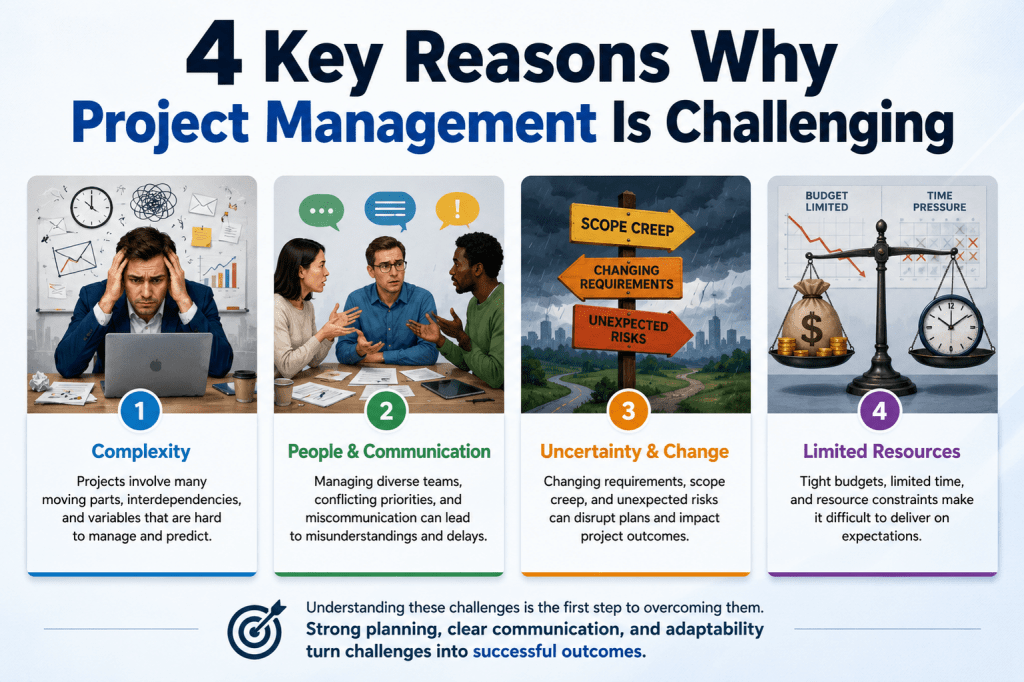
From the outside, information technology and software initiatives often appear structured and predictable, as if they follow a neat sequence of steps from idea to delivery. In reality, they are some of the most uncertain and fast-changing types of work a project manager can face. Unlike physical construction or repetitive production tasks, software projects rarely begin with a fully stable blueprint. The solution is often being shaped while the problem itself is still being understood. This creates a situation where expectations evolve continuously, and the target keeps shifting as new insights emerge during development. A project manager must constantly balance ambition with feasibility, while also guiding stakeholders who may not fully understand technical limitations. This makes planning far more fluid and less reliable than it appears at the beginning.
Constantly evolving requirements make control difficult
One of the biggest challenges in IT and software projects is that requirements rarely stay fixed. Even when detailed specifications are created at the start, they tend to change as stakeholders interact with early versions of the product. Seeing something in action often reshapes expectations, revealing new needs or exposing gaps that were not previously considered. This means the project manager must continuously manage changes without allowing the project to spiral out of scope. Each modification can impact timelines, budgets, and technical design, creating a ripple effect across the entire plan. Maintaining stability while accommodating necessary changes becomes a delicate balancing act that requires strong decision-making and prioritization skills.
Unclear problem definitions create uncertainty
Many software projects begin with only a partial understanding of the actual problem being solved. Stakeholders may have a general idea of what they want, but the details are often vague or inconsistent. This lack of clarity makes it difficult to design a precise solution from the beginning. The project manager must work closely with teams to translate abstract ideas into structured tasks, often refining the problem definition as the project progresses. This ongoing clarification process consumes time and energy, but it is essential for ensuring that the final outcome aligns with real business needs. Without this alignment, even technically successful projects can fail to deliver meaningful value.
Rapid technological change increases unpredictability
Technology evolves at a fast pace, and this constant change adds another layer of difficulty to IT projects. Tools, frameworks, and platforms that seem reliable at the start of a project may become outdated or less efficient before the project is completed. This forces project managers to make decisions without knowing whether better alternatives will emerge later. In some cases, new technologies can even disrupt the original approach entirely, requiring partial redesign or adaptation. The pressure to stay current while maintaining progress creates a challenging environment where long-term planning must always account for uncertainty.
Coordinating people and tasks is structurally difficult
Managing a project is not just about planning tasks, but about ensuring that multiple people and teams work together in harmony. Each individual brings different skills, working styles, and priorities, which must be aligned toward a shared objective. The project manager acts as the central coordinator, ensuring that work flows smoothly between contributors without delays or confusion. This requires constant communication and adjustment, especially when dependencies exist between tasks. A delay in one area can affect multiple others, making timing and coordination extremely sensitive. Maintaining this balance across a complex network of activities is one of the most demanding aspects of project management.
Managing workflow dependencies requires constant attention
In many projects, tasks are deeply interconnected, meaning one activity cannot begin or finish without another being completed first. These dependencies create a chain reaction effect where small disruptions can escalate quickly. The project manager must carefully map out these relationships and continuously monitor progress to prevent bottlenecks. Even with strong planning, unexpected issues such as delays, resource shortages, or technical obstacles can disrupt the flow. Adjusting schedules and reallocating resources becomes a continuous process rather than a one-time setup. This need for ongoing orchestration makes the role highly dynamic and mentally demanding.
Balancing team efficiency with flexibility is challenging
A project team must be both productive and adaptable at the same time, which is not easy to achieve. If the structure is too rigid, the team may struggle to respond to changes or unexpected issues. If it is too flexible, coordination can break down and productivity may suffer. The project manager must find the right balance between structure and freedom, ensuring that team members know their responsibilities while still having room to adjust when necessary. This requires understanding not only the work itself but also how people perform under different conditions. Maintaining this equilibrium is an ongoing challenge throughout the project lifecycle.
Understanding the overall direction is not straightforward
Seeing the big picture of a project is far more complex than simply tracking individual tasks. The project manager must understand how all components fit together and how progress in one area affects the entire system. This requires constant synthesis of information from different sources, including technical updates, stakeholder feedback, and risk assessments. Without a clear overall perspective, it becomes easy to focus too much on small details and lose sight of broader objectives. However, maintaining this high-level awareness is difficult because project conditions change frequently, requiring continuous reassessment of priorities and direction.
Aligning goals across stakeholders is complex
Different stakeholders often have different expectations and definitions of success. Business leaders may focus on outcomes and return on investment, while technical teams may prioritize feasibility and stability. End users may have entirely different expectations based on usability and experience. The project manager must continuously reconcile these perspectives and ensure that decisions reflect a balanced approach. This requires negotiation, communication, and sometimes difficult compromises. Misalignment between stakeholders can lead to confusion, conflict, or shifting priorities, all of which make maintaining a unified direction more difficult.
Tracking progress accurately is harder than it seems
Measuring the true progress of a project is not always straightforward. Completing tasks does not always reflect meaningful advancement toward the final goal. Some work may appear finished but still require adjustments, while other critical components may be less visible but essential for success. The project manager must interpret progress reports carefully and understand what they truly represent. This requires both technical awareness and contextual understanding of the project’s goals. Without accurate interpretation, decisions may be based on misleading signals, increasing the risk of delays or failures.
Human relationships shape project outcomes significantly
Beyond systems, tools, and processes, people remain the most influential factor in any project. Each team member brings different motivations, communication styles, and working habits, which can affect collaboration. The project manager must ensure that individuals remain aligned, motivated, and productive while also managing interpersonal dynamics. This involves continuous communication, encouragement, and sometimes conflict resolution. Even small misunderstandings can escalate if not addressed early, affecting team morale and efficiency. Managing these human elements requires emotional intelligence as much as technical understanding.
Communication challenges increase complexity
Effective communication is essential for project success, but it is often difficult to maintain consistently. Information must flow between teams, stakeholders, and management levels without distortion or delay. Miscommunication can lead to incorrect assumptions, missed deadlines, or duplicated effort. The project manager must act as a communication bridge, ensuring that everyone has the right information at the right time. This includes translating technical details into business language and vice versa. The constant need to clarify, confirm, and repeat information makes communication one of the most time-consuming aspects of the role.
Conflict and differing priorities must be managed carefully
Conflicts naturally arise in any project environment where multiple people with different priorities work together. These conflicts may involve resource allocation, design decisions, timelines, or expectations. The project manager must address these issues in a way that maintains progress without damaging relationships. This often requires negotiation and compromise, as well as the ability to remain neutral while understanding multiple viewpoints. Handling conflict effectively is essential to keeping the project moving forward, but it also adds emotional and managerial pressure to an already demanding role.
Coordinating large teams requires constant alignment
Project management becomes especially difficult when multiple teams or departments are involved in delivering different parts of the same outcome. Each group often works at its own pace, using different methods and priorities, which can easily lead to misalignment. The project manager must continuously ensure that everyone is moving in the same direction, even when their day-to-day tasks look completely different. This requires frequent check-ins, status updates, and adjustments to keep all contributors synchronized. Without this ongoing coordination, work can quickly drift apart, causing delays and rework that slow down the entire project.
Resource limitations create continuous pressure
One of the most persistent difficulties in project management is dealing with limited resources. Time, budget, and skilled personnel are almost always constrained, while expectations remain high. The project manager must constantly decide how to allocate these limited resources in the most effective way. Every decision involves trade-offs, where improving one area may negatively affect another. For example, speeding up delivery might require additional budget or reduce quality checks. Managing these competing demands requires careful judgment and the ability to prioritize what matters most at any given stage of the project.
Prioritization becomes a moving target
Even when priorities are defined at the beginning of a project, they rarely stay fixed. Business needs change, stakeholders shift focus, and unexpected issues emerge. This means the project manager must continuously reassess what is most important. Tasks that once seemed critical may become less urgent, while previously lower-priority items suddenly demand immediate attention. Keeping the project aligned with these changing priorities is challenging because it affects schedules, workloads, and expectations across the team. Constant reprioritization must be done carefully to avoid confusion and maintain stability in execution.
Scheduling work accurately is inherently difficult
Creating a realistic project schedule is far more complex than simply listing tasks and assigning deadlines. Each activity depends on various assumptions, such as resource availability, technical complexity, and external dependencies. These assumptions are often uncertain at the start, making initial timelines fragile. As the project progresses, unexpected delays or faster-than-expected completions can disrupt the entire schedule. The project manager must continuously update timelines and adjust expectations while keeping stakeholders informed. This ongoing recalibration makes scheduling an evolving process rather than a fixed plan.
Risk management requires constant awareness
Every project carries risks, but identifying and managing them effectively is an ongoing challenge. Some risks are visible early, while others only emerge as the project develops. These may include technical failures, resource shortages, shifting requirements, or external disruptions. The project manager must stay alert to potential issues and prepare strategies to reduce their impact. However, not all risks can be predicted, and some will materialize unexpectedly. When that happens, the ability to respond quickly and effectively becomes critical to keeping the project on track.
Decision-making often happens with incomplete information
Project managers are frequently required to make decisions without having full clarity. Information may be incomplete, outdated, or inconsistent across different sources. Waiting for perfect information is rarely an option, as delays can cause further complications. Instead, decisions must be made based on the best available understanding at the time. This introduces uncertainty into every major choice, from scheduling and budgeting to technical direction. The ability to remain confident and rational under these conditions is a key challenge in managing complex projects.
Managing expectations across different levels is demanding
Different groups involved in a project often have very different expectations. Senior leadership may focus on strategic outcomes, while teams are more concerned with execution details. Clients or users may prioritize usability and performance, while technical staff focus on feasibility and stability. The project manager must balance all of these perspectives while ensuring that expectations remain realistic. This often involves difficult conversations where compromises must be made. Managing expectations is not a one-time task but an ongoing responsibility throughout the entire project lifecycle.
Maintaining visibility into project progress is complex
Keeping an accurate view of what is happening across all parts of a project is not simple. Work may be distributed across multiple teams, tools, and locations, making it difficult to see the full picture at any given time. Reports and updates help, but they may not always reflect real conditions accurately. The project manager must interpret available information carefully and identify gaps or inconsistencies. Without clear visibility, it becomes harder to detect problems early or make informed decisions. This makes monitoring one of the most important and challenging responsibilities in project execution.
Change management adds continuous disruption
Change is a constant factor in most projects, and managing it effectively is a major challenge. Even small changes in requirements can have wide-reaching effects on timelines, resources, and technical design. The project manager must evaluate each change request carefully, considering both its benefits and its impact. Accepting too many changes can lead to instability, while rejecting them can result in dissatisfaction among stakeholders. Finding the right balance requires structured evaluation and disciplined control over scope, which is often easier said than done in dynamic environments.
Maintaining stability while adapting is a constant struggle
One of the most difficult aspects of project management is maintaining a stable direction while still being flexible enough to adapt. Projects operate in environments where uncertainty is unavoidable, yet progress depends on consistency and control. The project manager must ensure that teams remain focused on long-term objectives while adjusting plans as needed. This balancing act requires careful judgment, as too much rigidity can lead to failure in adapting, while too much flexibility can result in loss of direction. Managing this tension is a continuous challenge that defines much of the role’s difficulty.
Maintaining project visibility across multiple layers is difficult
As projects grow in size, it becomes increasingly hard for a project manager to maintain clear visibility into everything that is happening. Work is often spread across different teams, tools, time zones, and sometimes even external vendors. Each group produces its own updates, reports, and interpretations of progress, but these do not always align perfectly. The project manager must continuously gather, filter, and interpret this scattered information to form an accurate understanding of the overall situation. This process is not straightforward because some issues remain hidden until they start affecting other parts of the project, making early detection a constant challenge.
Information overload makes clarity harder to achieve
Modern projects generate large volumes of data, including task updates, performance metrics, risk logs, and communication threads. While this information is useful, too much of it can create confusion rather than clarity. The project manager must distinguish between what is important and what is noise, which is not always easy. Important signals can get buried in large amounts of less relevant information, increasing the risk of missing critical developments. Managing this overload requires strong analytical thinking and the ability to focus on meaningful indicators without becoming overwhelmed by detail.
Dependency chains increase fragility in execution
Many project tasks are interconnected, meaning that one activity depends on the completion of another. These dependency chains create a fragile structure where delays or issues in one area can affect multiple others. The project manager must constantly monitor these relationships and anticipate where bottlenecks may occur. Even a small delay in an early-stage task can have a cascading effect across the entire schedule. Managing these interdependencies requires careful planning, continuous tracking, and frequent adjustments to keep everything aligned and moving forward.
Technical uncertainty affects planning accuracy
In many projects, especially those involving technology, there is a level of uncertainty about how difficult certain tasks will be until work actually begins. Some features may turn out to be more complex than expected, while others may be simpler. This unpredictability makes it difficult to estimate timelines and resource needs accurately at the planning stage. The project manager must work with imperfect estimates and remain prepared to adjust plans as more information becomes available. This ongoing uncertainty makes long-term planning less reliable and increases the need for flexibility.
External dependencies introduce uncontrollable risks
Projects often rely on external systems, vendors, or services that are outside the direct control of the project team. These external dependencies can introduce delays or issues that are difficult to predict or manage. If a third-party service experiences downtime or delivers late, it can directly impact project timelines. The project manager must account for these risks and build contingency plans where possible. However, since these dependencies cannot be fully controlled, they always add a layer of unpredictability to project execution.
Communication breakdowns can silently damage progress
Even when teams are working hard, poor communication can silently undermine project success. Misunderstandings about requirements, deadlines, or responsibilities can lead to duplicated effort or missed tasks. These issues may not become visible immediately, allowing them to grow into larger problems over time. The project manager must ensure that communication channels remain clear and consistent across all levels of the project. This includes not only sharing information but also confirming understanding, which is often more difficult than it seems.
Maintaining momentum over long durations is challenging
Many projects run for extended periods, and sustaining momentum over time becomes increasingly difficult. At the beginning, enthusiasm and focus are usually high, but as time passes, fatigue, shifting priorities, and external pressures can reduce energy levels within the team. The project manager must continuously motivate and guide the team to maintain productivity. This requires both structured planning and emotional awareness, as different individuals respond differently to pressure and long-term workloads.
Scope expansion creates gradual complexity growth
As projects evolve, there is a natural tendency for scope to expand beyond the original plan. New ideas, additional requirements, and stakeholder requests can slowly increase the size and complexity of the project. While some of these changes may add value, uncontrolled expansion can lead to delays, budget overruns, and reduced focus. The project manager must carefully evaluate each addition to ensure it aligns with the core objectives. Managing scope effectively requires discipline and the ability to push back when necessary to prevent unnecessary growth.
Team alignment becomes harder as complexity increases
As projects become more complex, keeping everyone aligned becomes increasingly difficult. Different teams may focus on different aspects of the work, leading to variations in understanding and execution. Over time, small misalignments can grow into larger inconsistencies that affect overall delivery. The project manager must continuously reinforce shared goals and ensure that everyone understands how their work contributes to the bigger picture. This requires ongoing communication and coordination across all levels of the project structure.
Unpredictable changes in environment affect stability
External factors such as market conditions, organizational changes, or shifting business priorities can significantly impact a project’s direction. These changes are often outside the control of the project manager but can still force adjustments in planning and execution. Responding to these shifts requires flexibility and quick decision-making. However, frequent changes in direction can also reduce stability and make it harder to maintain consistent progress. Balancing responsiveness with stability is one of the ongoing challenges in managing complex projects.
Coordination overhead increases with scale
As projects grow larger, the effort required just to coordinate activities increases significantly. More teams, more tasks, and more communication channels all contribute to higher coordination overhead. The project manager must spend more time aligning people, resolving dependencies, and ensuring that information flows correctly. This administrative burden can reduce the time available for strategic thinking and problem-solving. Managing this overhead efficiently is essential to maintaining productivity in large-scale projects.
Ensuring consistent quality across all outputs is demanding
Maintaining consistent quality throughout a project is another major challenge. Different teams may interpret standards differently or apply varying levels of rigor in their work. Without careful oversight, this can lead to uneven results across different parts of the project. The project manager must ensure that quality expectations are clearly defined and consistently applied. This often involves regular reviews, feedback loops, and corrective actions when deviations occur, making quality management an ongoing responsibility rather than a final step.
Managing human emotions is one of the hardest aspects of projects
No matter how well a project is planned, human emotions can strongly influence its outcome. People experience stress, frustration, motivation shifts, and pressure in different ways, and these emotional states directly affect performance. A project manager must constantly be aware of team morale and emotional balance, because even highly skilled teams can underperform when motivation drops. Supporting individuals through difficult phases, while still keeping focus on deadlines and deliverables, requires sensitivity and awareness. Emotional management becomes especially challenging when deadlines are tight and expectations are high, as pressure can amplify tensions within the team.
Conflict between stakeholders is unavoidable
In most projects, different stakeholders have competing priorities, and these differences naturally lead to conflict. Business leaders may want faster delivery, while technical teams may prioritize stability and quality. Users may demand more features, while budgets remain limited. The project manager sits in the middle of these conflicting expectations and must find ways to balance them without damaging relationships. Resolving these conflicts requires negotiation, diplomacy, and sometimes difficult trade-offs. Even when decisions are made, not all parties may be fully satisfied, making stakeholder management an ongoing challenge throughout the project.
Leadership responsibility adds constant pressure
A project manager is not just a coordinator but also a leader responsible for guiding people toward a shared goal. This leadership role brings constant pressure, as decisions made by the project manager directly affect timelines, costs, and team performance. Unlike other roles where responsibilities may be limited to specific tasks, the project manager is accountable for the overall success or failure of the project. This responsibility requires confidence, clarity, and consistency in decision-making, even when information is incomplete or uncertain. The weight of this accountability is one of the most demanding aspects of the role.
Maintaining motivation during setbacks is difficult
Projects rarely move forward without obstacles. Delays, technical issues, or unexpected challenges can reduce team morale and slow down progress. During these moments, the project manager must find ways to keep the team motivated and focused on solutions rather than problems. This involves encouraging persistence, recognizing effort, and maintaining a sense of direction even when conditions are not ideal. However, sustaining motivation during repeated setbacks is not easy, especially in long or complex projects where challenges occur frequently.
Balancing authority and collaboration requires skill
A project manager must strike a balance between directing work and collaborating with the team. Too much control can make the environment rigid and reduce creativity, while too little control can lead to confusion and lack of direction. Finding the right balance requires understanding when to guide decisions and when to allow teams to take ownership. This balance also affects how the team perceives leadership, as overly strict management can create resistance, while overly relaxed management can lead to a loss of structure.
Managing uncertainty is a continuous responsibility
Uncertainty is present in almost every stage of a project, from planning to execution. Requirements may change, resources may shift, and external conditions may evolve without warning. The project manager must continuously adapt to this uncertainty while keeping the project moving forward. This involves making decisions based on incomplete information and adjusting plans as new details emerge. Unlike predictable environments, project management requires comfort with ambiguity and the ability to operate effectively even when outcomes are not fully defined.
Ensuring accountability across teams is complex
In multi-team environments, ensuring accountability can be challenging. Each team may be responsible for different parts of the project, but their work is often interconnected. If one team falls behind or fails to meet expectations, it can impact the entire project. The project manager must ensure that responsibilities are clearly defined and that each team understands its role in the bigger picture. However, enforcing accountability without creating tension or blame requires careful communication and balanced leadership.
Adapting to changing priorities requires flexibility
Project priorities often shift due to business needs, market changes, or stakeholder input. These changes require the project manager to quickly reassess plans and redirect efforts. While flexibility is necessary, constant changes can also disrupt stability and create confusion within the team. The challenge lies in adapting quickly while still maintaining a clear sense of direction. This requires strong judgment to decide which changes are necessary and which can be deferred or rejected.
Sustaining clarity in complex environments is difficult
As projects become more complex, maintaining clarity becomes harder. There are more tasks, more dependencies, and more communication channels to manage. Without careful organization, it becomes easy for important details to get lost or misunderstood. The project manager must continuously simplify complexity by structuring information, prioritizing tasks, and ensuring that everyone understands the current status of the project. This effort to maintain clarity is ongoing and becomes more demanding as the project grows.
Execution pressure makes project management mentally intense
Even when planning is strong and coordination is effective, the final stages of a project bring intense pressure. This is the point where deadlines become real, deliverables must be completed, and any small mistake becomes highly visible. The project manager must ensure that everything comes together correctly under time constraints, which often feel tighter as the end approaches. At this stage, there is little room for experimentation or delay, and the focus shifts entirely to execution. Managing this pressure while maintaining clarity and control is mentally demanding and requires strong composure.
Last-minute issues are almost unavoidable
As projects near completion, unexpected problems often appear. These can include technical bugs, missing requirements, integration failures, or misaligned expectations. Even well-managed projects are not immune to these last-minute challenges. The project manager must quickly identify issues, prioritize fixes, and ensure that the team responds effectively without losing momentum. These situations can be particularly stressful because there is limited time to resolve problems, and decisions often need to be made quickly without perfect information.
Final integration of all parts is highly complex
Bringing all components of a project together is one of the most difficult phases. Different teams may have completed their individual tasks, but combining everything into a fully functional whole can reveal hidden issues. Interfaces may not align perfectly, dependencies may behave unexpectedly, or assumptions made earlier may no longer hold true. The project manager must oversee this integration process carefully, ensuring that all parts work together smoothly. This requires coordination across teams, rapid problem-solving, and continuous monitoring of system-wide behavior.
Pressure from stakeholders peaks at delivery stage
As delivery approaches, stakeholders become more focused on outcomes and results. Expectations are high, and attention to detail increases significantly. Any delays or issues become more visible and more critical. The project manager must manage these expectations while ensuring that the team is not overwhelmed by external pressure. This involves clear communication, regular updates, and careful management of promises versus actual progress. Balancing stakeholder pressure with team capacity becomes especially difficult during this stage.
Quality assurance becomes more demanding under time constraints
Ensuring quality is always important, but it becomes even more challenging when time is limited. The project manager must make sure that testing, reviews, and validations are completed properly without causing delays. There is often tension between speed and quality, where increasing one can negatively impact the other. Finding the right balance requires careful prioritization and risk assessment. Rushing this stage can lead to long-term problems, while slowing it down can impact delivery commitments.
Approvals can introduce unexpected delays
Even when technical work is completed, projects often require final approvals from stakeholders, clients, or internal governance teams. These approval processes can introduce delays due to additional feedback, compliance checks, or last-minute concerns. The project manager must coordinate these approvals carefully and ensure that all necessary requirements are met in advance. However, since approval processes often involve multiple people, they can be unpredictable and difficult to control fully.
Closure activities are often underestimated
Project closure involves more than just delivering the final product. It includes documentation, reporting, handover, and sometimes training or support preparation. These activities are often underestimated in terms of time and effort required. The project manager must ensure that all closing tasks are completed properly so that the project is fully transitioned and no loose ends remain. Failure to manage this phase properly can create long-term issues even after delivery is complete.
Team fatigue becomes a major factor at the end
By the final stage of a project, teams are often fatigued due to sustained effort over a long period. This fatigue can affect focus, productivity, and attention to detail. The project manager must recognize this and find ways to support the team through the final push. Maintaining energy and motivation becomes more difficult, especially when pressure is high and deadlines are close. Ensuring that the team remains effective during this period is a critical leadership challenge.
Lessons learned must be captured while still managing delivery
At the end of a project, it is important to reflect on what went well and what could be improved. However, capturing these lessons often happens while the team is still focused on completing final tasks. The project manager must balance reflection with execution, ensuring that valuable insights are recorded without distracting from delivery. This dual focus can be difficult to manage, especially when time is limited and attention is divided.
Project completion does not always mean full success is guaranteed
Even after a project is completed, success is not always fully assured. Issues may emerge after deployment, or stakeholders may have unmet expectations. The project manager must ensure that post-delivery support and monitoring are in place to address any emerging problems. This extended responsibility highlights that project management does not end at delivery but continues into ensuring that outcomes are stable and effective in real-world use.
Sustaining consistency across changing conditions is extremely difficult
One of the most underestimated challenges in project management is maintaining consistency while everything around the project is changing. Requirements evolve, team members shift, priorities adjust, and external conditions fluctuate. Despite all of this, the project manager is expected to keep delivery stable, predictable, and aligned with goals. This requires constant recalibration of plans, communication, and expectations. Even small inconsistencies in execution can accumulate over time and create larger structural problems later in the project.
Balancing short-term execution with long-term vision is complex
Project managers must constantly operate in two different timeframes at once. On one side, there are immediate tasks that require urgent attention, deadlines, and daily problem-solving. On the other side, there is a long-term vision that defines the purpose and success of the entire project. Focusing too much on short-term issues can cause the bigger picture to be lost, while focusing only on long-term strategy can lead to missed deadlines and operational failure. Maintaining this dual awareness is mentally demanding and requires continuous prioritization.
Decision fatigue becomes a hidden challenge over time
As projects progress, the number of decisions a project manager must make increases significantly. These decisions range from small operational choices to large strategic directions. Over time, this constant decision-making creates mental fatigue, which can reduce clarity and speed of judgment. Even simple decisions can start to feel complex when made under pressure. Managing this fatigue while still making consistent, high-quality decisions is one of the less visible but very real difficulties in the role.
Dependency on team performance increases vulnerability
Project success is heavily dependent on how well individual team members perform their responsibilities. While planning can be perfect, execution depends on human effort, skill levels, and reliability. If one team member underperforms or delays their work, it can affect the entire chain of deliverables. The project manager must therefore not only assign tasks but also monitor performance, provide support, and sometimes intervene when issues arise. This dependency creates a level of vulnerability that cannot be fully eliminated through planning alone.
Managing expectations after delivery is often overlooked
Even after a project is completed, the work is not entirely finished. Stakeholders may have new expectations once they see the final output in real use. Users may request improvements, fixes, or additional features that were not part of the original plan. The project manager often has to transition into handling these expectations while ensuring that the original scope is not endlessly expanded. This post-delivery phase can be just as challenging as execution because expectations tend to evolve after real-world exposure.
Emotional resilience is required throughout the entire lifecycle
Project management is not only a technical and organizational role but also an emotional one. The project manager must remain steady during setbacks, delays, conflicts, and pressure from stakeholders. Emotional resilience is needed to stay calm, make rational decisions, and maintain team confidence even in difficult situations. Without this stability, stress can easily spread across the team and affect overall performance. This constant emotional responsibility adds another layer of difficulty that is often invisible in structured plans.
Success is often judged without full visibility of effort
When a project succeeds or fails, the evaluation is usually based on visible outcomes such as delivery time, budget, and final results. However, the amount of hidden effort involved in managing complexity, resolving conflicts, and adapting to changes is often not fully visible to outsiders. The project manager operates behind the scenes, constantly adjusting and problem-solving to keep everything aligned. This lack of visibility can make the role feel underappreciated despite its high level of responsibility.
Continuous adaptation is more important than perfect planning
In real project environments, no plan remains perfect for long. What matters more is the ability to adapt quickly and effectively when conditions change. This means revising timelines, reallocating resources, and adjusting expectations without losing direction. The project manager must treat planning as a flexible guide rather than a fixed structure. This continuous adaptation is what ultimately determines whether a project can survive uncertainty and still reach its goals successfully.
Conclusion
Project management is difficult because it brings together many demanding elements that must all be handled at the same time. It is not just about planning tasks or tracking deadlines, but about managing uncertainty, guiding people, adapting to constant change, and making decisions with incomplete information. Every stage of a project introduces new challenges, from unclear requirements at the beginning to high pressure during execution and final delivery. Even after completion, expectations and responsibilities can continue to evolve.
The role requires a balance of technical understanding, organizational skill, and human insight. A project manager must coordinate teams, resolve conflicts, manage risks, and maintain a clear direction while everything around the project is shifting. Success depends not only on processes and tools but also on communication, leadership, and emotional resilience.
Ultimately, project management is hard because it operates in a constantly changing environment where no single solution guarantees success. It demands adaptability, patience, and consistent focus under pressure. This combination of responsibilities is what makes it one of the most challenging and important roles in any organization.