
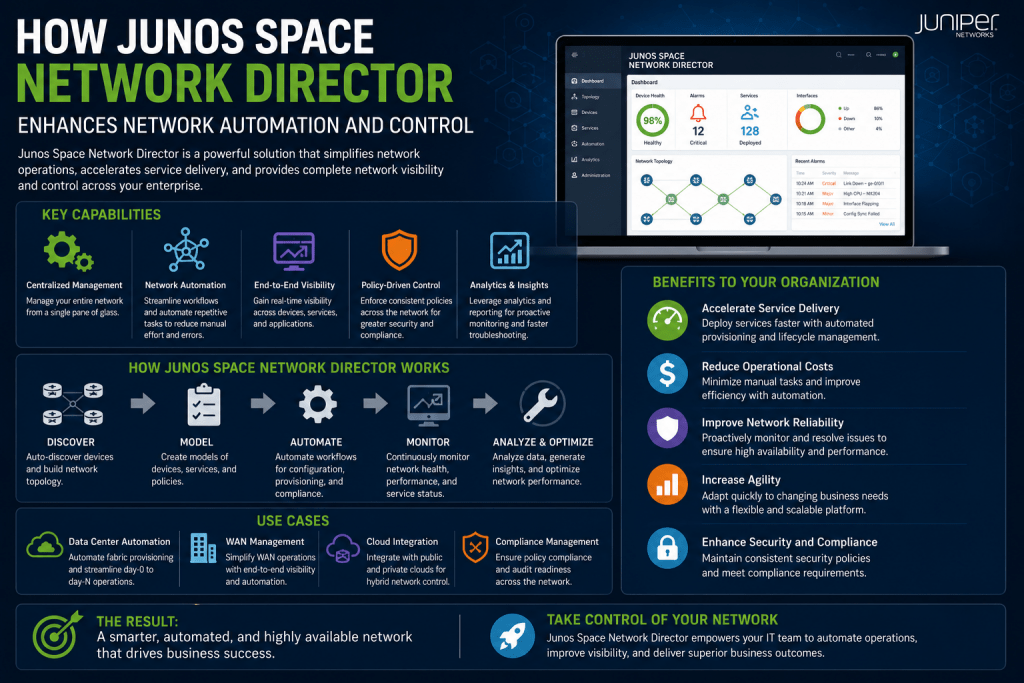
Modern enterprise networks operate in environments where scale, automation, and consistency determine operational success. As infrastructure becomes more distributed and software-defined, traditional manual configuration approaches become inefficient and error-prone. Junos Space combined with Network Director introduces a centralized management framework designed to unify control across network devices, automate repetitive configuration tasks, and provide a consistent operational model across complex infrastructures. This approach aligns closely with Software Defined Networking principles, where abstraction layers replace device-by-device management with policy-driven automation. In such architectures, Junos Space acts as the orchestration layer, while Network Director focuses on operational visibility, provisioning, and lifecycle management of network elements.
Centralized Network Operations and Unified Control Architecture
One of the fundamental shifts introduced by Junos Space with Network Director is the transition from distributed management to centralized orchestration. In traditional environments, network engineers often rely on multiple disconnected tools to manage switching, routing, security policies, and device provisioning. This fragmentation increases operational complexity and creates inconsistencies between configurations applied across different devices. A centralized control architecture resolves these challenges by consolidating management functions into a single operational framework. Through this model, engineers can define configurations once and apply them consistently across multiple network layers, ensuring uniform behavior and reducing configuration discrepancies.
Centralized management also improves governance by enforcing standardized operational policies. Instead of relying on individual device-level configuration changes, administrators can implement structured workflows that control how changes are introduced into the network. This ensures that updates follow predefined validation processes, reducing the likelihood of misconfigurations that could impact network performance or stability.
Role of Automation in Modern Network Provisioning
Automation is a core component of Junos Space and Network Director functionality. In large-scale environments, manual configuration of network devices is not only time-consuming but also prone to human error. Automation enables repetitive tasks such as device provisioning, configuration deployment, and policy enforcement to be executed programmatically. This reduces the operational burden on network engineers while improving consistency across infrastructure components.
Within this automated model, provisioning workflows can be pre-defined and executed whenever new devices are introduced into the network. Instead of manually configuring each device, engineers can rely on automated templates and policies that define how devices should behave once connected. This approach ensures that every new device adheres to organizational standards from the moment it becomes operational.
Complexity of DHCP Configuration in Enterprise Networks
Dynamic Host Configuration Protocol plays a critical role in network operations by automatically assigning IP addresses and network parameters to devices. However, while basic DHCP functionality is straightforward, advanced configurations introduce significant complexity. Enterprise environments often require specialized DHCP options that extend beyond simple address assignment. These options may include vendor-specific instructions, boot parameters, or network provisioning directives that guide devices during initialization.
The complexity arises from the fact that many DHCP options require structured formatting or encoding before they can be interpreted correctly by network devices. In some cases, values must be converted into hexadecimal representation, especially when dealing with vendor-specific parameters or advanced bootstrapping instructions. This introduces additional operational overhead, as engineers must ensure that values are accurately converted and validated before deployment.
Challenges Associated with Manual DHCP Option Management
Manually configuring DHCP options in large environments introduces several challenges. First, it requires precise formatting, as even small errors in configuration syntax or data representation can result in failed deployments. Second, the process is repetitive, particularly in environments where multiple DHCP scopes must be maintained across different network segments. Third, manual configuration increases the risk of inconsistency, especially when multiple administrators are involved in managing network infrastructure.
These challenges are amplified in environments that rely heavily on automation and rapid provisioning. As networks scale, the number of DHCP scopes and associated configurations increases, making manual management impractical. This is where centralized orchestration through Junos Space and Network Director becomes particularly valuable, as it enables standardized DHCP configuration deployment across multiple environments.
Simplifying DHCP Operations Through Centralized Control
By integrating DHCP management into a centralized orchestration framework, Junos Space reduces the complexity associated with configuring and maintaining DHCP options. Instead of manually defining parameters for each scope, engineers can leverage centralized templates and policy-based configurations. These templates define how DHCP options should be structured and applied across the network, ensuring consistency and reducing the likelihood of errors.
Centralized DHCP management also allows for easier updates. When changes are required, they can be applied once at the orchestration level and propagated across all relevant DHCP scopes. This eliminates the need for repetitive manual updates and ensures that all network segments remain synchronized with the latest configuration standards.
Automation of Data Transformation in DHCP Configurations
Certain DHCP configurations require data transformation before they can be applied. A common example is the conversion of IP addresses or vendor-specific parameters into hexadecimal format. This requirement often introduces complexity, as engineers must manually calculate and validate these values before applying them to DHCP scopes. Mistakes in this process can lead to incorrect device behavior or failed network provisioning.
Automation capabilities within Junos Space and Network Director eliminate the need for manual data transformation. Instead, values can be defined in their native format, and the system handles the necessary conversions automatically. This ensures accuracy and consistency across all DHCP configurations while reducing the operational burden on network teams.
Improving Accuracy and Reducing Configuration Errors
One of the primary benefits of automation in network configuration is the reduction of human error. Manual configuration processes are inherently prone to mistakes, especially in complex environments where multiple parameters must be defined accurately. Errors in DHCP configuration, for example, can result in devices failing to obtain network connectivity or receiving incorrect configuration data.
By automating configuration workflows, Junos Space with Network Director minimizes the risk of such errors. Standardized templates, validation mechanisms, and automated deployment processes ensure that configurations are applied consistently and accurately across the network. This improves overall network reliability and reduces the need for troubleshooting caused by configuration issues.
Integration with Software Defined Networking Principles
Software Defined Networking emphasizes the separation of control and data planes, enabling centralized management of network behavior. Junos Space and Network Director align with this principle by providing a centralized control layer that manages configuration and policy distribution across network devices. This abstraction allows engineers to focus on defining network behavior rather than managing individual device configurations.
In SDN-aligned environments, network policies are defined centrally and pushed to devices dynamically. This enables rapid adaptation to changing network conditions and business requirements. Junos Space supports this model by enabling centralized policy definition and automated distribution across the network infrastructure.
Enhancing Operational Efficiency in Large-Scale Deployments
As network environments grow in size and complexity, operational efficiency becomes increasingly important. Manual processes do not scale effectively when managing hundreds or thousands of devices. Junos Space with Network Director improves efficiency by automating repetitive tasks and centralizing control functions.
This efficiency is particularly evident during large-scale deployments, where multiple devices must be provisioned simultaneously. Instead of configuring each device individually, engineers can rely on automated workflows that handle configuration, provisioning, and integration into the network management system. This significantly reduces deployment time and ensures consistency across all devices.
Supporting Standardization Across Network Infrastructure
Standardization is a key requirement in enterprise network environments. Without standardized configurations, networks become difficult to manage, troubleshoot, and scale. Junos Space with Network Director enforces standardization by enabling centralized definition of configuration templates and operational policies.
These standardized templates ensure that all devices follow consistent configuration patterns, regardless of their location or role within the network. This not only simplifies management but also improves security and operational predictability across the infrastructure.
Expanding Network Automation Through Junos Space and Network Director
Modern enterprise networks are no longer static infrastructures. They are dynamic systems that continuously evolve in response to application demand, user growth, and distributed workloads. In such environments, automation is not a convenience but a structural requirement. Junos Space combined with Network Director extends automation beyond basic provisioning into deeper operational domains such as configuration lifecycle management, policy enforcement, and continuous infrastructure optimization. This allows network teams to shift focus from repetitive device-level tasks to higher-value architectural and performance considerations.
Automation within this framework is not limited to initial deployment. It extends across the entire lifecycle of a device, including onboarding, configuration updates, monitoring integration, and eventual retirement. Each stage is governed by predefined workflows that reduce manual intervention and ensure consistency across the infrastructure. This lifecycle-oriented approach ensures that network behavior remains predictable even as scale and complexity increase.
Centralized Policy Distribution Across Distributed Infrastructure
In traditional network environments, policies are often applied locally on individual devices. This creates fragmentation, especially when policies need to be updated across multiple segments or geographic locations. Junos Space with Network Director addresses this challenge by centralizing policy creation and distribution. Policies defined at the orchestration layer are propagated consistently across all relevant devices, ensuring uniform enforcement regardless of physical topology.
This centralized approach eliminates discrepancies that commonly arise when multiple administrators manage different parts of the network. It also reduces the operational overhead associated with updating policies individually on each device. Instead, a single policy change can be applied across the entire infrastructure in a controlled and auditable manner.
Policy consistency is particularly important in environments with strict compliance requirements. Centralized enforcement ensures that security rules, access controls, and operational parameters remain aligned with organizational standards at all times.
Zero Touch Provisioning as a Foundational Deployment Model
Zero Touch Provisioning represents a significant shift in how network devices are deployed. Instead of requiring manual configuration during installation, devices automatically retrieve configuration instructions from a centralized system once they connect to the network. Junos Space with Network Director integrates this model into its provisioning framework, enabling fully automated device onboarding.
When a new device is introduced into the network, it does not require pre-configuration. Instead, it connects to the network, identifies its role through predefined rules, and downloads the appropriate configuration profile. This process eliminates the need for on-site configuration expertise during deployment and significantly reduces setup time.
Zero Touch Provisioning also ensures that devices are configured correctly from the beginning. Since configurations are applied automatically based on standardized templates, there is no variability introduced by manual setup procedures. This leads to more predictable network behavior and reduces the likelihood of deployment-related issues.
Handling DHCP Complexity in Large-Scale Environments
As network size increases, DHCP configuration complexity grows exponentially. Each network segment may require unique addressing schemes, specialized options, and vendor-specific parameters. Managing these configurations manually becomes increasingly difficult, especially when changes need to be propagated across multiple scopes simultaneously.
Junos Space with Network Director simplifies this complexity by introducing centralized DHCP orchestration. Instead of configuring each scope individually, engineers define global or template-based configurations that can be applied across multiple network segments. This reduces duplication and ensures consistency in how DHCP parameters are implemented.
Advanced DHCP options, including those requiring encoded or structured data, are managed through automated transformation processes. This eliminates the need for manual conversion and reduces the risk of misconfiguration. The system ensures that all values are formatted correctly before being applied to DHCP scopes, improving reliability and operational efficiency.
Reducing Operational Overhead Through Configuration Templates
Configuration templates play a critical role in reducing operational workload. In environments where similar device types are deployed repeatedly, templates allow engineers to define configuration structures once and reuse them across multiple deployments. Junos Space with Network Director supports template-driven configuration models that standardize how devices are initialized and managed.
These templates include predefined settings for routing, switching, security, and network services such as DHCP. When a new device is deployed, it inherits configuration parameters from the appropriate template, eliminating the need for manual setup. This not only reduces configuration time but also ensures that all devices adhere to consistent operational standards.
Template-based management also simplifies updates. When a configuration change is required, it can be made at the template level and automatically propagated to all associated devices. This reduces administrative effort and ensures uniformity across the infrastructure.
Improving Network Reliability Through Standardized Configuration Practices
Network reliability is closely tied to configuration consistency. Inconsistent configurations often lead to unpredictable behavior, service interruptions, and troubleshooting complexity. Junos Space with Network Director improves reliability by enforcing standardized configuration practices across all managed devices.
Standardization ensures that devices behave predictably under similar conditions. It also simplifies troubleshooting, as engineers can rely on known configuration baselines when diagnosing issues. Instead of investigating device-specific variations, teams can focus on systemic issues that affect broader parts of the network.
This standardized approach also reduces configuration drift, which occurs when devices gradually deviate from intended configurations over time. By continuously aligning device configurations with centralized templates, Junos Space ensures long-term stability across the network.
Streamlining Firmware and Software Management Across Devices
Network infrastructure requires continuous updates to maintain performance, security, and compatibility. Managing firmware and software updates manually across large environments is both time-consuming and error-prone. Junos Space with Network Director streamlines this process by enabling centralized software management.
Updates can be scheduled, validated, and deployed across multiple devices simultaneously. This ensures that all devices operate on approved software versions, reducing compatibility issues and security vulnerabilities. Centralized management also allows for rollback mechanisms in case of update failures, improving operational resilience.
By automating software lifecycle management, network teams can ensure that infrastructure remains up to date without introducing unnecessary operational risk.
Enhancing Visibility Into Network Behavior and Performance Metrics
Visibility is a key requirement for effective network management. Without real-time insight into network behavior, identifying performance issues becomes reactive rather than proactive. Junos Space with Network Director provides centralized visibility into device status, configuration states, and operational metrics.
This visibility allows engineers to monitor network health continuously and identify potential issues before they impact users. Performance trends can be analyzed across devices and network segments, enabling more informed capacity planning and optimization decisions.
Centralized visibility also improves incident response times. When issues occur, engineers can quickly identify affected devices and configuration states without needing to access individual systems manually.
Integrating Device Lifecycle Management Into a Unified System
Device lifecycle management encompasses all stages of a network device’s existence, from initial deployment to retirement. Junos Space with Network Director integrates lifecycle management into a unified system, enabling consistent handling of devices throughout their operational lifespan.
During onboarding, devices are automatically provisioned and configured. During operation, they are continuously monitored and updated. When devices reach end-of-life, they can be safely decommissioned through controlled workflows. This structured approach ensures that devices remain properly managed at all times, reducing operational risk and improving infrastructure hygiene.
Lifecycle integration also improves auditability, as all changes and transitions are tracked within the centralized system. This provides a clear operational history for each device, supporting compliance and governance requirements.
Scaling Network Operations Without Increasing Administrative Complexity
One of the primary challenges in enterprise networking is scaling operations without proportionally increasing administrative effort. As networks grow, manual processes become unsustainable. Junos Space with Network Director addresses this challenge by enabling automation-driven scaling.
New devices can be added to the network without requiring additional manual configuration effort. Automated workflows handle provisioning, configuration, and integration into existing management systems. This allows networks to scale efficiently while maintaining operational consistency.
Scalability is further enhanced through centralized policy enforcement and template-based configuration models. These mechanisms ensure that growth does not introduce variability or complexity into the network environment.
Advanced Network Automation Use Cases with Junos Space and Network Director
As enterprise networks evolve, automation extends beyond basic provisioning into advanced operational intelligence and lifecycle orchestration. Junos Space combined with Network Director enables structured automation use cases that support complex infrastructure environments. These include automated fault remediation, dynamic policy adjustment, service provisioning workflows, and infrastructure-wide configuration orchestration. Instead of treating network management as a sequence of isolated tasks, the system enables end-to-end automation pipelines that respond to predefined triggers and operational conditions.
In advanced deployments, automation is no longer limited to reducing manual configuration effort. It becomes a mechanism for maintaining continuous alignment between network behavior and organizational requirements. This includes adjusting configurations based on network utilization patterns, enforcing security policies dynamically, and ensuring that service-level expectations are consistently met across all segments of the infrastructure.
Automated Fault Detection and Network Response Mechanisms
One of the key capabilities in modern network orchestration is automated fault detection. Networks generate a continuous stream of operational data, including performance metrics, interface status updates, and protocol-level events. Junos Space with Network Director leverages this data to identify anomalies and potential faults in real time. Instead of relying on manual monitoring, the system correlates events across multiple devices to detect patterns that indicate underlying issues.
Once a fault is detected, automated response mechanisms can be triggered. These may include rerouting traffic, restarting affected services, applying configuration corrections, or isolating problematic segments of the network. This reduces downtime and minimizes the impact of failures on end users. The ability to respond automatically to network conditions represents a shift from reactive troubleshooting to proactive infrastructure management.
Dynamic Policy Adjustment Based on Network Conditions
Traditional network policies are static, meaning they remain unchanged unless manually updated by administrators. In contrast, modern automated environments support dynamic policy adjustment. Junos Space with Network Director enables policies to be adapted based on real-time network conditions such as congestion levels, device health, and traffic patterns.
For example, if a particular network segment experiences increased traffic load, policies can be adjusted to redistribute traffic or prioritize critical services. Similarly, security policies can be tightened automatically when suspicious activity is detected. This dynamic behavior ensures that the network remains optimized and secure without requiring constant manual intervention.
Dynamic policy adjustment also supports business agility. As application demands change, network behavior can adapt automatically, ensuring that infrastructure remains aligned with organizational priorities.
End-to-End Service Provisioning Across Network Layers
Service provisioning in complex networks involves multiple layers, including access, distribution, and core infrastructure. Each layer must be configured correctly to support end-to-end service delivery. Junos Space with Network Director enables coordinated provisioning across all network layers, ensuring that services are deployed consistently and efficiently.
Instead of configuring each layer independently, engineers define service requirements at a high level. The system then translates these requirements into specific configurations across all relevant devices. This includes VLAN assignments, routing configurations, security policies, and DHCP parameters.
By automating service provisioning, the risk of configuration mismatches between network layers is significantly reduced. This ensures that services function correctly from the moment they are deployed.
Advanced DHCP Orchestration in Large Enterprise Environments
DHCP remains a critical component of enterprise networking, particularly in environments with large numbers of dynamically connected devices. Advanced DHCP orchestration involves more than simple IP assignment. It includes managing multiple scopes, applying vendor-specific options, and integrating DHCP behavior with broader network automation workflows.
Junos Space with Network Director allows DHCP configurations to be managed centrally and applied consistently across multiple environments. This is particularly important in distributed networks where multiple DHCP servers may be operating simultaneously. Centralized orchestration ensures that all DHCP scopes follow standardized configuration models.
In advanced scenarios, DHCP configurations are also integrated with device provisioning workflows. This allows devices to receive not only IP addresses but also configuration instructions and operational parameters during the initial network connection process.
Managing Network Fabric Environments Through Centralized Control
Modern data center and enterprise networks often rely on fabric-based architectures. These architectures require coordinated configuration across multiple interconnected devices to maintain performance and scalability. Junos Space with Network Director provides centralized control over fabric environments, enabling consistent configuration across all participating devices.
Fabric management includes automated creation of network segments, configuration of inter-device links, and enforcement of routing policies across the entire fabric. This ensures that the network operates as a unified system rather than a collection of independent devices.
Centralized fabric management also simplifies expansion. New devices can be added to the fabric without requiring manual configuration of each connection point. The system automatically integrates new devices into the existing topology based on predefined rules.
Traffic Behavior Analysis and Network Optimization Techniques
Understanding traffic behavior is essential for optimizing network performance. Junos Space with Network Director collects and analyzes traffic data across the infrastructure to identify usage patterns, bottlenecks, and performance inefficiencies. This analysis enables engineers to make informed decisions about capacity planning and network optimization.
Traffic analysis also supports proactive optimization. Instead of reacting to performance issues after they occur, the system identifies potential congestion points before they impact users. This allows network configurations to be adjusted in advance, ensuring consistent performance under varying load conditions.
Optimization techniques may include load balancing adjustments, routing changes, or bandwidth allocation modifications. These adjustments help maintain optimal performance across the network.
End-to-End Visibility Across Multi-Layer Network Architectures
Modern networks consist of multiple interconnected layers, each contributing to overall system behavior. Without end-to-end visibility, it becomes difficult to understand how issues in one layer affect others. Junos Space with Network Director provides unified visibility across all network layers, enabling engineers to trace issues from end devices to core infrastructure components.
This visibility includes configuration states, operational metrics, and real-time performance data. By correlating information across layers, engineers can identify root causes of network issues more efficiently.
End-to-end visibility also supports long-term optimization efforts. By analyzing how different layers interact, engineers can identify structural improvements that enhance overall network efficiency.
Reducing Configuration Drift Through Continuous Alignment
Configuration drift occurs when network devices gradually deviate from intended configurations due to manual changes or inconsistent updates. Over time, this can lead to instability and unpredictable network behavior. Junos Space with Network Director addresses this issue through continuous configuration alignment.
Devices are regularly checked against centralized configuration templates. If deviations are detected, corrective actions are applied automatically to restore consistency. This ensures that all devices remain aligned with defined operational standards.
Continuous alignment also simplifies compliance management. Since configurations are consistently enforced, audit processes become more straightforward and reliable.
Infrastructure Scalability Through Automated Integration Models
Scalability is a fundamental requirement in modern networking environments. As organizations expand, their network infrastructure must scale without introducing additional operational complexity. Junos Space with Network Director supports scalability through automated integration models that allow new devices and services to be added seamlessly.
These models define how new infrastructure components should be integrated into the existing network. Once a device is introduced, it automatically receives configuration instructions, joins the appropriate management domain, and becomes fully operational without manual intervention.
This approach ensures that network growth does not require proportional increases in administrative effort.
Security Enforcement Through Centralized Network Policies
Security is deeply integrated into network operations in modern environments. Instead of being treated as a separate layer, security policies are embedded directly into network configurations. Junos Space with Network Director enables centralized security policy enforcement across all devices.
This ensures that security rules are applied consistently, reducing the risk of misconfigurations that could expose vulnerabilities. Policies can include access controls, traffic filtering rules, and segmentation requirements.
Centralized enforcement also simplifies security updates. When policies need to be updated, changes can be applied once and propagated across the entire network infrastructure.
Operational Efficiency Through Unified Network Intelligence
Operational efficiency is achieved when networks can be managed with minimal manual intervention while maintaining high levels of performance and reliability. Junos Space with Network Director achieves this through unified network intelligence, which combines automation, visibility, and policy enforcement into a single operational framework.
This intelligence enables networks to operate with greater autonomy, reducing the need for constant human oversight. At the same time, it provides engineers with detailed insights into network behavior, allowing them to make informed strategic decisions.
Unified intelligence transforms network management from a reactive process into a proactive and continuously optimized system.
Conclusion
In modern enterprise environments, network infrastructure is no longer a static backbone but a continuously evolving ecosystem that must respond to rapid changes in demand, application behavior, and security requirements. Within this context, Junos Space combined with Network Director represents a shift toward centralized orchestration and automation-driven operations, where complexity is managed through structured intelligence rather than manual intervention. The overall value of this approach is not limited to individual features such as provisioning or monitoring, but rather emerges from the integration of these capabilities into a unified operational framework that governs the entire lifecycle of network devices and services.
One of the most significant outcomes of this architecture is the reduction of operational fragmentation. Traditional network management environments often rely on multiple disconnected tools, each responsible for a specific domain such as switching, routing, or IP address management. This separation creates inefficiencies, increases the likelihood of configuration inconsistencies, and complicates troubleshooting processes. By consolidating these functions into a centralized system, Junos Space with Network Director eliminates much of this fragmentation and enables engineers to operate from a single authoritative source of network truth. This consolidation improves both speed and accuracy in day-to-day operations.
Another key advantage lies in the standardization of configuration practices. In large-scale networks, consistency is critical to maintaining stability and predictability. When devices are configured manually or through disparate tools, subtle differences in configuration can accumulate over time, leading to configuration drift. This drift often manifests as unpredictable behavior, performance degradation, or security vulnerabilities that are difficult to trace. A centralized orchestration model ensures that configuration templates and policies are consistently applied across all devices, reducing variability and reinforcing operational discipline.
Automation plays a central role in this transformation. Rather than treating automation as an optional enhancement, Junos Space with Network Director embeds it into the core of network operations. Tasks that would traditionally require manual intervention, such as device provisioning, DHCP configuration, firmware updates, and policy deployment, are executed through automated workflows. These workflows are designed to ensure repeatability and accuracy, which significantly reduces the risk of human error. In environments where hundreds or thousands of devices must be managed, this automation becomes essential for maintaining operational efficiency.
The impact of automation is particularly evident in provisioning processes. With Zero Touch Provisioning capabilities integrated into the system, new devices can be introduced into the network without manual configuration. Once connected, they automatically retrieve their configuration parameters, join the appropriate network segment, and become operational. This not only accelerates deployment timelines but also ensures that every device adheres to predefined standards from the moment it is activated. The result is a more predictable and controlled network environment, even as scale increases.
Another important dimension of this architecture is its ability to handle complex configuration requirements such as advanced DHCP options. In traditional environments, configuring such options often involves manual data transformation, including encoding values into specific formats such as hexadecimal. This introduces unnecessary complexity and increases the likelihood of errors. By abstracting these requirements into automated processes, Junos Space reduces the cognitive burden on engineers and ensures that configurations are applied correctly and consistently across all relevant scopes.
Visibility is also significantly enhanced through centralized management. In complex networks, understanding the state of devices, services, and traffic flows is essential for maintaining performance and diagnosing issues. Without unified visibility, engineers are forced to gather information from multiple sources, which slows down troubleshooting and increases the risk of incomplete analysis. A centralized operational view provides real-time insight into network health, configuration states, and performance metrics, enabling faster and more accurate decision-making.
From a scalability perspective, the system is designed to support growth without proportional increases in administrative overhead. As organizations expand their infrastructure, the number of devices and services under management grows rapidly. Without automation and centralized control, this growth would lead to unsustainable operational complexity. However, by leveraging template-driven configuration, policy-based management, and automated onboarding, Junos Space with Network Director allows networks to scale efficiently while maintaining consistency and control.
Security enforcement is another critical outcome of centralized orchestration. In distributed environments, inconsistent security configurations can create vulnerabilities that are difficult to detect and remediate. By enforcing security policies centrally, the system ensures that all devices comply with organizational security standards. This reduces the risk of misconfiguration and strengthens the overall security posture of the network. It also improves response times during security incidents, since policy adjustments can be deployed across the entire infrastructure simultaneously rather than requiring manual updates on individual devices. Over time, this centralized model helps establish a more resilient security baseline where deviations are minimized and compliance becomes an inherent property of the network rather than an ongoing manual effort.
Lifecycle management further enhances operational control by ensuring that devices are properly managed from deployment through retirement. Each stage of the device lifecycle is governed by structured workflows that define how devices are onboarded, updated, monitored, and eventually decommissioned. This structured approach reduces operational ambiguity and ensures that devices remain aligned with organizational policies throughout their existence. It also provides clear traceability, allowing network teams to track configuration history, software versions, and operational changes over time. This historical visibility is particularly valuable in troubleshooting scenarios, where understanding the evolution of a device’s configuration can help identify the root cause of complex issues. Additionally, lifecycle automation reduces administrative overhead by eliminating repetitive manual tasks associated with device provisioning and retirement, which in turn allows engineering teams to focus on higher-value architectural and optimization work.
Beyond individual operational improvements, centralized lifecycle and security management contribute to long-term network stability. When devices are consistently deployed, updated, and retired through standardized workflows, the infrastructure becomes more predictable and easier to maintain. This predictability reduces downtime risks and ensures that network behavior remains aligned with design expectations even as scale increases. It also supports better capacity planning, since administrators can rely on consistent data regarding device performance and lifecycle status.
Ultimately, the value of Junos Space with Network Director lies in its ability to transform network management from a manual, fragmented process into a cohesive, automated, and policy-driven system. It enables organizations to operate more efficiently, reduce operational risk, and maintain consistency across increasingly complex infrastructures. As networks continue to evolve toward greater scale and automation, such centralized orchestration frameworks become essential for maintaining control, visibility, and performance in enterprise environments. This transformation is not simply about reducing workload but about enabling a fundamentally more reliable and scalable operational model where intelligence, automation, and governance work together to sustain enterprise-grade network performance over time.