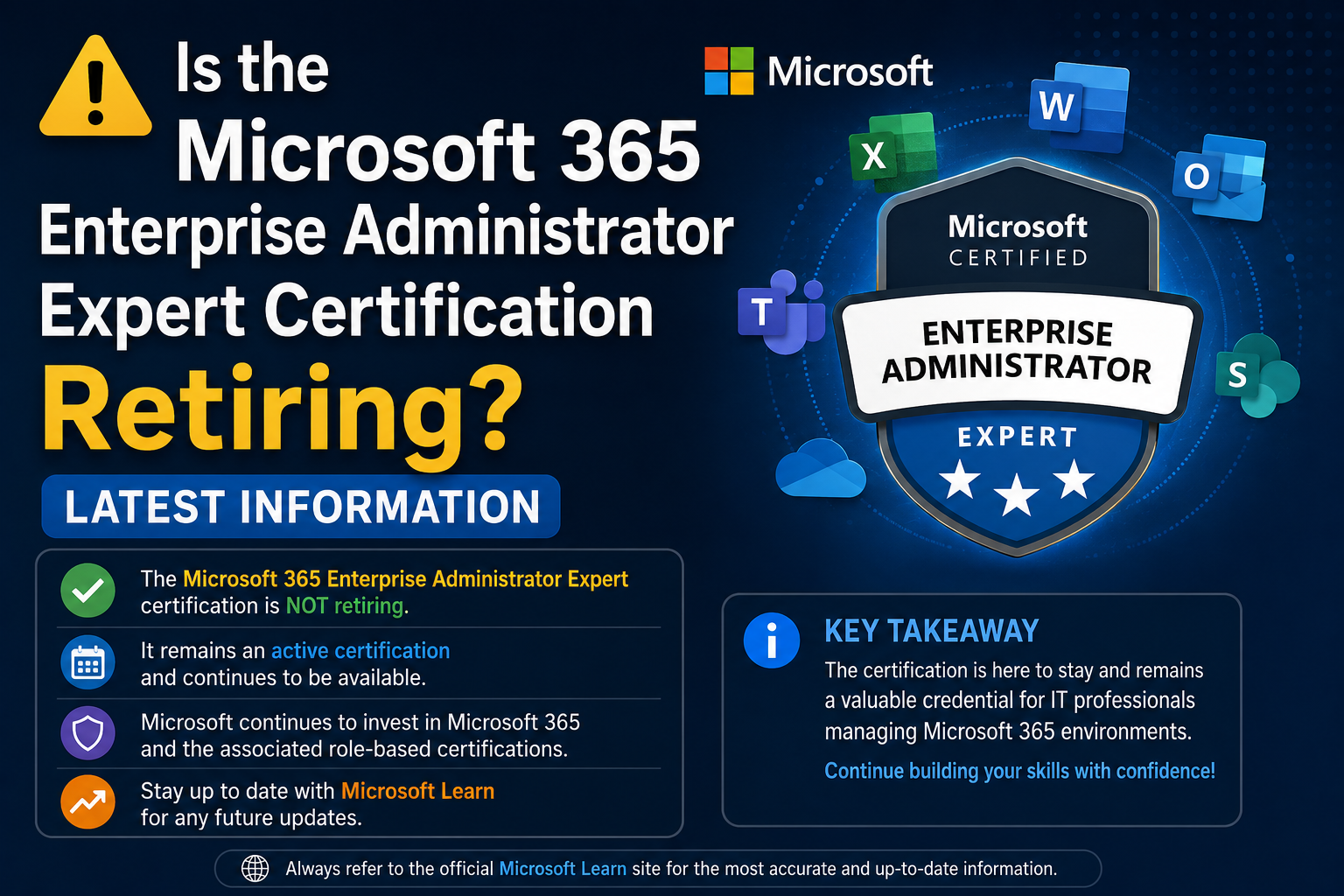
The Microsoft 365 certification ecosystem has undergone continuous restructuring as enterprise IT environments have transitioned toward cloud-first architectures. Traditional certification models that focused on isolated technical products have gradually been replaced with role-based certifications that reflect real operational responsibilities. This shift is driven by the increasing complexity of modern IT systems, where administrators are no longer responsible for a single platform but instead manage interconnected services spanning identity, security, compliance, and collaboration.
In earlier certification frameworks, professionals were evaluated primarily on product-specific knowledge, often requiring separate exams for different technologies. However, as Microsoft 365 evolved into a unified productivity and security platform, this approach became less effective in measuring real-world administrative capability. Organizations began to require professionals who could manage integrated environments rather than isolated systems. This led to the introduction of role-based certifications designed to evaluate end-to-end operational skills.
Within this structure, Microsoft 365 certifications were positioned around job roles such as administrator, security engineer, and enterprise architect. These certifications emphasize applied knowledge, requiring candidates to demonstrate how different services interact within a unified tenant environment. The Enterprise Administrator Expert certification emerged as one of the highest-level credentials within this framework, representing advanced expertise in managing enterprise-scale Microsoft 365 deployments.
As cloud adoption increased globally, Microsoft continued refining certification pathways to ensure alignment with evolving technologies. This included periodic updates to exam content, restructuring of prerequisites, and eventual consolidation of overlapping exams. The goal of these changes has been to ensure that certifications remain relevant to current job roles while reducing unnecessary complexity in the certification journey.
Enterprise Administrator Expert Certification Structure and Original Design Intent
The Microsoft 365 Certified: Enterprise Administrator Expert certification was originally designed to validate advanced-level expertise in managing enterprise Microsoft 365 environments. It was intended for IT professionals responsible for overseeing large-scale deployments, ensuring secure identity management, maintaining compliance standards, and optimizing collaboration services across organizations.
This certification path required candidates to demonstrate a deep understanding across multiple technical domains. These included tenant configuration, identity synchronization, security policy enforcement, compliance management, and enterprise application integration. The structure was intentionally comprehensive, reflecting the complexity of real-world Microsoft 365 environments where multiple systems operate simultaneously.
Candidates pursuing this certification typically follow a structured learning path beginning with associate-level certifications. These foundational certifications provided targeted knowledge in specific areas such as identity management, messaging, security, or device administration. Once these were completed, candidates progressed to the expert-level certification, which required integration of all previously learned concepts into a unified administrative skill set.
The Enterprise Administrator Expert certification was widely recognized as a benchmark for senior-level Microsoft 365 professionals. It validated not only technical knowledge but also the ability to design, implement, and manage enterprise environments at scale. However, as Microsoft 365 services expanded and became more integrated, the original multi-exam structure began to show limitations in reflecting modern administrative workflows.
MS-100 and MS-101 Exam Framework and Functional Coverage Areas
The certification structure was historically supported by two primary exams: MS-100 and MS-101. These exams were designed to evaluate complementary skill sets required for enterprise administration. Each exam focused on specific domains of Microsoft 365 management, ensuring that candidates demonstrated both depth and breadth of knowledge.
The MS-100 exam primarily focused on identity and tenant-level administration. It evaluated skills related to Microsoft 365 tenant setup, user identity management, synchronization between on-premises and cloud environments, and directory services configuration. Candidates were expected to understand how identity systems function within enterprise architectures and how authentication mechanisms impact overall security and access control.
The MS-101 exam expanded the scope into security, compliance, and modern workplace management. It assessed knowledge of Microsoft 365 security tools, device management strategies, threat protection mechanisms, and compliance frameworks. This included understanding how to implement organizational policies that align with regulatory requirements and enterprise governance standards.
Together, MS-100 and MS-101 provided a comprehensive evaluation of Microsoft 365 enterprise administration capabilities. However, the separation of topics into two distinct exams created challenges in reflecting the integrated nature of real-world environments. In practice, identity, security, and compliance are deeply interconnected, and administrative decisions in one area often directly impact others.
As Microsoft 365 evolved, the limitations of this split-exam model became more apparent. The increasing integration of services such as Microsoft Defender, Microsoft Purview, and Azure Active Directory made it necessary to evaluate candidates in a more unified manner. This led to the development of a consolidated exam structure that better reflects modern administrative responsibilities.
Transition Toward Consolidated Certification Model and Structural Modernization
The transition from a dual-exam certification model to a consolidated framework represents a significant modernization of Microsoft 365 certification design. Instead of assessing candidates across multiple separate exams, the updated structure introduces a single comprehensive evaluation that measures end-to-end administrative capability.
This change reflects the operational reality of Microsoft 365 environments, where administrative tasks are not compartmentalized into isolated domains. Identity management directly impacts security policies, compliance configurations influence data access, and tenant-level settings affect collaboration and communication services. A unified exam structure allows for a more realistic assessment of how these systems interact in practice.
The consolidation also simplifies the certification journey for candidates. Rather than preparing for multiple exams with overlapping content, professionals can focus on a single integrated assessment that covers all required skill areas. This reduces redundancy in study material and ensures that learning efforts are aligned with real-world administrative scenarios.
From an organizational perspective, this modernization improves the relevance of certification outcomes. Employers benefit from clearer validation of candidate skills, as the certification now reflects comprehensive expertise rather than segmented knowledge areas. This makes it easier to identify professionals capable of managing complex Microsoft 365 environments without requiring multiple certifications to demonstrate equivalent competency.
The updated model also aligns with Microsoft’s broader strategy of continuously evolving certification pathways to match technological advancements. As new services are introduced and existing tools are enhanced, certification structures must adapt to ensure continued relevance in enterprise IT ecosystems.
Retirement of MS-100 and MS-101 and Structural Realignment of Certification Pathways
The retirement of MS-100 and MS-101 represents a strategic realignment of the Microsoft 365 certification framework. These exams were phased out as part of a broader effort to streamline certification pathways and eliminate redundancy in assessment structures. Their retirement marks the transition from a segmented evaluation model to a unified certification approach.
The decision to retire these exams was influenced by the increasing overlap in their subject matter. As Microsoft 365 services became more interconnected, the separation between identity management and security administration became less distinct. Modern administrative tasks often require a simultaneous understanding of multiple service areas, making isolated exam structures less representative of actual job responsibilities.
During the transition period, candidates were given a defined window to complete existing certification requirements under the legacy structure. This ensured continuity for those already engaged in the certification process while gradually guiding new candidates toward the updated exam format. The phased retirement approach allowed for a smooth transition without disrupting ongoing professional development efforts.
The removal of MS-100 and MS-101 also paved the way for a more integrated certification model. By consolidating content into a single exam, Microsoft ensured that candidates are evaluated on their ability to manage complete Microsoft 365 environments rather than segmented technical domains. This reflects the increasing demand for professionals capable of handling complex, multi-service administrative responsibilities in enterprise environments.
The structural realignment also supports better alignment with modern IT roles. Today’s Microsoft 365 administrators are expected to manage identity, security, compliance, and collaboration simultaneously, often within hybrid or fully cloud-based infrastructures. The updated certification framework ensures that these expectations are accurately reflected in the assessment process.
Emergence of Unified Exam Structure and Updated Certification Direction
The introduction of a unified exam structure represents a significant evolution in Microsoft 365 certification design. Instead of multiple exams evaluating separate domains, a single comprehensive exam now assesses all core areas of enterprise administration. This approach reflects the reality of modern IT environments, where administrative responsibilities are highly integrated and interdependent.
The unified exam evaluates skills across tenant management, identity and access control, security operations, and compliance enforcement. Candidates are expected to demonstrate not only theoretical knowledge but also practical understanding of how these systems function together within enterprise environments. This ensures that certified professionals are prepared for real-world administrative challenges.
The updated certification direction also places greater emphasis on modern security frameworks and compliance requirements. As organizations face increasing regulatory pressures and cybersecurity threats, Microsoft 365 administrators must be capable of implementing advanced security controls and maintaining organizational compliance across distributed environments.
This shift toward unified evaluation improves both efficiency and relevance. Candidates benefit from a streamlined certification process, while organizations gain confidence that certified professionals possess comprehensive administrative expertise. The consolidation of exam content also ensures that certification standards remain aligned with current technological developments and enterprise operational needs.
The evolution of the certification structure reflects a broader trend in IT credentialing, where emphasis is placed on practical, role-based competencies rather than fragmented technical knowledge. This approach ensures that certifications remain meaningful indicators of professional capability in rapidly changing technology environments.
Introduction of MS-102 and Consolidation of Microsoft 365 Expert-Level Assessment
The introduction of the MS-102 exam represents a major structural shift in the Microsoft 365 certification ecosystem. Rather than maintaining multiple exams that assess different administrative domains separately, Microsoft transitioned toward a single unified evaluation model. This consolidated exam is designed to measure comprehensive expertise in Microsoft 365 administration, reflecting the reality of modern enterprise environments where services are deeply interconnected.
The MS-102 exam serves as a replacement for the previous multi-exam structure that included MS-100 and MS-101. This change simplifies the certification pathway while increasing the depth and integration of assessed skills. Candidates are no longer evaluated on isolated topics but instead are expected to demonstrate holistic understanding across identity management, tenant configuration, security operations, and compliance enforcement.
This shift reflects how Microsoft 365 environments function in real-world scenarios. Administrative decisions are rarely limited to a single service area. For example, changes in identity configuration can directly affect security policies, compliance rules, and user access across multiple workloads. The MS-102 exam structure is designed to evaluate how well candidates understand these interdependencies and how effectively they can manage them in enterprise environments.
The consolidation also reduces redundancy in exam preparation. Previously, candidates needed to study overlapping material across multiple exams, often covering similar concepts in different contexts. With MS-102, the content is unified into a single framework, allowing for more efficient preparation and more consistent evaluation standards.
Expansion of Tenant-Level Administration and Unified Management Scope
A defining characteristic of the MS-102 exam is its strong emphasis on tenant-level administration. In modern Microsoft 365 environments, the tenant serves as the central management boundary where identity, security, compliance, and collaboration services are configured and controlled. Effective administration requires understanding how all these components interact within a unified environment.
Tenant-level administration involves configuring organizational settings, managing user identities, controlling access policies, and ensuring that services operate in alignment with business requirements. The MS-102 exam evaluates how well candidates can manage these responsibilities in a cohesive manner rather than treating them as separate tasks.
This approach reflects real-world enterprise operations, where administrators must maintain oversight across multiple systems simultaneously. For example, a change in tenant configuration may impact authentication flows, security enforcement policies, or data access rules. Understanding these relationships is critical for maintaining a secure and efficient Microsoft 365 environment.
The unified scope of tenant management also requires familiarity with administrative portals, policy frameworks, and configuration tools that span multiple services. Candidates are expected to demonstrate the ability to navigate these systems effectively and apply consistent governance practices across the entire tenant.
By focusing on tenant-level administration, the MS-102 exam ensures that certified professionals are capable of managing Microsoft 365 environments at scale. This includes not only technical configuration but also strategic oversight of how services are deployed and maintained across an organization.
Identity and Access Management in Modern Microsoft 365 Environments
Identity and access management remains a foundational component of Microsoft 365 administration and is a core focus of the MS-102 exam. Modern enterprise environments rely heavily on centralized identity systems to control access to resources, enforce security policies, and ensure compliance with organizational standards.
Identity management involves creating and maintaining user accounts, configuring authentication methods, and implementing access control policies. In Microsoft 365 environments, identity services are tightly integrated with cloud-based directory systems that provide centralized control over user authentication and authorization.
The MS-102 exam evaluates the ability to manage these identity systems effectively, including configuring synchronization between on-premises directories and cloud environments. This hybrid identity model is common in enterprise organizations, where legacy systems must coexist with cloud-based infrastructure.
Access management extends beyond basic authentication to include conditional access policies, multi-factor authentication enforcement, and role-based access control. These mechanisms ensure that users only have access to the resources they need based on organizational policies and security requirements.
Understanding identity and access management is critical because it forms the foundation for all other Microsoft 365 services. Security, compliance, and collaboration tools all depend on accurate identity information and properly configured access controls. Without a strong identity framework, enterprise environments become vulnerable to unauthorized access and security breaches.
The MS-102 exam places significant emphasis on these concepts, requiring candidates to demonstrate both theoretical knowledge and practical application of identity management principles in complex environments.
Security Operations and Threat Protection in Microsoft 365 Ecosystem
Security operations represent another major focus area within the MS-102 certification framework. As organizations increasingly rely on cloud-based services, protecting data, identities, and applications has become a critical responsibility for administrators. Microsoft 365 provides a comprehensive set of security tools designed to detect, prevent, and respond to threats across the enterprise environment.
Security management involves configuring threat protection policies, monitoring security alerts, and responding to incidents in real time. Administrators must understand how to implement security controls that protect against a wide range of threats, including phishing attacks, malware infections, and unauthorized access attempts.
The MS-102 exam evaluates knowledge of integrated security platforms that provide centralized visibility and control over organizational security posture. These platforms enable administrators to monitor security events, investigate suspicious activity, and apply remediation actions across multiple services.
A key aspect of security operations is the ability to interpret security signals and respond appropriately. This requires understanding how different security tools interact and how alerts from one system may indicate broader issues across the environment. Effective security management is not reactive but proactive, involving continuous monitoring and policy refinement.
Modern Microsoft 365 security frameworks also emphasize automation and intelligent threat detection. Administrators must understand how automated systems identify anomalies and enforce security policies without manual intervention. This reflects the growing importance of artificial intelligence and machine learning in enterprise security operations.
The MS-102 exam assesses both conceptual understanding and practical application of these security principles, ensuring that certified professionals are capable of managing enterprise-level security environments effectively.
Compliance Management and Organizational Governance Frameworks
Compliance management is a critical component of Microsoft 365 administration and plays a significant role in the MS-102 exam structure. Organizations operating in regulated industries must adhere to strict data governance policies, privacy regulations, and industry standards. Microsoft 365 provides tools that help administrators enforce these requirements across enterprise environments.
Compliance management involves configuring data retention policies, managing information protection rules, and ensuring that organizational data is handled in accordance with regulatory requirements. These responsibilities require a deep understanding of how data flows through Microsoft 365 services and how policies can be applied consistently across different workloads.
The MS-102 exam evaluates knowledge of compliance frameworks that enable organizations to classify, protect, and manage sensitive information. This includes implementing data loss prevention policies, configuring retention labels, and monitoring compliance status across the tenant.
Governance frameworks also play a key role in compliance management. Administrators must ensure that organizational policies are consistently applied and that access to sensitive data is properly controlled. This requires coordination between identity management, security policies, and compliance configurations.
Effective compliance management is not limited to technical configuration. It also involves understanding regulatory requirements and translating them into actionable policies within Microsoft 365 environments. This ensures that organizations remain compliant while maintaining operational efficiency.
The MS-102 exam reflects these responsibilities by assessing both technical and conceptual understanding of compliance management principles. Candidates are expected to demonstrate the ability to implement governance strategies that align with organizational and regulatory requirements.
Integration of Security, Identity, and Compliance in Unified Administrative Model
One of the most significant aspects of the MS-102 certification framework is the integration of identity, security, and compliance into a unified administrative model. In modern Microsoft 365 environments, these domains are no longer separate areas of responsibility but are deeply interconnected components of a single operational ecosystem.
Identity management provides the foundation for access control, security policies determine how resources are protected, and compliance frameworks ensure that data is handled appropriately. Changes in any one of these areas can have cascading effects across the entire environment.
The MS-102 exam evaluates how well candidates understand these interdependencies and how effectively they can manage them in real-world scenarios. This requires a holistic approach to administration, where decisions are made with consideration of their impact across multiple domains.
For example, modifying an identity policy may affect security enforcement mechanisms, which in turn could influence compliance reporting and data protection rules. Understanding these relationships is essential for maintaining a stable and secure Microsoft 365 environment.
The unified administrative model reflects how modern enterprises operate, where siloed management approaches are no longer effective. Administrators must have a comprehensive understanding of how different services interact and how to manage them cohesively.
This integration is a defining characteristic of the MS-102 exam and represents a significant evolution in Microsoft 365 certification design. It ensures that certified professionals are prepared to handle the complexity of modern cloud environments where multiple systems operate simultaneously and interdependently.
Expanded Skill Domains and Microsoft 365 Administrator Expert Competency Scope
The Microsoft 365 Certified: Administrator Expert certification represents a comprehensive validation of advanced administrative capabilities across enterprise cloud environments. The MS-102 exam, which defines this certification path, evaluates a wide range of technical and operational competencies required to manage modern Microsoft 365 infrastructures effectively.
These competencies span multiple domains, including tenant administration, identity governance, security operations, compliance enforcement, and organizational policy management. Rather than focusing on isolated technical skills, the certification assesses the ability to integrate these domains into cohesive administrative strategies.
The expanded scope reflects the growing complexity of enterprise IT environments. Modern organizations rely on Microsoft 365 as a central platform for communication, collaboration, identity management, and data governance. As a result, administrators must possess a broad understanding of how these systems function together and how changes in one area can impact others.
The certification emphasizes applied knowledge, requiring candidates to demonstrate not only familiarity with tools and concepts but also the ability to apply them in real-world scenarios. This includes configuring enterprise environments, managing access controls, enforcing security policies, and ensuring compliance with regulatory standards.
The MS-102 framework is designed to evaluate these capabilities in an integrated manner, ensuring that certified professionals are equipped to manage complex environments that require both technical expertise and strategic decision-making.
Modern Microsoft 365 Security Architecture and Operational Responsibilities
Security architecture within Microsoft 365 environments has evolved significantly as organizations face increasing cybersecurity threats and regulatory requirements. The MS-102 certification places strong emphasis on understanding how security is structured across the Microsoft 365 ecosystem and how administrators are responsible for implementing and maintaining these protections.
Modern security architecture includes multiple layers of protection, ranging from identity-based controls to advanced threat detection systems. Administrators must understand how these layers interact to provide comprehensive protection for organizational data and resources.
Security responsibilities include configuring threat protection policies, monitoring security alerts, and responding to incidents. These tasks require continuous oversight and proactive management to ensure that potential threats are identified and mitigated before they impact the organization.
The integration of security tools across Microsoft 365 services allows for centralized visibility and control. Administrators can monitor security events across multiple workloads, identify patterns of suspicious activity, and apply remediation actions as needed. This centralized approach improves efficiency and enhances the overall security posture of the organization.
The MS-102 exam evaluates understanding of these security mechanisms and the ability to apply them effectively in enterprise environments. Candidates are expected to demonstrate knowledge of how security policies are implemented, how threats are detected, and how responses are coordinated across different systems.
Security administration also involves collaboration with other IT roles, including identity administrators, compliance officers, and network engineers. Effective security management requires coordination across these functions to ensure consistent policy enforcement and risk mitigation.
Advanced Identity Governance and Access Lifecycle Management
Identity governance plays a critical role in Microsoft 365 administration, forming the foundation for secure and efficient access management across enterprise environments. The MS-102 certification evaluates the ability to manage identity lifecycles, enforce access policies, and maintain secure authentication systems.
Identity governance involves managing user accounts from creation through deactivation, ensuring that access rights are properly assigned and revoked as organizational roles change. This process is essential for maintaining security and preventing unauthorized access to sensitive resources.
Access lifecycle management includes implementing policies that govern how users are authenticated, how permissions are assigned, and how access is monitored over time. These processes are particularly important in large organizations where users may have varying levels of access across multiple systems.
Modern identity governance frameworks rely heavily on automation and policy-driven management. Administrators must understand how to configure systems that automatically enforce identity rules based on organizational policies and user attributes. This reduces administrative overhead while improving consistency and security.
The MS-102 exam assesses knowledge of these identity governance principles, including the ability to configure and manage identity systems that support both cloud-based and hybrid environments. Candidates are expected to demonstrate an understanding of authentication methods, directory synchronization, and role-based access control mechanisms.
Identity governance is closely linked to security and compliance, as access decisions directly impact data protection and regulatory adherence. Effective identity management ensures that only authorized users can access sensitive information and that access is continuously reviewed and adjusted based on organizational needs.
Compliance Strategy Implementation and Data Protection Frameworks
Compliance strategy implementation is a core responsibility of Microsoft 365 administrators and a significant focus of the MS-102 certification. Organizations must adhere to a wide range of regulatory requirements related to data privacy, security, and information governance. Microsoft 365 provides a suite of tools that enable administrators to enforce these requirements across enterprise environments.
Data protection frameworks involve classifying information based on sensitivity, applying retention policies, and ensuring that data is stored and accessed in accordance with organizational and regulatory standards. These frameworks help organizations manage risk and maintain control over critical information assets.
Administrators are responsible for configuring policies that govern how data is handled throughout its lifecycle. This includes defining retention periods, applying labels to sensitive data, and enforcing restrictions on data sharing and movement.
The MS-102 exam evaluates the ability to implement these compliance strategies effectively. Candidates must understand how to configure compliance tools, monitor adherence to policies, and respond to potential violations.
Compliance management also involves auditing and reporting capabilities that provide visibility into how data is being used across the organization. Administrators must be able to interpret these reports and take corrective actions when necessary.
Data protection frameworks are closely integrated with security and identity systems, ensuring that access controls and compliance policies work together to protect organizational information. This integration is essential for maintaining a secure and compliant Microsoft 365 environment.
Tenant Configuration, Governance, and Enterprise Environment Management
Tenant configuration represents one of the most critical responsibilities within Microsoft 365 administration. The tenant serves as the central boundary for all organizational settings, including identity management, security policies, and service configurations. Effective tenant governance ensures that all services operate in alignment with organizational requirements and best practices.
Governance involves establishing policies and procedures that define how the tenant is managed and maintained. This includes configuring administrative roles, managing service settings, and ensuring that changes are implemented in a controlled and secure manner.
The MS-102 certification evaluates the ability to manage tenant environments effectively, including configuring organizational settings, managing subscriptions, and overseeing service deployment. Candidates are expected to understand how tenant-level decisions impact all connected services within the Microsoft 365 ecosystem.
Enterprise environment management also includes monitoring system performance, managing service health, and ensuring that resources are allocated efficiently. Administrators must be able to identify issues, implement solutions, and maintain operational stability across the environment.
Tenant governance frameworks are essential for maintaining consistency and control in large-scale deployments. They ensure that administrative actions are aligned with organizational policies and that changes are properly documented and reviewed.
The integration of tenant management with identity, security, and compliance systems ensures that all aspects of the Microsoft 365 environment are coordinated and managed cohesively. This holistic approach is a key focus of the MS-102 certification framework.
Operational Integration of Microsoft 365 Services in Enterprise Environments
Microsoft 365 environments are composed of multiple integrated services that work together to provide communication, collaboration, identity management, and security capabilities. The MS-102 certification emphasizes the ability to manage these services as a unified ecosystem rather than as separate components.
Operational integration involves understanding how services such as email, identity, collaboration tools, and security platforms interact within the broader enterprise environment. Administrators must be able to configure and manage these services in a way that ensures seamless operation and consistent policy enforcement.
This integration is particularly important in hybrid environments where on-premises systems coexist with cloud-based infrastructure. Administrators must ensure that identity synchronization, access controls, and security policies are consistently applied across both environments.
The MS-102 exam evaluates the ability to manage these integrated systems effectively, including configuring service dependencies, troubleshooting cross-service issues, and optimizing performance across the environment.
Operational integration also requires understanding how updates and changes in one service may impact others. This interconnected nature of Microsoft 365 services makes it essential for administrators to maintain a comprehensive understanding of the entire ecosystem.
The certification framework ensures that professionals are prepared to manage these complex environments by evaluating their ability to apply integrated administrative strategies across multiple service domains.
Strategic Role of Microsoft 365 Administrators in Modern IT Ecosystems
Microsoft 365 administrators play a strategic role in modern IT ecosystems, extending beyond technical configuration to include governance, security strategy, and operational planning. The MS-102 certification reflects this expanded role by evaluating both technical and strategic competencies.
Administrators are responsible for ensuring that Microsoft 365 environments support organizational objectives, including productivity, security, and compliance goals. This requires alignment between IT operations and business requirements, ensuring that technology decisions support broader organizational strategies.
The strategic role also involves continuous evaluation of system performance, security posture, and compliance status. Administrators must be able to identify areas for improvement and implement changes that enhance efficiency and reduce risk.
In addition, Microsoft 365 administrators often collaborate with other IT and business stakeholders to design and implement solutions that meet organizational needs. This requires strong communication skills and a deep understanding of both technical systems and business processes.
The MS-102 certification framework reflects this strategic dimension by assessing not only technical knowledge but also the ability to apply that knowledge in organizational contexts. This ensures that certified professionals are prepared to operate effectively in complex enterprise environments.
The evolving nature of Microsoft 365 administration highlights the importance of continuous learning and adaptation. As technologies and organizational requirements change, administrators must remain up to date with new tools, frameworks, and best practices to maintain effective system management.
Conclusion
The evolution of Microsoft 365 certification, particularly the transition from the Enterprise Administrator Expert path to the consolidated MS-102-based Administrator Expert model, reflects a broader transformation in how enterprise IT competency is defined and validated. Rather than maintaining fragmented assessments that separate identity, security, compliance, and tenant administration into distinct exam boundaries, the updated structure recognizes that modern cloud environments operate as unified systems. This shift is not simply a change in exam format; it represents a fundamental rethinking of how administrative expertise is measured in cloud-first organizations.
In earlier certification models, professionals were evaluated through multiple exams that each focused on a specific technical domain. While this approach provided depth in isolated areas, it did not always reflect the interconnected nature of real-world Microsoft 365 administration. Identity configurations directly influence security enforcement. Security policies impact compliance outcomes. Tenant-level settings affect collaboration, communication, and data governance across the entire organization. In practice, these systems do not function independently, and administrators are required to manage them as a cohesive whole. The consolidation into a single comprehensive exam acknowledges this reality and aligns certification expectations with operational experience.
The retirement of the MS-100 and MS-101 exams marks an important milestone in this transition. These exams served as foundational components of the previous certification structure, covering identity and tenant management as well as security and compliance operations. However, as Microsoft 365 evolved into a more integrated platform, maintaining separate assessments for overlapping domains became less effective in evaluating true administrative capability. The introduction of the MS-102 exam addresses this limitation by combining all critical skill areas into a unified evaluation framework. This ensures that candidates are tested on their ability to apply knowledge across multiple domains simultaneously rather than in isolation.
The updated certification structure also reflects the increasing importance of modern security and compliance requirements in enterprise environments. Organizations today operate in highly regulated and threat-prone digital landscapes where data protection, identity security, and compliance enforcement are central to business continuity. Microsoft 365 administrators are expected to implement advanced security controls, manage identity lifecycles, enforce governance policies, and ensure regulatory compliance across distributed systems. The MS-102 exam integrates these expectations into a single assessment, reinforcing the idea that security and compliance are not optional specialties but core responsibilities of enterprise administrators.
Another significant aspect of this transition is the emphasis on tenant-level administration as a central skill domain. The Microsoft 365 tenant functions as the foundational boundary for all organizational configurations, serving as the control plane for identity, security, compliance, and collaboration services. Effective administration requires a deep understanding of how changes at the tenant level cascade across all connected systems. By focusing on tenant-level governance, the updated certification ensures that professionals are equipped to manage Microsoft 365 environments holistically rather than through fragmented service-specific knowledge.
Identity and access management continues to serve as the backbone of Microsoft 365 administration, and its importance is further reinforced in the MS-102 framework. Modern identity systems are no longer limited to simple authentication mechanisms; they encompass complex governance structures that include conditional access policies, multi-factor authentication, hybrid identity synchronization, and role-based access control. These systems form the foundation upon which all other Microsoft 365 services operate. Without robust identity management, security and compliance frameworks cannot function effectively. The certification structure reflects this dependency by placing strong emphasis on identity governance as a core competency.
Security operations within Microsoft 365 environments have also become increasingly sophisticated, driven by the rise of advanced persistent threats, phishing attacks, and data breaches. Administrators must now operate within integrated security ecosystems that provide real-time threat detection, automated response capabilities, and centralized monitoring across multiple services. The MS-102 exam evaluates the ability to manage these security systems in a coordinated manner, ensuring that candidates understand how to interpret security signals, respond to incidents, and maintain organizational resilience against evolving threats.
Compliance management adds another critical layer of responsibility for Microsoft 365 administrators. Organizations are required to adhere to a growing number of regulatory frameworks that govern data privacy, retention, and usage. Administrators must configure and maintain compliance policies that align with these requirements while ensuring that business operations remain efficient and uninterrupted. This involves managing data classification, retention policies, and information governance controls across the entire Microsoft 365 environment. The integration of compliance into the MS-102 certification highlights its importance as a core administrative function rather than an auxiliary responsibility.
The consolidation of certification requirements into a single exam also improves clarity and efficiency in the professional certification journey. Candidates no longer need to navigate multiple overlapping exams to achieve expert-level recognition. Instead, they can focus on a unified body of knowledge that reflects real-world administrative responsibilities. This streamlined approach reduces redundancy while increasing the relevance of certification outcomes to actual job roles. Employers benefit as well, as the updated certification provides a clearer indication of a candidate’s ability to manage complex Microsoft 365 environments effectively.
From a broader perspective, this transition reflects a wider trend in IT certification design, where emphasis is placed on role-based, integrated skill validation rather than fragmented technical testing. As cloud platforms continue to evolve, the boundaries between individual services become increasingly blurred. Administrators are expected to operate across multiple domains simultaneously, making decisions that impact security, compliance, identity, and productivity at the same time. Certification frameworks must therefore evolve to reflect this reality, ensuring that validated skills align with modern operational demands.
The Microsoft 365 Administrator Expert certification, powered by the MS-102 exam, represents this new direction in enterprise IT validation. It emphasizes holistic understanding, integrated administration, and real-world applicability. Rather than focusing on isolated technical expertise, it evaluates the ability to manage complex, interconnected systems that define modern digital workplaces. This approach ensures that certified professionals are not only technically proficient but also capable of supporting the strategic objectives of organizations operating in increasingly cloud-dependent environments.