
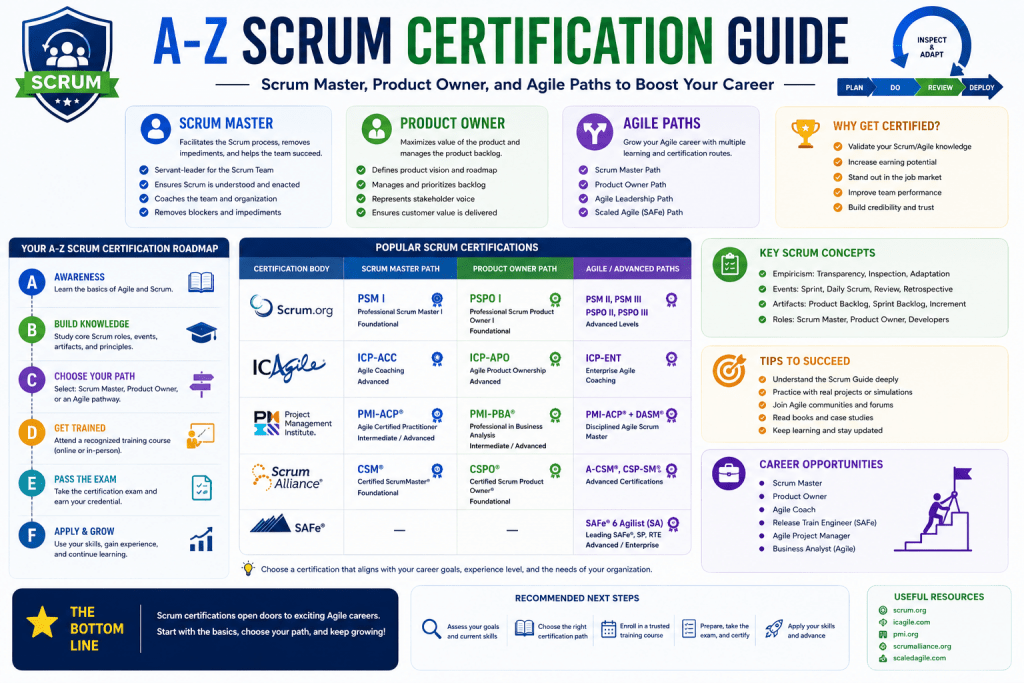
Scrum certification represents a formal validation of an individual’s ability to operate effectively within Agile project environments using the Scrum framework. It confirms both conceptual understanding and practical awareness of iterative development, team collaboration, and adaptive planning. In modern organizations, where digital transformation and rapid delivery cycles are standard, Scrum certification has become a key indicator of professional competence in Agile practices.
The demand for Scrum-certified professionals continues to grow across industries such as software development, IT services, finance, healthcare technology, and product engineering. Organizations rely on Scrum practitioners to streamline workflows, improve cross-functional collaboration, and deliver incremental value in shorter cycles. Certification acts as a signal that a professional understands structured Agile delivery methods and can contribute meaningfully to high-performing teams.
Scrum certification is not limited to theoretical knowledge. It validates applied understanding of roles, responsibilities, and frameworks that support Agile execution. Professionals who earn these credentials are often expected to demonstrate skills in backlog management, sprint planning, stakeholder communication, and continuous improvement cycles.
What is Scrum and How It Enables Agile Delivery Models
Scrum is an Agile framework designed to manage complex and evolving work through structured iterations known as sprints. Instead of following rigid long-term plans, Scrum enables teams to deliver work in smaller increments, allowing for continuous feedback and rapid adaptation.
At its core, Scrum is built on empirical process control theory, which emphasizes learning through experience, frequent inspection, and adaptation. This means decisions are based on real-world progress rather than fixed predictions. Scrum helps teams navigate uncertainty by breaking down large objectives into manageable tasks that can be reviewed and adjusted regularly.
Scrum is widely adopted in environments where requirements change frequently or are not fully defined at the start of a project. It is especially effective in product development scenarios where customer feedback plays a central role in shaping outcomes.
The framework is intentionally lightweight, focusing on essential elements that guide collaboration and delivery without introducing unnecessary complexity. It defines clear roles, structured events, and standardized artifacts to ensure alignment and transparency across teams.
Foundational Principles of the Scrum Framework
Scrum operates on a set of guiding principles that shape how teams collaborate and deliver value. These principles ensure consistency while allowing flexibility in execution.
Transparency is a core principle that ensures all aspects of work are visible to stakeholders and team members. This includes progress, challenges, and priorities. Transparency helps build trust and enables informed decision-making.
Inspection involves regularly reviewing progress and outputs to identify deviations or opportunities for improvement. Scrum incorporates frequent checkpoints where teams evaluate completed work and overall progress toward goals.
Adaptation ensures that teams can adjust their approach based on feedback and changing requirements. If issues are identified during inspection, teams modify their process or backlog to improve outcomes.
In addition to these pillars, Scrum encourages values such as commitment, focus, openness, respect, and courage. These values support effective collaboration and help teams maintain alignment even in complex and fast-changing environments.
Core Roles Within a Scrum Environment
Scrum defines three primary roles that form the structure of every Agile team. Each role has specific responsibilities that contribute to the overall success of the project.
The Product Owner is responsible for maximizing product value by managing the product backlog. This includes prioritizing tasks, defining requirements, and ensuring that the development team focuses on the most valuable work. The Product Owner acts as the communication bridge between stakeholders and the development team, ensuring that business needs are clearly understood and translated into actionable tasks.
The Scrum Master serves as a facilitator and process guide. Rather than managing the team in a traditional hierarchical manner, the Scrum Master ensures that Scrum practices are followed correctly and that the team remains productive. This role involves removing obstacles, supporting meetings, improving workflow efficiency, and guiding the team toward continuous improvement. The Scrum Master also plays a key role in helping organizations adopt Agile practices at scale.
The Development Team consists of professionals who execute the actual work required to deliver product increments. These individuals are cross-functional, meaning they collectively possess the skills needed to complete tasks without relying heavily on external input. They are also self-organizing, deciding internally how best to accomplish sprint goals. This structure promotes accountability, collaboration, and efficiency.
Scrum Events and Their Role in Structured Delivery
Scrum includes a set of structured events that provide rhythm and consistency to Agile workflows. These events ensure that teams remain aligned and continuously evaluate progress.
Sprint Planning is the starting point of each sprint. During this event, the team defines what work will be completed and how it will be achieved. It establishes a clear sprint goal and sets expectations for deliverables.
The Daily Scrum is a short, regular meeting where team members synchronize their activities and discuss progress. It helps identify obstacles early and ensures that everyone remains aligned with the sprint goal.
The Sprint Review takes place at the end of each sprint. During this event, the team presents completed work to stakeholders and gathers feedback. This ensures that the product evolves based on real input and changing requirements.
The Sprint Retrospective focuses on process improvement. The team reflects on what went well, what could be improved, and how workflows can be optimized in future sprints. This continuous improvement cycle is essential for long-term efficiency.
Backlog Refinement is an ongoing activity where items in the product backlog are reviewed and updated. This ensures that upcoming work is well-defined and ready for future sprints.
Scrum Artifacts and Their Functional Purpose
Scrum artifacts represent key work items that provide structure and transparency within the framework. They help track progress and ensure alignment between stakeholders and development teams.
The Product Backlog is a dynamic list of all desired work for the product. It is continuously updated and prioritized by the Product Owner based on business value and urgency.
The Sprint Backlog contains items selected for completion during a specific sprint. It represents the team’s immediate focus and serves as a working plan for the iteration.
The Increment is the sum of all completed backlog items during a sprint. It must meet predefined quality standards and be potentially releasable. The increment reflects tangible progress toward the final product.
The Definition of Done is a shared understanding of what it means for work to be considered complete. It ensures consistency in quality and prevents incomplete or unclear deliverables from being accepted as finished work.
Scrum Team Structure and Collaborative Dynamics
Scrum teams are designed to be small, flexible, and highly collaborative. Each team member contributes unique skills, but responsibility is shared collectively. This structure eliminates traditional silos and encourages direct communication between roles.
Cross-functionality ensures that teams have all the skills needed to complete work independently. This reduces dependencies on external teams and improves delivery speed.
Self-organization allows teams to decide how work will be completed without micromanagement. This autonomy increases accountability and encourages innovation in problem-solving.
Collaboration is continuous and structured through Scrum events and daily interactions. This constant communication ensures that issues are identified early and resolved quickly, improving overall efficiency.
Scrum Workflow and Iterative Development Cycle
The Scrum workflow follows a repeating cycle of planning, execution, review, and improvement. Each iteration, known as a sprint, produces a usable product increment.
The process begins with sprint planning, where goals and tasks are defined. The team then executes the work during the sprint while holding daily synchronization meetings. At the end of the sprint, the team presents completed work for review and gathers feedback. Finally, the retrospective phase allows the team to analyze performance and improve future cycles.
This iterative structure enables continuous delivery of value while maintaining flexibility to adapt to changing requirements. It reduces risk by breaking work into smaller segments and ensures consistent progress toward long-term objectives.
Importance of Scrum Certification in Professional Development
Scrum certification plays a critical role in validating an individual’s ability to work within Agile environments. It provides recognition of structured knowledge and practical understanding of Scrum principles.
Professionals with Scrum certification are often better positioned for roles that require Agile expertise, including project coordination, product management, and team facilitation. Certification also demonstrates commitment to continuous learning and professional growth in dynamic work environments.
Organizations value certified professionals because they reduce onboarding time, improve team alignment, and contribute to more predictable project outcomes. This makes Scrum certification a strategic advantage for career development in Agile-driven industries.
Overview of Scrum Certification Pathways in Agile Careers
Scrum certification pathways are designed to support professionals at different stages of their Agile career journey. These pathways typically begin with foundational certifications and progress toward advanced, role-specific, and leadership-focused credentials. The structure is intentionally tiered to ensure that individuals build conceptual understanding first before advancing into complex, real-world application scenarios.
At the entry level, certifications focus on core Scrum principles, terminology, and team roles. These are ideal for individuals transitioning into Agile environments or those seeking to understand how Scrum operates in practice. Mid-level certifications emphasize applied knowledge, including backlog management, sprint execution, and stakeholder communication. Advanced certifications focus on leadership, scaling Agile across organizations, and optimizing complex delivery systems.
Scrum certification pathways are not linear in all cases, but they generally follow a progression from foundational understanding to specialized expertise. This structure allows professionals to align certification choices with their career objectives, whether they aim to become Scrum Masters, Product Owners, Agile Coaches, or delivery leads.
Foundational Scrum Certifications and Entry-Level Learning Focus
Entry-level Scrum certifications are designed for individuals who are new to Agile methodologies or transitioning from traditional project management environments. These certifications focus on building a strong understanding of Scrum principles, roles, events, and artifacts.
At this stage, learners are introduced to the core structure of Scrum, including how teams collaborate, how work is planned in sprints, and how progress is continuously evaluated. The emphasis is on conceptual clarity rather than deep technical application.
Entry-level certifications typically require candidates to understand the Scrum framework thoroughly but do not always demand prior experience. This makes them accessible to a wide range of professionals, including business analysts, developers, testers, and project coordinators.
These certifications serve as a gateway into Agile careers by establishing foundational competence. They also prepare individuals for more advanced certifications by introducing essential terminology and workflows used in Scrum environments.
Scrum Master Certification Path and Role Expectations
The Scrum Master certification path is one of the most widely pursued routes in Agile careers. It focuses on developing facilitation, coaching, and process management skills required to support Scrum teams effectively.
A Scrum Master is responsible for ensuring that Scrum practices are correctly implemented within a team environment. This includes facilitating meetings, removing obstacles, and supporting continuous improvement. The role is not managerial in a traditional sense but rather serves as a servant-leader who enables team productivity.
Scrum Master certifications validate the ability to guide teams through Agile processes and ensure adherence to Scrum principles. These certifications often assess knowledge of sprint planning, daily stand-ups, sprint reviews, and retrospectives.
Professionals pursuing this path are typically expected to understand team dynamics, conflict resolution, and workflow optimization. The certification also emphasizes the importance of fostering collaboration and ensuring that teams remain focused on delivering value.
Scrum Master certifications are commonly chosen by individuals seeking roles in Agile project facilitation, team leadership, or process improvement.
Scrum Product Owner Certification Path and Strategic Focus
The Product Owner certification path focuses on product strategy, value delivery, and backlog management. It is designed for professionals responsible for defining product direction and ensuring that development efforts align with business objectives.
A Product Owner plays a critical role in maximizing product value by prioritizing work items and ensuring that teams focus on the most important features. This requires a deep understanding of customer needs, market trends, and organizational goals.
Certification in this area validates the ability to manage product backlogs effectively, define user stories, and communicate requirements clearly to development teams. It also demonstrates competence in decision-making and prioritization under changing conditions.
Unlike technical roles, the Product Owner certification path emphasizes business alignment and stakeholder engagement. It is particularly relevant for product managers, business analysts, and professionals involved in digital product development.
The certification ensures that individuals can balance technical constraints with business priorities while maintaining a clear product vision.
Advanced Scrum Certifications and Leadership Development
Advanced Scrum certifications are designed for experienced professionals who already have practical exposure to Agile environments. These certifications focus on deepening expertise and preparing individuals for leadership roles in complex organizational settings.
At this level, certification assessments often evaluate real-world application of Scrum principles rather than basic theoretical knowledge. Candidates are expected to demonstrate advanced understanding of scaling Agile practices, managing multiple teams, and driving organizational change.
Advanced certifications may include multi-team coordination, enterprise-level Agile transformation, and strategic product leadership. These credentials are typically pursued by senior Scrum Masters, experienced Product Owners, and Agile Coaches.
The primary objective of advanced certifications is to develop leadership capabilities that extend beyond individual teams. This includes influencing organizational culture, optimizing delivery pipelines, and improving cross-functional collaboration at scale.
Professionals with advanced Scrum certifications are often involved in mentoring, coaching, and guiding Agile adoption across departments or entire organizations.
Scrum Certification Exam Structure and Evaluation Approach
Scrum certification exams are structured to assess both conceptual understanding and practical application of Agile principles. The format typically includes scenario-based questions, knowledge-based assessments, and situational problem-solving exercises.
Most entry-level exams focus on foundational knowledge, including Scrum roles, events, and artifacts. Candidates are expected to demonstrate clear understanding of how Scrum operates in real-world scenarios.
Mid-level and advanced exams often include more complex questions that evaluate decision-making, prioritization, and team facilitation skills. These assessments may present real-world Agile challenges and require candidates to select the most appropriate course of action.
Exam structures are designed to ensure that certified professionals can apply Scrum principles effectively in practical environments. This helps maintain consistency and quality across Agile teams globally.
Time constraints and passing criteria vary depending on the certification level, but the overall objective remains consistent: to validate both knowledge and applied understanding of Scrum practices.
Cost Structure of Scrum Certifications and Financial Considerations
The cost of Scrum certification varies significantly depending on the certifying organization, certification level, and whether training is included. Entry-level certifications are generally more affordable, while advanced certifications and structured training programs involve higher investment.
Basic certification exams typically involve a one-time fee, while more comprehensive certification paths may include training courses, workshops, and study materials. Some certification models allow self-study and only require payment for the examination, while others bundle training and assessment together.
Recurring costs may also apply in certain certification frameworks where renewal is required. This can include continuing education requirements, membership fees, or periodic re-examination to maintain certification validity.
Financial planning for Scrum certification should consider both initial costs and long-term maintenance requirements. In addition to exam fees, candidates may also invest in practice tests, training resources, and professional development programs.
Despite these costs, Scrum certification is often viewed as a high-value investment due to its potential impact on career growth, job opportunities, and earning potential.
Factors Influencing Certification Costs Across Different Levels
Several factors influence the overall cost of Scrum certification. The most significant factor is the certification level, as advanced certifications generally require more extensive assessment and preparation.
Another factor is the delivery model of training. Self-paced learning paths tend to be more cost-effective, while instructor-led training programs typically involve higher fees due to structured guidance and classroom interaction.
Geographic location can also influence cost structures, particularly when in-person training or region-specific certification providers are involved. However, many modern certification pathways are globally standardized, reducing regional cost differences.
Additional costs may include retake fees, study materials, and optional coaching sessions. These supplementary expenses can vary depending on the candidate’s preparation approach and learning preferences.
Overall, certification cost should be evaluated in relation to long-term career benefits rather than as a standalone expense.
Training Approaches for Scrum Certification Preparation
Effective preparation for Scrum certification requires a structured learning approach that combines theoretical study with practical exposure. Candidates are encouraged to understand not only the Scrum framework but also how it is applied in real-world environments.
A strong foundation begins with studying core Scrum concepts, including roles, events, artifacts, and Agile principles. This theoretical understanding forms the basis for more advanced application-based learning.
Practical experience is equally important. Working within Agile teams or simulated environments helps candidates understand how Scrum operates in dynamic settings. This includes exposure to sprint planning, backlog refinement, and team collaboration practices.
Many professionals also use practice assessments to evaluate readiness. These help identify knowledge gaps and improve familiarity with exam-style questions.
Continuous learning plays a key role in preparation. Agile methodologies evolve over time, and staying updated with best practices ensures better performance in both certification exams and real-world applications.
Role of Real-World Experience in Scrum Certification Success
Real-world experience significantly enhances success in Scrum certification pathways. While theoretical knowledge provides the foundation, practical exposure helps bridge the gap between concept and execution.
Professionals who have participated in Agile projects are better equipped to understand scenario-based exam questions and apply Scrum principles effectively. Experience in team collaboration, sprint execution, and backlog management contributes to stronger conceptual clarity.
Working in Agile environments also helps develop soft skills such as communication, problem-solving, and adaptability. These skills are essential for roles such as Scrum Master and Product Owner, where interaction with teams and stakeholders is constant.
Real-world exposure reinforces learning by allowing professionals to observe how Scrum principles function in dynamic, often unpredictable environments.
Importance of Continuous Learning in Scrum Career Development
Scrum certification is not a one-time achievement but part of an ongoing professional development journey. Continuous learning ensures that professionals remain relevant in evolving Agile environments.
Agile methodologies are constantly refined to improve efficiency and adaptability. Staying updated with these changes helps certified professionals maintain effectiveness in their roles.
Continuous learning can include participation in Agile projects, advanced certification pathways, peer collaboration, and structured training programs. It also involves reflecting on practical experiences and applying lessons learned to future projects.
This ongoing development strengthens both technical understanding and leadership capabilities, enabling professionals to take on more complex responsibilities within Agile organizations.
Career Impact of Scrum Certification in Agile-Driven Industries
Scrum certification has a significant impact on career trajectories in modern Agile-driven industries. It serves as a structured validation of a professional’s ability to work within iterative, collaborative, and value-focused environments. As organizations continue to adopt Agile frameworks at scale, the demand for certified Scrum practitioners has increased across technology, finance, healthcare, telecommunications, and product development sectors.
The certification signals that an individual understands how to operate within structured Agile workflows, manage evolving requirements, and contribute effectively to cross-functional teams. This makes certified professionals more attractive to employers seeking candidates who can integrate quickly into Agile delivery environments without extensive onboarding.
Scrum certification also acts as a differentiator in competitive job markets. When multiple candidates possess similar technical skills, certification often becomes the deciding factor in hiring decisions. It demonstrates not only knowledge but also commitment to professional development and structured learning.
Beyond hiring advantages, Scrum certification influences long-term career progression. Professionals often transition into higher-responsibility roles such as Agile Coach, Program Manager, Product Lead, or Delivery Manager after gaining experience and additional certifications.
Scrum Certification and Its Influence on Salary Growth
One of the most notable benefits of Scrum certification is its positive impact on earning potential. Certified professionals typically command higher salaries compared to non-certified peers due to their validated expertise in Agile methodologies and team-based delivery systems.
Scrum Masters, for example, often fall within mid-to-high salary brackets depending on experience, industry, and geographic location. Entry-level Scrum Masters generally earn competitive salaries, while experienced professionals in senior roles or enterprise environments can earn significantly higher compensation.
Product Owners also experience strong salary growth, particularly when they are responsible for managing large product portfolios or strategic digital initiatives. Their ability to align product development with business objectives adds substantial value to organizations, which is reflected in compensation structures.
Advanced roles such as Agile Coaches and Enterprise Scrum practitioners tend to earn premium salaries due to their involvement in organizational transformation and multi-team coordination. These roles require deep expertise and are often reserved for professionals with extensive Scrum experience and multiple certifications.
In addition to base salaries, many organizations offer performance-based bonuses, project incentives, and equity options. These additional components can significantly increase total compensation for Scrum-certified professionals.
Scrum Master Career Path and Professional Responsibilities
The Scrum Master career path focuses on facilitating Agile team performance and ensuring effective implementation of Scrum principles. This role evolves significantly with experience, transitioning from team-level facilitation to organizational-level coaching.
At the entry level, Scrum Masters primarily focus on supporting one or two teams. Responsibilities include facilitating daily stand-ups, ensuring sprint goals are met, removing workflow obstacles, and promoting Agile best practices.
As professionals gain experience, their responsibilities expand to include coaching multiple teams, optimizing Agile processes, and supporting organizational adoption of Scrum frameworks. This requires a deeper understanding of team dynamics, conflict resolution, and process improvement methodologies.
At senior levels, Scrum Masters often transition into Agile Coaching or Transformation Leadership roles. These positions involve guiding entire departments or organizations through Agile adoption, aligning teams with strategic objectives, and improving overall delivery efficiency.
The Scrum Master career path emphasizes continuous improvement, communication skills, and leadership development. It is one of the most versatile roles within Agile environments due to its focus on facilitation rather than technical execution.
Product Owner Career Path and Strategic Influence
The Product Owner career path is centered around product strategy, value delivery, and stakeholder alignment. This role plays a critical part in determining what is built, why it is built, and how it aligns with business goals.
At the entry level, Product Owners focus on managing product backlogs, writing user stories, and working closely with development teams to ensure clarity in requirements. They also engage with stakeholders to gather business needs and translate them into actionable tasks.
As professionals progress, their responsibilities expand into product strategy development, market analysis, and prioritization of complex feature sets. They begin to influence product direction based on customer insights, competitive analysis, and organizational objectives.
Senior Product Owners often operate at a strategic level, managing entire product lines or digital ecosystems. They collaborate with executive leadership to define long-term product vision and ensure alignment with business growth strategies.
The Product Owner role is highly influential because it directly impacts product success, customer satisfaction, and revenue generation. It requires a combination of analytical thinking, communication skills, and business acumen.
Agile Coach and Enterprise-Level Scrum Roles
Beyond Scrum Master and Product Owner roles, advanced Agile career paths include positions such as Agile Coach and Enterprise Scrum Practitioner. These roles focus on scaling Agile practices across large organizations.
An Agile Coach works with multiple teams and departments to improve Agile maturity. This includes mentoring Scrum Masters, supporting leadership teams, and designing frameworks that enhance collaboration and efficiency.
Enterprise Scrum roles involve managing Agile transformation at an organizational level. Professionals in these roles ensure that Scrum practices are aligned with business strategy, operational goals, and cultural transformation initiatives.
These advanced roles require extensive experience in Agile environments, deep understanding of Scrum principles, and strong leadership capabilities. Professionals in these positions often influence organizational structure, decision-making processes, and long-term strategic planning.
Industry Demand for Scrum-Certified Professionals
The demand for Scrum-certified professionals continues to grow across global industries. Organizations are increasingly adopting Agile methodologies to improve efficiency, reduce time-to-market, and enhance product quality.
In the technology sector, Scrum is widely used in software development, mobile application design, cloud services, and system architecture. Teams rely on Scrum frameworks to manage complex development cycles and deliver continuous updates.
In financial services, Scrum is used to support digital transformation initiatives, improve customer experience platforms, and develop secure, scalable systems. Agile teams help financial institutions respond quickly to regulatory changes and market demands.
Healthcare organizations also use Scrum to manage digital health platforms, patient management systems, and data-driven applications. The iterative nature of Scrum allows for rapid adaptation to evolving healthcare needs.
Other industries, including retail, manufacturing, and telecommunications, have also adopted Scrum to improve operational efficiency and accelerate innovation.
This widespread adoption has created a consistent demand for professionals who understand Agile principles and can apply them effectively in diverse environments.
Scrum Certification and Leadership Development
Scrum certification contributes significantly to leadership development by enhancing communication, decision-making, and team management skills. Agile leadership is fundamentally different from traditional hierarchical leadership, as it emphasizes collaboration, adaptability, and servant leadership principles.
Scrum-certified professionals often develop strong facilitation skills, enabling them to guide teams through complex challenges and maintain focus on shared objectives. They also learn to manage stakeholder expectations effectively, ensuring alignment between business goals and technical execution.
Leadership in Agile environments requires the ability to balance structure with flexibility. Scrum certification helps professionals develop this balance by providing frameworks for managing uncertainty while maintaining productivity.
As professionals advance in their careers, they often take on leadership responsibilities that involve mentoring teams, guiding organizational change, and improving delivery performance.
Long-Term Career Growth Through Scrum Expertise
Scrum expertise provides a strong foundation for long-term career growth in Agile and project management domains. Professionals who continue to build on their certification through experience and advanced learning often move into senior strategic roles.
Career progression typically follows a path from team-level roles to leadership positions, with increasing responsibility for strategic decision-making and organizational impact. Scrum-certified professionals often transition into roles such as Program Manager, Delivery Director, or Agile Transformation Lead.
Long-term growth is also supported by continuous learning and adaptation to evolving Agile practices. Professionals who stay updated with industry trends and emerging frameworks maintain a competitive advantage in the job market.
Scrum expertise also enables cross-functional mobility, allowing professionals to move between industries while maintaining relevance due to the universal nature of Agile principles.
Advanced Applications of Scrum in Large-Scale Organizations
In large-scale organizations, Scrum is often extended beyond individual teams to coordinate multiple Agile teams working on interconnected projects. This requires advanced coordination, alignment, and governance structures.
Scaled Scrum implementations involve synchronizing multiple teams, managing shared backlogs, and ensuring consistent delivery across departments. This level of complexity requires experienced Scrum practitioners who understand both team-level execution and organizational alignment.
Advanced Scrum applications also include integration with other Agile frameworks, allowing organizations to create hybrid models that suit their operational needs. These models help balance flexibility with structure while maintaining delivery efficiency.
Enterprise-level Scrum usage emphasizes strategic alignment, ensuring that all teams contribute to broader organizational objectives while maintaining autonomy at the team level.
Continuous Improvement and Professional Development in Scrum Careers
Continuous improvement is a core principle of Scrum and plays a critical role in professional development. Scrum-certified individuals are expected to continuously evaluate their performance, identify improvement opportunities, and adapt their practices accordingly.
Professional development in Scrum involves gaining experience, pursuing advanced certifications, and participating in Agile communities. It also includes learning from real-world project challenges and applying insights to future work.
Continuous improvement ensures that Scrum practitioners remain effective in dynamic environments where requirements, technologies, and business priorities are constantly evolving.
This mindset of ongoing learning and adaptation is one of the key reasons Scrum certification remains highly valuable in long-term career development.
Conclusion
Scrum certification has established itself as a significant professional benchmark in modern Agile-driven industries, shaping how individuals enter, grow, and advance within project management and product development careers. Across all levels of experience, from entry-level practitioners to senior Agile leaders, Scrum credentials provide a structured pathway for understanding how complex work can be delivered in iterative, collaborative, and value-focused ways. The framework’s emphasis on adaptability, transparency, and continuous improvement aligns closely with how organizations now operate in fast-changing business and technology environments.
One of the most important outcomes of Scrum certification is the clarity it brings to professional roles and responsibilities. In traditional project environments, responsibilities are often hierarchical and rigid, which can slow decision-making and reduce flexibility. Scrum, by contrast, distributes accountability across clearly defined roles such as Scrum Master, Product Owner, and Development Team members. Certification ensures that professionals understand not only their own responsibilities but also how those roles interact to deliver consistent value. This shared understanding reduces friction within teams and improves coordination, which directly contributes to better project outcomes.
Another key impact of Scrum certification is its ability to bridge the gap between theoretical knowledge and real-world application. Many professionals are familiar with general project management concepts, but Scrum introduces a more dynamic approach that requires continuous learning and adaptation. Certification programs reinforce this by focusing on practical scenarios, Agile principles, and structured workflows such as sprint planning, backlog refinement, and iterative delivery cycles. As a result, certified professionals are better equipped to handle uncertainty, manage changing requirements, and maintain productivity in complex environments.
From a career development perspective, Scrum certification plays a transformative role. It not only enhances employability but also significantly influences career progression. Organizations actively seek individuals who can contribute to Agile teams from day one, and certification provides evidence of readiness. This is particularly important in competitive job markets where technical skills alone may not be enough to differentiate candidates. Certified professionals often find themselves considered for roles with greater responsibility, including team leadership, product ownership, and Agile coaching positions.
Salary growth is another major factor associated with Scrum certification. Because Agile methodologies are widely adopted across industries, organizations place high value on professionals who can effectively implement and manage Scrum practices. This demand translates into competitive compensation packages, especially for experienced Scrum Masters and Product Owners. In many cases, certification acts as a catalyst for salary negotiation, promotions, and access to higher-level opportunities. When combined with practical experience, Scrum expertise becomes a strong driver of long-term financial growth.
Beyond individual benefits, Scrum certification also contributes to organizational performance. Teams led by certified professionals tend to be more structured, better aligned, and more efficient in delivering outcomes. The framework encourages frequent feedback loops, continuous improvement, and transparent communication, all of which enhance productivity. Organizations benefit from reduced project risk, improved delivery timelines, and better alignment between business goals and technical execution. This is why many companies integrate Scrum certification into their hiring and training strategies.
Another important dimension of Scrum certification is its role in fostering leadership development. Unlike traditional management models, Scrum leadership emphasizes facilitation rather than control. Scrum Masters and Agile leaders are expected to guide teams, remove obstacles, and create environments where collaboration can thrive. This requires strong communication skills, emotional intelligence, and the ability to influence without authority. Certification helps develop these capabilities by exposing professionals to structured Agile practices and real-world problem-solving scenarios.
As professionals advance in their careers, Scrum certification continues to provide value through its scalability and adaptability. Whether working in small teams or large enterprise environments, the principles of Scrum remain applicable. In larger organizations, Scrum practices are often extended across multiple teams and departments, requiring advanced coordination and strategic alignment. Certified professionals are better prepared to operate in these scaled environments because they understand both the foundational principles and the broader implications of Agile transformation.
Continuous learning is another essential aspect of Scrum career development. The Agile landscape evolves constantly, influenced by new technologies, market demands, and organizational structures. Scrum certification encourages professionals to stay engaged with these changes through ongoing practice, experience, and advanced training. This commitment to learning ensures that certified individuals remain relevant and effective throughout their careers. It also supports long-term adaptability, which is increasingly important in industries characterized by rapid innovation.
Scrum certification also enhances professional confidence. By mastering structured frameworks and understanding how to apply them in real-world situations, individuals gain a clearer sense of direction in their roles. This confidence translates into better decision-making, improved team collaboration, and stronger leadership presence. It also enables professionals to take on more complex responsibilities without hesitation, further accelerating career growth.
In addition to technical and leadership benefits, Scrum certification also improves communication and collaboration skills. Agile environments depend heavily on effective interaction between team members, stakeholders, and leadership. Certified professionals learn how to communicate requirements clearly, manage expectations, and facilitate productive discussions. These soft skills are essential not only for Scrum roles but also for broader career success in any collaborative work environment.
Ultimately, Scrum certification represents more than just a credential. It reflects a professional mindset centered around adaptability, continuous improvement, and value-driven delivery. It equips individuals with the tools needed to navigate complex projects, lead teams effectively, and contribute meaningfully to organizational success. As industries continue to evolve toward Agile methodologies, the relevance and importance of Scrum certification are likely to grow even further, making it a foundational element in modern career development pathways.