
A virtual private network is a secure communication framework designed to extend a private network across a public infrastructure such as the internet. It creates an encrypted communication channel between a user device and a network gateway, ensuring that data transmitted between them remains protected from unauthorized access. The primary purpose of this system is to allow remote users to interact with internal resources as if they were physically connected to a local network environment. This is achieved through tunneling protocols that encapsulate data packets and encryption mechanisms that protect confidentiality, integrity, and authenticity of transmitted information. In practical deployment, a VPN establishes a logical extension of a private network, allowing geographically dispersed users to function within a unified network space. This abstraction is essential in modern enterprise environments where distributed workforces require secure and consistent access to internal systems regardless of physical location. The encryption layer ensures that even if traffic traverses untrusted networks, it remains unreadable without proper decryption keys. Authentication mechanisms validate user identity before granting access, while integrity checks ensure that data remains unaltered during transit. Together, these elements form the foundational security model of VPN technology.
Core Principles of Network Tunneling Mechanisms
Tunneling is the underlying process that enables VPN functionality. It involves encapsulating one network protocol within another, allowing data to be transmitted securely across incompatible or untrusted networks. In a VPN context, original data packets are wrapped inside encrypted packets before being transmitted through the public internet. Once these packets reach the destination gateway, they are decrypted and forwarded to their intended internal network destination. This encapsulation process creates a virtual tunnel through which secure communication can occur. The tunnel itself is not a physical connection but a logical construct defined by encryption protocols and routing rules. The purpose of tunneling is to isolate sensitive traffic from external exposure while maintaining seamless connectivity between remote users and internal systems. Without tunneling, data transmitted over public networks would be vulnerable to interception and manipulation. The tunnel ensures that only authorized endpoints can access the transmitted information, preserving confidentiality and operational security.
Full Tunnel VPN Behavior and Traffic Centralization
In a full tunnel configuration, all network traffic generated by a user device is routed through the VPN gateway regardless of its destination. This means that both internal and external traffic is encrypted and sent through the secure tunnel before being forwarded to its final destination. The VPN gateway acts as a central routing point for all communication, enforcing security policies and managing data flow. While this approach provides comprehensive protection, it also introduces significant performance overhead. Every request, whether destined for internal servers or external internet resources, must traverse the encryption and decryption process. This increases latency and places additional processing demands on the VPN infrastructure. The centralized nature of full tunneling also creates potential scalability challenges in environments with large numbers of concurrent users. As traffic volume increases, the VPN gateway must handle a proportional increase in encryption workload, which can lead to bottlenecks. Despite these limitations, full tunneling remains widely used in high-security environments where maximum control over data flow is required.
Introduction to Split Tunneling as a Traffic Optimization Model
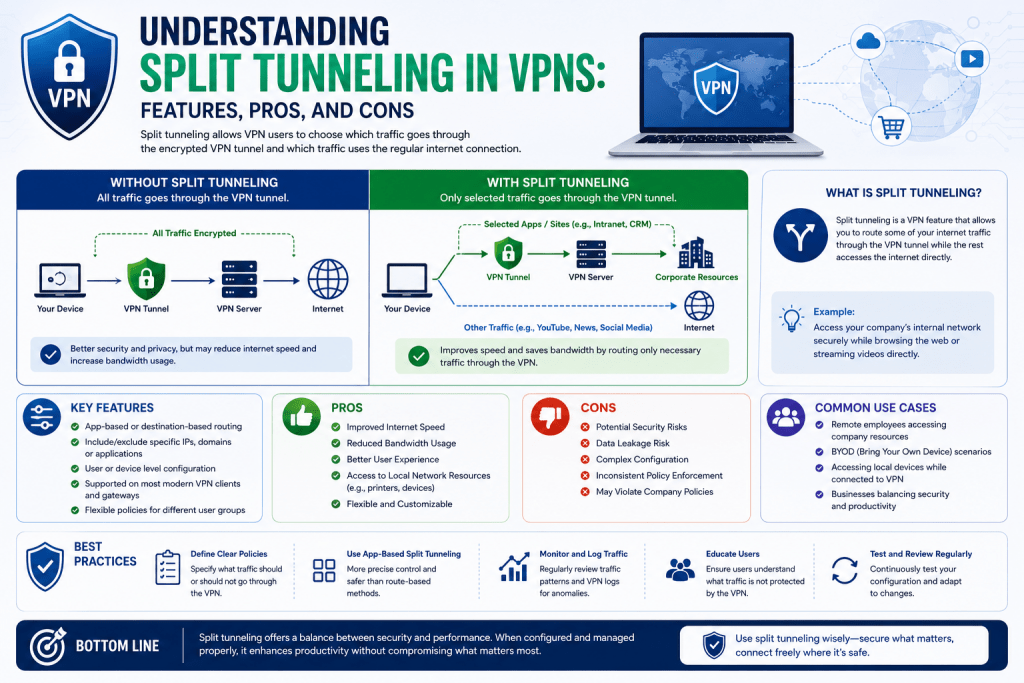
Split tunneling introduces a more flexible approach to VPN traffic management by dividing network traffic into two distinct paths. One path is routed through the encrypted VPN tunnel, while the other bypasses the tunnel and accesses external networks directly. This division is based on predefined routing policies that classify traffic according to destination networks or application types. Internal traffic destined for private corporate resources is directed through the VPN tunnel, ensuring secure access. External traffic, such as requests to public websites or cloud-based services, is allowed to bypass the tunnel and use the local internet connection. This selective routing model reduces unnecessary load on VPN infrastructure and improves performance for non-sensitive traffic. It also allows users to maintain simultaneous access to internal and external resources without forcing all communication through a centralized security gateway. The concept of split tunneling is fundamentally based on traffic intelligence, where routing decisions are made dynamically based on destination analysis.
Traffic Classification and Routing Decision Processes
The effectiveness of split tunneling depends on accurate classification of network traffic. When a user device generates a data packet, the destination address is evaluated against a set of predefined rules. These rules determine whether the packet should be encrypted and sent through the VPN tunnel or transmitted directly through the local network interface. Internal network ranges, such as private IP address blocks, are typically included in the tunneling rules. Any traffic matching these ranges is encapsulated and routed through the VPN gateway. Conversely, traffic that does not match internal definitions is considered external and is routed directly to the internet. This decision-making process is implemented at the operating system level or within the VPN client software, depending on the network architecture. Routing tables are dynamically updated when a VPN session is established, ensuring that traffic flows adhere to the configured policy. This mechanism allows for precise control over how different types of traffic are handled without requiring manual intervention during each communication session.
Role of VPN Gateways in Policy Enforcement
VPN gateways serve as central enforcement points for split tunneling policies. When a user establishes a connection, the gateway authenticates the session and assigns a policy profile that defines routing behavior. This profile contains information about which networks must be tunneled and which are exempt. The gateway communicates these instructions to the client device during session initialization. Once received, the client applies these rules to its local routing table, determining how outgoing traffic is handled. The gateway also maintains visibility into active sessions, allowing administrators to monitor traffic distribution and policy compliance. In enterprise environments, these gateways are often responsible for managing multiple concurrent connections, each with different routing requirements based on user roles or departmental policies. This centralized policy management ensures consistency across the network while allowing flexibility in traffic handling. The gateway essentially acts as the control plane for VPN operations, defining the rules that govern data flow between internal and external networks.
Enterprise Network Requirements Driving Split Tunneling Adoption
Modern enterprise networks often support a wide range of applications and services that require different levels of security and performance. Internal systems such as databases, file servers, and authentication services require secure access through encrypted tunnels. At the same time, users frequently need access to external resources such as cloud applications, communication platforms, and public websites. Routing all traffic through a VPN can create inefficiencies in such environments due to increased latency and bandwidth consumption. Split tunneling addresses this challenge by allowing organizations to optimize traffic flow based on functional requirements. Internal traffic remains protected within the VPN tunnel, while external traffic is routed directly to the internet, reducing load on central infrastructure. This approach is particularly beneficial in large-scale deployments where hundreds or thousands of users connect simultaneously from remote locations. It enables organizations to maintain security for sensitive data while improving overall network performance and scalability.
Network Segmentation and Security Boundary Definition
Effective split tunneling requires clear segmentation between internal and external network boundaries. Internal networks are defined using specific IP ranges or subnet configurations that are recognized by the VPN system. These definitions allow the routing mechanism to distinguish between protected resources and public destinations. Security boundaries are established through policy configuration, ensuring that only authorized traffic is permitted to traverse the VPN tunnel. This segmentation is critical in preventing accidental exposure of sensitive resources. If internal networks are not properly defined, routing errors may occur, leading to potential security risks or connectivity failures. Proper segmentation also enables granular control over access permissions, allowing organizations to define which resources are accessible through the VPN and which remain restricted. This structured approach ensures that split tunneling operates within clearly defined security parameters while maintaining operational efficiency.
Performance Implications of Selective Traffic Routing
One of the primary advantages of split tunneling is improved network performance. By reducing the volume of traffic processed by the VPN gateway, system resources are utilized more efficiently. Encryption and decryption processes consume significant computational power, and limiting these operations to internal traffic reduces overall system load. Additionally, bypassing the VPN for external traffic eliminates unnecessary routing hops, resulting in lower latency and faster response times for internet-based applications. This optimization is particularly important in environments where users frequently access bandwidth-intensive services. However, performance improvements must be balanced with security considerations, as bypassed traffic does not benefit from VPN encryption. Organizations must therefore carefully evaluate which traffic types are suitable for direct routing and which require secure tunneling.
Security Trade-offs in Split Tunneling Architectures
While split tunneling improves efficiency, it introduces certain security trade-offs that must be carefully managed. Traffic that bypasses the VPN tunnel is not protected by enterprise security controls, making it more susceptible to external threats such as interception or manipulation. This creates potential exposure points in the network architecture. To mitigate these risks, organizations typically implement endpoint security measures such as host-based firewalls, intrusion detection systems, and secure configuration policies. Sensitive applications and data flows are restricted to tunnel-only access to ensure they remain within protected environments. Security policies must clearly define acceptable use cases for split tunneling to prevent unauthorized exposure of critical systems. Continuous monitoring and policy enforcement are essential to maintaining a secure operational environment.
Dynamic Traffic Routing in Split Tunneling Environments
Split tunneling operates through dynamic traffic routing mechanisms that determine the path each data packet takes based on predefined policy rules. Once a VPN connection is established, the client device receives routing instructions that modify its local routing table. These instructions define which network destinations must be sent through the encrypted tunnel and which can bypass it. The routing decision is executed in real time for every outbound packet generated by the device. When a packet is created, the operating system evaluates the destination IP address against the installed routing rules. If the destination matches a defined internal network range, the packet is encapsulated and forwarded through the VPN tunnel. If the destination falls outside these defined ranges, it is transmitted through the default network gateway using the standard internet connection. This dual-path routing model enables simultaneous secure and non-secure communication without requiring manual user intervention. The process is transparent to the end user but heavily dependent on correct policy configuration at the VPN gateway.
Client-Side Routing Table Adjustments and Policy Application
When a VPN session is initiated, the client device modifies its routing table to incorporate VPN-specific routes. These routes take precedence over default network routes for specified destination networks. For example, internal corporate subnets are assigned explicit routes that direct traffic into the VPN interface. These entries override the default gateway, ensuring that internal traffic is always encrypted and securely transmitted. External traffic, however, remains unaffected by these changes and continues to follow the local network’s default routing path. The routing table becomes a hybrid structure containing both secure and non-secure pathways. This configuration is temporary and persists only for the duration of the VPN session. Once the connection is terminated, the routing table reverts to its original state. This dynamic modification of routing behavior is central to the functionality of split tunneling and allows seamless integration with existing network configurations without permanent system changes.
VPN Gateway Role in Traffic Policy Distribution
The VPN gateway acts as the central authority responsible for defining and distributing split tunneling policies. When a user authenticates, the gateway assigns a group policy based on user identity, role, or organizational affiliation. This policy contains routing definitions that specify which network ranges must be tunneled. The gateway communicates these rules to the client during the handshake phase of the VPN connection. This ensures that both endpoints share a consistent understanding of traffic handling behavior. The gateway also enforces access control rules that determine which internal resources are accessible through the tunnel. In enterprise environments, multiple policies may exist to accommodate different departments or security levels. For example, administrative users may be granted access to a broader range of internal networks compared to standard users. The gateway continuously monitors active sessions and can update or revoke policies as needed to maintain security compliance.
Policy-Based Routing Logic and Decision Frameworks
Split tunneling relies on policy-based routing logic that evaluates traffic against a set of predefined conditions. These conditions typically include destination IP ranges, network subnets, or application-level identifiers. The routing decision is made at the moment a packet is generated, ensuring that each communication flow is handled according to its classification. Internal traffic is prioritized for secure tunneling to maintain confidentiality and integrity. External traffic is excluded from the tunnel to optimize performance and reduce unnecessary encryption overhead. This decision framework is hierarchical in nature, meaning that more specific rules take precedence over general ones. For example, a rule defining a specific internal subnet will override broader routing rules that apply to all traffic. This hierarchical structure allows for granular control over network behavior and ensures predictable routing outcomes.
Enterprise Deployment Models for Split Tunneling
Organizations implement split tunneling in various deployment models depending on security requirements and operational needs. In centralized models, all policy decisions are managed through a single VPN gateway, which distributes routing rules to all connected clients. This approach provides consistent policy enforcement and simplifies management. In distributed models, multiple gateways may exist across different regions or departments, each with its own set of routing policies. This allows for localized optimization of traffic flows and reduces latency for geographically dispersed users. Hybrid models combine elements of both approaches, enabling centralized policy control while allowing regional customization. Regardless of the model used, the core principle remains the same: internal traffic is routed securely through the VPN, while external traffic is allowed to bypass the tunnel. The choice of deployment model depends on factors such as organizational size, network complexity, and security requirements.
Bandwidth Optimization and Infrastructure Efficiency Gains
One of the primary operational benefits of split tunneling is improved bandwidth utilization across VPN infrastructure. In full tunneling environments, all user traffic must pass through centralized VPN gateways, resulting in high bandwidth consumption and increased processing demands. Split tunneling reduces this burden by allowing non-essential traffic to bypass the VPN entirely. This significantly decreases the volume of data processed by encryption engines, freeing up resources for critical internal traffic. As a result, organizations can support a larger number of concurrent users without requiring proportional increases in infrastructure capacity. This optimization is particularly valuable in large-scale remote access environments where users frequently access both internal and external services. By reducing unnecessary traffic load, split tunneling improves overall network efficiency and reduces operational costs associated with scaling VPN infrastructure.
Latency Reduction and User Experience Improvements
Latency is a critical performance metric in network communications, and split tunneling has a direct impact on reducing latency for external traffic. In full tunnel configurations, all traffic must travel through the VPN gateway before reaching its final destination, introducing additional hops and processing delays. Split tunneling eliminates this requirement for external traffic, allowing it to reach its destination directly through the local internet connection. This reduces round-trip time and improves responsiveness for web-based applications, cloud services, and streaming platforms. The improved latency experience enhances user productivity, particularly in environments where real-time communication or data access is required. Internal traffic continues to experience secure routing through the VPN tunnel, ensuring that security is not compromised for sensitive operations. The dual-path model balances performance and security by optimizing routing paths based on traffic classification.
Scalability Considerations in Large Enterprise Networks
Scalability is a major consideration in enterprise network design, particularly when supporting large numbers of remote users. Full tunneling architectures often face scalability limitations due to the centralized processing requirements of VPN gateways. As user numbers increase, the demand on encryption resources and bandwidth grows proportionally. Split tunneling addresses these limitations by distributing traffic load more efficiently. Since only internal traffic is routed through the VPN, the volume of data handled by central infrastructure is significantly reduced. This allows organizations to scale their remote access capabilities without proportionally increasing hardware investment. Additionally, split tunneling reduces congestion at network choke points, improving overall system stability. In highly distributed environments, this scalability advantage becomes a critical factor in maintaining consistent network performance across global user bases.
Security Policy Enforcement in Split Traffic Environments
Security enforcement in split tunneling environments requires careful policy design to ensure that sensitive data remains protected. Internal traffic is strictly controlled through VPN encryption and access policies, while external traffic is subject to endpoint security controls. Organizations typically implement layered security models that include firewall rules, endpoint protection software, and intrusion detection systems. These controls help mitigate risks associated with bypassed traffic. Policy enforcement is often tied to user identity and role-based access control systems, ensuring that only authorized users can access specific internal resources. The VPN gateway plays a central role in enforcing these policies by controlling which routes are distributed to clients. Continuous monitoring and logging are also essential components of security enforcement, allowing administrators to detect anomalies or unauthorized traffic patterns in real time.
Session Management and Connection Monitoring Techniques
VPN gateways maintain detailed session information for all connected users, including routing configurations, assigned policies, and traffic statistics. This session data is used to monitor the behavior of split tunneling configurations and ensure compliance with organizational policies. Administrators can view active connections to determine which users are connected, what routes are in effect, and how traffic is being distributed between tunneled and non-tunneled paths. This visibility is critical for troubleshooting connectivity issues and verifying that split tunneling policies are functioning as intended. Session monitoring also enables proactive detection of misconfigurations or security anomalies. In addition, historical session data can be analyzed to identify trends in network usage and optimize policy definitions over time.
Operational Challenges in Split Tunneling Environments
Despite its advantages, split tunneling introduces operational challenges that must be carefully managed. One of the primary challenges is ensuring consistent security enforcement across both tunneled and non-tunneled traffic. Since external traffic bypasses centralized security infrastructure, organizations must rely on endpoint security mechanisms to maintain protection. Another challenge is policy complexity, as administrators must define precise routing rules to avoid conflicts or unintended exposure of internal resources. Misconfigured policies can result in traffic leaks or access issues. Additionally, troubleshooting network issues becomes more complex in split tunneling environments because traffic flows follow multiple paths. Network administrators must analyze both VPN and non-VPN traffic paths to identify and resolve connectivity problems. These challenges require robust network design and ongoing policy management to ensure stable operation.
Integration with Modern Network Architectures
Split tunneling is increasingly integrated into modern network architectures that emphasize flexibility and distributed access. In cloud-centric environments, split tunneling allows direct access to cloud services without routing traffic through corporate data centers. This reduces latency and improves application performance. In hybrid environments, it supports seamless interaction between on-premises infrastructure and external services. The flexibility of split tunneling aligns with modern networking trends that prioritize scalability, performance, and user-centric design. As organizations continue to adopt distributed computing models, split tunneling remains a key component in balancing secure access with operational efficiency.
Advanced Policy Design for Split Tunneling Environments
Split tunneling policies are built on structured routing logic that determines how traffic is classified and directed across multiple network paths. In advanced enterprise environments, these policies are not defined in a simple binary form but instead rely on layered rule sets that prioritize internal security requirements while maintaining external connectivity efficiency. Policy design begins with the identification of internal network boundaries, typically defined by private IP ranges, subnet allocations, or organizational network segments. These internal definitions form the foundation of tunneling rules. Once internal boundaries are established, exclusion rules are created to allow external traffic to bypass the VPN tunnel. The complexity of policy design increases in environments where multiple departments, user roles, or security tiers exist. In such cases, each group may have a distinct routing profile that defines unique tunneling behavior. For example, administrative users may require access to a broader set of internal resources compared to standard users, while still maintaining unrestricted access to external services. This hierarchical policy structure ensures that routing behavior aligns with organizational security models while supporting operational flexibility.
Dynamic Routing Table Construction During VPN Sessions
When a VPN session is initiated, the client device constructs a dynamic routing table that integrates both local network routes and VPN-provided routes. This routing table is temporary and exists only for the duration of the active session. It contains entries that explicitly define which destination networks must be routed through the encrypted tunnel and which should bypass it. Internal network routes are assigned higher priority, ensuring that any traffic matching these destinations is automatically directed through the VPN interface. External traffic retains its default routing path through the local gateway. The construction of this routing table is a critical step in split tunneling functionality, as it determines how all subsequent traffic is handled. The process is automated and occurs during the authentication phase of the VPN connection. Once the session ends, the routing table is restored to its original state, removing all VPN-specific entries. This dynamic behavior allows seamless integration with existing network configurations without requiring permanent changes to system routing structures.
Traffic Segmentation Logic and Decision Processing
Traffic segmentation in split tunneling environments is based on deterministic decision processing mechanisms that evaluate each packet against predefined routing rules. When a packet is generated by an application, the operating system examines its destination address and compares it against the routing table. If the destination matches an internal network definition, the packet is encapsulated and transmitted through the VPN tunnel. If it does not match any internal definition, it is forwarded through the default network interface. This decision process occurs at the kernel or network stack level, ensuring that routing decisions are made efficiently and without user intervention. The segmentation logic is highly dependent on accurate network definitions. Incorrect or incomplete definitions can result in traffic misclassification, leading to security risks or connectivity issues. In advanced implementations, segmentation may also include application-level filtering, where specific applications are forced to use either the VPN tunnel or the external network based on security requirements. This adds an additional layer of control over traffic behavior.
VPN Gateway Enforcement and Session Control Mechanisms
The VPN gateway plays a central role in enforcing split tunneling behavior across all connected clients. It is responsible for authenticating users, assigning group policies, and distributing routing instructions. During the connection handshake, the gateway evaluates user credentials and determines the appropriate policy profile. This profile includes routing definitions, access permissions, and security constraints. Once assigned, the gateway transmits these configurations to the client device, which applies them to its routing table. The gateway also maintains session-level control over active connections, allowing administrators to monitor and manage user activity in real time. Session control mechanisms include the ability to terminate connections, modify routing policies, or enforce re-authentication when necessary. This centralized enforcement model ensures that split tunneling behavior remains consistent across all users while allowing administrators to retain full control over network access. The gateway effectively acts as the control plane of the VPN infrastructure, coordinating traffic flow decisions across distributed endpoints.
Verification Techniques for Split Tunneling Configuration Integrity
Verifying split tunneling configuration requires a combination of client-side and network-side validation techniques. On the client side, routing tables are inspected to confirm that internal networks are correctly mapped to the VPN interface. This ensures that sensitive traffic is properly secured within the tunnel. External traffic verification involves testing access to public internet resources while the VPN is active, confirming that such traffic bypasses the tunnel as intended. On the network side, VPN gateway logs and session databases provide detailed information about active connections, including assigned policies and routing behavior. These logs can be analyzed to verify that split tunneling rules are being correctly applied. Additional verification methods include packet tracing and traffic flow analysis, which allow administrators to observe the actual path taken by data packets. These methods ensure that both tunneled and non-tunneled traffic behave according to policy definitions and that no unintended routing anomalies exist within the system.
Session Database Analysis and Connection Visibility
VPN systems maintain session databases that record detailed information about each active connection. These databases include user identity, assigned group policy, connection duration, and routing configuration details. In split tunneling environments, session analysis is particularly important because it provides visibility into how traffic is being distributed across multiple paths. Administrators can use session data to determine which internal networks are being accessed through the VPN tunnel and which external destinations are being accessed directly. This level of visibility is essential for maintaining security compliance and troubleshooting connectivity issues. Session databases also allow for historical analysis of network usage patterns, enabling optimization of routing policies over time. By analyzing this data, organizations can identify inefficiencies, detect anomalies, and refine split tunneling configurations to better align with operational requirements.
Impact of Split Tunneling on Network Performance Optimization
Split tunneling significantly improves network performance by reducing the volume of traffic processed by centralized VPN infrastructure. In full tunneling environments, all user traffic must be encrypted, transmitted through the VPN gateway, and then decrypted before reaching its destination. This process introduces latency and consumes computational resources. Split tunneling eliminates unnecessary processing for external traffic, allowing it to bypass the VPN entirely. As a result, the load on VPN gateways is reduced, improving overall system efficiency. Internal traffic continues to be securely processed through the tunnel, ensuring that sensitive communications remain protected. This selective routing model optimizes resource utilization and enhances performance for both internal and external traffic streams. In large-scale deployments, the performance benefits of split tunneling become increasingly significant as the number of concurrent users grows.
Latency Reduction and End-User Experience Improvements
Latency is a critical factor in determining the quality of network performance, particularly for interactive applications and real-time services. Split tunneling reduces latency for external traffic by eliminating the need for indirect routing through VPN gateways. In full tunnel configurations, all traffic must pass through a central point, which introduces additional network hops and processing delays. Split tunneling removes this requirement for non-sensitive traffic, allowing it to reach external destinations directly. This results in faster response times for web browsing, cloud applications, and streaming services. Internal traffic remains unaffected, as it continues to be routed securely through the VPN tunnel. The combination of secure internal routing and optimized external routing provides a balanced approach that enhances overall user experience without compromising security for critical systems.
Scalability Improvements in Large Distributed Networks
Scalability is a major consideration in enterprise network design, particularly in environments with large numbers of remote users. Full tunneling architectures often struggle to scale efficiently due to centralized processing constraints. As user numbers increase, VPN gateways must handle higher volumes of encrypted traffic, leading to potential performance degradation. Split tunneling improves scalability by reducing the amount of traffic processed by central infrastructure. Only internal traffic is routed through the VPN, while external traffic is handled locally by user devices. This distributed traffic model allows organizations to support larger user bases without proportionally increasing infrastructure capacity. It also reduces congestion at network bottlenecks, improving stability and reliability. In geographically distributed environments, split tunneling enables more efficient regional traffic handling, further enhancing scalability across global deployments.
Security Monitoring and Risk Mitigation Strategies
Security monitoring in split tunneling environments requires a multi-layered approach to ensure that both tunneled and non-tunneled traffic remain secure. Internal traffic is protected through encryption and centralized access control, while external traffic relies on endpoint security mechanisms. Monitoring systems track session activity, routing behavior, and traffic anomalies to detect potential security threats. Intrusion detection systems and endpoint protection tools provide additional layers of defense for traffic that bypasses the VPN tunnel. Risk mitigation strategies include strict policy definitions, application-level restrictions, and continuous auditing of routing configurations. These measures ensure that split tunneling does not introduce vulnerabilities into the network architecture. Proper monitoring and enforcement are essential to maintaining a secure operational environment while benefiting from the performance advantages of split tunneling.
Operational Challenges in Maintaining Split Tunneling Systems
Operating split tunneling systems introduces several challenges that require careful management. One of the primary challenges is maintaining consistent policy enforcement across diverse user environments. Since routing behavior is distributed across client devices, misconfigurations can lead to inconsistent traffic handling. Another challenge is troubleshooting connectivity issues, as traffic may follow multiple paths depending on its classification. This complexity requires advanced diagnostic tools and expertise in network analysis. Additionally, ensuring security compliance across both tunneled and non-tunneled traffic can be difficult, particularly in environments with strict regulatory requirements. Organizations must implement robust governance frameworks to manage these challenges effectively. Continuous policy updates, monitoring, and validation are necessary to maintain stable and secure split tunneling operations.
Conclusion
Split tunneling represents a strategic shift in how virtual private network traffic is managed, moving away from the traditional model where all data is forced through a centralized encrypted tunnel toward a more selective and performance-oriented routing approach. At its core, the concept is built on the principle of traffic separation, where internal communications remain protected within a secure VPN channel while external communications are allowed to travel directly through standard internet pathways. This dual-path architecture fundamentally changes how remote access networks operate, particularly in enterprise environments where users routinely interact with both internal systems and public services.
The evolution of split tunneling is closely tied to the growing complexity of modern network demands. As organizations expand their digital ecosystems, employees increasingly rely on a combination of on-premises infrastructure, cloud-based platforms, and external web services. Forcing all of this traffic through a single VPN gateway introduces inefficiencies that can negatively impact performance, scalability, and user experience. Split tunneling addresses these limitations by reducing unnecessary load on centralized security infrastructure and enabling more efficient use of available bandwidth. This optimization becomes especially important in large-scale deployments where thousands of users may be simultaneously connected from distributed locations.
From a technical perspective, split tunneling relies on precise routing logic that determines how traffic is classified and directed. This classification is typically based on destination networks defined within routing tables or policy configurations distributed by a VPN gateway. When a connection is established, the client device receives instructions that modify its routing behavior, ensuring that internal traffic is encapsulated within the encrypted tunnel while external traffic follows its native internet path. This dynamic adjustment of routing tables allows for real-time decision-making without requiring user intervention, making the process seamless from an operational standpoint.
One of the most significant advantages of this approach is the reduction in latency for non-sensitive traffic. In full tunneling environments, even simple requests such as accessing public websites must traverse the VPN gateway, undergo encryption and decryption, and then be forwarded to their destination. This additional processing introduces delays that can degrade the user experience. Split tunneling eliminates this unnecessary detour for external traffic, allowing it to reach its destination directly and more efficiently. As a result, applications that rely on real-time responsiveness, such as video streaming, collaboration tools, and cloud services, perform significantly better under a split tunneling configuration.
Scalability is another major factor driving the adoption of split tunneling in enterprise networks. VPN gateways have finite processing capacity, and when all user traffic is forced through them, they can quickly become bottlenecks under heavy load. By offloading external traffic directly to the internet, split tunneling reduces the computational burden on these gateways. This enables organizations to support a larger number of remote users without proportionally increasing infrastructure costs. In distributed enterprise environments, this scalability advantage is critical for maintaining consistent performance as workforce demands grow.
Despite these benefits, split tunneling introduces important security considerations that must be carefully managed. Because external traffic bypasses the VPN tunnel, it does not benefit from centralized security inspection or encryption. This creates potential exposure to threats such as interception, malicious routing, or data leakage if endpoint security is not properly enforced. Organizations must therefore implement complementary security measures at the device level, including endpoint protection, firewall controls, and application restrictions. These safeguards help ensure that even when traffic bypasses the VPN, it remains protected against external threats.
Another important aspect of split tunneling is policy design complexity. Unlike full tunneling, where traffic handling is uniform, split tunneling requires detailed definition of what constitutes internal versus external traffic. Incorrect or incomplete configuration can lead to routing inconsistencies, where sensitive data may inadvertently bypass secure channels or legitimate traffic may be unnecessarily forced through the VPN. This makes policy accuracy and ongoing maintenance essential components of a stable implementation. Network administrators must continuously review routing definitions to ensure they align with evolving infrastructure and application landscapes.
Operationally, split tunneling also introduces additional monitoring requirements. Since traffic is distributed across multiple paths, visibility into network behavior becomes more complex. VPN gateways must track which sessions are active, what routing policies are applied, and how traffic is being segmented. This information is critical for troubleshooting connectivity issues and ensuring compliance with security policies. Without proper monitoring, diagnosing network problems can become significantly more challenging due to the dual-path nature of traffic flow.
From a broader architectural standpoint, split tunneling aligns closely with modern network design trends that emphasize decentralization and cloud integration. As organizations move away from fully centralized infrastructure models, the need for flexible and efficient traffic routing becomes more important. Split tunneling supports this transition by enabling direct access to cloud services while maintaining secure connectivity to internal systems. This hybrid approach reflects the reality of contemporary enterprise environments, where no single network path is sufficient to handle all types of traffic efficiently.
In terms of user experience, split tunneling generally provides a more responsive and fluid interaction with network resources. Users benefit from faster access to external services while still maintaining secure access to internal systems when needed. This balance between performance and security is one of the key reasons why split tunneling has become a widely adopted strategy in remote access architectures. It allows organizations to maintain strong security postures without imposing unnecessary performance penalties on end users.
Ultimately, split tunneling is not simply a technical configuration but a broader networking strategy that reflects the evolving needs of distributed digital environments. It introduces a controlled separation of traffic flows that enhances performance, improves scalability, and supports modern application usage patterns. At the same time, it requires careful planning, precise policy definition, and continuous monitoring to ensure that security is not compromised. When implemented correctly, it provides a balanced and efficient approach to VPN traffic management that aligns with both operational and security objectives in complex network ecosystems.