
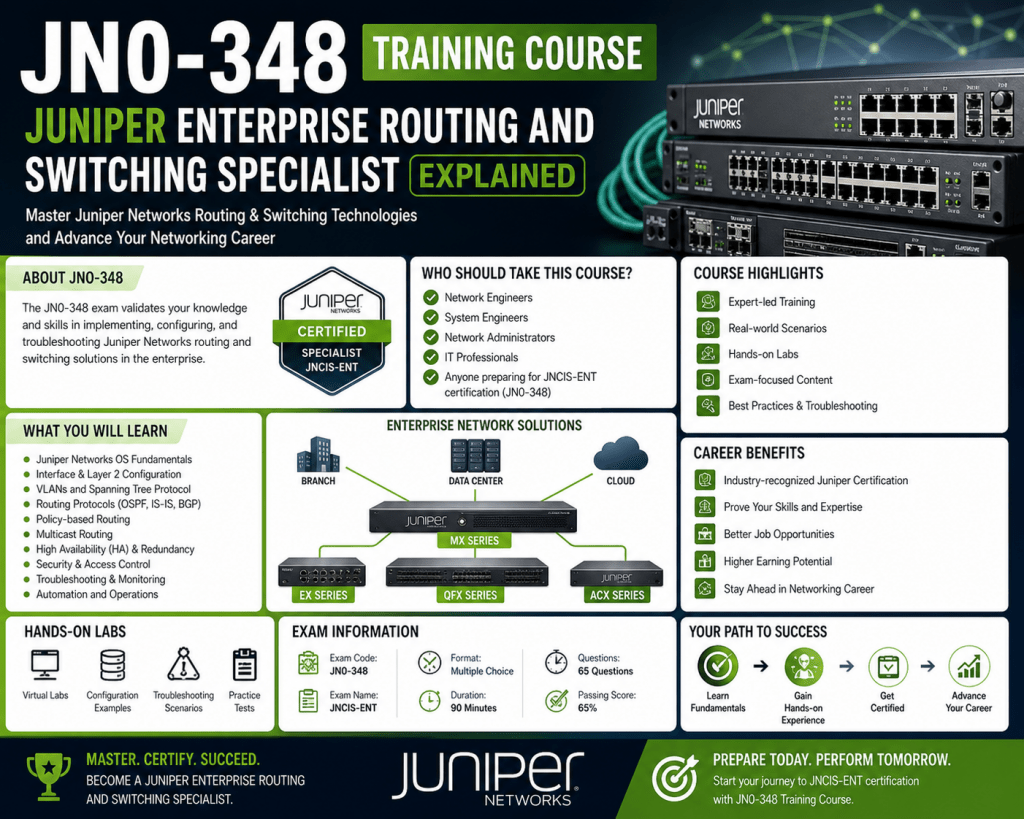
The JNCIS-ENT certification represents a specialist-level milestone in enterprise networking, specifically focused on routing and switching within Junos-based infrastructures. It is designed for network professionals who already understand core networking principles and are ready to operate in more complex enterprise environments where scalability, redundancy, and high availability are essential. The certification validates the ability to configure, monitor, and troubleshoot enterprise-grade networks using structured operational methodologies and protocol-level expertise.
Enterprise networks differ significantly from small or medium-sized networks due to their layered architecture and operational demands. These environments typically consist of multiple interconnected routing domains, redundant switching layers, and strict performance requirements. A network administrator working in such an environment must be capable of maintaining stability while also adapting to dynamic traffic patterns and evolving infrastructure requirements. The JNCIS-ENT framework focuses on building these capabilities through structured learning of protocols, system behaviors, and configuration practices.
Unlike entry-level certifications that focus on general networking theory, this specialist certification emphasizes Junos-specific implementations. This includes a deeper focus on how routing and switching technologies behave within Juniper devices and how enterprise-scale networks are designed using these systems. The goal is to bridge theoretical understanding with real-world operational competence.
Enterprise Routing and Switching Architecture Principles
Enterprise routing and switching form the backbone of modern network infrastructures. Routing determines how data travels between different networks, while switching controls how data moves within the same network segment. Together, they ensure seamless communication across complex environments.
In enterprise networks, routing is not limited to simple path selection. It involves policy-based decision-making, dynamic adaptation to network changes, and coordination between multiple routing protocols. Switching, on the other hand, must handle large volumes of traffic efficiently while maintaining segmentation, security, and performance optimization.
A key characteristic of enterprise environments is hierarchical design. Networks are typically structured into core, distribution, and access layers. Each layer serves a specific purpose, and routing and switching technologies must be configured accordingly. The core layer focuses on high-speed data transfer, the distribution layer handles policy enforcement and routing decisions, and the access layer connects end devices.
Understanding this structure is essential for configuring enterprise networks effectively. Administrators must ensure that routing protocols are properly implemented across layers and that switching configurations support scalability and redundancy.
Layer 2 Switching Fundamentals in Junos Environments
Layer 2 switching is a foundational component of enterprise networking. It operates at the data link layer and is responsible for forwarding frames based on MAC addresses. In Junos environments, Layer 2 switching is highly configurable and supports advanced features that enhance performance and security.
One of the most important concepts in Layer 2 switching is VLAN segmentation. VLANs allow administrators to divide a physical network into multiple logical networks. This improves security by isolating traffic and enhances performance by reducing broadcast domains. VLAN configuration is a critical skill for enterprise administrators, as it directly impacts network efficiency and structure.
Switching behavior in enterprise environments must also account for scalability. As networks grow, the number of devices and traffic volume increases significantly. Efficient switching configurations ensure that traffic is forwarded quickly and without unnecessary delays. This requires careful planning of MAC address tables, forwarding policies, and interface configurations.
Another important aspect of Layer 2 networking is loop prevention. Without proper controls, redundant connections can create loops that lead to broadcast storms and network instability. Spanning Tree Protocol plays a critical role in preventing these issues by dynamically disabling redundant paths and maintaining a loop-free topology.
VLAN Design and Segmentation Strategies
VLANs are essential for structuring enterprise networks. They allow administrators to logically separate different types of traffic, such as user data, voice communication, and management traffic. This segmentation improves both security and performance.
Effective VLAN design requires careful planning. Administrators must determine how devices will be grouped, how traffic will flow between segments, and how routing will be handled between VLANs. In large environments, improper VLAN design can lead to inefficiencies and increased complexity.
Inter-VLAN routing is another critical concept. While VLANs isolate traffic at Layer 2, communication between VLANs requires routing at Layer 3. This is typically achieved through router interfaces or Layer 3 switches. Proper configuration ensures that traffic can move efficiently between segments without compromising security or performance.
VLAN tagging is also an important technical detail. It allows multiple VLANs to share the same physical link while maintaining separation of traffic. This is essential in trunking scenarios where multiple VLANs must traverse a single connection between switches.
Layer 2 Security and Network Protection Mechanisms
Security at the switching layer is often overlooked but is extremely important in enterprise environments. Layer 2 networks are vulnerable to several types of attacks, including MAC spoofing, VLAN hopping, and address table flooding.
To mitigate these risks, administrators implement various security mechanisms. Port security is one such feature that restricts the number of MAC addresses allowed on a specific interface. This helps prevent unauthorized devices from connecting to the network.
Another important security measure is DHCP snooping, which helps prevent rogue DHCP servers from distributing incorrect IP configurations. This ensures that only trusted servers can assign IP addresses within the network.
Dynamic ARP inspection is also used to prevent ARP spoofing attacks. It verifies ARP packets against trusted databases to ensure that address mappings are legitimate.
These security mechanisms are essential for maintaining the integrity of enterprise networks. Without them, networks become vulnerable to internal and external threats that can disrupt operations or compromise data.
Link Aggregation and High-Bandwidth Design
Link aggregation is a technique used to combine multiple physical links into a single logical connection. This increases bandwidth and provides redundancy in case one of the links fails. In enterprise environments, this is essential for maintaining high performance and reliability.
In Junos-based systems, link aggregation is highly flexible and can be configured to meet different performance requirements. Administrators must understand how to distribute traffic across aggregated links and how to monitor their status.
Load balancing is a key aspect of link aggregation. Traffic must be distributed evenly across all available links to maximize efficiency. If not configured properly, some links may become overutilized while others remain underutilized.
Failure handling is another important consideration. If one link in an aggregated bundle fails, traffic must automatically be redistributed across the remaining links without disrupting connectivity. This ensures continuous network operation even under fault conditions.
Multi-Chassis Link Aggregation and Advanced Redundancy
Multi-chassis link aggregation extends the concept of link aggregation across multiple devices. This provides an additional layer of redundancy by allowing links to be distributed across different physical switches.
This architecture is particularly useful in environments where high availability is critical. If one device fails, traffic can continue flowing through another device without interruption. This eliminates single points of failure and improves overall network resilience.
Configuring multi-chassis link aggregation requires careful coordination between devices. Administrators must ensure that configurations are synchronized and that traffic distribution is balanced across all participating systems.
This technique is widely used in data centers and large enterprise environments where downtime is not acceptable. It represents an advanced level of network design that requires strong technical understanding and precise configuration.
Spanning Tree Protocol and Loop Prevention
Spanning Tree Protocol is essential for maintaining loop-free Layer 2 topologies. In networks with redundant paths, loops can form if multiple active paths exist between switches. These loops can cause broadcast storms and severely degrade network performance.
STP works by identifying redundant paths and selectively disabling them to create a logical tree structure. This ensures that only one active path exists between any two points in the network.
The protocol also includes mechanisms for reactivation. If a primary path fails, STP can automatically enable a previously blocked path to restore connectivity. This dynamic behavior ensures both stability and redundancy.
Understanding STP behavior is critical for enterprise administrators. Misconfigurations can lead to suboptimal network performance or even connectivity issues. Proper tuning of STP parameters ensures efficient and reliable network operation.
Introduction to Enterprise Routing Concepts
Routing is a fundamental aspect of enterprise networking that determines how data moves between different networks. In complex environments, multiple routing protocols are often used simultaneously to achieve scalability and redundancy.
Dynamic routing protocols are preferred in enterprise environments because they automatically adapt to network changes. This reduces administrative overhead and improves resilience.
Routing decisions are based on metrics such as path cost, bandwidth, and delay. These metrics help determine the most efficient path for data transmission. Understanding how these decisions are made is essential for optimizing network performance.
OSPF Fundamentals and Enterprise Deployment
Open Shortest Path First is one of the most widely used routing protocols in enterprise networks. It is designed for scalability and fast convergence, making it ideal for large environments.
OSPF operates by dividing networks into areas. This hierarchical structure reduces routing overhead and improves efficiency. Each area maintains its own topology, while a backbone area connects all other areas.
Administrators must understand how to configure OSPF, assign area types, and manage route propagation. Proper configuration ensures efficient routing and minimizes convergence time during network changes.
OSPF also supports cost-based path selection. Routes with lower cost are preferred, allowing administrators to optimize traffic flow based on network design requirements.
IS-IS Routing and Alternative Protocol Design
Intermediate System to Intermediate System is another routing protocol used in enterprise environments. While less common than OSPF, it is widely used in large-scale networks due to its scalability and stability.
IS-IS operates at the data link layer and uses a different structure compared to IP-based routing protocols. This makes it highly efficient in certain environments.
Administrators must understand how IS-IS forms adjacencies, exchanges routing information, and maintains topology databases. Proper configuration ensures stable and efficient routing behavior.
BGP Introduction and Inter-Network Routing
Border Gateway Protocol is used for routing between different networks, particularly across organizational boundaries. It is one of the most important protocols in global internet infrastructure.
BGP operates based on path attributes rather than simple metrics. These attributes determine route selection and influence traffic flow across networks.
Understanding BGP behavior is essential for enterprise administrators working in multi-network environments. It requires careful configuration to ensure optimal routing and prevent issues such as routing loops or suboptimal path selection.
Deep Dive into Enterprise Routing in Modern Network Architectures
Enterprise routing is a core discipline in large-scale network design, where the primary objective is to ensure efficient, reliable, and policy-driven movement of data across interconnected systems. In Junos-based environments, routing is not simply about selecting a path; it is about building an intelligent framework that adapts dynamically to topology changes, traffic conditions, and administrative policies.
Unlike smaller networks where static routing may suffice, enterprise environments depend heavily on dynamic routing protocols. These protocols continuously exchange information, allowing the network to converge automatically when changes occur. This adaptability is essential in infrastructures where downtime is unacceptable and traffic volumes are highly variable.
Routing in such environments is also deeply tied to design philosophy. Engineers must consider scalability, redundancy, failover behavior, and convergence speed. Each routing decision influences performance across the entire infrastructure, making careful configuration essential.
OSPF Architecture and Scalable Area Design
Open Shortest Path First is one of the most widely deployed interior gateway protocols in enterprise environments. Its design is based on link-state principles, where each router builds a complete map of the network topology and independently calculates the shortest path to each destination.
OSPF introduces the concept of areas, which is critical for scalability. Instead of maintaining a single large topology database, the network is divided into smaller segments. Each area handles its own routing information, reducing overhead and improving efficiency. The backbone area serves as the central point that connects all other areas, ensuring inter-area communication.
A key advantage of OSPF is its fast convergence. When a network change occurs, routers quickly exchange updated link-state advertisements and recalculate routes. This minimizes disruption and ensures that traffic is rerouted efficiently.
Designing OSPF networks requires careful planning of area boundaries. Poorly structured areas can lead to inefficiencies and suboptimal routing behavior. Administrators must balance the size of each area to optimize performance while maintaining manageability.
Route selection in OSPF is based on cost, which is typically derived from interface bandwidth. Lower cost paths are preferred, allowing engineers to influence traffic flow by adjusting interface metrics. This provides flexibility in optimizing network utilization.
OSPF Optimization Techniques and Advanced Configuration
Beyond basic deployment, OSPF offers several advanced features that enhance performance and control. One such feature is route summarization, which reduces the size of routing tables by aggregating multiple routes into a single advertisement. This improves efficiency and reduces processing overhead on routers.
Another important concept is area types. OSPF supports different area configurations, including standard areas, stub areas, and totally stubby areas. Each type has specific characteristics that influence how routing information is handled. By carefully selecting area types, engineers can optimize routing efficiency and control the flow of external routes.
OSPF also supports authentication mechanisms to ensure secure exchange of routing information. This prevents unauthorized devices from injecting false routes into the network. Security in routing protocols is essential in enterprise environments where integrity of data paths is critical.
Additionally, OSPF supports equal-cost multi-path routing. This allows traffic to be distributed across multiple paths with identical metrics, improving load balancing and redundancy. Proper configuration of this feature can significantly enhance network performance.
IS-IS Protocol Architecture and Enterprise Applications
Intermediate System to Intermediate System is another link-state routing protocol used in enterprise and service provider networks. While it shares similarities with OSPF, its architecture and operational model differ in several key aspects.
IS-IS operates directly over the data link layer rather than relying on IP. This makes it highly flexible and less dependent on IP addressing schemes. It is particularly well-suited for large-scale environments where scalability and stability are critical.
The protocol organizes networks into levels instead of areas. Level 1 routing operates within a local domain, while Level 2 routing connects different domains. This hierarchical structure allows for efficient scaling of large networks.
IS-IS is known for its stability and predictable behavior in complex environments. It handles topology changes efficiently and maintains consistent performance even in large deployments.
Configuration of IS-IS requires careful planning of levels and routing domains. Improper configuration can lead to suboptimal routing or connectivity issues. Engineers must ensure that routing hierarchies align with physical and logical network design.
Comparative Understanding of OSPF and IS-IS in Enterprise Design
Both OSPF and IS-IS serve similar purposes but differ in implementation and scalability characteristics. OSPF is widely used due to its IP-based structure and familiarity among engineers. IS-IS, on the other hand, is favored in very large or complex networks due to its simplicity at the protocol level.
OSPF relies on areas to manage scalability, while IS-IS uses levels. This difference influences how networks are designed and segmented. OSPF is often preferred in enterprise environments with moderate complexity, while IS-IS is commonly seen in large backbone infrastructures.
Understanding the strengths and limitations of each protocol allows engineers to select the most appropriate solution based on network requirements.
Border Gateway Protocol Fundamentals in Enterprise Routing
Border Gateway Protocol is the primary routing protocol used for inter-domain routing. It is responsible for exchanging routing information between different autonomous systems and is a critical component of global internet infrastructure.
Unlike interior gateway protocols, BGP does not focus on shortest path calculation. Instead, it uses a path-vector approach where routes are selected based on a set of attributes. These attributes include path length, origin type, local preference, and policy-based rules.
BGP is highly flexible and allows administrators to implement complex routing policies. This makes it suitable for enterprise environments that require control over traffic flow between multiple networks.
The protocol operates in a peer-based model, where routers establish sessions and exchange routing information. These sessions must be carefully configured to ensure stability and security.
BGP Path Selection and Policy Control Mechanisms
BGP route selection is based on a hierarchical decision-making process. Multiple attributes are evaluated to determine the best path to a destination. This process allows administrators to influence routing behavior based on organizational requirements.
Local preference is one of the most important attributes. It determines the preferred exit point from an autonomous system. Higher values are preferred, allowing engineers to control outbound traffic flow.
AS path length is another critical factor. Shorter paths are generally preferred, as they indicate fewer hops between networks. However, this can be overridden by policy-based configurations.
MED (Multi-Exit Discriminator) is used to influence inbound traffic from neighboring systems. It provides a way to suggest preferred entry points into a network.
Policy-based routing in BGP allows administrators to define custom rules for route acceptance, advertisement, and modification. This provides granular control over traffic behavior and enables advanced traffic engineering strategies.
Advanced BGP Configurations and Enterprise Scalability
BGP supports several advanced features that enhance scalability and performance in large networks. One such feature is route reflection, which reduces the need for full mesh connectivity between routers. Instead of each router peering with every other router, route reflectors distribute routing information efficiently.
Another important concept is BGP aggregation. This allows multiple routes to be combined into a single advertisement, reducing routing table size and improving efficiency.
BGP also supports multiprotocol extensions, allowing it to carry IPv6 routes alongside IPv4. This is essential in modern networks transitioning to dual-stack environments.
Stability in BGP is critical. Misconfigurations can lead to route flapping or instability, which can affect large portions of the network. Proper design and careful policy implementation are essential to maintain reliability.
Routing over Tunnels and Network Extension Techniques
Enterprise networks often require connectivity across geographically distributed locations. This is achieved through tunneling technologies that encapsulate routing traffic over intermediate networks.
Routing over GRE tunnels allows dynamic routing protocols to operate across non-native environments. This enables seamless integration of remote sites into a unified routing domain.
These techniques are essential for building scalable enterprise architectures that span multiple locations. They provide flexibility in network design and ensure consistent connectivity across distributed systems.
IPv6 Integration in Enterprise Routing Environments
IPv6 adoption is a critical aspect of modern networking. Routing protocols must be capable of handling both IPv4 and IPv6 traffic efficiently.
OSPF, IS-IS, and BGP all support IPv6 extensions. This allows networks to operate in dual-stack mode during transition phases. Administrators must ensure proper configuration to maintain compatibility and performance.
IPv6 introduces a larger address space and simplified header structure, which improves routing efficiency. However, it also requires updated configuration practices and careful planning.
Route Summarization and Network Efficiency Optimization
Route summarization is a technique used to reduce the number of routing entries in a network. By combining multiple specific routes into a single summary route, administrators can significantly reduce routing overhead.
This improves performance by decreasing the size of routing tables and reducing the amount of routing information exchanged between devices.
Proper summarization also enhances stability by limiting the impact of topology changes. Instead of propagating multiple route updates, only summarized information is exchanged.
High Availability Routing Design Principles
High availability is a fundamental requirement in enterprise networks. Routing protocols must be configured to ensure continuous operation even during failures.
Redundancy is achieved through multiple routing paths, failover mechanisms, and dynamic reconvergence. When a primary path fails, routing protocols automatically select alternative paths.
Fast convergence is critical in maintaining availability. Protocols like OSPF and IS-IS are designed to detect changes quickly and update routing tables accordingly.
Engineers must also consider hardware redundancy, link redundancy, and protocol redundancy when designing high-availability networks.
Network Convergence Behavior and Stability Engineering
Convergence refers to the time it takes for a network to reach a stable state after a change. Fast convergence is essential in enterprise environments to minimize downtime and maintain performance.
Different routing protocols have different convergence characteristics. Link-state protocols generally converge faster than distance-vector protocols due to their global view of the network.
Engineers can optimize convergence by tuning protocol timers, adjusting metrics, and designing efficient topologies.
Stability is equally important. Rapid but unstable convergence can lead to routing oscillations. Proper balance between speed and stability is essential for optimal network performance.
Enterprise Network Resiliency as a Design Discipline
Resiliency in enterprise networking is not a single feature but a design philosophy that ensures continuous service availability even under adverse conditions. In Junos-based enterprise environments, resiliency is achieved through layered redundancy, intelligent routing behavior, and fast failure recovery mechanisms. The objective is to eliminate single points of failure while maintaining predictable performance under load and during disruption events.
At scale, enterprise networks must assume that failures will occur. Links go down, devices reboot, routing adjacencies reset, and traffic patterns shift dynamically. A resilient architecture is designed to absorb these disruptions without impacting end-user experience. This requires coordination between routing protocols, switching technologies, and physical infrastructure design.
Resiliency is also closely tied to convergence behavior. The faster a network can detect and respond to a failure, the less impact it has on active sessions and services. Therefore, convergence optimization becomes a key engineering focus in enterprise routing and switching environments.
Redundancy Design Across Routing and Switching Layers
Redundancy is implemented at multiple layers of the enterprise network. At the physical layer, multiple links are deployed between devices to ensure connectivity even if one link fails. At the switching layer, redundant paths between access and distribution switches ensure that traffic can be rerouted instantly when needed.
At the routing layer, dynamic protocols maintain multiple potential paths to destinations. These protocols continuously evaluate path availability and automatically adjust forwarding decisions based on network conditions. This ensures uninterrupted communication even during topology changes.
Device-level redundancy is also critical. Dual routers, dual switches, and clustered systems ensure that hardware failures do not result in service disruption. These redundant systems often operate in active-active or active-standby configurations depending on design requirements.
A well-designed enterprise network does not rely on a single redundancy mechanism but combines multiple approaches to achieve layered fault tolerance. This multi-layer redundancy is what defines enterprise-grade resiliency.
Multi-Chassis Link Aggregation in High Availability Networks
Multi-Chassis Link Aggregation represents a key technology for achieving high availability in enterprise switching environments. It allows multiple physical switches to act as a single logical aggregation point, enabling links to be distributed across different devices.
This design eliminates single points of failure at the access and distribution layers. If one switch fails, traffic continues flowing through the remaining active devices without interruption. This seamless failover behavior is essential in environments where downtime is not acceptable.
MC-LAG also improves bandwidth utilization by allowing traffic to be distributed across multiple physical paths. This enhances performance while maintaining redundancy.
From an operational perspective, MC-LAG requires precise configuration synchronization between participating devices. Consistency in control plane behavior is essential to ensure stable forwarding and avoid traffic disruption during failover events.
Spanning Tree Optimization and Loop-Free Layer 2 Design
Spanning Tree Protocol remains a fundamental mechanism for maintaining loop-free Layer 2 topologies. In complex enterprise environments, redundant links are necessary for resiliency, but they introduce the risk of loops if not properly controlled.
STP prevents loops by logically blocking redundant paths while maintaining backup routes. When a primary link fails, previously blocked paths are activated to restore connectivity. This dynamic behavior ensures both redundancy and stability.
In enterprise-grade networks, STP must be carefully tuned to avoid inefficient path selection. Poor configuration can lead to suboptimal traffic flows, increased latency, or delayed convergence.
Advanced tuning techniques allow engineers to influence root bridge selection and control path priority. This ensures that traffic flows along optimal routes under normal conditions while still maintaining failover capability.
High-Speed Convergence Engineering in Routing Protocols
Convergence speed is a critical performance metric in enterprise routing environments. It determines how quickly the network adapts to topology changes and restores stable communication paths.
Link-state protocols such as OSPF and IS-IS are designed for fast convergence. They achieve this by maintaining a complete view of the network topology and recalculating paths immediately after a change is detected.
Convergence optimization involves adjusting protocol timers, improving detection mechanisms, and designing efficient topologies. Faster failure detection mechanisms such as BFD can also be integrated to reduce downtime during link failures.
However, convergence speed must be balanced with stability. Excessively aggressive timers can lead to routing instability, causing frequent recalculations and potential performance degradation.
Advanced Troubleshooting Methodology in Enterprise Networks
Troubleshooting in enterprise routing and switching environments requires a structured and methodical approach. Issues can originate from multiple layers, including physical connectivity, protocol misconfiguration, or policy conflicts.
The first step in troubleshooting is isolating the affected segment of the network. This involves identifying whether the issue is local to a device, confined to a specific layer, or affecting the entire routing domain.
Once the scope is defined, administrators analyze routing tables, interface states, and protocol adjacencies. This helps determine whether the issue is related to connectivity, routing decisions, or control plane behavior.
Log analysis plays a critical role in identifying root causes. System logs provide detailed information about protocol events, interface changes, and error conditions.
A systematic approach ensures that issues are resolved efficiently without introducing additional instability into the network.
Routing Table Analysis and Path Validation Techniques
Routing tables are the central reference point for all forwarding decisions in an enterprise network. Each entry represents a potential path to a destination network, along with associated metrics and attributes.
Analyzing routing tables allows administrators to verify whether routes are being learned correctly, whether preferred paths are selected, and whether unexpected routing behavior is occurring.
Path validation involves tracing the flow of traffic through the network to ensure it follows the intended route. This is particularly important in environments where policy-based routing or multiple dynamic protocols are in use.
Incorrect routing decisions can result from misconfigured metrics, incorrect policy application, or protocol conflicts. Identifying these issues requires careful comparison of expected and actual routing behavior.
BGP Scalability and Large-Scale Routing Design
In large enterprise environments, Border Gateway Protocol plays a critical role in managing inter-domain routing. However, as networks scale, BGP design must evolve to maintain performance and stability.
One of the key challenges in large-scale BGP environments is managing full-mesh requirements. Without optimization, every router must maintain a session with every other router, leading to scalability issues.
Route reflection is used to address this challenge. By designating specific routers as route reflectors, the need for full-mesh peering is eliminated, significantly reducing complexity.
Another important scalability feature is route aggregation. By summarizing multiple routes into a single advertisement, routing table size is reduced, improving efficiency and reducing processing overhead.
Proper BGP design also involves careful policy control. Route filtering, attribute manipulation, and path selection rules ensure that traffic flows according to organizational requirements.
Traffic Engineering and Policy-Based Routing Control
Traffic engineering allows administrators to influence how data flows through the network. This is achieved by manipulating routing metrics, protocol attributes, and policy rules.
In enterprise environments, traffic engineering is used to optimize performance, balance load, and ensure efficient utilization of network resources. It also plays a key role in enforcing business-driven routing policies.
Policy-based routing allows traffic decisions to be made based on criteria other than destination address. This provides granular control over routing behavior and enables advanced network optimization strategies.
Effective traffic engineering requires deep understanding of routing protocols and network topology. Poorly designed policies can lead to routing inefficiencies or unintended traffic patterns.
Network Monitoring and Operational Visibility
Operational visibility is essential for maintaining enterprise network health. Without proper monitoring, issues may go undetected until they impact users or services.
Monitoring systems track key performance metrics such as latency, packet loss, interface utilization, and routing stability. These metrics provide insight into network behavior and help identify potential issues before they escalate.
Protocol-level monitoring is also critical. Observing routing adjacencies, convergence events, and topology changes provides deeper insight into network dynamics.
Visibility tools enable proactive network management, allowing administrators to address issues before they impact production environments.
Failure Recovery Mechanisms and Automated Restoration
Failure recovery is a key aspect of enterprise network design. When failures occur, the network must automatically restore connectivity without manual intervention.
Dynamic routing protocols play a central role in this process. They detect changes in topology and automatically recalibrate routing tables to restore connectivity.
Fast reroute mechanisms further enhance recovery speed by precomputing backup paths. This allows traffic to be redirected almost instantly in the event of a failure.
Automation is increasingly used in enterprise environments to accelerate recovery processes. Automated systems can detect, diagnose, and respond to network events without human intervention.
Enterprise Operational Excellence and Configuration Discipline
Operational excellence in enterprise networking is achieved through consistent configuration practices, structured design methodologies, and disciplined change management.
Standardization reduces complexity and minimizes the risk of misconfiguration. Consistent naming conventions, modular design principles, and documented procedures improve maintainability.
Change management ensures that modifications to the network are carefully planned and tested before deployment. This reduces the likelihood of unintended disruptions.
Documentation is also critical. Accurate network documentation provides a reference point for troubleshooting, expansion, and auditing.
Final Operational Considerations in Large-Scale Networks
Enterprise networks must be designed with long-term scalability in mind. As traffic grows and infrastructure expands, systems must be able to adapt without requiring complete redesign.
This requires forward-thinking architecture that accommodates growth, integrates new technologies, and maintains performance under increasing load.
The combination of resilient design, advanced routing protocols, and disciplined operational practices ensures that enterprise networks remain stable, secure, and efficient over time.
Conclusion
The JNCIS-ENT enterprise routing and switching domain represents a structured progression into real-world network engineering where theoretical knowledge is no longer sufficient on its own. At this level, networking becomes a systems discipline that requires an integrated understanding of protocols, infrastructure design, operational behavior, and failure management. The entire framework of enterprise networking is built around stability, scalability, and predictable performance under continuously changing conditions.
One of the most important realizations in this domain is that enterprise networks are not static systems. They are constantly evolving environments where traffic patterns shift, hardware components age, routing topologies change, and operational requirements expand. Because of this, network design cannot rely on isolated configurations or one-time implementations. Instead, it must be built on adaptable principles that allow systems to respond dynamically while maintaining service continuity.
Routing protocols such as OSPF, IS-IS, and BGP form the backbone of this adaptability. Each protocol serves a distinct role in ensuring that data can traverse complex environments efficiently. OSPF provides fast convergence and structured intra-domain routing, IS-IS offers scalability in large and stable topologies, and BGP governs inter-domain routing with policy-driven control. Together, these protocols create a layered routing ecosystem where decisions are continuously optimized based on topology, metrics, and administrative intent.
Switching technologies complement routing by ensuring that local network segments operate efficiently and securely. Layer 2 designs using VLANs, spanning tree mechanisms, and link aggregation provide both segmentation and redundancy. These mechanisms ensure that traffic flows remain stable even when physical or logical changes occur within the network. The ability to isolate traffic, prevent loops, and distribute load effectively is fundamental to maintaining performance at scale.
A key theme across enterprise networking is redundancy. Redundancy is not simply about duplication of resources but about intelligent design that allows systems to recover gracefully from failures. Whether through multi-chassis link aggregation, redundant routing paths, or failover-enabled switching architectures, the goal is always to ensure uninterrupted service. The strength of a network is measured not by its normal operation but by how effectively it responds to unexpected disruptions.
Another critical aspect is convergence behavior. In dynamic environments, changes are inevitable, and the speed at which a network stabilizes after a change determines its overall reliability. Fast convergence reduces packet loss, minimizes downtime, and improves user experience. However, convergence must be balanced with stability, as overly aggressive tuning can lead to oscillations and unpredictable behavior. Achieving the right balance requires deep understanding of protocol mechanics and network design principles.
Troubleshooting in enterprise environments is equally important and demands a structured methodology. Issues rarely originate from a single cause; instead, they are often the result of multiple interacting factors across different layers of the network. Effective troubleshooting requires isolating the problem domain, analyzing protocol behavior, validating routing tables, and interpreting system logs. This systematic approach ensures that root causes are identified accurately without introducing additional instability.
Operational visibility plays a central role in maintaining network health. Monitoring systems provide continuous insight into performance metrics, protocol states, and traffic behavior. Without visibility, networks become opaque systems where issues are discovered only after they impact users. Proactive monitoring allows administrators to detect anomalies early, analyze trends, and take corrective action before failures escalate into major disruptions.
As enterprise networks scale, complexity increases significantly. Routing tables grow larger, topology changes become more frequent, and policy requirements become more granular. To manage this complexity, techniques such as route summarization, policy-based routing, and hierarchical design are essential. These techniques reduce overhead, simplify management, and improve overall efficiency.
Security is also deeply embedded within enterprise networking. At the switching layer, mechanisms such as port security, DHCP protection, and ARP inspection safeguard local networks from malicious activity. At the routing layer, authentication and policy controls ensure that only trusted information influences network behavior. Security in this context is not an isolated function but an integrated component of overall network design.
Another important dimension is scalability. Enterprise networks must be designed to accommodate future growth without requiring fundamental redesign. This involves selecting appropriate routing protocols, designing modular topologies, and implementing flexible addressing schemes. Scalability ensures that networks can expand in size and complexity while maintaining consistent performance.
Automation is increasingly influencing enterprise networking operations. While traditional configuration methods remain important, automation enables faster deployment, reduced human error, and more consistent system behavior. Automated monitoring, configuration validation, and recovery processes contribute to higher operational efficiency and reliability.
Ultimately, enterprise routing and switching is not just about configuring protocols or connecting devices. It is about designing intelligent systems that can sustain themselves under pressure, adapt to change, and deliver consistent performance in complex environments. Mastery in this field requires both technical depth and architectural thinking, where every decision has cascading effects across the entire infrastructure.
The JNCIS-ENT level represents this transition from basic operational knowledge to advanced engineering capability. It emphasizes not only how networks function but why they behave the way they do under different conditions. This deeper understanding allows network professionals to move beyond reactive troubleshooting and toward proactive design and optimization.
In real enterprise environments, success is defined by stability, efficiency, and resilience. Networks must support business operations continuously, often across global infrastructures with strict performance expectations. Achieving this requires a combination of protocol expertise, design discipline, operational awareness, and continuous refinement.
The knowledge areas covered in enterprise routing and switching ultimately form a foundation for long-term growth in network engineering. They provide the conceptual and practical tools needed to build, maintain, and evolve large-scale infrastructures. As technology continues to evolve, these principles remain central to ensuring that networks remain robust, scalable, and capable of supporting increasingly complex digital ecosystems.