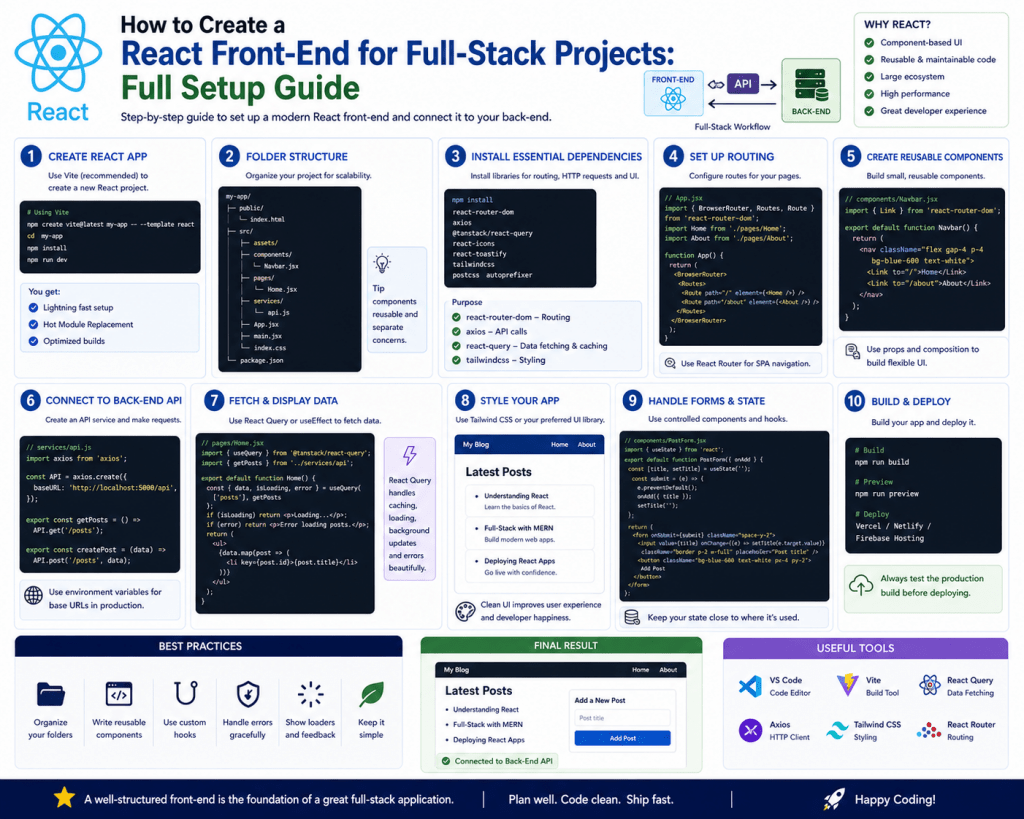
React is a front-end library used to build interactive user interfaces for modern web applications. In a full-stack setup, React handles everything the user sees and interacts with, while backend systems manage data, authentication, and server-side logic. This separation of concerns allows applications to remain scalable, modular, and easier to maintain over time.
When starting a full-stack journey, React is usually the first layer developers work with because it defines how users experience the application. Every click, input, page transition, and data display is controlled through React components. Understanding this structure early helps avoid confusion when backend integration begins later.
React applications are designed as single-page applications, meaning the browser does not reload pages in the traditional sense. Instead, content is dynamically updated within the same page structure. This results in smoother user experiences and faster performance compared to traditional multi-page systems.
Before diving into full-stack integration, it is important to first understand how to properly set up a React front-end environment, structure a project correctly, and establish a stable development workflow.
Preparing the Development Environment for React Projects
A properly configured development environment is essential before building any React application. The environment provides the foundation for running JavaScript outside the browser, managing project dependencies, and executing development scripts.
The first requirement is a runtime environment that allows JavaScript to run on the system level. This runtime environment also includes a package manager, which is used to install and manage libraries needed for React development.
Once installed, it becomes possible to create, run, and manage React applications locally. This setup is essential because React relies heavily on external packages and build tools that automate complex tasks such as bundling code, optimizing performance, and enabling live development updates.
Another important part of the environment is version control awareness. Different projects may require different runtime versions, especially when working in teams or maintaining older applications. Understanding how to manage these versions ensures that projects remain stable and compatible across different systems.
Developers often overlook environment setup, but it is one of the most important steps in building reliable full-stack applications. A stable environment reduces errors, improves workflow consistency, and prevents unexpected issues during development.
Creating a New React Application from Scratch
Once the development environment is ready, the next step is generating a new React application. This process creates a fully structured project with predefined folders, configuration files, and essential dependencies.
When a new React project is created, it automatically includes everything needed to start building a user interface. This includes a component structure, a development server setup, and a build system that compiles code for browser compatibility.
The creation process also installs required libraries that allow React to function correctly. These libraries handle rendering components, updating the user interface efficiently, and managing the internal state of the application.
After the setup is complete, a new project directory is generated. This directory becomes the main workspace where all development activities take place. Inside it, developers can begin building components, organizing files, and preparing the application for future backend integration.
This structured setup is one of the reasons React is widely used in modern development. It eliminates the need to manually configure complex build systems, allowing developers to focus on writing application logic instead of setup tasks.
Understanding the React Project Structure
A React application follows a structured layout designed for scalability and maintainability. Each part of the structure serves a specific purpose in managing the application lifecycle.
At the core of the project is the entry point, which connects the React application to the browser. This file is responsible for rendering the main application component and initializing the user interface.
Surrounding this entry point is a collection of reusable components. Components are the building blocks of React applications and represent independent sections of the user interface. Each component can handle its own logic, styling, and behavior.
For example, a component may represent a navigation bar, a form, a dashboard section, or a list of items. These components can be combined to build complex user interfaces without duplicating code.
The project structure also includes configuration files that control how the application behaves during development and production. These settings define how code is compiled, how assets are handled, and how the development server operates.
Another important part of the structure is the assets folder, which stores images, icons, and static files used throughout the application. Proper organization of these files ensures the project remains clean and manageable as it grows.
Understanding this structure is critical because full-stack applications often expand quickly. A well-organized front-end makes it easier to integrate APIs, manage state, and scale features over time.
Running the React Development Server
After the project structure is in place, the next step is launching the development environment. This process starts a local server that runs the React application on a system-level host.
When the development server is active, it continuously monitors the project files for changes. Any modification made to the code is automatically reflected in the browser without requiring manual refresh. This feature significantly improves development efficiency and speeds up the debugging process.
The development server also provides real-time feedback. If there are errors in the code, the system displays detailed messages that help identify and fix issues quickly. This immediate feedback loop is one of the most valuable features of modern front-end development workflows.
Once the server is running, a default interface appears in the browser. This confirms that the setup is working correctly and that the application is ready for development.
At this stage, developers can begin modifying the default structure, adding new components, and experimenting with layout and design.
Understanding Component-Based Architecture
React is built around the concept of components, which are independent, reusable pieces of user interface logic. Each component is responsible for rendering a specific part of the application.
This approach allows developers to break down complex interfaces into smaller, manageable sections. Instead of writing large blocks of code, developers create multiple components that work together to form the complete application.
Components can also manage their own internal state. State represents dynamic data that changes over time, such as user input, API responses, or interactive UI elements.
When state changes, React automatically updates the affected parts of the interface. This makes applications highly responsive and efficient without requiring manual DOM manipulation.
Component-based architecture is one of the key reasons React is widely used in full-stack development. It allows for modular design, easier debugging, and better scalability.
Preparing for Full-Stack Integration
Before moving into backend integration, it is important to ensure that the front-end structure is stable and well-organized. A strong front-end foundation simplifies communication with backend systems and improves overall application performance.
At this stage, developers should focus on understanding how components interact with each other, how data flows through the application, and how user interactions trigger updates.
Once these concepts are clear, the application becomes ready for integration with backend services such as APIs and databases.
Full-stack development begins when the front-end starts communicating with external systems to retrieve and store data dynamically. React plays a central role in displaying this data and ensuring a smooth user experience.
This transition from static front-end setup to dynamic full-stack functionality marks an important milestone in application development.
Understanding the Role of Components in React Applications
In a React-based front-end, components are the foundation of the entire user interface. Every visible element on the screen is built using components, whether it is a simple button, a navigation bar, or a complex dashboard layout. The idea behind components is to break the interface into smaller, reusable pieces that can be independently managed and combined to create complete user experiences.
A component is essentially a self-contained unit that defines how a part of the interface should appear and behave. It can include structure, logic, and dynamic behavior. This modular approach makes it easier to develop, test, and maintain applications, especially when they become large and complex in full-stack environments.
Components also promote reusability. Instead of rewriting the same code multiple times, developers create a component once and reuse it wherever needed. This reduces redundancy and improves consistency across the application.
Structuring a React Project for Scalability
As a React application grows, structure becomes extremely important. A poorly organized project can quickly become difficult to manage, especially when multiple features and developers are involved.
A well-structured project separates components based on functionality. For example, interface elements are grouped separately from layout structures and utility functions. This separation ensures that each part of the application has a clear responsibility.
In scalable applications, components are often categorized into small reusable units and larger feature-based structures. Small components handle simple tasks, while larger components combine multiple smaller ones to form complete sections of the application.
This layered approach allows developers to build complex interfaces without losing control over the codebase. It also makes debugging easier because each component has a defined role.
Creating Functional Components for User Interfaces
Functional components are the most commonly used type of component in modern React applications. These components are defined as functions that return interface elements.
Each functional component represents a part of the user interface. It can display static content, render dynamic data, or respond to user interactions. The simplicity of functional components makes them ideal for building scalable applications.
Functional components can also accept inputs that control how they behave. These inputs allow components to become flexible and reusable across different parts of the application.
For example, a single button component can be reused with different labels, styles, or actions depending on where it is used. This flexibility is essential in full-stack applications where data-driven interfaces are common.
Understanding Component Composition
Component composition is the process of combining multiple smaller components to build more complex user interfaces. Instead of creating a single large structure, developers assemble multiple reusable parts.
This approach improves readability and maintainability. Each component focuses on a single responsibility, while higher-level components manage how they are arranged and connected.
In full-stack applications, component composition becomes especially important when dealing with dynamic data. For example, a dashboard may consist of multiple sections such as statistics, user information, and activity feeds. Each section can be a separate component that receives data and renders it independently.
This modular structure ensures that changes in one part of the application do not affect unrelated sections.
Managing Data Flow Between Components
Data flow is a key concept in React applications. Since components are independent units, they often need to share information with each other. This is done through a structured flow of data.
Data tyom higher-level components to lower-level components. This ensures that the application remains predictable and easier to debug. When data changes at the top level, it automatically updates the components that depend on it.
This flow of data is essential in full-stack applications where data often comes from external sources such as servers or databases. The front-end must be able to receive, process, and display this data efficiently.
Understanding how data moves through components is critical for building responsive and interactive applications.
Introduction to State in React Components
State is one of the most important concepts in React development. It represents data that can change over time within a component. Unlike static data, state allows components to update dynamically based on user interaction or external events.
When the state changes, the component automatically re-renders to reflect the updated information. This automatic update mechanism is what makes React applications highly interactive.
State is commonly used for handling form inputs, toggling interface elements, and storing temporary data within a component.
In full-stack applications, state often plays a key role in managing data retrieved from backend systems. Once data is received from a server, it is stored in a state and displayed within the interface.
Handling User Interactions in Components
User interaction is a core part of any front-end application. React components are designed to respond to user actions such as clicks, typing, scrolling, and form submissions.
When a user interacts with the interface, components update their state or trigger specific actions based on predefined logic. This allows applications to behave dynamically instead of remaining static.
For example, when a user submits a form, the component can capture the input data, validate it, and prepare it for further processing. In a full-stack environment, this data is often sent to a backend system for storage or computation.
Handling user interactions effectively is essential for creating smooth and intuitive user experiences.
Building Reusable UI Elements
Reusability is one of the most powerful features of React. By designing components that can be reused across different parts of an application, developers can significantly reduce development time and improve consistency.
Reusable components are designed to be flexible. They can adapt their appearance and behavior based on the data they receive. This makes them suitable for multiple use cases without requiring modification.
In large applications, reusable components form the backbone of the interface. They ensure that design patterns remain consistent and that updates can be made in a centralized way.
This approach is especially useful in full-stack applications where different pages or features may share similar interface elements.
Organizing Components for Real-World Applications
In real-world applications, component organization becomes more complex as features increase. Developers often group components based on functionality or feature domains.
For example, authentication-related components may be grouped, while dashboard components are stored in a separate section. This structure makes it easier to navigate the project and locate specific functionality.
Organizing components properly also improves collaboration in team environments. Multiple developers can work on different sections of the application without interfering with each other’s code.
A well-organized structure ensures that the application remains maintainable even as it scales into a large full-stack system.
Preparing Components for Backend Integration
As the front-end becomes more structured, the next step is preparing it for backend integration. This involves designing components that can handle dynamic data instead of static content.
Components should be built in a way that allows them to receive data from external sources. This includes designing flexible layouts, preparing state structures, and ensuring that components can update when new data arrives.
In full-stack applications, this preparation is essential because the front-end depends heavily on backend systems for real-time and stored data.
By the end of this stage, the React front-end is structured, modular, and ready to interact with backend services in the next phase of development.
Transitioning From Front-End Structure to Full-Stack Integration
Once a React front-end is properly structured with reusable components and an organized architecture, the next stage is integrating it into a full-stack system. This transition shifts the application from a static interface into a dynamic, data-driven environment where information flows between the user interface and backend services.
In a full-stack application, the front-end is responsible for displaying data and handling user interactions, while the backend manages data processing, storage, authentication, and business logic. The connection between these two layers is what transforms a simple interface into a functional application.
At this stage, the focus moves from building visual components to enabling communication between systems. This includes sending requests, receiving responses, and updating the interface based on real-time data.
Understanding Data Communication in Full-Stack Applications
Data communication between front-end and backend systems is typically handled through structured requests. These requests allow the React application to retrieve or send data to a server.
When a user interacts with the application, the front-end may need to request information from a backend service. For example, retrieving a list of items, submitting a form, or loading user-specific data.
The backend processes these requests and returns responses that the front-end can display. This interaction creates a continuous flow of data between both layers of the application.
Understanding this communication flow is essential for building responsive and dynamic applications. Without it, the front-end remains static and unable to reflect real-world data changes.
Handling Asynchronous Data in React Components
In full-stack applications, data is not always immediately available. Requests to backend systems take time to complete, which introduces the concept of asynchronous data handling.
React components must be designed to handle situations where data is loading, unavailable, or updating. This ensures that the user interface remains stable and responsive even when waiting for external information.
During the data fetching process, components may display temporary states such as loading indicators or placeholders. Once the data is received, the interface updates automatically to reflect the new information.
This asynchronous behavior is a key part of modern web applications and is essential for creating smooth user experiences.
Integrating Backend APIs Into React Applications
Backend systems expose structured endpoints that allow front-end applications to interact with data. These endpoints serve as communication points between the client and server.
In a React application, components can request data from these endpoints and use the responses to update the user interface. This process allows the application to remain dynamic and data-driven.
Each interaction with the backend follows a predictable pattern: a request is sent, the server processes it, and a response is returned. The front-end then uses this response to update the state and re-render components.
This integration is the core of full-stack development and allows applications to function as complete systems rather than isolated interfaces.
Managing Application State in Full-Stack Environments
State management becomes more complex when dealing with full-stack applications because data is no longer limited to local components. Instead, the state often represents data retrieved from external systems.
In such environments, the state must be carefully structured to ensure consistency across the application. This includes managing user data, application settings, and dynamically loaded content.
When backend data changes, the front-end must reflect those changes accurately. This requires a structured approach to updating the state based on external responses.
Proper state management ensures that the application remains synchronized with backend systems and provides users with accurate, real-time information.
Handling User Input and Data Submission
User input is a critical part of full-stack applications. Whether users are logging in, submitting forms, or interacting with dynamic content, their input must be captured and processed correctly.
In React applications, user input is typically stored in component state before being sent to the backend. This allows the application to validate, format, or modify data before submission.
Once the data is ready, it is sent to backend services for processing or storage. The backend then returns a response indicating whether the operation was successful.
This cycle of input, processing, and response is fundamental to interactive web applications and ensures that users can actively engage with the system.
Expanding the Role of Dynamic UI Updates in React Applications
One of the most defining characteristics of React is its ability to keep the user interface in sync with underlying data without requiring manual intervention. When state changes or when new data is received from external systems, React intelligently identifies which parts of the interface need to be updated and re-renders only those components. This selective rendering process is what makes React highly efficient compared to traditional approaches, where entire pages or sections need to be refreshed manually.
In full-stack applications, this capability becomes even more important because data is rarely static. Users continuously interact with systems by submitting forms, updating records, or navigating through dynamic content. At the same time, backend systems may also update data independently based on scheduled processes or external triggers. React ensures that these changes are reflected in the interface automatically, maintaining consistency between what the user sees and the actual state of the system.
This automatic synchronization reduces the complexity of front-end development significantly. Instead of manually tracking every change and updating the interface step by step, developers define how the UI should look based on data, and React handles the rest. This allows development efforts to focus more on logic, architecture, and user experience rather than repetitive DOM manipulation tasks.
Deepening the Understanding of Full-Stack Data Flow Architecture
A full-stack application relies on a continuous exchange of data between the client and the server. This flow is not one-directional but cyclical in nature. Data originates from backend systems, travels to the front-end for presentation, and then returns to the backend based on user actions or system events.
This structure creates a feedback loop where both layers are constantly interacting. The backend acts as the authoritative source of data, handling storage, validation, and business logic. The front-end acts as the presentation and interaction layer, translating raw data into meaningful user experiences.
As applications become more complex, maintaining clarity in this flow becomes essential. Without a well-defined structure, data can become inconsistent, duplicated, or difficult to manage. A properly designed system ensures that each piece of data has a clear origin, transformation path, and destination.
Scalability is heavily dependent on this structure. When new features are introduced, they must integrate into the existing flow without disrupting current functionality. A well-organized data flow allows developers to extend applications smoothly without introducing instability or breaking existing components.
Enhancing Component Responsiveness to External Data Changes
React components are designed to respond dynamically to changes in data, whether that data originates internally or from external systems. When external data is introduced into the application, components must be able to adapt quickly and efficiently.
This responsiveness is achieved by designing components that listen for changes in their data sources. When updates occur, the component re-evaluates its output and renders the updated interface. This ensures that users always interact with the most current version of the application.
In full-stack environments, data can change frequently due to multiple factors such as user interactions, server-side updates, or external integrations. Because of this, components must be designed with flexibility in mind. They should not assume that data remains constant but instead should be capable of handling continuous updates.
This dynamic behavior is what allows modern applications to feel alive and interactive rather than static and unresponsive.
Strengthening Error Handling in Complex Systems
Error handling is a critical aspect of full-stack development because no system is completely immune to failures. Network interruptions, server issues, invalid responses, and unexpected conditions can all disrupt normal application flow.
React components must therefore be designed to handle these situations in a controlled manner. Instead of allowing the application to break or display incomplete information, error handling mechanisms ensure that users receive clear and meaningful feedback.
This may involve displaying fallback content when data is unavailable, showing messages when requests fail, or attempting to retry operations when possible. The goal is to maintain usability even when parts of the system are not functioning as expected.
Good error handling also improves user trust. When users understand what is happening behind the scenes, they are more likely to continue using the application rather than abandoning it due to confusion or frustration.
Improving Performance in Data-Driven Applications
As applications scale, performance becomes a key concern. React provides several internal optimizations that help reduce unnecessary updates and improve rendering efficiency. However, developers must also design applications in a way that supports these optimizations.
Efficient component design ensures that only the necessary parts of the interface are updated when data changes. This prevents unnecessary re-rendering and reduces computational overhead. Similarly, controlling how often data is fetched from backend systems helps minimize network load and improves responsiveness.
In full-stack applications, performance is not improved by the front-end alone. Backend response time, data size, and API efficiency all contribute to the overall performance of the system. A slow backend can directly impact the front-end experience, regardless of how well the interface is optimized.
Therefore, performance optimization must be considered holistically across both layers of the application. When both front-end and backend are designed efficiently, the result is a smooth, fast, and scalable user experience.
Scaling Large Applications Through Structured Design
As applications grow, maintaining structure becomes increasingly important. Large-scale systems often involve multiple features, complex data flows, and multiple development teams working simultaneously.
To manage this complexity, applications must be organized in a way that clearly separates responsibilities. Components should be grouped based on functionality, data flow should remain predictable, and backend integration should follow consistent patterns.
This structured approach prevents confusion and reduces the risk of introducing bugs during development. It also makes onboarding new developers easier, as they can understand the system more quickly when it is logically organized.
In large systems, even small structural decisions can have long-term impacts on maintainability. A well-planned architecture ensures that the application can evolve over time without becoming unmanageable.
Preparing Applications for Real-oyment Environments
Once development and integration are complete, applications must be prepared for deployment in real-world environments. This stage involves more than simply making the application accessible to users. It requires ensuring that the system is stable, secure, and optimized for production usage.
Before deployment, thorough testing is necessary to verify that all components function correctly with backend systems. This includes checking data flow, user interactions, and error handling mechanisms. Performance testing is also important to ensure that the application can handle expected traffic levels.
Security considerations become more prominent at this stage as well. Proper validation, secure data handling, and protection against unauthorized access are essential for maintaining system integrity.
Deployment also involves optimizing the build of the application so that it loads efficiently and runs smoothly in production environments. This ensures that users experience fast performance and minimal delays.
A well-prepared React front-end plays a critical role in this process. When the front-end is structured correctly and integrated properly with backend systems, deployment becomes significantly smoother and more reliable.
Conclusion
In modern web development, building a React front-end as part of a full-stack application represents a shift from static page design to dynamic, data-driven systems that respond intelligently to user behavior and backend processes. Throughout the development journey, the front-end evolves from a simple interface layer into a structured, component-based architecture capable of handling complex workflows, asynchronous data, and real-time updates. This transformation is what makes React a foundational technology in contemporary application development.
At its core, React introduces a mental model that encourages developers to think in terms of reusable building blocks rather than monolithic pages. This approach not only simplifies development but also enhances scalability. As applications grow, the ability to reuse components, manage state efficiently, and maintain a clear structure becomes essential. Without these principles, even small projects can become difficult to maintain over time. React addresses this challenge by promoting modular design, where each component has a specific responsibility and interacts with others through predictable data flows.
The transition from front-end setup to full-stack integration is where the true value of React becomes evident. On its own, a front-end application can display content and handle user interactions, but it becomes significantly more powerful when connected to backend services. This connection enables the application to fetch real-world data, store user input, authenticate users, and deliver personalized experiences. The front-end becomes a live interface between users and complex server-side logic, allowing information to move seamlessly between systems.
One of the most important concepts in this journey is the flow of data. In a full-stack environment, data is constantly moving between the client and the server. The React front-end requests information, receives responses, updates its state, and re-renders components accordingly. This continuous cycle creates a responsive and interactive user experience. Understanding how this flow works is critical for building reliable applications, as it ensures that the interface always reflects the most up-to-date state of the system.
Another key aspect is the handling of asynchronous operations. Unlike static applications, full-stack systems rely heavily on external data sources, which means responses are not instantaneous. React applications must therefore be designed to manage delays, loading states, and potential errors. This introduces the need for thoughtful user experience design, where users are informed about ongoing processes and are not left confused by delays or missing content. Proper handling of asynchronous behavior ensures that the application remains stable and user-friendly even under unpredictable network conditions.
State management plays a central role in maintaining consistency across the application. As data flows from backend systems into the front-end, it must be stored, updated, and synchronized correctly. Poor state management can lead to inconsistencies, outdated information, or unexpected behavior in the user interface. By carefully structuring state and updating it in response to external events, developers ensure that the application remains predictable and reliable. This becomes even more important in large-scale systems where multiple components depend on shared data.
As applications grow in complexity, organization becomes just as important as functionality. A well-structured React project separates concerns clearly, grouping components based on their role within the application. This might include separating layout elements, feature-specific components, and utility functions. Such organization makes it easier to navigate the codebase, debug issues, and introduce new features without disrupting existing functionality. In collaborative environments, this structure also ensures that multiple developers can work simultaneously without creating conflicts or confusion.
User interaction is another defining aspect of React-based applications. Every click, input, and action taken by the user must be captured, processed, and reflected in the interface. This interaction loop is what makes applications feel alive and responsive. When combined with backend communication, user actions can trigger data updates, server requests, or interface changes that reflect new states in real time. This level of interactivity is one of the key reasons modern web applications feel significantly more dynamic than traditional websites.
Error handling and stability are equally important in full-stack systems. Since applications depend on external services, failures are always a possibility. Network issues, server errors, or invalid responses can disrupt normal operations. A well-designed React front-end anticipates these situations and provides fallback behaviors that maintain usability. This might include displaying error messages, retrying requests, or showing alternative content when data is unavailable. By handling errors gracefully, applications maintain trust and usability even under less-than-ideal conditions.
Performance optimization also becomes a major consideration as applications scale. Efficient rendering, minimized re-renders, and optimized data requests all contribute to smoother performance. React provides mechanisms that help manage these concerns, but it is ultimately the developer’s responsibility to design components and data flows that avoid unnecessary processing. In full-stack applications, performance also depends on how efficiently the front-end communicates with backend systems, making both layers equally important in achieving optimal results.
When all these elements come together, the result is a fully functional full-stack application where the React front-end serves as the primary interface between users and backend systems. It is responsible not only for displaying information but also for orchestrating how data is requested, processed, and presented. This makes the front-end a critical part of the overall system architecture rather than just a visual layer.
Ultimately, building a React front-end for full-stack applications is not just about learning syntax or following setup steps. It is about developing a structured way of thinking about applications as interconnected systems. Each component, state update, and data request plays a role in a larger ecosystem that must remain consistent, responsive, and scalable. Once these principles are understood and applied effectively, developers gain the ability to build sophisticated applications that can evolve over time and adapt to increasingly complex requirements.