
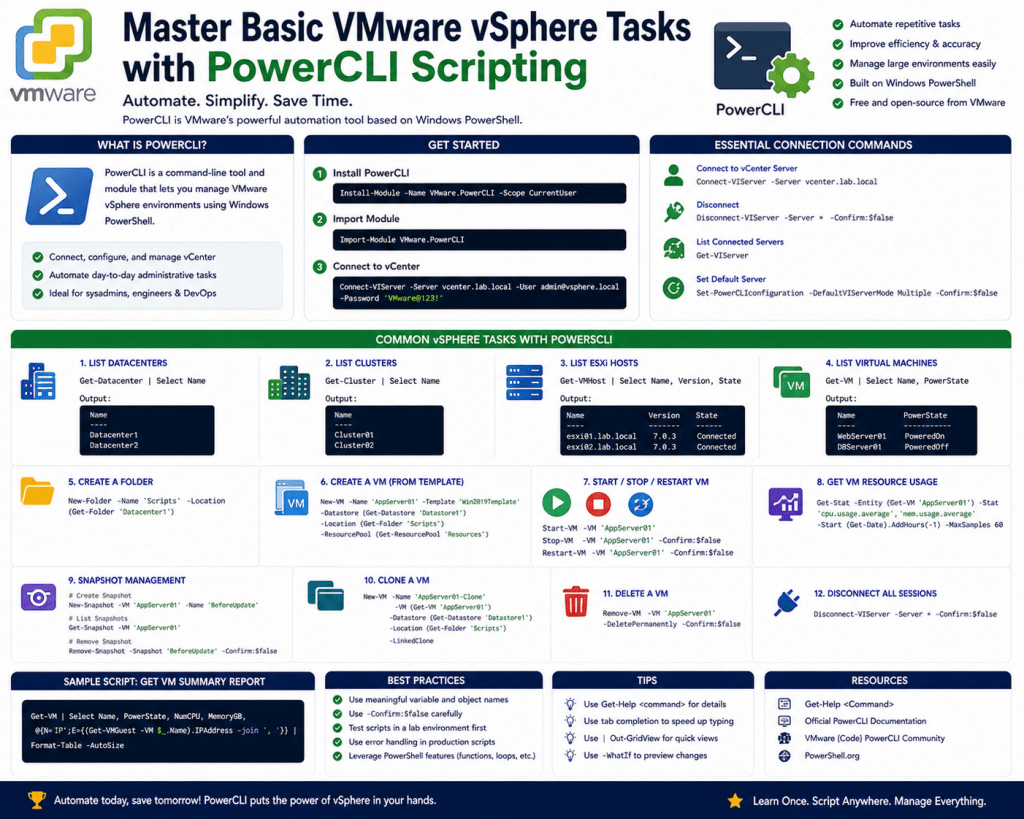
Virtualized infrastructure has become a foundational layer for modern computing because it allows multiple independent workloads to run on shared physical resources. As organizations scale their environments, the number of virtual machines, hosts, and storage systems increases rapidly. At that point, relying solely on graphical management tools begins to slow operations down because each task requires multiple manual interactions. Actions such as checking system health, reviewing resource allocation, or performing bulk updates become repetitive and time-consuming. Automation provides a structured alternative where tasks are defined once and executed consistently across the environment. This improves operational speed and reduces the likelihood of human error. In large-scale systems, automation is not just a convenience but a necessity for maintaining stability and efficiency.
Introduction to Scripting-Based System Control
Scripting introduces a method of system control where administrators define instructions in a logical sequence that can be executed without manual intervention. Instead of clicking through multiple interface layers, tasks are written as reusable scripts that can be executed repeatedly. This approach ensures consistency because the same script always performs the same operations in the same order. It also improves reliability in environments where configuration drift can lead to inconsistencies. Scripts can be reused across teams and adapted for different environments with minimal changes. This makes scripting a core skill in modern infrastructure management, especially in environments where speed and accuracy are critical.
Core Architecture of an Object-Based Command Environment
Modern automation systems are built on the concept of object-based processing rather than plain text output. Each command generates structured objects that contain multiple data fields and associated behaviors. These objects carry meaningful information such as system names, configuration values, and operational states. Because the data is structured, it can be directly consumed by other commands without requiring conversion or parsing. The pipeline mechanism enables these objects to flow from one command to another, creating a continuous processing chain. Each stage in the pipeline can refine, filter, or transform the data, allowing complex operations to be built from simple components. This architecture significantly increases flexibility in automation design.
Role of PowerShell in Modern Administrative Operations
PowerShell is a widely used automation framework designed for managing systems through structured command execution. It supports both interactive usage for immediate tasks and scripted execution for repeated or scheduled operations. Its command structure follows a consistent verb-noun format, which makes it easier to understand and apply. Unlike traditional command-line tools, PowerShell is built on a framework that processes structured objects, allowing deeper interaction with system components. This makes it suitable for managing complex infrastructures where multiple systems must be coordinated efficiently. Over time, it has become a standard tool for system administrators working in enterprise environments.
Extending PowerShell for Virtualization Management
While PowerShell is powerful on its own, it requires extensions to interact with virtualization platforms. These extensions provide specialized commands that connect PowerShell to virtualization APIs. Through this connection, administrators can manage virtual machines, hosts, storage systems, and network configurations. The commands are translated into API requests that the virtualization platform understands. This allows administrators to perform infrastructure operations directly from the command line without relying on graphical interfaces. The integration between PowerShell and virtualization systems creates a unified environment for automation and management.
Communication Between Automation Tools and Virtual Infrastructure
Automation tools interact with virtualization platforms through structured API communication. When a command is executed, it is converted into a request that is sent to the virtualization management system. The system processes this request and returns structured data in response. This communication model ensures that all operations are executed in a controlled and secure manner. It also allows for real-time retrieval and modification of infrastructure components. Because the interaction is based on APIs, it is consistent and scalable across large environments. This makes it possible to manage hundreds or even thousands of virtual machines efficiently.
Understanding Command Structure in Automation Frameworks
Commands in automation environments are designed with a consistent structure to improve clarity and usability. Each command performs a specific function, such as retrieving data or modifying configurations. This structured design allows administrators to quickly understand the purpose of a command without needing extensive documentation. Commands can also accept parameters that modify their behavior, allowing for flexible execution. This modular design makes it easier to combine multiple commands into complex workflows. As a result, automation scripts become more readable and maintainable over time.
Retrieving System Information from Virtual Environments
One of the primary uses of automation tools is retrieving detailed information about virtual infrastructure components. Commands can be used to list virtual machines, examine host systems, and review storage configurations. The output is returned as structured objects containing multiple attributes. These attributes include system names, power states, resource allocations, and performance metrics. Because the data is structured, it can be filtered and refined to display only relevant information. This makes it easier to analyze system conditions and identify operational patterns. In large environments, this capability is essential for maintaining visibility and control.
Data Interpretation Through Object Properties and Methods
Every object returned by an automation command contains properties that describe its characteristics. These properties can represent static configuration values or dynamic runtime states. In addition to properties, objects may include methods that allow actions to be performed directly on them. This combination of data and functionality provides a powerful way to interact with system components. Administrators can inspect objects to understand their full structure and capabilities. This deeper level of visibility enables more precise and effective automation design. It also reduces the need for manual interpretation of system data.
Refining Output Through Filtering Techniques
In large-scale environments, raw output data can become overwhelming due to the number of systems involved. Filtering techniques allow administrators to extract only relevant information from large datasets. By selecting specific attributes such as system name, status, or resource usage, the output becomes more focused and readable. This improves efficiency when analyzing system behavior or generating reports. Filtering also reduces processing overhead in automation scripts by limiting unnecessary data handling. It is a critical technique for managing complexity in virtual infrastructure environments.
Structuring Data for External Analysis and Reporting
Automation output is often used beyond the command-line environment for reporting and analysis purposes. Structured data can be transformed into formats that are compatible with external analysis tools. This enables administrators to perform historical tracking, performance analysis, and trend identification. Exported data may include system inventories, usage statistics, and configuration details. By integrating automation output with external analysis systems, organizations gain deeper insight into infrastructure behavior. This supports more informed decision-making and long-term planning.
Using Stored Variables for Efficient Workflow Management
Variables provide a way to store and reuse data within an automation session. When a command retrieves system information, the results can be stored in a variable for later use. This eliminates the need to repeatedly execute the same command. Stored data can be manipulated using filtering, sorting, and grouping operations. This allows for more efficient workflow design and reduces redundancy in scripts. Variables are particularly useful in complex automation scenarios where the same dataset is used across multiple operations.
Early Practical Applications in Virtual Infrastructure Automation
Early use cases of automation in virtual environments typically focus on basic operational tasks such as monitoring system status and retrieving inventory information. These tasks, when performed manually, require significant time and effort. Automation simplifies these processes by allowing them to be executed through predefined commands. Over time, these basic applications evolve into more advanced workflows that include automated provisioning, resource balancing, and scheduled maintenance. As automation maturity increases, administrators develop more sophisticated scripts that manage entire infrastructure environments with minimal manual intervention.
Expanding the Role of Automation in Large-Scale Virtual Infrastructure
As virtual environments grow beyond small clusters into enterprise-scale deployments, the complexity of managing them increases exponentially. Administrators are no longer dealing with a handful of virtual machines but with hundreds or even thousands of interconnected workloads distributed across multiple hosts and data centers. In such environments, manual management becomes inefficient and prone to inconsistencies. Automation emerges as the only sustainable approach to maintain control, visibility, and operational stability. It allows repetitive tasks to be executed consistently across the entire infrastructure without requiring manual intervention. This includes operations such as resource allocation, system monitoring, configuration validation, and lifecycle management of virtual machines. The shift toward automation also enables infrastructure teams to focus more on optimization and strategic planning rather than repetitive operational tasks. Over time, automation becomes deeply integrated into the operational model of virtual environments, forming the backbone of modern infrastructure management strategies.
Deep Dive into Object-Oriented Data Handling in Automation Systems
One of the most powerful aspects of modern automation frameworks is their ability to handle data as structured objects rather than unstructured text. Each command executed within the system returns an object that encapsulates multiple layers of information. These objects may include system metadata, configuration parameters, performance metrics, and relational information linking one system component to another. Because the data is structured, it can be directly passed between commands without requiring manual parsing or transformation. This object-oriented approach significantly reduces complexity in automation workflows. It also allows administrators to build highly granular queries that target specific properties within large datasets. For example, instead of retrieving all information about a virtual machine, a script can extract only the relevant attributes such as CPU allocation, memory usage, and host association. This level of precision makes automation not only more efficient but also more scalable as environments grow.
Pipeline Processing as a Foundation of Automation Workflows
The pipeline mechanism is a core concept in automation environments that enables sequential processing of structured data. Instead of executing isolated commands, pipelines allow the output of one command to be directly fed into another for further processing. This creates a continuous flow of data transformation where each stage refines or filters the information. For example, a command that retrieves a list of virtual machines can pass that list into another command that filters only running systems, which can then be passed into another command that extracts specific properties. This layered approach eliminates the need for intermediate storage or manual intervention. It also allows complex operations to be constructed from simple, reusable components. Pipeline processing is particularly valuable in large environments where efficiency and clarity are essential for managing large datasets.
Advanced Filtering and Conditional Data Selection Techniques
Filtering is a critical capability in automation systems because it allows administrators to isolate specific subsets of data from large datasets. In virtual environments, where thousands of objects may exist simultaneously, raw output is often too large to interpret effectively. Filtering mechanisms enable conditions to be applied to object properties so that only relevant results are returned. These conditions can be based on system state, resource usage, configuration attributes, or relational dependencies. Conditional filtering allows dynamic selection of objects based on real-time system conditions, which is especially useful in monitoring and automation scenarios. For instance, only virtual machines exceeding a certain resource threshold can be selected for further processing. This targeted approach reduces noise in data output and improves the efficiency of decision-making processes within automation workflows.
Multi-Level Data Transformation in Virtual Infrastructure Management
Automation systems support multi-level data transformation, where raw system data is progressively refined through multiple stages of processing. At the initial stage, raw objects are retrieved from the virtualization environment. These objects are then filtered based on specific criteria, followed by the selection of relevant properties. Additional transformation stages may involve sorting, grouping, or formatting the data for readability or external usage. Each transformation step adds structure and clarity to the dataset, making it easier to analyze and interpret. This layered processing approach is particularly useful when generating reports or performing infrastructure analysis. It allows administrators to start with a broad dataset and gradually narrow it down to highly specific insights without losing data integrity or context.
Automation in Virtual Machine Lifecycle Management
Virtual machines undergo multiple lifecycle stages, including creation, configuration, operation, maintenance, and decommissioning. Automation plays a crucial role in managing these lifecycle stages efficiently. During creation, automation scripts can define system specifications such as CPU allocation, memory size, and storage configuration. During operation, scripts can monitor system performance and adjust resources dynamically if needed. Maintenance tasks such as updates, patching, and backups can also be automated to ensure consistency across environments. When systems are no longer required, decommissioning processes can safely remove virtual machines while preserving necessary data. This lifecycle automation reduces manual workload and ensures standardized handling of virtual resources across the infrastructure.
Resource Optimization Through Automated Infrastructure Control
Resource optimization is one of the most important benefits of automation in virtual environments. Physical hardware resources such as CPU, memory, and storage must be distributed efficiently across virtual machines to ensure optimal performance. Automation enables continuous monitoring of resource usage and allows dynamic adjustments based on workload demands. For example, if a virtual machine experiences increased CPU usage, automation scripts can allocate additional resources or redistribute workloads across other hosts. This ensures balanced utilization of infrastructure resources and prevents performance bottlenecks. Automated optimization also reduces the need for manual intervention in routine capacity management tasks, allowing systems to operate more efficiently under varying workloads.
Standardization of Infrastructure Configuration Through Automation
Consistency is a critical requirement in large-scale virtual environments. Without standardization, configurations can drift over time, leading to inconsistencies and operational issues. Automation ensures that infrastructure components are deployed and configured using predefined templates and rules. This guarantees that all virtual machines and hosts adhere to consistent configuration standards. Standardization also simplifies troubleshooting because systems behave predictably across the environment. In addition, it enhances security by ensuring that all systems follow uniform policies and configurations. By enforcing standardization through automation, organizations reduce variability and improve overall system reliability.
Real-Time System Monitoring and Data Collection Automation
Monitoring is an essential aspect of infrastructure management, and automation significantly enhances its effectiveness. Automated monitoring systems continuously collect data from virtual machines and host systems without requiring manual intervention. This includes metrics such as CPU usage, memory consumption, disk activity, and network throughput. The collected data is processed in real time and can be used to trigger alerts or automated responses when certain thresholds are exceeded. This proactive approach helps identify potential issues before they impact system performance. It also reduces the need for manual monitoring, allowing administrators to focus on higher-level operational tasks.
Integration of Automation with Multi-Environment Virtual Deployments
In many organizations, virtual infrastructure spans multiple environments such as development, testing, staging, and production. Managing these environments consistently can be challenging without automation. Automation frameworks allow scripts and workflows to be applied uniformly across all environments while still allowing environment-specific configurations. This ensures that changes made in one environment can be replicated or adapted in others without manual duplication of effort. It also supports controlled deployment pipelines where updates are tested in non-production environments before being applied to production systems. This structured approach reduces risk and improves deployment reliability across the entire infrastructure ecosystem.
Scalability Considerations in Automated Virtual Infrastructure Management
Scalability is one of the key advantages of automation in virtual environments. As infrastructure grows, manual management becomes increasingly impractical due to the rising number of systems and dependencies. Automation enables consistent management regardless of scale by applying the same logic across all components. Whether managing ten virtual machines or ten thousand, the same automation framework can be used without modification to core logic. This scalability ensures that infrastructure operations remain efficient even as demand increases. It also allows organizations to expand their environments without proportionally increasing administrative overhead, making growth more manageable and predictable.
Error Reduction and Operational Consistency Through Automation Design
Human error is one of the most common causes of system misconfiguration and operational issues in manual environments. Automation reduces this risk by eliminating repetitive manual actions and replacing them with predefined, tested workflows. Each automated process follows a consistent sequence of steps, ensuring that operations are executed the same way every time. This consistency improves system reliability and reduces unexpected behavior caused by manual inconsistencies. Additionally, automated workflows can be tested in controlled environments before deployment, further reducing the likelihood of errors in production systems. Over time, this leads to more stable and predictable infrastructure behavior.
Evolution of Administrative Practices Through Automation Adoption
The adoption of automation fundamentally changes how infrastructure administration is performed. Instead of focusing on individual system management, administrators shift toward designing, maintaining, and optimizing automation workflows. This represents a transition from reactive management to proactive infrastructure design. Administrative tasks become more strategic, focusing on improving efficiency, scalability, and resilience. Automation also encourages documentation and standardization of processes, which improves knowledge sharing across teams. As automation practices mature, they become an integral part of infrastructure architecture, shaping how systems are deployed, managed, and evolved.
Advanced Automation Strategies in Enterprise Virtual Environments
As virtual infrastructure matures in enterprise environments, automation moves beyond basic operational tasks and becomes a strategic layer of system design. Instead of only retrieving information or performing isolated actions, automation begins to orchestrate entire workflows that span multiple systems and dependencies. These workflows are designed to handle complex operational scenarios such as workload balancing, disaster recovery preparation, and large-scale configuration updates. At this level, automation is no longer just a tool for efficiency but a structural component of infrastructure architecture. It ensures that systems behave predictably under changing conditions and that operational decisions can be executed consistently across distributed environments. This shift represents a transition from tactical scripting to strategic infrastructure orchestration, where automation defines how systems interact and evolve.
Orchestrating Multi-System Operations Through Scripted Logic
In large virtual environments, operations rarely involve a single system. Instead, actions often span multiple virtual machines, hosts, clusters, and storage layers. Automation enables these multi-system operations to be coordinated through scripted logic that defines relationships and dependencies between components. For example, starting an application may require powering on multiple virtual machines in a specific order, ensuring that database systems are initialized before application servers. Similarly, maintenance operations may require gracefully shutting down dependent services before performing updates on the underlying infrastructure. Scripted orchestration ensures that these sequences are executed correctly every time, eliminating the risk of human error or missed steps. This structured approach allows complex operational procedures to be standardized and repeated reliably across environments.
Dynamic Resource Allocation in Virtual Infrastructure
One of the most powerful capabilities enabled by automation is dynamic resource allocation. In traditional environments, resource allocation is often static, meaning that virtual machines are assigned fixed amounts of CPU, memory, and storage. However, workloads in modern environments are rarely static and often fluctuate based on demand. Automation enables systems to monitor resource consumption in real time and adjust allocations accordingly. When a virtual machine experiences increased demand, additional resources can be provisioned automatically. Conversely, when demand decreases, resources can be reclaimed and redistributed to other workloads. This dynamic balancing ensures optimal utilization of physical infrastructure and reduces resource wastage. It also improves overall system performance by ensuring that critical workloads always have access to sufficient resources.
Automated Incident Detection and Response Mechanisms
Incident management is a critical aspect of infrastructure operations, and automation plays a key role in improving response times and reducing downtime. Automated monitoring systems continuously analyze system metrics and detect anomalies such as performance degradation, resource exhaustion, or connectivity failures. When predefined thresholds are exceeded, automated response mechanisms can be triggered. These responses may include restarting services, reallocating resources, or isolating affected systems for further investigation. By reducing the time between detection and response, automation minimizes the impact of incidents on end users. It also reduces the dependency on manual intervention, allowing systems to self-correct in many common failure scenarios.
Infrastructure Scaling Through Automated Provisioning
Scaling virtual infrastructure manually can be time-consuming and error-prone, especially when dealing with large numbers of systems. Automation simplifies this process by enabling automated provisioning of virtual machines and infrastructure components. Templates define the standard configuration for systems, including operating system settings, resource allocations, and network configurations. When new workloads are required, these templates can be deployed automatically, ensuring consistency across all instances. Automated provisioning also supports rapid scaling in response to changing demand, allowing infrastructure to expand or contract dynamically. This capability is essential in environments where workloads fluctuate frequently, and rapid deployment is required to maintain service availability.
Policy-Based Infrastructure Management Models
Automation enables the implementation of policy-based management, where system behavior is governed by predefined rules rather than manual intervention. Policies define how systems should behave under specific conditions, such as resource thresholds, security requirements, or operational constraints. For example, a policy may specify that virtual machines exceeding a certain memory usage threshold should be migrated to less-utilized hosts. These policies are continuously evaluated by automation systems, which enforce compliance without manual oversight. This approach ensures that infrastructure remains aligned with organizational standards and operational goals. It also reduces the complexity of managing large environments by abstracting decision-making into rule-based systems.
Continuous Configuration Validation and Compliance Enforcement
Maintaining a consistent configuration across virtual environments is essential for stability and security. Automation enables continuous validation of system configurations against predefined standards. Systems are regularly scanned to ensure compliance with configuration policies, and deviations are automatically detected. When inconsistencies are identified, automated correction mechanisms can be triggered to restore systems to their desired state. This continuous validation process ensures that infrastructure remains stable over time and reduces configuration drift caused by manual changes. It also supports regulatory compliance by ensuring that systems adhere to required standards at all times.
Automation in Virtual Network Management
Virtual networks are a critical component of modern infrastructure, and automation plays a significant role in managing them efficiently. Network configurations such as routing rules, firewall settings, and segmentation policies can be defined and applied through automation workflows. This ensures consistency across all networked systems and reduces the risk of misconfiguration. Automated network management also enables dynamic adjustments based on workload requirements, allowing network resources to adapt to changing traffic patterns. In large environments, this level of automation is essential for maintaining performance and security across distributed systems.
Storage Optimization Through Automated Management Systems
Storage systems in virtual environments must be managed efficiently to ensure optimal performance and capacity utilization. Automation enables continuous monitoring of storage usage and performance metrics. Based on this data, systems can automatically adjust storage allocations, migrate data between storage tiers, or trigger cleanup processes to reclaim unused space. This ensures that storage resources are used efficiently and that performance remains consistent across workloads. Automated storage management also reduces the risk of storage bottlenecks and helps maintain system stability in high-demand environments.
Multi-Environment Synchronization and Configuration Replication
Organizations often operate multiple virtual environments, such as development, testing, staging, and production. Maintaining consistency across these environments is a complex challenge. Automation enables synchronization of configurations and workflows across multiple environments, ensuring that changes are consistently applied. This includes replicating system configurations, deploying standardized templates, and synchronizing policy definitions. By maintaining consistency across environments, automation reduces discrepancies and ensures that systems behave predictably throughout the development and deployment lifecycle.
Security Automation in Virtual Infrastructure Systems
Security is a critical concern in virtualized environments, and automation plays a key role in maintaining secure operations. Automated security systems continuously monitor infrastructure for vulnerabilities, unauthorized access attempts, and policy violations. When security issues are detected, automated responses can be triggered to mitigate risks. These responses may include isolating affected systems, applying security patches, or updating firewall rules. Automation also ensures that security policies are consistently enforced across all systems, reducing the risk of human error in security configuration.
Performance Optimization Through Continuous Analysis
Automation enables continuous performance analysis of virtual infrastructure systems. By collecting and analyzing performance metrics in real time, systems can identify inefficiencies and adjust configurations accordingly. This may include redistributing workloads, adjusting resource allocations, or optimizing system parameters. Continuous performance optimization ensures that infrastructure operates at peak efficiency and adapts dynamically to changing workload conditions. It also reduces the need for manual performance tuning, allowing systems to self-optimize based on observed behavior.
Automation in Disaster Recovery Planning and Execution
Disaster recovery is a critical aspect of infrastructure management, and automation significantly improves its effectiveness. Automated disaster recovery systems can replicate virtual machines, synchronize data across locations, and maintain standby environments ready for activation. In the event of a failure, automated workflows can initiate recovery procedures, restoring services with minimal downtime. This reduces reliance on manual intervention during critical situations and ensures faster recovery times. Automation also enables regular testing of disaster recovery plans, ensuring that they remain effective and up to date.
Lifecycle Automation for Long-Term Infrastructure Stability
Beyond initial deployment and operation, virtual systems require ongoing lifecycle management. Automation supports the entire lifecycle of infrastructure components, from creation to decommissioning. Systems can be automatically provisioned, monitored, updated, and eventually retired based on predefined policies. This ensures that infrastructure remains efficient and free from outdated or unused components. Lifecycle automation also helps maintain organizational governance by ensuring that systems follow standardized processes throughout their operational life.
Integration of Automation with Hybrid and Distributed Environments
Modern infrastructure often spans multiple environments, including on-premises systems and distributed or hybrid architectures. Automation enables seamless integration across these environments by providing consistent management interfaces and workflows. This allows administrators to manage diverse systems using a unified automation framework. It also ensures that policies and configurations are applied consistently regardless of where systems are located. This level of integration is essential for maintaining control and visibility in complex distributed infrastructures.
Conclusion
The evolution of virtual infrastructure management has fundamentally changed how modern computing environments are operated, maintained, and scaled. What began as a primarily graphical, manually driven process has gradually shifted toward a model where automation defines the structure and behavior of entire systems. This shift is not simply a matter of convenience but a response to the increasing complexity, scale, and performance demands of enterprise environments. As organizations expand their use of virtualization technologies, the limitations of manual administration become more visible, particularly when dealing with large numbers of virtual machines, distributed workloads, and rapidly changing operational requirements. Automation through scripting and command-driven frameworks provides a structured alternative that ensures consistency, repeatability, and scalability across all layers of infrastructure.
One of the most important transformations introduced by automation is the way administrators interact with systems. Instead of performing repetitive tasks through graphical interfaces, infrastructure management is now increasingly defined by logic-based instructions that can be executed across entire environments. This approach reduces dependency on manual execution and shifts focus toward designing workflows that reflect operational intent. These workflows can manage everything from system provisioning and configuration to monitoring and optimization. As a result, infrastructure teams are able to operate at a higher level of abstraction, concentrating on outcomes rather than individual steps.
Another significant advantage of automation in virtual environments is its ability to enforce consistency. In large-scale systems, even minor inconsistencies in configuration can lead to performance issues, security vulnerabilities, or operational instability. Manual processes inherently introduce variability due to human error, oversight, or differences in execution style. Automation eliminates much of this variability by ensuring that predefined processes are followed the same way every time. This consistency becomes especially important in environments where systems must adhere to strict operational or regulatory standards. By encoding best practices directly into automation workflows, organizations can maintain a stable and predictable infrastructure.
Scalability is another area where automation demonstrates clear advantages. As infrastructure grows, the complexity of managing individual components increases exponentially. Tasks that are manageable in small environments become impractical when applied at scale. Automation allows the same operational logic to be applied regardless of the environment size. Whether managing a small cluster or a globally distributed infrastructure, automated workflows can execute uniformly without requiring additional manual effort. This makes it possible for organizations to expand their virtual environments without proportionally increasing administrative workload. In many cases, automation becomes the only viable method for maintaining operational control at scale.
The role of data handling in automation further enhances its effectiveness. Modern automation frameworks treat system information as structured data rather than simple textual output. This allows for more precise interaction with infrastructure components and enables advanced filtering, transformation, and analysis of system states. Instead of manually interpreting large volumes of data, administrators can define rules that automatically extract relevant information. This structured approach not only improves efficiency but also enables more sophisticated decision-making processes. Systems can be designed to react dynamically to changing conditions, adjusting configurations or triggering actions based on real-time data.
Automation also plays a critical role in improving system reliability and reducing downtime. In traditional environments, detecting and responding to system issues often relies on manual monitoring and intervention. This introduces delays that can significantly impact system availability and performance. Automated monitoring systems continuously analyze infrastructure health and can respond to issues immediately when they arise. These responses may include restarting services, reallocating resources, or isolating affected components. By reducing the time between detection and response, automation minimizes the impact of failures and improves overall system resilience.
Another important aspect of automation is its contribution to operational efficiency. Repetitive administrative tasks such as system updates, resource allocation, and configuration changes can consume significant amounts of time when performed manually. Automation removes much of this burden by enabling these tasks to be executed programmatically. This allows administrators to focus on higher-level responsibilities such as infrastructure design, optimization, and strategic planning. Over time, this shift leads to more efficient use of human resources and improved overall productivity within IT teams.
Security is also significantly enhanced through the use of automation. In complex environments, maintaining consistent security configurations across all systems is a major challenge. Manual security management increases the risk of misconfigurations, outdated settings, and inconsistent policy enforcement. Automation ensures that security policies are applied uniformly and continuously across all systems. It also enables real-time detection of security anomalies and rapid response to potential threats. Automated security workflows can enforce compliance, apply patches, and isolate compromised systems without requiring manual intervention, reducing the overall attack surface of the infrastructure.
In addition to operational benefits, automation also supports better long-term infrastructure planning. By collecting and analyzing historical data, organizations can identify usage trends, performance patterns, and capacity requirements. This information can be used to make informed decisions about resource allocation, infrastructure expansion, and system optimization. Automation tools can continuously gather this data without disrupting normal operations, ensuring that planning decisions are based on accurate and up-to-date information.
The integration of automation into virtual environments also changes the role of infrastructure administrators. Rather than focusing primarily on manual system management, administrators increasingly act as designers and maintainers of automation frameworks. This involves creating scripts, defining workflows, and establishing policies that govern system behavior. As a result, the skill set required for modern infrastructure management is shifting toward programming, systems thinking, and process design. This evolution reflects the growing importance of automation as a foundational component of IT operations.
Despite its advantages, automation also requires careful design and implementation. Poorly designed automation workflows can lead to unintended consequences, especially in production environments. This makes testing, validation, and governance critical components of any automation strategy. Systems must be carefully evaluated before deployment to ensure that they behave as expected under different conditions. Additionally, monitoring and auditing mechanisms are necessary to maintain visibility into automated processes and ensure accountability.
Ultimately, automation represents a fundamental transformation in how virtual infrastructure is managed. It replaces manual, repetitive tasks with structured, repeatable processes that scale efficiently across complex environments. It enhances consistency, improves reliability, strengthens security, and enables more efficient use of resources. As virtual environments continue to grow in size and complexity, the importance of automation will only increase. It is becoming not just a tool for efficiency, but a core architectural principle that defines how modern infrastructure systems are built and operated.