Modern cloud infrastructure relies heavily on identity verification and encrypted communication to protect data and services. As organizations move applications, workloads, and services into cloud platforms, the need for strong authentication mechanisms becomes more critical. One of the most widely used mechanisms for securing digital communication is the digital certificate. These certificates form the backbone of secure interactions between systems by ensuring that identities can be verified and data exchange remains protected from unauthorized access or tampering.
In cloud environments, certificate management is no longer a manual task handled by isolated administrators. Instead, it has evolved into a structured, automated process integrated into centralized security services. This shift is driven by the increasing complexity of distributed systems, where multiple applications, microservices, and APIs constantly communicate across networks. Without centralized certificate management, maintaining trust across these systems would be highly inefficient and prone to errors.
Understanding Digital Certificates and Their Role in Identity Validation
A digital certificate is an electronic credential that binds a public key to an identity. This identity can represent a user, a device, a server, or an application. The purpose of this binding is to establish trust during communication between systems. When one system presents a certificate to another, it is essentially proving its identity through cryptographic validation.
The certificate contains structured information such as the identity of the owner, the issuing authority, the validity period, and a public key used for encryption. The corresponding private key remains securely stored and is never shared. This separation of keys ensures that even if communication is intercepted, the encrypted data cannot be decrypted without the private key.
The validation process involves verifying the certificate’s authenticity through a trusted authority. If the certificate is issued by a recognized and trusted entity, it is accepted. If not, the communication is rejected or flagged as untrusted. This mechanism forms the foundation of secure communication protocols used across the internet and enterprise systems.
Public Key Infrastructure and Its Importance in Certificate Management
Public Key Infrastructure serves as the underlying framework that enables the creation, distribution, validation, and revocation of digital certificates. It defines the trust hierarchy that ensures only legitimate entities are issued certificates.
Within this structure, Certificate Authorities play a critical role. They are responsible for verifying identities before issuing certificates. Once issued, certificates become part of a trust chain that can be traced back to a root authority. This hierarchical structure ensures that trust is not arbitrary but based on validated relationships between entities.
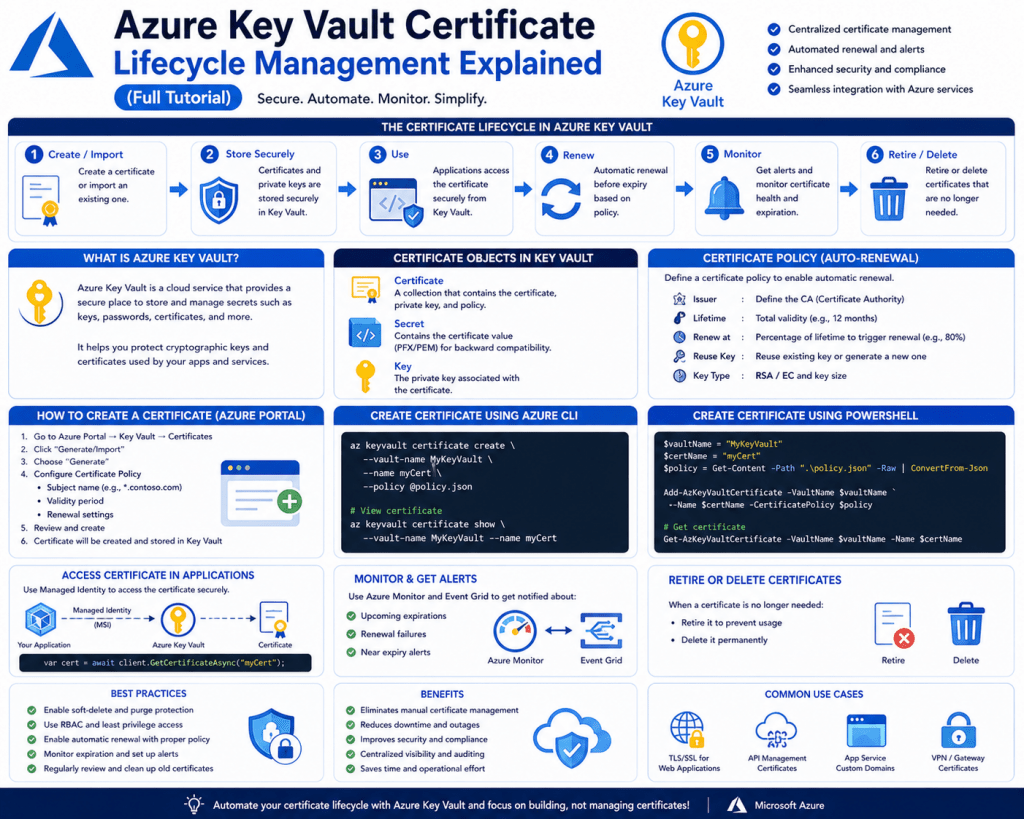
The lifecycle of a certificate within Public Key Infrastructure includes multiple stages. It begins with the generation of a key pair, followed by the creation of a certificate signing request. The Certificate Authority validates the request and issues the certificate. After issuance, the certificate is deployed to services where it is used for authentication and encryption. Over time, it must be renewed or revoked depending on its validity status or security requirements.
Managing this lifecycle manually in large-scale environments is inefficient and error-prone. This is why automated systems are essential in modern cloud platforms.
Challenges of Manual Certificate Management in Distributed Systems
In traditional IT environments, certificates were often managed manually by system administrators. This involved generating certificates, tracking expiration dates, and renewing them before they expired. While this approach may work for small systems, it becomes highly inefficient in cloud-based distributed architectures.
Modern applications often rely on dozens or even hundreds of certificates across different services. Each certificate has its own lifecycle, dependencies, and security requirements. Manually tracking all of these elements introduces a high risk of human error, which can lead to expired certificates, service outages, or security vulnerabilities.
Another challenge is visibility. Without centralized management, it becomes difficult to track where certificates are deployed and how they are being used. This lack of visibility can result in unmanaged certificates remaining active long after they are needed, increasing the attack surface.
Automation and centralized control are therefore essential to ensure consistency, reliability, and security in certificate management processes.
Introduction to Centralized Certificate Management in Cloud Platforms
Cloud platforms address these challenges by providing centralized services for managing cryptographic assets. These services allow organizations to store, manage, and control access to certificates from a single location. This approach simplifies operations and improves security governance.
Centralized certificate management systems provide several advantages. They allow administrators to define access policies, automate certificate renewal, and monitor usage patterns. They also integrate with identity management systems, ensuring that only authorized users or applications can access certificate resources.
By centralizing certificate management, organizations reduce operational complexity while improving security posture. This is particularly important in environments where applications are dynamically deployed and scaled.
Role of Azure Key Vault in Certificate Lifecycle Management
Azure Key Vault is a centralized security service designed to manage sensitive information such as certificates, cryptographic keys, and secrets. It provides a secure environment where these assets can be created, stored, and managed throughout their lifecycle.
In the context of certificate management, Azure Key Vault acts as a secure repository and control plane. It allows certificates to be generated or imported and ensures that their private keys remain protected. Access to certificates is governed by strict identity-based policies, ensuring that only authorized entities can perform operations on them.
The service also supports automation capabilities, enabling certificates to be renewed and rotated without manual intervention. This reduces the risk of expired certificates disrupting services and ensures continuous security compliance.
Integration with other cloud services allows applications to retrieve certificates securely when needed. This eliminates the need to embed sensitive credentials within application code or configuration files.
Structure and Components Within a Secure Certificate Storage System
A secure certificate management system consists of several key components that work together to maintain trust and security. These include certificate objects, key pairs, access policies, and lifecycle management rules.
Certificate objects represent the actual digital certificates stored within the system. They contain metadata such as issuer information, validity period, and associated cryptographic keys. Key pairs consist of a public key used for encryption and a private key used for decryption and signing operations.
Access policies define which identities are allowed to perform specific actions on certificates. These actions may include creation, retrieval, deletion, or renewal. By enforcing strict access control, the system ensures that sensitive cryptographic assets are protected from unauthorized access.
Lifecycle management rules define how certificates are handled over time. These rules may include automatic renewal schedules, expiration notifications, and revocation procedures. Proper lifecycle management ensures that certificates remain valid and secure throughout their usage period.
Certificate Authorities and Trust Hierarchies in Secure Communication
Certificate Authorities are trusted entities responsible for issuing and validating digital certificates. They form the foundation of trust in Public Key Infrastructure systems. Before issuing a certificate, a Certificate Authority verifies the identity of the requesting entity to ensure legitimacy.
Once issued, the certificate becomes part of a trust chain. This chain typically includes intermediate authorities and a root authority. The root authority is inherently trusted by systems and serves as the anchor of the trust hierarchy.
When a certificate is presented during communication, the receiving system verifies the entire chain to ensure authenticity. If any part of the chain is invalid or untrusted, the certificate is rejected. This process ensures that only verified entities can establish secure communication channels.
Importance of Secure Storage and Access Control for Certificates
Storing certificates securely is essential for maintaining the integrity of encrypted communication systems. If certificates or their private keys are exposed, attackers can impersonate legitimate services and gain unauthorized access to sensitive data.
Secure storage systems use encryption and strict access controls to protect certificate assets. Encryption ensures that even if storage is compromised, the data remains unreadable without proper authorization. Access controls ensure that only authorized identities can retrieve or manage certificates.
Audit logging is another important aspect of secure storage. It provides visibility into who accessed certificates and when those actions occurred. This helps in detecting suspicious activity and maintaining compliance with security policies.
Initial Configuration Considerations for Certificate Management Systems
Setting up a secure certificate management system requires careful planning and configuration. The first step involves defining the structure of certificate storage, including how certificates will be organized and categorized.
Organizational structure may be based on applications, environments, or functional roles. This helps in managing certificates efficiently and reduces complexity as the system scales.
Access policies must be defined to control who can interact with certificate assets. These policies should follow the principle of least privilege, ensuring that users and applications only have access to the resources they need.
Lifecycle rules should also be established early to automate renewal and expiration processes. This ensures that certificates remain valid without requiring manual intervention and reduces the risk of service disruption due to expired certificates.
Setting Up a Secure Foundation for Certificate Management
Establishing a reliable certificate management process begins with building a secure and well-structured environment. In cloud platforms, this involves creating a centralized vault where certificates, keys, and secrets can be stored and controlled. A properly configured vault acts as the foundation for all certificate-related operations, ensuring that sensitive cryptographic assets are protected from unauthorized access while remaining accessible to trusted services.
The setup process typically includes defining resource boundaries, selecting appropriate regions for deployment, and configuring identity-based access controls. These decisions directly influence the performance, availability, and security of certificate operations. A well-designed foundation ensures that certificate management remains scalable and resilient as workloads grow.
Creating and Structuring a Key Vault for Certificate Storage
When creating a vault, it is important to organize it in a way that aligns with the structure of applications and environments. Certificates can be grouped based on usage, such as separating production, staging, and development environments. This segmentation reduces risk by preventing accidental misuse of certificates across different environments.
Naming conventions also play a critical role in maintaining clarity. Consistent naming allows administrators to quickly identify the purpose and ownership of each certificate. This becomes increasingly important in large deployments where hundreds of certificates may exist simultaneously.
Access control should be defined during the creation stage. Permissions can be assigned to users, applications, or managed identities, ensuring that only authorized entities can perform actions such as creating, retrieving, or deleting certificates. Properly configured access control reduces the risk of unauthorized modifications and strengthens overall security.
Navigating the Certificate Management Interface
Once the vault is created, administrators interact with it through a management interface that provides access to all certificate-related functions. This interface typically includes options for viewing existing certificates, creating new ones, importing external certificates, and managing certificate authorities.
Understanding how to navigate this interface is essential for efficient management. Each section is designed to provide visibility into specific aspects of certificate operations. For example, the certificates section displays all stored certificates along with their status, expiration dates, and associated metadata.
The interface also allows administrators to monitor certificate activity and identify potential issues such as nearing expiration dates or failed renewal attempts. This visibility ensures that problems can be addressed before they impact system functionality.
Generating New Certificates Within the Vault
Creating a new certificate involves defining a set of parameters that determine how the certificate will be issued and managed. These parameters include the certificate name, subject information, validity period, and key properties. Administrators can also specify whether the certificate should be issued by a trusted authority or be self-signed.
The process is typically guided by a step-by-step configuration workflow. During this process, administrators can define policies that control the lifecycle of the certificate. These policies may include automatic renewal settings, key usage restrictions, and exportability options.
Once the configuration is complete, the system generates the certificate and stores it securely within the vault. The private key remains protected, while the public portion of the certificate can be distributed to services that require it.
Importing Existing Certificates into the Vault
In addition to generating new certificates, the vault also supports importing certificates that were created externally. This is particularly useful when migrating existing systems into a cloud environment or when using certificates issued by external authorities.
The import process requires the certificate file and its associated private key. During import, administrators can define additional settings such as access policies and lifecycle rules. This ensures that imported certificates are managed consistently with those generated within the vault.
Proper handling of imported certificates is essential to maintain security. The private key must be transferred securely, and access should be restricted to authorized entities only. Once imported, the certificate becomes part of the centralized management system and can be monitored and maintained accordingly.
Understanding Certificate Policies and Their Role
Certificate policies define the rules and parameters governing how certificates are created and managed. These policies act as templates that ensure consistency across certificate operations. By using policies, administrators can standardize configurations and reduce the likelihood of errors.
Policies typically include settings for key size, encryption algorithms, validity periods, and renewal thresholds. They may also define how certificates are issued, whether through an integrated authority or a manual approval process.
Using policies simplifies the management process by allowing administrators to apply predefined configurations to multiple certificates. This is particularly useful in large environments where consistency is critical for maintaining security and compliance.
Configuring Certificate Authorities for Trusted Issuance
For certificates to be trusted, they must be issued by recognized authorities. Configuring these authorities within the vault allows administrators to request and manage certificates directly from trusted sources. This integration streamlines the issuance process and ensures that certificates meet industry standards.
When adding a certificate authority, administrators must provide account details and authentication credentials. Once configured, the authority can be used to issue certificates automatically based on defined policies.
This integration eliminates the need for manual certificate requests and reduces the time required to deploy secure communication channels. It also ensures that certificates are consistently issued by trusted sources, maintaining the integrity of the trust chain.
Managing Certificate Lifecycle and Expiration Policies
Certificates have a defined validity period, after which they expire and must be renewed. Managing this lifecycle is critical to ensuring uninterrupted service availability. Expired certificates can cause communication failures and disrupt application functionality.
Lifecycle management involves monitoring certificate status, setting renewal thresholds, and automating the renewal process. By configuring automatic renewal, administrators can ensure that certificates are replaced before they expire, reducing the risk of downtime.
Expiration policies can also include notifications that alert administrators when certificates are nearing the end of their validity period. These alerts provide an additional layer of assurance, allowing manual intervention if necessary.
Proper lifecycle management ensures that certificates remain valid and secure throughout their usage, maintaining trust between systems.
Implementing Access Control for Certificate Operations
Access control is a fundamental aspect of certificate management. It ensures that only authorized users and services can interact with certificate resources. Without proper access control, sensitive cryptographic assets could be exposed or misused.
Access policies can be defined at various levels, allowing granular control over specific actions. For example, some users may have permission to view certificates but not modify them, while others may be allowed to create or delete certificates.
Role-based access control simplifies the management of permissions by assigning predefined roles to users and services. This approach ensures consistency and reduces the complexity of managing individual permissions.
Enforcing strict access control helps maintain the integrity of the certificate management system and prevents unauthorized actions.
Monitoring Certificate Usage and Activity Logs
Monitoring is essential for maintaining visibility into certificate operations. Activity logs provide detailed information about actions performed on certificates, including creation, retrieval, modification, and deletion.
These logs help administrators track usage patterns and identify potential security issues. For example, unexpected access attempts or unusual activity may indicate a security breach or misconfiguration.
Regular monitoring also supports compliance requirements by providing an audit trail of certificate-related actions. This is particularly important in regulated environments where strict security standards must be maintained.
By analyzing activity logs, administrators can gain insights into how certificates are used and ensure that management practices align with security policies.
Automating Certificate Renewal and Rotation Processes
Automation is a key advantage of modern certificate management systems. By automating renewal and rotation processes, administrators can reduce manual effort and minimize the risk of errors.
Automated renewal ensures that certificates are replaced before they expire, maintaining continuous service availability. Rotation processes involve updating certificates periodically to enhance security and reduce the risk of compromise.
Automation can be configured through policies that define when and how certificates should be renewed or rotated. These policies ensure that all certificates follow consistent management practices.
Implementing automation not only improves efficiency but also strengthens security by ensuring that certificates are always up to date.
Handling Certificate Revocation and Replacement
In some cases, certificates must be revoked before their expiration date. This may occur if a private key is compromised or if the certificate is no longer needed. Revocation ensures that the certificate can no longer be used for authentication or encryption.
The revocation process involves updating the certificate’s status and notifying relevant systems to reject it. This prevents unauthorized use and maintains the integrity of secure communication channels.
Replacement involves issuing a new certificate to take the place of the revoked one. This ensures continuity of service while addressing the underlying security issue.
Proper handling of revocation and replacement is essential for maintaining trust and preventing security breaches.
Integrating Certificates with Applications and Services
Certificates are only useful when they are integrated into applications and services. This integration allows systems to use certificates for authentication, encryption, and secure communication.
Applications can retrieve certificates from the vault using secure identity mechanisms. This eliminates the need to store certificates locally, reducing the risk of exposure.
Integration also enables dynamic updates, allowing applications to use renewed certificates without requiring manual configuration changes. This improves reliability and simplifies management.
By integrating certificates with applications, organizations can ensure that all communication remains secure and aligned with centralized management practices.
Ensuring High Availability and Redundancy for Certificate Services
High availability is critical for certificate management systems, as any disruption can impact multiple applications and services. Cloud platforms provide built-in redundancy to ensure that certificate storage and management remain accessible even during failures.
Redundancy involves replicating data across multiple locations, ensuring that certificates can be retrieved even if one location becomes unavailable. This enhances reliability and supports continuous operations.
Designing for high availability also includes planning for failover scenarios and ensuring that applications can continue functioning during disruptions. This requires careful configuration and testing of certificate retrieval mechanisms.
By ensuring high availability, organizations can maintain uninterrupted, secure communication across all systems.
Optimizing Certificate Management for Large-Scale Environments
As organizations scale their cloud infrastructure, certificate management becomes increasingly complex. Large-scale environments may involve thousands of certificates across multiple applications and regions.
Optimizing management processes involves standardizing policies, automating routine tasks, and implementing monitoring systems that provide real-time insights. These practices help maintain consistency and reduce operational overhead.
Segmentation strategies can also be used to organize certificates based on specific criteria such as application type or geographic location. This improves manageability and ensures that certificates are easily identifiable.
Continuous optimization ensures that certificate management remains efficient and secure as the environment evolves.
Evolving Role of Certificate Management in Modern Cloud Security
As cloud environments continue to grow in complexity, certificate management has evolved from a simple administrative task into a strategic component of overall security architecture. Organizations are no longer dealing with a handful of certificates tied to static servers. Instead, they are managing dynamic infrastructures where services are deployed, scaled, and retired continuously. In such environments, certificates must be provisioned, validated, and rotated in near real time to maintain trust across all communication channels.
This shift has increased the importance of automation, governance, and integration in certificate management systems. A robust strategy ensures that certificates are not only secure but also aligned with operational requirements. Without a well-defined approach, organizations risk service disruptions, compliance violations, and exposure to security threats.
Designing a Scalable Certificate Management Architecture
A scalable certificate management architecture is essential for handling growth in cloud environments. As the number of applications and services increases, so does the demand for certificates. Designing for scalability involves creating a structure that can accommodate this growth without compromising performance or security.
One of the key elements of scalability is segmentation. Certificates can be organized based on environments such as development, testing, and production. This separation ensures that changes in one environment do not impact others and reduces the risk of accidental misuse. Additionally, segmentation allows for more precise access control, enabling administrators to grant permissions based on specific roles and responsibilities.
Another important factor is standardization. By defining consistent policies for certificate creation, renewal, and usage, organizations can ensure uniformity across all systems. This reduces complexity and makes it easier to manage certificates at scale.
Strengthening Security Through Certificate Governance Policies
Governance plays a crucial role in maintaining the integrity of certificate management systems. It involves defining rules and guidelines that dictate how certificates are handled throughout their lifecycle. These policies ensure that all certificate-related activities align with organizational security standards.
Governance policies typically include requirements for key length, encryption algorithms, and validity periods. They may also define procedures for certificate issuance, renewal, and revocation. By enforcing these policies, organizations can reduce the risk of weak or misconfigured certificates being deployed.
Another aspect of governance is compliance. Many industries have strict regulations regarding data protection and encryption. Proper certificate management helps organizations meet these requirements by ensuring that secure communication protocols are consistently implemented.
Implementing Zero Trust Principles with Certificate-Based Authentication. Zero-trust security models emphasize the importance of verifying every request, regardless of its origin. In this model, certificates play a vital role in establishing trust between systems. Instead of relying on network boundaries, zero-trust architectures use strong authentication mechanisms to validate identities.
Certificate-based authentication is particularly effective in this context. It provides a secure and reliable method for verifying the identity of users, devices, and services. By requiring certificates for access, organizations can ensure that only authorized entities can interact with critical resources.
Implementing zero trust principles involves integrating certificate management systems with identity and access controls. This integration allows for continuous verification and reduces the risk of unauthorized access.
Automating Security Operations for Certificate Management
Automation is a cornerstone of modern cloud security practices. In certificate management, automation reduces the need for manual intervention and minimizes the risk of human error. Automated processes can handle tasks such as certificate issuance, renewal, and revocation, ensuring that certificates remain valid and secure at all times.
Automation also enables faster response to security incidents. For example, if a certificate is compromised, automated systems can revoke it immediately and issue a replacement. This rapid response helps contain potential threats and maintain system integrity.
In addition to improving efficiency, automation supports consistency. By applying predefined policies to all certificate operations, organizations can ensure that security standards are uniformly enforced.
Managing Secrets, Keys, and Certificates Together for Unified Security
Certificates are often used in conjunction with other sensitive assets such as secrets and cryptographic keys. Managing these assets together provides a unified approach to security, allowing organizations to maintain control over all critical components in one place.
This unified management approach simplifies operations by reducing fragmentation. Instead of using separate systems for different types of sensitive data, organizations can rely on a centralized solution that provides consistent security controls.
Integration between certificates, keys, and secrets also enhances security by enabling coordinated lifecycle management. For example, when a certificate is rotated, associated keys and secrets can be updated simultaneously. This ensures that all components remain synchronized and secure.
Enhancing Visibility with Monitoring and Auditing Practices
Visibility is essential for effective certificate management. Without proper monitoring, it becomes difficult to detect issues such as expired certificates, unauthorized access attempts, or misconfigurations. Monitoring systems provide real-time insights into certificate status and usage, allowing administrators to take proactive measures.
Auditing complements monitoring by providing a historical record of certificate-related activities. Audit logs capture details such as who accessed a certificate, when it was modified, and what actions were performed. This information is invaluable for troubleshooting, compliance, and forensic analysis.
By combining monitoring and auditing, organizations can maintain a comprehensive view of their certificate management processes and ensure that security policies are being followed.
Addressing Common Security Risks in Certificate Management
Despite the benefits of centralized management, certificate systems are not immune to risks. One common issue is the exposure of private keys, which can lead to unauthorized access and data breaches. Protecting private keys is therefore a top priority in any certificate management strategy.
Another risk is the use of weak or outdated encryption algorithms. As cryptographic standards evolve, older algorithms may become vulnerable to attacks. Regular updates and adherence to current standards are essential to maintaining security.
Expired certificates also pose a significant risk. If a certificate expires without being renewed, it can disrupt communication and cause service outages. Automated renewal processes help mitigate this risk by ensuring that certificates are replaced before they expire.
Optimizing Certificate Rotation and Renewal Strategies
Certificate rotation is the process of replacing certificates at regular intervals to enhance security. Frequent rotation reduces the window of opportunity for attackers to exploit compromised certificates. However, it must be carefully managed to avoid disruptions.
Effective rotation strategies involve balancing security and operational efficiency. Shorter validity periods increase security but require more frequent renewals. Longer periods reduce operational overhead but may increase risk.
Automation plays a key role in optimizing rotation strategies. By scheduling renewals and integrating them with application workflows, organizations can ensure seamless transitions between certificates. This minimizes downtime and maintains continuous security.
Integrating Certificate Management with DevOps Practices
In modern development environments, DevOps practices emphasize continuous integration and continuous deployment. Certificate management must align with these practices to support rapid application development and deployment.
Integration with DevOps pipelines allows certificates to be provisioned and configured automatically as part of the deployment process. This ensures that applications are always equipped with the necessary security credentials.
Infrastructure as code can also be used to define certificate management configurations. This approach enables consistent and repeatable deployments, reducing the risk of configuration errors.
By integrating certificate management with DevOps workflows, organizations can achieve both agility and security.
Ensuring Compliance with Industry Security Standards
Compliance is a critical consideration for organizations operating in regulated industries. Certificate management systems must adhere to standards that govern data protection and encryption practices.
Compliance requirements often include the use of strong encryption algorithms, secure storage of private keys, and regular auditing of certificate usage. Failure to meet these requirements can result in penalties and reputational damage.
Implementing robust certificate management practices helps organizations maintain compliance by ensuring that security controls are consistently applied. Regular audits and monitoring further support compliance efforts by providing evidence of adherence to standards.
Handling Multi-Region and Distributed Deployments
Global organizations often operate in multiple regions, requiring certificate management systems to support distributed deployments. This adds complexity, as certificates must be accessible across different geographic locations while maintaining security and performance.
Multi-region strategies involve replicating certificate data and ensuring that access controls are consistently enforced across all locations. This ensures that applications can retrieve certificates quickly, regardless of their location.
Latency and availability considerations must also be addressed. By leveraging distributed infrastructure, organizations can ensure that certificate management services remain responsive and reliable.
Preparing for Future Trends in Certificate Management
The field of certificate management continues to evolve as new technologies and security challenges emerge. Trends such as quantum computing, increased automation, and advanced threat detection are shaping the future of cryptographic systems.
Organizations must stay informed about these developments and adapt their strategies accordingly. This may involve adopting new encryption standards, enhancing automation capabilities, or integrating advanced monitoring tools.
Proactive planning ensures that certificate management systems remain resilient and capable of addressing future challenges. By continuously improving practices, organizations can maintain strong security in an ever-changing landscape.
Building a Resilient and Secure Certificate Management Strategy
A resilient certificate management strategy combines security, automation, and governance to create a robust system capable of supporting modern cloud environments. It involves careful planning, continuous monitoring, and ongoing optimization.
Key elements of resilience include redundancy, scalability, and adaptability. Systems must be designed to handle failures, accommodate growth, and respond to changing requirements. This ensures that certificate management remains effective under all conditions.
By focusing on these principles, organizations can build a secure and efficient certificate management framework that supports their long-term goals and protects critical assets.
Conclusion
Certificate management in modern cloud environments represents far more than a supporting administrative task. It is a foundational security function that directly influences the reliability, trustworthiness, and resilience of digital systems. As organizations increasingly depend on distributed applications, APIs, microservices, and automated workflows, the role of digital certificates becomes deeply embedded in everyday operations. They are no longer isolated security artifacts but active components that continuously validate identity, encrypt communication, and maintain trust across systems that may span multiple regions and platforms.
The core idea has remained consistent: certificates are essential building blocks of secure communication, and their proper management determines the strength of an organization’s security posture. In cloud-native architectures, where services scale dynamically and interact constantly, manual certificate handling is no longer practical. The complexity of modern systems demands centralized, automated, and policy-driven approaches that reduce human error while improving visibility and control.
A centralized certificate management system, such as a secure vault-based solution, introduces structure into what would otherwise be a fragmented and error-prone process. Instead of scattering certificates across servers, applications, and storage locations, organizations can consolidate them into a controlled environment. This consolidation allows security teams to apply consistent policies, monitor usage, and enforce lifecycle rules across all certificates. It also simplifies auditing, which is essential for maintaining compliance with industry regulations and internal governance standards.
One of the most important lessons in certificate management is understanding the lifecycle of a certificate. Every certificate has a beginning, a period of active use, and an eventual expiration or revocation. Expired certificates can lead to service outages, broken connections, and application failures. Compromised certificates can result in unauthorized access and data breaches. This is why lifecycle automation is not just a convenience but a necessity in modern infrastructures.
Automation ensures that certificates are issued, renewed, and rotated without manual intervention. It reduces operational burden and eliminates the risk of human oversight. In dynamic environments, where applications may scale up or down within seconds, automation ensures that security keeps pace with infrastructure changes. This alignment between operations and security is essential for maintaining continuous protection without slowing down development or deployment processes.
Another critical aspect of certificate management is trust. Certificates derive their value from the trust chain that validates them. This chain begins with a trusted certificate authority and extends through intermediate authorities down to the issued certificate. If this chain is broken or invalid, the certificate loses its credibility. Maintaining trust requires careful configuration of certificate authorities, validation processes, and secure storage of cryptographic keys. Any weakness in this chain can compromise the integrity of the entire system.
Security in certificate management also depends heavily on access control. Not every user or system should have the ability to create, modify, or retrieve certificates. Implementing strict identity-based access policies ensures that only authorized entities can interact with sensitive cryptographic assets. This reduces the risk of misuse and ensures that certificates remain protected even in complex, multi-user environments. Least privilege principles play a central role here, limiting access strictly to what is necessary for each role or service.
Equally important is visibility. Without proper monitoring, certificate-related issues can go unnoticed until they cause disruptions. Expiration dates, renewal status, access patterns, and usage logs all provide valuable insight into the health of a certificate management system. Continuous monitoring allows organizations to detect anomalies early and respond proactively to potential issues. This visibility also supports compliance efforts by providing a clear record of all certificate-related activities.
In distributed and multi-region architectures, certificate management becomes even more challenging. Certificates must be accessible across different geographic locations while maintaining consistent security controls. Latency, redundancy, and synchronization all become important considerations. A well-designed system ensures that certificates can be securely retrieved regardless of location while maintaining centralized governance and control.
Another evolving aspect of certificate management is its integration with modern development practices. In environments that follow continuous integration and continuous deployment models, security must be embedded directly into the development lifecycle. Certificates should not be manually configured after deployment, but instead provisioned automatically as part of the deployment process. This ensures that applications are secure from the moment they are launched and reduces the risk of configuration drift over time.
Infrastructure as code further strengthens this approach by allowing certificate configurations to be defined, versioned, and deployed alongside application code. This makes security practices repeatable, predictable, and easier to audit. It also enables teams to rapidly reproduce environments with consistent security configurations, improving both efficiency and reliability.
Despite all the advancements in automation and centralized management, human oversight remains important. Security teams must continuously evaluate policies, review access controls, and adapt strategies based on emerging threats and evolving best practices. Technology can automate processes, but strategic decisions still require human judgment and expertise. A balance between automation and governance is essential for maintaining a strong security posture.
Looking forward, certificate management will continue to evolve alongside advancements in technology. Emerging trends such as zero trust architectures, increased encryption standards, and the potential impact of quantum computing will reshape how certificates are issued, managed, and validated. Organizations will need to remain adaptable, continuously updating their practices to align with new security requirements and technological capabilities.
Ultimately, effective certificate management is about maintaining trust in an increasingly complex digital world. It ensures that communication between systems remains secure, identities remain verifiable, and data remains protected. By combining centralized control, automation, strong governance, and continuous monitoring, organizations can build a resilient security foundation that supports both operational efficiency and long-term stability.