
Scrum is a structured yet flexible framework used for managing complex work, especially in environments where requirements evolve. It is widely applied in software development, but its principles extend to any field that benefits from iterative progress and continuous improvement. At its core, Scrum is designed to help teams deliver value in small, manageable increments rather than attempting to complete large, rigid plans all at once.
The framework belongs to the broader Agile methodology, which emphasizes adaptability, collaboration, and customer-focused delivery. Unlike traditional project management approaches that rely heavily on fixed planning phases, Scrum encourages continuous reassessment of work based on feedback and changing priorities. This makes it particularly effective in fast-moving industries where requirements are not always fully known at the beginning of a project.
Scrum organizes work into short cycles called sprints. Each sprint typically lasts between two and four weeks and represents a focused effort to complete a specific set of tasks. These tasks contribute to a potentially shippable product increment, meaning that at the end of each sprint, the team has produced something usable or valuable.
The structure of Scrum is intentionally simple, but it relies on clear roles, events, and artifacts to function effectively. While roles such as Product Owner and Scrum Master guide responsibilities and communication, artifacts serve as the backbone for tracking work, maintaining transparency, and ensuring alignment across the team.
Understanding the Concept of Scrum Artifacts in Agile Systems
Scrum artifacts are essential components that represent key information about the product and the work being performed. They are not physical objects in the traditional sense, but rather structured records or tools that provide visibility into progress, priorities, and outcomes.
In practical terms, artifacts help teams answer critical questions such as what work needs to be done, what is currently in progress, and what has already been completed. They ensure that everyone involved in the project has access to the same information, reducing confusion and improving coordination.
One of the most important aspects of Scrum artifacts is that they promote transparency. In a collaborative environment, transparency ensures that all team members and stakeholders have a shared understanding of the project’s status. This reduces miscommunication and allows for faster decision-making when changes are needed.
Scrum artifacts also support inspection and adaptation, which are two core principles of the Scrum framework. Inspection refers to regularly reviewing progress and outcomes, while adaptation involves making adjustments based on what is learned. Without well-defined artifacts, these processes would be difficult to execute effectively.
Another important characteristic is that Scrum artifacts evolve. They are not static documents created once and left unchanged. Instead, they are continuously refined as new information becomes available, ensuring that they always reflect the current state of the project.
Core Principles That Support Scrum Artifacts
Scrum artifacts operate within a system built on three foundational pillars: transparency, inspection, and adaptation. These principles ensure that teams remain aligned and responsive throughout the development process.
Transparency means that all relevant aspects of the project are visible to those involved. This includes work items, progress status, and priorities. When transparency is maintained, teams can make better decisions because they are working with complete and accurate information.
Inspection involves regularly reviewing both the product and the process. This allows teams to identify issues early, such as delays, misunderstandings, or incorrect assumptions. Inspection is not a one-time activity but a continuous practice embedded within Scrum events and artifact updates.
Adaptation follows inspection and refers to making necessary changes based on what has been observed. This could involve re-prioritizing work, adjusting goals, or refining requirements. Adaptation ensures that the project remains aligned with user needs and business objectives even as conditions change.
Scrum artifacts are the tools that enable these principles to function effectively. Without structured artifacts, transparency would be limited, inspection would lack reliable data, and adaptation would become inconsistent or reactive rather than strategic.
Overview of Key Scrum Artifacts and Their Functional Roles
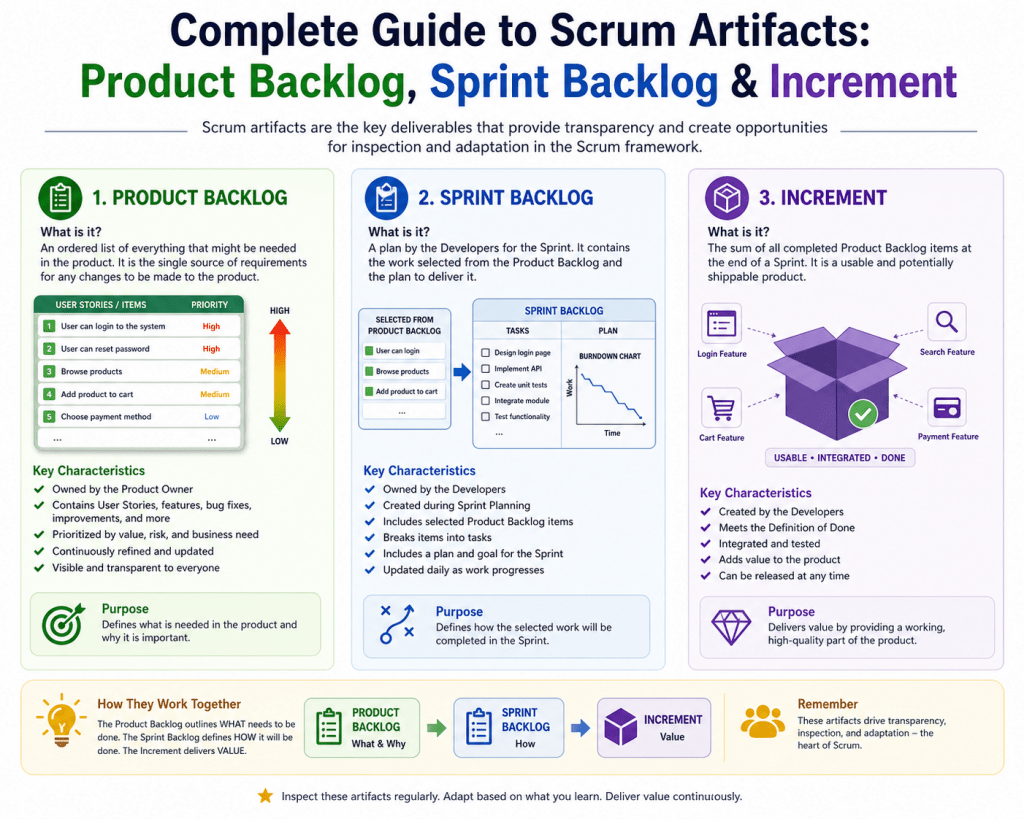
Scrum defines three primary artifacts that form the foundation of work management within the framework. These include the Product Backlog, Sprint Backlog, and Increment. Each artifact serves a distinct purpose and contributes to the overall flow of work from idea to delivery.
The Product Backlog represents the complete list of work items needed to improve or build a product. It includes features, enhancements, fixes, and other requirements. This backlog is continuously updated and prioritized based on value, urgency, and business goals.
The Sprint Backlog is a more focused subset of the Product Backlog. It contains the work items selected for completion during a specific sprint. Once a sprint begins, the Sprint Backlog guides the team’s daily work and helps maintain focus on short-term objectives.
The Increment represents the sum of all completed work items at the end of a sprint. It reflects a usable version of the product that has been improved or expanded. Each increment builds upon previous work, gradually moving the product closer to its final vision.
Together, these artifacts create a structured flow of work. Items begin in the Product Backlog, move into the Sprint Backlog when prioritized, and ultimately become part of the Increment when completed. This progression ensures clarity and continuity throughout the development lifecycle.
How Scrum Artifacts Support Work Visibility and Alignment
One of the key strengths of Scrum artifacts is their ability to make work visible. In traditional project management systems, work progress can often be hidden within documents or isolated communication channels. Scrum addresses this by making all critical information accessible and regularly updated.
Visibility ensures that everyone involved in the project understands what is happening at any given time. Developers know what they are working on, stakeholders understand what is being prioritized, and teams can quickly identify bottlenecks or delays.
This visibility also improves alignment. When work is clearly defined and visible, teams are more likely to stay focused on shared goals. Misalignment often occurs when different team members have different interpretations of priorities or requirements. Scrum artifacts reduce this risk by serving as a single source of truth.
Another important benefit is accountability. Because work is clearly tracked through artifacts, it becomes easier to identify ownership and responsibility. This encourages teams to take responsibility for their tasks and ensures that progress is measurable and traceable.
The Role of Structured Information in Agile Workflows
Scrum artifacts are not just tracking tools; they also structure how information is organized and communicated within a project. This structured approach is essential in complex environments where multiple tasks and priorities must be managed simultaneously.
Without structure, teams may struggle to prioritize work effectively or understand dependencies between tasks. Scrum artifacts provide a clear framework for organizing information so that it can be easily interpreted and acted upon.
For example, the Product Backlog organizes all potential work in a single place, while prioritization ensures that the most valuable items are addressed first. The Sprint Backlog then narrows this focus to a specific set of tasks, allowing teams to concentrate their efforts without distraction.
This structured flow of information reduces cognitive overload and helps teams maintain productivity. It also supports better planning, as teams can clearly see what work is upcoming, what is in progress, and what has already been completed.
User Stories as a Foundational Element of Scrum Artifacts
User stories play an important role within Scrum artifacts, particularly within the Product Backlog. A user story represents a small, meaningful piece of functionality described from the perspective of the end user. It captures what the user needs and why it is important.
User stories are intentionally simple and concise. They are not detailed technical specifications but rather conversation starters that guide further discussion between team members. This approach ensures that development work remains focused on delivering real user value rather than just completing technical tasks.
Each user story typically includes acceptance criteria, which define the conditions required for completion. These criteria help ensure clarity and provide a measurable way to determine whether the work has been completed.
User stories also help break down complex requirements into manageable pieces. Large features or goals can be divided into multiple smaller stories, making it easier for teams to plan and execute work within sprint cycles.
The use of user stories enhances collaboration because it encourages ongoing communication between developers, product owners, and stakeholders. Rather than relying on static documentation, teams continuously refine their understanding of requirements as the project evolves.
Continuous Evolution of Scrum Artifacts in Real Projects
Scrum artifacts are not static entities but continuously evolving components of the development process. As new information becomes available, priorities shift, or user feedback is received, artifacts are updated to reflect the current state of the project.
This continuous evolution ensures that the project remains aligned with real-world needs rather than outdated assumptions. It also allows teams to respond quickly to changes without disrupting the overall workflow.
The Product Backlog, for example, is regularly refined to include new items, adjust priorities, or remove outdated tasks. Similarly, the Sprint Backlog is adjusted during sprint planning to reflect the team’s current capacity and goals.
This adaptability is one of the key strengths of Scrum. It allows teams to remain flexible while still maintaining structure and focus. By continuously refining artifacts, teams ensure that their work remains relevant, efficient, and aligned with overall objectives.
Scrum artifacts, therefore, act as living tools that guide decision-making throughout the entire development process, supporting both short-term execution and long-term product evolution.
The Product Backlog as the Central Pillar of Scrum Work Organization
The Product Backlog is one of the most important structures in the Scrum framework because it acts as the central repository for all work related to a product. It is a continuously evolving list that contains everything needed to build, maintain, and improve a product over time. This includes new features, enhancements, bug fixes, technical improvements, and even long-term ideas that may not yet be fully defined.
Unlike traditional project plans that attempt to define everything up front, the Product Backlog is dynamic. It changes as the product evolves, user needs shift, and new insights are gained. This adaptability makes it a powerful tool for managing uncertainty in complex projects.
At its core, the Product Backlog is ordered based on priority. The most valuable and urgent items are placed at the top, while less critical or long-term items remain lower in the list. This ordering ensures that the team always works on the most important tasks first, maximizing value delivery at every stage of development.
The Product Backlog is not limited to a simple checklist. It is a structured collection of work items that are continuously refined. Each item becomes more detailed as it moves closer to implementation, ensuring that the development team has enough clarity to execute effectively during sprint cycles.
How Product Backlog Items Evolve Through Refinement
Product Backlog items do not remain static once they are created. Instead, they go through a process known as refinement, which involves adding detail, clarity, and structure over time. This ensures that items are well understood before they are selected for a sprint.
During the early stages, backlog items may be broad or vague. They might represent high-level ideas or goals without detailed specifications. As they move closer to implementation, they are broken down into smaller, more actionable components.
Refinement involves collaboration between the Product Owner, development team, and sometimes stakeholders. This collaborative approach ensures that everyone has a shared understanding of what needs to be built and why it is important.
As refinement progresses, backlog items begin to include acceptance criteria, technical considerations, and effort estimates. This additional information helps the team evaluate complexity and determine whether an item is ready to be included in a sprint.
A well-refined Product Backlog ensures that sprint planning sessions are efficient and focused. Instead of spending time clarifying requirements, the team can concentrate on selecting and delivering work.
The Structure and Composition of Product Backlog Items
Each item in the Product Backlog represents a distinct piece of work that contributes to the overall product. These items are often referred to as user stories, but they can also include technical tasks, research activities, or improvements.
A key characteristic of backlog items is that they are outcome-focused rather than task-focused. Instead of describing how something should be built, they describe what needs to be achieved and why it matters.
This outcome-oriented approach encourages creativity and problem-solving within the development team. It allows engineers and designers to determine the best technical implementation while staying aligned with the intended user value.
Backlog items are also typically small enough to be completed within a single sprint. Large or complex items are broken down into smaller components to ensure they are manageable and deliverable within a short timeframe.
This decomposition process improves predictability and reduces risk. Smaller items are easier to estimate, understand, and complete, which leads to more consistent sprint performance.
Prioritization as a Driving Force Behind the Product Backlog
Prioritization is a critical function of the Product Backlog because it determines the order in which work is completed. Without prioritization, teams may struggle to focus on what truly matters, leading to inefficiency and reduced value delivery.
The Product Owner is typically responsible for setting priorities, but this is done in collaboration with stakeholders and development teams. Business value, customer needs, technical dependencies, and risk factors all influence prioritization decisions.
High-priority items are placed at the top of the backlog so that they are selected first during sprint planning. These items usually represent the most important features or urgent fixes required to maintain product quality and user satisfaction.
Lower-priority items remain in the backlog until they become more relevant. This ensures that the team is always working on the most impactful tasks while still maintaining visibility of future work.
Prioritization is not a one-time activity. It is continuously adjusted based on new information, feedback, and changing business conditions. This ongoing adjustment ensures that the backlog remains aligned with current goals.
Understanding the Sprint Backlog as a Focused Work Container
The Sprint Backlog is a subset of the Product Backlog that contains only the work selected for a specific sprint. It represents a short-term commitment made by the development team to achieve a defined set of goals within a fixed time period.
Unlike the Product Backlog, which covers the entire scope of the product, the Sprint Backlog is narrow and focused. It is designed to help the team concentrate on delivering a specific set of outcomes without distraction.
The Sprint Backlog is created during sprint planning sessions, where the team selects items from the Product Backlog based on priority and capacity. Once selected, these items become the sprint goal and guide all development activities during the sprint.
This focused approach allows teams to work efficiently within a limited timeframe. By reducing scope and concentrating on a smaller set of tasks, teams can maintain higher productivity and deliver more consistent results.
The Sprint Backlog is owned by the development team, meaning they have full responsibility for managing and organizing the work within it. This ownership encourages self-organization and accountability.
Workflow and Movement of Items Within the Sprint Backlog
Once items are added to the Sprint Backlog, they move through different stages of completion. These stages typically include to-do, in-progress, and done. This workflow structure provides visibility into the status of each task.
Items in the to-do stage represent work that has been planned but not yet started. These tasks are ready for execution and await assignment or initiation by team members.
When work begins, items move into the in-progress stage. This indicates that active development is taking place. Team members collaborate to complete the required tasks and move them toward completion.
Once all requirements and acceptance criteria are met, items move into the done stage. This signifies that the work is complete and has been verified as meeting expectations.
This structured movement helps teams track progress in real time. It also highlights potential bottlenecks, such as tasks that remain in progress for too long or items that are not progressing as expected.
The Role of Sprint Planning in Defining the Sprint Backlog
Sprint planning is the event where the Sprint Backlog is created. During this session, the team determines what work will be completed in the upcoming sprint and how it will be executed.
The process begins by reviewing the Product Backlog and identifying high-priority items. The team then assesses its capacity based on available resources, skills, and time constraints.
Once capacity is understood, the team selects items that can realistically be completed within the sprint timeframe. These items are then moved into the Sprint Backlog and broken down into actionable tasks.
Sprint planning also involves defining the sprint goal. This goal provides a clear objective for the sprint and helps guide decision-making throughout the development cycle.
By the end of sprint planning, the team has a well-defined Sprint Backlog that serves as a roadmap for the upcoming work cycle.
The Increment as the Outcome of Scrum Execution
The Increment represents the sum of all completed work items at the end of a sprint. It is a usable and potentially releasable version of the product that includes all improvements made during the sprint.
Each increment builds upon previous increments, gradually enhancing the product over time. This incremental approach ensures continuous delivery of value rather than waiting for a final product release.
The Increment must meet a defined standard of quality known as the Definition of Done. This ensures that all completed work is fully tested, integrated, and ready for use.
The concept of the Increment reinforces the idea of continuous improvement. With each sprint, the product becomes more complete, functional, and valuable to users.
Progress Tracking Within Scrum Artifacts and Their Importance
Progress tracking is essential in Scrum because it provides visibility into how work is advancing over time. It helps teams understand whether they are on track to meet their sprint goals and identify potential issues early.
Tracking progress is often visualized through tools that show the movement of work items across different stages. These visual representations make it easy to understand the current status of the sprint at a glance.
One common method is tracking work completion over time, which helps teams see how quickly tasks are being finished. This information can be used to improve future planning and estimate more accurately.
Progress tracking also supports communication with stakeholders. Instead of relying on verbal updates or lengthy reports, stakeholders can quickly understand project status through clear visual indicators.
This transparency improves trust and ensures that everyone remains aligned on expectations and outcomes.
The Relationship Between Scrum Artifacts and Team Collaboration
Scrum artifacts play a critical role in supporting collaboration within teams. They provide a shared reference point that helps team members communicate effectively and stay aligned on goals.
Because artifacts are visible and continuously updated, they encourage ongoing discussion and feedback. Team members can easily identify what needs attention, what is in progress, and what has been completed.
This shared understanding reduces misunderstandings and ensures that everyone is working toward the same objectives. It also fosters a sense of collective responsibility for the success of the project.
Scrum artifacts also support cross-functional collaboration. Developers, testers, designers, and product owners all rely on the same artifacts to coordinate their work and make informed decisions.
This collaborative environment is essential for delivering high-quality products in a consistent and efficient manner.
Continuous Adaptation of Backlogs and Sprint Structures
One of the defining characteristics of Scrum is its ability to adapt continuously. Both the Product Backlog and Sprint Backlog evolve based on feedback, changing requirements, and new insights.
This adaptability ensures that teams remain responsive to real-world conditions rather than being locked into rigid plans. It allows for adjustments in priority, scope, and approach as needed.
Continuous adaptation also supports innovation. Teams are encouraged to refine ideas, experiment with solutions, and improve processes based on what they learn during each sprint.
This iterative approach leads to better outcomes over time, as each cycle builds on the knowledge gained from previous work.
Understanding User Stories as the Foundation of Scrum Work Definition
User stories are one of the most essential building blocks within Scrum because they define what needs to be built from the perspective of the end user. Instead of focusing on technical implementation details, user stories focus on value, purpose, and outcomes. This makes them a powerful tool for aligning development work with real-world needs.
A user story represents a small, self-contained piece of functionality that contributes to the overall product. It describes a need or requirement in simple language that can be understood by both technical and non-technical stakeholders. This simplicity ensures that communication remains clear and that development efforts remain focused on delivering value rather than complexity.
In Scrum, user stories are not treated as rigid specifications. Instead, they serve as conversation starters that guide collaboration between team members. Developers, product owners, and stakeholders use them to discuss requirements, clarify expectations, and refine understanding over time.
The structure of a user story is intentionally lightweight. It typically includes three key elements: the user type, the desired action, and the benefit or outcome. This structure helps ensure that every piece of work is tied to a meaningful purpose rather than existing in isolation.
User stories are primarily stored in the Product Backlog, where they are continuously refined and prioritized. As they move closer to implementation, they become more detailed, ensuring that the development team has sufficient clarity to complete the work effectively during a sprint.
The Structure and Purpose Behind Effective User Stories
A well-constructed user story focuses on clarity and value. It avoids unnecessary technical detail and instead emphasizes what the user needs and why it matters. This approach ensures that development teams remain focused on solving real problems rather than simply completing tasks.
Each user story typically follows a format that describes who the user is, what they want to achieve, and why it is important. This helps create a shared understanding of the requirement across all team members.
One of the key strengths of user stories is their flexibility. They can represent features, improvements, fixes, or even research tasks. This versatility allows them to be used across a wide range of development activities.
User stories are intentionally small to ensure they can be completed within a single sprint. If a story is too large or complex, it is broken down into smaller, more manageable pieces. This process improves predictability and makes planning more effective.
The goal of a user story is not to provide exhaustive documentation but to enable meaningful conversation. The real understanding of the requirement often emerges through discussion rather than written detail alone.
Acceptance Criteria and Their Role in Defining Completion
Acceptance criteria are an essential part of every user story because they define what it means for the work to be considered complete. Without clear acceptance criteria, it would be difficult to determine whether a requirement has been successfully fulfilled.
These criteria act as measurable conditions that must be met before a user story can be marked as done. They provide clarity for both developers and stakeholders by outlining expected outcomes in a structured way.
Acceptance criteria also help reduce ambiguity. Instead of relying on subjective interpretation, teams have a clear set of conditions that define success. This ensures consistency in how work is evaluated across different stories and sprints.
From a development perspective, acceptance criteria guide implementation. They help engineers understand what needs to be built and provide a reference point for testing and validation.
From a business perspective, they ensure that the delivered functionality aligns with expectations. Stakeholders can review completed work against these criteria to confirm that requirements have been met.
How User Stories Drive Collaboration in Scrum Teams
User stories are not just documentation tools; they are central to collaboration within Scrum teams. They encourage ongoing communication between developers, product owners, and stakeholders throughout the development process.
Rather than relying on detailed specifications created at the beginning of a project, Scrum teams use user stories to facilitate continuous dialogue. This ensures that requirements are understood correctly and adjusted as needed.
During backlog refinement sessions, user stories are discussed in detail. Teams explore different interpretations, identify dependencies, and clarify expectations. This collaborative process helps prevent misunderstandings and improves the quality of the final product.
User stories also support shared ownership. Because they are not overly prescriptive, team members have the flexibility to contribute ideas and solutions. This encourages creativity and innovation within the development process.
By focusing on outcomes rather than strict instructions, user stories create an environment where collaboration is natural and continuous rather than forced or formal.
The Product Backlog as a Dynamic Repository of Work
The Product Backlog serves as the central repository for all user stories and work items related to a product. It is a continuously evolving list that reflects the current and future needs of the product.
Unlike traditional project plans, the Product Backlog is not fixed. It changes over time as new requirements emerge, priorities shift, and feedback is received. This adaptability allows teams to remain responsive to changing conditions.
Each item in the Product Backlog represents a potential piece of work that may be implemented in future sprints. These items are ordered based on priority, ensuring that the most valuable work is addressed first.
The Product Backlog is constantly refined to ensure clarity and relevance. Items that are closer to implementation are more detailed, while long-term items may remain high-level until they are further refined.
This ongoing refinement process ensures that the backlog remains useful and actionable. It prevents the accumulation of outdated or irrelevant work items.
Prioritization as a Strategic Function of the Product Backlog
Prioritization is one of the most important functions of the Product Backlog because it determines the order in which work is completed. It ensures that teams focus on delivering maximum value at every stage of development.
Work items are prioritized based on several factors, including business value, customer impact, technical dependencies, and risk. This ensures that the most important tasks are completed first.
The Product Owner plays a key role in managing prioritization. However, this process is collaborative and involves input from development teams and stakeholders to ensure balanced decision-making.
Prioritization is not static. It changes as new information becomes available or as business needs evolve. This flexibility ensures that the backlog remains aligned with current goals.
Effective prioritization helps teams avoid wasted effort by ensuring that low-value tasks are not worked on before high-value ones.
Refinement Process and Continuous Improvement of Backlog Items
Backlog refinement is an ongoing activity that ensures user stories and other items are well understood before they are selected for development. It involves breaking down large items, clarifying requirements, and adding necessary details.
This process helps improve the quality of backlog items by ensuring they are ready for sprint planning. Well-refined items reduce uncertainty and improve the accuracy of estimates.
Refinement sessions are collaborative and involve the entire Scrum team. Discussions during these sessions help uncover hidden complexities and identify potential risks early.
As backlog items are refined, they become more actionable and easier to implement. This reduces delays during sprint execution and improves overall team efficiency.
Continuous refinement also ensures that the Product Backlog remains relevant and up to date. Outdated or unclear items are updated or removed as needed.
The Sprint Backlog as a Focused Execution Plan
The Sprint Backlog represents the set of work items selected for completion during a specific sprint. It is a focused and time-bound plan that guides the development team’s activities over a short period.
Unlike the Product Backlog, which contains all potential work, the Sprint Backlog contains only the tasks that have been committed to for the current sprint. This creates a clear and manageable workload.
The Sprint Backlog is created during sprint planning sessions. The team selects items based on priority and capacity, ensuring that the workload is realistic and achievable within the sprint timeframe.
Once the sprint begins, the Sprint Backlog becomes the primary reference point for all development activities. It helps the team stay focused and aligned on sprint goals.
The Sprint Backlog is flexible in terms of execution but stable in terms of scope. While tasks may be adjusted or clarified, the overall set of committed work remains consistent throughout the sprint.
Workflow Stages Within the Sprint Backlog
Work items in the Sprint Backlog move through defined stages that represent their progress toward completion. These stages typically include to-do, in-progress, and done.
Items in the to-do stage are ready for execution but have not yet been started. These tasks are prioritized and await assignment or initiation.
When work begins, items move into the in-progress stage. This indicates active development and collaboration among team members.
Once all requirements are met and the work has been verified, items move into the done stage. This signifies completion and readiness for integration into the product increment.
This structured workflow provides transparency into progress and helps teams identify bottlenecks or delays early.
Sprint Planning and Its Role in Creating the Sprint Backlog
Sprint planning is the event where the Sprint Backlog is created. It is a collaborative session where the team determines what work will be completed during the upcoming sprint.
The process begins with reviewing the Product Backlog to identify high-priority items. The team then assesses its capacity based on available resources and time constraints.
Selected items are moved into the Sprint Backlog and broken down into actionable tasks. This ensures that the work is clearly defined and ready for execution.
A sprint goal is also established during this process. The sprint goal provides a clear objective that guides decision-making throughout the sprint.
By the end of sprint planning, the team has a clear and actionable Sprint Backlog that serves as a roadmap for the sprint.
The Increment as the Outcome of Scrum Execution
The Increment represents the completed work at the end of a sprint. It is a usable and potentially releasable version of the product that reflects all improvements made during the sprint.
Each increment builds upon previous increments, gradually enhancing the product over time. This ensures continuous delivery of value rather than waiting for a final release.
To be considered complete, the increment must meet the Definition of Done, which ensures quality, consistency, and readiness for use.
The Increment is a key measure of progress in Scrum. It demonstrates tangible results from the team’s efforts and provides a foundation for future development.
Progress Tracking and Visibility Across Scrum Artifacts
Progress tracking is essential in Scrum because it provides insight into how work is advancing. It helps teams understand whether they are on track to meet sprint goals and identify potential issues early.
Work progress is often visualized through charts or boards that show the movement of tasks across different stages. This visual representation makes it easy to understand the status at a glance.
Tracking progress over time also helps improve planning accuracy. Teams can use historical data to better estimate future work and adjust capacity accordingly.
Visibility into progress also improves communication with stakeholders. Instead of relying on reports, stakeholders can directly observe how work is progressing.
This transparency strengthens trust and ensures alignment between teams and business objectives.
Continuous Adaptation and Evolution of Scrum Artifacts
Scrum artifacts are continuously updated as new information becomes available. This adaptability ensures that the framework remains responsive to change.
Both the Product Backlog and Sprint Backlog evolve based on feedback, changing priorities, and emerging requirements. This ensures that work remains relevant and valuable.
Continuous adaptation is a key strength of Scrum. It allows teams to learn from each sprint and apply improvements to future work cycles.
Over time, this iterative approach leads to higher quality outcomes and more efficient workflows.
Conclusion
Scrum artifacts play a central role in shaping how agile teams plan, execute, and deliver work in complex environments. Throughout Scrum, the Product Backlog, Sprint Backlog, Increment, and supporting elements like user stories collectively form a structured system that brings clarity to what would otherwise be an unpredictable and constantly changing workflow. While Scrum may initially feel unfamiliar due to its terminology and iterative nature, the artifacts provide the practical structure that makes the framework usable in real-world projects.
At a broader level, Scrum is built to address uncertainty. Modern product development rarely follows a perfectly linear path. Requirements evolve, customer expectations shift, and technical challenges emerge unexpectedly. Traditional project management methods often struggle in such environments because they rely on fixed plans created at the beginning of a project. Scrum takes a different approach by embracing change rather than resisting it. The artifacts are what make this adaptability possible while still maintaining control and visibility.
The Product Backlog acts as the long-term memory of the product. It captures everything that might be needed, from major features to minor improvements and technical enhancements. Its value lies not just in storing information but in organizing it based on priority and business value. Because it is continuously refined, it ensures that teams are always working on the most relevant tasks at any given time. This prevents wasted effort and keeps development aligned with real-world needs. Over time, the backlog becomes a reflection of both the product vision and the evolving understanding of users and stakeholders.
The Sprint Backlog, in contrast, brings focus to the short term. It translates long-term vision into immediate action by selecting a manageable set of tasks for a single sprint cycle. This separation between long-term planning and short-term execution is one of Scrum’s most powerful ideas. It allows teams to think strategically about direction while still executing tactically on a day-to-day basis. By limiting scope to a fixed time period, the Sprint Backlog helps teams avoid overload and maintain a sustainable pace of work.
The Increment represents the tangible outcome of effort. It is not just a collection of completed tasks but a working version of the product that has real value. Each Increment builds on the previous one, creating a continuous flow of improvement. This incremental delivery model reduces risk because progress is always visible, and functional software or product output is consistently produced. Instead of waiting for a final release after months or years of development, stakeholders see regular updates that demonstrate real progress.
User stories act as the bridge between abstract requirements and actionable development work. They translate user needs into structured but flexible descriptions that guide implementation. Their simplicity is intentional. By focusing on what the user wants and why it matters, user stories prevent teams from becoming overly focused on technical details too early in the process. This ensures that development remains aligned with actual value delivery rather than internal assumptions or unnecessary complexity. Acceptance criteria further strengthen this alignment by clearly defining when a story is considered complete, reducing ambiguity and improving quality control.
One of the most important outcomes of using Scrum artifacts is improved transparency. In traditional project environments, progress can often be difficult to track. Information may be scattered across documents, emails, or isolated reports. Scrum replaces this fragmentation with shared visibility. Everyone involved in the project can see what is being worked on, what is planned next, and what has already been completed. This shared understanding reduces miscommunication and creates a stronger sense of alignment across teams.
Another key benefit is adaptability. Because Scrum artifacts are continuously updated, they allow teams to respond quickly to change. If priorities shift or new requirements emerge, the Product Backlog can be re-ordered without disrupting ongoing work. If issues arise during a sprint, teams can adjust their approach while still maintaining focus on the sprint goal. This flexibility is essential in modern product development, where change is constant rather than exceptional.
Scrum artifacts also improve decision-making. With clear visibility into work items, priorities, and progress, teams and stakeholders can make more informed choices. Instead of relying on assumptions, decisions are based on actual data and current conditions. This reduces risk and improves the likelihood of delivering successful outcomes. It also ensures that effort is directed toward the most valuable work at any given time.
Collaboration is another area where Scrum artifacts have a significant impact. Because they serve as shared references, they encourage ongoing communication between team members. Discussions around backlog items, sprint planning, and progress updates ensure that everyone remains aligned. This collaborative environment reduces silos and fosters a stronger sense of shared ownership over the product.
Over time, Scrum artifacts also contribute to continuous improvement. Each sprint provides an opportunity to learn from what worked and what did not. The Product Backlog evolves based on feedback, the Sprint Backlog becomes more refined with experience, and the Increment reflects ongoing improvements in quality and functionality. This iterative learning cycle helps teams become more efficient and effective over time.
It is also important to recognize that Scrum artifacts are not isolated tools. They are interconnected parts of a larger system. The Product Backlog feeds into the Sprint Backlog, which leads to the creation of the Increment. User stories flow through these artifacts as they are refined, implemented, and completed. Progress tracking tools provide visibility across all of them, ensuring that the entire system remains synchronized. This interconnectedness is what gives Scrum its strength as a framework rather than just a set of practices.
Ultimately, Scrum artifacts exist to simplify complexity. Large projects can easily become overwhelming without structure. By breaking work into manageable pieces, organizing it clearly, and maintaining continuous visibility, Scrum makes complexity more manageable and predictable. It does not eliminate uncertainty, but it provides a framework for navigating it effectively.
When used correctly, these artifacts create a rhythm of planning, execution, review, and adaptation that supports steady progress. Teams are able to focus on delivering value incrementally while continuously improving both the product and the process. This balance between structure and flexibility is what makes Scrum widely adopted across industries and why its artifacts remain central to its effectiveness.