Quality engineering is a discipline focused on ensuring that software systems perform correctly, consistently, and reliably before they reach end users. In modern development environments, a quality engineer operates across multiple stages of the software lifecycle rather than only testing finished products. Their primary responsibility is to evaluate whether software behaves as intended under different conditions and usage patterns. This involves analyzing requirements, designing structured test cases, and validating that both functional and non-functional aspects of applications meet defined expectations. Quality engineers often work closely with developers and product teams to ensure that potential issues are identified early, reducing the cost and complexity of fixing defects later in the process. As software systems become more distributed and interconnected, their role expands beyond simple bug detection into ensuring system-wide reliability, performance stability, and seamless user experience across platforms.
The Evolving Nature of Quality Engineering in Technology Teams
The role of quality engineers has changed significantly over the years. In earlier development models, testing was often treated as a final stage before software release. However, modern engineering practices integrate quality assurance throughout the entire development lifecycle. This shift is largely driven by agile methodologies and continuous integration practices, where software is developed, tested, and deployed in shorter cycles. Quality engineers are now involved from the initial planning phase, contributing to defining requirements in a way that makes them testable and measurable. They also participate in sprint planning sessions and collaborate with developers during feature development. This continuous involvement ensures that defects are identified earlier, reducing delays and improving product stability. The modern quality engineer is no longer a gatekeeper at the end of development but an active participant throughout the process.
Core Responsibilities That Define the Role
Quality engineers perform a wide range of responsibilities that extend across technical and analytical domains. One of their primary tasks is designing and executing test plans that evaluate different aspects of software functionality. These test plans are structured to cover both expected behavior and edge cases that might not be immediately obvious during development. Another key responsibility is identifying defects and documenting them in a clear, reproducible manner so that development teams can quickly understand and resolve issues. Quality engineers also validate bug fixes to ensure that issues have been properly addressed without introducing new problems elsewhere in the system. In addition, they are responsible for maintaining test environments, managing test data, and ensuring that testing conditions accurately reflect real-world usage scenarios. Their work helps maintain consistency and reliability across software releases.
Different Specializations Within Quality Engineering
Quality engineering is not a single uniform role but a field with multiple specializations depending on organizational needs. Some professionals focus on manual testing, where they execute predefined test cases and explore software behavior through structured user interaction. Others specialize in automation, where they build scripts and frameworks that allow tests to run automatically across different environments and conditions. Automation engineers typically work with coding languages and testing libraries to create scalable test systems that reduce manual effort over time. There are also performance testing specialists who evaluate how systems behave under high traffic or stress conditions, ensuring that applications remain stable under load. Additionally, some quality engineers focus on integration testing, validating that different components within a system work together correctly. Each specialization contributes to a broader goal of ensuring overall software reliability.
Technical Foundations Required for Success
Modern quality engineering requires a strong technical foundation that blends software understanding with analytical reasoning. A key requirement is familiarity with programming or scripting languages that enable automation of test processes. These skills allow quality engineers to write reusable test scripts, build frameworks, and analyze system behavior programmatically. Understanding software architecture is equally important, as it helps engineers identify where potential failures might occur within complex systems. Knowledge of databases, APIs, and backend services is often necessary for validating data flow and system interactions. In addition to technical expertise, quality engineers must understand testing methodologies such as regression testing, integration testing, and system testing. These methodologies provide structured approaches to identifying defects and ensuring comprehensive coverage across different layers of software functionality.
Analytical Thinking and Problem-Solving in QA Roles
Beyond technical skills, quality engineering requires strong analytical thinking. Identifying defects is only part of the job; understanding why those defects occur is equally important. Quality engineers must be able to analyze system behavior, identify patterns in failures, and determine root causes that may not be immediately visible. This often involves breaking down complex systems into smaller components to isolate issues effectively. Problem-solving in this field also requires creativity, as not all bugs follow predictable patterns. Engineers must anticipate unusual user behavior and design tests that account for real-world variability. This analytical mindset ensures that software is not only functional under ideal conditions but also resilient in unpredictable environments.
Communication and Collaboration Across Teams
Quality engineers operate at the intersection of multiple teams, which makes communication a critical part of their role. They must clearly document issues in a way that developers can understand and act upon efficiently. This includes providing detailed steps to reproduce bugs, describing expected versus actual behavior, and highlighting potential system impacts. Collaboration is also essential during development cycles, where quality engineers work alongside developers, product managers, and sometimes designers. By participating in discussions early in the development process, they help shape features in ways that reduce testing complexity later. Strong communication ensures that quality concerns are addressed quickly and that teams remain aligned on product goals and expectations.
Tools That Support Quality Engineering Workflows
Quality engineers rely on a variety of tools that help streamline testing and improve efficiency. Automation tools allow them to simulate user actions across different platforms and verify that applications respond correctly. Issue tracking systems help organize defects, assign priorities, and monitor resolution progress. API testing tools are used to validate communication between software services, ensuring that data is transmitted accurately and securely. Performance testing tools evaluate system behavior under heavy usage conditions, identifying bottlenecks and scalability limitations. Version control systems are also important because they allow engineers to manage changes to test scripts and collaborate effectively with development teams. These tools collectively enable structured, repeatable, and scalable testing processes.
Quality Engineering in Agile and Continuous Delivery Environments
In agile and continuous delivery environments, quality engineering is deeply integrated into daily development activities. Instead of waiting for a complete product release, testing occurs continuously as new features are developed. Quality engineers participate in sprint cycles where they help define acceptance criteria and ensure that features are testable from the start. They also contribute to continuous integration pipelines where automated tests run every time new code is introduced. This approach allows teams to detect issues quickly and reduce the risk of large-scale failures. Continuous testing also ensures that software remains stable even as it evolves rapidly, which is essential in modern fast-paced development environments.
Industry Demand and Expanding Career Opportunities
The demand for quality engineers continues to rise as organizations increasingly depend on software-driven systems. Industries such as finance, healthcare, telecommunications, and e-commerce rely heavily on stable and secure applications, making quality engineering a critical function. As digital transformation accelerates, companies require professionals who can ensure system reliability at scale. This demand has created strong career opportunities for individuals with both technical and analytical skills. Quality engineering is also evolving alongside trends such as cloud computing, artificial intelligence, and microservices architecture, which introduce new challenges and require more advanced testing approaches. As a result, professionals who adapt to these changes are positioned for long-term career growth.
Entry-Level Experience and Skill Development Pathways
At the entry level, quality engineers typically focus on learning testing fundamentals and understanding how software systems operate. Their responsibilities often include executing predefined test cases, documenting defects, and assisting senior engineers in identifying issues. This stage is crucial for building foundational knowledge of software behavior and testing workflows. Entry-level professionals gradually develop familiarity with tools, environments, and development processes used within their organization. Over time, they begin contributing to more complex testing tasks and may start exploring automation techniques. This early phase is centered on skill development and understanding how quality assurance integrates into broader software engineering practices.
Transitioning Into More Advanced Quality Engineering Roles
As quality engineers gain experience, their responsibilities expand into more advanced technical and strategic areas. They begin designing test frameworks, automating complex workflows, and improving testing efficiency across multiple projects. Mid-level professionals often take ownership of specific application areas and are expected to identify risks independently. They also collaborate more closely with developers during design and implementation phases, ensuring that quality considerations are embedded early in development. This stage marks a shift from task execution to proactive involvement in shaping testing strategies and improving overall development processes.
Senior-Level Influence and Broader Responsibilities
Senior quality engineers play a strategic role in shaping how organizations approach software quality. They are responsible for designing scalable testing systems, defining quality standards, and leading initiatives that improve overall engineering efficiency. Their responsibilities often include overseeing multiple projects, mentoring junior engineers, and collaborating with leadership teams on technical strategy. At this level, the focus shifts from individual testing tasks to ensuring consistency, reliability, and long-term scalability of software systems. Senior professionals often contribute to decisions about tooling, architecture, and development practices, making their role essential to organizational success.
Understanding Quality Engineer Salary Structures in Modern Tech Markets
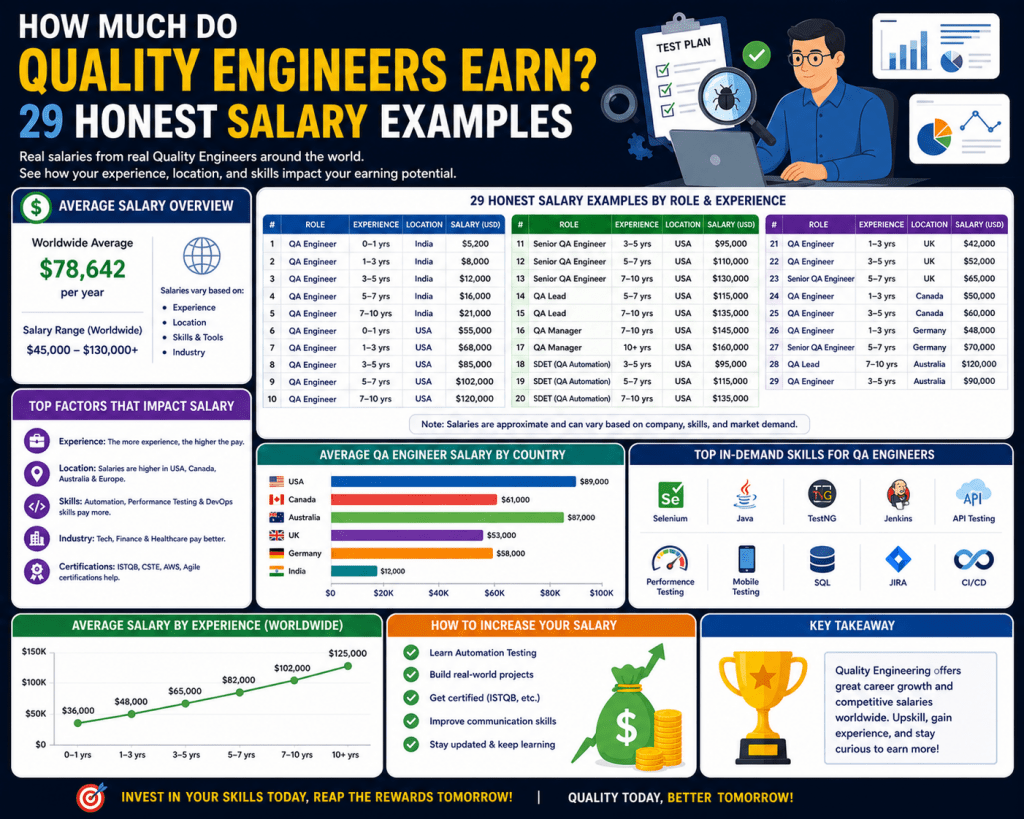
Quality engineer salaries are influenced by a wide range of factors, including location, experience level, technical skills, and industry demand. Unlike fixed compensation roles, quality engineering pay scales vary significantly across organizations because the role can range from manual testing to highly technical automation engineering. In modern software-driven industries, compensation is often tied to the level of responsibility an engineer holds within the development lifecycle. Engineers who focus on automation, continuous integration, and advanced testing frameworks typically earn more than those in manual testing roles. Salary structures also reflect how deeply quality engineers are integrated into engineering teams, with more embedded roles receiving higher compensation due to their impact on product reliability and delivery speed.
How Geographic Location Impacts Salary Levels
Location remains one of the most important factors influencing quality engineer salaries. Technology hubs and metropolitan regions tend to offer higher compensation due to increased demand for skilled professionals and higher living costs. Cities with strong concentrations of software companies typically provide more competitive salary packages because organizations compete for the same talent pool. These regions also tend to offer more advanced roles that require automation and DevOps integration skills, which further increase compensation levels. On the other hand, smaller cities or regions with lower living costs generally offer lower base salaries, although the difference is often balanced by affordability. Remote work has begun to reduce these geographic disparities, allowing professionals in lower-cost areas to access higher-paying opportunities traditionally reserved for major tech hubs.
Experience-Based Salary Progression in Quality Engineering
Experience plays a central role in determining how much a quality engineer earns. Entry-level professionals typically begin with foundational responsibilities that include manual testing, bug reporting, and learning basic automation tools. As they gain experience, their responsibilities expand to include designing test strategies and working with automation frameworks. Mid-level engineers often transition into roles that require more technical depth, including scripting, system integration testing, and participation in development planning. Senior-level professionals take on leadership responsibilities, guiding testing strategy across teams and contributing to architectural decisions. Each stage of this progression brings a significant increase in compensation, reflecting the growing complexity and impact of the role within the software development lifecycle.
The Role of Automation Skills in Salary Growth
Automation is one of the most influential factors in determining quality engineer salaries. Professionals who can design and maintain automated test systems are generally compensated at a higher level because their work directly improves efficiency and reduces manual effort in development pipelines. Automation engineers are responsible for building frameworks that allow repetitive testing tasks to be executed quickly and consistently. These frameworks are often integrated into continuous integration systems, enabling real-time feedback during development. The ability to write and maintain automation scripts requires programming knowledge, which increases the technical value of the role. As organizations continue to adopt agile and DevOps practices, automation skills have become a key driver of salary growth in quality engineering careers.
Industry Differences and Their Impact on Compensation
Different industries offer varying salary levels for quality engineers based on complexity, risk, and regulatory requirements. Highly regulated industries such as healthcare, finance, and aerospace often provide higher compensation due to strict compliance standards and the critical nature of their systems. In these environments, quality engineers are responsible not only for testing functionality but also for ensuring adherence to regulatory requirements and security standards. In contrast, industries focused on consumer applications or early-stage startups may offer lower base salaries but compensate with equity or growth opportunities. The complexity of the software being tested also plays a role, as systems with high levels of integration or scale require more advanced testing strategies.
The Growing Influence of DevOps on Salary Expectations
The integration of DevOps practices has significantly changed how quality engineering roles are valued. In traditional environments, testing was a separate phase after development. However, in DevOps-driven organizations, quality engineering is embedded directly into the development pipeline. This means engineers are involved in continuous testing, deployment validation, and monitoring system performance in real time. Professionals who understand DevOps tools and workflows are often more valuable because they contribute to faster release cycles and improved software stability. This integration has led to higher salary expectations for quality engineers who can operate effectively within continuous delivery environments and collaborate across development and operations teams.
Remote Work and Global Salary Standardization Trends
Remote work has introduced new dynamics into quality engineer compensation structures. In some cases, companies maintain location-based salary adjustments, while others adopt standardized pay scales regardless of geographic location. This shift has allowed professionals in lower-cost regions to access higher-paying roles traditionally concentrated in major technology hubs. Remote work also increases competition among candidates globally, which can influence salary expectations and negotiation dynamics. At the same time, organizations benefit from access to a broader talent pool, often prioritizing skills and experience over physical location. This trend is gradually reshaping how quality engineering salaries are structured across the industry.
Automation vs Manual Testing Salary Differences
A clear distinction exists between manual testing roles and automation-focused roles in terms of compensation. Manual testers typically focus on executing predefined test cases and exploring software behavior through structured interactions. While this role remains important, it generally offers lower salary growth compared to automation engineering. Automation engineers, on the other hand, design frameworks and scripts that allow testing to be executed at scale without manual intervention. This technical capability significantly increases their value within development teams. Organizations prioritize automation because it reduces long-term testing costs and improves release efficiency, which directly impacts salary levels for engineers with these skills.
Mid-Level Career Expansion and Salary Scaling
As quality engineers move into mid-level roles, their responsibilities become more technically demanding and strategically important. At this stage, engineers are expected to design automated test systems, improve testing coverage, and contribute to development planning. They often take ownership of specific system components and are responsible for ensuring quality across those areas. This increased responsibility leads to higher compensation as engineers are no longer just executing tests but actively shaping testing strategies. Mid-level roles also require stronger collaboration with developers and product teams, making communication and technical alignment essential skills for career progression and salary growth.
Senior-Level Quality Engineering and Leadership Compensation
Senior quality engineers operate at a strategic level, focusing on system-wide quality assurance rather than individual testing tasks. Their responsibilities include designing testing frameworks, leading automation initiatives, and defining quality standards across teams. Many senior engineers also manage teams or act as technical leads, guiding the direction of quality engineering practices within an organization. Compensation at this level reflects both technical expertise and leadership responsibilities. Senior professionals are often involved in architectural decisions that influence how software systems are built and tested, making their role critical to long-term product success and organizational efficiency.
Impact of Programming Skills on Salary Growth
Programming knowledge has become one of the most important factors influencing salary growth in quality engineering. Engineers who can write code to build automation frameworks or analyze system behavior programmatically are significantly more valuable to organizations. Common programming languages used in this field include Python, Java, and JavaScript, which are often used to develop automated test scripts and integrate testing systems with development pipelines. These skills allow engineers to move beyond manual testing and contribute to engineering-level tasks, which increases both their responsibilities and compensation potential. Programming proficiency also enables better collaboration with development teams, further enhancing career advancement opportunities.
Continuous Integration and Delivery Environments and Pay Scale Impact
Continuous integration and continuous delivery environments have transformed how software is developed and tested. In these environments, code is frequently integrated, tested, and deployed, requiring quality engineers to work continuously rather than in isolated testing phases. Engineers who understand CI/CD pipelines and can integrate automated tests into these workflows are highly valued. Their work ensures that new code does not introduce defects into production systems. This level of responsibility increases compensation because it directly affects system reliability and deployment speed. As more organizations adopt continuous delivery models, demand for engineers with these skills continues to rise.
Regional Salary Variation and Cost of Living Balance
While high-tech regions offer higher salaries, the cost of living plays a significant role in determining overall financial benefit. In expensive metropolitan areas, higher salaries are often offset by housing, transportation, and living costs. In contrast, smaller cities may offer lower salaries but provide greater purchasing power due to reduced expenses. This balance is important when evaluating compensation packages. Remote work has further complicated this dynamic by allowing professionals to earn higher salaries while living in lower-cost regions. As a result, salary evaluation increasingly considers both compensation and lifestyle factors.
Market Demand and Long-Term Salary Outlook
The long-term outlook for quality engineering remains strong due to increasing reliance on software systems across industries. As organizations continue to prioritize digital transformation, the need for reliable, scalable, and secure software grows. This demand directly influences salary growth as companies compete for skilled professionals. Emerging technologies such as cloud computing, artificial intelligence, and microservices architecture also create new challenges that require advanced testing strategies. Quality engineers who adapt to these changes and continuously develop their technical skills are likely to experience sustained salary growth over time.
Long-Term Career Development in Quality Engineering
Quality engineering offers a structured yet flexible career path that evolves significantly over time. Unlike roles that remain narrowly defined, quality engineering expands as professionals gain experience and technical depth. Early career stages focus on learning testing fundamentals and understanding system behavior, while later stages shift toward designing testing strategies, managing automation frameworks, and influencing software architecture decisions. Over time, professionals move from executing tasks to shaping how entire development pipelines function. This progression makes quality engineering a strong long-term career option for individuals who enjoy both technical problem-solving and cross-team collaboration. As software systems become more complex and integrated, experienced quality engineers increasingly become key contributors to product success and engineering efficiency.
Transition from Tester to Engineering Mindset
One of the most important transformations in a quality engineering career is the shift from a testing mindset to an engineering mindset. Early roles often focus on finding bugs and executing predefined test cases, but advanced roles require deeper system thinking. Engineers begin to understand how applications are designed, how data flows between components, and how different services interact under load. This broader perspective allows them to design better testing systems that anticipate failures rather than simply reacting to them. As engineers develop this mindset, they become more involved in architectural discussions and decision-making processes. This transition is essential for salary growth because it elevates the role from execution-based work to strategic technical contribution.
Building High-Value Technical Skills for Career Advancement
Technical skill development is one of the strongest drivers of salary growth in quality engineering. Professionals who invest in learning automation frameworks, scripting languages, and system integration tools position themselves for higher-paying roles. Programming skills allow engineers to build reusable test systems that improve efficiency and reduce manual effort. Knowledge of API testing, backend systems, and data validation further enhances technical value. In addition, understanding how distributed systems operate helps engineers identify complex failure points that may not be visible through surface-level testing. As organizations move toward microservices and cloud-based architectures, engineers with strong technical foundations become increasingly valuable in ensuring system reliability and scalability.
Automation as a Core Career Growth Accelerator
Automation has become the most important factor in shaping quality engineering careers. Engineers who specialize in automation are able to design systems that run tests continuously and provide real-time feedback during development. This capability significantly increases productivity and reduces the time required for software releases. Automation engineers often work with frameworks that simulate user behavior, validate APIs, and monitor system performance across environments. These skills require programming knowledge and a deep understanding of system architecture. Because automation directly impacts efficiency and delivery speed, professionals with strong automation expertise tend to earn significantly higher salaries than those focused solely on manual testing. As software development cycles become faster, automation continues to be a critical driver of career advancement.
The Role of DevOps Integration in Salary Growth
DevOps integration has reshaped how quality engineering functions within modern organizations. Instead of operating as a separate phase in development, testing is now embedded within continuous integration and continuous delivery pipelines. Quality engineers who understand DevOps principles can contribute directly to building, testing, and deployment processes. They help ensure that code changes are validated automatically before reaching production environments. This integration requires familiarity with pipeline tools, version control systems, and deployment automation workflows. Engineers who can bridge the gap between development and operations are highly valued because they improve release reliability and reduce production risks. As a result, DevOps knowledge has become a major factor in salary progression within quality engineering roles.
Leadership Development and Senior-Level Responsibilities
As quality engineers advance into senior roles, their responsibilities shift from individual testing tasks to leadership and strategy. Senior engineers often define quality standards, design testing frameworks, and guide teams in implementing best practices. They may also oversee multiple projects, ensuring consistency across different development teams. Leadership roles in quality engineering require not only technical expertise but also strong communication and decision-making abilities. Senior professionals often mentor junior engineers, helping them develop technical skills and understand system behavior more effectively. In many organizations, senior quality engineers also collaborate with product and engineering leadership to align quality goals with business objectives. This broader scope of responsibility is reflected in significantly higher compensation levels.
Impact of Industry Specialization on Salary Growth
Industry specialization plays an important role in shaping long-term salary potential for quality engineers. Certain industries require more rigorous testing standards due to regulatory requirements, system complexity, or security concerns. For example, financial systems require high levels of accuracy and security, while healthcare systems demand strict compliance and reliability. Aerospace and automotive industries also require detailed validation processes due to safety-critical systems. Quality engineers working in these sectors often receive higher compensation because their work directly impacts risk management and regulatory compliance. Specializing in a high-demand industry can significantly increase long-term earning potential and career stability.
Certifications and Their Role in Career Advancement
Certifications can support career growth by validating technical knowledge and demonstrating commitment to professional development. While not always mandatory, certifications help quality engineers stand out in competitive job markets. Foundational certifications typically focus on testing principles, methodologies, and best practices. Advanced certifications may cover topics such as automation frameworks, quality management systems, or cloud-based testing environments. Some certifications also emphasize process improvement and system optimization, which are valuable in enterprise-level organizations. Although certifications alone do not guarantee higher salaries, they can enhance credibility and support career transitions into more advanced or specialized roles.
The Importance of Continuous Learning in Quality Engineering
Continuous learning is essential for long-term success in quality engineering because the field evolves rapidly with changes in technology and development practices. New tools, frameworks, and methodologies are constantly introduced, requiring engineers to stay updated with industry trends. Cloud computing, artificial intelligence, and containerized environments have all introduced new testing challenges that require updated skills. Engineers who actively learn and adapt are more likely to advance into higher-paying roles because they can handle modern system complexities. Continuous learning also helps professionals remain relevant as automation becomes more advanced and integrated into development pipelines.
Remote Work and Global Career Opportunities
Remote work has expanded career opportunities for quality engineers by removing geographic limitations. Professionals are no longer restricted to local job markets and can apply for roles across different regions and countries. This shift has created more competitive salary structures, especially for skilled engineers who can work in distributed teams. Remote environments also require strong communication and self-management skills, as engineers must collaborate across time zones and digital platforms. Companies benefit from access to a global talent pool, while engineers gain flexibility and broader career options. This global accessibility has contributed to increased salary competition in the quality engineering field.
Performance Testing and Scalability Expertise as Salary Drivers
Performance testing has become increasingly important as applications scale to support larger user bases and higher transaction volumes. Engineers who specialize in performance testing evaluate how systems behave under stress, identifying bottlenecks and scalability issues before they impact users. This type of testing requires a deep understanding of system architecture, load balancing, and resource management. Professionals with expertise in this area are highly valued because they help prevent system failures in high-traffic environments. As digital platforms continue to grow, performance testing skills are becoming a significant factor in determining salary levels within quality engineering roles.
Security Awareness and Quality Engineering Value
Security has become a major concern in software development, and quality engineers play an important role in identifying vulnerabilities early in the development process. While security testing is often handled by specialized teams, quality engineers contribute by ensuring that basic security practices are validated during functional testing. This includes checking for data integrity, authentication issues, and potential system weaknesses. Engineers with security awareness add additional value to development teams because they help reduce risks before software reaches production. As cybersecurity threats increase, this skill area is becoming more important in determining career growth and compensation.
Shift-Left Testing and Early Lifecycle Involvement
Shift-left testing is a modern development approach where quality engineers become involved early in the software lifecycle. Instead of waiting for code to be completed, testing begins during the design and development phases. This approach allows teams to identify potential issues earlier and reduce the cost of fixing defects. Quality engineers contribute by reviewing requirements, designing testable features, and collaborating with developers during implementation. Early involvement improves software quality and reduces delays in release cycles. Engineers who adopt shift-left practices often gain higher recognition within organizations because they contribute to efficiency and risk reduction at multiple stages of development.
Future Outlook for Quality Engineering Careers
The future of quality engineering is closely tied to advancements in software development practices. As systems become more complex, the need for structured testing and quality assurance continues to grow. Automation, artificial intelligence, and cloud-based architectures are reshaping how testing is performed, requiring engineers to develop more advanced technical skills. Quality engineers who adapt to these changes will likely experience continued career growth and increasing salary opportunities. The role is evolving from traditional testing into a more integrated engineering discipline that supports the entire software lifecycle. This evolution ensures that quality engineering remains a critical and valuable profession in the long term.
Conclusion
Quality engineering has become one of the most strategically important roles in modern software development, even though it is still sometimes underestimated compared to development or product-focused positions. At its core, the discipline exists to ensure that software systems behave correctly, remain stable under pressure, and deliver a consistent experience to users across different environments. As digital systems expand in scale and complexity, the importance of this role continues to grow, especially in industries where reliability, security, and performance directly affect business outcomes.
One of the most defining characteristics of quality engineering is its evolving nature. It is no longer limited to manual testing or late-stage bug detection. Instead, it now spans the entire development lifecycle, from early requirement analysis to post-release monitoring. This shift has changed how organizations view quality assurance. Rather than treating it as a separate function, companies now embed quality engineers within development teams so that testing becomes a continuous process rather than a final checkpoint. This integration has improved software reliability while also increasing the technical expectations placed on professionals in this field.
The growing emphasis on automation has significantly reshaped career paths in quality engineering. Engineers who can build and maintain automated testing frameworks are increasingly valued because they reduce repetitive manual effort and enable faster release cycles. Automation is not just a technical advantage; it has become a core requirement in most modern engineering environments. As a result, professionals who develop strong programming and scripting skills tend to progress faster in their careers and achieve higher salary levels. This shift has also blurred the traditional boundary between testers and developers, with many quality engineers now operating as hybrid technical contributors within engineering teams.
Another major factor influencing the importance of quality engineering is the rise of continuous integration and continuous delivery practices. In these environments, code is frequently updated, tested, and deployed, sometimes multiple times per day. This rapid pace requires testing systems that are highly reliable and fully automated. Quality engineers play a critical role in ensuring that new changes do not introduce defects into production systems. Their work directly impacts release stability and deployment confidence, making them essential participants in modern software delivery pipelines. Without effective quality engineering, continuous delivery systems would struggle to maintain reliability at scale.
Industry demand for skilled quality engineers continues to expand across multiple sectors. Technology companies are the most obvious employers, but industries such as finance, healthcare, logistics, telecommunications, and retail also rely heavily on software systems that must remain accurate and secure. In regulated industries, the role becomes even more critical because software failures can have legal, financial, or safety consequences. This increased responsibility often translates into higher compensation levels for professionals working in these environments. As organizations become more dependent on digital systems, the demand for quality engineering expertise is expected to remain strong.
Salary variation in this field reflects the diversity of responsibilities and technical expectations. Entry-level professionals typically focus on executing test cases, documenting defects, and learning system behavior. As they gain experience, they transition into roles that involve designing test strategies, building automation frameworks, and participating in development planning. Mid-level engineers often take ownership of specific system areas and contribute to improving testing efficiency across teams. Senior professionals move into leadership and architectural roles, where they define quality standards and guide engineering strategy. This progression demonstrates that salary growth in quality engineering is closely tied to skill development, technical depth, and responsibility rather than time alone.
Geography and remote work trends also play a significant role in shaping compensation. Traditionally, major technology hubs offered the highest salaries due to high demand and living costs. While this pattern still exists, remote work has introduced new flexibility into the job market. Skilled quality engineers can now work for organizations in high-paying regions while living in lower-cost areas. This shift has created more balanced opportunities and expanded access to global job markets. At the same time, it has increased competition, as companies can now recruit talent from a much larger pool of candidates.
Technical specialization remains one of the strongest drivers of long-term career growth. Engineers who focus on areas such as automation, performance testing, API validation, or system integration tend to have higher earning potential than those focused solely on manual testing. Each specialization requires deeper technical understanding and contributes directly to system reliability at scale. Performance testing, for example, ensures that applications remain stable under heavy usage, while API testing validates communication between complex systems. These specialized skills are increasingly important as software architectures become more distributed and interconnected.
Soft skills also play a meaningful role in career advancement. Quality engineers must communicate effectively with developers, product managers, and other stakeholders. Clear documentation, precise reporting, and collaborative problem-solving are essential for ensuring that defects are understood and resolved efficiently. Engineers who can combine technical expertise with strong communication abilities are often more successful in leadership roles. As responsibilities grow, the ability to influence decisions and guide teams becomes just as important as technical execution.
Continuous learning is another essential aspect of long-term success in this field. Technology evolves rapidly, and quality engineers must adapt to new tools, frameworks, and development practices. Cloud computing, microservices, and artificial intelligence are reshaping how software is built and tested. Engineers who stay updated with these changes are better positioned to handle modern system complexities and remain competitive in the job market. This ongoing learning process ensures that the role continues to evolve alongside the broader software industry.
Looking ahead, the future of quality engineering is closely tied to automation, intelligence-driven testing, and integrated development environments. As systems become more complex, testing will increasingly rely on intelligent tools that can predict failures, optimize test coverage, and analyze system behavior at scale. However, human expertise will remain essential for interpreting results, designing meaningful test strategies, and ensuring that software meets real-world expectations. The combination of human insight and automated systems will define the next phase of quality engineering.
Ultimately, quality engineering is a profession that blends technical depth, analytical thinking, and system-wide awareness. It is not limited to finding defects but extends to improving how software is designed, built, and delivered. The role continues to grow in importance as organizations prioritize reliability, speed, and user experience. For individuals entering or advancing in this field, long-term success depends on continuous skill development, adaptability to new technologies, and the ability to contribute meaningfully across the entire software lifecycle.