The global business environment is changing faster than ever before. Organizations are no longer operating in stable, predictable conditions. Instead, they face constant disruption driven by technological innovation, digital transformation, global competition, and evolving customer expectations. These changes affect how businesses operate at every level, from internal workflows to large-scale strategic planning.
In such an environment, organizations need professionals who can bring order to complexity. This is where project management becomes essential. Project managers are responsible for guiding work through uncertainty, ensuring that goals are achieved even when conditions change. Their role is not just administrative; it is deeply strategic and operational, requiring a combination of leadership, technical understanding, and organizational awareness.
As industries continue to evolve, the demand for individuals who can manage structured work effectively has increased significantly. Companies are investing more in structured execution, efficient delivery systems, and measurable outcomes. This shift has made project management one of the most valuable skill sets in the modern workforce.
What Project Management Means in a Practical Sense
Project management can be understood as a structured approach to achieving specific objectives within a defined timeframe and resource limit. Unlike routine operations, which continue indefinitely, projects are temporary efforts with a clear beginning and end. Each project is designed to produce a unique outcome, such as a product, service, system, or organizational improvement.
At its core, project management involves planning work before it begins, organizing tasks into a logical sequence, allocating resources efficiently, and monitoring progress throughout execution. The goal is to ensure that the project is completed successfully while staying within constraints such as time, budget, and scope.
In real-world scenarios, project management applies to almost every industry. It can be seen in construction projects, where buildings are designed and completed according to strict timelines. It is also present in technology development, where software systems are created and deployed. Marketing campaigns, event planning, infrastructure development, and business transformation initiatives all rely heavily on project management principles.
Despite differences in industry and scale, all projects share common characteristics. They require coordination between multiple stakeholders, careful planning of resources, risk identification, and continuous monitoring of progress. These shared elements form the foundation of project management as a discipline.
The Role and Responsibilities of a Project Manager
A project manager plays a central role in ensuring that projects are executed successfully. Their responsibilities extend far beyond simple task coordination. They act as the primary point of control and communication for all aspects of a project.
One of their most important responsibilities is defining project objectives clearly. Without a well-defined goal, projects can easily become unfocused and inefficient. The project manager ensures that all stakeholders understand what the project aims to achieve and what success looks like.
Planning is another critical responsibility. This involves breaking down the project into smaller tasks, estimating the time required for each task, identifying dependencies, and creating a structured timeline. Effective planning ensures that work progresses smoothly and reduces the likelihood of delays or confusion.
Resource management is also essential. A project manager must ensure that the right people, tools, and materials are available when needed. This includes assigning tasks based on skills and availability, managing budgets, and ensuring that resources are not wasted.
Monitoring progress is an ongoing responsibility throughout the project lifecycle. Project managers track performance, identify deviations from the plan, and implement corrective actions when necessary. This helps keep the project aligned with its original goals.
Communication is another key function. Project managers act as a bridge between teams, executives, and stakeholders. They provide updates, clarify expectations, and ensure that everyone involved remains informed and aligned. Effective communication reduces misunderstandings and improves collaboration.
Risk management is also part of the role. Every project involves uncertainty, and it is the responsibility of the project manager to anticipate potential problems and develop strategies to address them before they escalate.
Why Project Management Skills Are in High Demand
The increasing complexity of modern business operations has led to a growing demand for skilled project managers. Organizations are no longer focused only on completing tasks; they are focused on delivering value efficiently and consistently. This requires structured planning and execution.
As businesses adopt new technologies and expand into global markets, projects become more complex and interconnected. Teams are often distributed across different locations, making coordination more challenging. In such situations, strong project management becomes essential for maintaining alignment and ensuring successful outcomes.
Another reason for the growing demand is the need for accountability. Businesses want measurable results, and project management provides a framework for tracking progress and evaluating success. This has made project management a key function in both private and public sector organizations.
Additionally, project management skills are transferable across industries. A skilled project manager can work in construction, IT, healthcare, finance, education, and many other fields. This flexibility has made it a highly attractive career path for professionals seeking long-term growth.
Understanding the Concept of Project Management Training
Project management training is designed to equip individuals with the knowledge and skills required to manage projects effectively. It covers both theoretical concepts and practical applications, ensuring that learners understand not only what to do but also how to do it in real-world situations.
Training programs typically focus on two main areas: technical skills and interpersonal skills. Technical skills include planning techniques, scheduling methods, budgeting, risk analysis, and the use of project management tools. These skills help ensure that projects are structured and executed efficiently.
Interpersonal skills are equally important. These include communication, leadership, teamwork, conflict resolution, and decision-making. Since project managers work closely with diverse teams and stakeholders, strong interpersonal skills are essential for maintaining collaboration and resolving challenges.
Effective training also introduces learners to different project management frameworks. These frameworks provide structured approaches to managing projects and help professionals understand how to apply best practices in various scenarios.
The Importance of Structured Learning in Project Management
While some individuals learn project management through experience, structured learning provides a more comprehensive and systematic approach. It ensures that learners are exposed to all essential aspects of the discipline rather than learning concepts in isolation.
Structured learning helps bridge the gap between theory and practice. It allows learners to understand not only the principles of project management but also how those principles are applied in real-world environments. This is particularly important because project management often involves complex decision-making under pressure.
Another benefit of structured learning is consistency. It ensures that all learners receive the same foundational knowledge, which is essential for standardizing skills across industries. This consistency is one of the reasons why certification programs are widely recognized.
Structured learning also helps individuals build confidence. By practicing scenarios, analyzing case studies, and understanding common challenges, learners become better prepared for real-world situations.
The Growing Value of Certification in Project Management
In today’s competitive job market, employers look for clear evidence of skills and knowledge. Certifications provide this evidence by validating that an individual has met a recognized standard of competency.
Project management certifications are particularly valuable because they demonstrate both theoretical understanding and practical capability. They indicate that a professional is capable of applying structured methods to manage complex projects effectively.
These certifications also help standardize expectations across industries. Regardless of where a certification is earned, it signals a consistent level of knowledge and skill, making it easier for employers to evaluate candidates.
Another important benefit of certification is career advancement. Certified professionals often have better job opportunities, higher earning potential, and greater access to leadership roles. This is because certification demonstrates commitment to professional development and mastery of essential skills.
Challenges Faced in Learning Project Management
Despite its importance, learning project management can be challenging. One of the main difficulties is the wide range of knowledge required. Project management involves multiple disciplines, including planning, communication, budgeting, risk management, and leadership.
Another challenge is understanding how different methodologies apply to different situations. Each framework has its own structure, terminology, and processes. Learning these differences requires time and careful study.
The cost of formal training can also be a barrier for many learners. Structured programs and certification pathways often require significant investment, making it difficult for some individuals to access them.
Additionally, the availability of learning resources can create confusion. With so much information available, it can be difficult to determine which resources are accurate, relevant, and aligned with industry standards.
These challenges highlight the importance of choosing a structured and reliable learning path that provides both clarity and practical application.
The Role of Methodologies in Modern Project Management
Project management is not a single universal system. Instead, it is a collection of structured approaches known as methodologies. These methodologies provide frameworks that guide how projects are planned, executed, monitored, and completed. Each methodology defines specific principles, workflows, and terminology that help teams stay organized and consistent.
The purpose of a methodology is to reduce uncertainty and improve predictability in project execution. Without a structured approach, projects can become chaotic, leading to missed deadlines, wasted resources, and unclear responsibilities. Methodologies provide a shared language and process that allow teams to work together efficiently.
Different methodologies exist because not all projects are the same. Some projects require flexibility and rapid iteration, while others require strict planning and documentation. The choice of methodology depends on factors such as industry, team structure, project complexity, and organizational goals.
Understanding these differences is essential for anyone pursuing project management as a career because training programs are often aligned with specific methodologies.
Agile and Scrum as Adaptive Project Approaches
One of the most widely recognized modern approaches to project management is Agile thinking. Agile is not a single method but rather a philosophy that emphasizes flexibility, collaboration, and continuous improvement. It is especially useful in environments where requirements change frequently and rapid delivery is important.
Scrum is one of the most popular frameworks within the Agile philosophy. It is commonly used in software development and technology-driven environments. Scrum divides work into short cycles called iterations, allowing teams to deliver incremental progress instead of waiting for a final product.
In Scrum-based environments, teams work in structured time periods where they plan tasks, execute work, and review outcomes. This repetitive cycle allows for constant feedback and adaptation. It also encourages close collaboration between team members, ensuring that issues are identified and resolved quickly.
Scrum roles are clearly defined. There is typically a facilitator who ensures that the process is followed correctly, a product-focused role that defines priorities, and a development team responsible for executing tasks. This structure helps maintain clarity while still allowing flexibility.
One of the key advantages of Scrum is its ability to respond to change. Since work is delivered in small increments, adjustments can be made without disrupting the entire project. This makes it ideal for environments where customer needs or technical requirements evolve rapidly.
However, Scrum also requires strong discipline and communication. Without proper coordination, the flexibility of the system can lead to confusion or a lack of direction.
Traditional Project Management and Structured Frameworks
In contrast to Agile-based approaches, traditional project management methodologies emphasize detailed planning and structured execution. These approaches are often used in industries where requirements are stable and changes are minimal.
Traditional frameworks rely heavily on documentation and predefined stages. A project is typically divided into phases such as initiation, planning, execution, monitoring, and closure. Each phase must be completed before moving on to the next, creating a linear progression.
This structured approach is particularly useful in industries such as construction, manufacturing, and large-scale infrastructure development. In these environments, changes are costly and must be carefully controlled.
One of the strengths of traditional methodologies is predictability. Because everything is planned, it is easier to estimate timelines, budgets, and resource requirements. This makes it suitable for projects where precision and control are critical.
However, traditional approaches can be less flexible when unexpected changes occur. Adjusting plans mid-project may require significant effort and reorganization. As a result, this approach works best when project requirements are well-defined from the beginning.
Hybrid Approaches in Modern Project Environments
In many real-world scenarios, organizations do not rely exclusively on either Agile or traditional methodologies. Instead, they adopt hybrid approaches that combine elements of both.
Hybrid project management allows organizations to benefit from the structure of traditional methods while also incorporating the flexibility of Agile principles. This approach is especially useful in complex environments where some parts of a project require strict planning while others require adaptability.
For example, a large enterprise project may use traditional planning for budgeting and scheduling while using Agile techniques for product development and testing. This combination helps balance control with innovation.
Hybrid approaches are becoming increasingly common because they reflect the complexity of modern business environments. Projects are rarely simple or uniform, and a flexible approach is often necessary to achieve success.
The Structure of Project Management Training Programs
Project management training is designed to build both conceptual understanding and practical ability. Training programs typically follow a structured curriculum that covers essential knowledge areas in a logical sequence.
The learning process usually begins with foundational concepts such as project lifecycle, roles, and responsibilities. This provides learners with an understanding of how projects function at a basic level.
As training progresses, more advanced topics are introduced. These include planning techniques, scheduling methods, resource allocation, and risk management strategies. Learners are also introduced to tools and techniques used in real-world project environments.
Another important aspect of training is exposure to case studies and scenario-based learning. These exercises simulate real project situations and help learners apply theoretical knowledge to practical problems.
Training programs also emphasize communication and leadership skills. Since project managers work closely with teams and stakeholders, the ability to communicate clearly and manage relationships is essential.
Technical Skills Developed Through Project Management Training
Project management requires a strong foundation of technical skills that support planning and execution. One of the most important technical skills is scheduling, which involves creating timelines and organizing tasks in a logical sequence.
Another key skill is budgeting. Project managers must understand how to allocate financial resources effectively and ensure that projects remain within financial constraints. This requires careful estimation and ongoing monitoring.
Risk management is also a critical technical skill. Projects often face uncertainties, and project managers must be able to identify potential risks, assess their impact, and develop strategies to reduce their likelihood or severity.
Data analysis is another important area. Project managers often use data to track progress, measure performance, and make informed decisions. This helps ensure that projects remain aligned with their objectives.
Familiarity with project management tools is also essential. These tools help organize tasks, track progress, and facilitate communication between team members.
Soft Skills Essential for Project Success
While technical skills are important, soft skills play an equally significant role in project management success. Communication is one of the most critical soft skills. Project managers must be able to clearly explain goals, expectations, and updates to different audiences.
Leadership is another essential skill. Project managers must guide teams, motivate individuals, and ensure that everyone remains focused on shared objectives. Effective leadership helps maintain productivity and morale.
Conflict resolution is also important. In any team environment, disagreements may arise, and project managers must be able to address these issues constructively without disrupting progress.
Decision-making is another key soft skill. Project managers often need to make quick and informed decisions based on incomplete information. This requires confidence and analytical thinking.
Time management is also essential. Project managers must balance multiple responsibilities and ensure that tasks are completed within deadlines.
Differences in Training Based on Industry Needs
Project management training is not identical across all industries. Different sectors have unique requirements, which influence how training is structured and delivered.
In technology-driven industries, training often emphasizes Agile methodologies, iterative development, and rapid delivery cycles. These environments require flexibility and continuous adaptation.
In contrast, industries such as construction or manufacturing place greater emphasis on planning, documentation, and risk control. Training in these areas focuses on structured processes and long-term planning.
Business and corporate environments often require a balanced approach. Training in these settings typically covers a mix of methodologies and focuses on leadership, communication, and strategic planning.
Understanding these differences is important for learners because it helps them choose training that aligns with their career goals.
The Importance of Continuous Skill Development
Project management is not a static discipline. It evolves continuously as new technologies, tools, and methodologies emerge. As a result, professionals must engage in ongoing learning to remain effective.
Continuous skill development helps project managers stay updated with industry trends and improve their ability to manage complex projects. It also enhances career growth by expanding opportunities for advancement.
Learning does not stop after initial training. Real-world experience, combined with ongoing education, helps professionals refine their skills and adapt to changing environments.
Organizations also benefit from continuous development because skilled project managers contribute to better project outcomes, improved efficiency, and stronger organizational performance.
Understanding Project Management Certification Pathways
Project management certifications serve as structured benchmarks that validate a professional’s ability to manage projects effectively. These certifications are designed to measure both theoretical understanding and practical application of project management principles across different environments.
A certification pathway typically begins with foundational knowledge and progresses toward more advanced levels of expertise. Entry-level certifications focus on basic concepts such as project lifecycle, terminology, and core responsibilities. These are designed for individuals who are new to project management or transitioning from other roles.
Intermediate and advanced certifications assess deeper knowledge, including complex planning techniques, risk management strategies, stakeholder communication, and leadership capability. At these levels, professionals are expected to demonstrate not only knowledge but also the ability to apply concepts in real-world scenarios.
Each certification pathway is associated with a specific framework or methodology. Some emphasize structured, predictive planning models, while others focus on adaptive, iterative approaches. Understanding which pathway aligns with a professional’s career goals is essential for long-term success.
The value of certification lies in standardization. It provides employers with a reliable way to assess whether a candidate possesses the skills required to manage projects efficiently. This standardization is particularly important in global industries where teams are diverse and geographically distributed.
How Certification Aligns with Industry Expectations
Organizations today expect project managers to operate with a high level of consistency and accountability. Certification helps bridge the gap between theoretical knowledge and workplace expectations by ensuring that professionals are trained according to recognized standards.
Certified professionals are often expected to understand how to initiate projects, define scope, manage schedules, allocate resources, and monitor progress effectively. They are also expected to communicate with stakeholders, manage risks, and ensure that project outcomes align with business objectives.
In addition to technical knowledge, certifications emphasize behavioral and leadership competencies. These include decision-making under pressure, conflict resolution, and team coordination. These soft skills are critical in ensuring that projects are delivered successfully in real-world environments.
Employers often view certification as an indicator of commitment and discipline. It demonstrates that an individual has invested time and effort into structured learning and is capable of following standardized processes.
The Structure of Project Management Learning Pathways
Learning pathways in project management are designed to guide individuals from a basic understanding to advanced expertise. These pathways typically begin with foundational concepts that introduce the core principles of project management.
At the foundational stage, learners focus on understanding what projects are, how they are structured, and what roles exist within project environments. This stage also introduces basic terminology and concepts that are essential for further learning.
As learners progress, they are introduced to planning techniques, scheduling methods, and resource management strategies. This stage emphasizes practical application and helps learners understand how to organize and execute projects effectively.
Advanced stages of learning focus on complex topics such as risk analysis, stakeholder engagement, performance measurement, and leadership strategies. At this level, learners are expected to integrate multiple concepts and apply them in dynamic environments.
The final stage of learning often involves scenario-based training and real-world simulations. These exercises help learners develop critical thinking and decision-making skills, which are essential for managing complex projects.
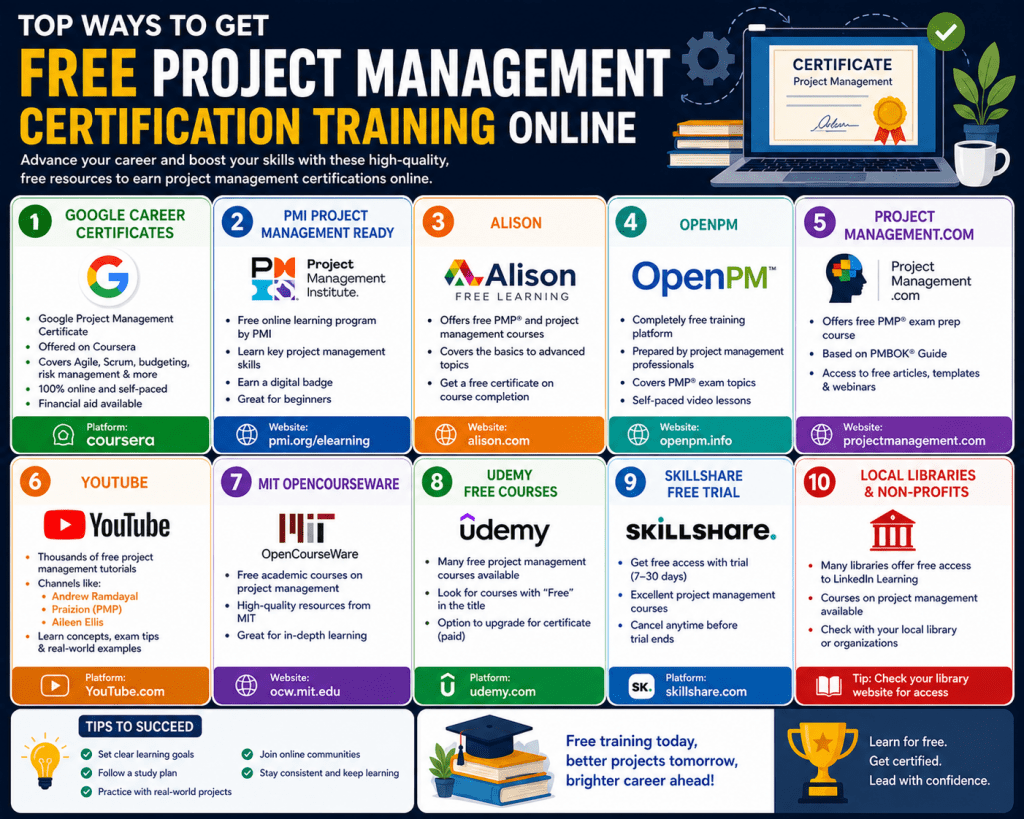
The Role of Free Learning Resources in Project Management Education
Free learning resources have become increasingly popular due to their accessibility and convenience. These resources allow individuals to explore project management concepts without financial barriers, making them an attractive option for beginners.
Free learning materials typically provide introductory-level knowledge. They cover basic concepts such as project definition, lifecycle stages, and fundamental terminology. These resources are useful for gaining an initial understanding of the field.
However, free resources often vary in quality and depth. Some may provide accurate and useful information, while others may lack structure or alignment with recognized standards. This variation makes it important for learners to evaluate resources carefully.
Free learning is most effective when used as a starting point rather than a complete learning solution. It helps individuals explore the field and understand whether project management is aligned with their career goals before committing to structured training.
One limitation of free learning is the lack of guided progression. Without a structured pathway, learners may struggle to connect concepts or understand how they apply in real-world situations.
Comparing Structured Training and Informal Learning
Structured training and informal learning serve different purposes in project management education. Structured training follows a predefined curriculum that is designed to cover all essential knowledge areas in a logical sequence.
This type of training ensures consistency and completeness. Learners progress through topics in a structured manner, building knowledge step by step. It also includes assessments and practice scenarios that reinforce learning.
Informal learning, on the other hand, is more flexible and self-directed. It allows individuals to explore topics at their own pace and focus on areas of personal interest. While this approach offers flexibility, it may lack depth and structure.
Structured training is particularly beneficial for individuals preparing for professional certification or formal roles in project management. It provides a clear roadmap and ensures that all critical areas are covered.
Informal learning is useful for gaining exposure and building foundational awareness. It can complement structured training but is generally not sufficient on its own for professional certification.
Challenges in Self-Guided Project Management Learning
Self-guided learning presents several challenges, especially in a complex field like project management. One of the main challenges is information overload. With so many resources available, it can be difficult to determine what is relevant and accurate.
Another challenge is the lack of feedback. In structured environments, learners receive guidance and correction, which helps them improve. In self-guided learning, this feedback loop is often missing.
Without a clear structure, learners may also struggle with progression. They may understand individual concepts but fail to see how those concepts connect within a broader framework.
Motivation is another challenge. Self-directed learning requires discipline and consistency, which can be difficult to maintain over time without external accountability.
Despite these challenges, self-guided learning can still be valuable when combined with structured resources. It is most effective when used as a supplement rather than a replacement for formal training.
The Importance of Choosing the Right Learning Path
Choosing the right learning path is critical for success in project management. The right path depends on an individual’s experience level, career goals, and preferred learning style.
Beginners may benefit from starting with foundational learning to build a basic understanding before moving into structured training. This helps create a strong knowledge base that supports advanced learning.
Intermediate learners may focus on structured training that aligns with specific methodologies. This allows them to deepen their expertise and prepare for professional certification.
Advanced professionals may focus on specialized learning that enhances leadership skills, strategic thinking, and industry-specific knowledge.
The key is alignment. Learning should match both current ability and future career objectives. Without alignment, learning may become inefficient or disconnected from real-world applications.
Career Impact of Project Management Skills
Project management skills have a significant impact on career development. These skills are applicable across industries, making them highly versatile and valuable.
Professionals with strong project management abilities are often able to take on leadership roles and manage larger, more complex responsibilities. This increases opportunities for career advancement.
Project management skills also improve employability. Organizations value individuals who can organize work efficiently, manage resources effectively, and deliver results consistently.
In addition, project management skills contribute to better problem-solving abilities. Professionals learn how to analyze situations, evaluate options, and make informed decisions under pressure.
These skills are not limited to formal project management roles. They are also useful in general business environments where coordination and planning are required.
Long-Term Value of Project Management Expertise
The long-term value of project management expertise lies in its adaptability. As industries continue to evolve, the need for structured execution and leadership remains constant.
Project management skills remain relevant across technological changes, organizational shifts, and market fluctuations. This makes them a stable and future-proof skill set.
Professionals who continuously develop their project management abilities are better positioned to adapt to new challenges and opportunities. This adaptability enhances long-term career stability.
Organizations also benefit from experienced project managers who can lead teams effectively, improve efficiency, and ensure successful project outcomes.
Strategic Approach to Building Project Management Knowledge
Building expertise in project management requires a strategic and consistent approach. It involves combining foundational learning, structured training, and practical experience.
A strong foundation helps learners understand core principles and terminology. Structured training provides depth and alignment with industry standards. Practical experience reinforces learning through real-world application.
This combination ensures that knowledge is both theoretical and practical. It also helps learners develop confidence in applying their skills in real environments.
Continuous improvement is essential. Project management is an evolving field, and staying updated with new methods, tools, and practices is necessary for long-term success.
A strategic learning approach ensures that individuals not only gain knowledge but also develop the ability to apply that knowledge effectively in professional settings.
Conclusion
Project management has become one of the most essential disciplines in modern business environments, not because it is a trend, but because it solves a fundamental problem that organizations constantly face: how to turn ideas into results in a structured, efficient, and predictable way. As industries evolve, technologies shift, and markets become more competitive, the ability to manage work in a controlled and goal-oriented manner has become a core requirement rather than an optional skill. This is why project management continues to grow in importance across every major sector, from technology and construction to healthcare, finance, education, and public services.
At its core, project management is about coordination and clarity. It transforms complex objectives into manageable steps, assigns responsibility, allocates resources, and ensures that progress is continuously tracked. Without this structure, even the most promising ideas can fail due to confusion, miscommunication, or inefficient execution. The role of a project manager is therefore not limited to supervising tasks; it extends to guiding entire teams through uncertainty, balancing competing priorities, and ensuring that outcomes align with organizational goals.
One of the key takeaways from understanding project management is that success depends on both structure and adaptability. Structure ensures that there is a clear plan, defined milestones, and measurable outcomes. Adaptability ensures that the plan can respond to unexpected changes, whether those changes come from shifting customer needs, technological challenges, or resource limitations. The most effective project managers are those who can maintain this balance without losing control of the overall objective.
Training plays a significant role in developing this capability. While experience in the field provides valuable insights, structured learning helps individuals understand the underlying principles that guide decision-making. It introduces standardized approaches to planning, risk management, communication, and execution. More importantly, it helps professionals develop a consistent mindset that can be applied across different types of projects and industries. This consistency is what allows project management to function as a globally recognized discipline.
Certification further strengthens this foundation by providing formal validation of skills and knowledge. In competitive job markets, certification acts as a signal of credibility. It demonstrates that an individual has not only studied project management concepts but has also met a defined standard of understanding. Employers often rely on these certifications as a baseline indicator of competence, especially when evaluating candidates for roles that require leadership and coordination responsibilities.
However, certification alone is not the end goal. It is part of a broader learning journey that includes practical application, continuous improvement, and real-world experience. The most successful professionals in this field are those who treat learning as an ongoing process rather than a one-time achievement. They continuously refine their skills, adapt to new methodologies, and stay updated with emerging tools and practices that shape modern project environments.
Different methodologies within project management reflect the diversity of real-world challenges. Some approaches emphasize flexibility and rapid iteration, while others focus on detailed planning and strict control. Each methodology has its strengths and limitations, and understanding when to apply each one is a critical skill. This flexibility allows organizations to tailor their approach based on project complexity, industry requirements, and team dynamics. It also reinforces the idea that there is no single “correct” way to manage a project, only the most appropriate way for a given situation.
Another important insight is the role of communication and leadership. Technical skills such as scheduling, budgeting, and risk analysis are essential, but they are not sufficient on their own. Projects are ultimately executed by people, and effective collaboration depends on clear communication, trust, and shared understanding. A project manager must be able to translate technical details into actionable guidance, resolve conflicts when they arise, and maintain alignment among diverse stakeholders. These interpersonal skills often determine whether a project succeeds or fails, even when the technical plan is sound.
The value of project management skills extends beyond formal project roles. These skills are applicable in everyday business operations and decision-making. The ability to plan effectively, prioritize tasks, manage time, and coordinate with others is valuable in virtually any professional context. This is one of the reasons why project management has become such a widely respected discipline. It enhances not only career prospects but also overall professional effectiveness.
Free learning resources have made it easier than ever to access introductory knowledge in project management. They allow individuals to explore basic concepts and gain initial exposure without financial commitment. However, while these resources are useful for awareness and exploration, they are often limited in depth and structure. They may not fully prepare individuals for professional expectations or certification requirements. This is why structured learning remains important for those who want to pursue project management seriously.
The challenge for many learners is finding the right balance between accessibility and depth. Too much unstructured information can lead to confusion, while overly rigid systems can limit flexibility. The most effective learning paths combine both approaches, starting with foundational exposure and gradually moving toward structured, guided training. This progression allows learners to build confidence while steadily increasing their level of expertise.
Another important aspect of project management development is real-world application. Knowledge alone is not enough; it must be applied in practical situations to be fully understood. Every project presents unique challenges, and experience helps professionals learn how to adapt theoretical concepts to real conditions. Over time, this experience builds intuition, judgment, and problem-solving ability, which are essential qualities for effective leadership.
As organizations continue to evolve, the demand for skilled project managers is expected to remain strong. Businesses increasingly rely on structured execution to remain competitive, and project managers play a central role in ensuring that this execution is successful. Whether managing small internal initiatives or large-scale strategic programs, the principles remain the same: clear goals, structured planning, effective communication, and continuous monitoring.
Ultimately, project management is not just a career path but a way of thinking. It encourages organization, discipline, and strategic awareness. It teaches individuals how to break down complexity into manageable components and how to guide work toward meaningful outcomes. These skills are valuable not only in professional settings but also in everyday problem-solving and decision-making.
As the business world continues to change, the importance of project management will only increase. Those who invest time in developing these skills will find themselves better prepared to navigate uncertainty, lead teams effectively, and contribute to meaningful outcomes across a wide range of industries and challenges.