
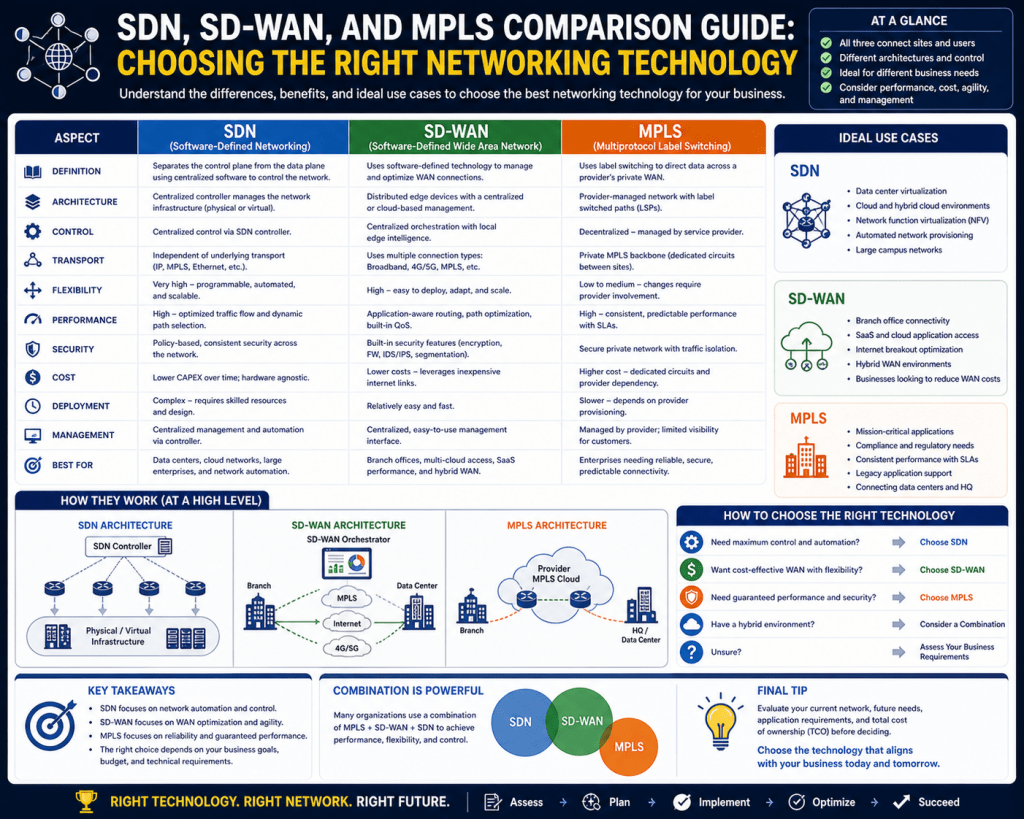
Modern enterprise networking has evolved from rigid, hardware-centric architectures into more flexible and software-driven systems. Traditional networking relies on tightly coupled devices where the control logic and data forwarding functions exist within the same physical hardware. In such environments, every switch, router, or firewall must be individually configured, often requiring manual updates across multiple devices to implement even simple policy changes. As organizations scale across multiple offices, data centers, and cloud environments, this operational model becomes increasingly difficult to maintain. Configuration drift, human error, and inconsistent policy enforcement are common challenges. Software-defined networking introduces a fundamentally different approach by separating the control plane from the data plane. This separation allows centralized systems to define how traffic should behave across the entire network, while physical devices focus solely on forwarding packets. The shift transforms networking into a programmable environment where policies are defined centrally and executed consistently across distributed infrastructure. This architectural change is not merely a technical enhancement but a redefinition of how networks are designed, managed, and scaled in modern IT environments.
Decoupling Control Plane and Data Plane in SDN Architecture
The most critical concept in Software Defined Networking is the separation between the control plane and the data plane. In traditional networking devices, these two functions are embedded within the same system. The control plane is responsible for making decisions about where traffic should be sent, while the data plane executes those decisions by forwarding packets accordingly. In SDN architecture, these responsibilities are decoupled. The control plane is centralized in a software-based controller that communicates with multiple network devices, while the data plane remains distributed across switches and routers that handle packet forwarding. This separation allows network behavior to be defined globally rather than locally. The centralized controller maintains a holistic view of the entire network topology, enabling more intelligent routing decisions and policy enforcement. Devices in the network become simpler and more standardized, as they no longer need to independently calculate complex routing decisions. Instead, they follow instructions received from the controller. This architecture reduces complexity at the edge while increasing intelligence at the core, enabling more efficient and scalable network management.
Centralized Network Intelligence and Programmability in SDN Systems
A defining characteristic of Software Defined Networking is the introduction of centralized intelligence. Instead of distributing decision-making across numerous devices, SDN consolidates network logic into a central controller. This controller acts as the brain of the network, maintaining a real-time map of all connected devices, links, and traffic flows. Administrators can define high-level policies that dictate how traffic should be handled under various conditions. These policies are then translated into device-level instructions and distributed automatically. This programmability enables networks to behave more like software systems than static infrastructure. APIs and automation frameworks allow integration between networking systems and application deployment tools. As a result, network configuration can be aligned directly with application requirements, ensuring that connectivity is provisioned dynamically as workloads are deployed. This level of automation reduces manual intervention and enables faster response to changing business needs. The network becomes an adaptive system capable of adjusting itself based on predefined logic and real-time conditions.
Operational Efficiency Gains Through Centralized Policy Management
One of the most significant benefits of SDN is the improvement in operational efficiency. In traditional environments, network administrators must configure each device individually, which increases the likelihood of inconsistencies and errors. For example, implementing a new VLAN or routing policy requires changes across multiple switches and routers. Missing a single configuration step can lead to connectivity issues that are difficult to diagnose. SDN eliminates this fragmentation by centralizing policy management. Administrators define network behavior once, and the controller ensures that all devices comply with those instructions. This reduces configuration overhead and minimizes the risk of human error. Troubleshooting is also simplified because network behavior can be analyzed from a centralized perspective rather than inspecting each device individually. Changes can be deployed rapidly across the entire infrastructure, improving agility and reducing downtime associated with manual configuration processes. Over time, this centralized approach significantly reduces operational workload and increases network consistency.
Scalability and Dynamic Network Provisioning in SDN Environments
Scalability is a core advantage of Software Defined Networking, particularly in environments that experience frequent growth or change. Traditional networks require manual provisioning of new devices and configurations whenever additional capacity is needed. This process can be slow and resource-intensive, especially in large distributed environments. SDN addresses this challenge by enabling dynamic provisioning of network resources. New devices can be automatically integrated into the network and configured according to predefined policies. Virtual network segments can be created on demand to support specific applications, departments, or tenants. This is particularly valuable in cloud-based environments where workloads are frequently created and destroyed. Development teams can deploy isolated network environments without requiring manual intervention from network engineers. In large-scale data centers, SDN enables multi-tenant architectures where multiple users share the same physical infrastructure while maintaining logical separation. This improves resource utilization and allows organizations to scale infrastructure efficiently without proportional increases in operational complexity.
Security Policy Enforcement and Network Segmentation in SDN Models
Security in Software Defined Networking is closely tied to centralized policy enforcement and network segmentation capabilities. Because policies are defined at a central controller, security rules can be applied uniformly across all network devices. This reduces the risk of inconsistent configurations that can create vulnerabilities. Network segmentation is another important security feature, allowing administrators to divide the network into isolated zones based on application, user group, or sensitivity level. These segments can be dynamically adjusted without physical reconfiguration of infrastructure. SDN also enables micro-segmentation, where even individual workloads can be isolated from each other within the same physical network. This limits lateral movement in the event of a security breach. However, the centralized nature of SDN introduces a dependency on the controller, making it a critical component that must be secured and made highly available. Proper access control, redundancy, and monitoring are essential to maintaining a secure SDN environment.
Integration of SDN with Automation and Cloud Ecosystems
Modern IT environments increasingly rely on automation and cloud integration, and SDN plays a key role in enabling this transformation. By exposing network functions through programmable interfaces, SDN allows integration with orchestration systems that manage application deployment and infrastructure provisioning. When a new application is deployed in a cloud environment, corresponding network configurations can be automatically generated and applied. This eliminates the delay between application deployment and network readiness. Automation also ensures consistency across environments, reducing the risk of configuration drift. In hybrid cloud scenarios, SDN enables unified network management across on-premises and cloud infrastructure. This allows organizations to extend consistent policies across multiple environments without requiring separate management systems. The integration of networking with automation frameworks transforms the network into an active participant in the application lifecycle rather than a static support layer.
Performance Optimization and Traffic Control in SDN Architectures
Performance management in SDN environments is achieved through intelligent traffic control mechanisms. The centralized controller continuously monitors network conditions and can adjust routing decisions based on real-time metrics such as latency, congestion, and link utilization. This allows traffic to be dynamically rerouted to optimize performance. High-priority applications can be assigned preferred paths, ensuring consistent performance even during periods of network congestion. Less critical traffic can be routed through alternative paths to balance load across the infrastructure. This level of control is not easily achievable in traditional static routing environments. SDN also enables more granular visibility into traffic patterns, allowing administrators to identify bottlenecks and optimize resource allocation. Over time, this results in improved network efficiency and better user experience across distributed systems.
Challenges in SDN Adoption and Organizational Transformation Requirements
Despite its advantages, adopting Software Defined Networking introduces several challenges. One of the primary challenges is the need for organizational transformation. Network teams must transition from device-centric management to policy-driven, centralized control models. This requires new skill sets and a shift in operational mindset. Legacy infrastructure compatibility can also present challenges, as not all existing hardware supports SDN integration. In some cases, partial or full infrastructure upgrades may be required, leading to increased initial investment. Additionally, reliance on centralized controllers introduces architectural dependencies that must be carefully managed through redundancy and failover strategies. Security of the control layer is also critical, as compromise of the controller could impact the entire network. These challenges highlight the importance of careful planning and phased implementation when transitioning to SDN-based architectures.
Evolution of Wide Area Networking Toward Software Defined Models
Wide area networking has historically been built on rigid, circuit-based infrastructures designed to connect geographically distributed enterprise locations. Traditional WAN architectures rely heavily on private leased lines and fixed routing policies that prioritize stability over flexibility. These systems were effective in an era where business applications were primarily hosted in centralized data centers and traffic patterns were predictable. However, the rise of cloud computing, remote work, and distributed applications has fundamentally changed network requirements. Organizations now require connectivity models that can adapt dynamically to changing workloads, fluctuating traffic demands, and diverse transport conditions. Software-defined wide-area networking represents an evolution of WAN design principles by introducing centralized control and policy-driven traffic management across multiple transport types. Instead of relying on a single dedicated circuit model, SD-WAN enables the aggregation of broadband internet, MPLS, LTE, and other connectivity options into a unified logical network. This shift allows enterprises to design WAN architectures that are more flexible, cost-efficient, and responsive to real-time network conditions while maintaining centralized visibility and control.
Architectural Principles of SD-WAN Overlay Networks
SD-WAN operates through an overlay architecture that abstracts network connectivity from underlying physical transport layers. In this model, an intelligent control layer defines how traffic should flow across different available links, while the data plane handles actual packet forwarding across those links. This separation allows organizations to use multiple transport media simultaneously without requiring uniform infrastructure across all locations. Each branch site typically connects to a centralized SD-WAN controller that distributes routing policies and configuration instructions. These policies determine how traffic is classified, prioritized, and routed based on application requirements and network conditions. The overlay approach ensures that connectivity decisions are not tied to a single transport provider or technology, allowing enterprises to optimize performance and cost independently. This architectural flexibility is particularly important in environments where network conditions vary significantly between locations, enabling a consistent user experience regardless of underlying infrastructure differences.
Transport Agnostic Connectivity and Multi-Link Optimization
One of the core strengths of SD-WAN is its ability to operate across multiple transport types without requiring changes to the application layer. This transport-agnostic design allows enterprises to combine broadband internet, MPLS circuits, and cellular connections into a single unified network fabric. Traffic is dynamically routed based on real-time performance metrics such as latency, jitter, packet loss, and bandwidth availability. If one link experiences degradation, traffic can be automatically rerouted to alternative paths without manual intervention. This improves network resilience and reduces dependency on any single connectivity provider. In addition, SD-WAN systems can intelligently balance traffic across multiple links to maximize utilization efficiency. This approach not only enhances performance but also reduces operational risk associated with link failures or congestion. The ability to seamlessly integrate diverse transport options provides organizations with greater flexibility in designing cost-effective and resilient WAN architectures.
Application Aware Routing and Intelligent Traffic Classification
SD-WAN introduces a significant advancement in traffic management through application-aware routing. Instead of treating all network traffic equally, SD-WAN systems classify traffic based on application identity, performance requirements, and business priority. This classification enables granular control over how different types of traffic are handled within the network. Critical applications such as real-time communication tools or transactional systems can be assigned high-priority paths that minimize latency and packet loss. Less sensitive traffic, such as file downloads or software updates, can be routed through lower-cost or lower-priority links. The system continuously monitors network performance and adjusts routing decisions dynamically to maintain optimal application performance. This intelligent traffic handling ensures that business-critical applications receive the necessary network resources even under conditions of congestion or link degradation. The result is a more predictable and consistent user experience across distributed environments.
Centralized Management and Policy-Driven WAN Control
A defining characteristic of SD-WAN architecture is centralized management. Instead of configuring each branch site individually, administrators define global policies through a centralized controller. These policies are then distributed automatically to all connected devices, ensuring consistent configuration across the entire network. This model significantly reduces operational complexity and minimizes the risk of configuration inconsistencies between sites. Centralized management also provides a unified view of network performance, allowing administrators to monitor traffic patterns, link utilization, and application behavior from a single interface. Policy-driven control enables organizations to align network behavior directly with business objectives. For example, policies can be defined to prioritize specific applications during peak hours or to restrict bandwidth usage for non-essential traffic. This level of centralized control enhances operational efficiency while maintaining flexibility in how network resources are allocated.
Security Architecture and Encrypted WAN Connectivity Models
Security in SD-WAN environments is implemented through encrypted overlay tunnels that protect data across all transport types. Regardless of whether traffic is transmitted over public internet connections or private circuits, encryption ensures that data remains secure during transit. This eliminates reliance on the inherent security of the underlying transport infrastructure. SD-WAN platforms also integrate security policies directly into the network architecture, enabling consistent enforcement across all sites. Features such as segmentation, access control, and traffic inspection can be applied uniformly through centralized policy definitions. This reduces the need for separate security appliances at each branch location. In addition, SD-WAN systems often include built-in threat detection capabilities that monitor traffic for anomalies and potential security risks. The combination of encryption, segmentation, and centralized policy enforcement creates a comprehensive security framework that is well-suited to distributed enterprise environments.
Cost Optimization and Infrastructure Rationalization in SD-WAN Deployment
One of the primary drivers for SD-WAN adoption is cost optimization. Traditional WAN architectures often rely heavily on expensive private circuits that provide guaranteed performance but come with high recurring costs. SD-WAN enables organizations to reduce reliance on these circuits by leveraging more affordable broadband internet connections while maintaining performance through intelligent traffic management. This allows enterprises to significantly reduce operational expenses without sacrificing connectivity quality. Over time, SD-WAN deployments can lead to substantial cost savings, particularly in environments with a large number of branch locations. Infrastructure rationalization also plays a key role, as SD-WAN reduces the need for complex hardware configurations at each site. Branch devices can be standardized, simplifying deployment and maintenance processes. This streamlined approach reduces both capital and operational expenditures while improving overall network scalability.
Deployment Models and Transition Strategies for SD-WAN Adoption
Implementing SD-WAN requires careful planning and structured transition strategies. Many organizations adopt a phased approach, where SD-WAN is gradually introduced alongside existing WAN infrastructure. This allows for controlled migration and reduces the risk of disruption during transition. In some cases, SD-WAN is initially deployed at select branch locations to evaluate performance and compatibility before broader rollout. Hybrid architectures are common during transition periods, where MPLS and SD-WAN operate simultaneously to support different types of traffic. Over time, organizations may shift more traffic onto SD-WAN as confidence in the system increases. Deployment models vary depending on organizational size, complexity, and existing infrastructure. Some enterprises choose fully managed solutions, while others maintain internal control over configuration and policy management. Regardless of the model, successful adoption requires coordination between network engineering, security teams, and business stakeholders.
Operational Complexity and Skill Transformation Requirements in SD-WAN Environments
While SD-WAN simplifies many aspects of WAN management, it also introduces new operational paradigms that require skill development and process adaptation. Network teams must transition from device-level configuration management to policy-driven network design. This shift requires an understanding of application behavior, traffic engineering principles, and centralized management platforms. Monitoring and troubleshooting also become more abstract, as issues may be related to policy configuration rather than individual device settings. Additionally, organizations must adapt to new security models that integrate networking and security functions. Training and knowledge development are essential to ensure that operational teams can effectively manage SD-WAN environments. Despite the learning curve, SD-WAN ultimately reduces operational complexity once fully adopted, but the transition period requires careful management and structured skill development.
Performance Management and Real-Time Network Adaptability in SD-WAN Systems
SD-WAN systems continuously monitor network performance to ensure optimal traffic flow across all available links. Metrics such as latency, jitter, and packet loss are collected in real time and used to make routing decisions. This enables dynamic adaptation to changing network conditions without manual intervention. If a particular link becomes congested or unstable, traffic can be automatically redirected to alternative paths that offer better performance. This real-time adaptability ensures consistent application performance even in fluctuating network environments. Performance management is further enhanced through analytics capabilities that provide insights into long-term traffic trends and utilization patterns. These insights allow organizations to optimize bandwidth allocation and improve infrastructure planning. The combination of real-time responsiveness and long-term analytics makes SD-WAN a powerful tool for managing complex distributed networks.
Integration of SD-WAN with Cloud and Hybrid Infrastructure Ecosystems
Modern enterprise environments increasingly rely on cloud-based services and hybrid infrastructure models. SD-WAN is well-suited to these environments due to its ability to dynamically connect branch locations to both on-premises and cloud-based resources. Traffic can be intelligently routed based on application destination, ensuring that cloud applications receive optimized connectivity paths. This reduces reliance on centralized data center routing and improves application performance for cloud-native workloads. SD-WAN also supports direct-to-cloud connectivity models, where branch sites connect directly to cloud services without backhauling traffic through central locations. This reduces latency and improves efficiency. In hybrid environments, SD-WAN provides a unified networking layer that spans both private infrastructure and public cloud platforms, enabling consistent connectivity policies across diverse environments.
MPLS Fundamentals and Label Switching Architecture in WAN Networks
Multiprotocol Label Switching is a wide-area networking technology designed to improve the efficiency and predictability of packet forwarding across carrier-managed infrastructures. Unlike traditional IP routing, which relies on destination address lookups at each hop, MPLS uses short path labels that are attached to packets at the network edge. These labels determine forwarding behavior through pre-established paths within the service provider’s backbone. When traffic enters an MPLS network, it is assigned a label that corresponds to a specific forwarding equivalence class. Routers within the MPLS core do not perform full IP routing lookups; instead, they use label information to quickly forward packets along predefined paths. This approach reduces processing overhead and improves forwarding efficiency across large-scale carrier networks. MPLS is typically deployed by service providers who maintain full control over the infrastructure, ensuring consistent performance and predictable routing behavior for enterprise customers. This architecture has made MPLS a long-standing choice for organizations requiring stable and highly reliable connectivity between distributed sites.
Carrier Managed Infrastructure and Dedicated WAN Service Models
MPLS networks are commonly delivered as managed services by telecommunications providers. In this model, the carrier is responsible for maintaining the core network infrastructure, routing policies, and service quality. Enterprises connect to this infrastructure through customer premises equipment installed at branch locations. These edge devices interface with the carrier’s MPLS backbone and handle traffic entry and exit points. The carrier manages the internal routing topology, ensuring that traffic flows efficiently between sites based on predefined service classes. This managed approach reduces operational burden for enterprises, as they do not need to design or maintain the underlying WAN infrastructure. Instead, they focus on endpoint configuration and application-level requirements. Service providers often offer multiple service tiers with different performance guarantees, allowing organizations to select connectivity options based on business criticality. This model is particularly useful for enterprises that prioritize stability and outsourced network management over flexibility and customization.
Predictable Performance and Quality of Service in MPLS Networks
One of the most significant advantages of MPLS is its ability to provide predictable network performance. Because traffic flows are engineered within a controlled carrier environment, latency, jitter, and packet loss can be tightly managed. MPLS networks often implement traffic engineering techniques that allocate bandwidth based on service class and priority levels. This ensures that critical applications receive consistent performance even during periods of high network utilization. Quality of Service mechanisms further enhance this predictability by categorizing traffic into different classes with specific forwarding behaviors. For example, real-time applications such as voice and video communication can be assigned a higher priority than bulk data transfers. This structured approach to traffic management enables enterprises to rely on consistent performance levels across geographically distributed locations. The deterministic nature of MPLS routing makes it particularly suitable for applications that require strict performance guarantees.
Security Characteristics and Traffic Isolation in MPLS Environments
MPLS provides a level of logical isolation between customer networks by separating traffic within the service provider’s backbone. Each customer operates within a private routing domain that is isolated from other customers using the same infrastructure. This separation ensures that traffic is not directly exposed to external networks, reducing the risk of unauthorized access. However, MPLS does not inherently encrypt data, meaning that security is based primarily on isolation rather than cryptographic protection. In environments where data confidentiality is critical, additional encryption layers may be implemented on top of MPLS connections. Despite this limitation, MPLS is often considered secure due to its closed-network design and controlled access model. Service providers enforce strict routing policies to ensure that customer traffic remains segregated and does not intersect with other network segments. This controlled environment contributes to the widespread adoption of MPLS in enterprise WAN architectures.
Cost Structure and Economic Considerations in MPLS Deployment
MPLS networks are generally associated with higher operational costs compared to more modern connectivity models. The pricing structure is influenced by the dedicated nature of the infrastructure, service level guarantees, and carrier-managed operations. Enterprises pay for guaranteed bandwidth, performance consistency, and reliability, which results in higher recurring expenses. Installation and provisioning processes can also be time-consuming, particularly when establishing new branch connections across geographically dispersed locations. Despite these costs, many organizations continue to use MPLS due to its reliability and predictable performance characteristics. The economic model of MPLS is often justified in environments where application stability and uptime are more critical than cost efficiency. However, as alternative technologies emerge, organizations increasingly evaluate MPLS as part of a broader hybrid networking strategy rather than a standalone solution.
Operational Simplicity and Management Model in MPLS Networks
One of the operational benefits of MPLS is its simplicity from the enterprise perspective. Since the service provider manages the core network infrastructure, internal IT teams are not required to handle complex routing configurations across the WAN backbone. Instead, they focus on configuring edge devices and defining traffic requirements. This reduces the operational complexity associated with managing large-scale distributed networks. Troubleshooting is often handled in collaboration with the service provider, as issues within the core network fall under their responsibility. This division of responsibilities allows enterprises to offload significant portions of WAN management. However, it also introduces dependency on external providers for problem resolution and network changes. While this model simplifies internal operations, it can limit flexibility when rapid network modifications are required.
Comparative Architectural Differences Between SDN, SD-WA, N, and MPLS Models
When evaluating SDN, SD-WAN, and MPLS, it is important to understand their fundamental architectural differences. SDN focuses primarily on internal network programmability and centralized control within data center or cloud environments. It decouples control and data planes to enable flexible and automated network management. SD-WAN extends these principles to wide area connectivity, introducing overlay networks that operate across multiple transport types. MPLS, in contrast, is a carrier-managed solution that provides predictable and stable connectivity through label-based forwarding within a private backbone. While SDN and SD-WAN emphasize flexibility and automation, MPLS prioritizes reliability and deterministic performance. Each model addresses different aspects of network design, and their suitability depends on organizational requirements such as scalability, cost sensitivity, and application criticality. In many enterprise environments, these technologies are not mutually exclusive and are often used together in hybrid architectures.
Hybrid Networking Strategies Combining MPLS and SD-WAN Technologies
Many organizations adopt hybrid networking strategies that combine MPLS with SD-WAN to balance performance, cost, and flexibility. In such environments, MPLS is typically used for mission-critical applications that require guaranteed performance, while SD-WAN is used for general traffic and cost optimization. This approach allows enterprises to maintain high performance for sensitive workloads while reducing dependency on expensive dedicated circuits. SD-WAN systems can intelligently route traffic across both MPLS and internet-based links based on application requirements and network conditions. This hybrid model provides a transitional path for organizations moving away from traditional WAN architectures without requiring immediate full replacement of existing infrastructure. It also enables gradual modernization, allowing enterprises to evaluate performance and cost benefits over time. The combination of MPLS stability and SD-WAN flexibility creates a balanced network architecture suited for diverse enterprise needs.
Decision Factors for Selecting WAN and Network Architecture Models
Selecting the appropriate networking model requires careful evaluation of multiple factors, including performance requirements, budget constraints, scalability needs, and operational capabilities. Organizations with highly stable workloads and strict performance requirements may continue to rely on MPLS due to its predictable behavior and service guarantees. Enterprises focused on agility, cloud integration, and cost optimization may favor SD-WAN due to its flexibility and transport independence. SDN is typically adopted in environments where internal network automation and centralized control are priorities, particularly in data center and cloud infrastructure contexts. The decision-making process often involves analyzing application dependencies, traffic patterns, and long-term infrastructure strategies. In many cases, no single solution fully satisfies all requirements, leading to hybrid architectures that combine multiple technologies. This approach allows organizations to align network design with business objectives while maintaining operational efficiency.
Enterprise Network Modernization and Long-Term Architectural Evolution
Enterprise networking continues to evolve toward more software-driven and automated models. The increasing adoption of cloud services, distributed applications, and remote workforces is driving demand for more flexible connectivity solutions. Traditional WAN architectures are gradually being supplemented or replaced by SD-WAN and SDN-based systems that offer greater adaptability and integration capabilities. MPLS continues to play a role in environments where stability and performance guarantees are essential, but its dominance is gradually shifting as organizations prioritize agility and cost efficiency. Over time, network architectures are expected to become more dynamic, with greater reliance on centralized control systems and automated policy enforcement. This evolution reflects a broader trend in IT infrastructure toward abstraction, programmability, and service-driven design models that align network behavior more closely with business requirements.
Conclusion
The comparison between Software Defined Networking, Software Defined Wide Area Networking, and Multiprotocol Label Switching reflects a broader shift in how enterprise connectivity is designed and operated. Each model represents a different stage in the evolution of networking, shaped by changing business requirements, application architectures, and infrastructure expectations. Understanding these technologies in isolation is not sufficient; their real value becomes clear when they are evaluated in terms of how they support modern distributed systems, cloud integration, operational efficiency, and long-term scalability.
Traditional MPLS networks were designed for an era where enterprise traffic was predictable, centralized, and primarily internal to corporate data centers. Their strength lies in stability, deterministic performance, and strong service guarantees provided by carriers. For organizations that require consistent latency, minimal packet loss, and predictable routing behavior, MPLS remains a reliable foundation. Its managed nature reduces operational complexity for internal IT teams, since much of the routing intelligence and backbone maintenance is handled by service providers. However, this strength is also a limitation. MPLS networks are inherently rigid, expensive to scale, and slow to adapt to changing application demands. As enterprises move toward cloud-first architectures and distributed workloads, the lack of flexibility becomes increasingly difficult to justify. The economic model, based on dedicated circuits and premium service tiers, also places long-term pressure on operational budgets, especially for organizations with growing branch footprints.
SD-WAN emerged as a response to these limitations, introducing a more flexible and cost-efficient approach to wide area networking. Instead of relying on a single transport model, SD-WAN aggregates multiple connection types into a unified overlay network. This allows enterprises to use broadband internet, LTE, and existing MPLS circuits simultaneously, selecting the best path for traffic based on real-time performance metrics and application requirements. The result is a more adaptive network that can respond dynamically to changing conditions. Application-aware routing ensures that critical services receive priority treatment, while less sensitive traffic is routed over lower-cost paths. This intelligent traffic management significantly improves both performance efficiency and cost control.
From an operational perspective, SD-WAN reduces complexity by centralizing policy management. Instead of configuring each branch individually, administrators define global policies that are automatically distributed across all network endpoints. This reduces configuration errors and improves consistency across distributed environments. It also enables faster deployment of new sites, which is particularly important for organizations expanding rapidly or operating in geographically diverse regions. Security is also enhanced through encrypted tunnels and integrated policy enforcement, ensuring that data remains protected regardless of underlying transport. Despite these advantages, SD-WAN introduces its own challenges, particularly during migration. Organizations must redesign their WAN architecture, replace or upgrade edge devices, and develop new operational skills. The transition requires careful planning, but once implemented, SD-WAN typically delivers significant long-term benefits in flexibility and cost optimization.
SDN, while often discussed alongside SD-WAN, operates at a different layer of the networking stack. It is primarily focused on internal network architecture, particularly in data centers and cloud environments. By separating the control plane from the data plane, SDN enables centralized intelligence and programmability across the network. This allows administrators to define behavior through software-based policies rather than device-level configuration. SDN is particularly valuable in environments where workloads are highly dynamic, such as virtualized data centers or cloud-native infrastructures. It supports automation, rapid provisioning, and integration with orchestration platforms, making it a key enabler of modern infrastructure-as-code approaches. However, SDN requires a shift in mindset and operational structure, as traditional network management approaches are replaced with centralized, policy-driven models.
When comparing SDN, SD-WAN, and MPLS, it becomes clear that they are not direct replacements for one another but rather complementary approaches addressing different layers of network architecture. MPLS focuses on carrier-managed backbone connectivity with guaranteed performance. SD-WAN focuses on edge connectivity and transport abstraction, enabling flexibility across multiple link types. SDN focuses on internal network programmability and centralized control within enterprise and cloud environments. Together, they form a continuum of networking evolution, from rigid infrastructure toward fully software-defined ecosystems.
In modern enterprise environments, hybrid architectures are becoming increasingly common. Many organizations continue to use MPLS for mission-critical applications while gradually introducing SD-WAN to handle general traffic and cloud connectivity. This hybrid approach allows businesses to balance stability and innovation, maintaining reliable performance where needed while reducing costs and increasing flexibility elsewhere. SDN often operates in parallel within data centers, enabling internal automation and supporting virtualized workloads. Over time, these technologies increasingly integrate, forming unified networking frameworks that span across on-premises infrastructure, cloud platforms, and distributed branch locations.
The decision to adopt any of these technologies depends on multiple factors, including application requirements, geographic distribution, budget constraints, and internal technical maturity. Organizations with strict performance requirements and legacy systems may continue to rely heavily on MPLS, while those prioritizing agility and cloud integration tend to favor SD-WAN and SDN-based architectures. In reality, most enterprises do not follow a single-path strategy. Instead, they gradually evolve their networks, layering new technologies on top of existing infrastructure to meet changing business demands.
The long-term direction of enterprise networking is clearly moving toward greater abstraction, automation, and software-driven control. Networks are no longer static infrastructure components but dynamic systems that must adapt continuously to application needs and business priorities. This shift requires not only technological change but also organizational transformation. Networking teams must evolve from device-centric management roles to policy-driven, automation-focused disciplines. As this transformation continues, the boundaries between SDN, SD-WAN, and traditional networking models will continue to blur, eventually forming integrated platforms that unify control across the entire enterprise infrastructure landscape.